Understanding the Fed: Article 18/20
Every late August, global markets turn almost instinctively toward Jackson Hole beneath Wyoming's Grand Tetons. Traders and financial media watch for fragments of remarks from the Fed chair and other central-bank heads that might reveal a policy turning point. The Kansas City Fed organizes this prominent gathering, but it is fundamentally a high-level exchange of academic and policy ideas. It is not a statutory FOMC meeting and does not vote on benchmark rates.
The spotlight often obscures this regional bank's more durable, irreplaceable institutional foundation. Beyond Jackson Hole's summer breezes, the Kansas City Fed works throughout the Great Plains and eastern Rocky Mountain foothills, tracking underlying cash flows in agricultural credit, oil and gas drilling and Midwestern manufacturing.
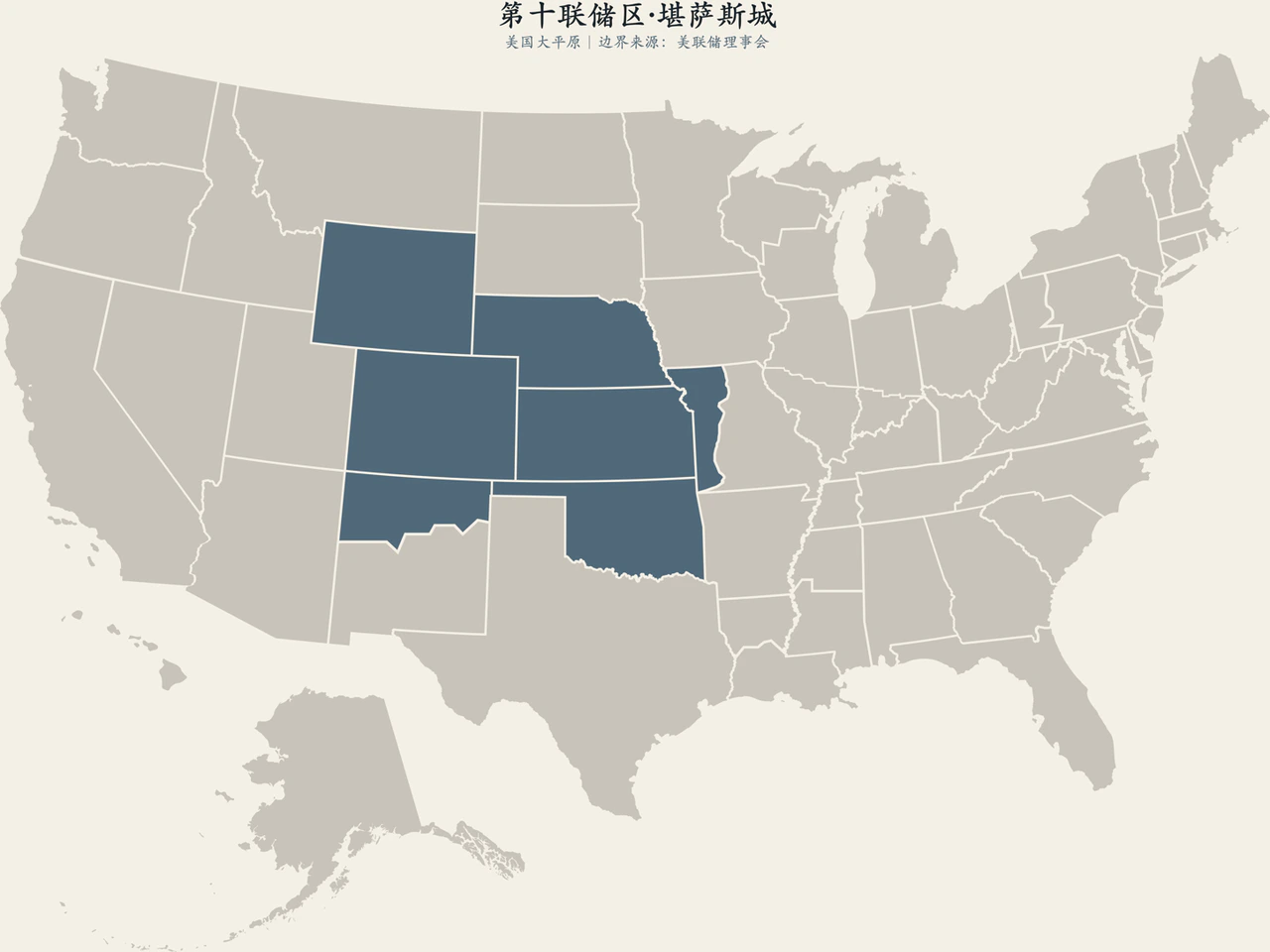
The Tenth District covers all of Colorado, Kansas, Nebraska, Oklahoma and Wyoming, plus 43 western Missouri counties and fourteen in northern New Mexico. Branches in Denver, Oklahoma City and Omaha serve a territory combining metropolitan finance and deep rural areas. From Denver's technology corridor and Omaha's logistics and financial hub to Oklahoma and Wyoming oil fields and the cornfields, winter-wheat belt and cattle ranches of Kansas and Nebraska, the district links thousands of agricultural businesses, independent energy explorers and community banks. It provides indispensable real-economy evidence for Washington's decision table.
1. Agricultural credit runs on its own clock
How a season's crop prices enter bank accounts
Agriculture follows a different rhythm from electronic market quotes: the natural and production cycle of planting, growth, harvest, storage and sale.
A family farm's or commercial agribusiness's balance sheet depends on far more than that day's CBOT soybean, corn or wheat price. Its real margin is bound by seeds, fertilizer, pesticides and diesel; machinery depreciation and maintenance; land rent; and interest. In a commodity boom, high crop prices and exports can quickly improve farm cash flow and lift land prices, but also encourage borrowing for large equipment, storage and expensive neighboring land. If global balances reverse, weather worsens or trade routes close, commodity prices can plunge while accumulated principal and interest remain unchanged. Repayment capacity and land-collateral value then face a simultaneous squeeze.
Independent community banks are the capillaries of rural finance. Unlike Wall Street banks, their assets concentrate in local seasonal farming and livestock loans and land mortgages, while liabilities rely heavily on local savings. This makes them sensitive to monetary policy and commodities. Tightening and persistently high rates squeeze both sides: higher benchmarks raise farmers' seasonal working-capital interest, while attractive Treasuries and money funds draw away savings, forcing local banks to increase deposit rates to defend liquidity.
That is why a finding of adequate capital at major U.S. banks does not establish easy real-economy credit nationwide. Even with calm eastern financial markets, agricultural credit deep in the Plains may already be tightening. The Kansas City Fed's quarterly Agricultural Credit Survey helps penetrate aggregate data, tracking credit demand, repayment rates, renewals and extensions, and collateral adequacy. It can detect regional financial strain months before lagging national statistics.
Land prices' downward stickiness is especially important. When grain prices turn lower, farmland values usually do not fall in the same quarter. Farmers often use liquid reserves, cut household spending or postpone equipment replacement to protect land assets, delaying bank default-risk recognition. Agricultural-cycle analysis therefore must connect loan applications, renewal stringency, actual collateral haircuts and land-transaction prices, rather than watch spot grain alone.
For producing regions, higher energy prices are both income and cost
Oklahoma's Anadarko Basin, Wyoming's Powder River Basin, the DJ Basin around Colorado and Wyoming, and northern New Mexico's oil-and-gas corridor place the Tenth District at the center of traditional U.S. energy production.
Energy volatility is a complex double-edged sword within the district. Higher oil and gas prices can quickly lift rigs, oilfield-service orders, skilled employment and state resource-tax receipts. For Great Plains agriculture and nonenergy small firms, however, energy inflation is an immediate cost shock: diesel for heavy tractors, natural-gas-based ammonia fertilizer, long-distance road and rail grain freight, household commuting and winter heating all become more expensive.
After repeated commodity booms and busts, independent exploration and production companies no longer expand blindly in response to short price spikes. Capex is constrained by discounted long futures curves, pipeline takeaway capacity and environmental compliance, as well as investor demands for capital discipline and priority buybacks and dividends. Higher spot oil therefore does not mechanically produce a simultaneous drilling surge.
The same oil-price increase thus exerts opposite forces inside the Tenth District. Policymakers must weigh national inflation against regional income: which lasts longer, imported costs or producer wealth effects? Is an energy boom spreading into a second round of local service wages, rents and bank commercial credit inflation? These are central questions for the quarterly Energy Survey.
2. Regional surveys and a global symposium serve different purposes
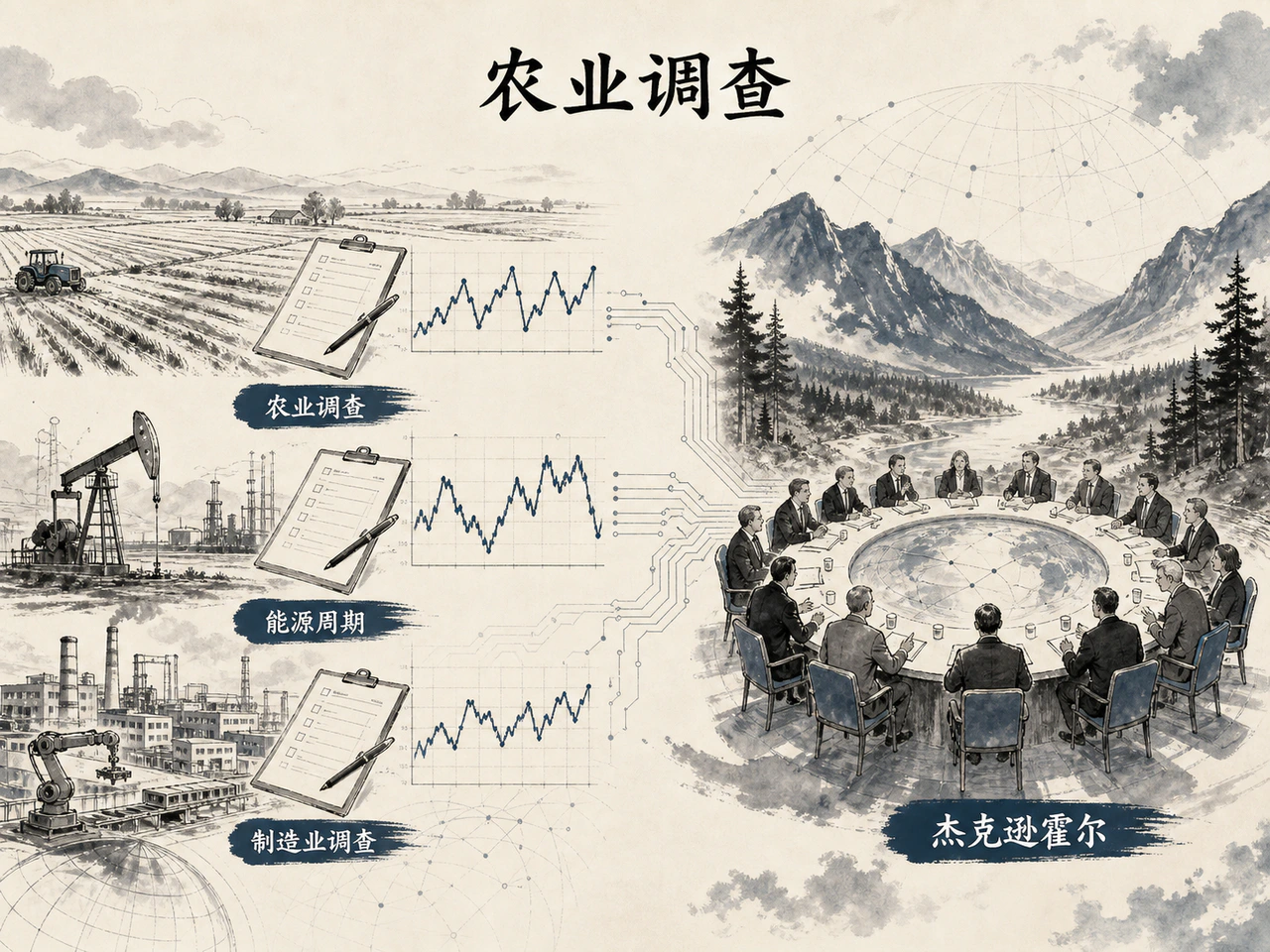
Manufacturing, services, energy and agriculture must be read together
Kansas City has developed a comprehensive high-frequency survey system covering manufacturing, services, energy and agriculture to measure conditions across district industries.
Monthly or quarterly diffusion indexes assess the pace and breadth of business expansion. Periodic special questions probe actual wage growth, future capex intentions and expectations for input and selling-price inflation. Every regional sample carries a distinct geographic and industrial imprint. Tenth District manufacturing emphasizes aircraft components, machinery, food processing and extraction equipment, quite unlike either coast. Its indexes therefore cannot casually replace national statistics.
The surveys yield real evidence when compared together. Falling manufacturing orders alongside expanding energy capex and stable agricultural credit may indicate ordinary sector rotation. Systemic spread becomes more likely when manufacturing schedules contract, farm repayment weakens, service hiring expectations deteriorate and exploration spending falls together. Before reaching a final judgment, these indexes must also be checked against commodity spot markets, detailed payroll statistics and FFIEC bank regulatory reports.
Jackson Hole can change the language, but cannot change rates on the spot
Kansas City's symposium history reaches back to the late 1970s. In 1982, it chose Jackson Hole to attract enthusiastic fly-fisherman Paul Volcker. That partly contingent location became a recognized intellectual center for global central-bank academics and policymakers.
For decades, the forum beneath the mountains has brought together central-bank officials, macroeconomic scholars and leading market economists, away from Wall Street's daily noise, to tackle long-term questions. Changes in monetary transmission, structural labor-market evolution, reassessment of the natural rate r* and limits on central-bank balance sheets have often first been explored here, reshaping the theoretical framework for long-term policy interpretation.
Markets often confuse Jackson Hole speeches with FOMC decisions. The symposium has no statutory vote and makes no immediate decision on a specific instrument. Officials exchange personal views based on research or macroeconomic analysis; unless explicitly representing committee consensus, these are not institutional decisions. Late August's thin summer liquidity can amplify a subtle word change through algorithms, but a market-sentiment pulse does not automatically become a binding policy commitment.
Mechanically counting hawkish or dovish words has little value for mature observers. The crucial question is whether leading policymakers' remarks reset the underlying reaction function or alter the weight between inflation and employment.
3. Follow the commodity cycle from prices into credit
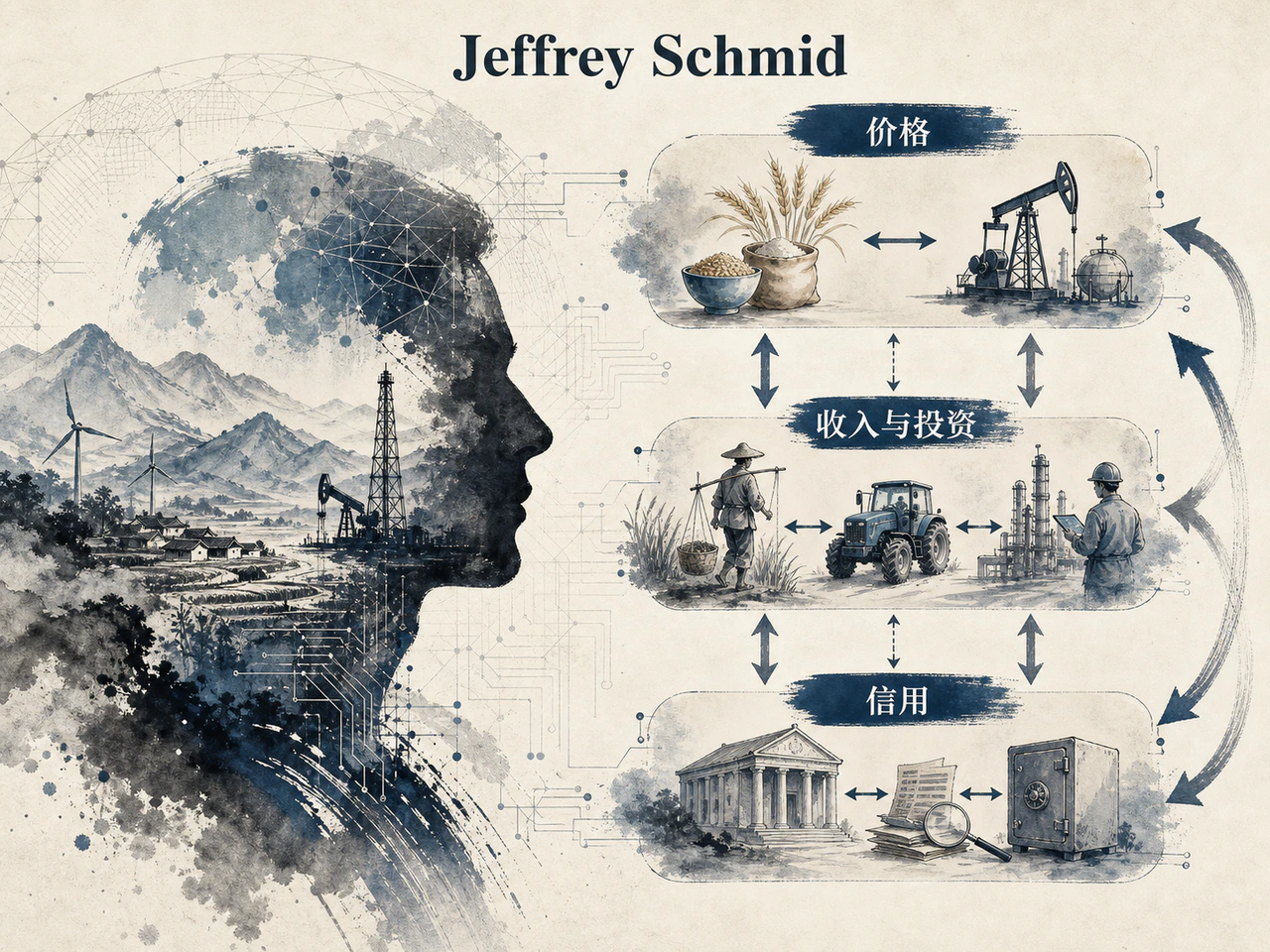
Jeffrey Schmid connects local accounts with global policy
Jeffrey R. Schmid became Kansas City's tenth president in August 2023. In 2026, although not a rotating FOMC voter—the Tenth District rotates with Dallas and San Francisco—he still attends all closed-door policy discussions and submits quarterly SEP and dot-plot projections.
Unlike presidents with purely theoretical backgrounds or long Fed administrative careers, much of Schmid's experience lies in frontline commercial banking and financial-professional education. This naturally brings a cautious view of bank balance-sheet health, interest-margin resilience and granular credit risk to monetary transmission. His public remarks combine national inflation persistence and labor resilience with the practical links between the Plains economy and global financial conditions.
Tracking his stance means watching how he balances resilient growth against the last mile of disinflation, especially his institutional judgments on quantitative tightening and minimum banking-system liquidity. As a regional president he is not simply a constituency representative. A poor district harvest or slower drilling does not automatically justify national cuts, just as strong Plains energy investment cannot justify tightening independently of national demand and price stability.
A commodity move passes through three layers
Understanding the Tenth District's policy importance requires following three layers of commodity transmission:
The first is the price layer. Wheat, soybeans, WTI and natural-gas spot and futures prices are the most immediate, visible form. Their frequent, sharp movements are repriced by global orders within milliseconds.
The second is the income and investment layer. Sustained price changes eventually affect farm profits and energy free cash flow, shaping purchases of tractors, harvesters, fertilizer and seeds, drilling utilization and resource-state fiscal receipts. When prices first turn lower, businesses and farms often cut flexible costs such as travel and maintenance. This layer's turning point therefore lags prices materially.
The third is the asset and credit layer, the deepest and most financially destructive. It appears in land revaluation, mineral-lease values, bank default provisions and tighter borrowing standards. Spot commodities can halve within weeks, while rigid debt incurred at high land and equipment prices remains. Only when liquidity buffers run out and impairments force banks to cut credit lines does the full credit contraction take hold.
Kansas City's regular field surveys are valuable precisely because they track whether a shock has moved from quotes into capex adjustment and then credit tightening and bad debts. Falling commodities with stable farmland, repayment and rural-bank liquidity usually mean profits returning toward historical norms. Rising renewal refusals, larger land-collateral haircuts and broadly frozen equipment financing instead indicate a real U.S. credit contraction beginning deep in the Plains.
Kansas City is often reduced to Jackson Hole's scenery and cameras, but its year-round institutional foundation is empirical work across the Plains: translating rural agriculture, deep oil fields and community-bank cash flows into evidence essential for national policy. The global symposium supplies a theoretical framework beyond daily noise, while actual regional accounts establish hard real-world constraints.
These information streams provide vital two-way correction between global and regional perspectives. Macroeconomic financial models detached from small-bank capital constraints and commodity-collateral valuation can underestimate the damage from credit divergence. Conversely, farmers and energy firms without a frame for global capital and monetary cycles can mistake a national turning point for a local slump.
For professional investors, value comes from testing policymakers' forward framework against quarterly district credit, land, energy and manufacturing accounts, rather than betting on a symposium slogan. A macro narrative that fails the test of real cash flows and credit cycles cannot ultimately determine the underlying policy turn.