Understanding the Federal Reserve, article 10/20
Among the twelve regional Reserve Banks, the Second District's territory is not especially vast, but its institutional role is irreplaceable. New York is the only regional Fed with a permanent FOMC vote, and its president traditionally serves continuously as the committee's vice chair. More importantly, the system's arm for implementing policy in real markets—the Open Market Trading Desk, or the Desk—is at 33 Liberty Street in Lower Manhattan.
That influence often invites misunderstanding. New York is neither the system's administrative headquarters—the central decision-making Board of Governors is in Washington—nor empowered to command the other eleven Reserve Banks. Its permanent vote and trading operations are not a privileged channel for Wall Street but an uninterrupted public duty: translate Washington's decisions into trillions in real transactions every day and relay global dollar and financial-market tremors faithfully back to policymakers.
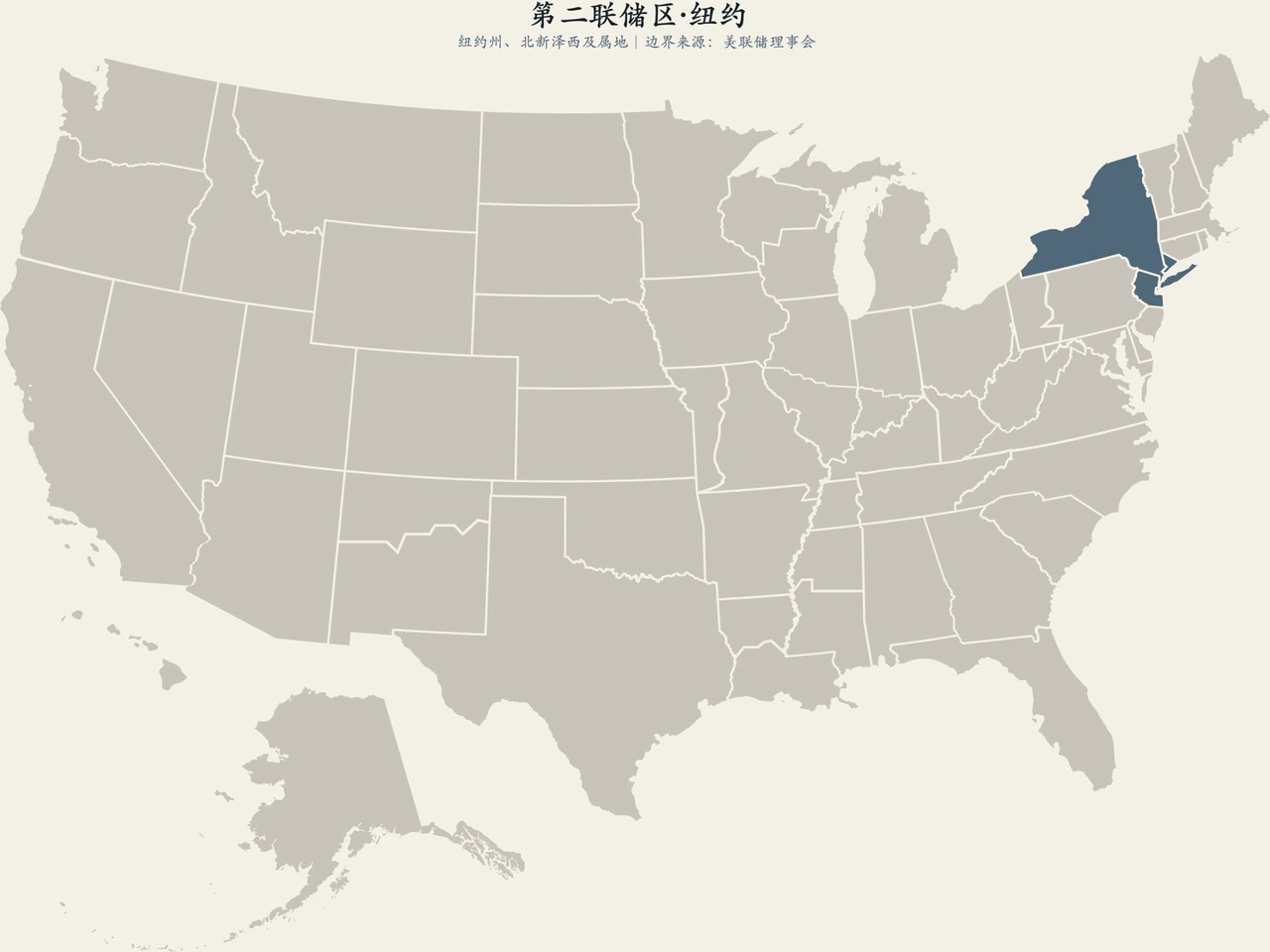
The Second District formally covers all New York State, Fairfield County in Connecticut, 12 northern New Jersey counties, Puerto Rico and the US Virgin Islands. Alongside Wall Street are upstate manufacturing and agricultural areas, New Jersey pharmaceutical and logistics corridors, and Caribbean territories facing climate and fiscal constraints. Wall Street is the best-known label, not the whole district.
1. A permanent seat carries a continuous responsibility
New York is special, but does not lead the other 11 Reserve Banks
In the Fed's two-level legal governance structure, the twelve Reserve Banks are legally parallel, each with its own board and subject to oversight from Washington's Board of Governors. New York cannot intervene in other districts' appointments, routine business or discount lending.
Its special position lies in FOMC arrangements and daily market operations. Presidents of the other eleven Reserve Banks rotate voting seats annually in fixed groups. New York's president alone votes permanently and regularly serves as vice chair; if absent, its first vice president may serve as statutory alternate.
The design reflects operational continuity, not favoritism toward eastern capital. Since the Banking Act of 1935 established the modern FOMC's outline and New York's permanent seat was fixed in 1942, policymakers have recognized that open-market operations require constant professional engagement with secondary Treasury markets, repos, reserve balances and cross-border dollar flows. Moving the operating hub around the country with rotating presidents would disrupt implementation and confuse signals. A permanent specialist entity close to financial arteries keeps Washington's instructions intact as they reach markets.
John C. Williams has been New York Fed president since 2018. A macroeconomist known for research on the natural rate, r*, he remained a central FOMC member in 2026. Markets particularly scrutinize his assumptions about disinflation, labor cooling and financial conditions. Even as vice chair, however, each speech expresses his professional assessment under the dual mandate, not automatically the Fed chair's final judgment.
The Second District extends far beyond Wall Street
Defining the district only by Lower Manhattan towers and trading screens would seriously mistake a part for the whole.
Outside metropolitan New York, Buffalo, Rochester, Syracuse and broad agricultural areas depend on precision manufacturing, green energy, dairy farming, higher education and health care, not the same cycle as Wall Street asset prices. Fairfield County has major wealth-management firms and commuters. Puerto Rico and the US Virgin Islands face offshore island economies' supply-chain fragility, natural disasters and debt-restructuring constraints.
The New York Fed must read not only global high-frequency quotes but also differences in real activity through business and community contacts. Reducing it to a huge trading floor ignores its research in large-bank prudential supervision, national household debt and credit, the Survey of Consumer Expectations (SCE) and regional financial health.
2. How a committee sentence becomes real transactions
SOMA belongs to the whole system, not New York's proprietary book
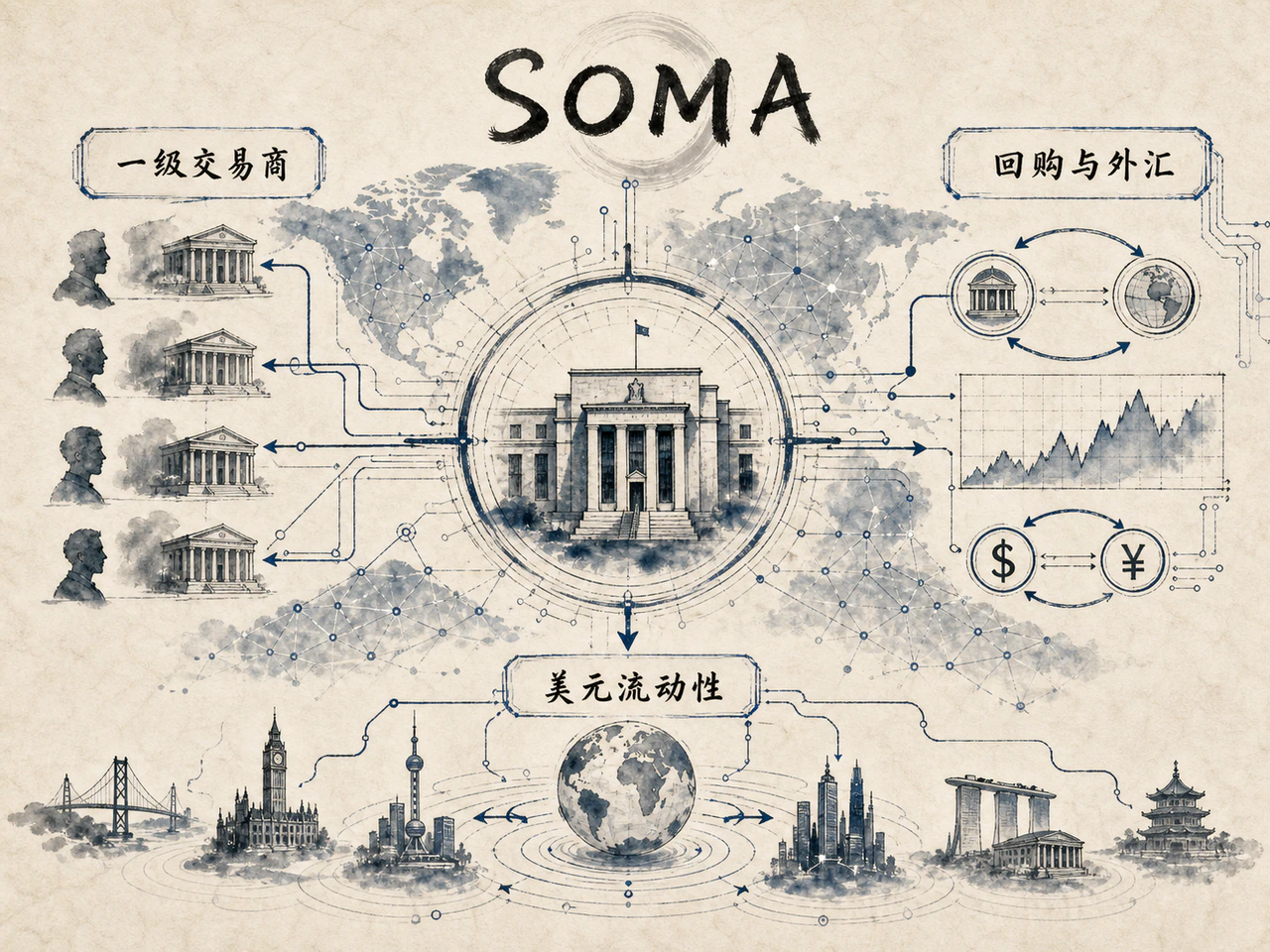
After each FOMC statement, a Domestic Policy Directive authorizes the Desk to manage money rates within the designated range. It conducts Treasury and agency mortgage-backed securities (MBS) purchases and sales, overnight repos and reverse repos, securities lending and related operations.
Securities from open-market operations enter the System Open Market Account, SOMA. Its balance sheet belongs jointly to the twelve Reserve Banks, with asset interest income after operating expenses remitted to Treasury according to statutory proportions. New York's Desk is the system's fiduciary executor, with no proprietary profit-seeking motive or ability to pursue capital gains independently of the committee's macroeconomic goals.
Primary dealers are core Desk counterparties. Their status is not simply a regulatory benefit: it carries binding market-making duties, including participation in all regular Treasury auctions, continuous two-way Desk quotations and comprehensive FR 2004 reporting on positions, financing and inventories. In recent years, counterparties have broadened to money-market funds, government-sponsored enterprises (GSEs) and eligible depository institutions. A narrative of dealings only among Wall Street insiders cannot explain the modern monetary framework.
Foreign-exchange intervention requires joint FOMC and Treasury instructions, with New York operating the Exchange Stabilization Fund (ESF) on their behalf. Washington likewise controls policy decisions on central-bank liquidity swaps used in crises, while New York handles daily technical settlement. Structural offshore dollar shortages often first become visible on the Desk's monitoring screens.
Smooth repos determine whether policy rates actually reach the market
Treasuries anchor global risk-free assets; the vast repo and reverse-repo markets connect outstanding securities with immediate cash. Financial institutions fund overnight positions against liquid collateral, directly setting the marginal price of short-term money.
Repos do not operate in isolation. Large banks' supplementary leverage ratio (SLR) constraints, quarter- and year-end balance-sheet presentation, and redistribution of reserves during Treasury settlements can sharply disturb repo rates. Funding frictions can push overnight costs above policy objectives and the effective federal funds rate (EFFR) outside the FOMC range.
New York uses a detailed floor system to support rate control: interest on reserve balances (IORB) and the Standing Repo Facility (SRF) address funding shortages toward the upper side, while overnight reverse repos (ON RRP) absorb surplus positions toward the lower side. The Desk's purpose is not to eliminate price discovery or flatten every micro spread, but to remove irrational technical squeezes so the intended stance transmits smoothly to the funding base.
3. The underground vault, payment services and market feedback
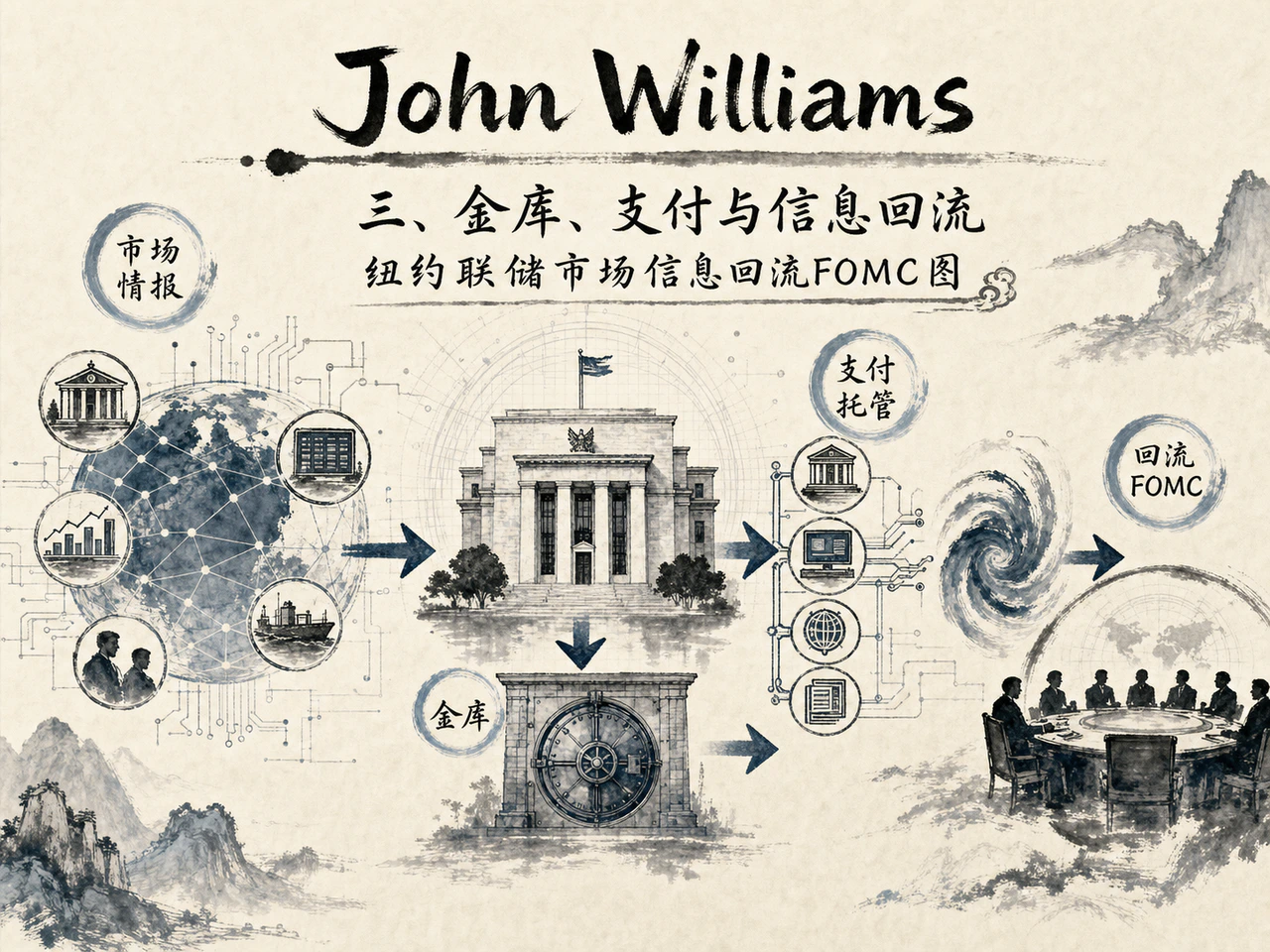
Vault gold is held in custody, not owned by the New York Fed
Eighty feet below Manhattan, in solid bedrock, lies the world's largest underground gold repository, a legendary location often central to public rumors.
The facts are clear: nearly all of its thousands of tonnes of bars belong to foreign governments, sovereign central banks and international organizations such as the Bank for International Settlements. New York is solely custodian and settlement provider. The gold is not its own balance-sheet asset and cannot be lent as collateral or sold at its discretion. US official gold is mainly stored at domestic facilities including Fort Knox, Kentucky, and West Point, with only a tiny share in New York's vault. Settlement between sovereign institutions simply involves staff moving bars between separate compartments, a custody service without credit expansion.
More central to modern finance is New York's wholesale payments infrastructure. Through Fedwire funds and securities services it supports final domestic and cross-border settlement, maintains central-bank accounts for foreign official institutions and very large settlement bodies, and deploys extensive supervisory teams at global systemically important banks (G-SIBs). Real-time payment traces, interbank flows and detailed supervisory records together form an exceptionally sensitive financial monitoring network.
Three groups of information matter most to investors
Following New York's macroeconomic role need not mean overinterpreting isolated headlines. Three core data groups provide the broad picture:
- SOMA balance-sheet disclosures and annual open-market reports: Thursday's H.4.1 releases and detailed portfolio lists reveal actual balance-sheet expansion or quantitative tightening (QT), security duration and reinvestment pace;
- Benchmark rates and money-market friction measures: spreads among SOFR, EFFR and IORB, alongside ON RRP usage and SRF frequency, help assess reserve abundance and structural distribution pressure within banking;
- High-frequency dealer data and micro expectations: primary-dealer FR 2004 positions track Treasury absorption and leverage preferences; the Global Supply Chain Pressure Index (GSCPI) measures external bottlenecks; SCE cross-checks inflation persistence and household balance-sheet resilience.
Every measure has limits. SOMA's static size alone cannot determine the 10-year yield, also influenced by term premiums, fiscal issuance and global expectations. An occasional repo-rate spike need not signal systemic liquidity crisis, and micro surveys depend on sampling and question design.
New York's irreplaceable contribution is a complete decision–execution–feedback loop. It is neither the apex of command nor an ordinary passive local office. From the front line of capital flows, it translates Washington's strategic instructions into market operations and returns the financial system's actual response impartially to the next FOMC debate.