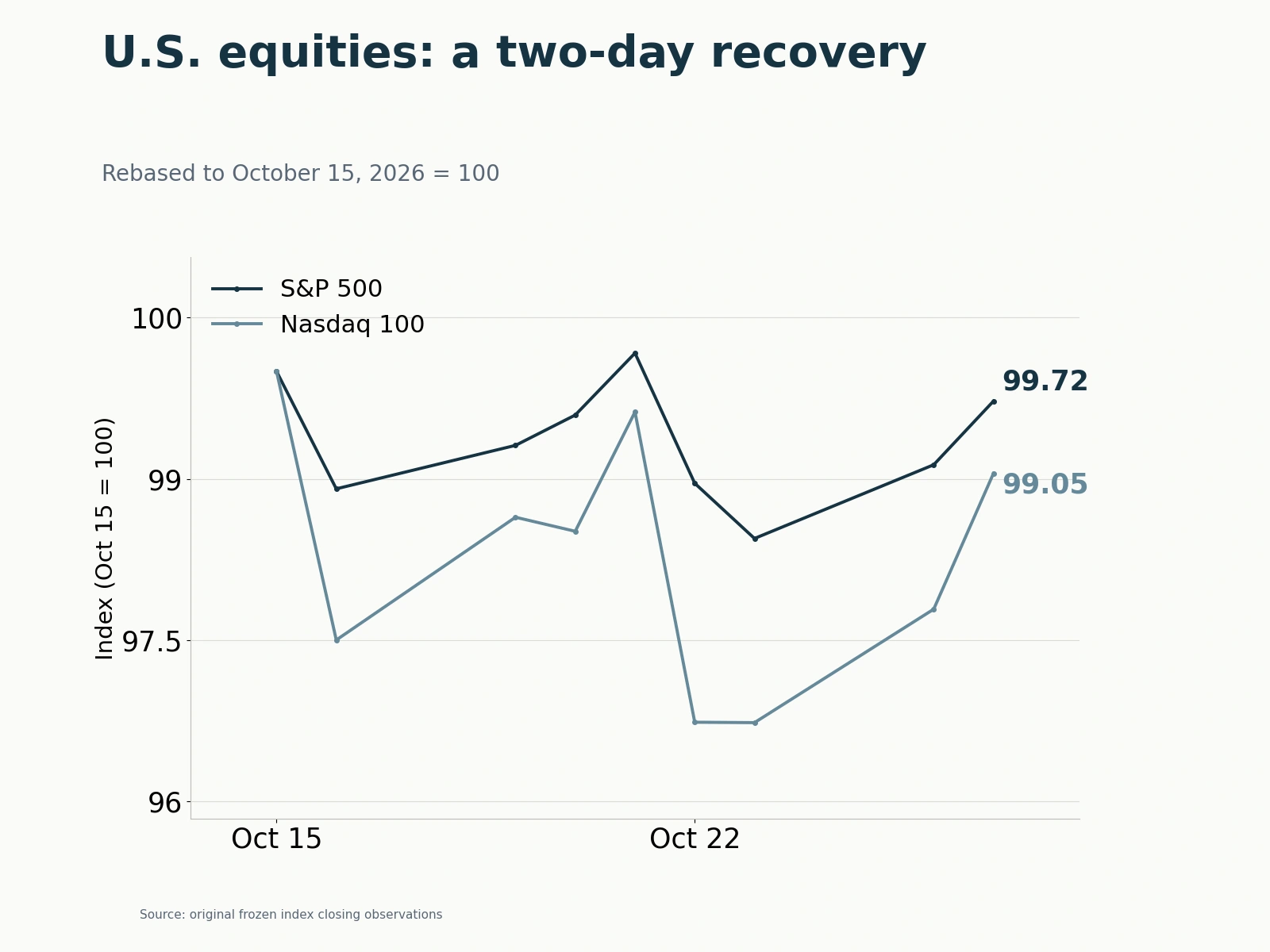
On August 27, 2026, Jackson Hole's opening day, four regional Fed presidents delivered unusually concentrated hawkish comments, yet markets barely reacted. Treasury yields rose just 1 basis point across maturities, while interest-rate options' implied September-hike probability actually declined. Material asset drivers followed two tracks. Washington's rejection of a return to June's memorandum framework, combined with delayed disclosure of a Hormuz tanker attack, drove a deep V-shaped Brent rebound to $89.70, up 2.1%. Nvidia's forecast-beating results independently supported technology, lifting the S&P 500 by 0.72% while most other sectors fell. With bonds waiting, equities dependent on one leg and oil and gold pricing geopolitics, the next global move rested on Warsh's Jackson Hole keynote that evening Beijing time.
Bonds: The Whole Curve Rises One Basis Point as Long-End Supply Pressure Persists
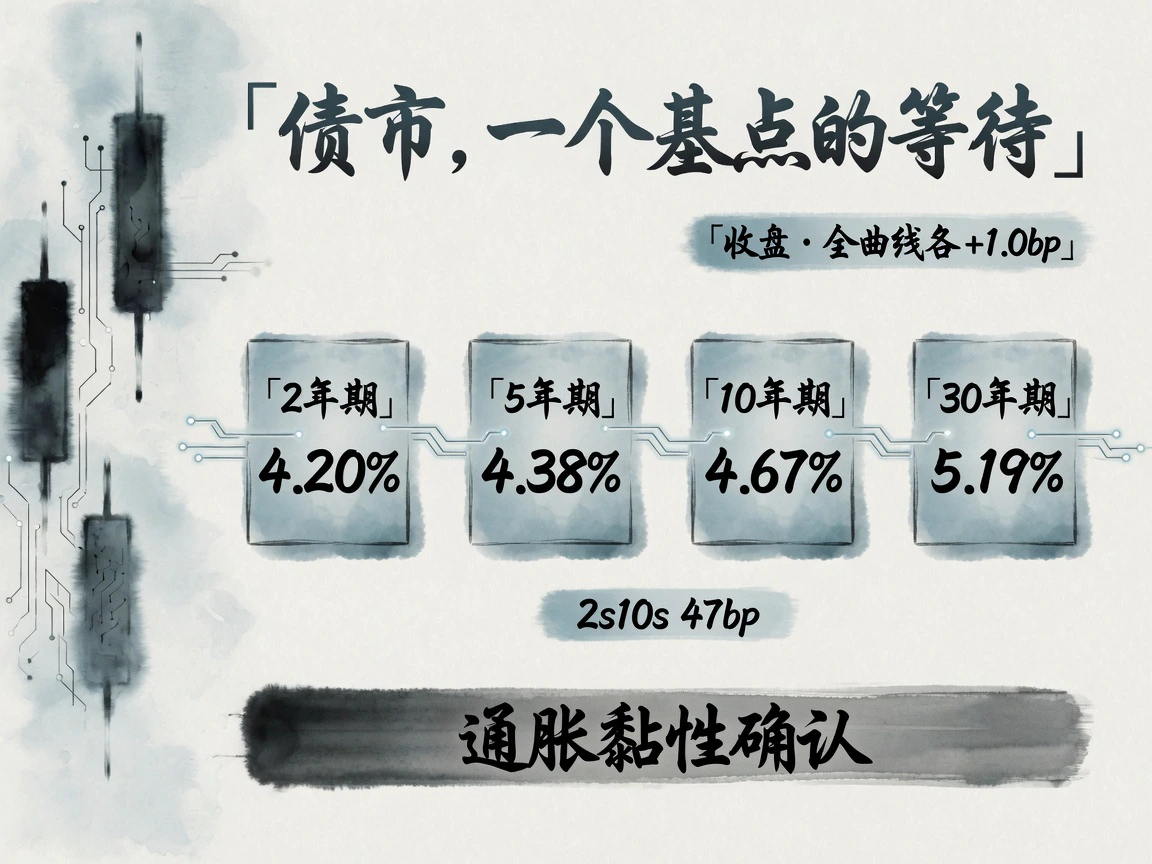
Thursday's data and Fed comments were hawkish. Initial claims were 203,000 versus 208,000 expected, and officials broadly stressed stubborn inflation. Yet short yields rose only 1 basis point, indicating this mix was not read as an immediate resumption of hikes. Overnight liquidity remained ample within the 3.50%–3.75% funds corridor, with SOFR at 3.64%, effectively anchoring the front end.
The 10-year breakeven edged from 2.32% to 2.33%, accounting for almost all the nominal yield's 1-basis-point rise, while the real yield stayed near 2.34%. Participants priced confirmation of sticky inflation rather than an immediate policy-rate increase. Closing yields were 2-year 4.20%, 5-year 4.38%, 10-year 4.67%, and 30-year 5.19%, all up 1.0 basis point; 2s10s stayed at 47 basis points.
Supply remained the main long-end selling pressure. This week's auctions illustrated it: $69 billion of 2-year notes cleared at 4.204%, with bid-to-cover 2.60 and indirect bidders taking 66%; $70 billion of 5-year notes cleared at 4.393%, marking the 15th consecutive small tail; and $44 billion of 7-year notes cleared at 4.512%, the highest since December 2024. The Treasury announced that from September 9, the per-operation limit on liquidity buybacks of 10–30-year debt would double from $2 billion to $4 billion. Yet a prior 9–12-basis-point drop in 30-year yields was erased in one session. A $4 billion buyback cannot offset the combined supply of deficit financing, AI-infrastructure corporate debt and structurally retreating official overseas buyers. At 08:21–08:30 Beijing time August 28, live snapshots—not daily changes—showed 2-year 4.228%, 5-year 4.391%, 10-year 4.672% and 30-year 5.195%, with the dollar index 99.14 and dollar/yen 159.37.
Policy: Hawkish Voices Diverge From Pricing as Hike Odds Fall
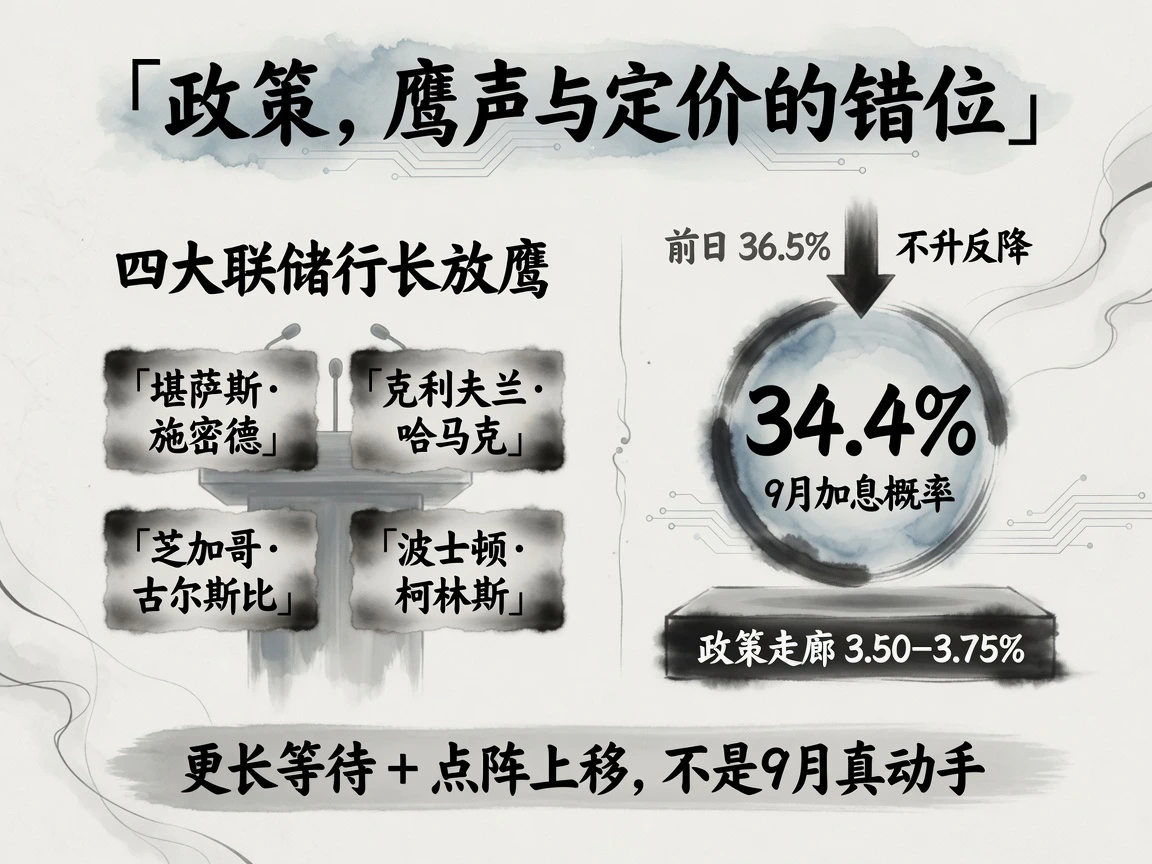
The four presidents broadly agreed but emphasized different points. Kansas City's Schmid questioned which sectors current rates actually restrained. Cleveland's Hammack said it was time to act. Chicago's Goolsbee called renewed inflation the main near-term concern and cautioned against complacency, while acknowledging the last three months' improvement was not bad. Boston's Collins described recent data as mixed. Sideline interviews lacked the authority of formal prepared guidance, so markets absorbed persistent inflation while setting aside an urgent Fed move.
CME FedWatch showed the sharpest contrast: implied hike probability for September 15–16 closed at 34.4%, down from 36.5%. For hike expectations to become substantive, short rates would first need to move beyond the 3.50%–3.75% benchmark corridor; ample overnight liquidity provided little basis for immediate tightening premiums to build. Investors instead priced a defensive path of higher for longer and upward dot revisions, rather than a direct September increase. The quiet Treasury curve reflected this structural wait-and-see stance.
Fundamentals remained insufficient to force hikes or support a pivot. The claims four-week average was 205,500: resilient but not overheated enough to compel faster tightening. July's goods-trade deficit widened to $118.8 billion, the largest since March 2025, underscoring nominal domestic-demand resilience. Japan's August Tokyo CPI rose 1.9% year on year and core excluding fresh food returned to 2.0%, reinforcing September 17–18 BOJ hike pricing already around 86%–87%.
Commodities: Oil Stages a Deep V Reversal as Precious Metals Hold High Ground
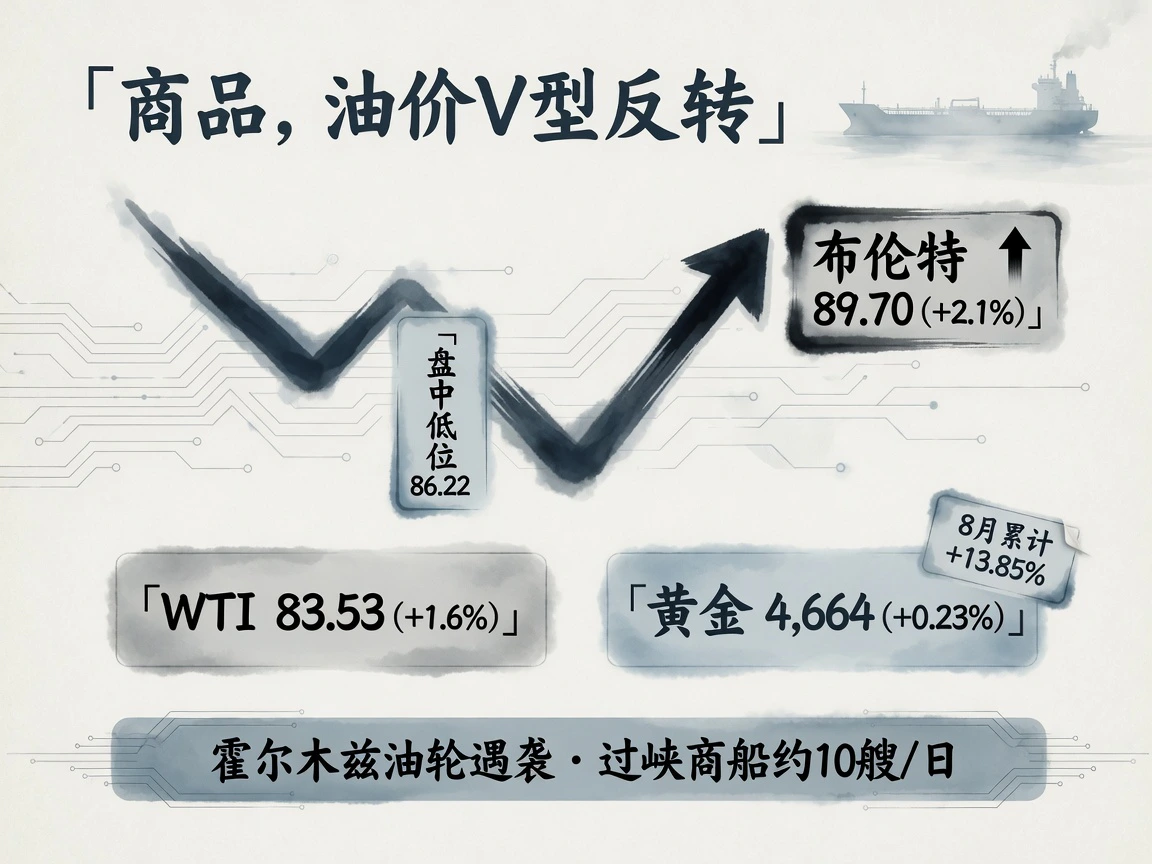
Oil's textbook deep V was driven almost entirely by rapidly shifting Middle East diplomacy. Optimism over Iran–Oman talks pushed Brent to an intraday $86.22 low during Asia–Europe trading, its fourth consecutive session of intraday declines; WTI broke $81 to reach $80.65. During New York trading, the Wall Street Journal reported Washington telling mediators it had no interest in restoring the June memorandum framework. The White House then said no substantive negotiations were underway. Benchmarks surged late to daily highs: October Brent settled at $89.70, up 2.1%, ending three declines; October WTI at $83.53, up 1.6%. Prices returned to the $83–$90 range without challenging August 21 highs of $87.06 WTI and $94.39 Brent. The emerging baseline was prolonged bargaining without a complete rupture: slowly implemented sanctions, US refusal to compromise and continuing regional mediation.
Physical shipping still lagged diplomatic optimism. UKMTO belatedly issued an alert for August 25 at 17:30 UTC: an unidentified projectile hit a tanker near Khasab in Hormuz, causing a quickly extinguished fire with no casualties, disclosed two days later. The Joint Maritime Information Center identified the Kuwaiti-flagged product tanker AL SALAM II. No one claimed responsibility, but it was the clearest recent actual transit disruption. Traffic measures differed: Kpler counted about 10 merchant ships on August 26, far below prewar levels; August 17–23 transits totaled 108, up 27% week on week; a Reuters column estimated August oil exports through Hormuz at only 2.3 million barrels a day versus 15.82 million prewar. US military figures reported 75 rerouted ships, 3 disabled and 2 boarded. The gap between louder diplomacy and delayed transit recovery appeared in deep WTI backwardation: October $83.53, November about $82.6, December about $80.8. Risk premiums concentrated in prompt contracts while distant months anticipated normalization within months. Bloomberg reported after hours that Venezuela was considering leaving OPEC. If true, it could imply extra supply and weaker cohesion, but implementation remained distant.
Precious metals held their core support between rate pressure and fiscal-hedging demand. Active December COMEX gold settled at $4,664 an ounce, up 0.23%, taking August gains to 13.85%; if maintained through month-end, this would be a record monthly gain. Gold stayed above $4,600 despite hawkish officials, roughly one-third September-hike odds and a firm, fluctuating dollar. This reflected resilient support from official purchases, a weaker monthly dollar cycle, ETF allocations and global reserve demand. Silver rose 2.12%, substantially outperforming gold, suggesting allocation money remained in precious-metal safe havens but shifted from aggressive anticipation to dip buying. Bulls still faced profit-taking in the $4,650–$4,700 resistance zone.
Equities: Nvidia Alone Supports the Market as Technology Lifts Indices
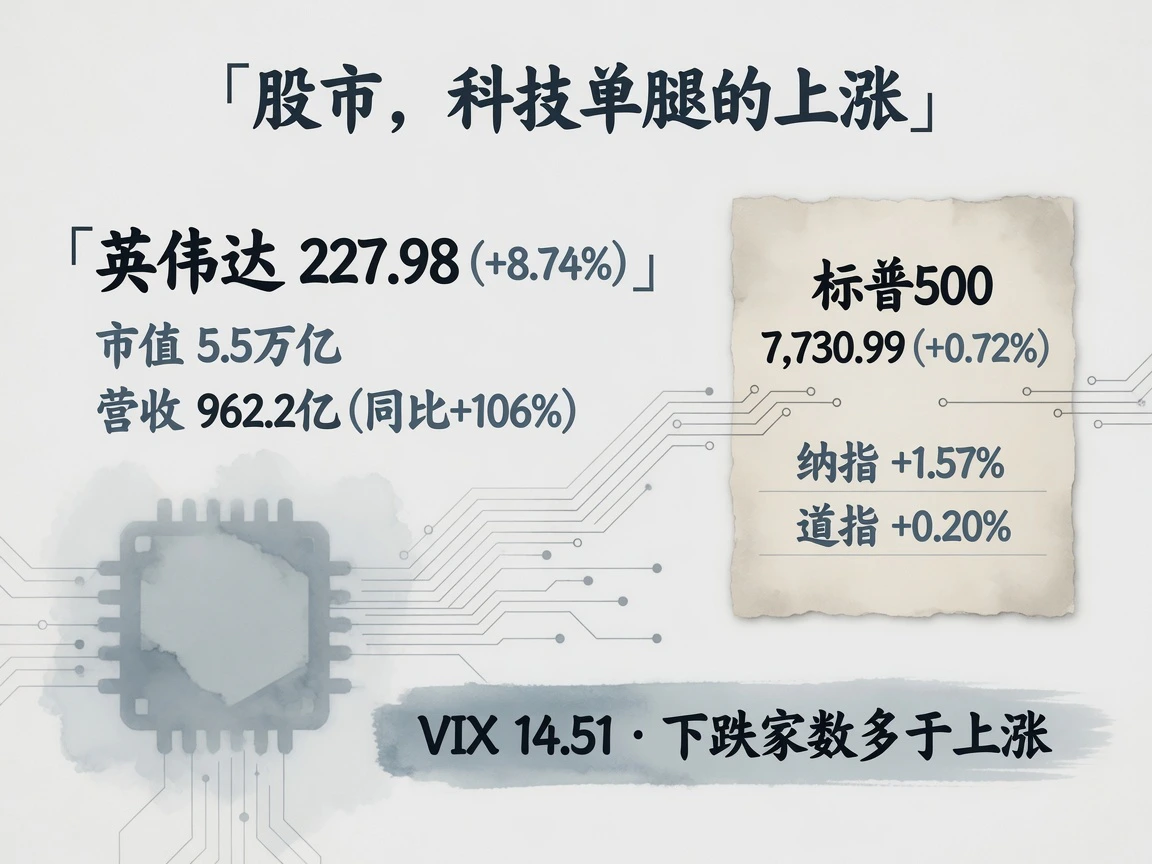
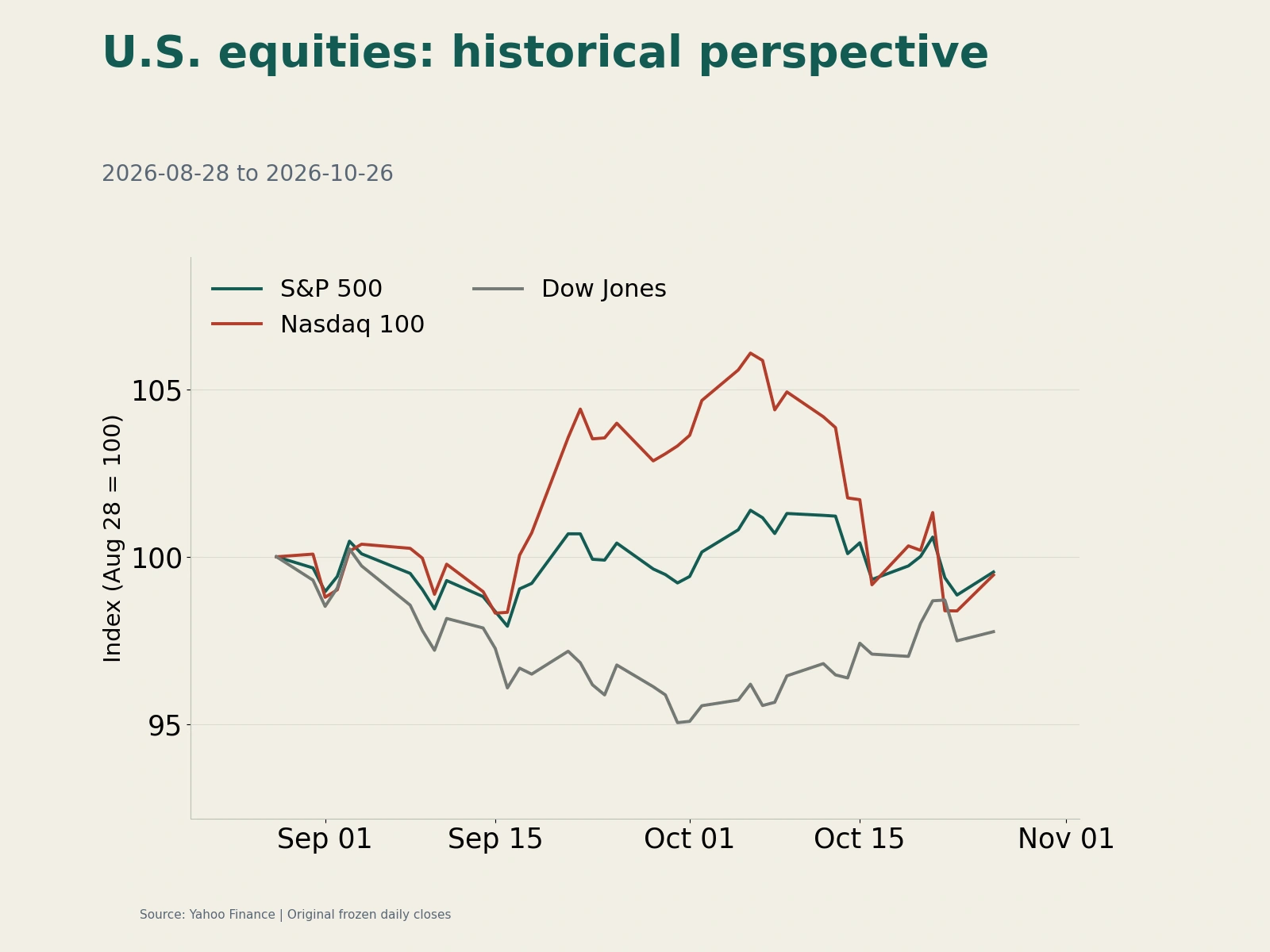
US equities showed a single-giant earnings-driven split rather than broad risk-on. The S&P 500 closed at 7,730.99, up 0.72%; Nasdaq gained 1.57%; Dow edged up 0.20%. NYSE decliners substantially outnumbered advancers, and only S&P information technology rose, gaining 3.4%, while staples and most nontechnology sectors fell. Nvidia supplied almost all the impetus, closing at $227.98, up 8.74%, and regaining a market value above $5.5 trillion. Results released the prior evening showed quarterly revenue of $96.22 billion, up 106%, third-quarter guidance above consensus and a first-ever roughly 70% compound-growth guide for fiscal 2028. This decisively countered fears of peaking AI demand and shifted the narrative to accelerating demand constrained by delivery. Software AI optimism lifted Salesforce 22.6% and CrowdStrike 20.5% to a 52-week high. VIX fell 4.6% to 14.51, but post-earnings implied-volatility collapse, or IV crush, is not equivalent to a systemic decline in overall macro volatility.
Marvell showed buy-the-rumor, sell-the-fact behavior after hours. Despite raising quarterly and longer-term guidance, including a fiscal 2028 target near $18 billion, shares fell 6%–8%. Scrutiny of expensive hardware shifted from whether growth remained high to whether order visibility could become still more concrete and beat expectations. The marginal lift from earnings beats was rapidly diminishing late in the season.
Asian transmission followed semiconductor manufacturing and hardware equipment. Korea had the strongest Nvidia linkage: KOSPI gained 1.53% Thursday, led by Samsung and SK Hynix. But the Bank of Korea unexpectedly raised rates 25 basis points to 3.00% for a second consecutive time, and Friday morning KOSPI quickly gave back more than 1%. Nikkei 225 edged higher and Australian shares rose slightly. Hong Kong's Hang Seng lost 0.34% Thursday on Chinese internet platforms, while mainland technology growth shares attracted stronger support: Shanghai gained 1.13% and STAR 50 3.8%. AI spillovers clearly favored advanced manufacturing and hardware over generic internet platforms.
Geopolitics and Macro: Commodity Premiums Persist as Attention Turns to Warsh

Global pricing showed clear risk segregation. Geopolitical premiums were almost confined to commodities: oil priced shipping and sanctions, equities relied independently on Nvidia and AI, and Treasuries moved only 1 basis point without panic safe-haven buying.
Diplomatic language shifted subtly. The White House's denial of ongoing negotiations directly challenged reconciliation optimism. Iran's Supreme National Security Council secretary led drafting of formal reopening conditions, shifting technical talks toward a confrontation over frameworks. Qatar's prime minister was the third envoy to visit Tehran during August 24–27, without announcing an immediate deal; mediators mainly transmitted demands rather than brokered substance. Large-scale strikes on Iranian territory had paused for about 28 nights without new major raids, temporarily giving way to shuttle diplomacy and financial sanctions. Within Iran, fuel queues extended kilometers in several cities and the free-market rial fell to a record near 2.02 million to one US dollar. Official indications that gasoline and diesel prices needed increases remained unimplemented, but expectations themselves prompted panic hoarding. A previously signaled US list of secondary sanctions on major financial institutions had not appeared by the cutoff, with Friday Eastern time still available. Whether it would reach wider institutions was the key tail risk.
The session thus followed three paths: Treasuries waiting sideways, equities rising on one leg, and commodities independently absorbing geopolitical premiums. Attention and volatility exposure centered on Warsh's forthcoming keynote that evening Beijing time. If he continued emphasizing longer-term institutions while avoiding near-term commitments, overheated hike premiums might keep unwinding and short liquidity gain relief. A harsher judgment on sticky inflation and a lower tightening threshold would trigger renewed short-rate hike repricing, pressuring both stocks and bonds. Before the September 15–16 FOMC blackout, this was the most important management anchor for policy expectations.