On August 28, Kevin Warsh delivered his first Jackson Hole keynote as Federal Reserve chair. He neither disclosed whether September would bring a hike nor supplied a tradable rate roadmap. Yet futures-implied September hike odds jumped from 35% to 57% afterward, and short-rate-sensitive yields rose broadly.
Markets first heard a clearly hawkish message. Warsh saw a resilient economy, a labor market still at full employment and broad financial conditions that could scarcely be called restrictive. Twelve-month core PCE inflation was 3.7%, with a six-month annualized rate of 4.1%. Relatively mild summer readings were far from proof of a stable inflation foundation. Until inflation converged rapidly and reliably to 2%, the task was unfinished.
More consequential than September's decision was the institutional question: should the central bank plan the whole future curve from above, or should markets discover it from below?
Warsh drew two boundaries. The Fed would firmly control today's short-term benchmark and retain ultimate responsibility for stable prices and full employment. But the dot plot, dense guidance and quasi-commitments should no longer substitute for discovery of the economic outlook and future rates. He sought to return the inference of future rates to markets while retaining decisions at critical moments.
1. Real interest rates are not a central-bank creation
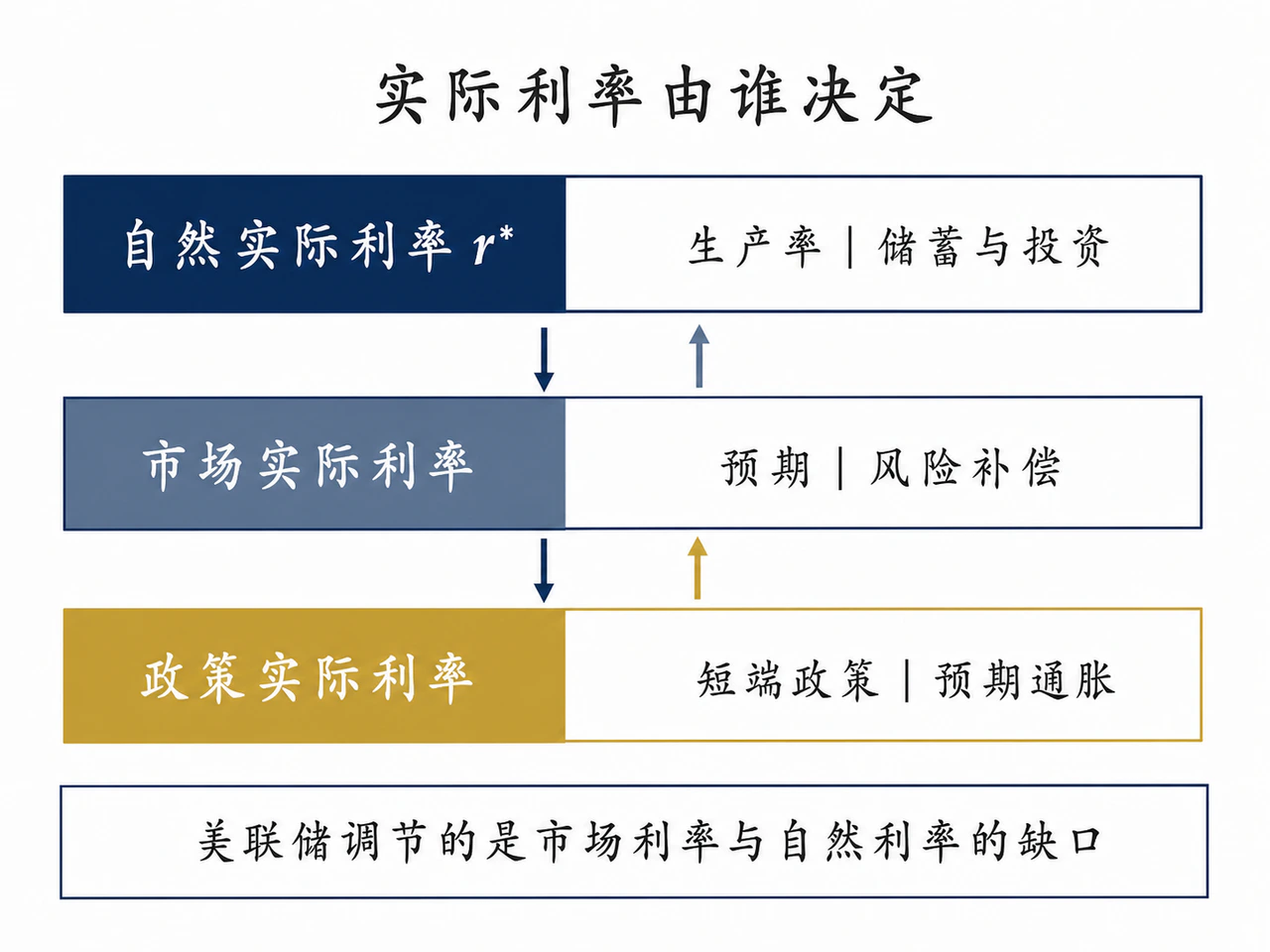
The real rate is the time price of capital. Productivity, demographics, saving preferences, investment returns, fiscal deficits and global flows jointly determine the real financing cost an economy can bear without overheating or recession. This equilibrium is the natural real interest rate.
The natural rate is rooted in the real economy and cannot be permanently controlled by FOMC preference. Technology raising capital returns lifts it; aging, excess saving or weak investment depress it. The central bank can temporarily push policy away from it but cannot permanently overturn capital supply and demand.
Investors face more layered market rates. Nominal Treasury yields combine expected real short rates, inflation compensation and term premiums. Credit, mortgages and commercial loans add credit spreads, liquidity discounts and bank-capital constraints. A rising curve may reflect stronger growth and capital returns, inflation concerns, duration repricing or funding stress.
Actual monetary tightness depends on financing rates relative to the unobservable natural rate. Persistently lower real rates make credit growth and inflation harder to restrain; persistently higher rates suppress investment and consumption. The central bank can actively influence the size of this gap.
Even without the Fed, savers, businesses, intermediaries and markets would price capital. The central issue is whether that price forms within a stable monetary and credit order, rather than whether markets can form rates at all.
2. If markets can form rates, why have a central bank?
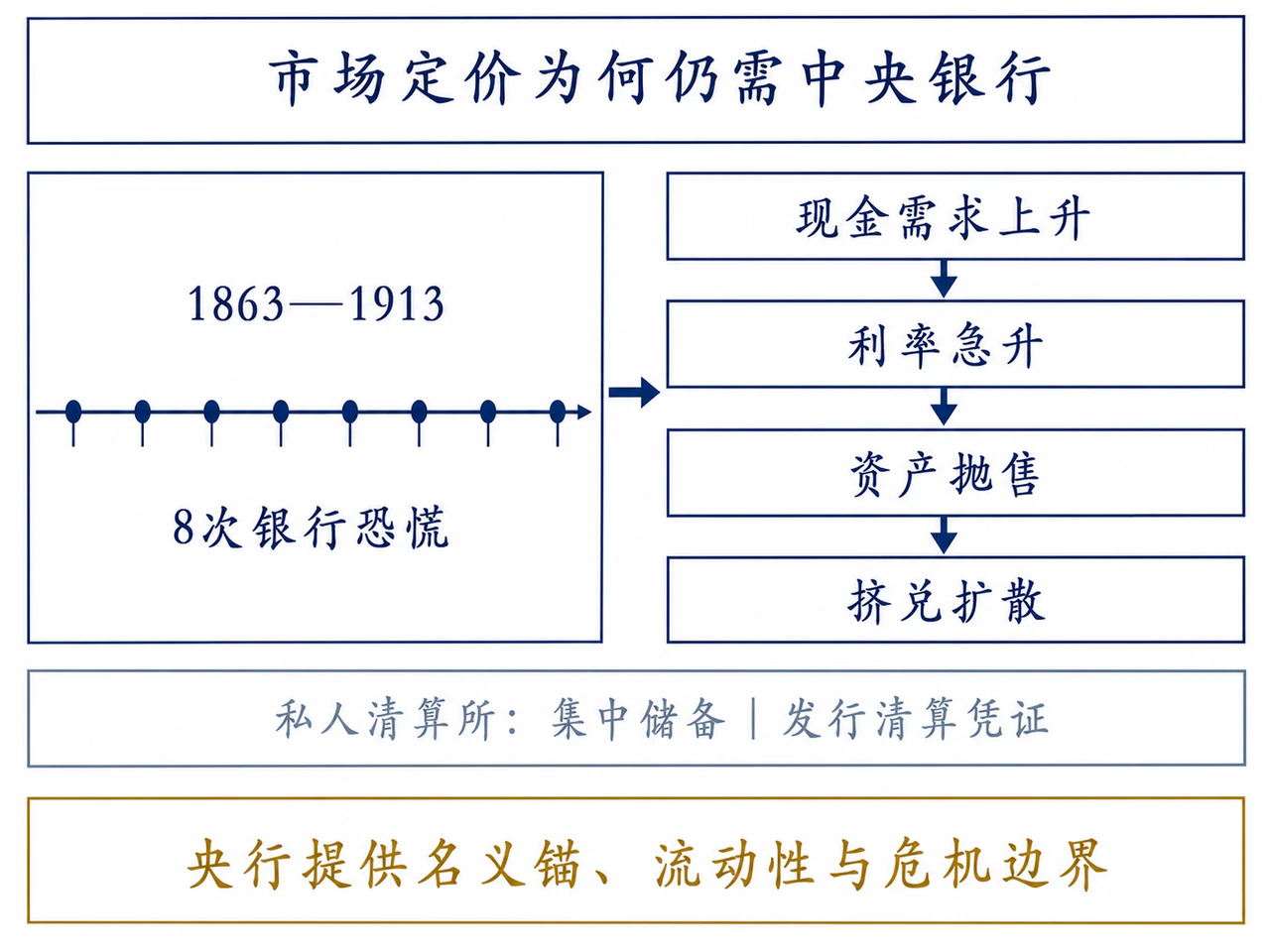
Pre-1913 U.S. history provides a long example. During half a century without a modern central bank, rapid industrialization coexisted with active interbank, commercial-paper and bond pricing. Yet New York experienced eight nationwide banking panics between 1863 and 1913. Autumn farm settlement and year-end consumption raised cash demand, but inelastic currency supply failed to respond, repeatedly sending overnight rates soaring and triggering collateral liquidation, asset crashes and bank runs.
These liquidity droughts reflected broken settlement-asset supply rather than suddenly exceptional real investment returns. The New York Clearing House often pooled reserves, issued clearing certificates and funded banks facing runs—private entities effectively performing central-bank functions. The 1907 panic exposed the credit limits of private rescue alliances in systemic crises and directly helped produce the 1913 Federal Reserve Act.
The Fed's original purpose was monetary elasticity, preventing settlement blockages and self-fulfilling runs from distorting fundamental prices, rather than monopolizing capital pricing.
In fiat money, a more central task is the nominal anchor. Capital supply and demand set relative real rates, but a dollar's future purchasing power requires credible monetary rules. Gold once supplied a fixed conversion anchor; modern dollars rely on the credibility of a central bank prioritizing price stability.
A central bank also resolves collective-action problems arising from individually rational behavior. Hoarding liquidity and reducing lending during a crisis protects each institution but collectively collapses credit and creates deflation. The lender of last resort offers an unlimited discount window to solvent but illiquid institutions, interrupting the chain from individual defense to systemic collapse. This inevitably creates moral hazard and policy-error risk.
Central banks correct market liquidity failures while introducing their own risks. The institution's foundation is the division of responsibilities: spontaneous pricing for markets and systemic safeguards for the central bank.
3. From monetary anchor to path management
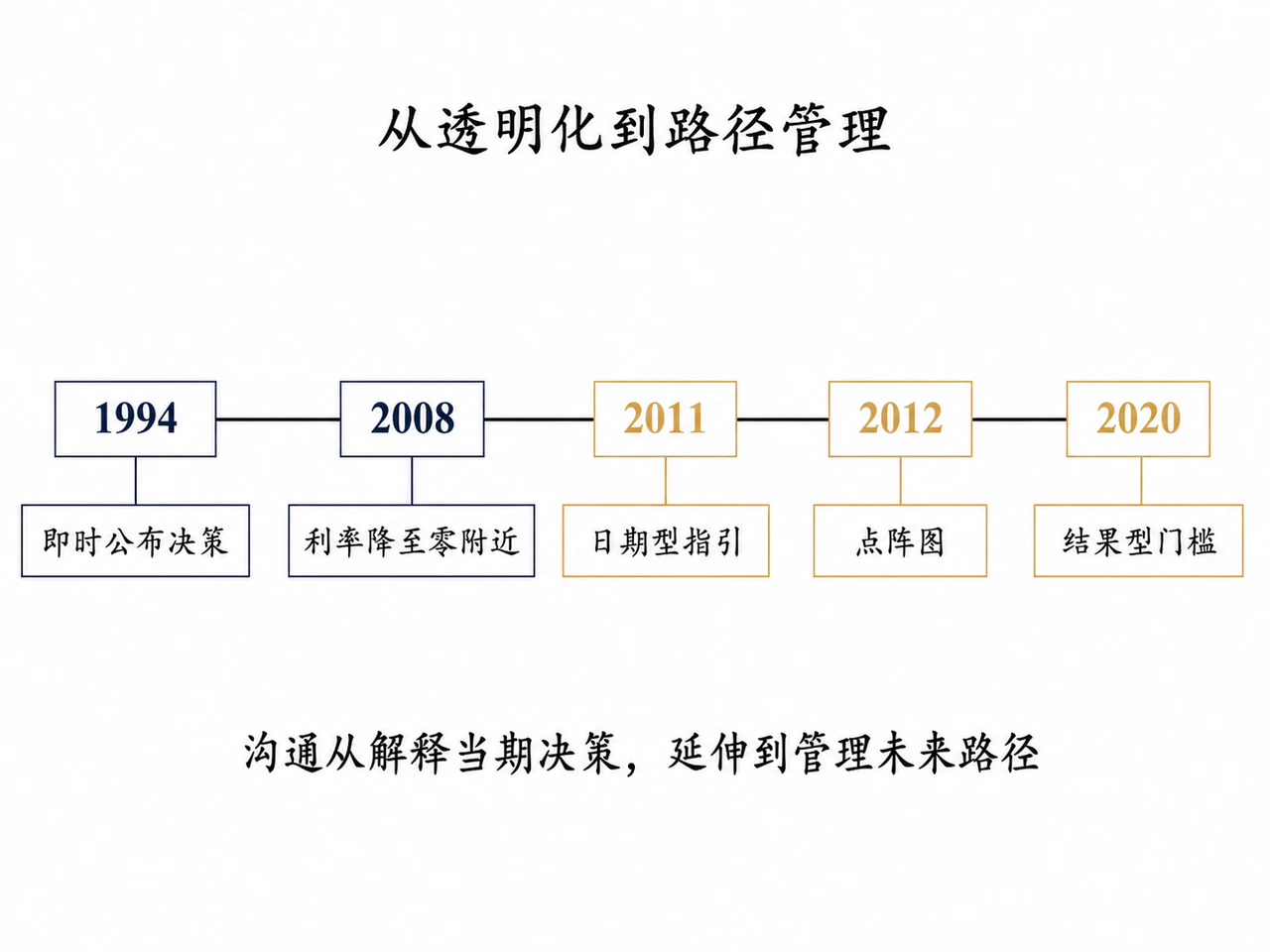
Over thirty years, that boundary shifted markedly toward the central bank. Before 1994, the FOMC did not even issue postmeeting rate statements; traders inferred intent from New York Fed operations. Transparency initially explained what had just been done, then evolved into repeated communication of future intentions.
The 2008 subprime crisis was the turning point. At the zero lower bound, conventional cuts were exhausted and the Fed managed expectations of future short rates to sustain easing. Date-based guidance in 2011, quarterly dots from 2012 and outcome-based guidance tied to unemployment and inflation in 2020 shared one logic: persuade markets with official certainty that low rates would last longer, directly lowering long Treasury yields, mortgages and corporate spreads.
Strong guidance stabilized confidence during crisis. Afterward, unconventional guidance became routine. Analysts shifted from economic data toward guessing officials' interpretations. Dots became market-wide pricing benchmarks rather than reference information, and speeches became continuous tools for correcting market prices.
Fed economist Eric Engstrom's research found dot forecasts useful across horizons but vulnerable to quickly lagging reality between quarterly updates. Excessive anchoring to old dots could reduce sensitivity to current data.
This is Warsh's hall-of-mirrors effect: the Fed publishes a path, markets price it, and the Fed then treats those guidance-shaped prices as independent macro signals. It reads its own reflection back from the market.
The 2021–2022 inflation failure exposed overcommitment: employment thresholds and purchase schedules constrained decisive adjustment as inflation changed rapidly. Warsh did not reject crisis guidance wholesale, but intended to end its normal-cycle overreach. The FOMC should set the current short benchmark; economic data, risk appetite and term premiums should price long and forward rates.
4. From central-bank direction to market discovery: a new place for shadow hikes
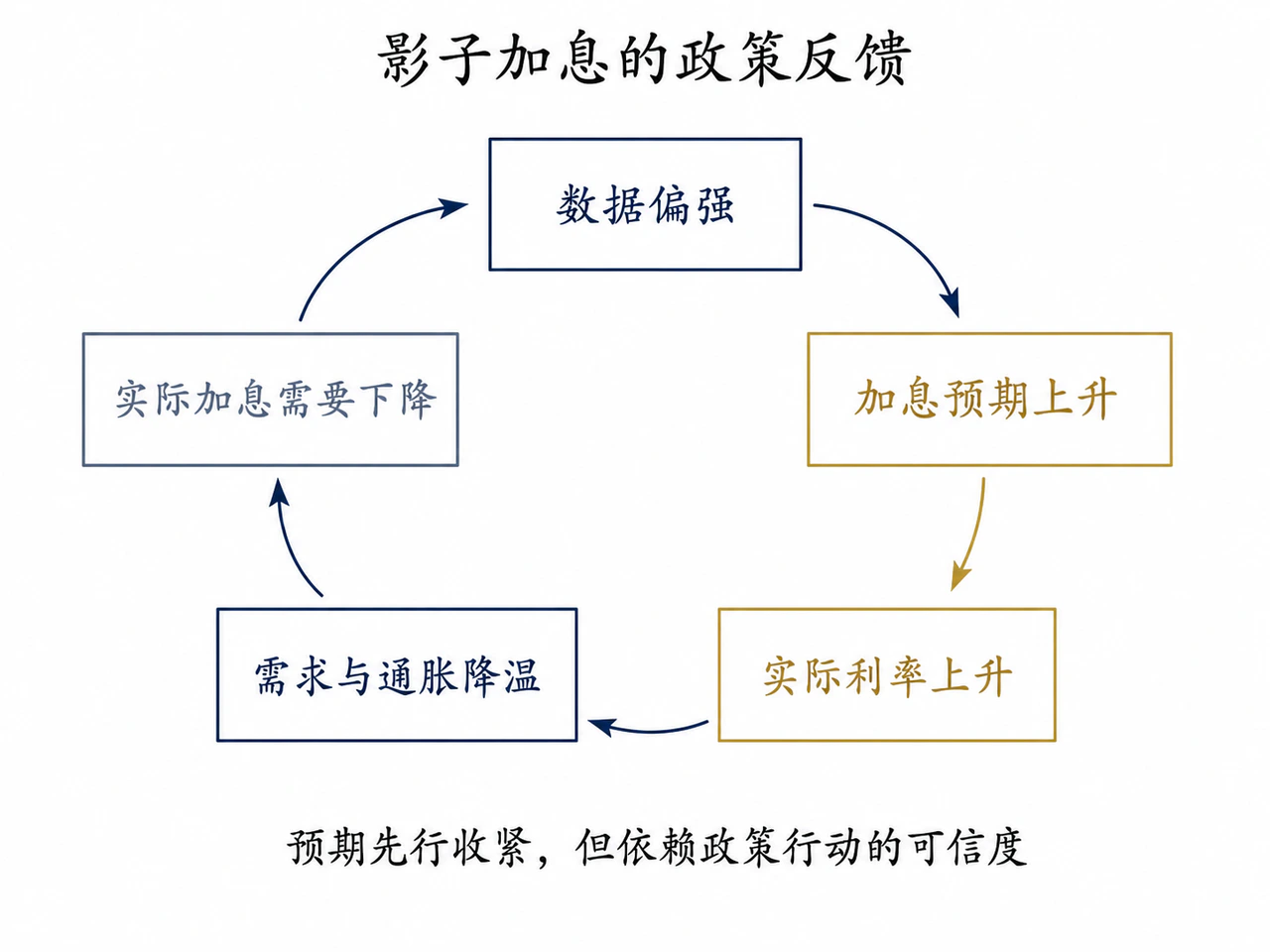
Expectations already have self-fulfilling transmission effects. Agreement on future hikes moves 2-year Treasuries, overnight-index swaps and other short-sensitive rates. With stable inflation expectations, ex-ante real rates rise. Higher corporate and mortgage costs, a stronger dollar and lower valuations transmit across credit, cooling demand before the Fed acts. This is commonly called a shadow hike.
Traditional guidance uses the same chain. The distinction is who initiates it. Previously the Fed drew the roadmap and markets passively transmitted it. Warsh's framework would have the Fed explain principles, reaction criteria and current conditions while markets reconstruct policy probabilities from new high-frequency data.
Data would first change prices, prices tighten financial conditions, and the Fed assess how much tightening markets had already delivered before deciding the remaining action needed. Strong data prompting early hike pricing could tighten real credit and cool demand months later, reducing the number or size of actual increases. Spontaneous pricing feedback becomes part of macro adjustment.
Substitution is not mechanical. Higher long yields caused by inflation compensation signal inflation risk, rather than policy restraint. Term premiums driven by uncontrolled deficits are not healthy monetary discipline either. Even higher real Treasury yields can coexist with easier broad conditions if equities surge and credit spreads narrow. Formal benchmark changes also directly affect overnight repos, floating commercial loans and bank funding costs, which long-curve fluctuations cannot fully replace.
More fundamentally, shadow tightening depends on credible belief that the central bank will act decisively when necessary. Only credible discretion makes expected tightening arrive early. If markets believe tighter conditions mean the Fed will never actually act, the expectations collapse.
Warsh seeks a central role for this mechanism: greater market sensitivity to data and explicit Fed consideration of tightening already absorbed in prices when calibrating residual action. The cost is more intense data-driven trading without an official path, systematically raising rate volatility and term-premium levels.
5. Warsh reduces path management, not policy responsibility
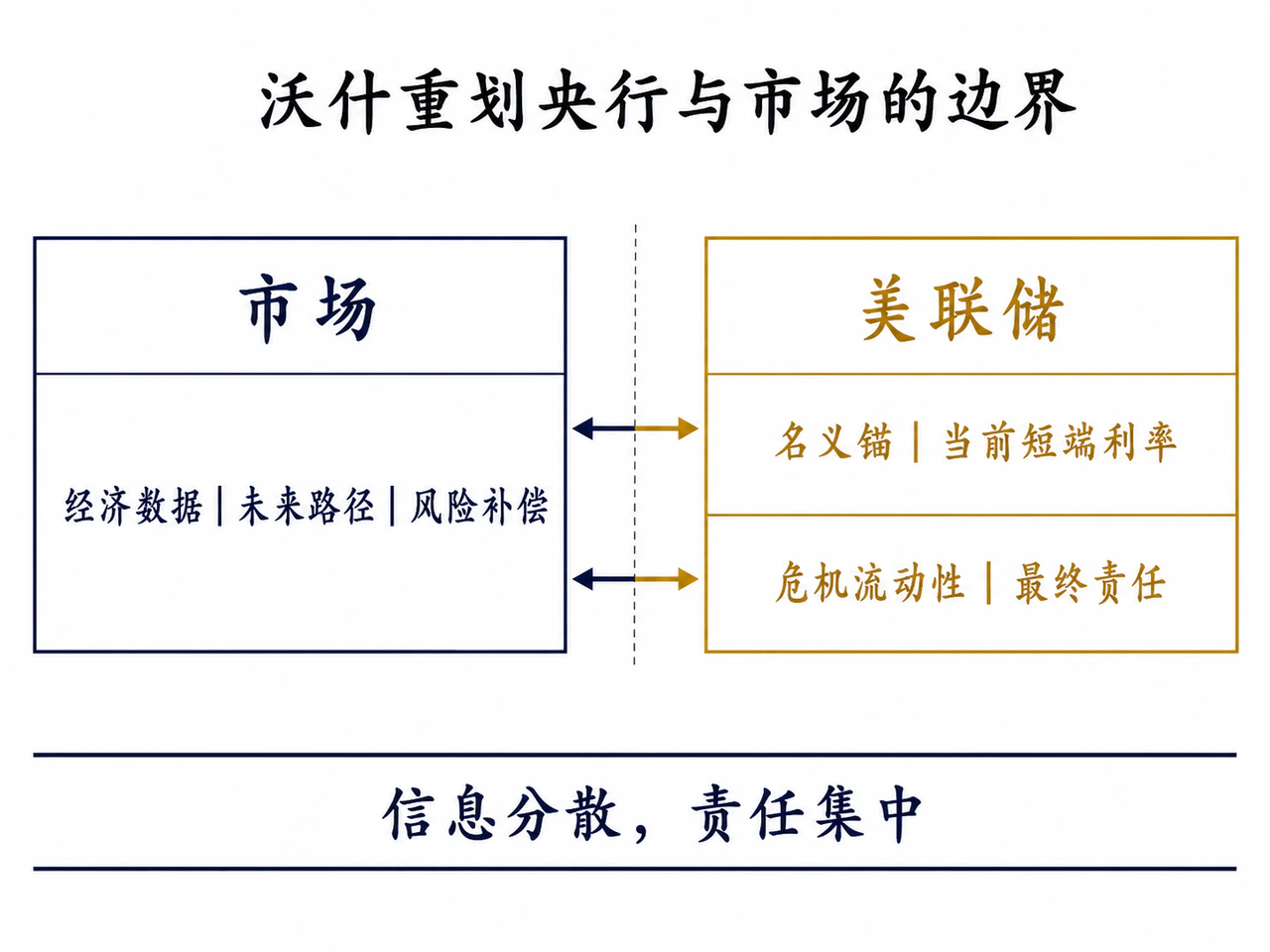
Returning curve evolution to markets does not diminish the Fed's duties. Warsh stressed its central economic role and the short-term benchmark as the basic instrument for the dual mandate of full employment and price stability.
He would shed the roles of ultimate macro prophet, round-the-clock guardian of the whole curve and commentator on every small fluctuation. The fiat nominal anchor, overnight-rate authority, crisis-liquidity backstop and ultimate inflation responsibility would remain intact.
The governance design is decentralized discovery of information from below, centralized responsibility from above.
The shift creates tensions. Warsh rejects both detailed guidance and a mechanical parameterized reaction function. That gives markets pricing freedom but also grants the FOMC substantial discretion at decisive moments. The strategic interaction survives; mirror effects can be reduced, not eliminated. If objectives and boundaries are unclear or untrusted, less communication produces deeper volatility anxiety rather than rational discovery.
At the highest level of institutional design, a very credible central bank need not speak, promise or act excessively. If markets trust it not to compromise on inflation, expectations brake activity ahead of the curve. If they trust it not to be trapped by obsolete commitments, rates can reverse with the data.
Interest rates are prices formed by capital trading. The central bank exists to anchor discovery in stable money, rather than price every asset: maintain a credible nominal anchor, control today's short-term funding gate, preserve settlement and clearing, and backstop self-fulfilling liquidity spirals decisively.
Warsh's Jackson Hole signal was to relinquish the ambition to design long-rate paths and reinforce responsibility for institutional boundaries and final outcomes. The Fed should move beyond being the master architect of future rates and return to guarding fiat rules, deciding the short-term liquidity benchmark and bearing ultimate systemic responsibility.