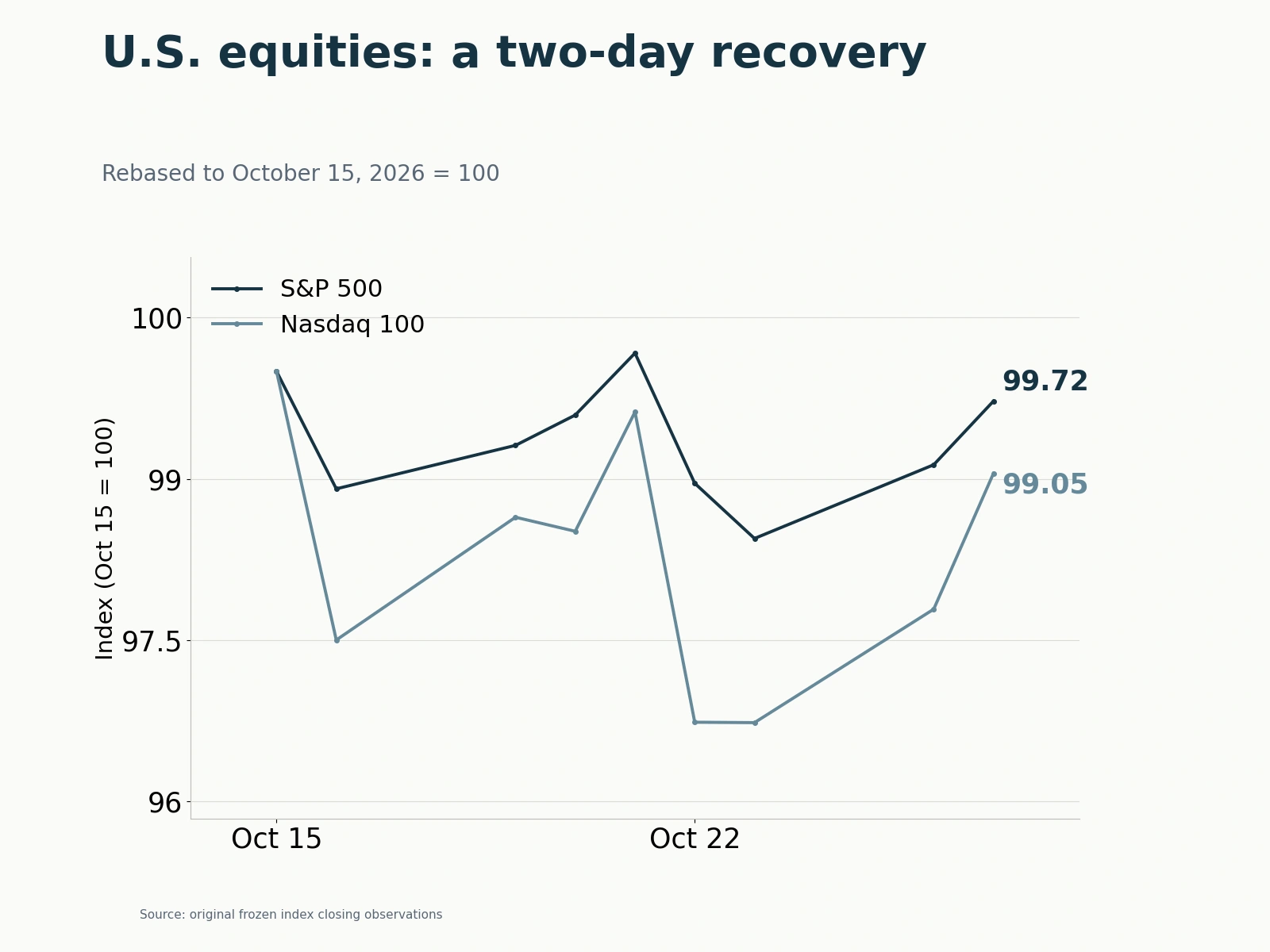
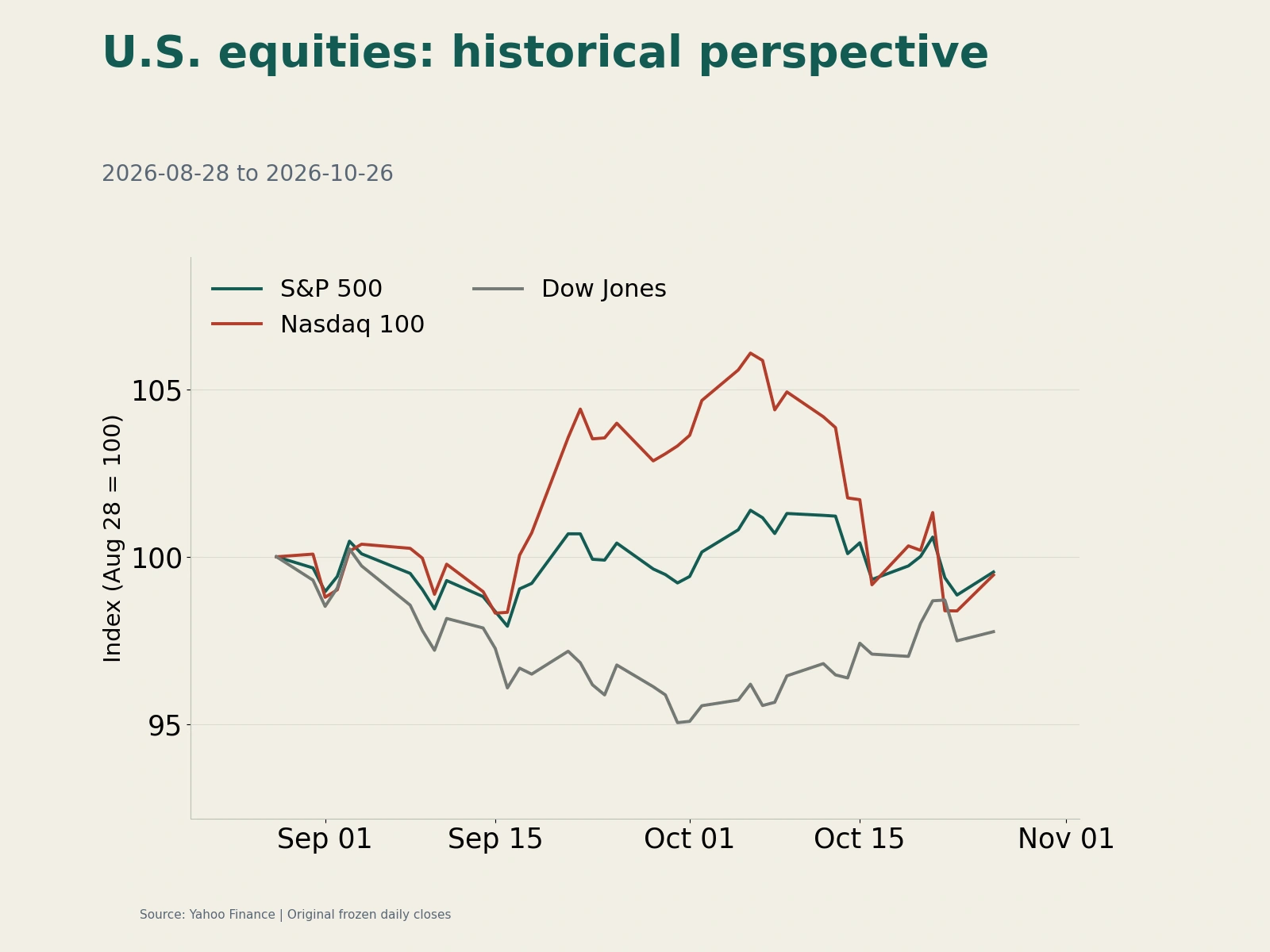
On August 31, 2026, renewed direct US-Iran fighting interacted with hawkish repricing after last week's Jackson Hole symposium. Markets traded a chain of geopolitical disruption, oil-price impulses and additional tightening, but remained relatively restrained: 2-year Treasury yields held at 4.34%, 10-year yields rose 2 basis points to 4.75%, and 30-year yields rose 3 to 5.25%. ICE Brent settled above $90; September Fed hike probabilities remained elevated at 58%–66% in rate futures and 52%–60% in prediction markets. COMEX gold fell about 1% while holding $4,480, and the S&P 500 declined 0.33%.
In past years, jumping oil, stronger hike expectations and higher long yields often produced daily US equity declines above 1%. Monday's resilience chiefly reflected the 10-year breakeven holding at 2.31%, with expectations still anchored. Long yields mainly reflected real-rate catch-up and geopolitical risk premiums rather than uncontrolled long-run inflation expectations.
Treasuries: long yields edge higher
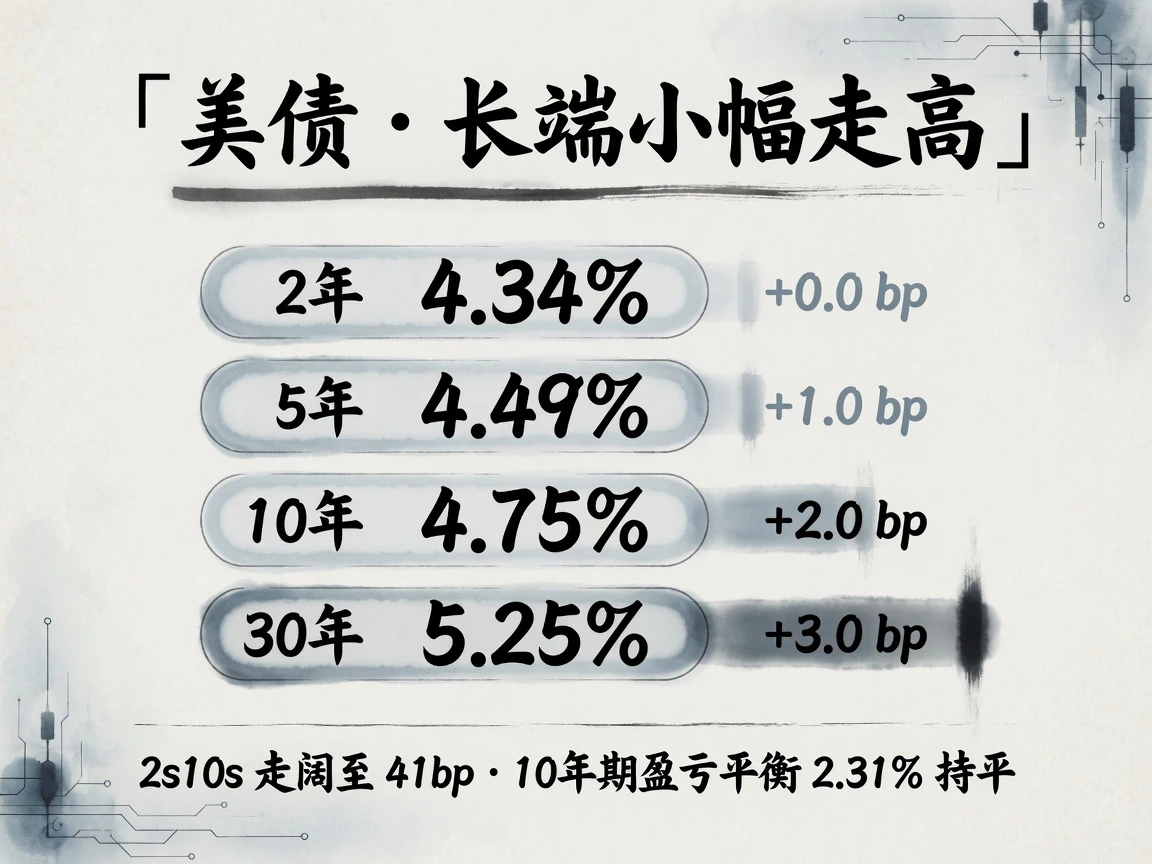
Treasury's daily par-yield curve shows the following August 31 changes from the August 28 close:
| Maturity | August 31 close | August 28 close | Change |
|---|---|---|---|
| 2-year | 4.34% | 4.34% | +0.0 bp |
| 5-year | 4.49% | 4.48% | +1.0 bp |
| 10-year | 4.75% | 4.73% | +2.0 bp |
| 30-year | 5.25% | 5.22% | +3.0 bp |
Curve divergence matters more than absolute levels. The 2-year, up 14 basis points Friday, held flat Monday, 0.0bp, indicating the September-hike debate had been fully reflected on Jackson Hole day. After Friday's +6bp/+3bp moves, 10-/30-year yields added 2bp/3bp, widening 2s10s from 39 to 41 basis points. Several forces pressured long bonds: oil's geopolitical premium raised distant inflation-tail risks; ultralong investors demanded more term premium over G20 debt discussions and doubts about Treasury buyback execution despite a high TGA balance; and markets debated continued December tightening after a September hike.
Inflation compensation stayed calm. Ten-year breakeven held 2.31% and 5y5y forward inflation edged down 1 basis point to 2.31%. The implied 10-year real yield was approximately 2.44%, up 2bp by identity. Nearly all the nominal increase came from real rates, reflecting repricing toward restrictive policy and defense of Fed anti-inflation credibility. WTI and Brent rose 2.7%–2.8%, but long inflation expectations did not amplify the move: investors viewed oil as a mean-reverting geopolitical disturbance, with Brent's prior weekly loss above 5% a ready reference. Only oil firmly above $90 with greater persistence would open meaningful room to reprice long inflation compensation.
Primary markets faced mainly bill maturities and steady auction demand. The 13-week, 91-day bill's high rate was 3.770%, bid-to-cover 2.77; the 26-week, 182-day bill's 3.885%, bid-to-cover 2.63. On September 3 Treasury will announce 3-, 10- and 30-year auction sizes, expected near $58 billion, $39 billion and $22 billion, auctioned September 8, 9 and 10 and settled September 15. This overlaps September 9–10's first expanded buybacks, with 10–20-year caps doubled from $2 billion to at least $4 billion. Concurrent large supply and official support make primary demand a key test of long-end term-premium direction.
At the August 31 close, CME FedWatch September hike odds were 58%–66%, Kalshi 53%–60% and Polymarket 52%–60.5%. Prediction markets consistently priced about 5–7 percentage points less tightening than futures; cut odds were below 1%. Barclays revised its baseline to one hike each in September and December. Money-market liquidity was sound: August 28 EFFR held 3.63% and overnight reverse-repo use was extremely low, confirming Friday's short-yield surge was policy repricing rather than funding stress.
Hike expectations had already reached offshore Hong Kong dollar liquidity. August 31 overnight HIBOR jumped approximately 67bp to 4.09857%, from August 28's 3.42464%, partly due to month-end seasonality. One-week, one-month, three-month and twelve-month tenors stayed stable, and the full HKD curve remained below the dollar policy corridor. Under the peg, a September Fed hike would still transmit chiefly through the front end. US dollar credit OAS was 0.79% investment grade and 2.60% high yield on August 28, at historically extremely low percentiles. Realization of the full tightening path would expose spread assets to both higher benchmarks and wider credit spreads.
After-hours snapshot, August 31 20:19–20:25 Eastern, September 1 08:19–08:25 Beijing: secondary trading-interface quotes showed 2-year 4.352%, 5-year 4.518%, 10-year 4.772% and 30-year 5.266%, approximately 0–2 basis points above official closing levels, without changing the day's pattern.
Macro: the G20 meets amid conflicting regional data
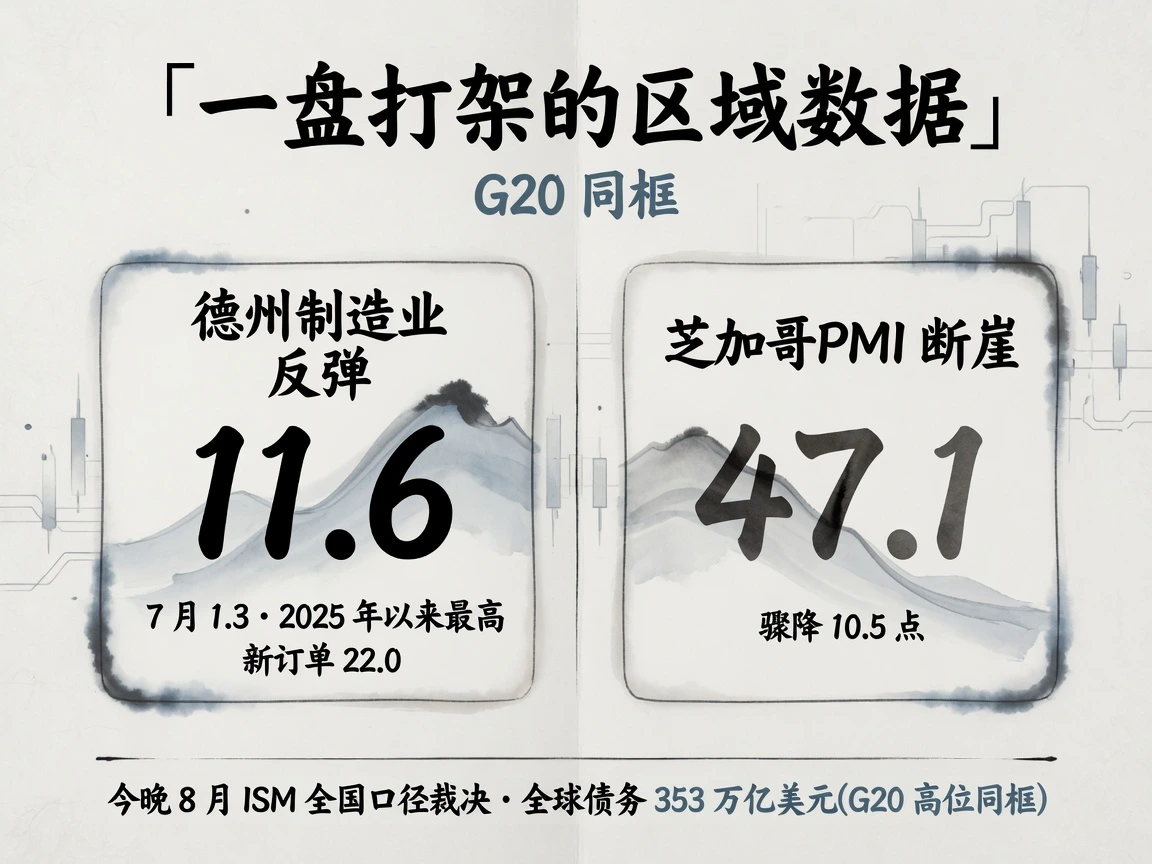
With no major national US release August 31, conflicting regional surveys dominated. Dallas Fed's August Texas manufacturing general activity index jumped from July's 1.3 to 11.6, highest since January 2025; new orders reached 22.0 and raw-material prices paid 44.1. This contrasted with August 28 Chicago PMI at 47.1, plunging 10.5 percentage points while prices reached their highest since February 2022. One showed recovering orders and high costs, the other collapsing orders and rising costs; elevated inflation costs were their common feature. National confirmation awaits August ISM manufacturing's final reading at 22:00 Beijing tonight. Conflicting regional samples heighten sensitivity to a single core release.
G20 finance ministers and central-bank governors opened in Asheville, North Carolina, their first joint appearance since long Treasury yields reached recent highs. Bessent framed the meeting around global debt burdens, with debt near a record $353 trillion in early 2026, arguing growth was the sole route out and citing deregulation, domestic energy and private-sector vitality as the US model. Asked about long yields and larger buybacks, he offered no specific fiscal commitment. Warsh's first multilateral appearance as Fed chair shifted the narrative from secular stagnation and excess savings toward AI-driven global investment and long-run growth potential, calling inflation and growth policy choices. He continued Jackson Hole's reduced-forward-guidance approach without adding a specific rate trajectory.
Fiscal and trade calendars approached without new substantive action. Congress returned from summer recess to negotiate temporary funding, the House proposing December 4 and Senate December 11 extensions, before September 30 fiscal year-end to avoid shutdown. Canada's countertariffs on approximately $27.6 billion of US goods, at 15%, 25% and 50%, with steel/aluminum at 50%, take effect September 8. Expanded Treasury buybacks had not yet begun; the TGA still held approximately $950.8 billion August 27.
Commodities: oil returns above $90 while inflation expectations stay quiet
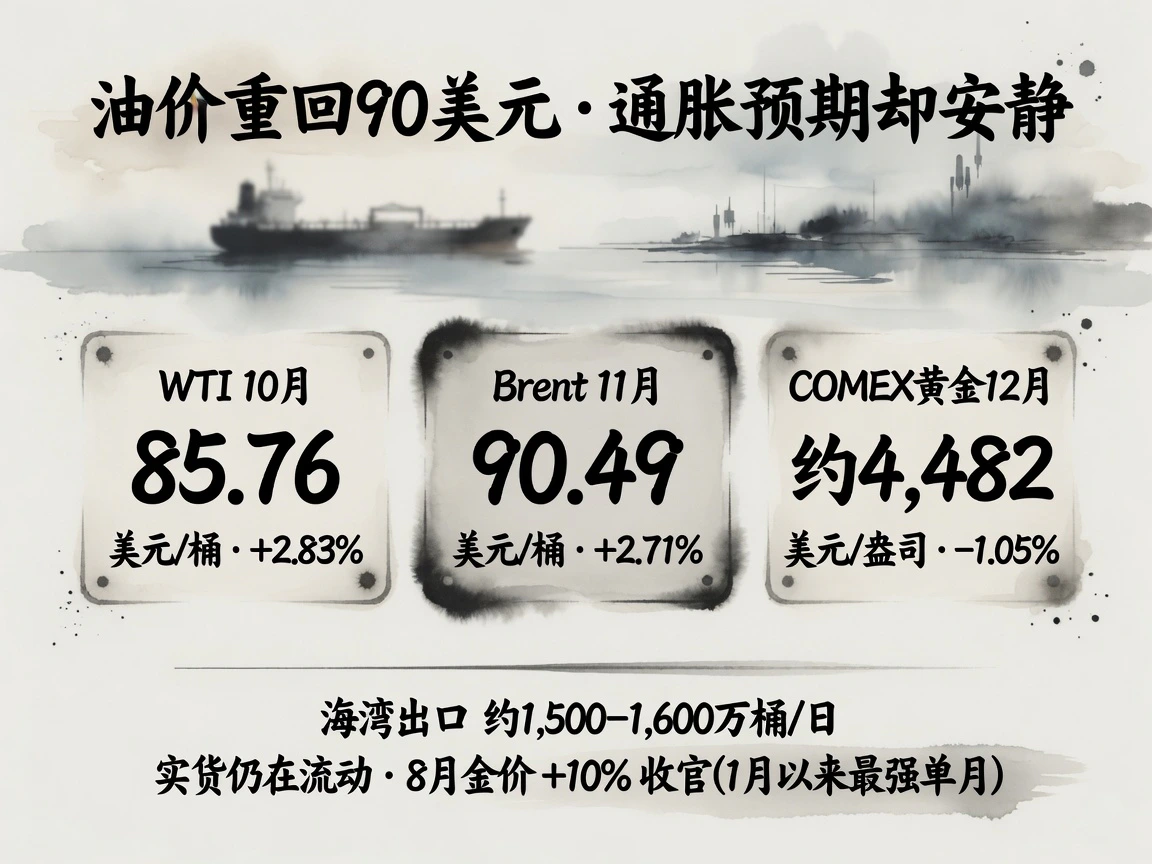
August 30 US airstrikes on Revolutionary Guards rocket sites on Larak Island in Hormuz restarted direct fighting. Monday oil priced the weekend escalation, using consistent specified-contract settlements:
| Asset | August 31 close | Previous session | Daily change |
|---|---|---|---|
| October WTI | $85.76/barrel | 83.40 | +2.36、+2.83% |
| November Brent | $90.49/barrel | 88.10 | +2.39、+2.71% |
| December COMEX gold | Approximately $4,482/ounce | 4,529.90 | Approximately -47.4, -1.05% |
| September COMEX silver | Approximately 66.40 | 66.995 | Approximately -0.9% |
Daily oil gains stayed within 2%–3%. Brent returned above $90 but remained below late-August highs of roughly $87.8 WTI and $93.8 Brent because no irreversible physical cutoff had occurred. Gulf exports recovered to 15 million–16 million barrels daily, two-thirds of prewar normal, preserving flows. The curve concentrated risk premiums nearby while deferred prices assumed normalization over coming months: October WTI $85.76 exceeded November around $84.3 and December $82.2; November Brent $90.49 exceeded December around $88.5 and next January $86.2, creating steep nearby backwardation.
Precious metals were pulled between tightening expectations and de-dollarization allocations, with higher real rates dominant near term. December COMEX gold settled near $4,482/ounce, -1.05%, a smaller loss than Friday's -2.88%; spot briefly neared a two-week low of $4,445. The dollar index slipped about 0.2% to 99.5, easing currency pressure. Main gold futures held $4,480 and recovered toward $4,505 electronically after hours. Gold gained about 10% in August, its best month since January; holding $4,445 spot support limited short-chasing. Oil +2.8%, gold about -1.0% and rising yields indicate energy-driven inflation and tighter-policy pricing, contrasting with both oil and gold falling in August's final week.
Equities: small losses mask reflation pricing
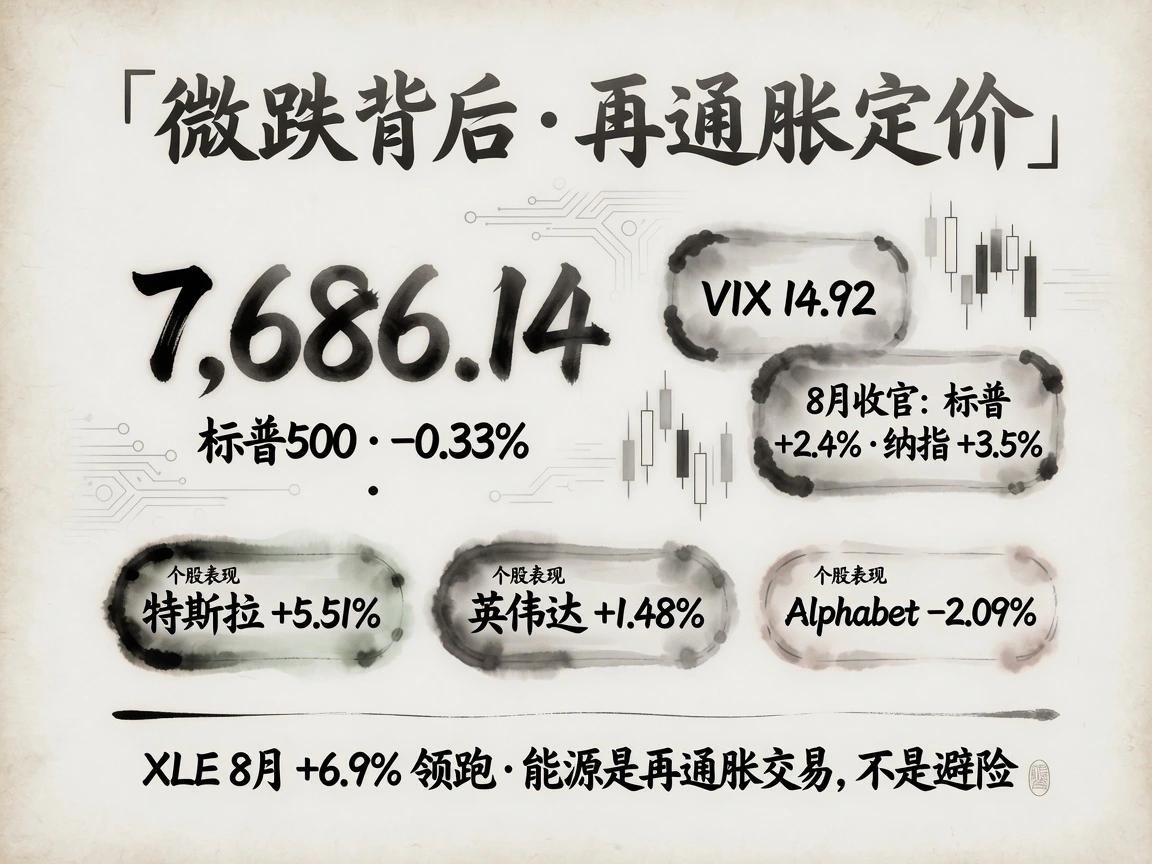
Monday's major US indexes were steady: S&P 500 7,686.14, -0.33%; Dow 53,185.90, -0.70%; Nasdaq Composite 26,370.89, -0.12%; VIX 14.92, still historically low. Markets priced geopolitics, energy and hikes as a causal chain rather than independent shocks. After six months digesting Hormuz conflict and oil volatility, marginal equity sensitivity had dulled. The central question remained whether energy would materially lift medium/long inflation expectations and turn Fed tightening from tail risk into baseline.
August ended positively: Dow +1.4%, its fifth consecutive positive month; S&P 500 +2.4% and Nasdaq +3.5%, each first monthly gains since May. Energy XLE led August at +6.9% and added 2.04% Monday, the day's strongest sector. Continued energy strength represented reflation trading rather than defensive haven demand.
Stocks showed valuation and fundamental differentiation rather than indiscriminate losses. Tesla gained 5.51% to $367.95 after cutting entry-model prices about 8.5% in Hong Kong and Macau, viewed as proactive demand marketing and the largest individual positive contributor to the S&P and Nasdaq. Nvidia gained 1.48% to $220.78, recovering some of its 4.57% postearnings one-day loss. Alphabet fell 2.09% to $339.35, dragging indexes and communication services; richly valued distant-cash-flow platforms are most sensitive to higher risk-free rates. Utilities generally fell, with PG&E heavily sold after wildfire-liability legislation was blocked. SAIC beat earnings and raised full-year guidance, while Lexin lost 10%–17% on weak consumer-finance assets.
Japan and Korea were especially energy-sensitive. Nikkei 225 closed 66,311.93, -0.14%, and KOSPI 6,820.02, +0.46%. Both opened weak and recovered steadily, Nikkei briefly reaching 64,832, showing active dip buying after weekend risk premiums were priced. Hang Seng edged down 0.07% to 25,566.99 but sharply split: property/construction -4.78%, Greentown -17%, Jinmao -16%, China Resources Land -9.4%; mainland banks firm, Postal Savings +7%, Bank of China +5.7%; AI applications surged afternoon. Main-board turnover reached HK$314.8 billion, first above HK$300 billion in almost a month; southbound net buying was about HK$2.1 billion. August Hang Seng fell 1.23% and Hang Seng Tech 4.34%. At September 1 08:05 Beijing, Nikkei snapshot 65,780, roughly -0.8% from August 31, and KOSPI opened 6,784, about -0.5%, partly reversing the prior V-shaped rebound.
Geopolitics and markets: escalation within limits
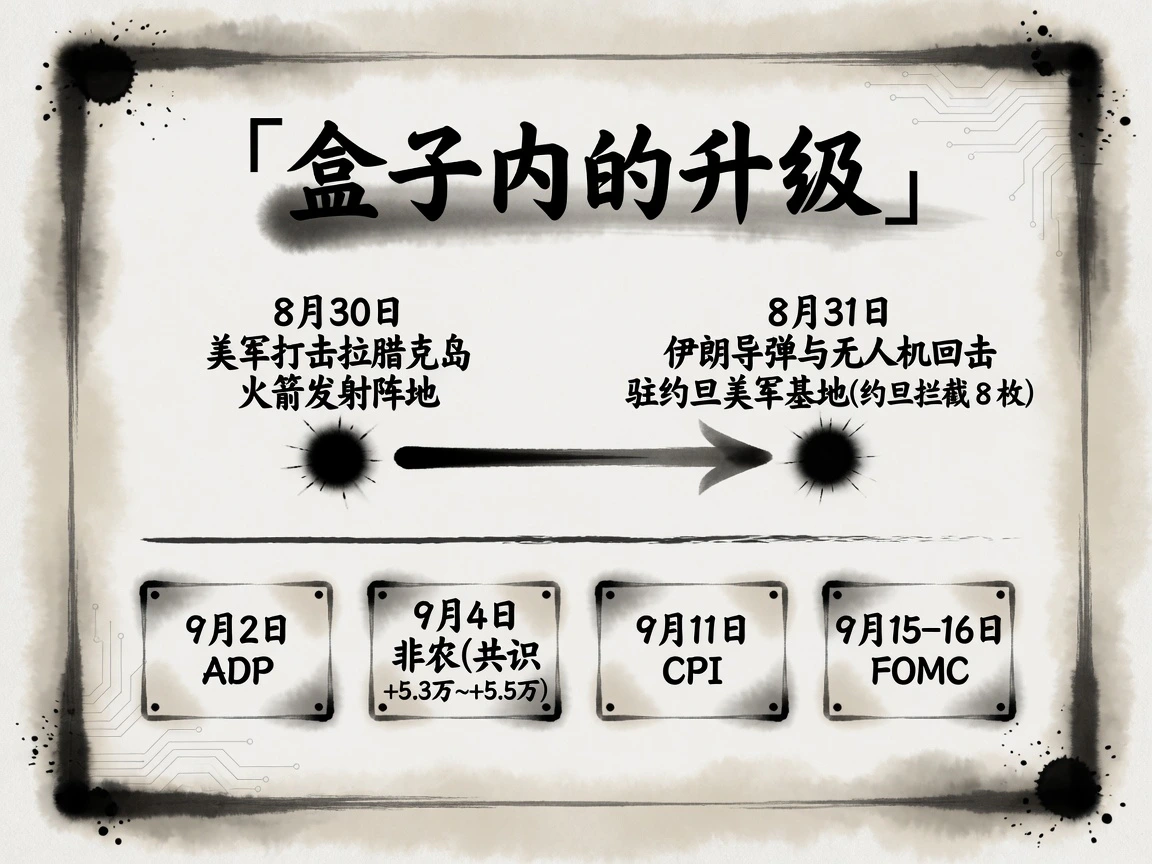
Direct US-Iran conflict reactivated within a controlled low-intensity range. August 30 US strikes on two Guards rocket sites on Larak were the first direct action against Iranian territory since late July, described by Washington as limited, precise self-defense. August 31 Iran retaliated with missiles/drones against a US base in Jordan and drones toward the UAE. Jordan reported intercepting 8 ballistic missiles; Washington said most attacks were intercepted without key infrastructure damage. Markets priced controlled escalation: Brent above $90, gold and stocks slightly lower, VIX below 15, suggesting orderly expansion of geopolitical premiums.
Economic confrontation followed existing laws and sanctions schedules: no new US sanctions list appeared during the window; Iran oil general-license grace periods end September 8. At the G20, Bessent warned third parties trading with Iran of secondary sanctions. Iranian pressure accumulated: the parallel currency fell to a record 2.065 million–2.112 million tomans per dollar, over 5% weaker than August 26 and around 30% away from the official rate; gasoline shortages were about 15 million liters daily. High inflation and depreciation imposed a strict endurance countdown. No substantive diplomatic text emerged; reported US review of a ten-day temporary ceasefire lacked confirmed progress, while Iran's deputy foreign minister said reopening Hormuz was not urgent.
The coming week brings concentrated tests. Tonight's Beijing-time August ISM manufacturing and JOLTS openings offer the first national resolution of regional divergence; September 2 ADP, September 4 payrolls with consensus 53,000–55,000 and unemployment unchanged at 4.1%, September 11 August CPI, then September 15–16 FOMC follow. The 5–7-point hike-probability gap between rate futures and prediction markets reflects competing scenarios of data confirming or disproving tightening. A meaningful core-data surprise can rapidly turn that gap into one-direction pricing.