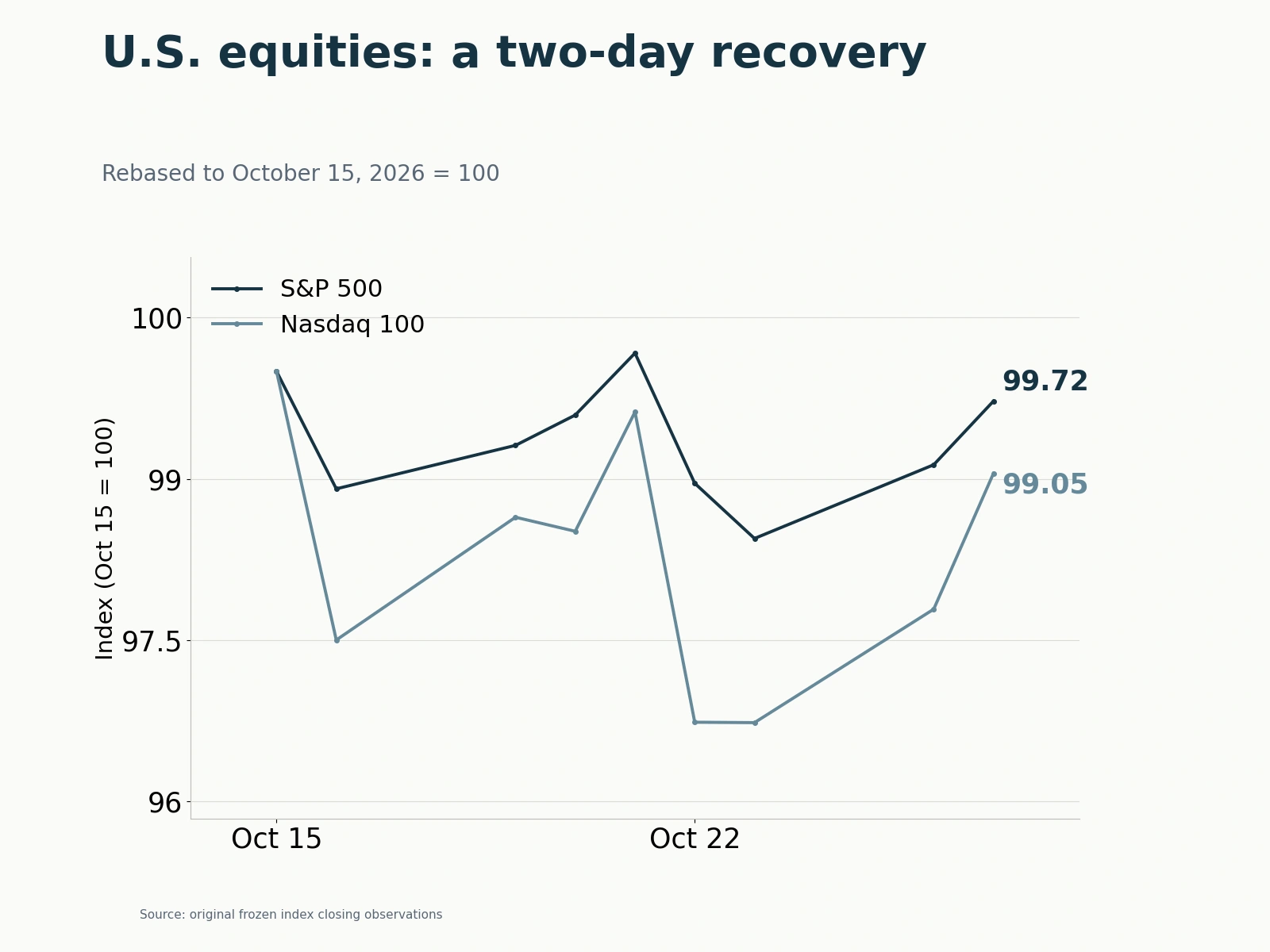
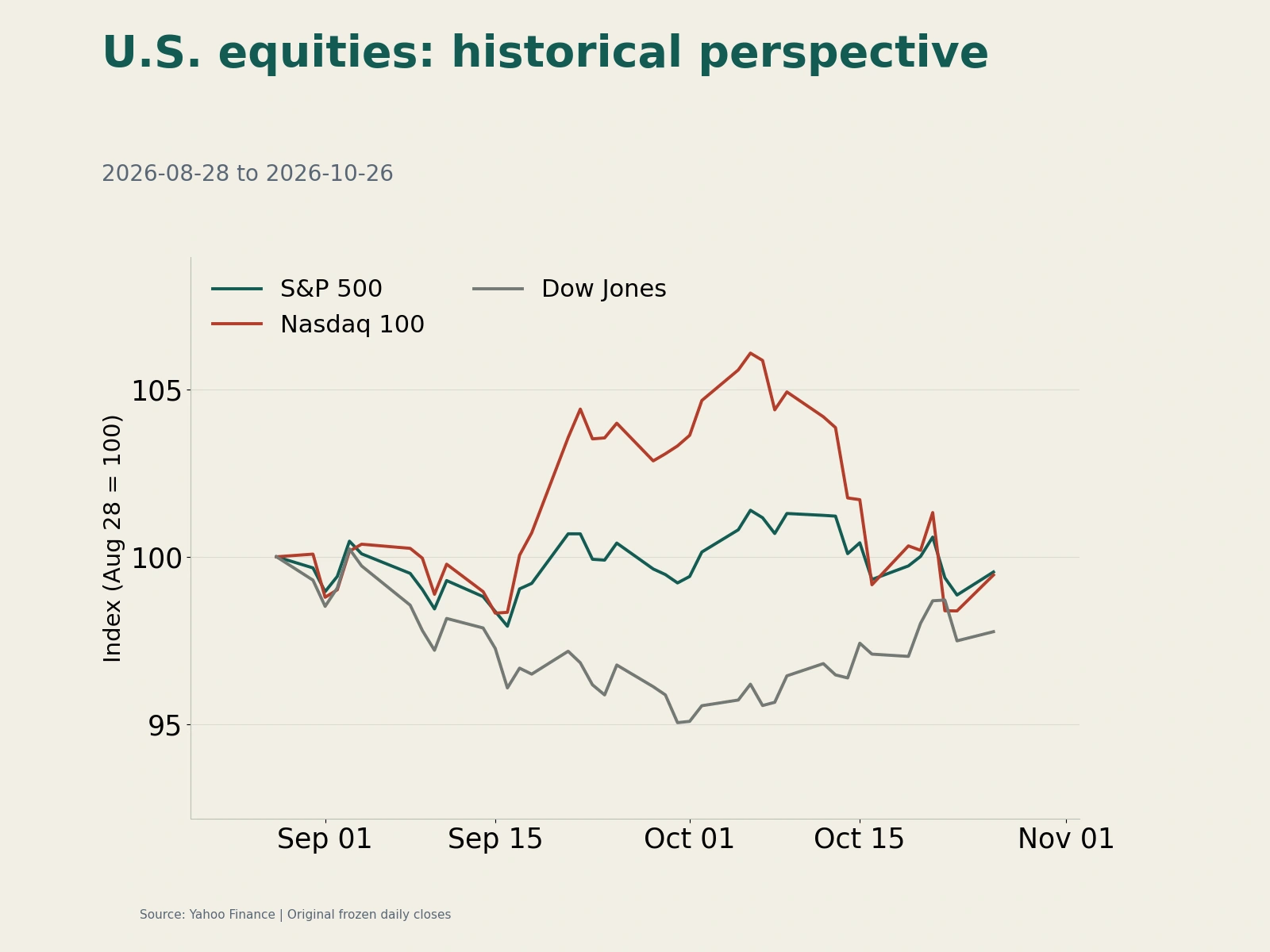
On September 2, 2026, overseas markets showed a typical pattern of consolidation at high levels and a modest retracement in expectations. Treasury yields paused after several days of increases, with official two- and ten-year closes broadly unchanged. Swaps and futures pricing for a September FOMC 25-basis-point hike fell from an intraday high near 70% to 62%–64%, against the previous week's low around 37%. Softer August ADP employment and relatively balanced comments by New York Fed President John Williams drove the pullback. Oil stayed elevated, with WTI at $90.62 a barrel, up 0.4%; stocks technically recovered after three declines, with the S&P 500 up 0.46%; and gold gained 1.9% back above $4,400. In currencies, the yen surged as dollar/yen fell from 160.4 to 158.2, the largest daily yen gain since joint U.S.-Japan intervention in late July. Final pricing of September Fed action was being deferred to Friday's payrolls and August CPI on September 11.
Fixed income: upward momentum fades after consecutive gains; the curve moves sideways at high yields
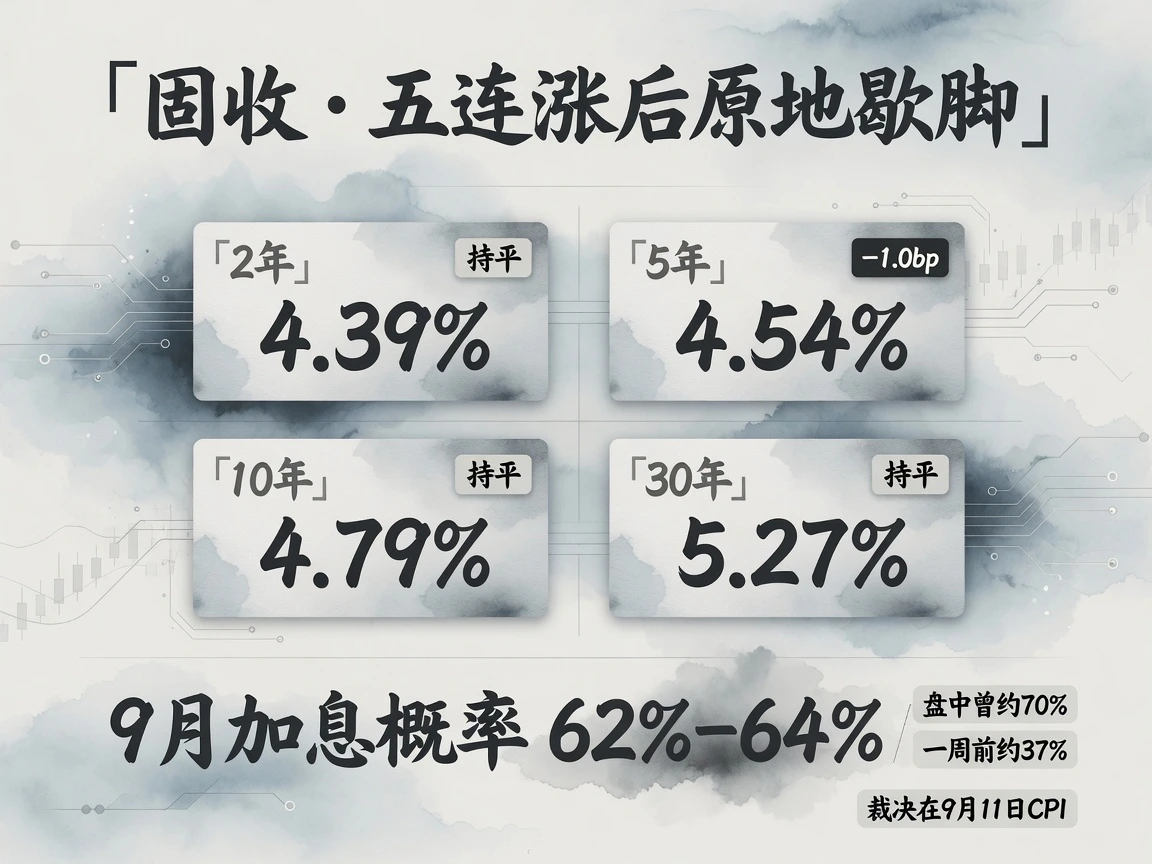
Daily nominal Treasury changes, using official Treasury closes for September 2 versus September 1:
| Maturity | September 2 close | Change |
|---|---|---|
| 2-year | 4.39% | Unchanged |
| 5-year | 4.54% | -1.0bp |
| 10-year | 4.79% | Unchanged |
| 30-year | 5.27% | Unchanged |
Sideways trading reflected slower near-term upward momentum rather than a trend reversal. The ten-year reached 4.818% intraday, the highest since November 2023, while the two-year touched a 52-week high of 4.41%. Late buying flattened yields to unchanged official closes, consistent with profit-taking and technical demand near the top of a multiyear range. The relative moves in nominal rates and inflation compensation were more revealing: ten-year breakeven inflation fell one basis point to 2.34%, leaving implied real rates elevated at 2.45%. The driver shifted from the previous day's inflation premium back to real-rate support, echoing Williams' view that stronger internal economic momentum and AI capex were chiefly behind higher long yields. At the reporting cutoff on the morning of September 3, Beijing time, major maturities were one to two basis points below the daily close, with a steady overall tone.
CME FedWatch's closing implied September hike probability was about 64.2%, while prediction markets including Kalshi and Polymarket clustered at 55%–59%, an eight-to-ten-percentage-point gap. The two-year's 4.39% level was anchored to an effective federal funds rate of 3.63% and priced about 60% of a hike. Weak Friday payrolls would likely send the two-year back toward 4.30% support and further lower inflation-compensation expectations. A stronger surprise would quickly shift front-end pricing from one hike toward continued tightening. Short-term money-market liquidity was ample: EFFR at 3.63% and SOFR at 3.66% were near the lower end of the corridor, and expectations for cuts this year had largely disappeared.
Overseas bonds reflected a contest between global-duration effects and spread retracement. Japan's ten-year government yield held above 3% for a second day, around 3.02%, extending its breakout to levels not seen since September 1996. The thirty-year reached a record 4.18%. BOJ board member Hajime Takata publicly supported flexible, successive hikes, nearly fully pricing tightening at the September 17–18 meeting. Meanwhile, yen appreciation triggered some cross-market carry unwinds, encouraging overseas investors to rebuild Treasury duration and offering marginal support. These opposing forces coexisted in the short term. Yen/JGB developments and U.S. payrolls/hike probabilities were the two macro themes requiring equal attention in the following week.
Data and policy: activity cools marginally as officials defend a growth premium
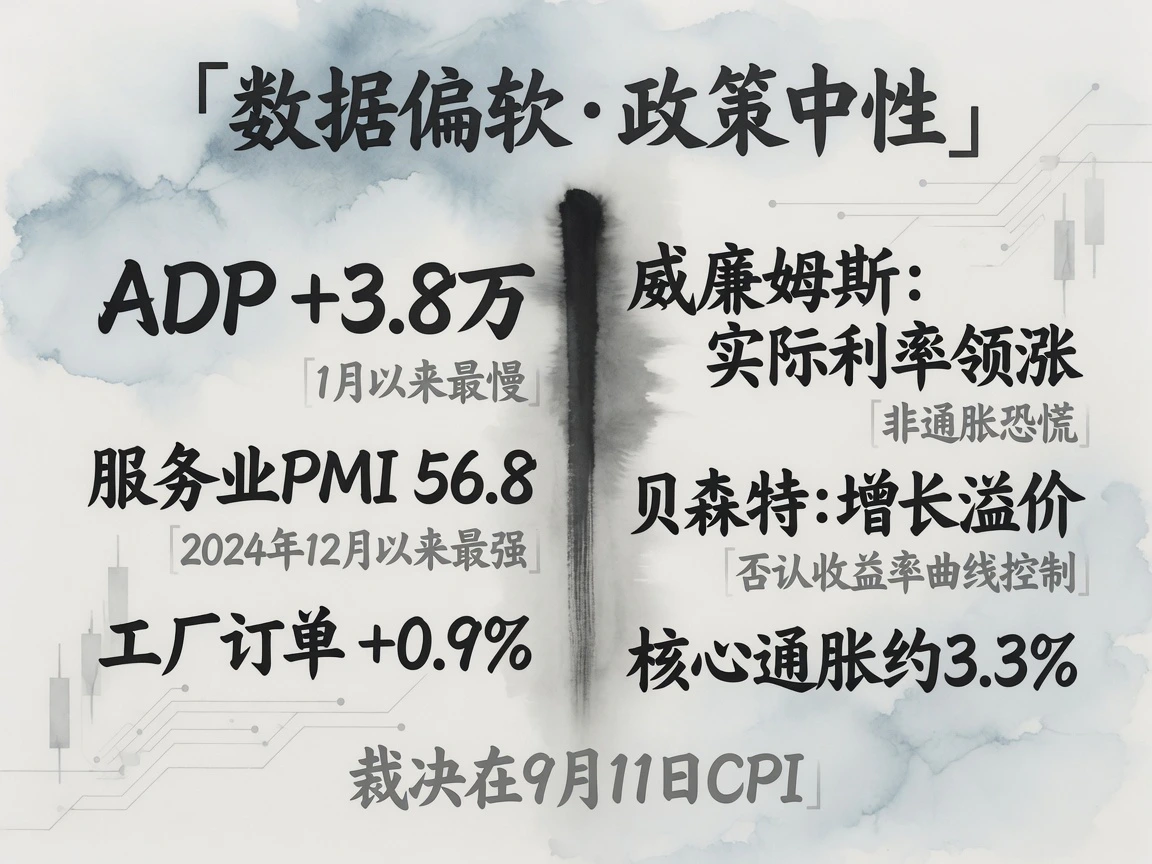
The day's indicators continued to show marginally softer real activity with sticky costs. August ADP private jobs rose only 38,000, below consensus of 42,000–48,000 and the slowest since January; large companies accounted for almost all gains. The data were soft without systematic deterioration, and ADP's historically variable guidance for official payrolls prevented a substantive reversal of tightening trades. July factory orders rose 0.9%, beating expectations mainly through large civil-aircraft orders. Final S&P Global services PMI was 56.8, maintaining strong expansion since late 2024. The Fed's Beige Book highlighted structural differences: energy, transport and other input costs rose markedly, but downstream pass-through became harder. Manufacturing sentiment improved in most districts, with data-center construction and defense orders especially strong.
The Fed and Treasury communicated in concert. Williams elaborated that higher long yields did not reflect uncontrolled inflation: they mainly represented strong prospects driven by AI and computing infrastructure, transmitted through real rates rather than inflation premiums. Core inflation was around 3.3%, with tariffs and energy the main contributors. He retained September flexibility and warned that higher market borrowing costs could not automatically perform the Fed's role. The comments directly contributed to lower intraday hike bets and a peak in Treasury yields. Treasury Secretary Scott Bessent similarly attributed higher long yields to growth and real-rate expansion, justified larger future long-maturity buybacks, explicitly rejected yield-curve control and mentioned marginal stabilization in Hormuz transit. Within the same window, the White House economic team and Fed supplied an official growth-premium narrative for long yields near 4.8%/5.3%. Its durability still required a test from September 11 core CPI.
Foreign exchange: broad yen strength and carry unwinds produce the largest daily move since intervention
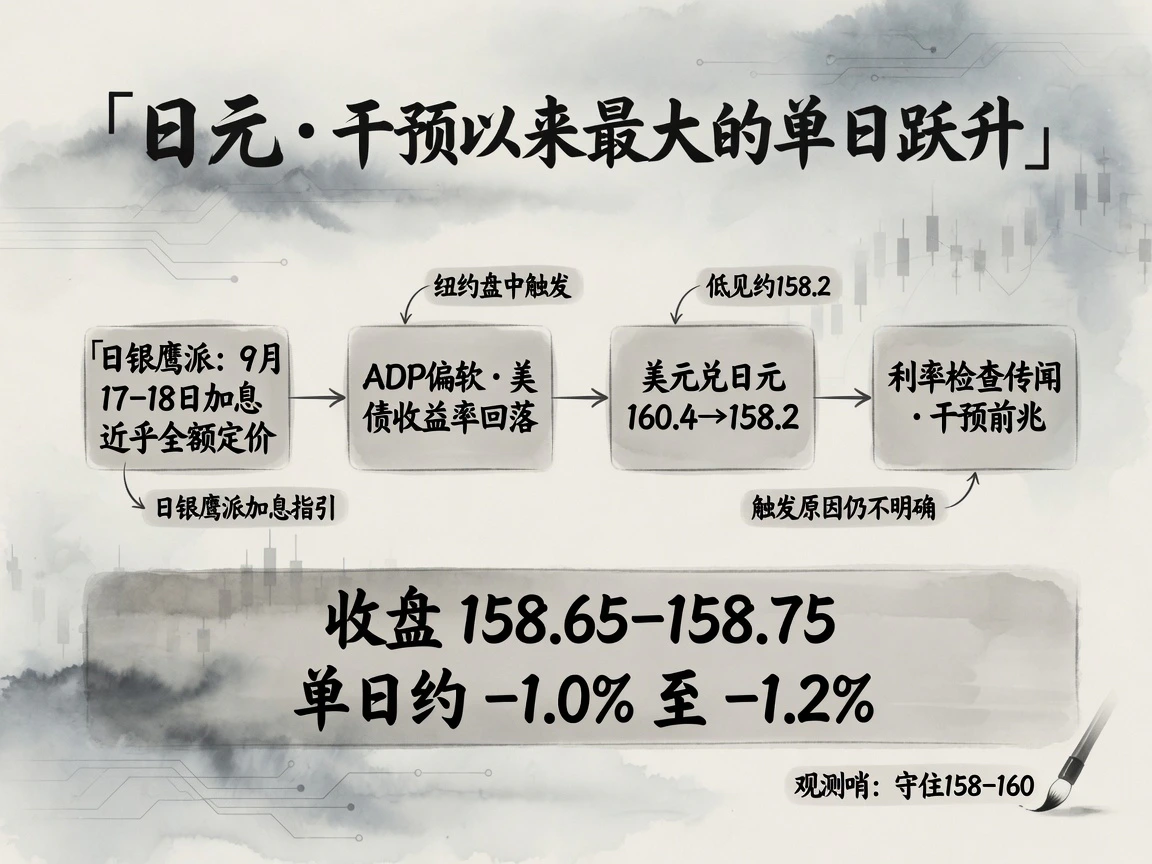
Currencies delivered the day's most independent and far-reaching move. The yen's surge reflected several reinforcing drivers rather than carry liquidation alone. The BOJ governor had offered strong hike guidance for the mid-September meeting, and hawkish Takata added comments supporting successive increases. Alongside weak U.S. ADP and an intraday Treasury-yield fall, dollar/yen dropped from above 160.4 to an intraday low of 158.2, closing around 158.65–158.75, down more than 1%. Beyond fundamental rate spreads, widespread rumors of official Japanese rate checks suggested a possible precursor to intervention. Yen appreciation has two-way cross-asset transmission for the Fed: it helps interrupt a potential external reflation channel, but a BOJ hike alongside a Fed hold could narrow U.S.-Japan rate differentials, repatriate liquidity and raise volatility, feeding back negatively into dollar risk assets. Support within the 158–160 range is an important window on the current global-liquidity reset.
Commodities: oil consolidates at high levels as gold recovers above $4,400
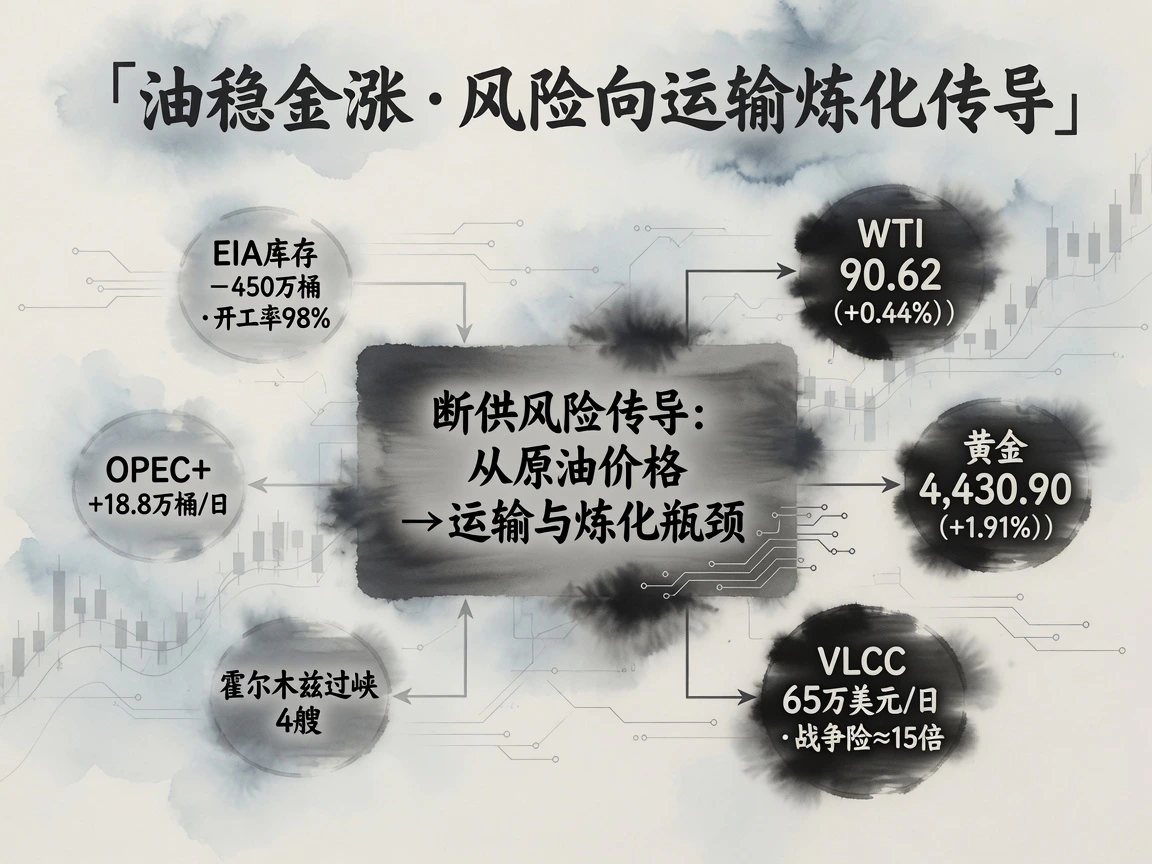
The previous oil-up/gold-down pattern shifted to oil-steady/gold-up. Official closes were WTI $90.62 a barrel, up 0.44%, and Brent $95.21, up 0.59%. Compared with the early-week surge, oil momentum slowed substantially. After pricing geopolitical cutoff premiums, traders were waiting for physical evidence of supply disruption. COMEX's active gold contract recovered to $4,430.90 an ounce, up 1.91%, regaining $4,400. As the extreme narrative of an oil surge forcing hikes temporarily weakened, real rates eased from high levels and shipping conflict had not yet spilled over chaotically, allowing safe-haven and allocation demand for precious metals to reinforce one another.
Hard fundamentals began to materialize. The latest EIA report showed a commercial crude draw of 4.5 million barrels to 424.5 million, much larger than expected, ending four weeks of small builds, with refinery utilization at 98%. OPEC+ continued its scheduled September increase of 188,000 barrels daily, without unexpected intervention around the meeting window. Deep crude backwardation persisted, focused on cutoff fears over the next three to six months; a flat deferred curve showed that investors were not assuming permanent Middle Eastern capacity destruction. Hidden downstream and shipping costs were spreading, however. Middle-distillate diesel prices reached recent highs; Middle East–China VLCC daily earnings held at a record $650,000 and war-risk surcharges around fifteen times normal. Geopolitical risk was shifting deeply from spot crude into transport and refining bottlenecks, where inflation is stickier and slower to recede.
Chokepoint shipping remained disrupted at low levels. Kpler counted only four commercial vessels through Hormuz on September 2, versus ten previously and a ten-day average near thirteen. The regional transit blacklist expanded from 45 to 56 vessels and first brought LNG carriers into focused monitoring. If the principal gas route became routinely obstructed, risk premiums would quickly spread into European and Asian gas prices, beginning another phase of imported commodity inflation.
Equities: an oversold rebound lifts U.S. stocks, while AI-chain pricing becomes more demanding and differentiated
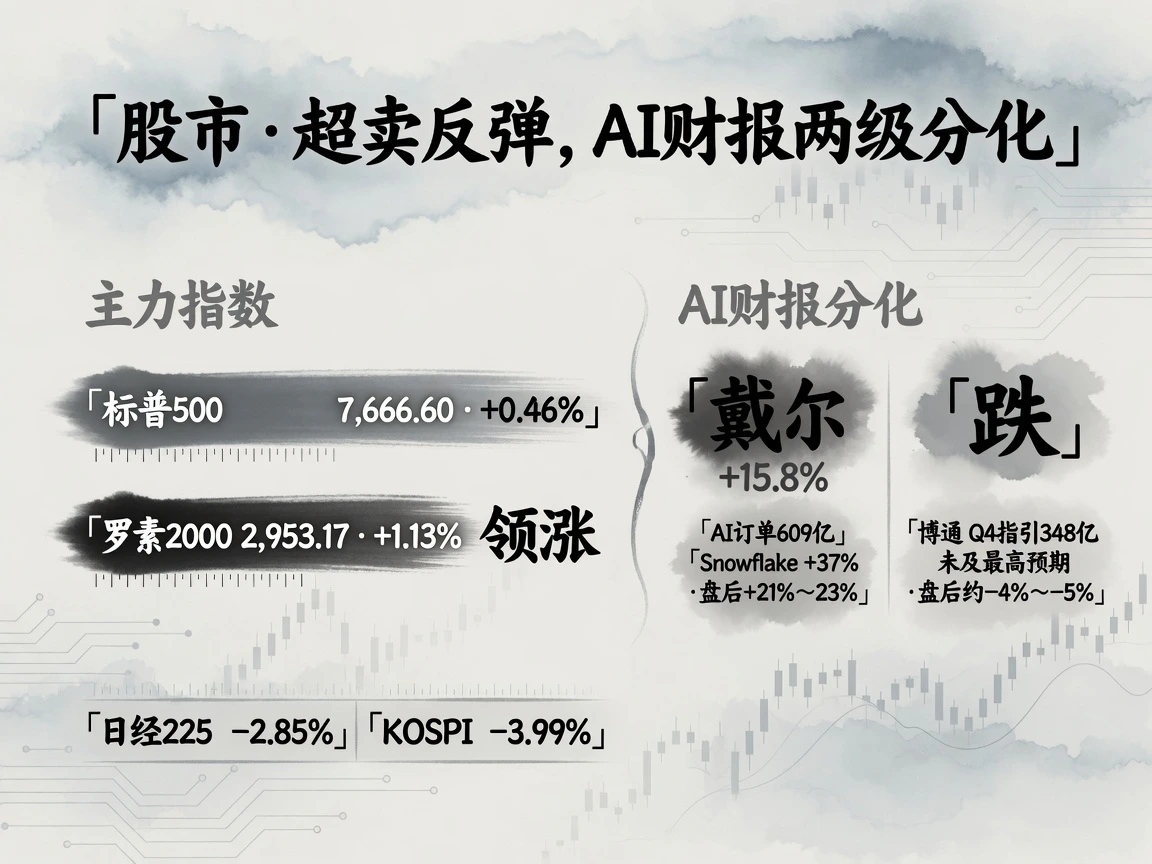
U.S. stocks ended three consecutive declines with a rebound. The S&P 500 closed at 7,666.60, up 0.46%; the Dow at 53,061.95, up 0.56%; and the Nasdaq at 26,217.83, up 0.45%. The previously pressured Russell 2000 led with a 1.13% gain, while VIX fell nearly 7% to 15.20. Index gains were moderate but internal divergence pronounced. Materials led, financials and communication services performed well, while real estate was the only clearly declining defensive sector because long yields remained high. Volume did not increase meaningfully and decliners still outnumbered advancers. The pattern resembled short covering and an oversold technical repair, rather than a clear start to renewed valuation expansion. Information technology ended down overall, indicating that money was merely trading confirmation that rates might stop worsening. High-valuation, long-duration assets would remain most vulnerable if inflation or employment again surprised higher.
AI-computing hardware now faced much stricter pricing standards. Beating expectations had given way to needing to beat the most demanding assumptions simply to sustain valuations. Dell surged 15.8% to $492.20, leading the S&P, after record quarterly revenue of $47 billion, up 58%, doubled AI-optimized server revenue, $60.9 billion of unfilled AI orders and broadly higher full-year guidance. Nvidia rose 3.21% on Dell's outlook. In contrast, software and security provider Palo Alto fell as much as 9.3% despite beating on both major earnings measures, as investors discounted generative AI's long-term erosion of traditional cybersecurity and SaaS models. After-hours divergence intensified. Broadcom's quarterly revenue of $29.59 billion, up 86%, and AI-semiconductor sales of $16.7 billion, up 221%, both beat consensus. But fourth-quarter guidance centered near $34.8 billion missed buyers' most optimistic expectations, sending it down nearly 5% after hours—a prominent early example of strong sequential acceleration failing to meet extreme AI-hardware expectations. Snowflake, meanwhile, reported 37% product-revenue growth, a third consecutive acceleration, lifting its shares more than 20% after hours. The next earnings framework was clear: beating ordinary consensus was far from sufficient; companies also had to absorb the highest expectations already priced far in advance.
Earlier Asia-Pacific sessions mainly absorbed the twin pressure of high rates and oil. The Nikkei 225 closed at 64,325.64, down 2.85%, under heavy pressure for a third day, led lower by semiconductors and consumer electronics. Korea's Kospi fell 3.99%, the region's largest daily decline, as soaring Middle Eastern crude costs hit petrochemicals and refining. Foreign and institutional net sales approached KRW 4 trillion. Hong Kong was more resilient, with the Hang Seng down only 0.07%. The Shanghai Composite fell 0.97% and ChiNext 2.39%, led by AI computing and growth stocks. Sharp overnight and early yen appreciation added a new variable, directly weighing on Japanese export-oriented advanced-manufacturing valuations while disturbing global-liquidity risk premiums.
Outlook: major decisions approach as macro data set the pricing range
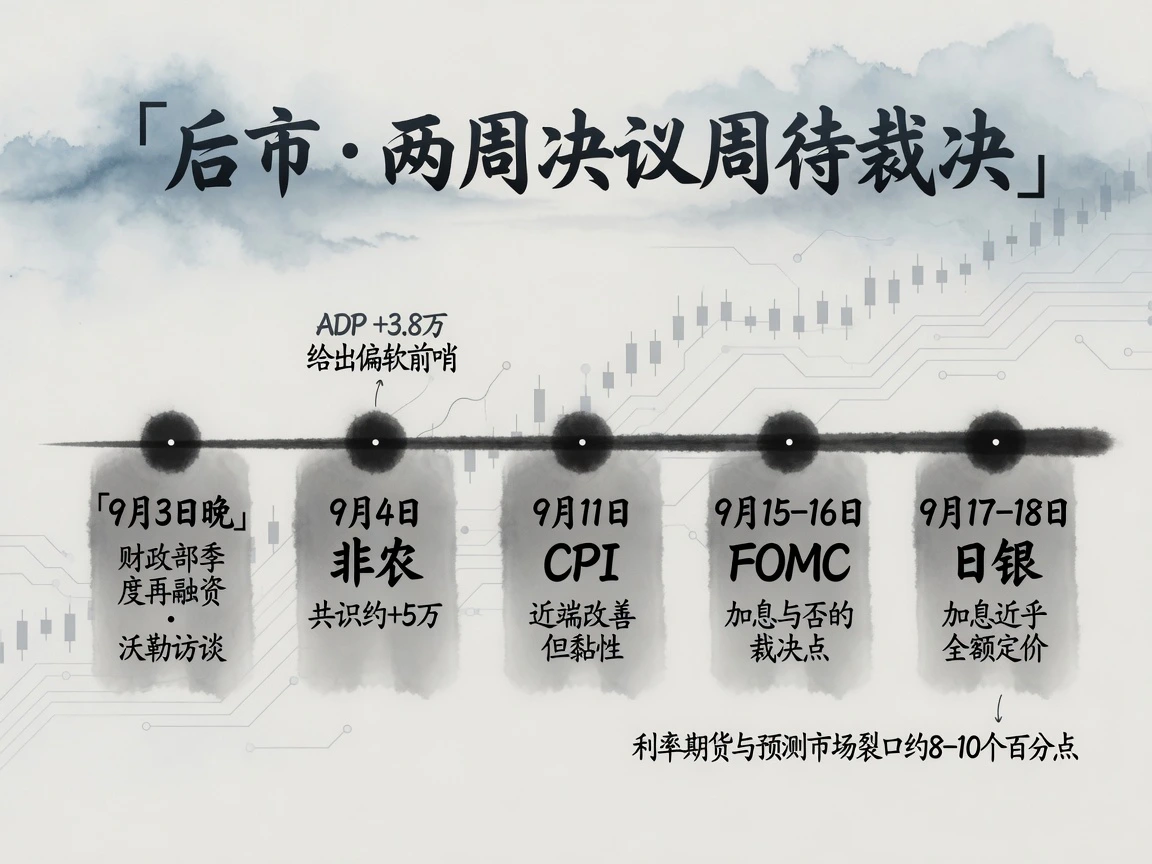
A concentrated series of releases was due on the evening of September 3, Beijing time: U.S. initial claims, the July trade deficit, an online Waller speech and details of the Treasury's third-quarter refunding announcement. Expectations were $58 billion in new three-year notes, $39 billion in ten-year reopenings and $22 billion in thirty-year reopenings. August payrolls on September 4 were the central anchor for the September FOMC decision. With ADP's 38,000 suggesting weakness, baseline consensus was around 50,000. An unexpected payroll rebound with resilient wages would likely lift hike odds quickly above 70%; confirmed weakness would bring tightening pricing toward prediction markets' 55%–59%, lower two-year yields and open more room for gold. August CPI on September 11 would provide the decisive verdict on inflation persistence, followed by the September 15–16 Fed and September 17–18 BOJ decisions in a central-bank superweek. The eight-to-ten-percentage-point gap between rate futures and prediction markets was a reservoir of cross-asset volatility: any single surprise over the next sessions could trigger directional repricing.