On September 3, 2026, global macro trading centered on the Fed's September 15–16 decision. Governor Waller gave his clearest conditional framework yet: if inflation over the next two weeks continued cooling as it had since July, he favored holding, giving disinflation a chance and observing another meeting. If renewed inflation proved persistent, he would consider modest hikes. Rate-futures-implied odds of a 25bp September increase quickly fell from about 63% to around 50%, repricing global assets.
Softer tightening expectations drove a short-end-led Treasury rally and bull steepening. The three main US equity indices each rebounded more than 1%, while gold gained nearly 4%. Oil alone remained near highs on geopolitical premiums, with limited gains. Whether the near-term balance shifted decisively still depended on September 4 payrolls and September 11 August CPI.
Treasuries: Short yields lead the decline in a bull steepener
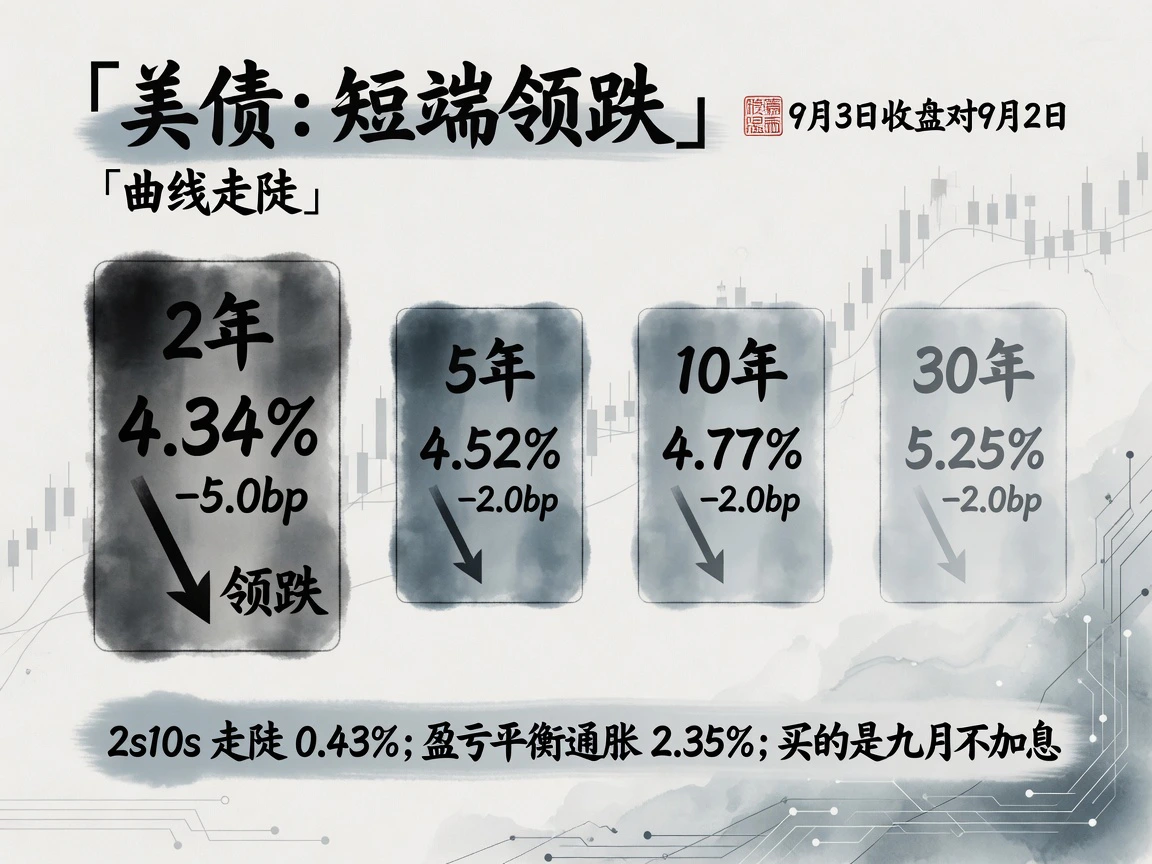
Yields fell across maturities, concentrated at the front end. Official September 3 closes versus September 2 were:
| Maturity | Closing yield | Change |
|---|---|---|
| 2-year | 4.34% | -5.0 bp |
| 5-year | 4.52% | -2.0 bp |
| 10-year | 4.77% | -2.0 bp |
| 30-year | 5.25% | -2.0 bp |
The 2-year fell 5.0bp, widening 2s10s by 3bp to 43bp. The 10-year breakeven edged up 1bp to 2.35%. The nominal decline came almost entirely from removal of the tightening risk premium, while inflation compensation and term premiums were broadly unchanged. Investors were trading the option of no September hike, rather than confirmed disinflation.
Heavy fiscal issuance and elevated real rates constrained the long end, largely blocking transmission of short-end easing expectations. Against September 2 intraday highs—10-year 4.818%, highest since November 2023; 2-year 4.41%, a 52-week high; 30-year 5.296%—declines of only 2–5bp did little to alter the high long-rate center.
Policy and data: Diverging signals return hike expectations to a tug-of-war
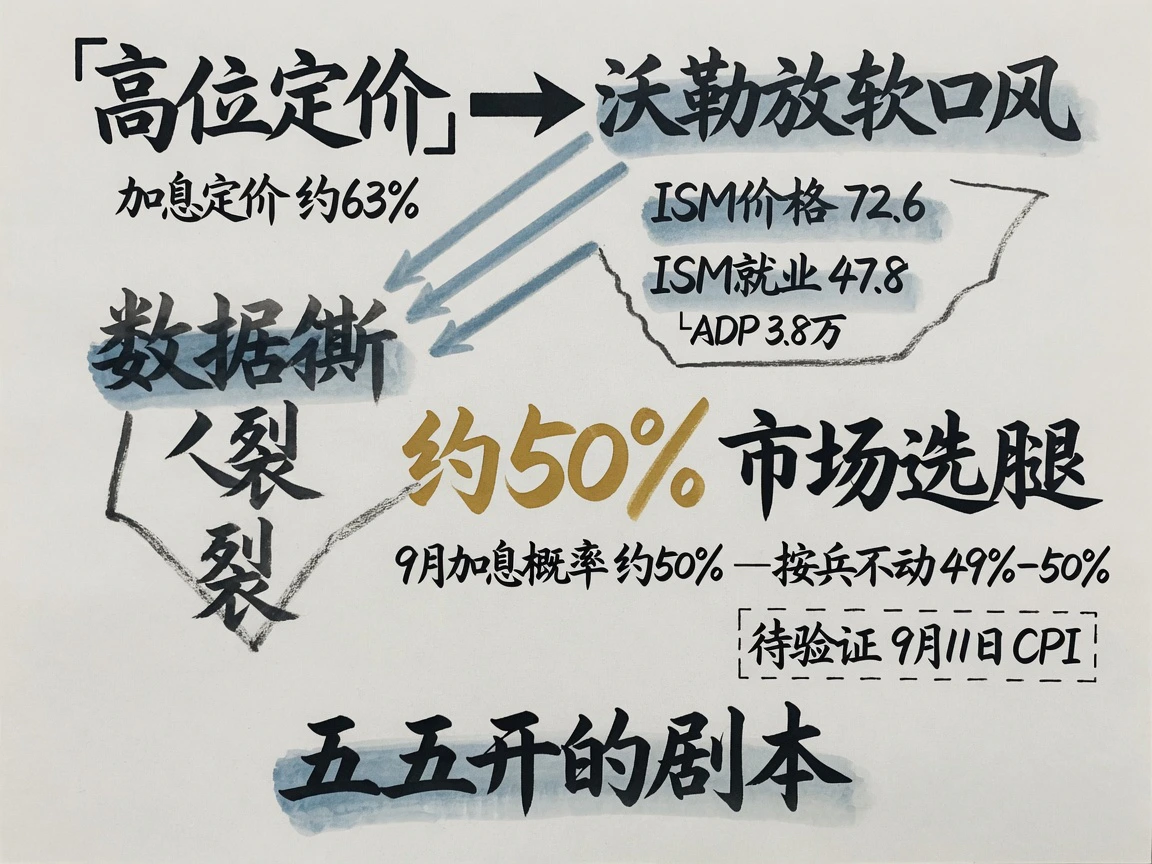
Waller's view was conditional rather than a commitment. The economy was sound and employment stable; inflation remained well above 2%, with July PCE at 3.7% annually and core at 3.3%. Yet three-month annualized core inflation had steadily fallen from February's 4.76% to 3.05%, and around half recent core increases came from imputed nonmarket services with greater noise. He favored holding if disinflation continued and considering hikes if it stalled or reversed, while acknowledging 25bp could not directly return CPI to 2%. This aligned with Williams's September 2 centrist view that long yields chiefly reflected resilience and AI investment. Hike odds retreated from post-Jackson Hole levels near 70% toward balance.
The target range remained 3.50%–3.75%, unchanged since December 2025. CME FedWatch snapshots showed September hike and hold odds each near 49%–50%, with cuts priced out. A hike by late October remained likely, and at least one by December was still priced near 100%. Markets were paying for a September delay; declaring tightening over was premature.
The day's data combined resilient demand, high prices and cooling jobs. August ISM services PMI was 55.4, its 26th expansion month; business activity reached 61.7, highest since November 2022. Employment was 47.8, contracting for a second month, while prices paid reached 72.6, highest since August 2022. Final second-quarter nonfarm productivity grew 1.4% annualized; unit labor costs were revised lower and labor's income share fell to the lowest since 1947. Productivity cushioned wage-price transmission. Initial claims were a historically low 206,000, but ADP jobs rose only 38,000, weakest since January. Investors prioritized cooling jobs and Waller's softer stance, deferring renewed inflation-risk judgment until September 11 CPI.
FX: Yen surges on US-Japan policy interaction
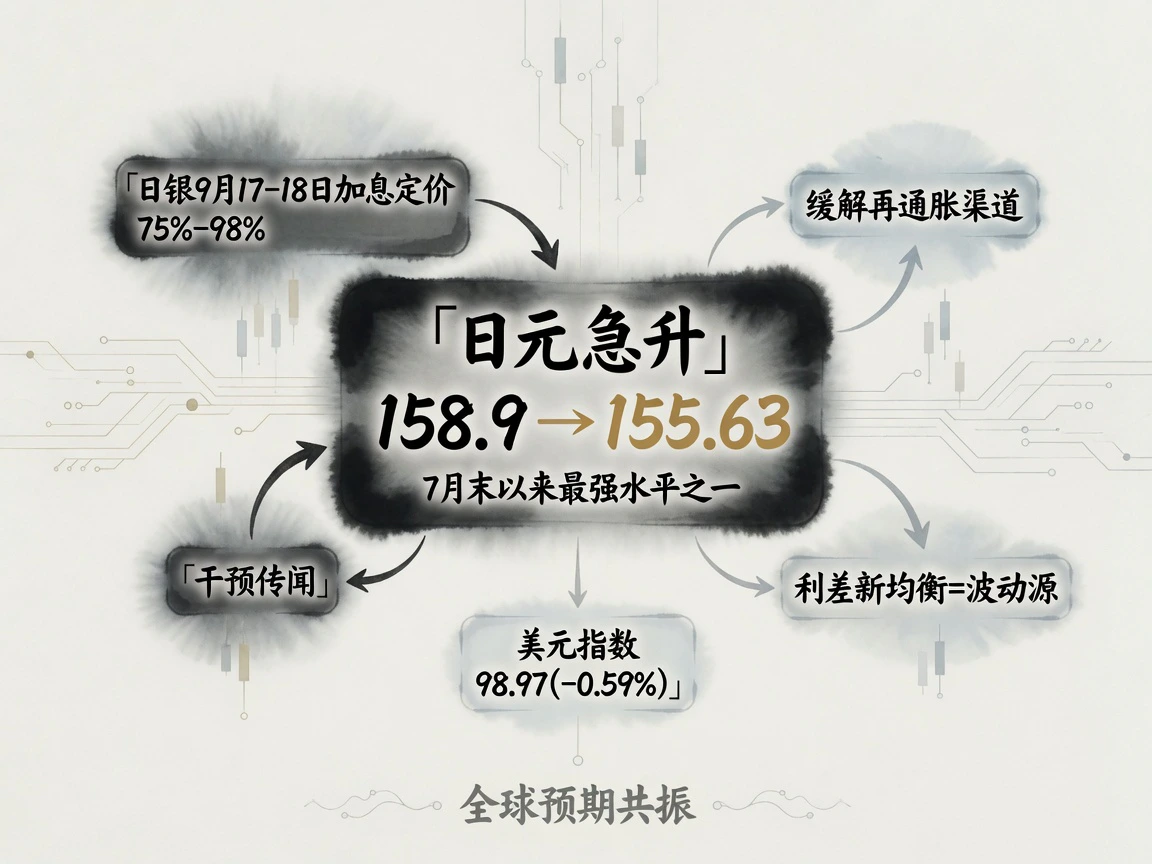
The yen maintained independent strength. USD/JPY quickly fell from around 158.9 to 155.63, among the yen's strongest levels since late-July joint intervention. BOJ September 17–18 hike odds surged to 75%–98%, helped by renewed intervention rumors. A stronger yen somewhat reduced US imported-inflation pressure, but a BOJ hike alongside a Fed hold could trigger carry unwinds as rate differentials changed, creating global volatility. The dollar index closed at 98.97, down 0.59%.
Commodities: Oil stalls at highs as gold rebounds strongly
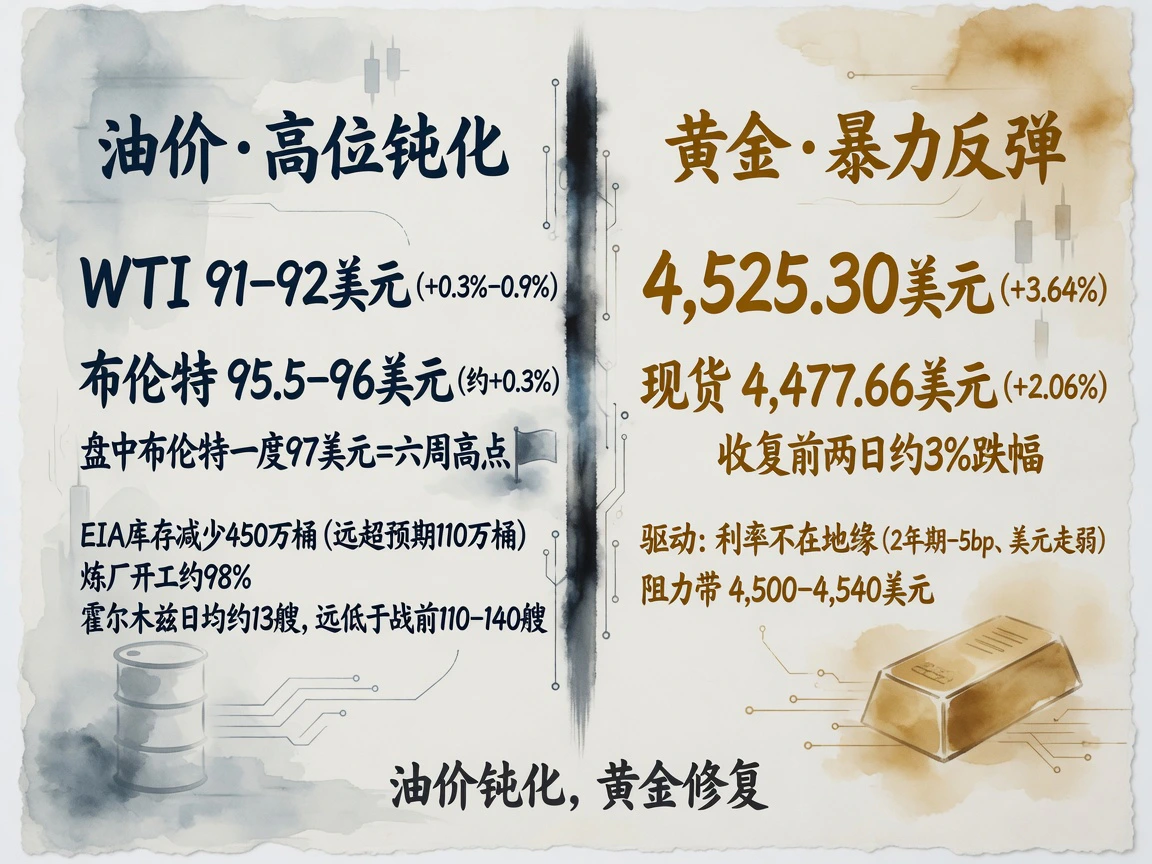
Oil was the exception. Israeli threats to paralyze Iranian energy facilities briefly lifted Brent above $97 to a six-week high, but US comments that operations would not be prolonged erased gains during New York trading. WTI closed around $91–$92, up roughly 0.3%–0.9%, and Brent around $95.5–$96, flat to +0.3%. A fourth consecutive gain came with clearly exhausted momentum. The $91–$97 range suggested persistent conflict and restricted Hormuz passage were fully in baseline expectations. Comparable geopolitical news drove a more than 5% jump on September 1, versus only an approximately 2% Thursday intraday pulse almost entirely erased by the close.
Fundamentals remained tightly balanced. EIA commercial crude stocks fell 4.5 million barrels versus 1.1 million expected; refinery utilization approached a multiyear high of 98%. OPEC+ reportedly planned unchanged October output policy at its September 6 meeting. Hormuz traffic remained low and volatile, a ten-day average near 13 ships versus 110–140 daily before conflict. Deep backwardation showed willingness to pay a large premium for supply-chain disruption over the next 1–3 months, without pricing permanent capacity destruction.
Gold saw substantial valuation recovery as rate expectations reversed. COMEX settled at $4,525.30, up 3.64%, fully recovering nearly 3% lost in the previous two sessions. Spot gold was $4,477.66, up 2.06%. Rates rather than geopolitics drove the move: a 5bp fall in 2-year yields and a weaker dollar lowered carrying and currency-pricing pressure. If September 11 CPI confirmed the renewed inflation risk signaled by ISM prices at 72.6, gold near $4,500–$4,540 resistance would face both rebounding rates and profit-taking.
Equities: A second US gain led by software and technology
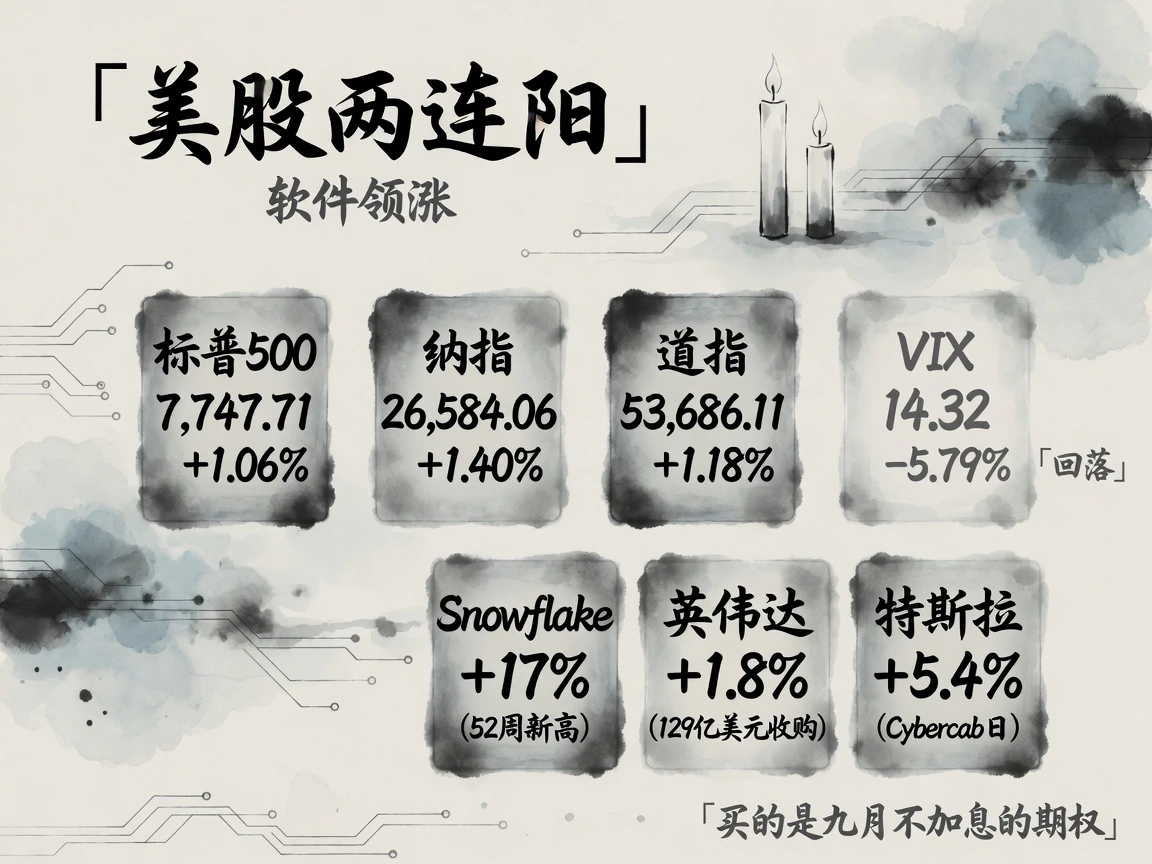
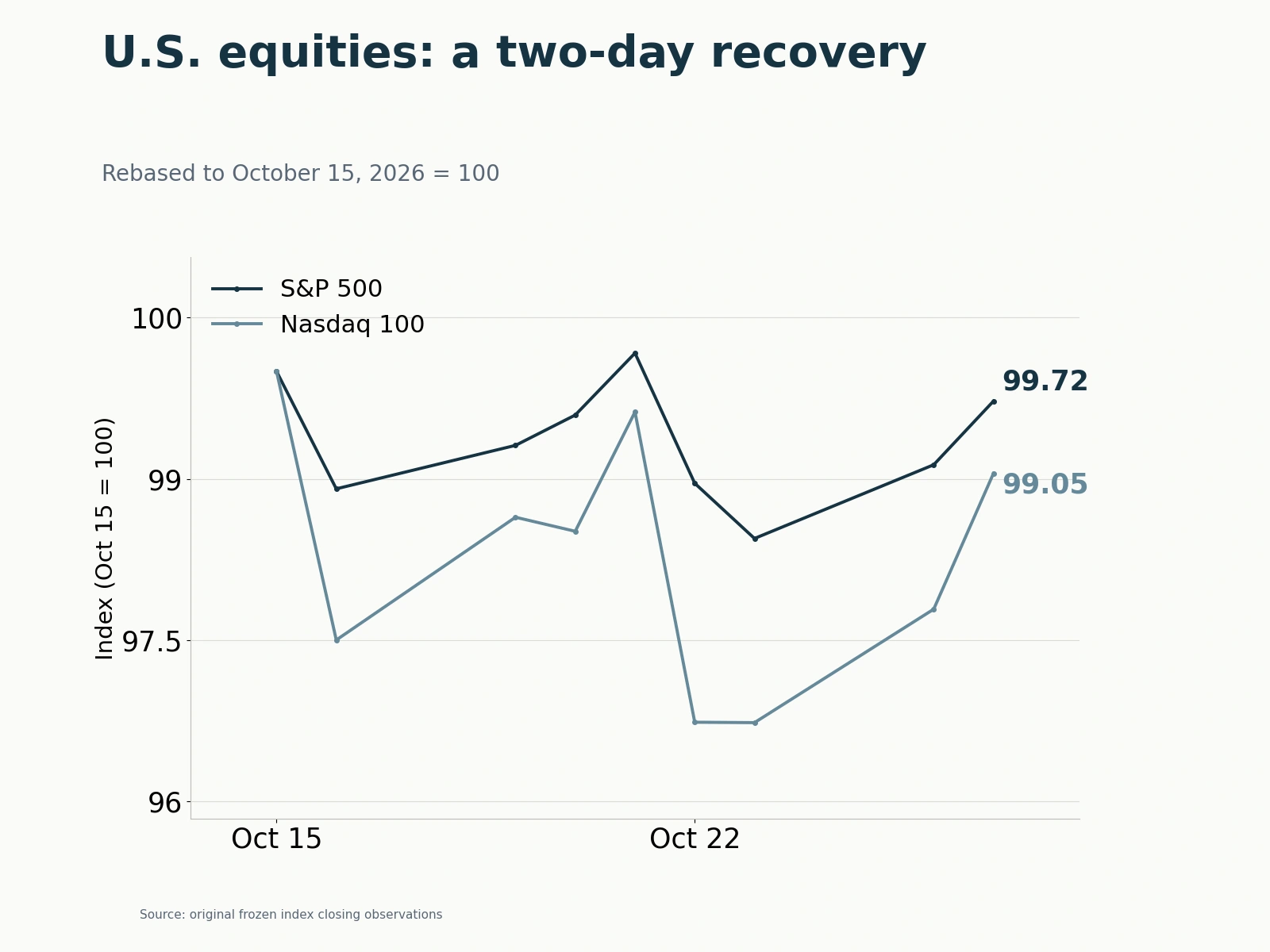
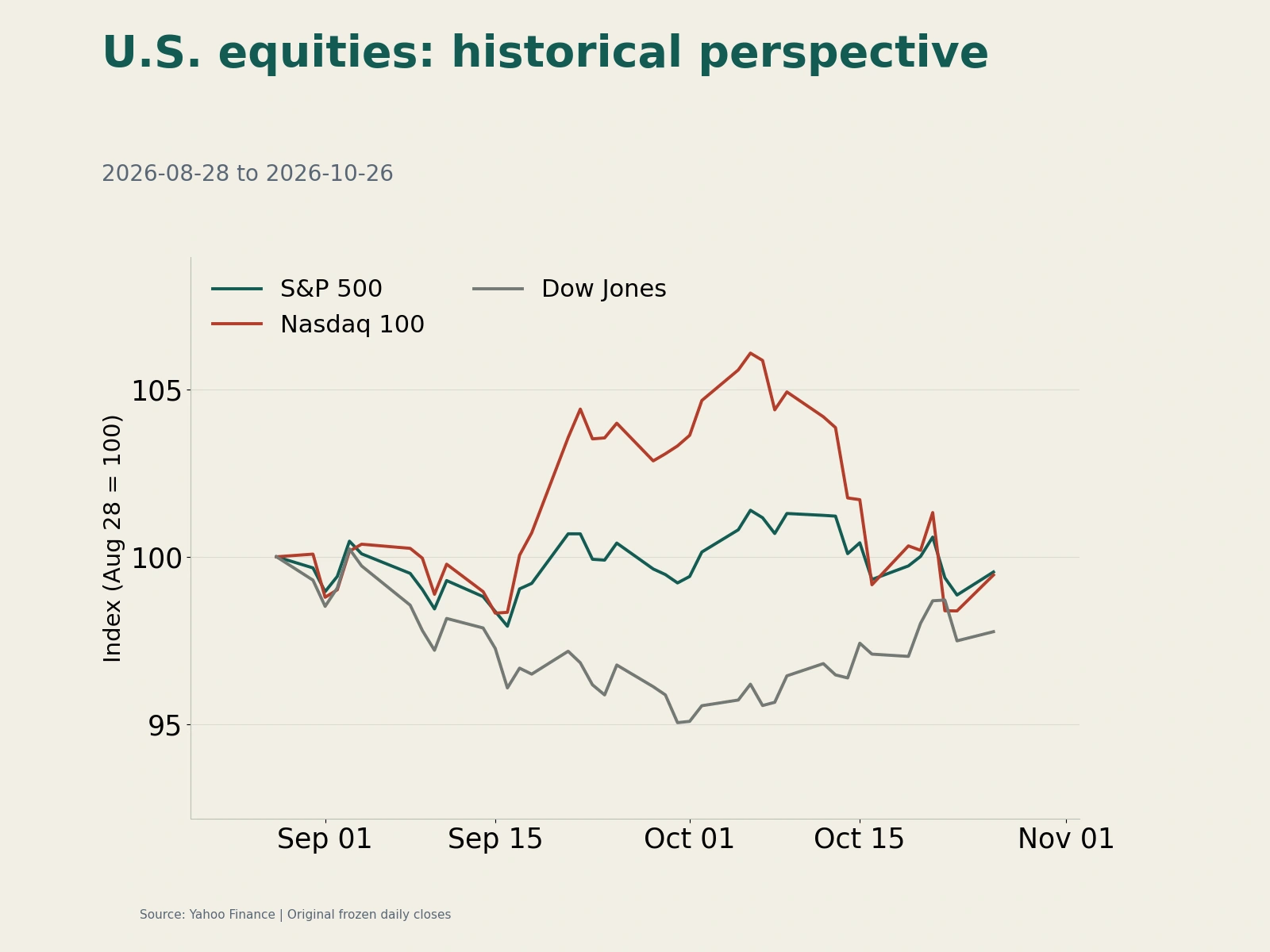
US stocks recovered from the early-month sell-off for a second session: S&P 500 7,747.71 (+1.06%), Dow 53,686.11 (+1.18%), Nasdaq Composite 26,584.06 (+1.40%), Russell 2000 2,968.27 (+0.51%) and VIX 14.32 (−5.79%). Software and technology led. Snowflake rose about 17%, after exceeding 20% intraday and a 52-week high, on fiscal second-quarter revenue of $1.55 billion, +35%, a third consecutive acceleration in product revenue and higher guidance. Nvidia gained 1.8% to $228.45 after confirming an approximately $12.9 billion Hugging Face acquisition. Tesla rose 5.4% after announcing two-seat Cybercabs would join its Robotaxi fleet and public Austin access, with investors anticipating event news. Only energy, materials and staples declined.
Small-cap gains were limited and the equal-weight S&P 500's weekly return stayed negative, underscoring defensive sentiment. The rebound was essentially a responsive recovery to higher September-hold odds rather than a fundamental reversal. Unexpectedly strong Friday jobs or higher CPI the next week would hit rate-sensitive expensive assets first.
After-hours results diverged: Lululemon fell sharply on weak current and full-year guidance; Guidewire and other software stocks followed lower, while DocuSign and Samsara rose. Capital increasingly distinguished realized current results from unsupported distant guidance.
In Asia-Pacific trading, the Nikkei 225 closed at 64,214.48, down 0.17%, a more-than-month low under pressure from yen strength and BOJ hike expectations. Hang Seng closed 25,213.31, down about 0.39%; KOSPI rebounded 0.26% with high energy-import costs unresolved. Before Friday's open, Nikkei and Hang Seng futures implied higher openings, while US futures were broadly flat to cash closes.
Conclusion

Near-term macro trades face successive tests: August payrolls at 20:30 Beijing time on September 4, with low expectations, then the decisive August CPI on September 11.
If jobs keep slowing moderately and core monthly CPI stays near 0.2%, a Fed hold becomes the baseline, the Treasury curve steepens further and gold may build support above $4,500. Unexpectedly strong employment or markedly higher inflation would rapidly return September hike odds above 60%, lift 2-year yields and retest September 2 long-end highs. The September 6 OPEC+ meeting, September 15–16 Fed meeting and September 17–18 BOJ meeting will resolve multiple supply and monetary uncertainties over the next two weeks.