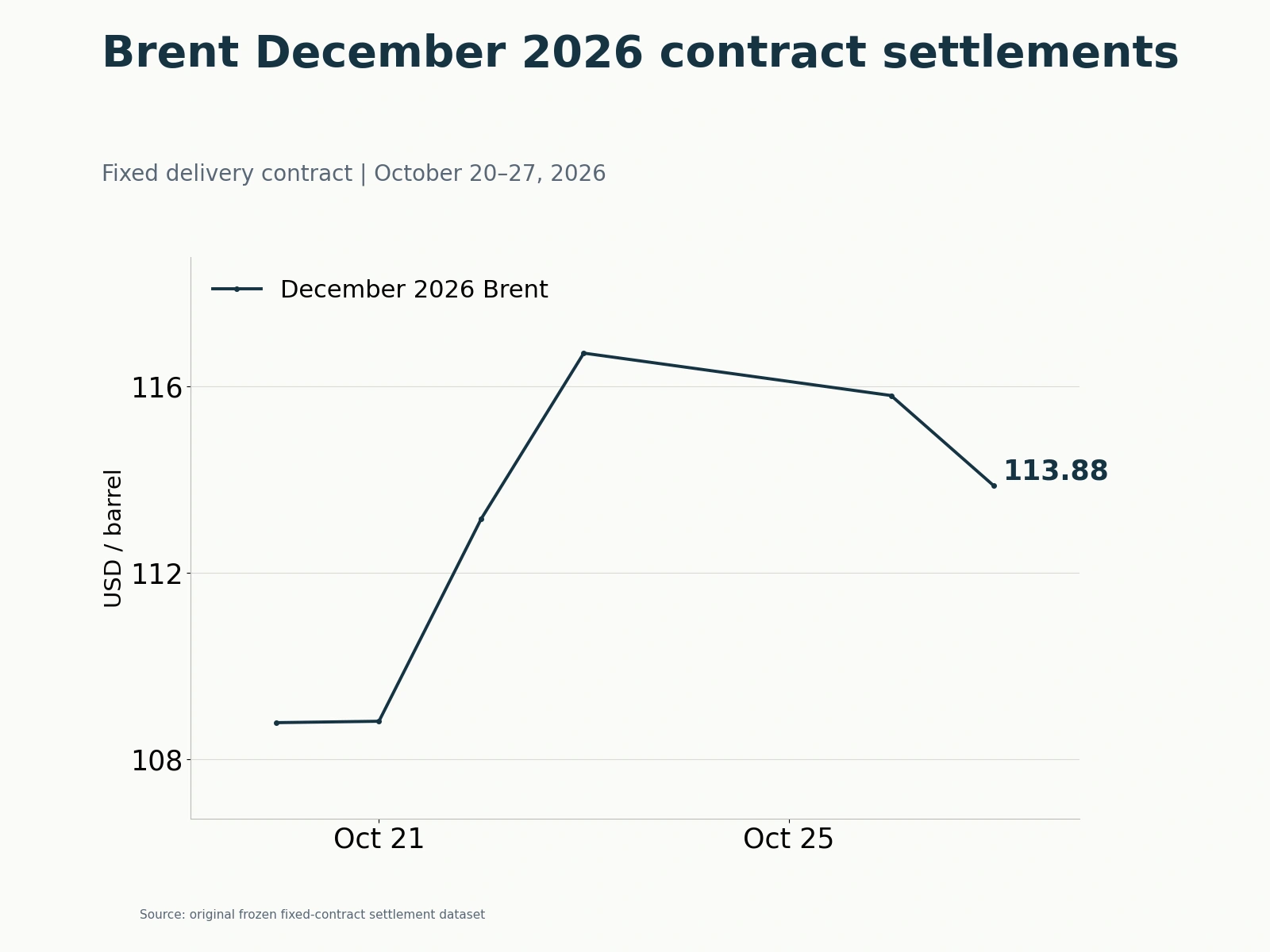
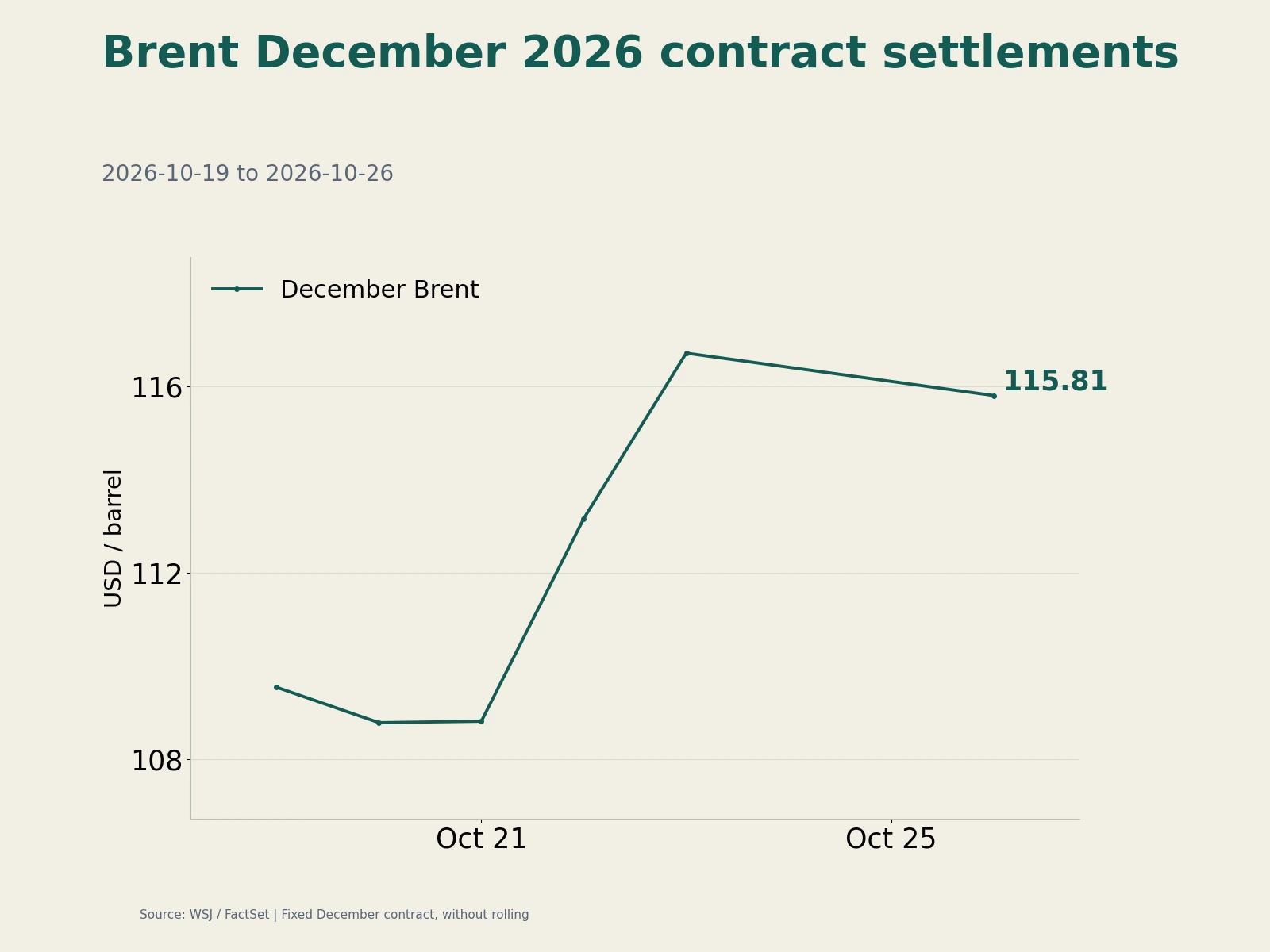
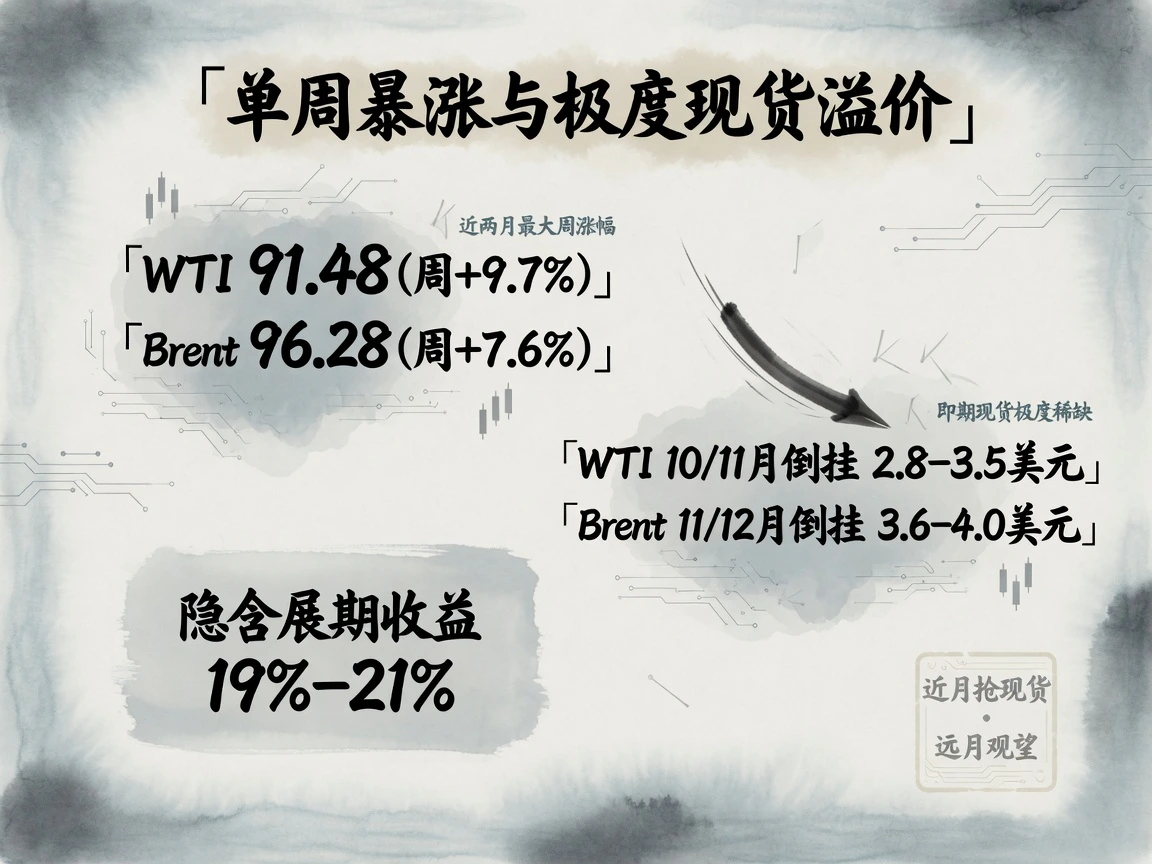
On September 4, 2026, oil fluctuated at elevated levels after a series of sharp gains, rising intraday before retreating into a narrow range. The tracking system's daily settlement measure put front-month October WTI at $91.22 a barrel, down $0.08, or 0.09%, and November Brent at $95.83, up $0.31, or 0.32%. Final official exchange settlements were $91.48 for October WTI, up 0.2%, and $96.28 for November Brent, up 0.8%. Daily momentum slowed, but weekly gains were about 9.7% and 7.6%, respectively, the strongest for both in nearly two months, since mid-July.
The oil market is being pulled in opposite directions. Middle Eastern fighting has brought Hormuz navigation to a near standstill, commercial war-risk insurance has soared, and U.S. diesel cracks and retail prices have set records. Supply-cutoff fears have directly lifted immediate spot premiums. Financial conditions, however, have turned colder: August U.S. payrolls far exceeded expectations, reviving Fed-hike pricing, while a stronger dollar and higher short Treasury yields weighed on commodity risk appetite. Nearby buyers are paying heavily for immediate scarcity, but deferred futures and core producers' official selling prices remain calm, declining to price a complete Middle Eastern crude cutoff.
Market action: strongest weekly gains in nearly two months; extreme backwardation signals immediate scarcity
After the September 1–2 advance, both benchmarks had consolidated for three consecutive sessions above $91 and $96. Prices rose intraday on September 4 before tighter-policy expectations pushed them back.
Intraday benchmark readings differed from official exchange settlements by $0.20–$0.50 because of timing. A Reuters summary put Brent around $95.80, close to the $95.83 tracking benchmark, while official settlements were WTI $91.48 and Brent $96.28. Both measures agreed on the preceding session's $91.30 and $95.52; the discrepancy came only from closing/settlement timing. Over the full week, WTI gained $8.08 from the previous Friday's $83.40, or 9.7%. Brent's comparable contract gained about 7.6%. Both were the strongest weekly performances in nearly two months.
The term structure says more about physical tightness than a single day's move. Both curves showed exceptionally steep backwardation: October WTI exceeded November by $2.8–$3.5 a barrel, and November Brent exceeded December by $3.6–$4.0. Saxo estimated one-year implied roll yields at an elevated 19%–21%.
Backwardation this deep leaves no room for storing crude for cash-and-carry arbitrage; buyers are competing for immediately deliverable barrels. Fear of an immediate cutoff is embedded in calendar spreads, but deferred contracts have not followed in a frenzy, with the market still watching developments.
Supply-demand balance: U.S. refining reaches a peak while Gulf shipments are diverted through deep discounts
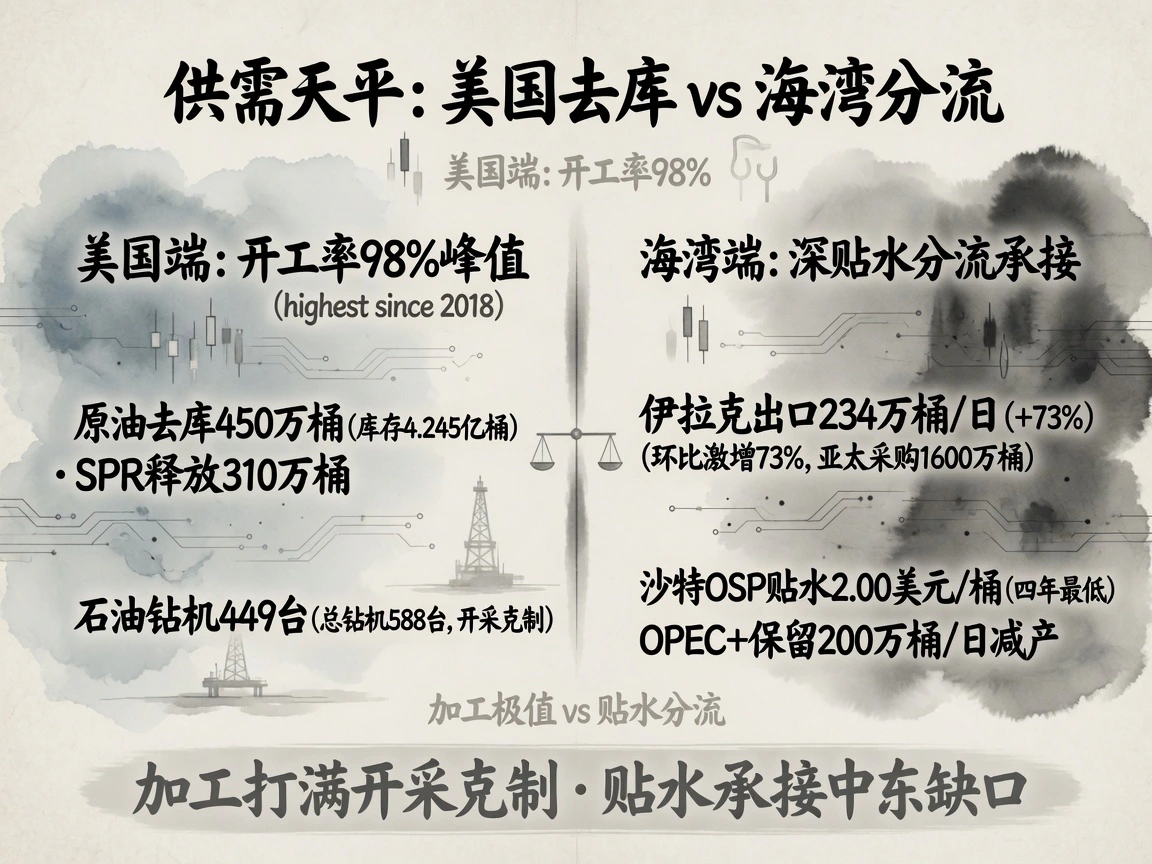
The supply-demand rhythms on either side of the Atlantic and in Middle Eastern production regions are sharply different.
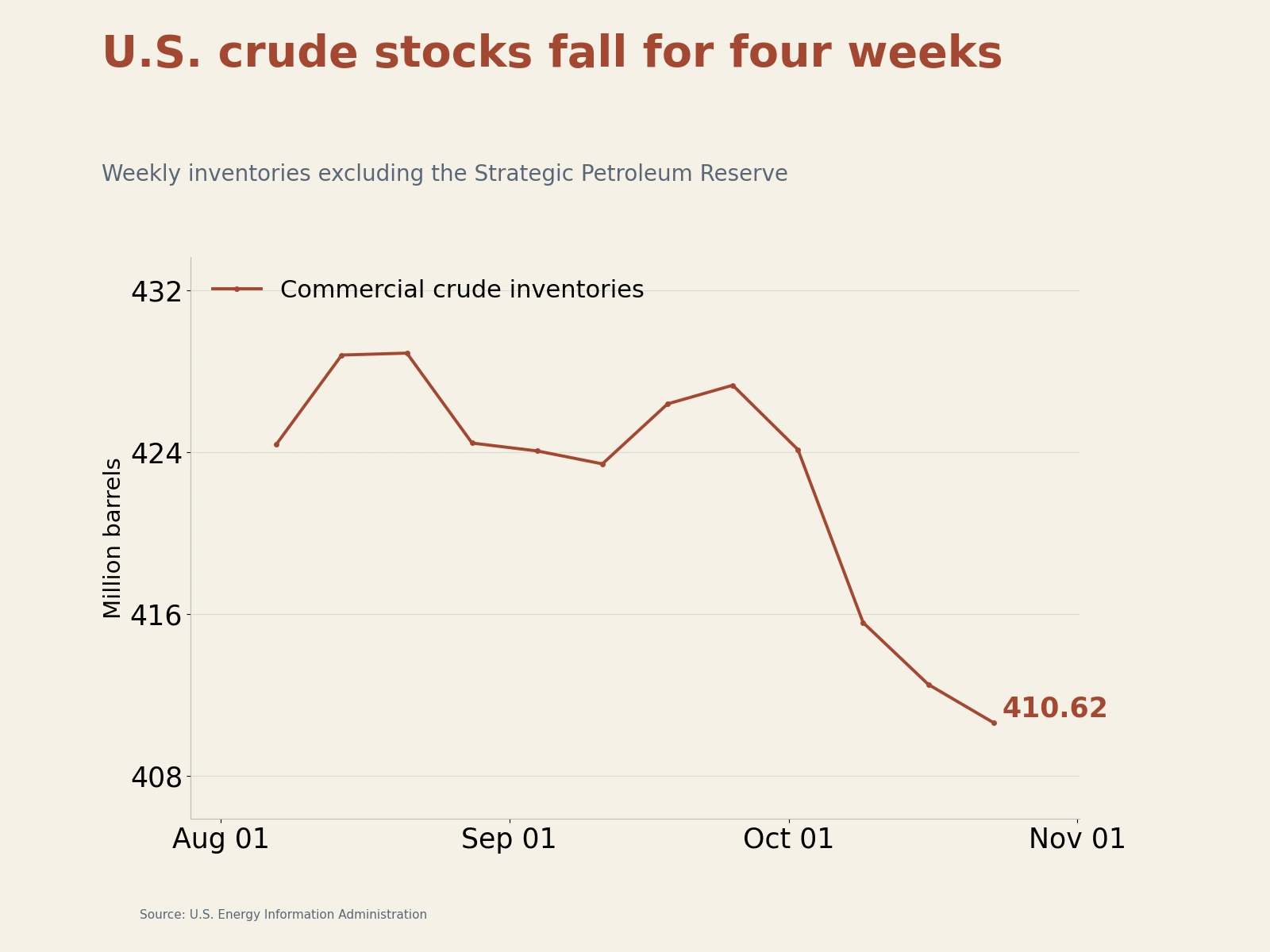
U.S. refinery utilization and inventory draw rates both reached yearly extremes. The EIA's official report for the week through August 28 showed a larger-than-expected commercial crude draw of 4.5 million barrels to 424.5 million. Stocks remained about 1% above the five-year seasonal average, but depletion was rapid. The SPR released 3.1 million barrels that week, refinery utilization reached 98%, the highest since 2018, and gasoline stocks kept falling. Labor Day delayed the next EIA weekly report to September 10. In its Short-Term Energy Outlook, the EIA forecast year-end 2026 commercial crude stocks below the five-year historical low, explicitly identifying structural medium- and long-term draw pressure.
Processing demand was running flat out, but upstream drilling remained restrained. Baker Hughes data on September 4 showed U.S. oil rigs up only two to 449, the Permian unchanged at 268, and total U.S. rigs unchanged for a second week at 588. Shale producers showed no intention of increasing capex.
Physical Gulf shipments were directly obstructed, but deep discounts diverted the gap into nontraditional channels. Shipping tracking showed Iraq's August crude exports surging 73% month on month, from about 1.35 million barrels a day in July to 2.34 million. With extreme navigation risk, buyers took deeply discounted cargoes; mainstream Asia-Pacific buyers had purchased at least 16 million barrels of Basra crude for September, providing a Far Eastern buffer. Detailed August customs trade figures were due progressively over September 7–10.
Core producers did not seize the chance to raise prices. In October OSPs announced September 3, Saudi Aramco kept Asian Arab Light at a $2.00-a-barrel discount to the Oman/Dubai average, unchanged from September and still the lowest since June 2020. OPEC+'s core seven were due to meet online September 6, with October output increases expected to remain paused. The monthly 188,000-barrel-a-day increases from September had completed the reversal of the earlier voluntary cuts of 1.65 million barrels a day, while about 2 million barrels a day of existing reductions would remain through end-2026. The real bargaining focus was shifting to the independent review of 2027 baseline quotas and capacity starting in late September.
Macro constraint: strong payrolls revive tightening expectations; dollar and short yields create headwinds
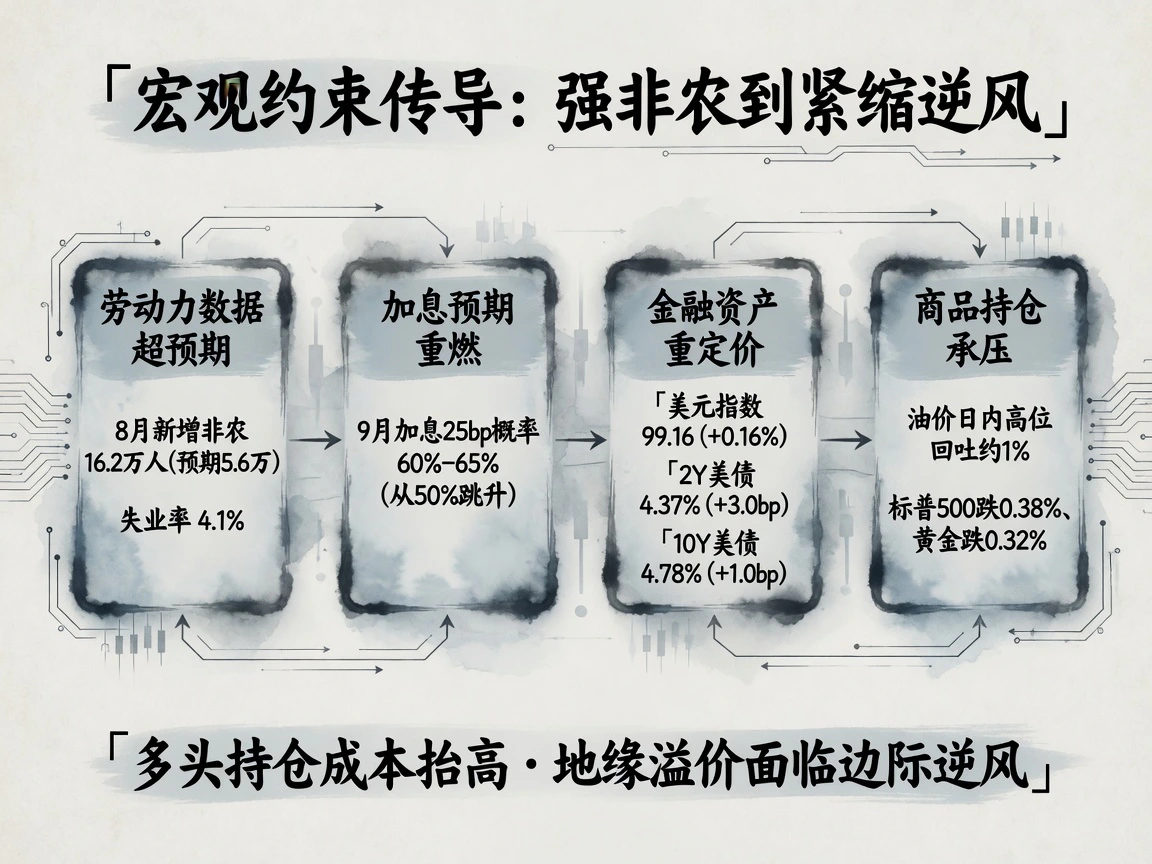
The September 4 employment data directly reversed expectations of rate cuts.
The BLS August report showed 162,000 new nonfarm jobs, far above expectations near 56,000. More important were revisions: July changed from an initial loss of 23,000 to a gain of 21,000, and June was also revised higher. The recent two-month average recovered to the 80,000–90,000 range, with unemployment at 4.1%. The labor market was not slowing rapidly as investors had feared.
Cut expectations faded and hike probabilities returned. CME FedWatch put the implied chance of a 25-basis-point increase at the September 15–16 meeting at 60%–65%, up from about 50% a day earlier.
Rapid asset repricing created resistance for commodity longs. The dollar index closed at 99.16, up 0.16%. On a close-to-close basis, Treasury yields rose three basis points to 4.37% for two years, two to 4.54% for five years, and one to 4.78% for ten years; only the thirty-year edged down one basis point to 5.24%. The S&P 500 fell 0.38% and spot gold 0.32%.
A rebounding dollar and higher short yields directly raised longs' carrying and financing costs, with oil giving back about 1% from intraday highs. Both benchmarks still closed near their weekly highs. Geopolitical cutoff risk remained the main theme, with tighter macro conditions only a marginal disturbance for now. The following week's August CPI and PPI would determine whether this tightening headwind intensified.
Shipping and spillovers: near-frozen strait traffic, extreme war insurance and freight establish a cost floor

Shipping remains the most direct bottleneck transmitting Middle Eastern conflict into oil.
Commercial Hormuz traffic reached a near standstill on September 4. Windward counted only three merchant transits and Kpler four, far below nine the previous day and the preceding ten-day average of about fifteen. Only two VLCCs crossed during the entire week. TankerTrackers' 28-day average put physical crude and product flow through the strait near 5 million barrels daily (5.04 million barrels a day).
Official statements differed markedly from commercial tracking. Washington claimed escorted cargo of about 15 million barrels on Friday alone, while mainstream shipping sources and foreign-media industry analysis put the effective average upper limit near 8 million daily. After U.S. strikes on nearly one hundred targets in southern Iran during September 1–3 and Iranian retaliation with more than 59 missiles and drones, September 4 brought no third round of direct confrontation. No verified damage occurred to the main energy-terminal facilities. The geopolitical premium was still at the deterrence stage rather than physical destruction.
Cargo insurance and detour costs were already adding directly to landed prices. More than seventy Middle East war-risk claims had accumulated, exceeding $2 billion. Hull war-risk premiums peaked at 10% of vessel value, versus a normal 0.25%, adding $7–$8 per barrel in insurance costs alone.
Detour freight also set records. Argus put a single VLCC charter from the U.S. Gulf to the Far East at about $29.75 million, with one-year VLCC time charters at $130,000 daily. Fearnleys' weekly report showed Middle East–Japan at Worldscale 650 and Middle East–Singapore at Worldscale 675. Capacity and insurance locked at high levels established hard cost support under oil.
Pricing logic: diesel cracks set records, but deferred prices reject a complete-cutoff scenario

The strongest weekly crude gains in nearly two months, deep nearby backwardation and extreme war insurance were accompanied by an even stronger product response. U.S. diesel cracks exceeded $106 a barrel and reached $108 intraday, both record highs. Average U.S. retail diesel jumped to a record $5.85 a gallon. Buying had fully priced expectations of immediate physical shortages.
The frenzy was confined to the near end. Front months approached $100, while deferred contracts remained in the $70s. Aramco's Asian light-crude OSP retained a deep six-year discount, and investment-bank estimates were much calmer than panic buying. JPMorgan estimated an incremental $7–$8-a-barrel increase for each month of substantive Hormuz disruption. Goldman argued that only prolonged, total paralysis would send oil above $120. A flatter deferred curve and restrained bank assumptions showed institutions' baseline remained temporary logistics disruption, rather than complete Middle Eastern supply loss.
At official settlements of $91.48 and $96.28, the market had fully priced a month of restricted passage. What happens next depends on which side breaks the deadlock first. Escalating supply loss provides upside: a complete closure or confirmed destruction of core energy facilities would quickly take Brent above $100. Downside pressure comes from effective alternatives and macro restraint. If bypass pipelines and ship-to-ship transfers cover the supply gap, alongside Fed-tightening expectations and a strong dollar, profit-taking will gradually unwind inflated war-insurance and freight premiums.