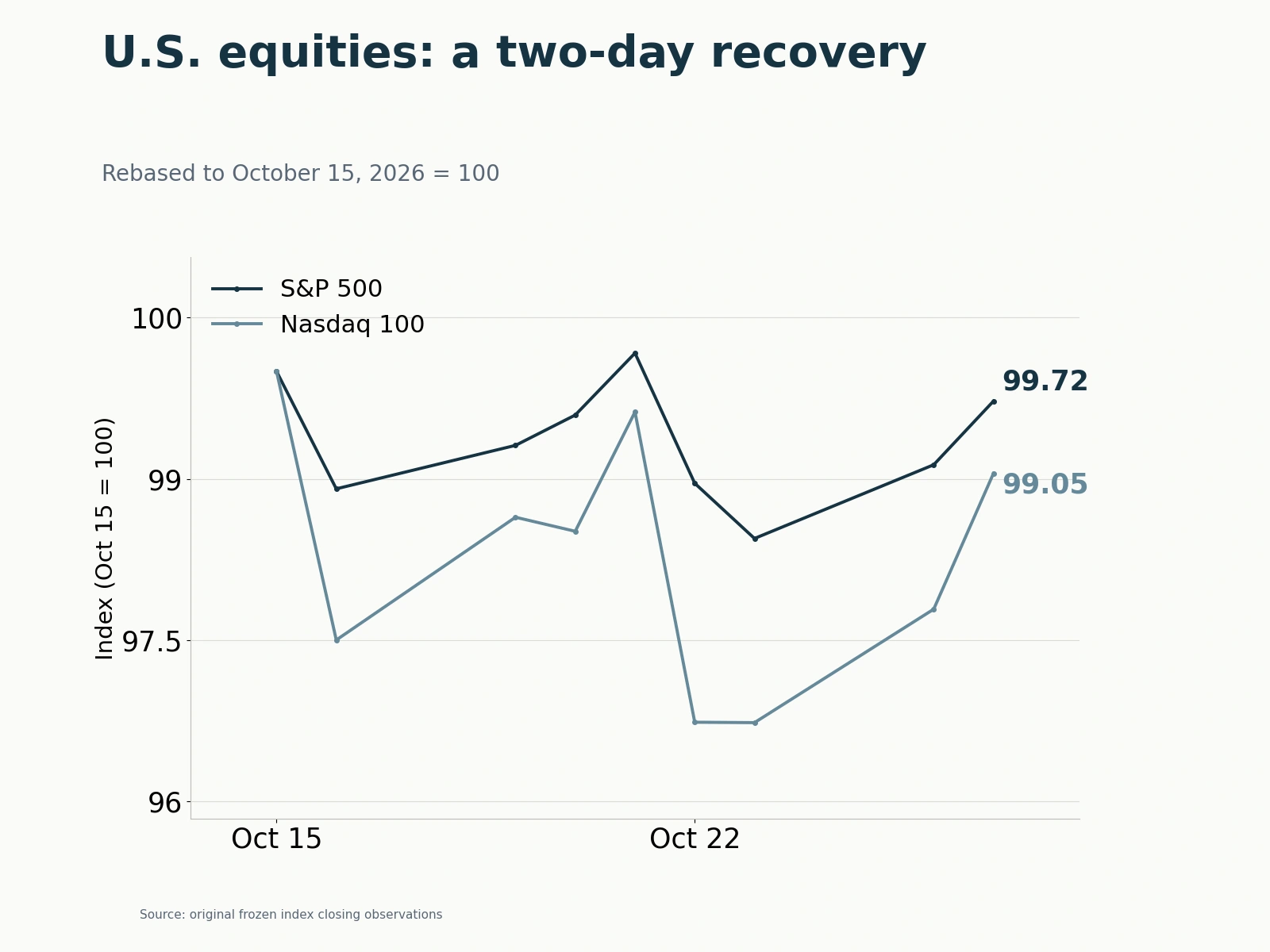
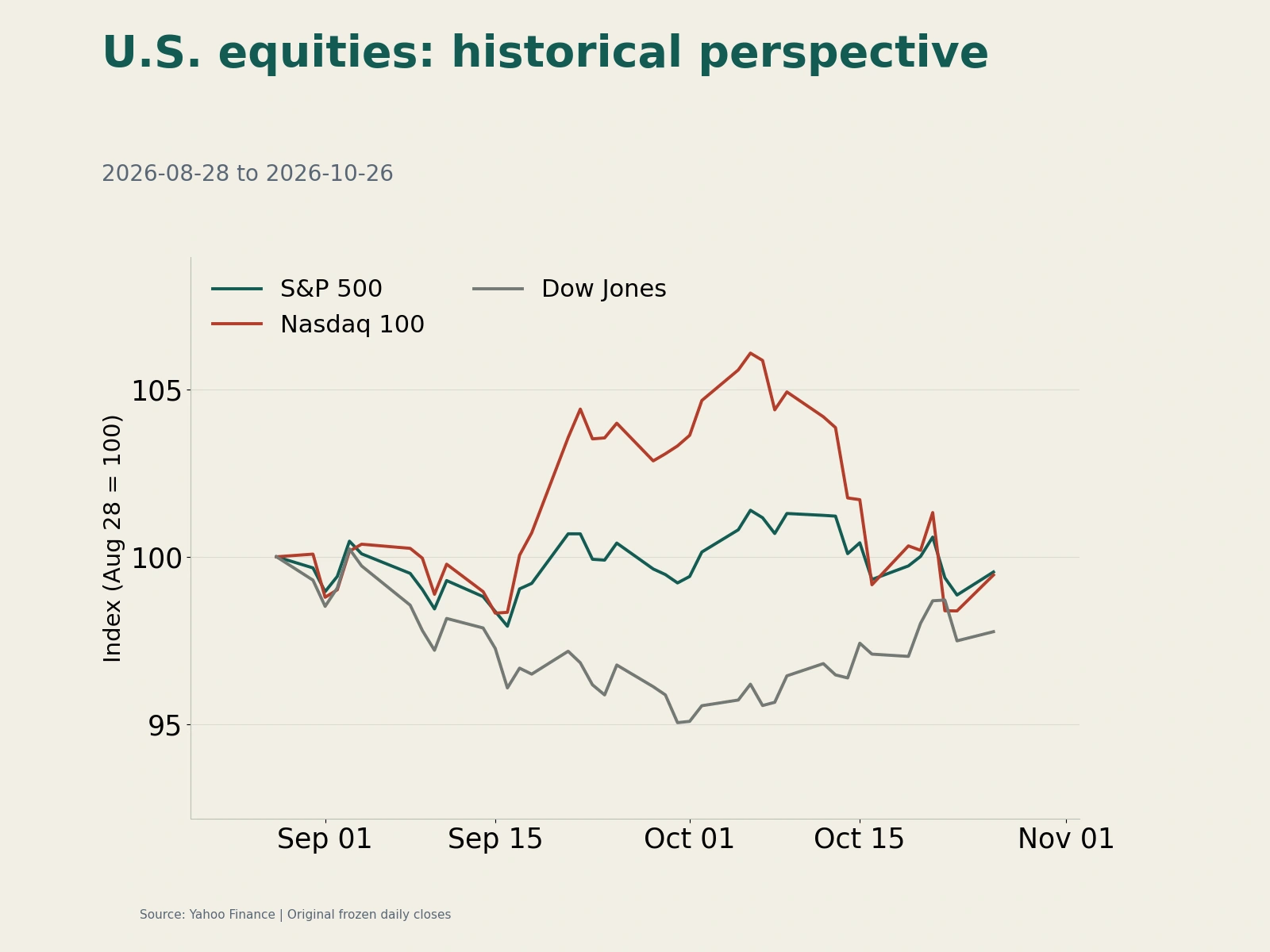
On September 14, 2026, supply risks lifted oil, the dollar strengthened, and gold and U.S. equities fell. The S&P 500 lost 0.48% and Nasdaq 100 0.82%. The 10-year Treasury yield touched 5% intraday and closed at 4.97%, up 1 basis point. Higher energy prices sustained inflation pressure, while calls to slow AI development prompted a reassessment of hardware investment. High funding costs and uncertain earnings restrained risk appetite, while a software rebound and lower ultralong yields showed continued differentiation among assets' growth and risks.
Treasury curve flattens slightly as high rates continue to constrain financing
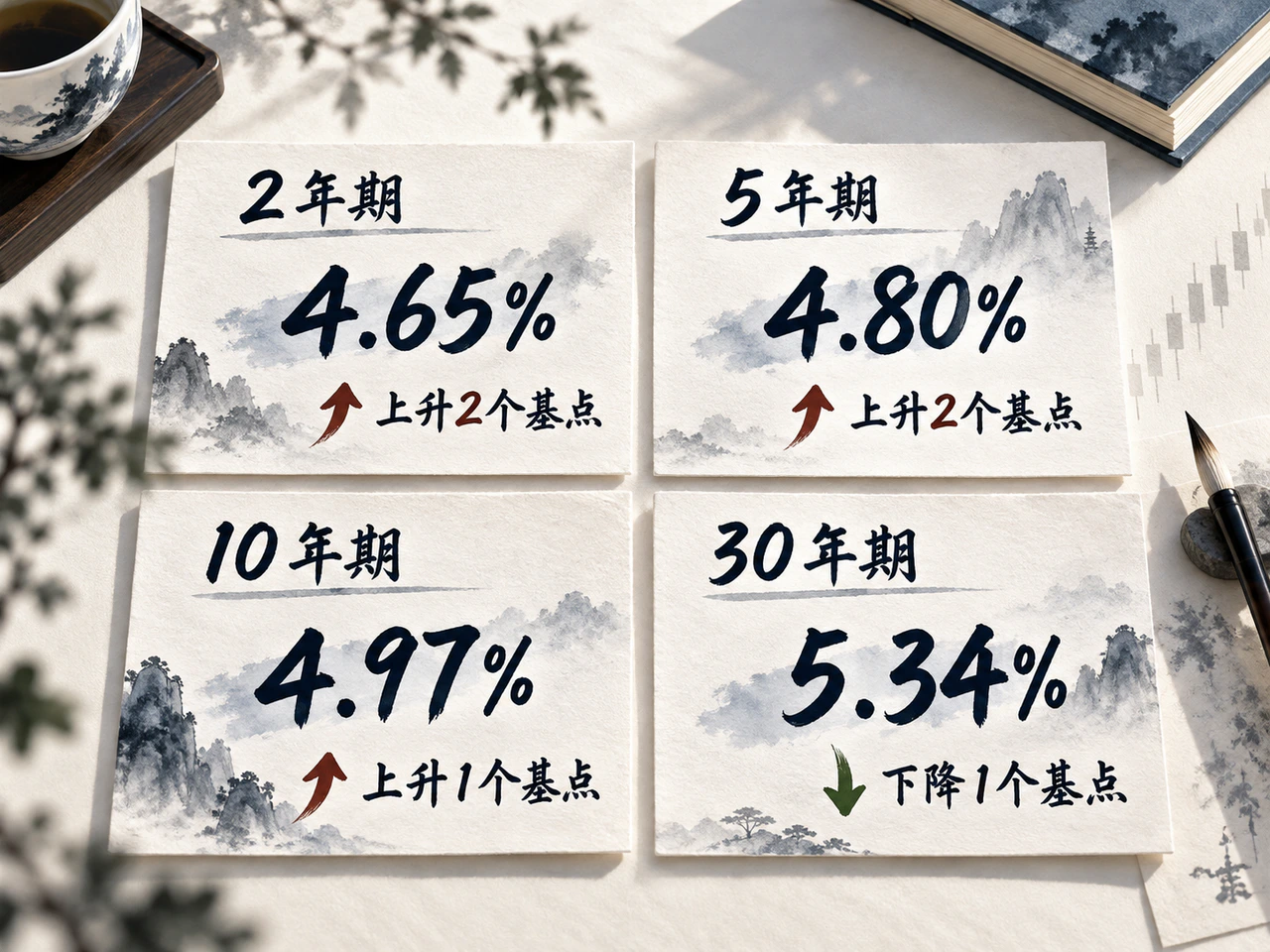
On the Treasury's consistent daily curve, September 14 yields changed from September 11 as follows:
| Maturity | Closing yield | Change from previous trading day |
|---|---|---|
| 2-year | 4.65% | Up 2 basis points |
| 5-year | 4.80% | Up 2 basis points |
| 10-year | 4.97% | Up 1 basis point |
| 30-year | 5.34% | Down 1 basis point |
The 10-year/2-year spread narrowed from 33 to 32 basis points, and the 30-year/5-year spread from 57 to 54. The 10-year's intraday touch of 5% drew attention, but daily moves were limited: modest short- and intermediate-yield increases and a lower ultralong yield flattened the curve slightly.
Hike expectations still supported short yields. A Reuters report published at 18:04 Beijing time on September 14 put the probability of a 25-basis-point increase that week at about 76%, with approximately 50 basis points cumulatively by year-end. Higher expected policy rates made substantial short- and intermediate-yield declines harder, while long yields also depended on expected growth and inflation effects.
Institutions disagreed. DoubleLine's Bill Campbell believed that no Fed increase could prompt demands for greater inflation compensation, hurting long bonds. BlackRock's Russell Brownback worried another increase would mainly squeeze already weak rate-sensitive sectors such as housing while doing little to other growth sources. A 1-basis-point decline in the 30-year that day did not establish that long-term supply or inflation risks had disappeared.
Credit still combined high benchmark rates with narrow spreads. ICE BofA indexes published September 14 showed September 11 investment-grade spreads unchanged at 80 basis points and high-yield spreads down 5 to 265. These reflected the preceding Friday. Reuters analysis cited resilient large-company fundamentals and allocation demand, but narrow spreads left limited protection against credit deterioration.
New borrowing and refinancing costs depend on both benchmarks and spreads, so open financing channels do not necessarily mean lower costs. Transaction advisers disclosed September 14 that China Nonferrous Mining issued $300 million of zero-coupon convertible bonds due 2031. Their conversion rights make the zero coupon incomparable with ordinary dollar debt. Refinancing pressure still requires assessment of revenue currencies, cash flow and near-term maturities.
Oil disruption raises costs while a stronger dollar depresses gold
On one provider's continuous-futures daily closes, WTI was $102.18 a barrel, up 2.13% from September 11; Brent $106.57, up 1.87%; gold $4,329.00 an ounce, down 1.81%. These are provider daily closing quotes, not exchange settlements or spot prices.
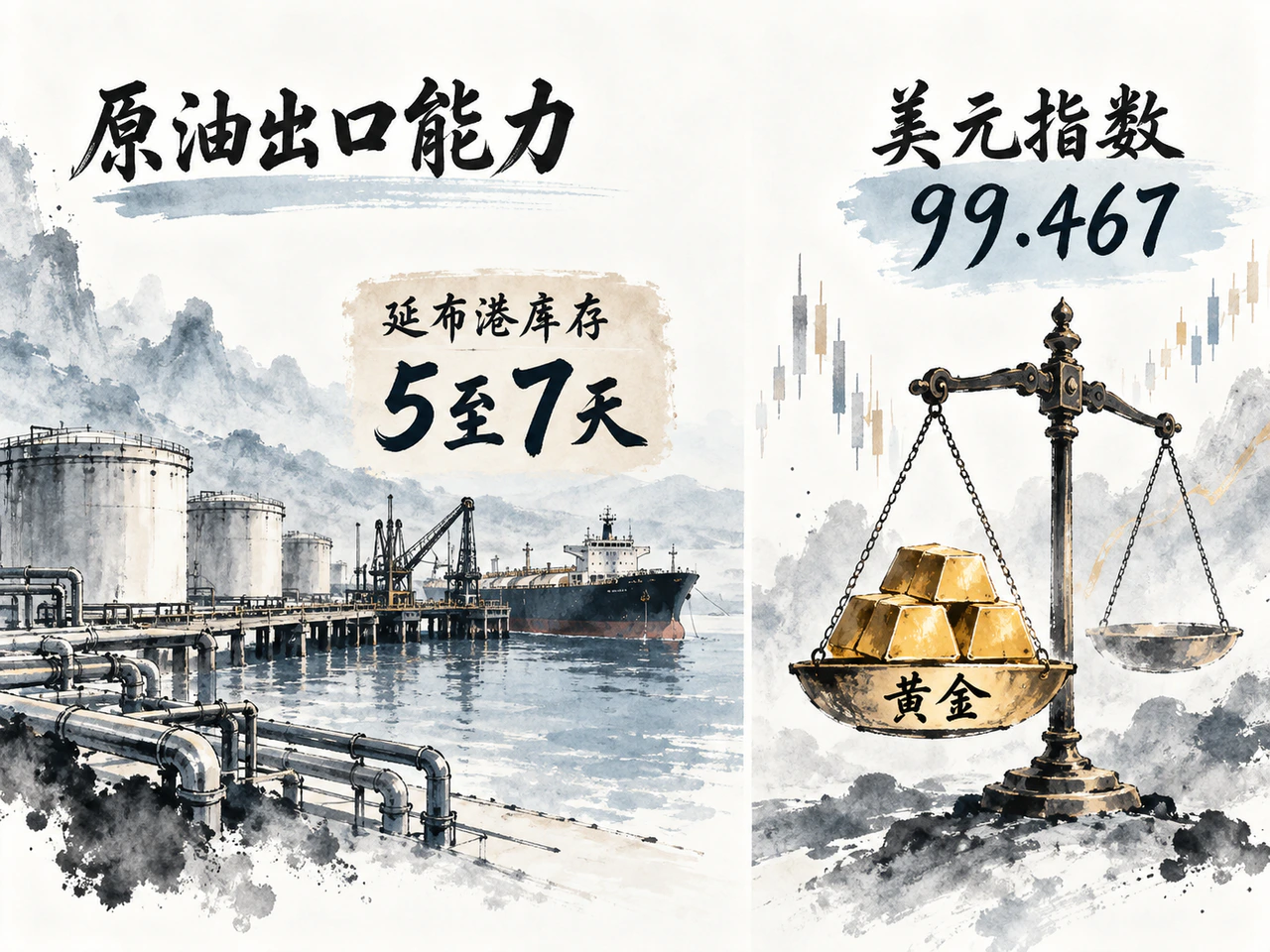
Saudi Arabia's East–West pipeline shutdown reduced export capacity bypassing Hormuz. Reuters cited industry sources saying Yanbu stocks could support only about five to seven days of exports, with longer outages increasing pressure. Asian purchasing costs had already risen. Reuters reported September 14 that GS Caltex bought 2 million barrels of U.S. crude the previous week at an approximately $24-a-barrel delivered premium over November Dubai, compared with about $13 for U.S. cargoes the previous month. Alternatives remained available but cost more.
Diplomacy limited the day's oil gains. Reuters said WTI and Brent rose nearly 5% intraday before partially reversing after Trump's comments about a deal and stopping attacks on energy targets. Negotiations can change expectations quickly; actual supply restoration still requires repairs and better transport conditions.
Gold faced pressure from both the dollar and rate expectations. The provider's dollar index rose 0.35% to 99.467, increasing non-dollar buyers' costs, while hike expectations raised gold's opportunity cost. KCM Trade's Tim Waterer cited energy inflation and pre-meeting hike expectations as pressures, while geopolitical and policy uncertainty could still attract safe-haven buying. Higher oil increases inflation risk but can also encourage monetary tightening, so it is not automatically positive for gold.
Chip-demand expectations weaken while software rallies
At the regular U.S. close, the S&P 500 was 7,619.98, down 0.48%; Dow 52,421.20, down 0.29%; Nasdaq 100 29,127.16, down 0.82%; Russell 2000 2,892.24, down 0.40%. Technology-heavy indexes fell further, with the AI investment chain central to the adjustment.
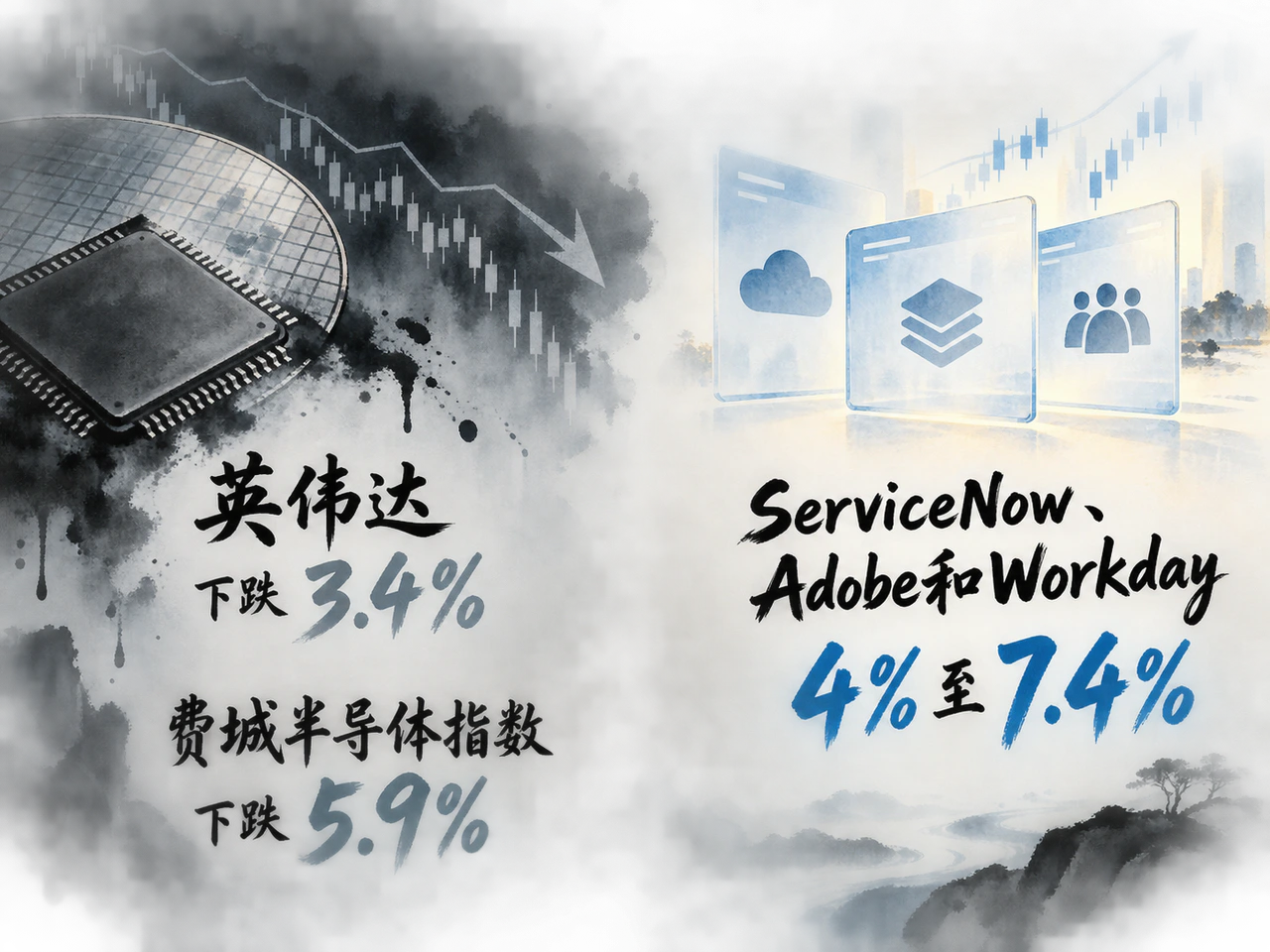
Reuters reported that Anthropic CEO Dario Amodei called over the weekend for slower advances in AI model capabilities, with OpenAI and xAI leaders agreeing. Investors worried about effects on chip, memory and computing-equipment orders. Nvidia fell 3.4% Monday, Micron more than 5%, Broadcom and AMD each more than 4%, and the Philadelphia Semiconductor Index 5.9%.
Software moved the other way: ServiceNow, Adobe and Workday gained between 4% and 7.4%. Investors had feared AI competition would erode software margins. Slower model advances could weaken hardware-demand growth but ease substitution pressure on software. One development thus produced opposing trades along the supply chain.
Slowing development remained an industry appeal, not evidence that purchases had already been cut. Deutsche Bank argued intense corporate and national competition made retreat difficult while rivals advanced. Reuters also reported Anthropic continued preparing a proposed listing and discussing an anchor investment with Nvidia. Subsequent orders and capital-spending guidance would determine whether the correction spread to earnings expectations.
Indexes also obscured stock-level differences. S&P 500 advancers outnumbered decliners about 1.3 to 1, showing a few heavyweights dragged the index disproportionately. Yet eight of eleven sectors fell and VIX rose 1.26 to 17.10, so pressure extended beyond chips. Bank of America's CEO expected lower third-quarter investment-banking fee revenue and its shares fell 5.1%. XLE fell 0.94%, with higher oil failing to lift energy shares.
Asian markets began absorbing the weekend AI news before Monday's U.S. open. AP reported the Nikkei 225 down about 0.8% and Kospi about 3.3%; SoftBank fell 10.7%, SK Hynix 6.4% and Samsung 4.1%. New Time Space's closing report put the Hang Seng up 0.45% and Hang Seng TECH down 0.06%, with pharmaceuticals, autos and banks rising while semiconductors and hardware weakened. Japanese and Korean markets were directly hit by memory, equipment and AI investment firms; Hong Kong reflected differences among hardware, internet applications and nontechnology businesses.
Chinese financing demand diverges as policy promotes payment to suppliers

Financial data released September 14 showed different household and business demand. Preliminary PBOC figures put first-eight-month RMB loan growth at RMB 10.44 trillion and aggregate financing at RMB 23.91 trillion, below AASTOCKS-reported expectations of RMB 10.78 trillion and RMB 24.37 trillion. End-August M2 grew 7.5% year on year, 0.2 percentage points slower than July; M1 rose 4.1%, up 0.1 percentage points.
Household borrowing remained weak. Loans fell RMB 1.03 trillion in the first eight months, including short-term loans down RMB 1.05 trillion and medium- and long-term loans up only RMB 18.8 billion. Business and institutional loans rose RMB 11.26 trillion, including RMB 5.64 trillion medium and long term. Business financing grew while household consumption and housing borrowing showed no clear recovery.
Direct financing partly offset weaker bank lending. Net corporate-bond financing was RMB 2.79 trillion, RMB 1.23 trillion more year on year; domestic equity financing was RMB 470 billion, up RMB 203.1 billion. Government-bond net financing was RMB 1.5 trillion lower, however, leaving cumulative aggregate financing RMB 2.64 trillion below a year earlier and overall credit expansion weak.
Policy addressed bank liquidity and business cash turnover. The central bank announced September 14 a planned RMB 500 billion six-month outright reverse repo for September 15; net injection depended on maturities. A briefing the same day supported large companies replacing payables with loans and bonds to pay suppliers promptly, with clearer disclosure and shorter terms. Timely supplier receipts ease procurement, payroll and debt-service pressure; effectiveness depends on actual payment progress.
August activity data due at 10:00 Beijing time on September 15 would clarify consumption, industry and investment. U.S. August retail sales were due September 16 at 20:30 Beijing time, followed by the Fed decision at 02:00 on September 17. Energy inflation could raise nominal retail sales while squeezing other spending, requiring assessment of real demand and the need for further tightening.
U.S. and European sanctions continue constraining cross-border settlement

Sanctions continued affecting banks and companies. On September 14, the U.S. State Department announced sanctions on VTB, alleging assistance in Iranian evasion and related financial arrangements. Public republication appeared after the U.S. cash close; initial implications concerned settlement, counterparty screening and fund-transfer costs.
The EU temporarily retained its Russian sanctions list. Reuters cited a spokesman for Ireland's rotating EU presidency saying ambassadors had not agreed a six-month renewal and extended restrictions on nearly 3,000 companies and individuals seven days to September 22. This concerned individual and entity lists, distinct from energy sanctions. Existing restrictions remained effective while longer renewal was negotiated.
Trump said September 13 he planned to remove the 10% Irish-whiskey tariff; AP gave no implementation date. Importer and distributor cost expectations might improve, but actual benefits depended on effectiveness and how savings were divided between margins and final prices.