On September 15, 2026, oil prices and Treasury yields rose together as U.S. stocks extended their retreat. WTI gained nearly 4%, the U.S. ten-year yield reached 5.00% and the S&P 500 fell 0.45%. New York manufacturing orders cooled significantly, yet business costs and selling prices continued rising. Slower demand had not eased price pressures, leaving markets facing both higher energy costs and tighter financing conditions.
Asset performance diverged. Gold fell under pressure from a stronger dollar and higher real rates, some chip stocks rebounded after the previous day's sharp losses, and Asian high-yield dollar bonds remained relatively resilient thanks to local-currency funding channels and limited supply. Rising rates were compressing valuations, but the impact on companies still depended on earnings growth, cost pass-through and refinancing timing.
Ten-year Treasury yield rises to 5%, without broad credit-spread widening
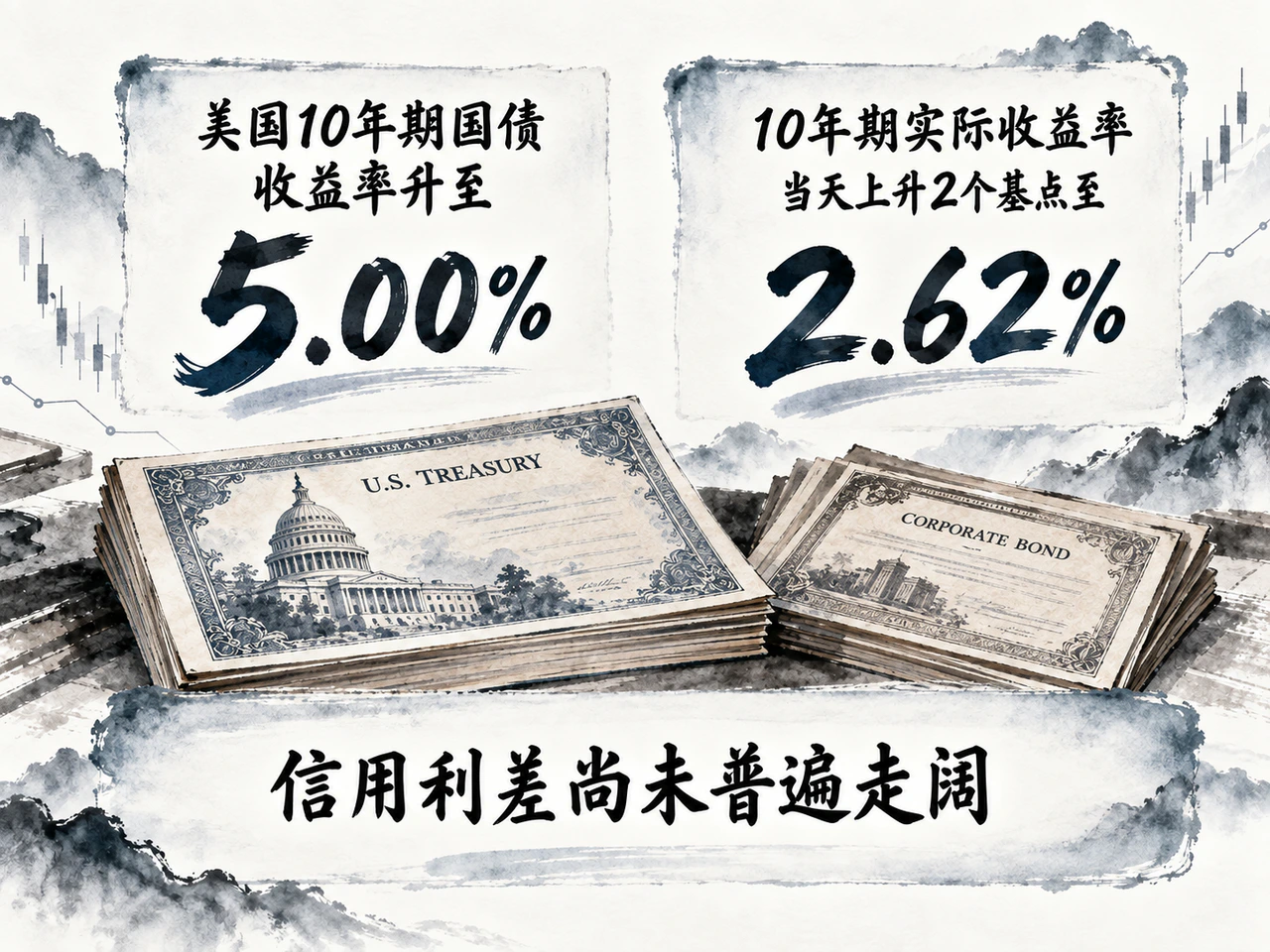
The Treasury's September 15 daily yield curve showed small increases across maturities, with the ten-year reaching 5.00%. Changes versus September 14 closes on the same basis were:
| Maturity | September 15 yield | Change from previous session |
|---|---|---|
| 2-year | 4.67% | +2bp |
| 5-year | 4.83% | +3bp |
| 10-year | 5.00% | +3bp |
| 30-year | 5.36% | +2bp |
The ten-year/two-year spread widened one basis point to 33 basis points, while the 30-year/five-year spread narrowed one basis point to 53. The curve shifted upward, with slightly larger gains in intermediate yields. Reuters and CNBC reported that the ten-year yield touched 5.041% intraday, its highest since 2007, before easing.
Rate-hike expectations continued constraining the short end. CNBC cited CME data during September 15 trading putting the probability of a 25-basis-point hike at that meeting above 92%. The rise in long yields was not driven solely by inflation expectations: the Treasury's ten-year real yield rose two basis points to 2.62%, and its five-year real yield rose two basis points to 2.42%. Higher real rates meant stronger financing constraints on companies and households.
Fiscal financing needs drew greater attention. At a September 15 congressional hearing, Treasury Secretary Bessent acknowledged that higher long yields reflected issues including the need to address deficits, while endorsing recent Treasury buybacks of long-dated debt. Goldman Sachs rates strategist George Cole said buybacks could improve liquidity and adjust maturity supply, but overall rates still depended on growth, inflation and public- and private-sector funding demand.
Fiscal pressure had not yet manifested in obvious sovereign-credit concerns. JPMorgan's September 15 research, using data through September 8, found no unusual Treasury underperformance against matched-maturity swap rates and orderly auctions. Reuters reported the same day that U.S. sovereign credit-default swaps had fallen to their lowest since February. These signals meant rising Treasury yields alone could not establish worsening sovereign-credit risk.
Companies were also demanding more long-term funding. Another JPMorgan report that day said public dollar-market AI-related bond issuance had reached $260 billion by August 20, including about $180 billion from five large cloud-computing companies. It attributed wider spreads in some investment-grade cloud bonds mainly to issuance timing and uncertainty about future supply, without a broad spillover across investment grade. Lower-rated issuers' debt-servicing ability depended more heavily on realizing future earnings.
Asian dollar bonds showed some resilience. Bloomberg reported on September 15 that Asian high-yield dollar bonds had returned 4.3% year to date, versus 1.8% for U.S. peers, although the Asian category's overall September return was -0.4%. Lower local-currency borrowing costs, fewer defaults and limited supply supported relative performance. Year-to-date nonfinancial high-yield dollar issuance in Asia excluding Japan rose 20% to about $12 billion, recovering from a low base.
For companies able to switch to local-currency borrowing, lower domestic rates can ease dollar refinancing pressure. Stable credit spreads do not mean stable financing costs, however: higher benchmark rates can still raise new-issue and refinancing costs. Maturity dates, revenue currencies and the ability to switch funding channels determine when rate pressure reaches actual interest expense.
New York manufacturing orders cool as price pressure keeps rising
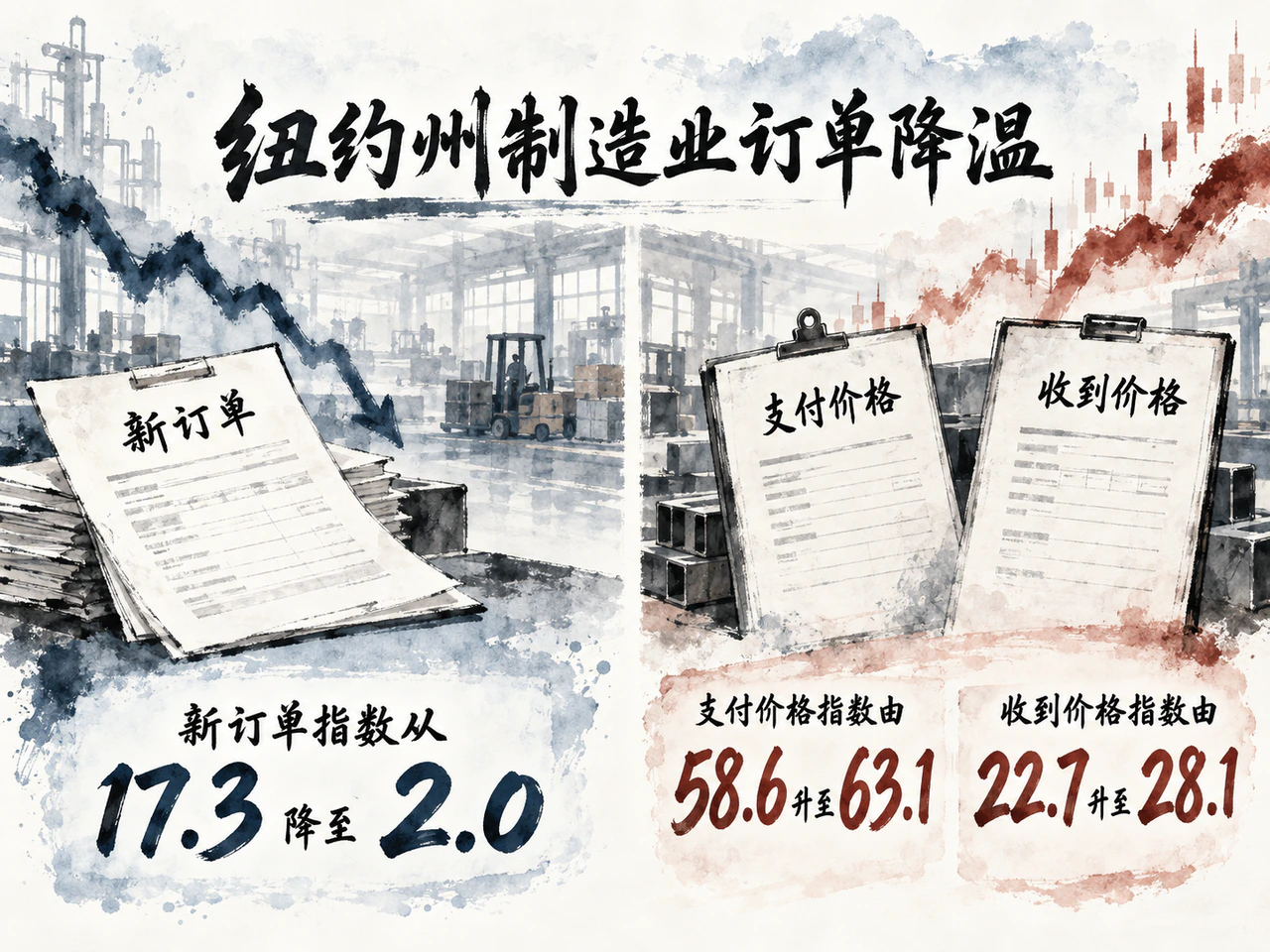
The New York Fed's September manufacturing survey showed the general business conditions index falling from 20.6 in August to 7.6, below the 15.0 consensus reported by InvestingLive. The positive reading still indicated expansion, but at a much weaker pace.
Orders and shipments changed more sharply. New orders fell from 17.3 to 2.0 and shipments from 11.7 to -3.2, while inventories rose from -5.2 to 8.9. Only modest order growth, declining shipments and rising stocks increased businesses' inventory-clearance pressure.
Employment and prices did not cool alongside them. Employment rose from 9.3 to 10.6, and average hours from 6.9 to 17.0, a nearly five-year high. Prices paid increased from 58.6 to 63.1 and prices received from 22.7 to 28.1, showing rising input costs and selling prices. Supply availability and delivery times improved slightly from the previous month, though supply remained tight.
Slower orders intensified growth concerns, while higher price pressure made rapid monetary easing difficult. This survey covers only New York manufacturers, however, and movements in diffusion indices cannot establish national stagflation. Future business conditions remained at 29.0, also showing that respondents had not become universally pessimistic.
The preliminary U.S. August retail-sales release was scheduled for 20:30 September 16 Beijing time. Whether consumption cooled alongside manufacturing orders would help assess the economy's capacity to withstand high rates. Renewed energy-price increases also sharpened attention on whether weaker demand could ease inflation.
Disrupted crude deliveries lift oil; dollar and real yields weigh on gold
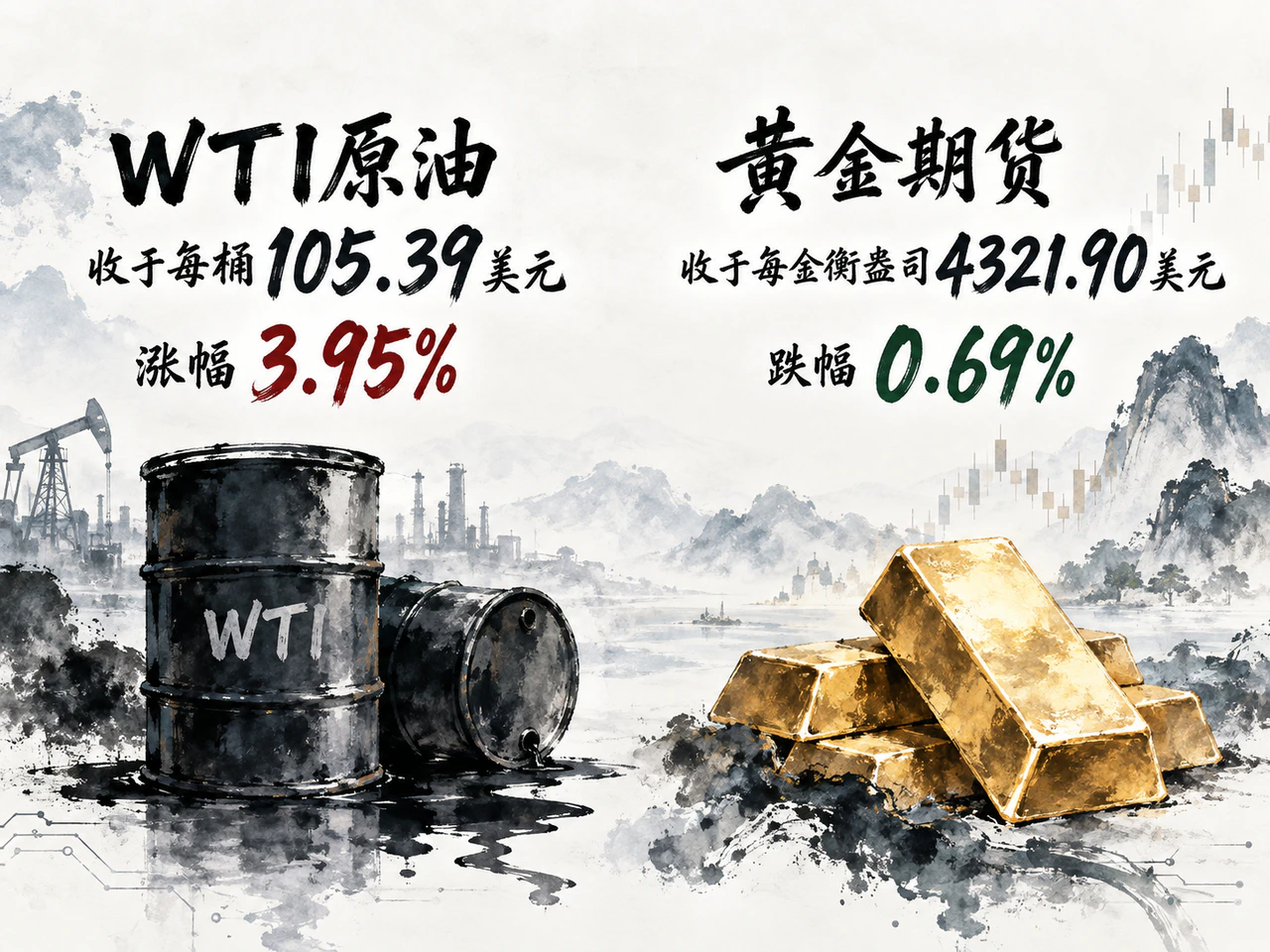
On September 15, vendor daily closes for continuous futures put WTI at $105.39 a barrel, up $4.00 or 3.95%, and Brent at $108.44, up $2.76 or 2.61%.
Concrete delivery disruptions were already behind the rise. Reuters cited shipping sources saying Saudi Arabia's Yanbu export terminal had suspended loading and some European customers received cancellations for late-September cargoes. Andy Lipow of Lipow Oil Associates said European refiners might turn to U.S. supplies, helping explain WTI's larger gain. Middle Eastern transport problems were affecting other crude markets through cargo cancellations and substitution.
The timing of supply recovery remained uncertain. Energy Secretary Chris Wright said Saudi Arabia's East–West pipeline should resume flows within days, while repair estimates cited by Goldman Sachs ranged from a rapid restart to eight weeks. Demand was also under pressure from high prices: the IEA's September 11 report projected that global oil demand would fall by 2.5 million barrels a day year on year in 2026. Supply constraints and weaker demand coexisted. The rise primarily reflected delivery risk and did not demonstrate strong demand.
Trade policy could further alter procurement costs. The Guardian reported on September 15 that a Russia-sanctions bill advancing in the House would cover Russian energy, defense and the shadow fleet, and authorize tariffs of up to 100% on major Russian-oil buyers. Further votes were still pending, with effects dependent on the final text, targeted parties and exemptions. Implementation could reroute crude trade and raise some buyers' import costs, but no tariff shock had yet taken effect.
Gold faced dollar and rate pressure. On the same vendor basis, gold futures closed at $4,321.90 a troy ounce, down $30 or 0.69%, while the dollar index gained 0.22% to 99.68. A stronger dollar and higher real rates increased the opportunity cost of holding gold, offsetting some safe-haven demand.
Reuters cited IG analyst Tony Sycamore saying gold could face further pressure if the Fed presented this move as the start of consecutive hikes, while a more moderate tightening pace could support it. Beyond the size of the immediate increase, the duration of higher rates was equally important for gold.
U.S. stocks fall broadly; chip rebound fails to reverse market losses
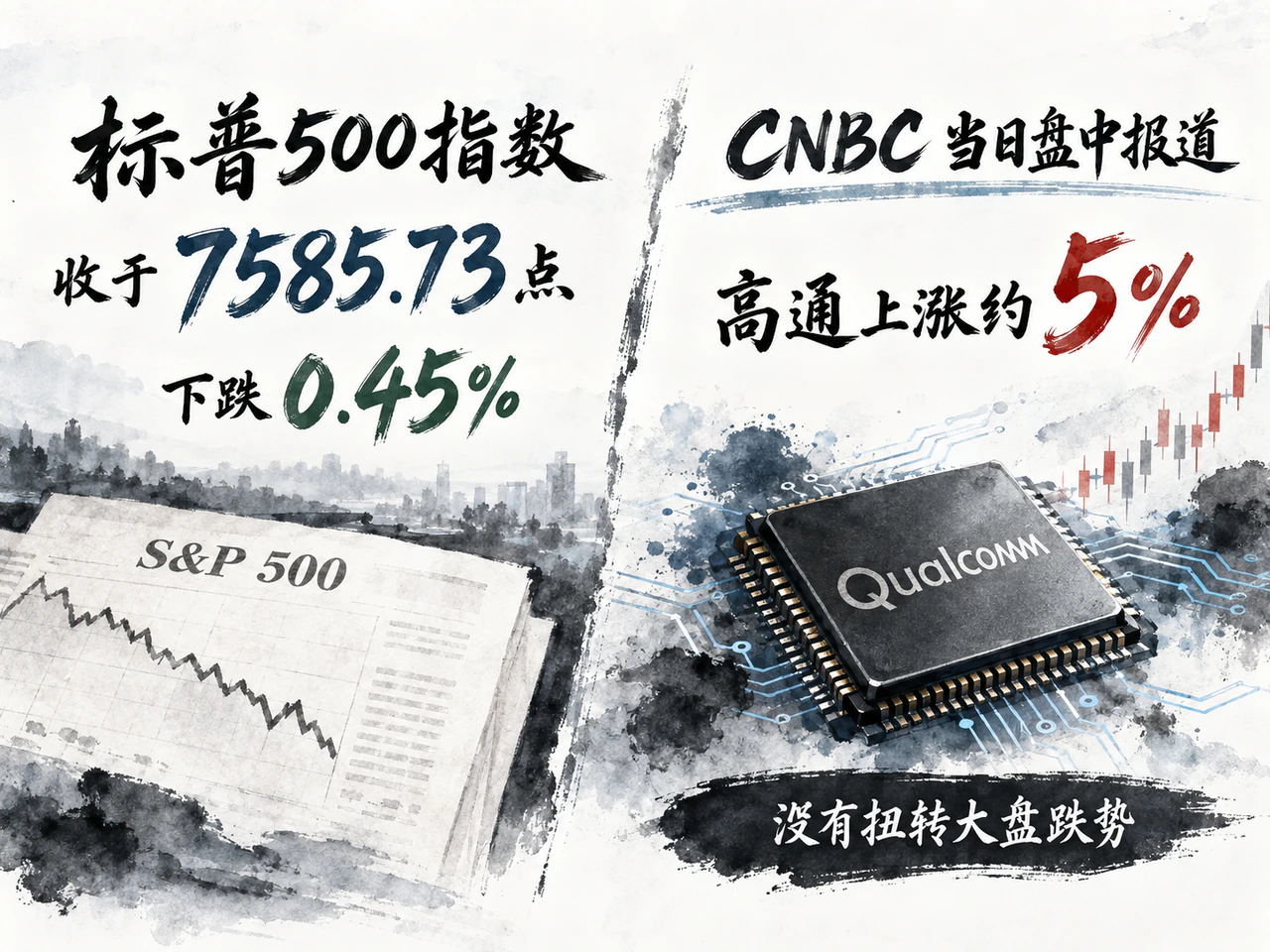
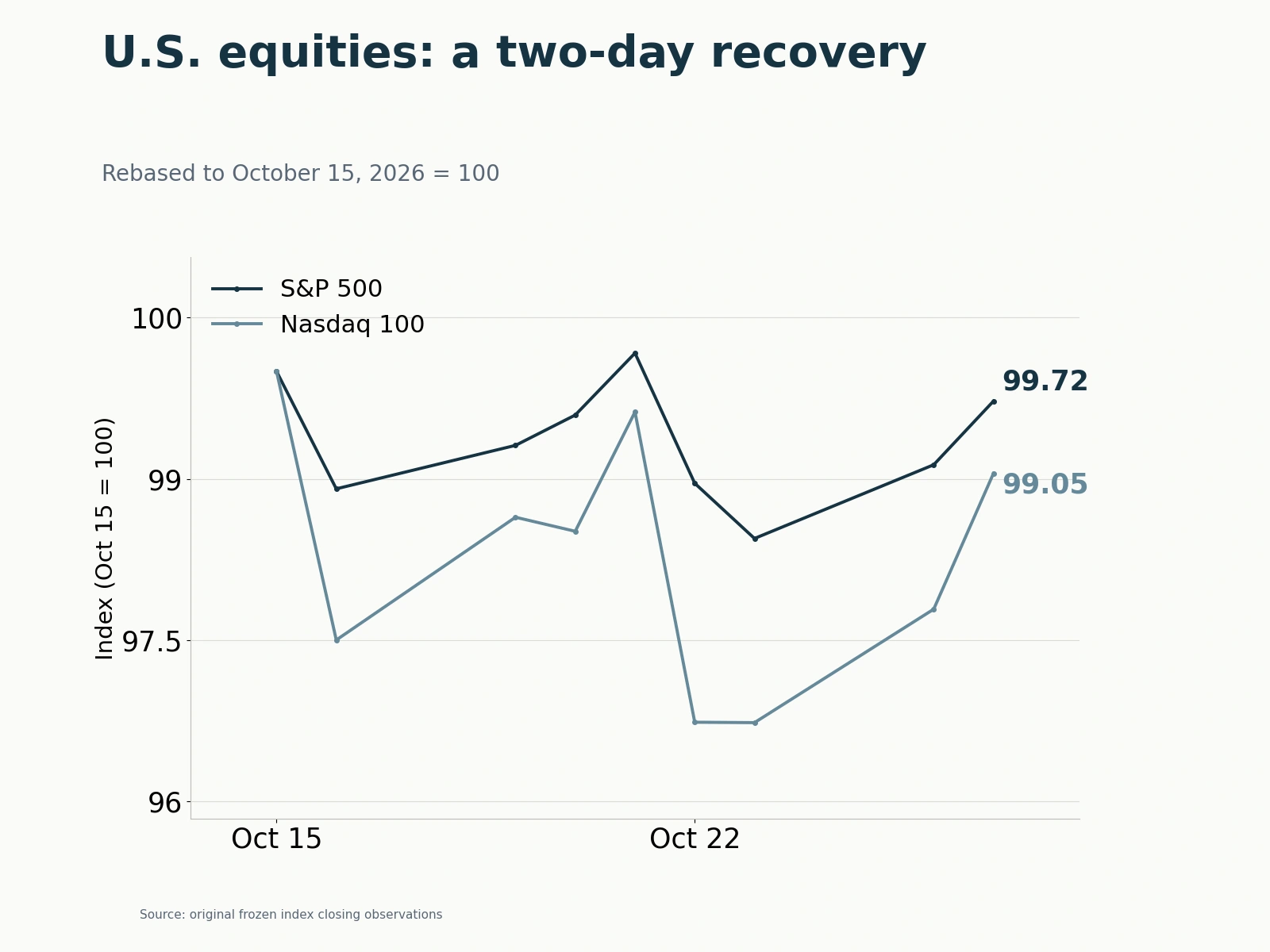
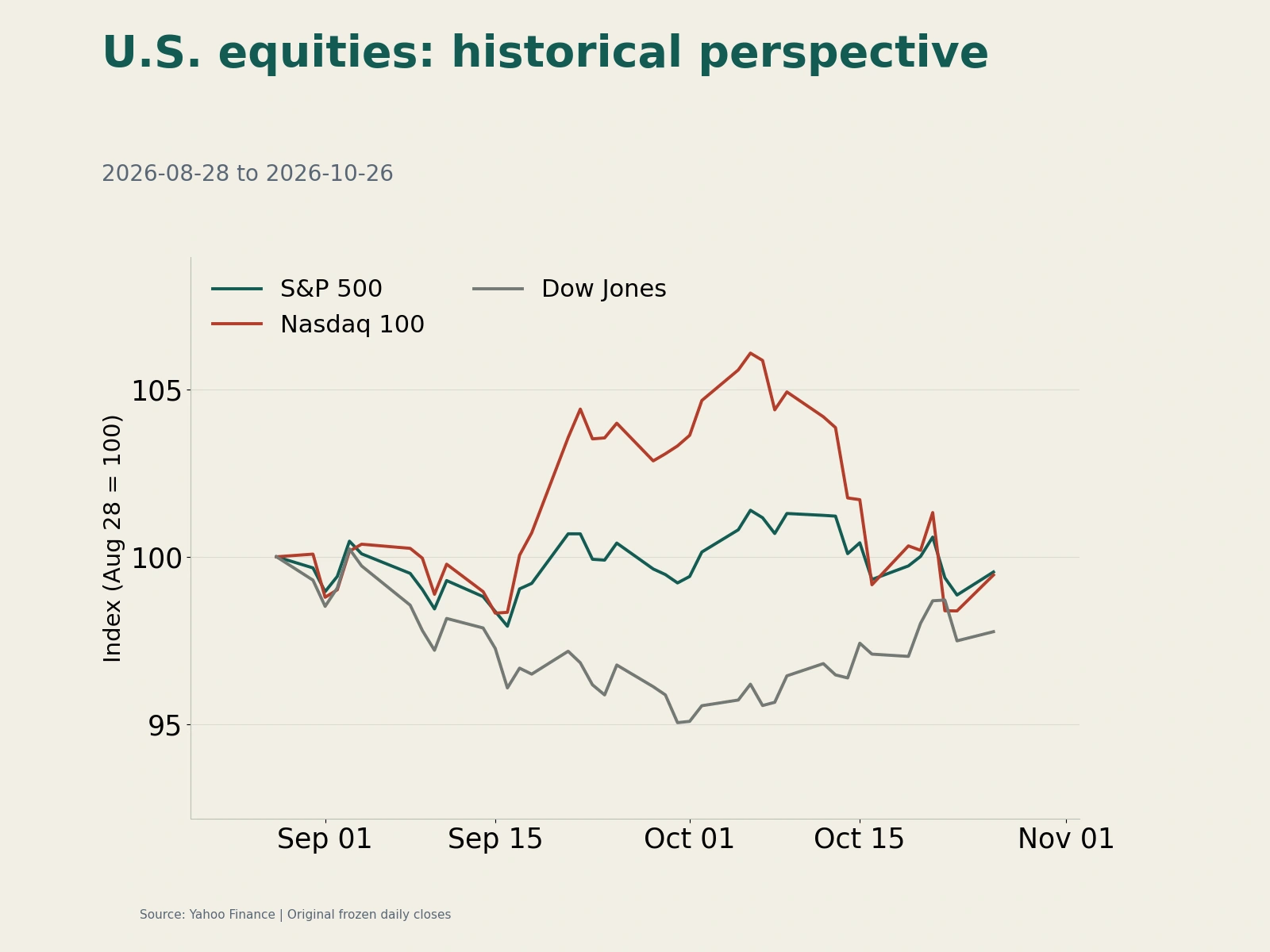
Major U.S. indices all closed lower on September 15. The S&P 500 finished at 7,585.73, down 0.45%; the Nasdaq 100 at 28,937.84, down 0.65%; the Dow Jones Industrial Average at 52,093.11, down 0.63%; and the Russell 2000 at 2,870.29, down 0.76%. Small caps fell more, but VIX rose just 0.10 point to 17.20, a limited volatility increase.
High rates were also reducing the appeal of some defensive sectors. CNBC reported intraday that utilities ETF XLU fell about 1% to $41, reaching a 52-week low, while NRG Energy and Exelon also touched lows of at least 52 weeks. Higher Treasury yields reduced the relative appeal of utility dividends. Barclays strategists said earnings growth had previously offset rate-driven valuation pressure, but with the ten-year yield near 5%, high-rate constraints would become more persistent.
Some chip stocks rebounded. CNBC's intraday report showed AMD up about 2%, Qualcomm about 5% and Coherent more than 1%. The day before, discussion of slower AI development hit hardware shares: Nvidia fell 3.4% and the Philadelphia Semiconductor Index 5.9%. Tuesday's recovery eased some pressure without reversing broader market losses.
Disagreement over AI development speed persisted. At Dreamforce that day, Anthropic CEO Dario Amodei supported slowing the pace of model capability gains, while Nvidia CEO Jensen Huang argued that speed and safety could coexist. Salesforce and Nvidia also announced a new Nemotron-based reasoning model for Agentforce. Safety constraints on frontier development were proceeding alongside continued application launches, warranting attention to their effects on capex, hardware orders and actual revenues.
Data-center cost allocation also entered the policy agenda. Politico reported that day that a House data-center electricity bill would establish a framework for states to ensure data centers paid their own power costs. The bill was still under consideration, but who pays for additional grid investment would affect project returns and utilities' cost recovery.
Crypto was hit by stalled regulatory legislation. On September 15, the Senate failed to advance a procedural motion on the Clarity Act, leaving blocked a proposed framework allocating SEC and CFTC responsibilities and establishing registration and AML requirements. At CNBC's reporting time, Bitcoin, Coinbase and Circle were down around 3%, 8% and 10%, respectively. These were contemporaneous quotes in a falling broader market. The legislative setback further delayed regulatory clarity and increased operating uncertainty.
Chinese industrial growth accelerates while consumption and investment remain weak
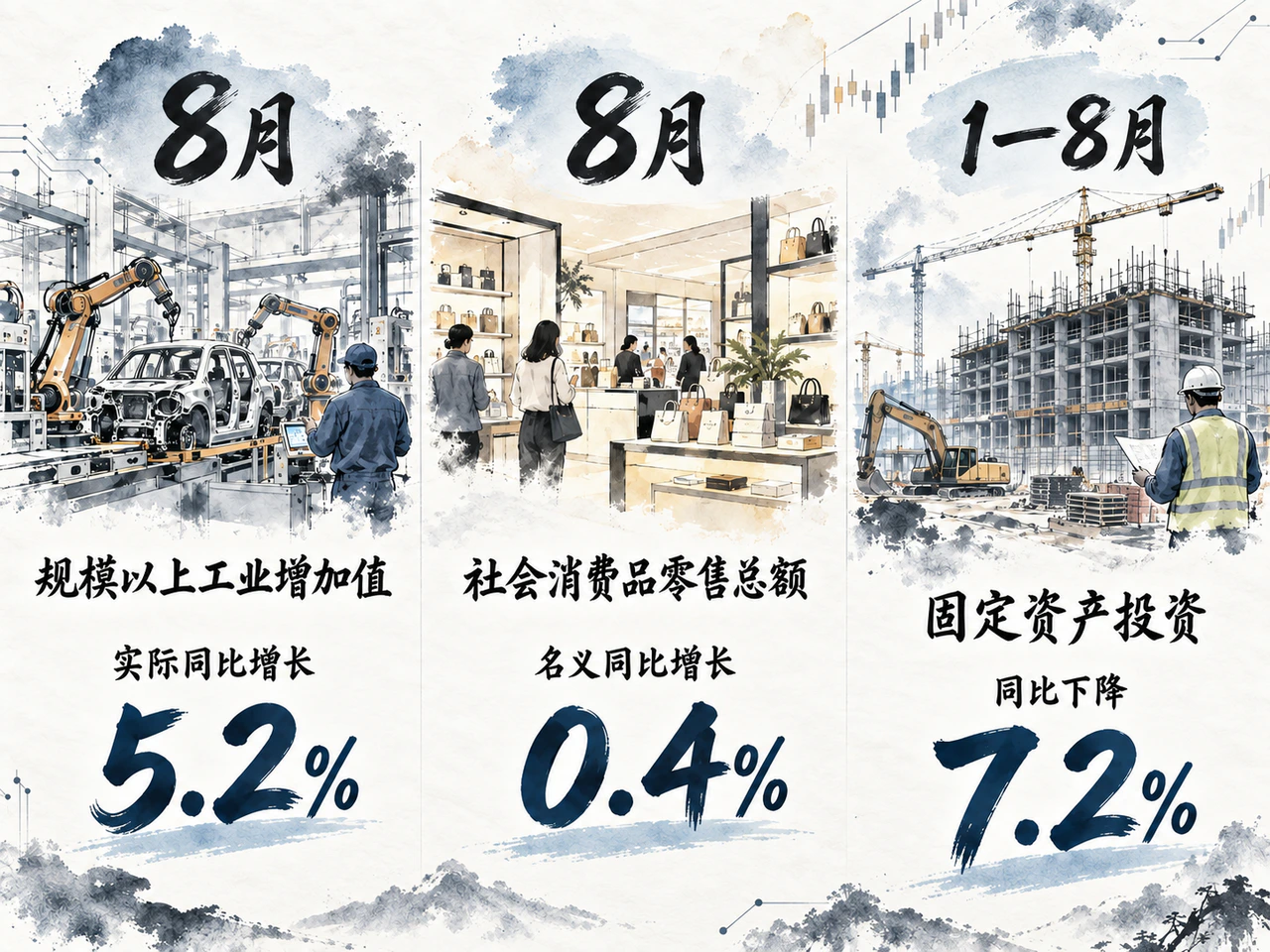
China's August data released September 15 showed industry outperforming consumption and investment. Real value added at industrial enterprises above designated size rose 5.2% year on year, 0.7 percentage point faster than July and above the 4.8% consensus cited by CNBC. Equipment manufacturing and high-tech manufacturing grew 12.1% and 16.7%, respectively, much faster than industry overall.
Consumption growth remained slow. August retail sales totaled 3.9824 trillion yuan, up a nominal 0.4% year on year, below July's 0.6% and the 0.8% consensus; sales fell 0.13% month on month. Services consumption performed relatively better: January–August service retail sales rose 4.9%, above the 1.0% growth in goods sales.
The investment contraction deepened. January–August fixed-asset investment fell 7.2% year on year, 0.5 percentage point more than in January–July. Property-development investment fell 19.9%, infrastructure 4.0% and manufacturing 2.3%. Excluding property development, investment still declined 4.2%. Weakness extended beyond property, although high-tech industry investment rose 5.2%, with some areas still growing.
The surveyed urban unemployment rate rose to 5.3% in August, up 0.1 percentage point from July. The statistics bureau attributed this mainly to the seasonal entry of graduates into the labor market. Unemployment among the core 30–59 age group stayed at 3.9%. A seasonal increase could not simply be equated with an overall deterioration in employment.
Whether fiscal funding could quickly turn into actual spending was especially important. The statistics bureau said central-budget investment allocations were largely complete, local special-bond issuance and use were accelerating, and funds from new policy-based financial instruments would be deployed promptly. Those funds would gradually support domestic demand once converted into construction, procurement and business cash flow. Zhang Zhiwei of Pinpoint Asset Management said fiscal transmission took time and growth still faced downside risks.
Asian markets were mixed on September 15. The Nikkei 225 edged down 0.01% to 63,484.10 and TOPIX fell 0.52%; South Korea's KOSPI lost 0.85% to 6,627.26 while KOSDAQ rose 0.70%; Hong Kong's Hang Seng fell 1.00% to 24,667.24. These were local Asian closes, preceding that day's U.S. cash-market close.
On the vendor's September 15 daily series, USD/JPY rose from 153.424 to 154.385 and USD/KRW from 1,344.64 to 1,345.61. Weaker local currencies helped translate some exporters' revenues but increased energy-import costs. Japanese and Korean semiconductor companies also faced uncertainty over AI investment schedules, while Hong Kong growth stocks were exposed to dollar rates, earnings and mainland demand. With both rates and energy costs rising, the ability of revenue growth to cover incremental costs would continue differentiating companies and assets.