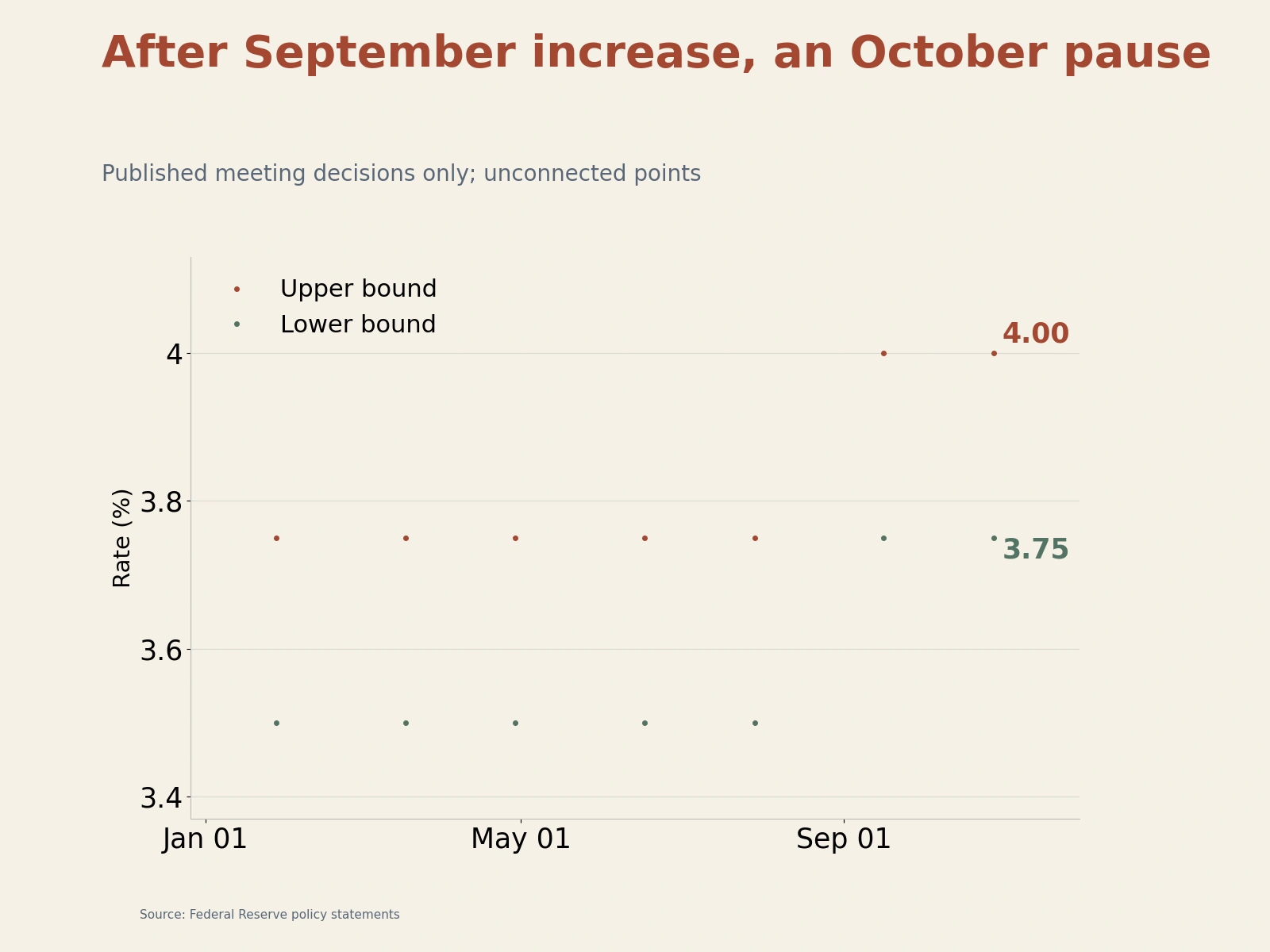
After the Fed's unanimous 12–0 vote on September 16 to raise the funds target 25 basis points to 3.75%–4%, real-economy pressure from continued restraint quickly became a focus. Fed data released September 18 showed August industrial production unchanged month on month, but its core manufacturing component fell 0.3%, ending seven consecutive monthly gains. This marginal weakening adds a practical growth constraint to further tightening, but one industrial-sector decline is insufficient to change the Fed's anti-inflation stance.
Sector divergence masks manufacturing weakness; equipment and construction slow
August industrial production failed to repeat July's 0.2% monthly increase. A flat aggregate concealed considerable divergence: mining rose 0.1% and utilities 1.8%, numerically offsetting manufacturing's decline.
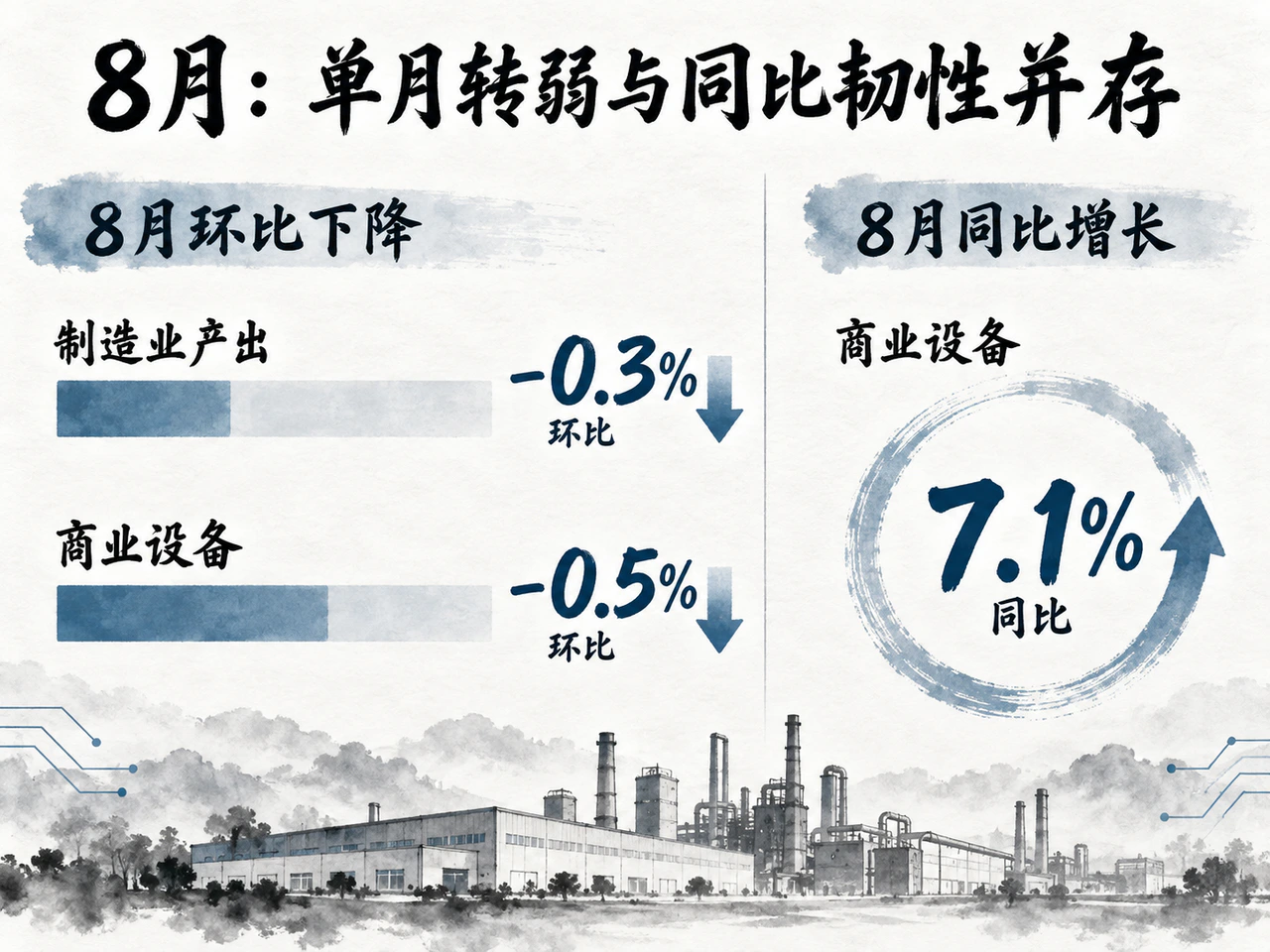
Manufacturing showed structural weakness. Durable output fell 0.5% with broad category declines; nondurables were flat. By end use, business equipment fell 0.5% and construction supplies, closely linked to property and infrastructure starts, 0.7%, indicating slower investment- and construction-related production. August manufacturing utilization fell 0.3 percentage points to 75.7%, 2.5 points below its 1972–2025 average, showing no broad industrial capacity tightness.
Lower utilization and contracting components add a growth constraint to tightening, but one month's output cannot establish causation. August business-equipment output still grew 7.1% year on year and total industrial production 1.4%. The monthly decline looks more like marginal cooling within expansion than an established equipment-production turning point. August output also preceded September's hike and should not be simply attributed to it.
Industrial cooling does not determine services inflation; capital-regulation reform is not a policy pivot

For the Fed, cooler industry does not mean inflation pressure has eased in tandem. Industrial data mainly cover capital-intensive manufacturing, mining and utilities, and cannot fully represent services demand and labor tightness, which matter more for current prices. The release weakens the assumption that all sectors are overheated, but does not justify ending tightening before more representative price measures fall.
Regulatory adjustments also require perspective. At the Lord Mayor of London's luncheon that day, supervision Vice Chair Bowman said the Fed planned to consider final stress-test framework revisions in coming weeks, proposing to average the last two years' results when calculating stress capital buffers, or SCBs, to smooth annual volatility. She stressed improved predictability without materially changing aggregate statutory bank capital. This helps banks plan capital and medium- to long-term credit more steadily, but is a technical macroprudential adjustment rather than broad credit easing or a monetary-policy pivot.
Key data must validate the macro direction: August PCE and final GDP

With early production weakness alongside sticky inflation, the rate path will depend more on subsequent comprehensive data.
Markets closely await the September 30 August personal income and outlays report. Its PCE prices will reveal core inflation and services-consumption developments; the same day's third, final second-quarter GDP estimate will refine assessment of earlier expansion. Sticky prices with continuing production weakness would intensify a stagflation-style balancing problem. If demand and inflation ease together, further tightening may become less necessary.