On September 24, 2026, long-term U.S. Treasury yields and international oil prices rose together, gold edged lower under pressure, and major U.S. stock indices recovered from intraday lows to finish near flat. Low layoffs highlighted labor-market resilience and weakened expectations of a rapid Fed turn toward easing. Weak demand at a new Treasury auction and rising Middle Eastern supply risks added significant upward pressure on long-term benchmarks. Narrow headline equity moves concealed deep internal divergence: resilient technology heavyweights obscured declines across most sectors and divisions within AI supply chains facing delivery constraints.
Labor resilience and weak auction demand lift the 10-year yield 7 basis points to 5.18%
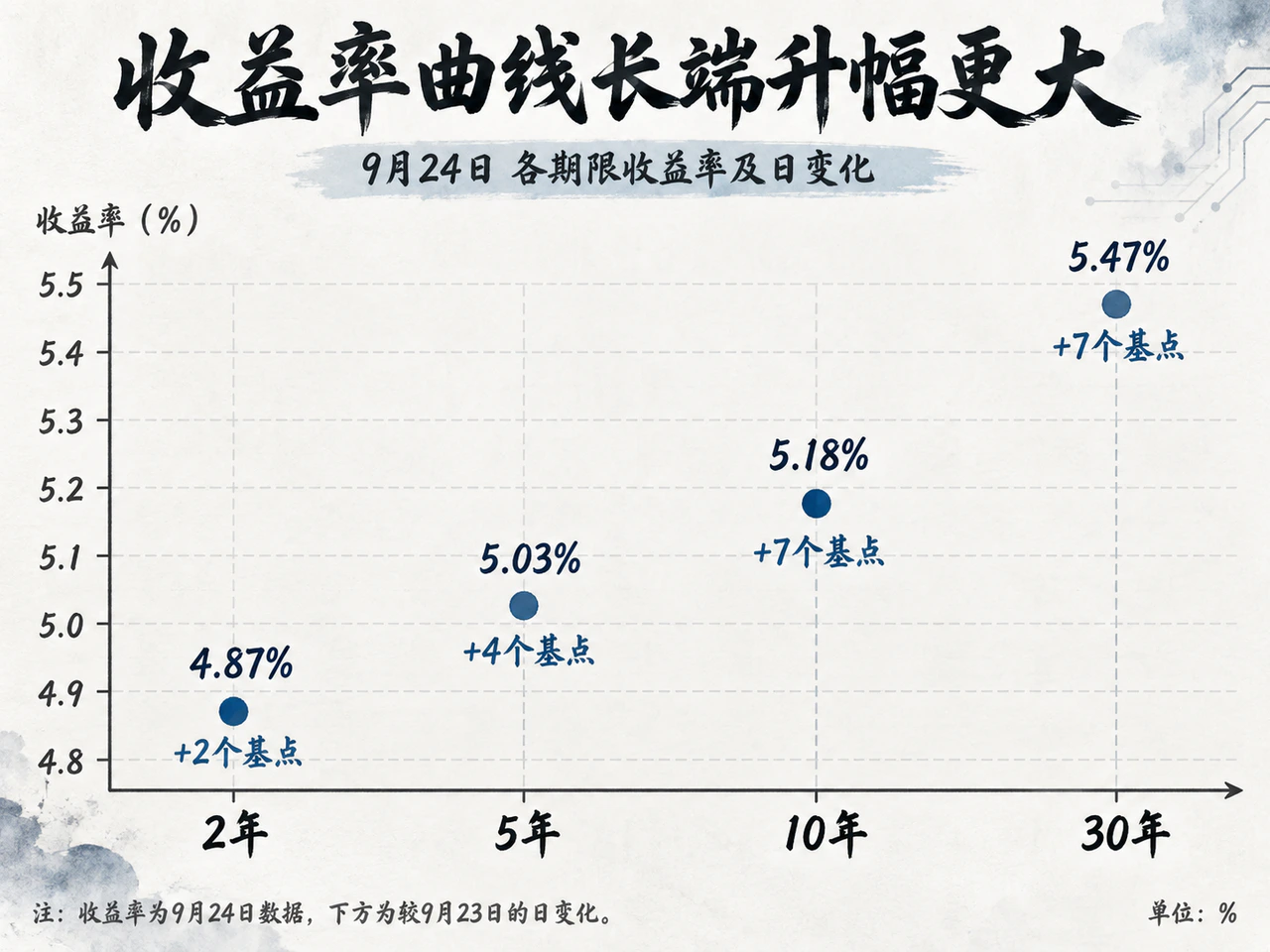
The Treasury's official curve showed yields higher across maturities on September 24 in a typical bear steepener. The 2-year edged up 2 basis points to 4.87%; the 10- and 30-year each rose 7 basis points, to 5.18% and 5.47%. The 10-year/2-year spread widened from the previous session's 26 basis points to 31.
| Maturity | September 23 | September 24 | Daily change |
|---|---|---|---|
| 2-year | 4.85% | 4.87% | +2 basis points |
| 5-year | 4.99% | 5.03% | +4 basis points |
| 10-year | 5.11% | 5.18% | +7 basis points |
| 30-year | 5.40% | 5.47% | +7 basis points |
Labor-market resilience supported short rates. Labor Department data showed initial claims of 197,000 in the week ended September 19, below Reuters consensus of 201,000. The previous week was revised from 196,000 to 198,000, and the four-week average fell to 202,250. Low layoffs indicated a stable employment foundation and reduced expectations of rapid Fed easing. Continuing claims edged up to 1.719 million in the week ended September 12.
Poor absorption of Treasury supply directly intensified long-end selling. Dow Jones reported weak demand for the day's $44 billion 7-year auction, with a 5.085% yield and a tail of about 0.7 basis points. Bid-to-cover fell from 2.50 to 2.42, while indirect bidders, representing nondealer institutions and overseas investors, received 57.2%, down from 61%. Higher nominal yields did not draw enough marginal allocation demand. Although the Treasury bought back about $4.08 billion of long bonds that day, below the $6 billion cap, new supply combined with inflation expectations to pressure long bonds overall.
Housing and external accounts showed high rates reaching the real economy. August new-home sales were a seasonally adjusted annualized 684,000, up 6.4% from July but down 2% year on year. The median price fell 5.8% annually to $393,700, with inventory equivalent to 8.5 months of sales. Reuters cited Freddie Mac data showing the 30-year fixed mortgage rate rising from 6.95% to 7.03% that week. Lower prices supporting volumes showed rate-sensitive demand still strained. A wider goods trade deficit also expanded the Q2 current-account deficit 15.7% to $246 billion, from 2.7% to 3.0% of GDP.
Geopolitical disruption lifts Brent above $106; higher yields and dollar weigh on gold
On the provider's daily closing basis for continuous futures, Brent rose 2.93% to $106.10 a barrel on September 24, and WTI gained 2.03% to $94.03. Gold futures edged down 0.25% to $4,307.70 a troy ounce. The dollar index strengthened 0.15% to 101.248.
Geopolitics dominated crude's risk premium. Reuters reported the Saudi-led coalition saying it intercepted six Houthi ballistic missiles, thwarting attacks on Taif and Yanbu. The news raised concerns about Middle Eastern crude supply and shipping stability. Later reports of U.S.-Iran discussions on reopening the strait narrowed gains, but expected supply disruption still supported oil despite dollar strength.
Product-trade policy added volatility. Bloomberg reported that U.S. officials denied rumors the White House was considering a 90-day diesel-export suspension, although restrictive options remained under discussion. JPMorgan estimated that a 30-day export restriction combined with Jones Act waivers could lower domestic retail diesel to around $4.70 a gallon within 15 days. This might compress refinery cracks and reduce processing, worsening overseas diesel premiums.
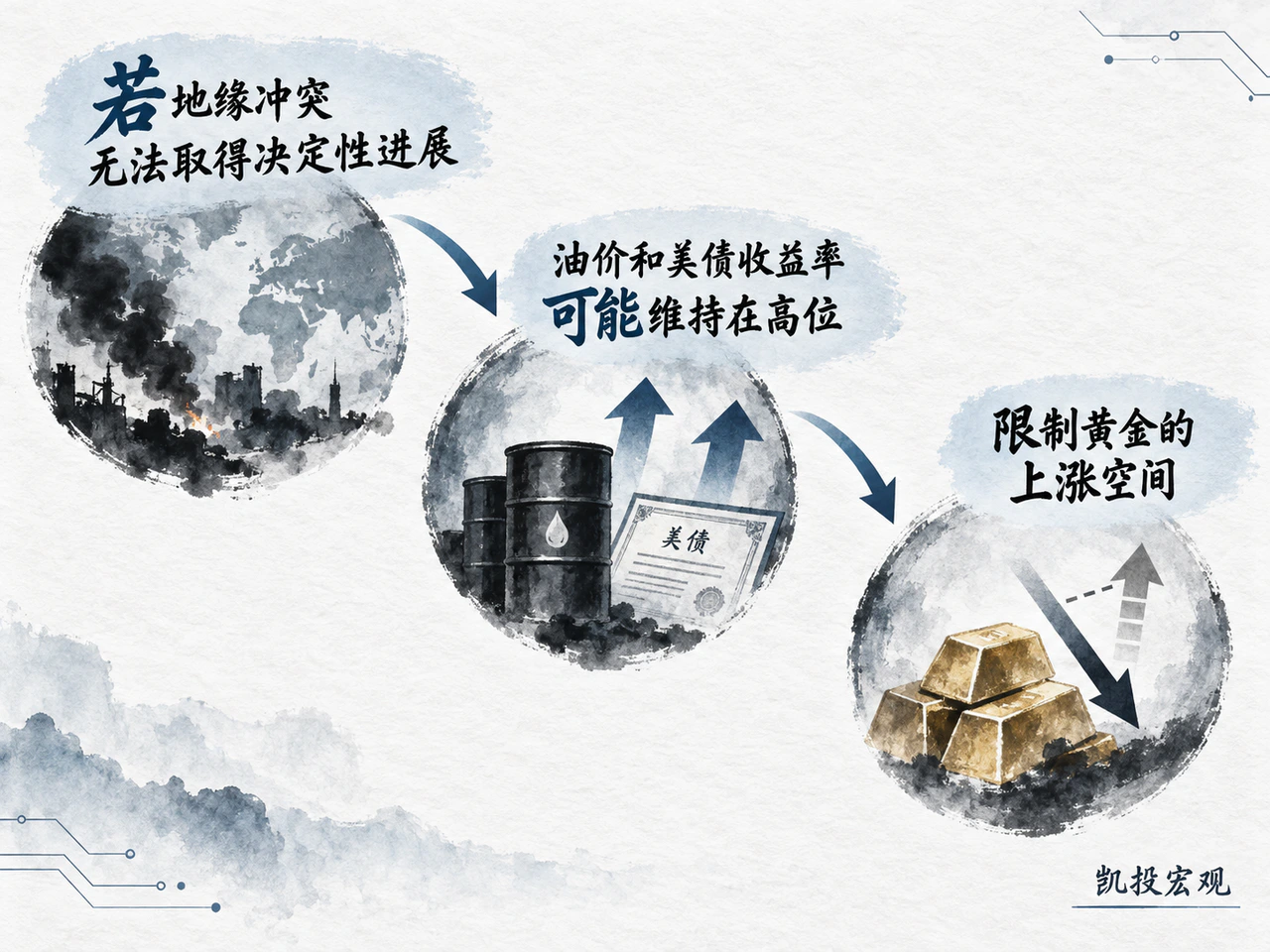
Commodities diverged markedly, with non-interest-bearing gold pressured by higher nominal Treasury yields and dollar strength. Capital Economics economist Hamad Hussain said that without decisive progress in the conflict, oil and Treasury yields might stay high and limit gold's upside.
Major U.S. indices consolidate near flat; AI commercialization and delivery paths diverge
U.S. equities traded in a narrow tug-of-war. The S&P 500 edged down 0.02% to 7,704.13; Nasdaq 100 edged up 0.03% to 30,478.86; Dow Jones fell 0.31% to 51,349.98; and Russell 2000 fell 0.11% to 2,835.57. The VIX rose 0.49 points to 15.67. Reuters counted declines in eight of the S&P's eleven sectors, with declining constituents outnumbering advancers 1.9:1. Resilience in leading heavyweights obscured broader weakness.
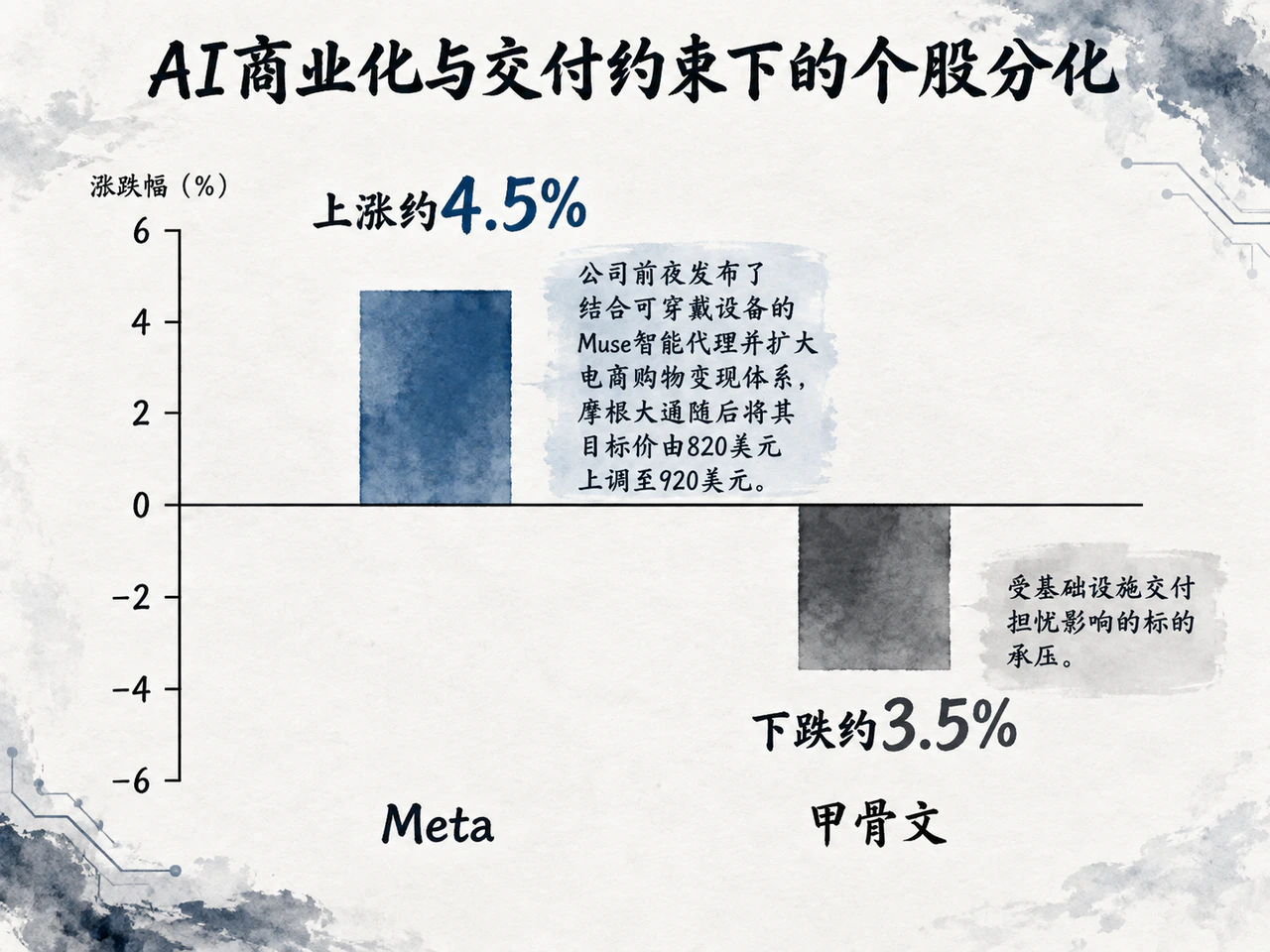
Technology divergence reflected different assessments of AI commercialization and physical delivery constraints. Meta rose about 4.5% against the trend after unveiling its Muse agent with wearables the previous evening and expanding e-commerce shopping monetization. JPMorgan raised its target from $820 to $920. Infrastructure-delivery concerns instead pressured Oracle, down about 3.5%. CNBC said Oracle had sent a force-majeure notice to the developer of New Mexico's Project Jupiter data center concerning payment protections if the project failed to open in 2028. Oracle emphasized construction was progressing, and investor Blue Owl said its long-term financial commitment was unchanged, but power and construction bottlenecks still alarmed markets. Hardware also fell: Arm about 8% and memory ETF DRAM about 2%.
Consumer businesses also showed mixed results. Online apparel platform Stitch Fix plunged around 22% on weak full-year revenue and earnings guidance. Costco's after-hours results showed channel resilience: Q4 net sales rose 11.2% to $93.873 billion; core comparable sales excluding currency and gasoline grew 6.7%; EPS was $6.75, including a one-time tariff-refund benefit of $0.15.
U.S.-China trade truce extended two months; China's central bank stresses moderate easing and policy coordination

There was marginal progress in geopolitical and macro policy. U.S. Treasury Secretary Bessent said on the evening of September 23 that the trade truce due to expire November 10 would be extended to January 10, 2027. The extension gave global supply chains more time for procurement scheduling and inventory handoffs, reducing the risk of a sudden near-term escalation in trade barriers.
Chinese macro policy retained a supportive orientation. The PBOC's September 24 account of its Monetary Policy Committee Q3 meeting stressed continued moderately accommodative policy, stronger fiscal-monetary coordination, lower economy-wide financing costs and a reasonable recovery in prices. It also called for attention to long-term government yields and irrational foreign-exchange expectations, balancing growth support with financial-asset valuations.
Major Asia-Pacific markets gradually reflected external developments following holidays. On September 24, Hong Kong's Hang Seng fell 0.3% to 24,761.13; the Nikkei 225 rose 0.8% from its previous actual session, September 18, to 65,513.99; South Korea was closed for Chuseok.
Dollar benchmarks stay high as offshore maturities and refinancing diverge by issuer
Higher long Treasury yields increased Chinese offshore issuers' dollar-refinancing benchmarks and repriced existing long-duration bonds. Repayment and funding arrangements differed across borrowers.
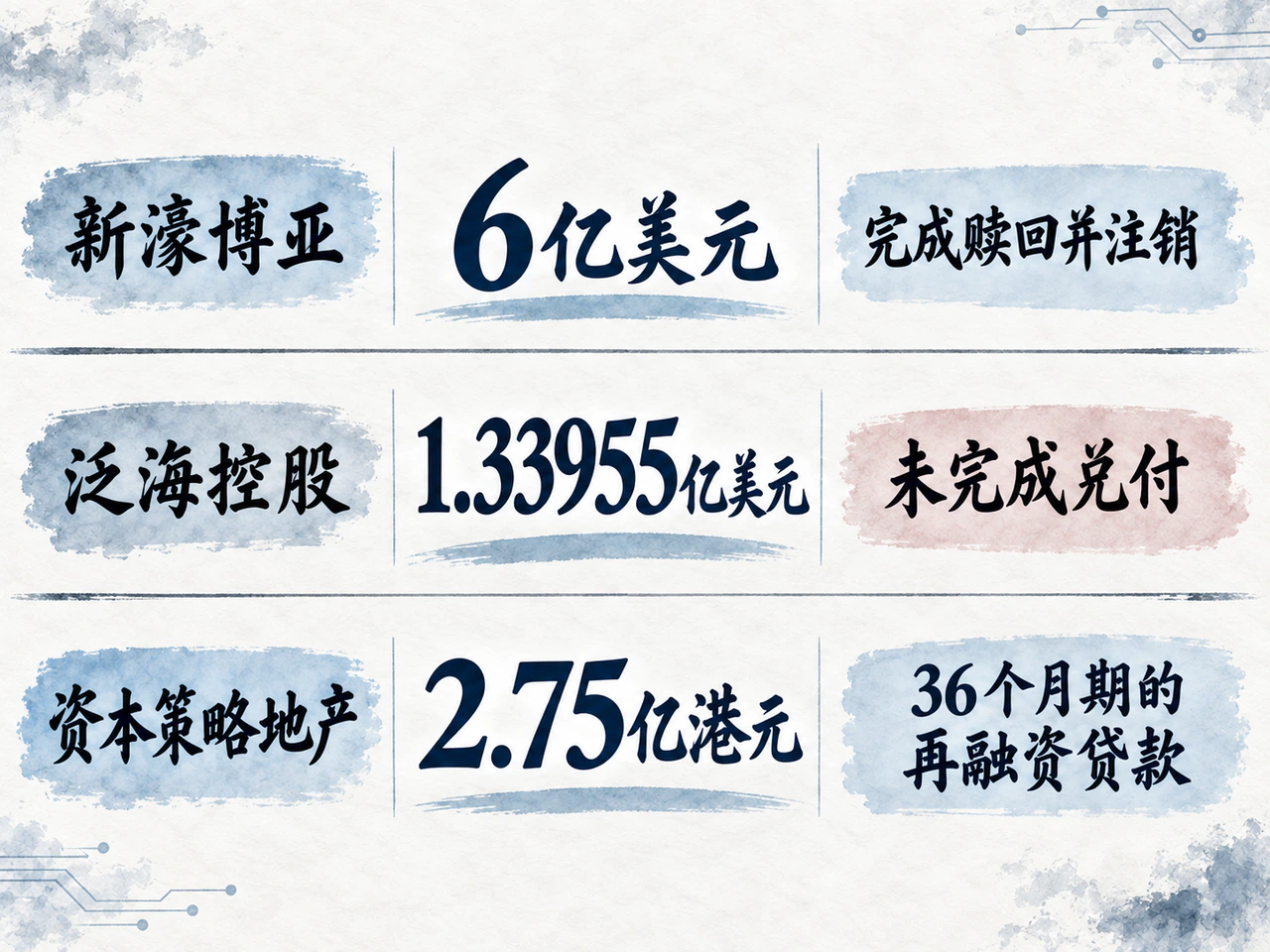
Duration Finance reported that Melco Resorts Finance completed redemption and cancellation on September 23 of all $600 million of its 5.625% senior notes due July 2027. Oceanwide Holdings, meanwhile, had not repaid a dollar bond with $133.955 million principal as of September 23. In bank credit, a CSI Properties subsidiary secured a HKD 275 million, 36-month refinancing loan. With dollar benchmarks remaining high, markets continued to focus on each borrower's maturity payments and liquidity rollover.