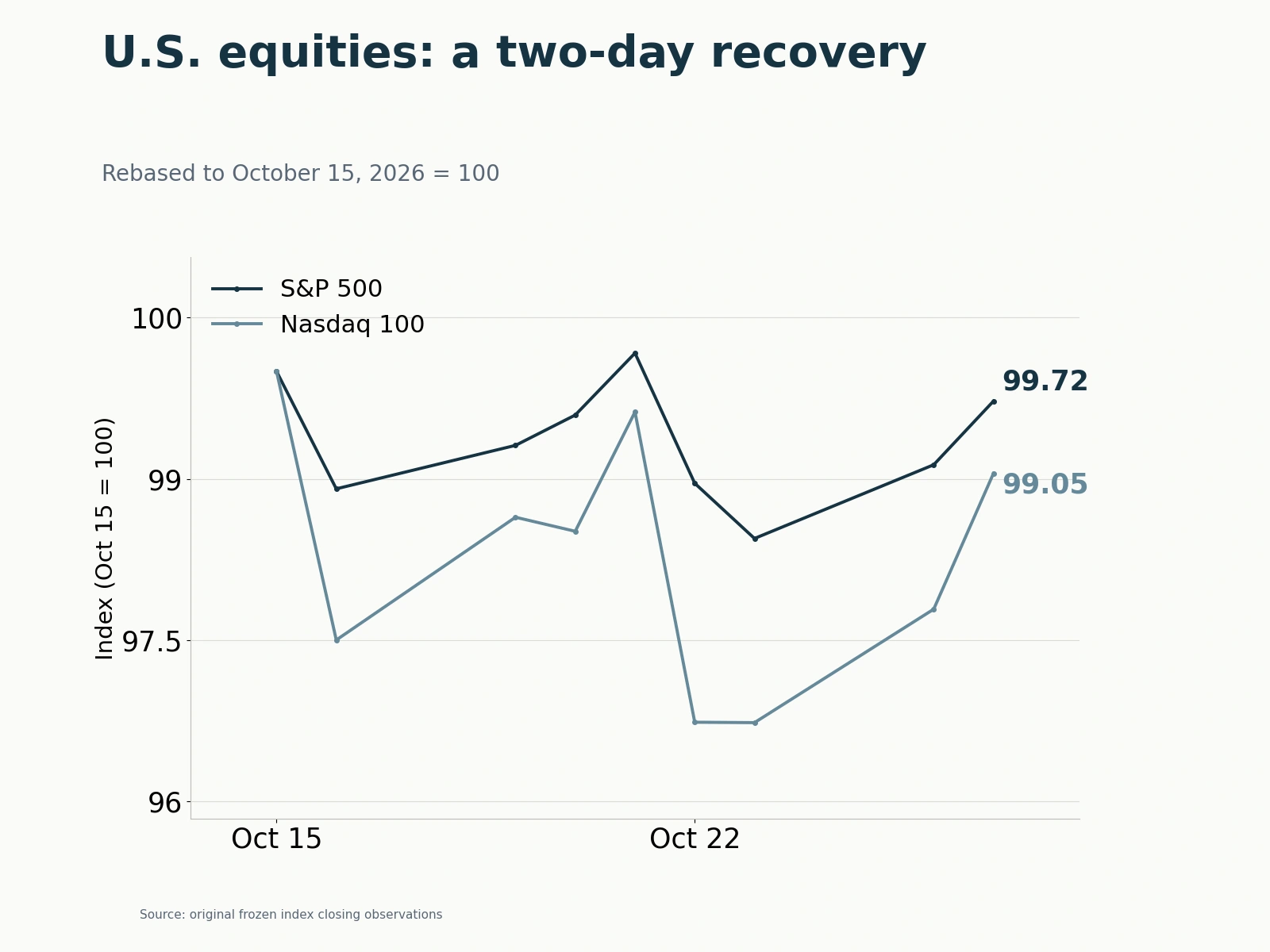
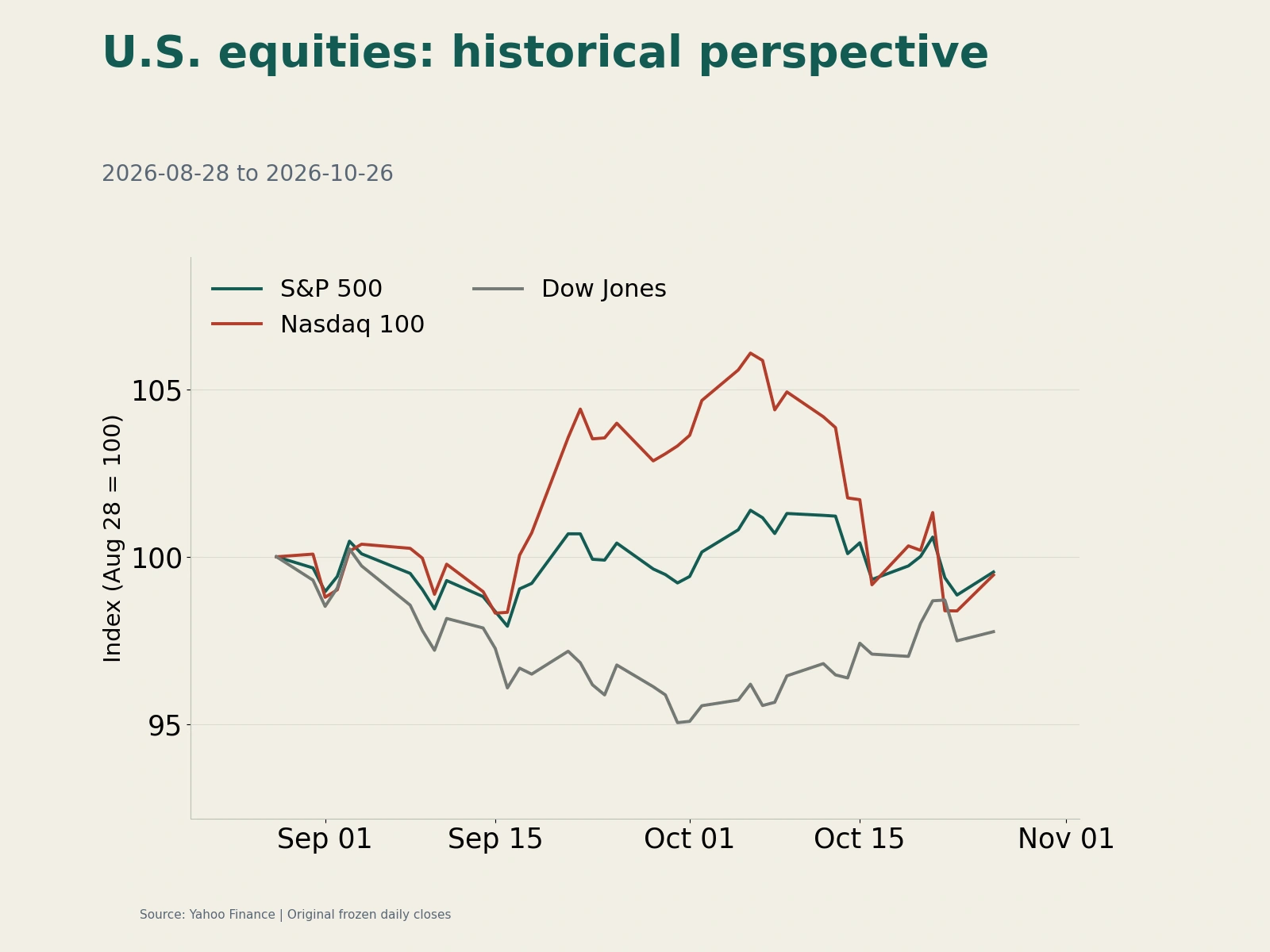
On September 30, 2026, softer-than-expected U.S. August core inflation failed to produce a broad stock-and-bond recovery. The two-year Treasury yield edged down one basis point to 4.88%, while ten- and 30-year yields rose to 5.29% and 5.64%, steepening the curve. Equities also diverged: technology leaders helped Nasdaq 100 gain 0.23%, while the S&P 500 and Dow fell amid broad sector pressure. Strong consumption and growth data reduced hopes for monetary easing; enormous corporate-bond supply and firm energy costs sustained long-term financing pressure. Global pricing diverged: computing orders and strong profits supported technology leaders, but persistently high capital costs tested firms' debt service and earnings delivery. China's manufacturing PMI returned to expansion that day, likewise facing improved production alongside cost pressure.
August core PCE misses expectations; strong consumption limits rate-cut hopes
BEA data showed August PCE prices up 0.3% month on month and 3.4% year on year, with core PCE up 0.2% and 3.0%. The monthly core increase was below ALM First's listed 0.3% forecast. Annual revisions lowered July's headline and core annual rates by 0.3 percentage points to 3.4% and 3.0%, and monthly increases from 0.2% to 0.1%. Reuters attributed the revisions mainly to methodological changes for software accessories, asset-management fees and legal services. On revised figures, August core annual inflation was unchanged and monthly inflation slightly firmer, showing an uneven disinflation path.
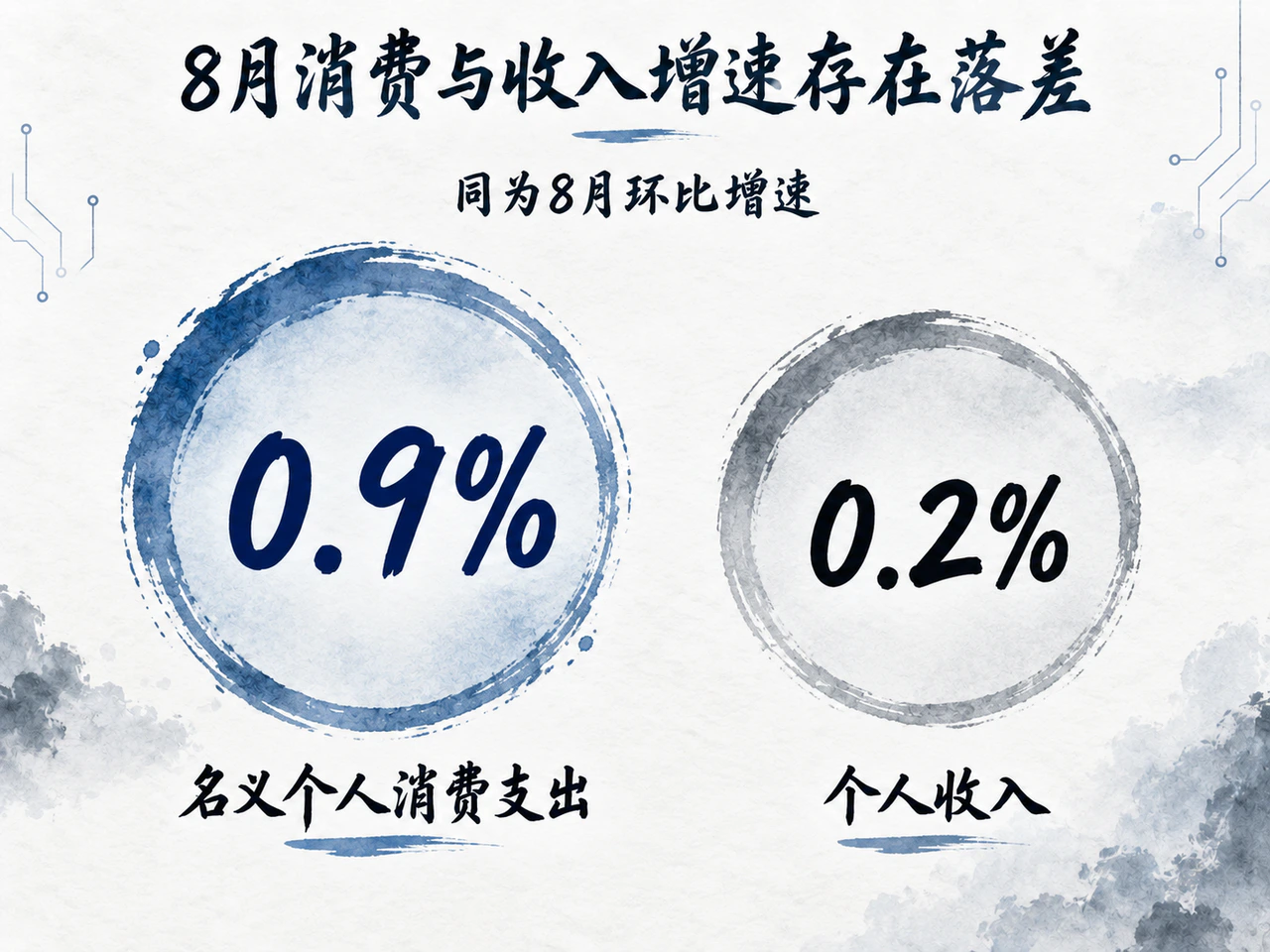
Demand was more resilient. Nominal August PCE rose 0.9% month on month and real spending 0.6%, accelerating from July's 0.1%. Personal income rose only 0.2%, real disposable income was flat and the saving rate fell to 4.1%, indicating some reliance on savings. The final second-quarter real GDP estimate was revised sharply from 1.5% to 2.2% at an annualized quarterly rate. Real final sales to private domestic purchasers, a core domestic-demand measure, were revised up 0.4 percentage points to 4.6%, supported importantly by investment such as data-center construction.
The labor market showed no abrupt loss of momentum. September ADP private payrolls rose 90,000, with August revised to 36,000, led by education, health care, leisure and hospitality, which together added 77,000. Finance and professional and business services still cut jobs. Amid resilient spending and uneven hiring, markets focused on the October 2 official payroll report to assess whether labor supply and demand and wage growth could continue supporting final consumption.
Ten-year Treasury yield reaches 5.29% as huge supply pressures the long end and widens spreads
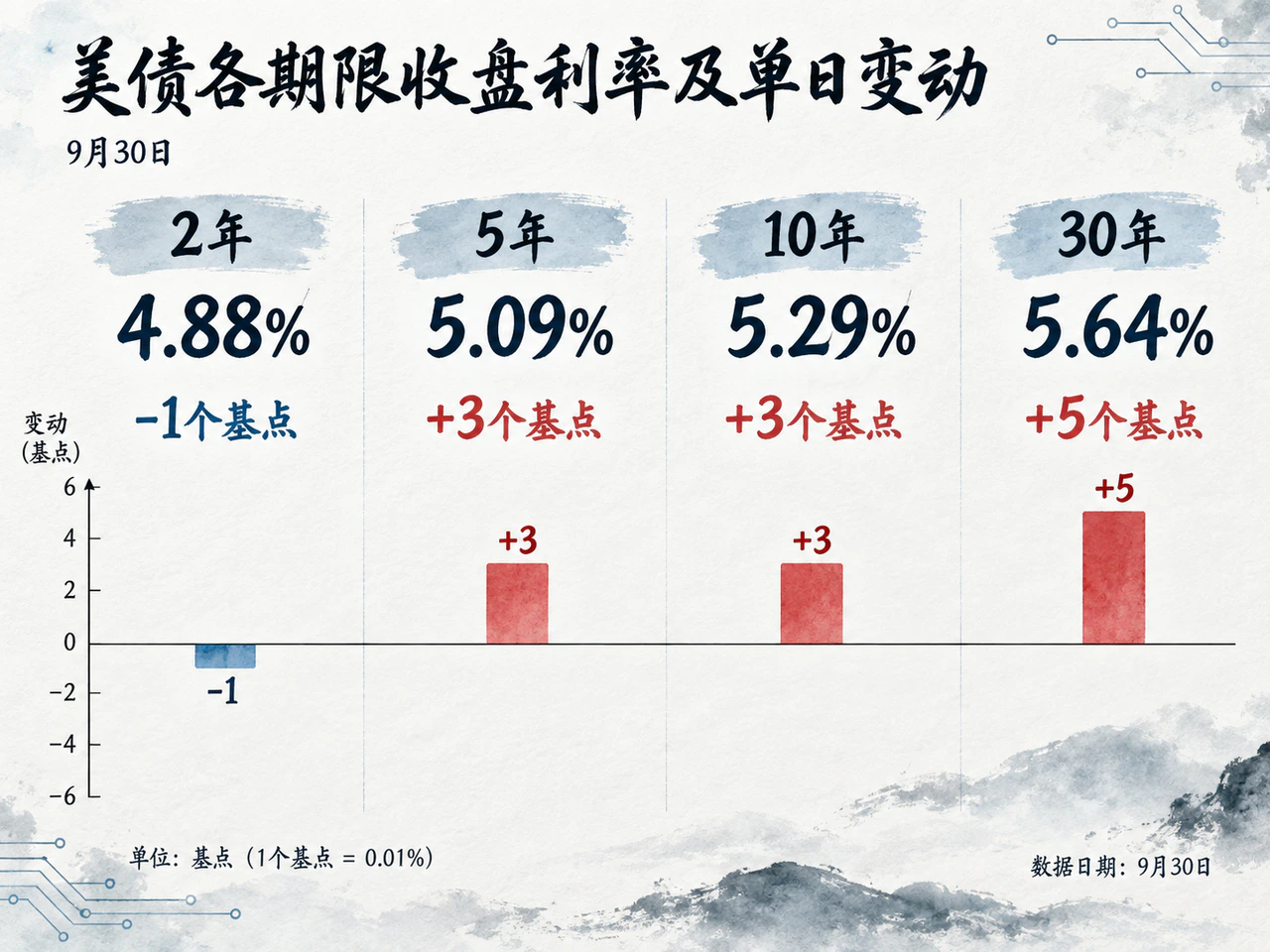
Divergence between short and long rates clearly outlined repricing of policy and bond supply. Consistently defined Treasury daily data showed short yields down and long yields up at the September 30 close:
| Maturity | Closing yield | Change from previous trading day |
|---|---|---|
| 2-year | 4.88% | -1 basis point |
| 5-year | 5.09% | +3 basis points |
| 10-year | 5.29% | +3 basis points |
| 30-year | 5.64% | +5 basis points |
The ten-year/two-year spread widened from 37 to 41 basis points. Slightly lower short yields reflected marginal relief from soft core inflation, but New York Fed President Williams's earlier comments that modest increases might still be needed later in the year kept policy-pivot expectations cautious.
Higher long yields accompanied rising real rates and supply disruption. Ten- and 30-year TIPS real yields rose to 2.93%, up two basis points, and 3.33%, up four. Nominal-real spreads were broadly stable, with the ten-year breakeven edging from 2.35% to 2.36%. Numerically, rising long yields primarily reflected a higher real cost of capital rather than sharply worse inflation expectations. On supply, Paramount Skydance launched about $32 billion of investment-grade bonds on September 29 as a key part of $52 billion of debt financing for Warner Bros. Discovery. SMBC strategists said concentrated megadeals diverted some secondary-market funds; Citi observed Treasury buyers waiting amid the supply wave. RBC BlueBay CIO Mark Dowding nevertheless considered the global bond selloff excessive and high absolute yields attractive for medium- to long-term allocation.
Credit-market stratification became clearer. Goldman Sachs put lower-rated firms' year-to-date AI-related financing at $88 billion. BNP Paribas counted $40 billion of AI-infrastructure high-yield issuance, several times 2025's $12 billion. State Street's credit outlook that day showed U.S. high-yield issuers' second-quarter operating profits up more than 14% year on year, aggregate leverage around 4.5 times and interest coverage above four times, but 21% of issuers still below two times coverage. For the Chinese US-dollar bond market in Hong Kong, higher long Treasury yields directly increase duration pressure and refinancing hurdles; debt resilience depends heavily on internal cash generation and maturity profiles.
Computing orders lift technology leaders; losses in over 80% of S&P sectors reveal weak breadth
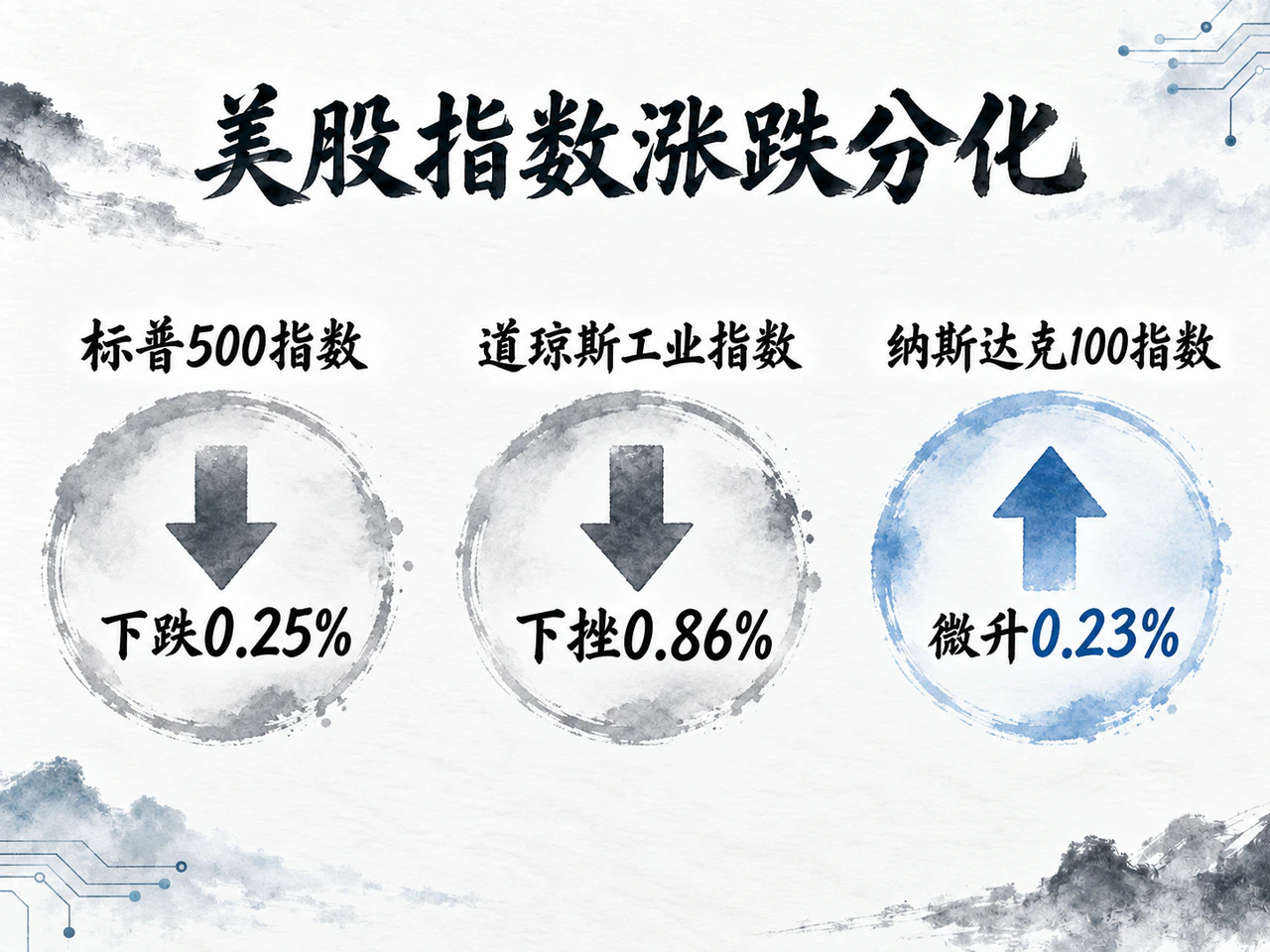
September 30 regular U.S. trading showed sharp sector divergence. The S&P 500 fell 0.25% to 7,651.54, the Dow 0.86% to 50,906.05 and Russell 2000 0.39%; only Nasdaq 100 rose, gaining 0.23% to 30,408.50. Technology ETF XLK added 0.64%, while financials XLF fell 1.13%. VIX edged up 0.30 point to 16.34.
Breadth showed a weak-market pattern. Despite Microsoft, Apple and Nvidia supporting the index and an intraday S&P 500 gain near 0.7%, it closed lower, with nine of 11 major sectors down and NYSE decliners about 1.66 times advancers. Ameriprise strategist Anthony Saglimbene said AI narratives and leaders' profits can temporarily help markets tolerate high rates, but sustained borrowing costs constraining credit and future real growth would quickly reduce tolerance for high equity valuations.
Commercial delivery in the AI chain continued. HPE announced a $1.2 billion computing order from cloud provider Vultr for AI racks and networking based on AMD Helios for U.S. data centers, lifting its shares 3.9%. After the close, Micron reported fiscal 2026 fourth-quarter revenue of $54.23 billion, versus $41.46 billion in the prior quarter and $11.32 billion a year earlier, and non-GAAP diluted earnings per share of $33.42. It guided fiscal 2027 first-quarter revenue to $60 billion–$63 billion, midpoint $61.5 billion, further confirming strong computing-hardware conditions.
Asian markets were mixed earlier. On September 30, Nikkei 225 rose about 1.9% and Hang Seng about 0.4%, while KOSPI fell 0.5% amid approximately KRW 2.05 trillion in foreign net selling. Samsung Electronics fell 1.47% and SK Hynix rose 0.62%. Hong Kong markets would close for the October 1 holiday and reopen October 2.
Both Brent contracts rise; higher real rates constrain gold
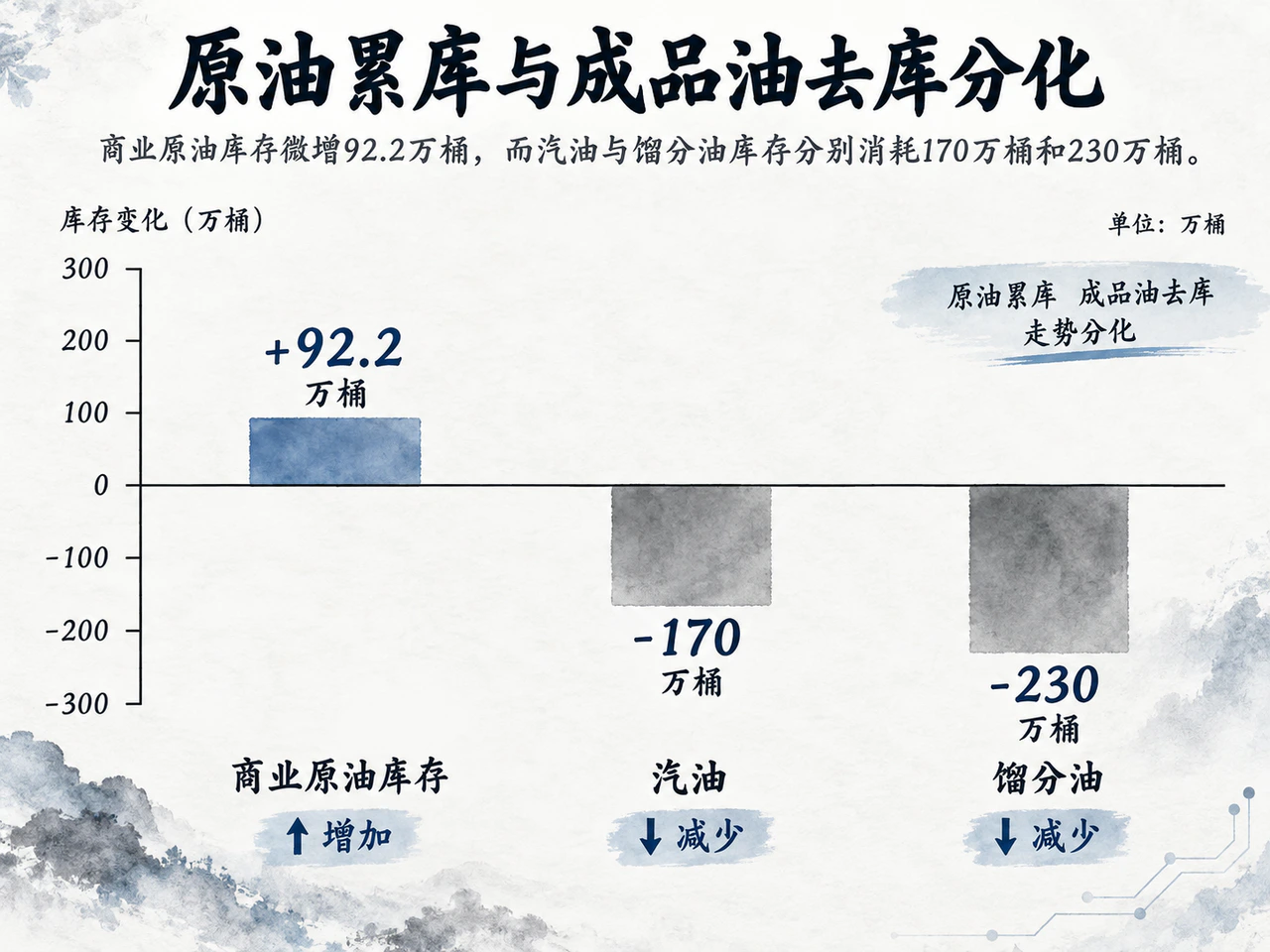
Softer U.S. inflation did not broadly lift commodities. Energy and precious metals followed different paths under supply-demand forces and rate pressure.
Crude remained tight. The November Brent contract expiring September 30 settled about 0.9% higher at $103.50 a barrel; the main December contract stood at $98.03, up 1.9%, at Reuters' reporting time. Front-month continuous WTI closed at $90.11, up 0.82%, while November settled at $90.42, up 1.2%. Although Saudi Arabia's east-west pipeline resumed and Yanbu loading restarted September 29, EIA weekly stocks diverged: commercial crude rose 922,000 barrels, while gasoline and distillates fell 1.7 million and 2.3 million barrels. MUFG said improving crude flows did not remove downstream fuel tightness or high geopolitical freight costs, which continued supporting oil.
Gold faced higher Treasury real yields and a stronger dollar. COMEX continuous gold futures closed at $4,184.60 an ounce, up 0.12%, while spot gold at one point fell 0.7% to $4,152.86. The dollar index rose 0.09% to 101.461. Geopolitical risk and energy-inflation expectations encouraged some defensive buying, but a 2.93% ten-year real yield substantially increased the opportunity cost of a non-yielding asset, leaving gold in a narrow tug-of-war.
China's September manufacturing PMI returns to 50.1%, with stronger production and input-cost pressure
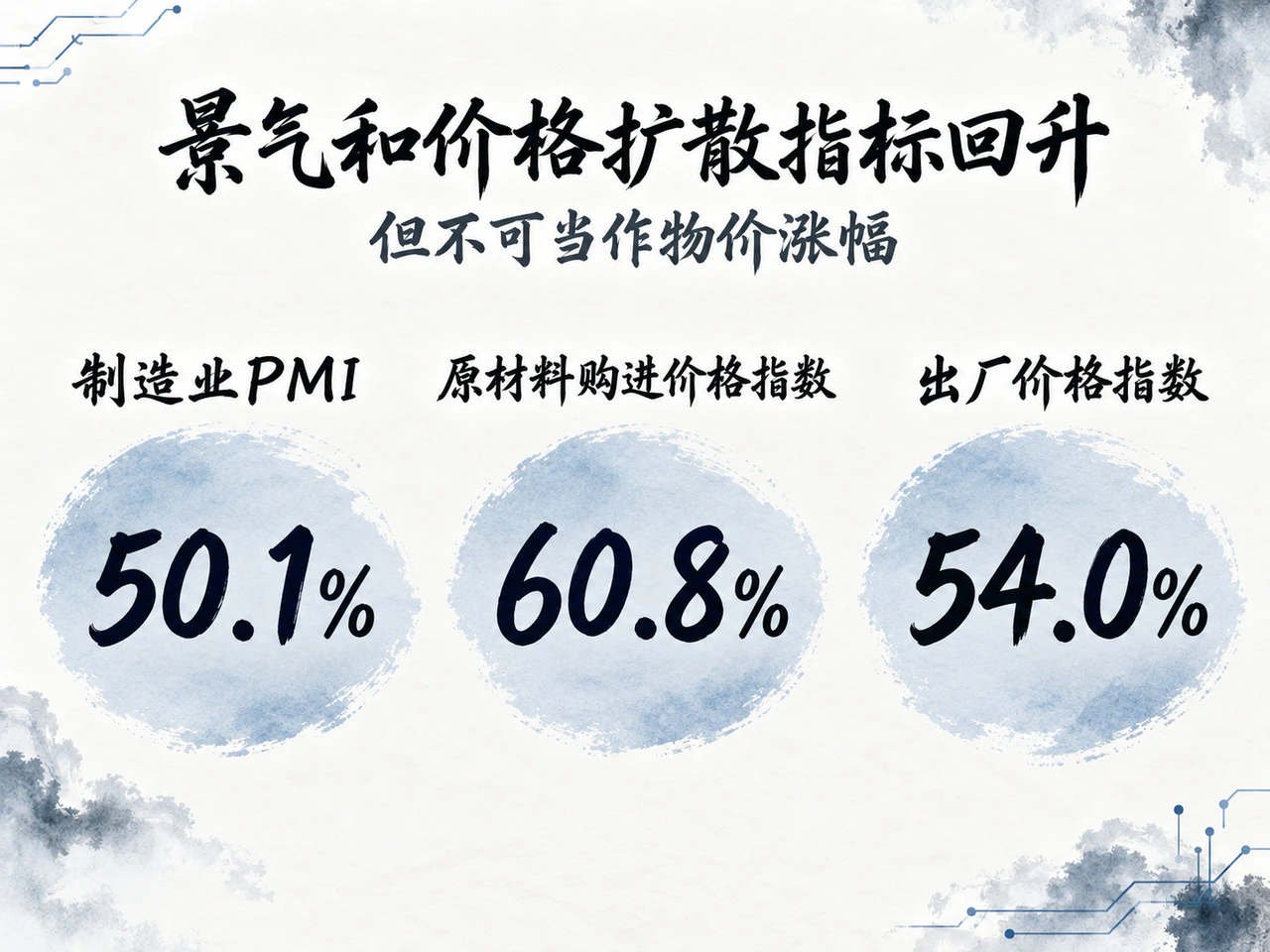
National Bureau of Statistics leading indicators returned to expansion. September official manufacturing PMI rose 0.3 percentage points to 50.1%, and nonmanufacturing business activity recovered 1.2 points to 50.2%. Manufacturing production improved to 51.7%, but demand was softer: new orders and new export orders each edged down 0.1 point to 50.5% and 50.0%, showing supply growing faster than demand.
Input- and factory-gate-price indices both recovered. September raw-material purchase prices jumped 4.2 percentage points to 60.8% and factory-gate prices rose 3.6 points to 54.0%. Higher international crude and other commodities lifted selling prices in petroleum, coal and other fuel processing and chemical materials, testing downstream manufacturers' pass-through capacity. Large firms' PMI expanded at 50.6%, while medium and small firms were at 49.7% and 48.9%. Nonmanufacturing new orders stood at 46.5%, showing demand at smaller firms and services still awaiting further recovery.
Policies continued supporting household consumption and credit. The previously announced first-home new commercial-mortgage interest subsidy took effect October 1, offering eligible households an annualized one-percentage-point subsidy for up to five years. It applies to homes no larger than 120 square meters and costing at most RMB1.5 million, with eligible loan principal capped at RMB1 million. Targeting essential housing demand, it aims to reduce household interest expenses and stabilize housing-consumption expectations.
European and Japanese fiscal responses address high rates and energy costs; trade and AI governance enter rule negotiations
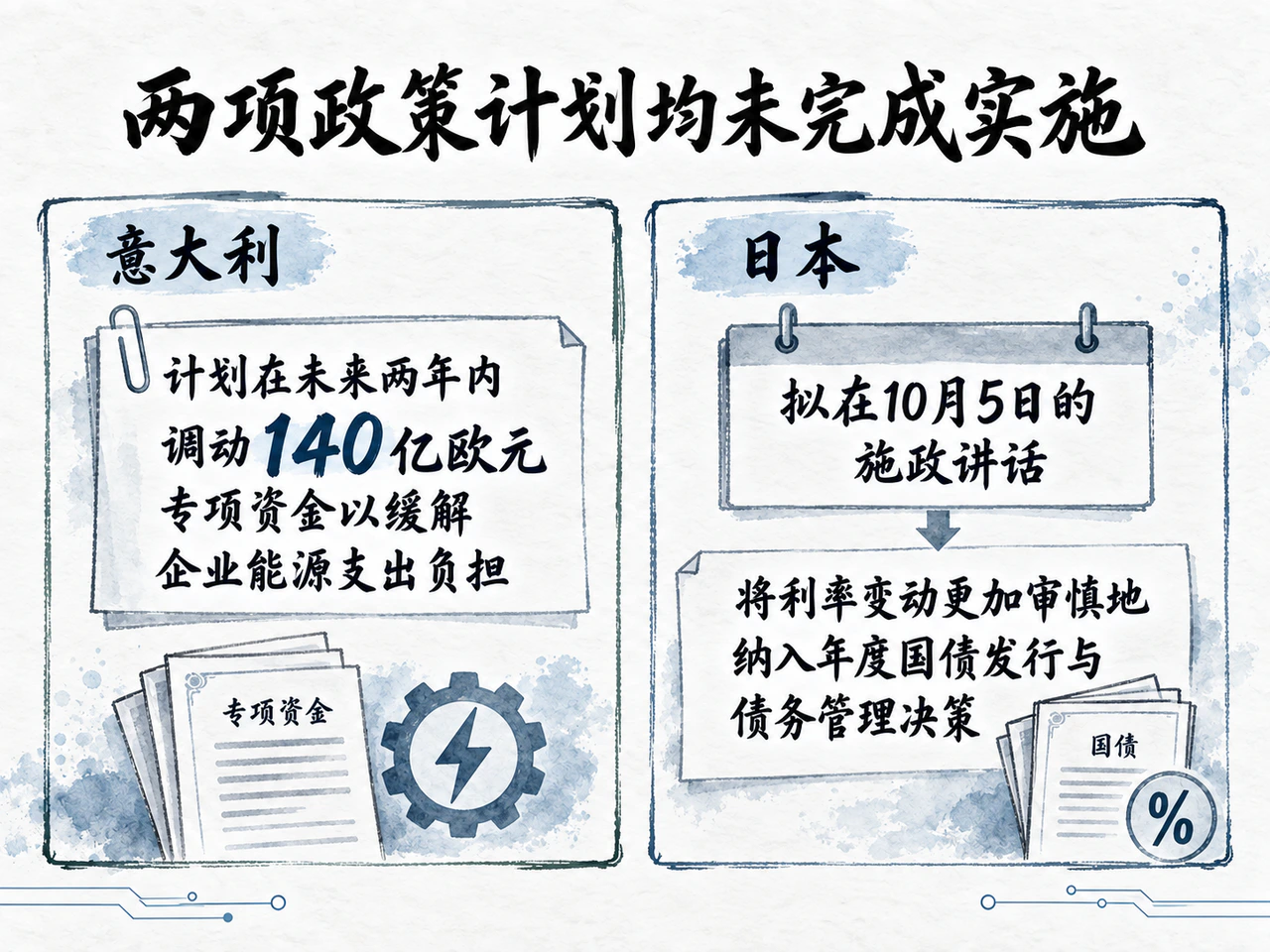
Lagged high-inflation effects and globally high interest rates are forcing major economies to adjust fiscal discipline and governance tools.
Italian Prime Minister Meloni said September 30 that she planned to mobilize €14 billion over two years to ease corporate energy expenses and formally sought EU budget-rule flexibility, highlighting the tension between energy-intensive manufacturers' urgent subsidy needs and sovereign-debt constraints. In Japan, Reuters cited a draft policy speech reported by domestic media showing Prime Minister Sanae Takaichi intended on October 5 to call for more cautious incorporation of rate changes into annual government-bond issuance and debt management, indicating greater fiscal discipline as yields rise.
Trade and emerging-industry rules showed marginal coordination. Brazil and the U.S. announced a joint working group for a bilateral trade agreement, with Washington to define the negotiating scope within weeks. U.S. Trade Representative Greer said previously agreed tariff-ceiling frameworks would be fully considered when assessing follow-up measures to global overcapacity investigations. In technology governance, a voluntary AI agreement released after the September 29 U.S. close called for independent external evaluations, stronger board governance and internal compliance and risk controls. In tight macro liquidity, actual earnings delivery and enforceable policy rules remain central to global risk assets' medium- and long-term direction.