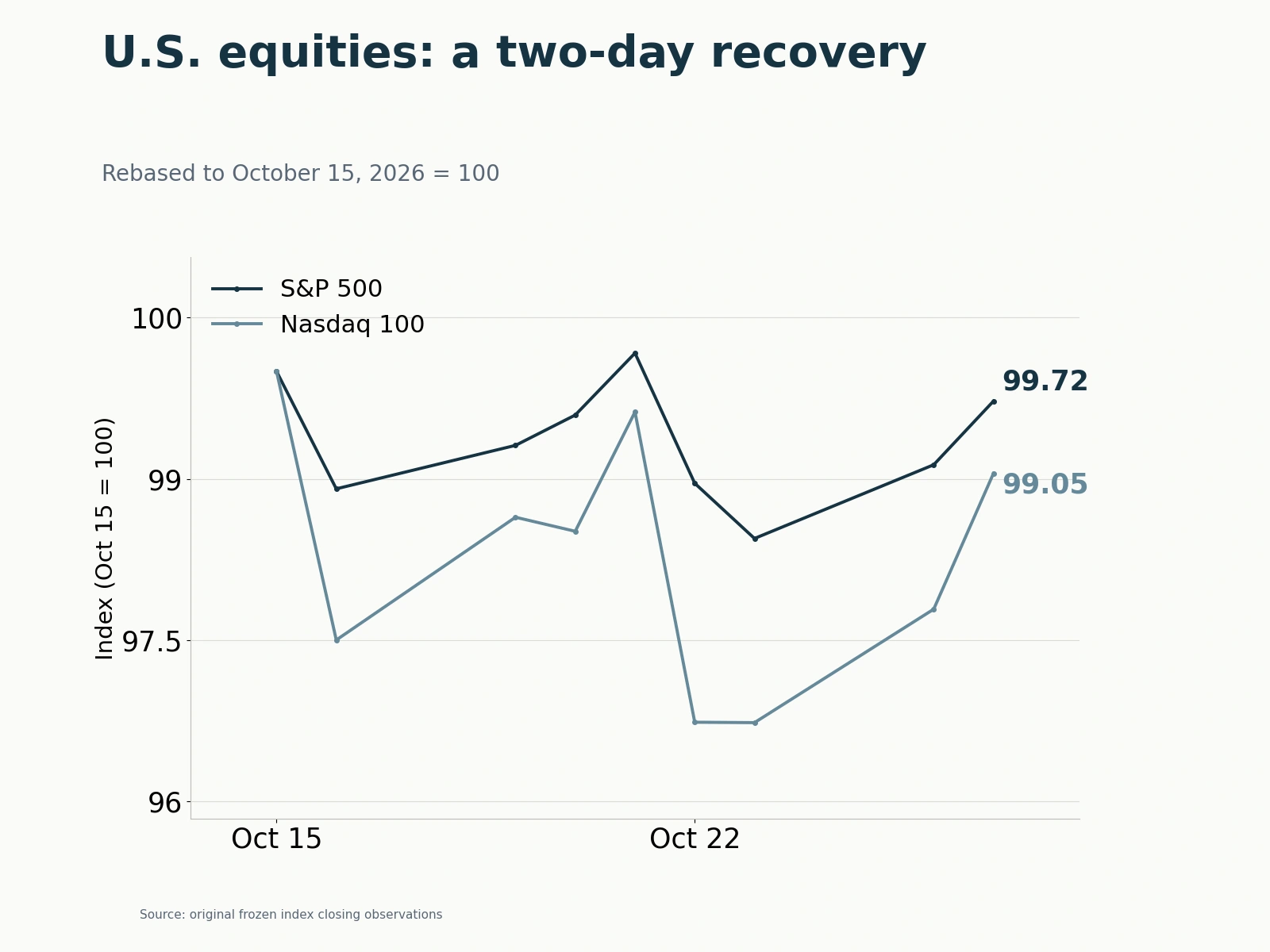
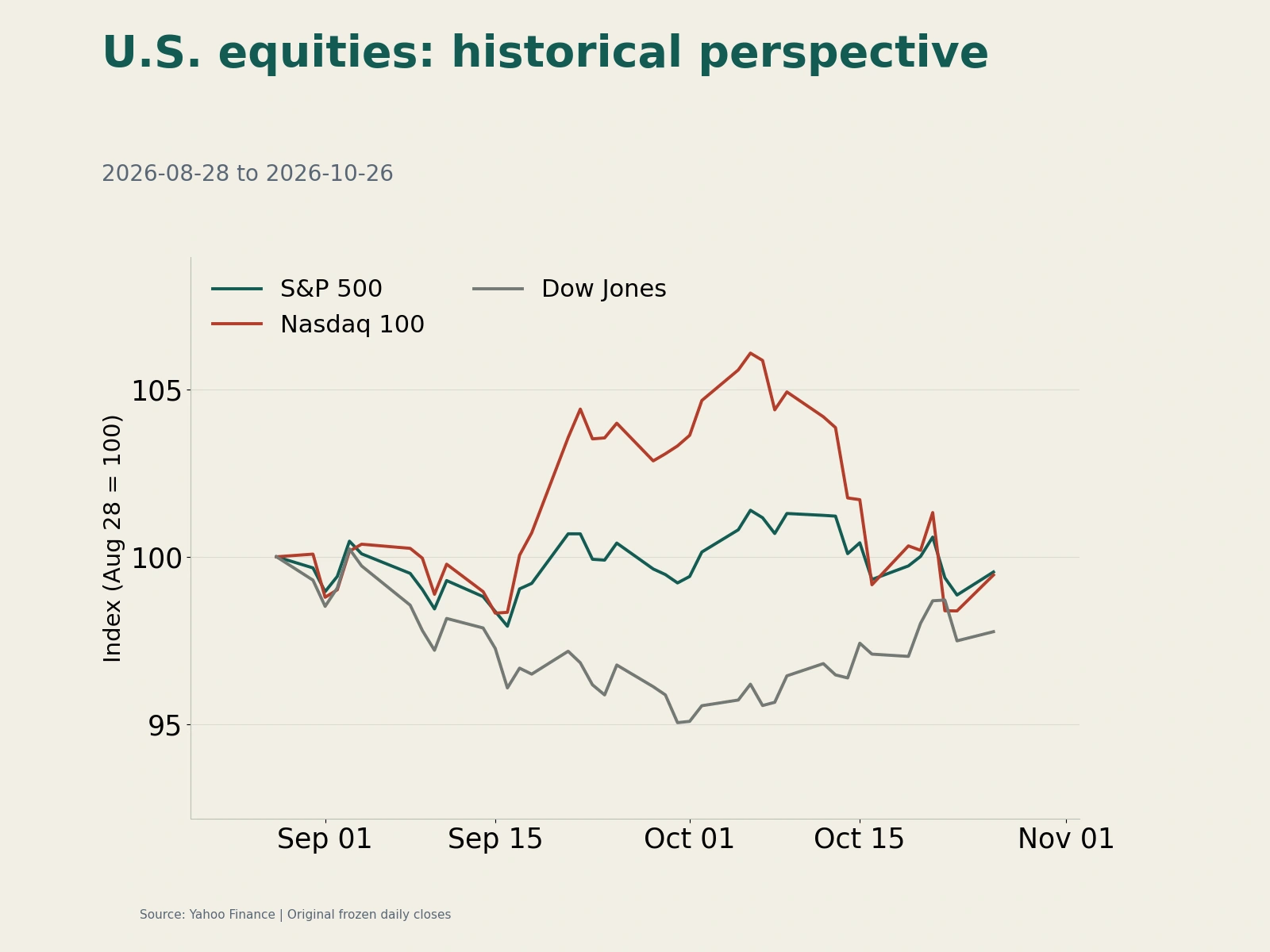
On October 1, 2026, U.S. Treasury yields rose before reversing, with the two-year falling 10 basis points and major equity indices closing slightly higher. Federal Reserve officials' calls for patience eased concern about another near-term increase. Yet economic data remained resilient, manufacturing input prices rose and supply concerns lifted oil, leaving insufficient conditions for a rapid monetary easing.
Lower rates supported asset prices, but corporate operations and financing remained uneven. AI demand continued supporting technology earnings, new acquisition-financing bonds came under pressure and consumer-company revenue had yet to recover. Markets gained breathing room without relief from cost and debt burdens.
Two-year Treasury yield falls 10 basis points as hike expectations cool
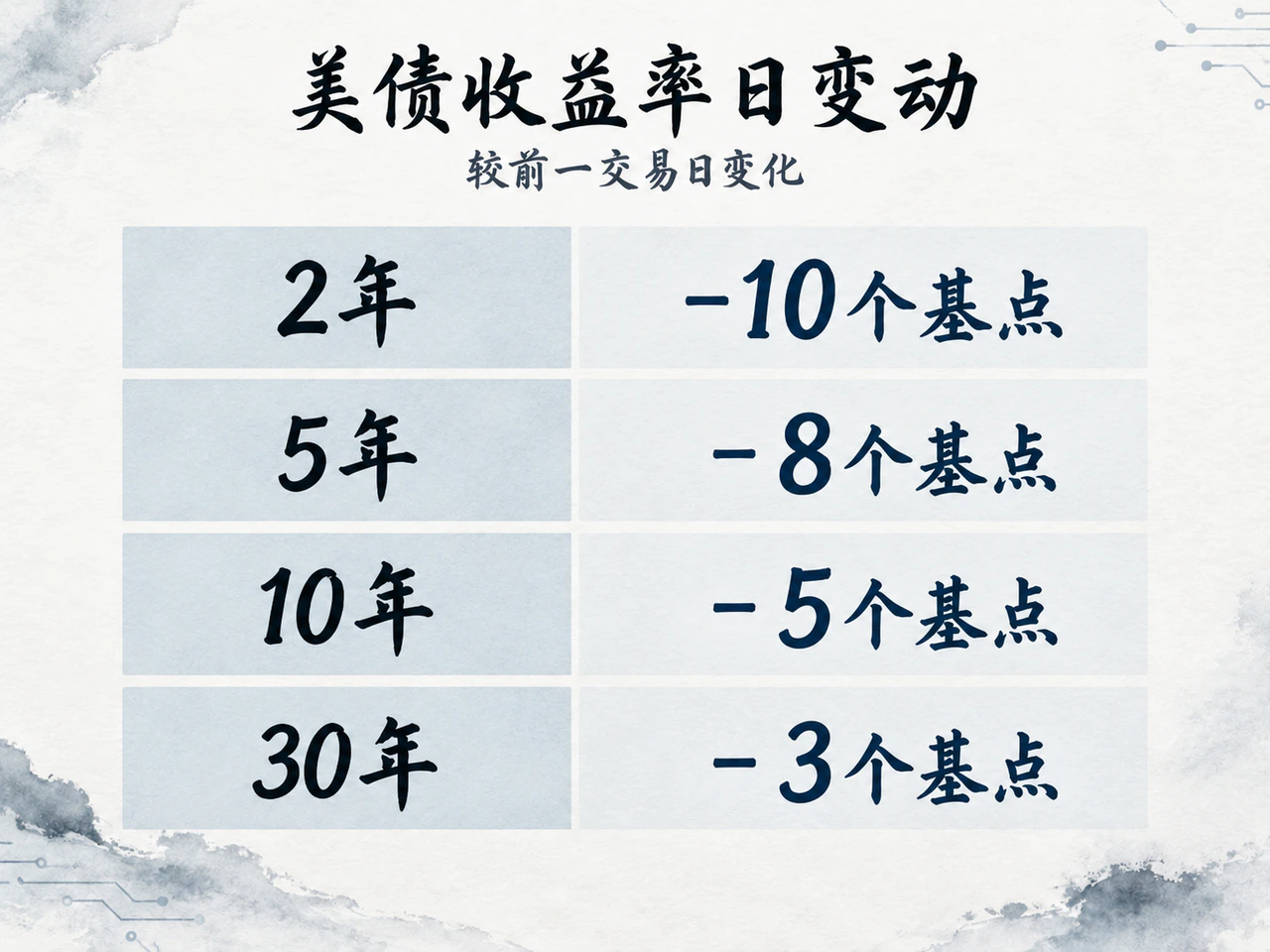
On the Treasury's consistently defined daily yield curve, major-maturity yields generally fell on October 1 from September 30, led by the short end.
| Maturity | October 1 yield | Change from previous trading day |
|---|---|---|
| 2-year | 4.78% | -10 basis points |
| 5-year | 5.01% | -8 basis points |
| 10-year | 5.24% | -5 basis points |
| 30-year | 5.61% | -3 basis points |
The 10-year/two-year spread widened from 41 to 46 basis points. Short-term policy expectations adjusted more sharply, while the 30-year yield remained as high as 5.61%, underscoring persistent long-term financing pressure.
Reuters reported that economic data initially weighed on bonds before buying returned. Fed Vice Chair Jefferson said policymakers could be patient before another increase, pushing yields lower. Reuters' closing report cited CME data showing a 28.2% implied probability of an October increase of at least 25 basis points, down from 68.6% a week earlier. Kashkari still saw further increases as necessary heading into 2027, although he was unsure about October. Officials' differences centered mainly on timing; discussion of cuts remained some way off.
Data also showed no clear easing of demand and price pressures. September ISM manufacturing PMI was 54.5, slightly below August's 54.6, but new orders rose from 53.7 to 55.3, employment from 51.2 to 52.7 and input prices from 71.1 to 77.9. Firms cited tariffs, freight, fuel and supply tightness from AI data-center demand. Some also mentioned advance customer purchases and postponed capital spending, leaving order durability uncertain.
Seasonally adjusted initial claims were 197,000 for the week ended September 26, below the 200,000 consensus and revised prior 198,000. Continuing claims for the week ended September 19 were 1.701 million, down 11,000 from the revised prior figure. Claims did not show broadly spreading layoffs; hiring and wage developments required more evidence. September's employment report, due at 20:30 Beijing time on October 2, would be the next major observation.
The bond rally was not mainly driven by easing inflation fears. Treasury daily tables showed five- and ten-year real yields falling to 2.65% and 2.88%, down eight and five basis points, matching the corresponding nominal declines. Simple nominal-minus-real yield differences remained approximately 2.36%. These differences also contain risk compensation and liquidity effects, but their stability indicates that the day's yield decline occurred mainly in real rates.
New acquisition bonds trade below par, exposing credit divergence despite lower benchmarks
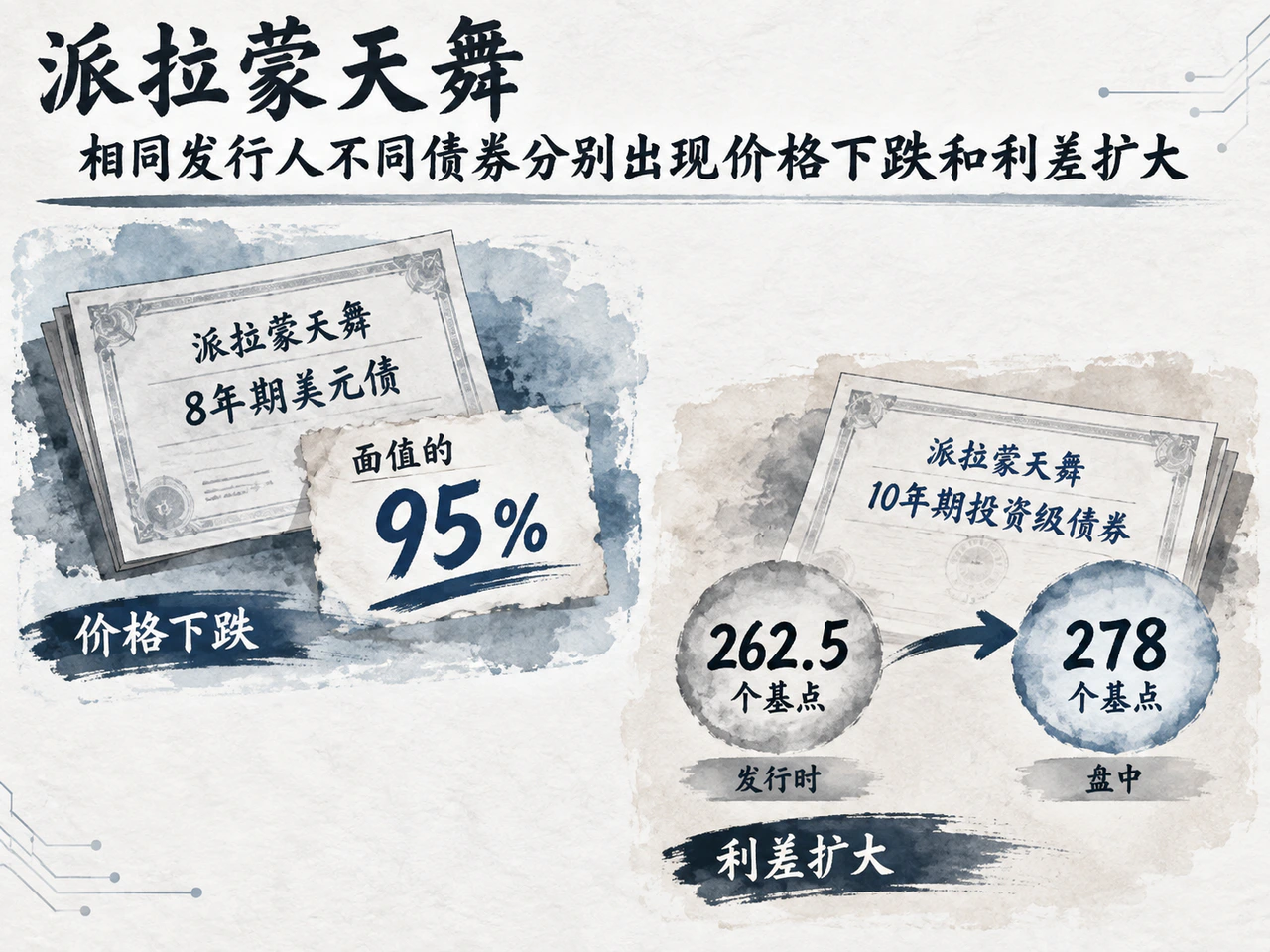
Corporate bonds need not benefit alongside Treasuries. Bloomberg reported during New York trading on October 1 that a Paramount Skydance eight-year dollar bond issued at par the previous day traded at 95% of face value. A $5.25 billion ten-year investment-grade bond widened from an issuance spread of 262.5 to 278 basis points.
The financing funded the acquisition of Warner Bros. Discovery. The report attributed pressure to concern about post-acquisition debt, lost long-end orders and selling by investors allocated too much. One issuer does not represent the entire credit market, but shows how rising corporate risk premiums can offset lower Treasury benchmarks. Leverage, financing size and position liquidity still shape pricing.
Hong Kong's U.S. dollar bond market likewise requires distinguishing issuers' repayment progress. Duration Finance reported September 30 that the winding-up hearing for Zhenro's Hong Kong subsidiary was adjourned to October 20 as negotiations with offshore creditors continued. Huangshi state-owned assets proposed repurchasing its 7% dollar bond due October 2027 at $1,008 per $1,000 face value. The former remained in litigation and restructuring, the latter a cash tender offer. Final recovery depends on cash flow and implementation of debt arrangements.
AI earnings support equities as chip financiers focus more on cash recovery
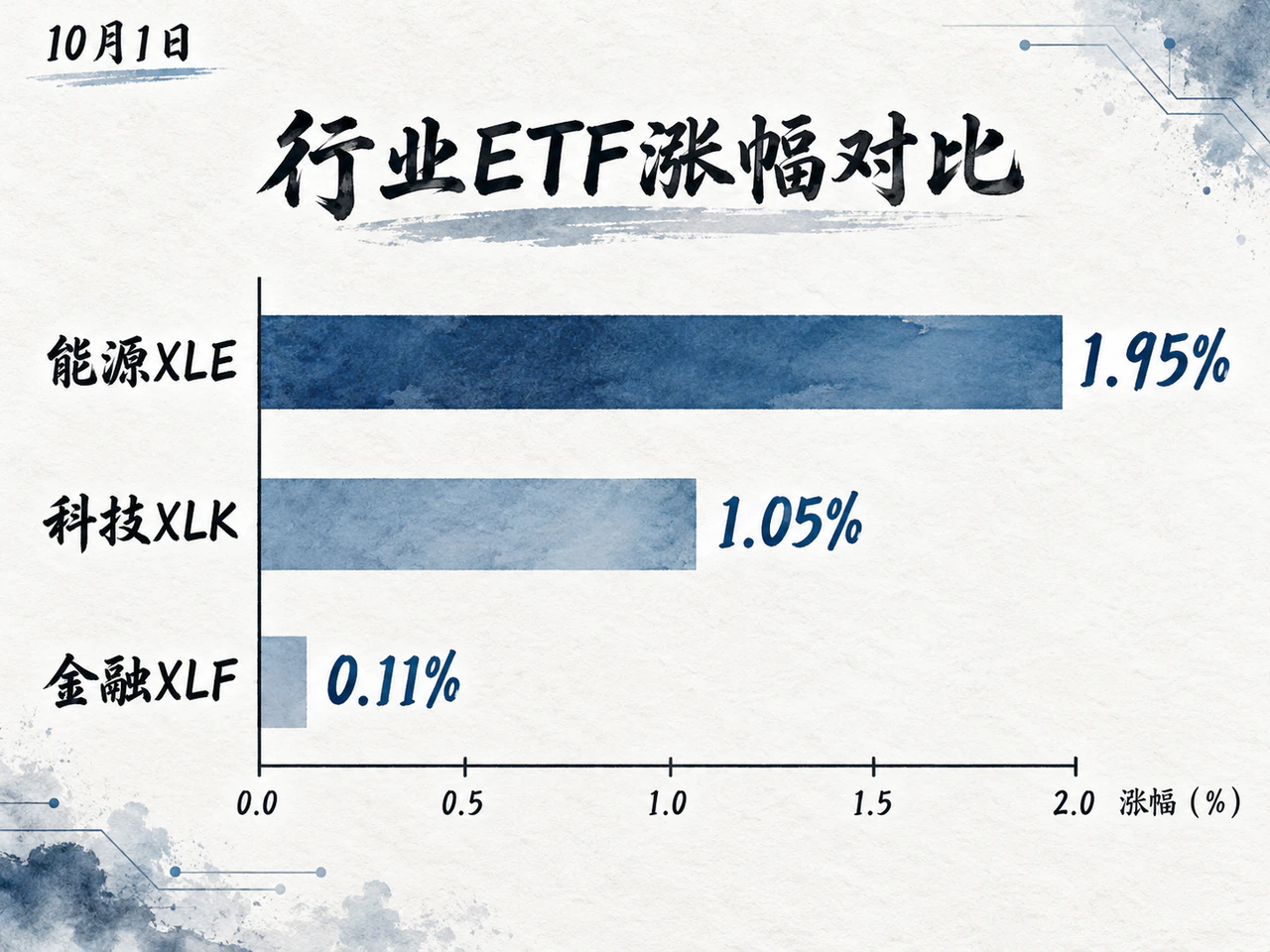
At the October 1 U.S. close, the S&P 500 rose 0.19% to 7,666.45, Nasdaq 100 0.31% to 30,501.56, Dow 0.04% to 50,926.56 and Russell 2000 0.35%. Sector ETFs rose 1.95% for energy XLE, 1.05% for technology XLK and only 0.11% for financials XLF. VIX edged from 16.34 to 16.39, so implied volatility did not decline materially as stocks stabilized.
Technology benefited from afternoon rate declines and earnings. Micron's revenue, earnings per share and outlook released after the September 30 close all exceeded expectations, with AI data-center demand for high-bandwidth memory and storage supporting orders. The Associated Press reported Micron up 3.0%, Nvidia 1.1%, Applied Materials 3.5% and Accenture 15.8% after better-than-expected quarterly profit.
Beyond earnings growth, financiers are scrutinizing AI investment's payback period. Reuters reported October 1 that some banks and credit investors assessing Nvidia-chip financing wanted stronger guarantees, with disagreement over GPUs' revenue-generating lives and residual values. Financing demand nevertheless remained strong. Strong demand and tighter lending terms can coexist: willing investors also assess depreciation, collateral value and cash recovery more carefully.
LSEG forecasts compiled by Reuters projected S&P 500 earnings growth of about 35% in 2026, slowing to 15% in 2027. The forward P/E fell from 22 at the start of the year to 19.2. These are forecasts, but frame the valuation question: can profit growth persist, and do current prices already reflect it fully?
Consumer companies were weaker. Nike's fiscal 2027 first-quarter results, released after the October 1 close, showed revenue of $11.2 billion, down 4% year on year. Gross margin improved 60 basis points to 42.8%, but direct sales fell 8% and digital sales 13%. Better costs and product mix had not restored revenue; the company still expected a high-single-digit full-year decline. The after-hours report provided a fresh demand signal for subsequent trading.
Uneven crude-supply recovery and fuel shortages lift prices
Crude reversed losses to finish higher. Reuters' settlement report put the new front-month December Brent contract at $102.31 a barrel, up 4.37% on a same-contract basis, and WTI at $92.87, up 2.71%. Another provider's continuous-futures daily series recorded WTI at $93.04, up 2.90%, and Brent at $102.45. Continuous series and specified-contract settlements use different price definitions.
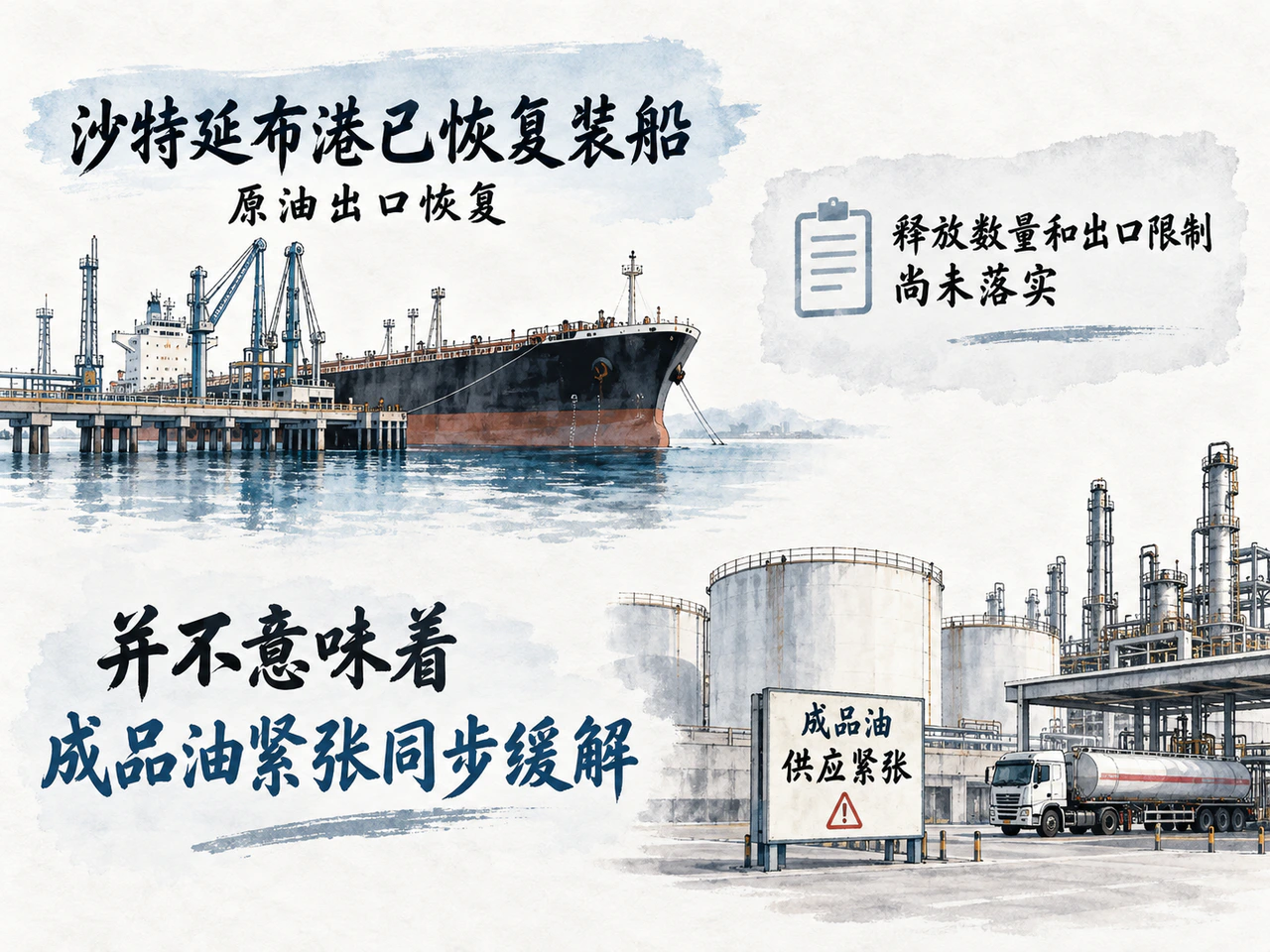
Supply concerns centered on fuels. Reuters cited people familiar with the matter saying Chinese refiners had halted refined-product exports outside Hong Kong and Macao until further notice. Saudi Arabia's Yanbu port had meanwhile resumed loading. Goldman Sachs estimated in Tuesday's report that Gulf crude exports, including vessels with tracking switched off, had recovered to 23.3 million barrels a day last week, roughly the 2025 average. Recovered crude exports do not ensure simultaneous relief in refined fuels; refinery facilities, export restrictions and transport costs still affect final fuel supply.
European reserve coordination also mattered. Reuters sources said October 1 that the U.S. asked Germany and France to release emergency diesel stocks or face a possible U.S. diesel-export ban; European institutions were consulting. Reserve releases could ease short-term shortages, while U.S. export restrictions could worsen supplies elsewhere. Neither release quantities nor restrictions had been finalized at reporting time. The U.S. also announced sanctions on Iranian automotive, railway and other industrial networks that day, tightening transaction-compliance constraints without a directly quantifiable crude-supply loss.
Gold recovered moderately despite a stronger dollar. The provider's continuous-futures daily series put gold at $4,211 an ounce, up 0.58%, while the dollar index rose 0.58% to 102.043. Reuters cited High Ridge Futures saying cooler hike expectations supported gold, consistent with lower real yields. A strong dollar raises costs for non-dollar buyers, however, and continued energy pass-through to inflation could again constrain gold and bond rebounds.
Slower aircraft export licensing creates supply-chain delivery uncertainty

Beyond energy, trade policy added uncertainty. Reuters sources said October 1 that the U.S. Commerce Department had slowed aircraft-parts export licensing to China in recent weeks and limited quantities licensed for COMAC. New rules involving parts such as aviation hydraulic fluid remained under discussion or in draft.
The effect currently centers on uncertain licensing and delivery times. Broader delays could pressure manufacturer deliveries, suppliers' revenue and airlines' maintenance-spares availability; existing information cannot quantify corporate losses.
Asian technology stocks benefit from Micron; holiday traffic awaits conversion into revenue
Micron's September 30 after-hours results first supported Asian trading on October 1. The Associated Press reported the Nikkei 225 up about 3.3% and South Korea's KOSPI about 1.9%, with Asian technology shares benefiting from AI demand expectations.
Hong Kong was closed for National Day on October 1 and reopened October 2. Japanese semiconductor equipment and Korean memory supply chains have more direct links to Micron's operating news. Hong Kong technology shares are more influenced by global growth-stock valuations and fund sentiment, requiring assessment alongside local companies' business and flows.
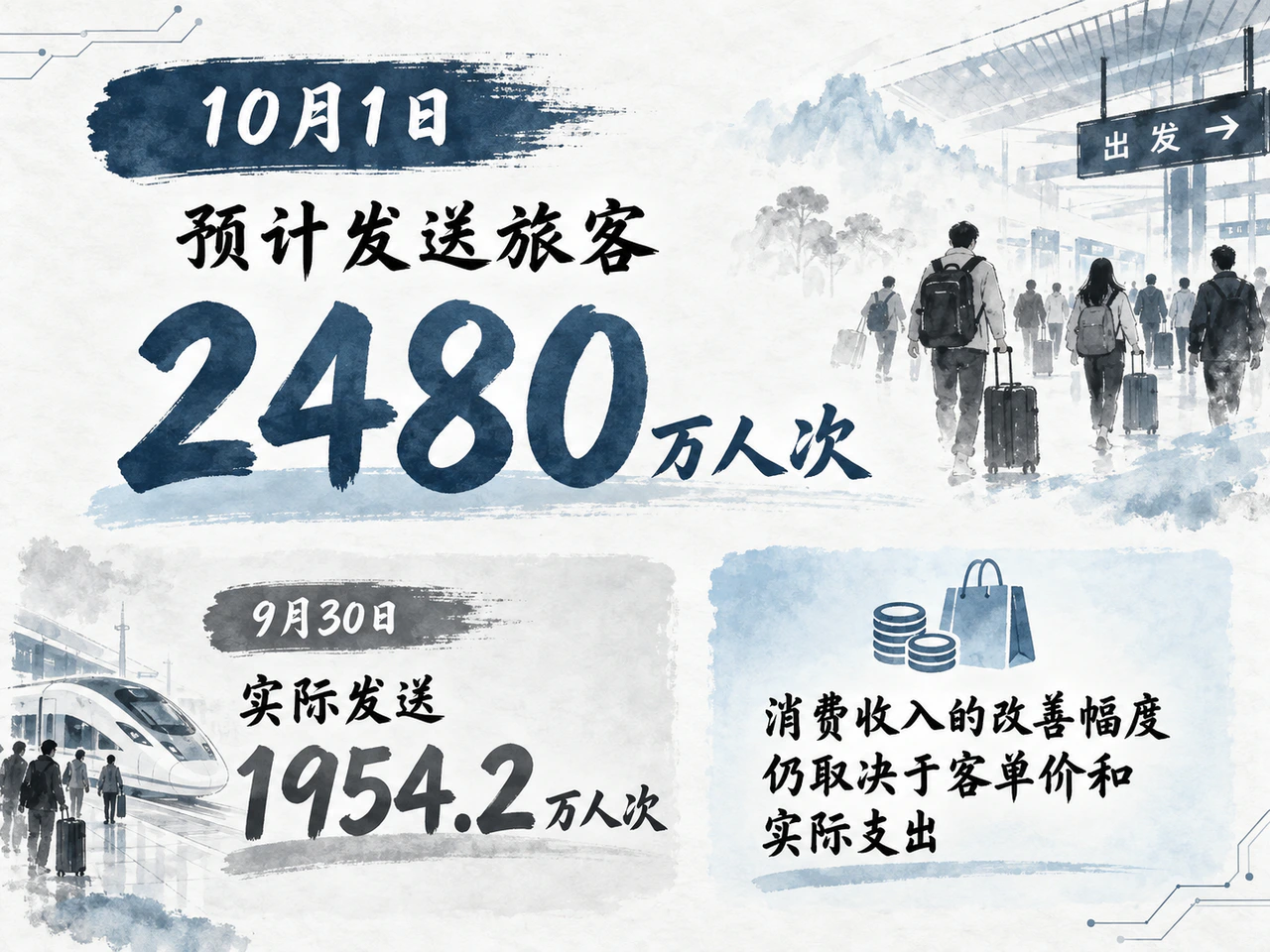
Fresh Chinese domestic-demand signals came from holiday travel and consumption support. Xinhua Finance reported October 1 that railways expected 24.8 million passenger journeys that day, versus an actual 19.542 million on September 30. Fliggy reported domestic attraction-ticket bookings up nearly 30% year on year on the holiday's first day. Travel and bookings bring traffic to dining, hotels and retail; revenue improvement still depends on average spending and actual purchases.
Central News Agency reported that Sichuan's provincial ticket-stub consumption subsidies took effect October 1 through March 31, 2027. Eligible consumers can use cultural-tourism or transport ticket stubs to claim subsidies for subsequent retail, dining and hotel purchases, up to RMB500 per stub. Results depend on redemption coverage and incremental consumption. Whether holiday traffic produces sustained revenue growth will also shape consumer-company earnings expectations.