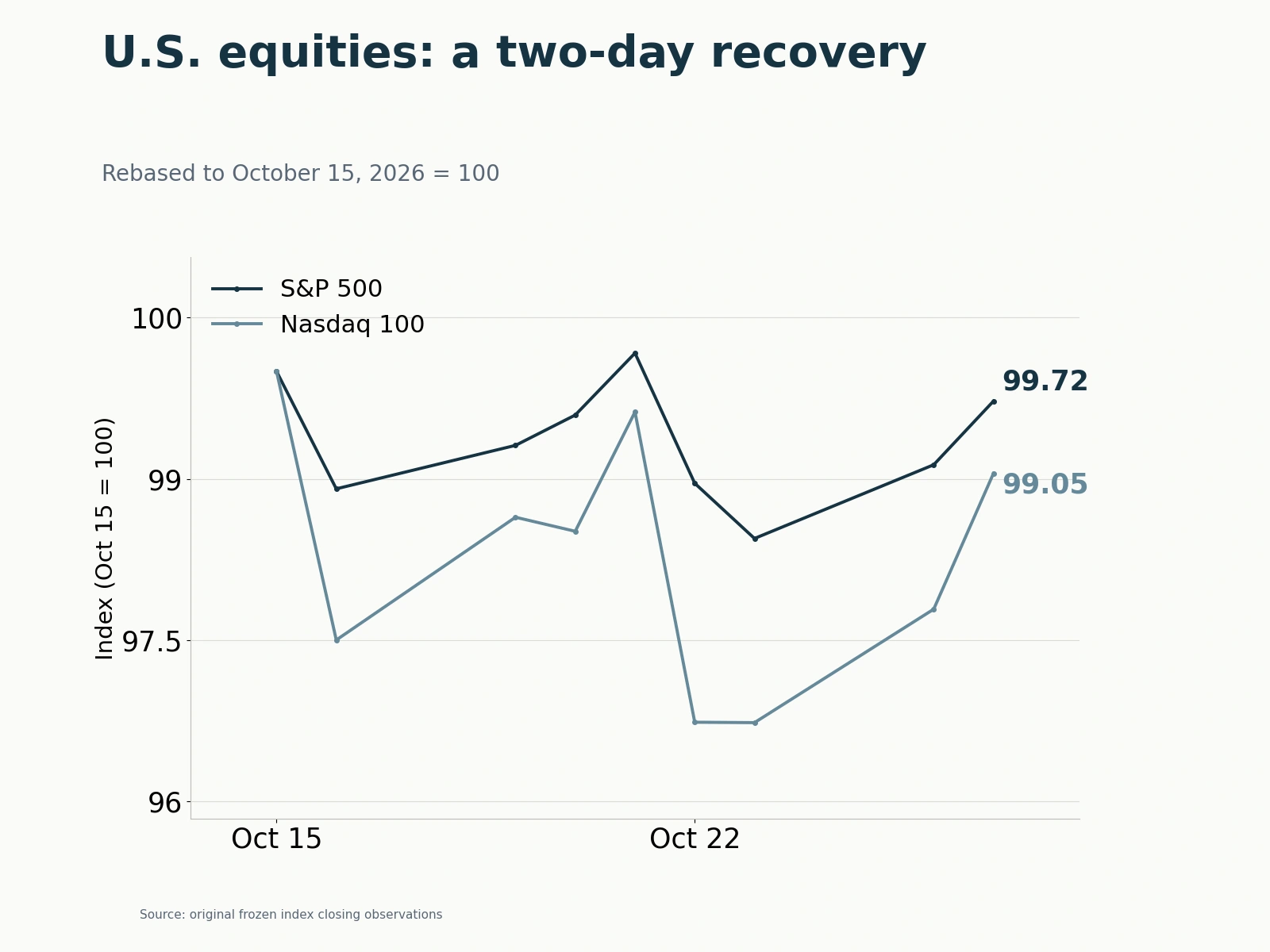
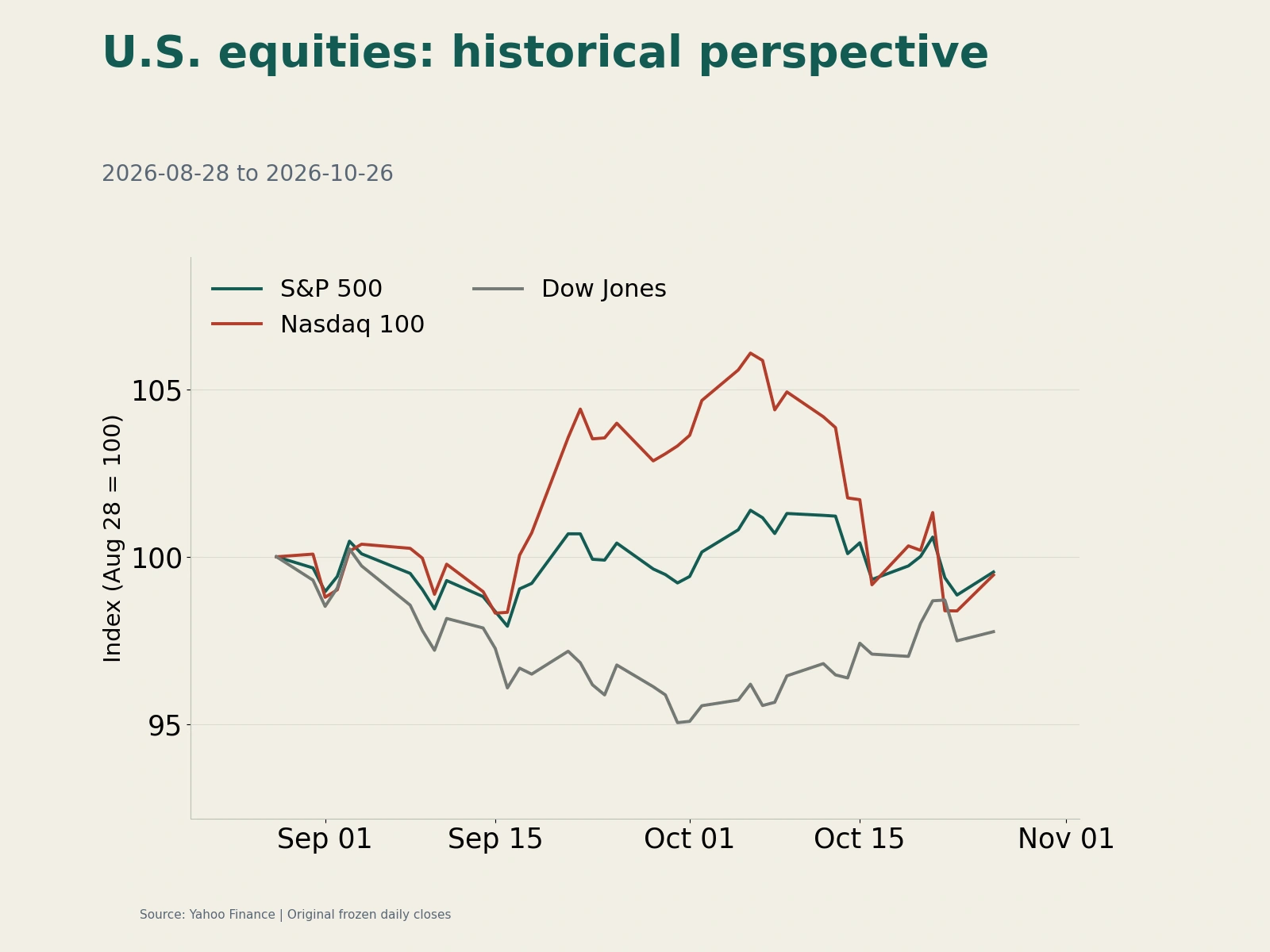
On October 2, 2026, a sharply cooler US employment report eased fears of further near-term monetary tightening. Major US stock indexes rose, with technology and small caps both participating. An early policy-driven Treasury rally failed to last: 2-year and 10-year yields ultimately rose 5 and 4 basis points, respectively, and gold closed lower. Cross-asset moves show that, despite reduced tightening anxiety, higher real rates and diverging corporate fundamentals still constrain valuations. On external supply, the G7 announced a coordinated reserve release of 100 million barrels and the US president later rejected a diesel export ban, easing energy risks somewhat. European fiscal pressure and wider credit spreads nevertheless prevented broad financial easing.
September payrolls rise just 29,000, easing tightening fears; core capital-goods orders keep growing
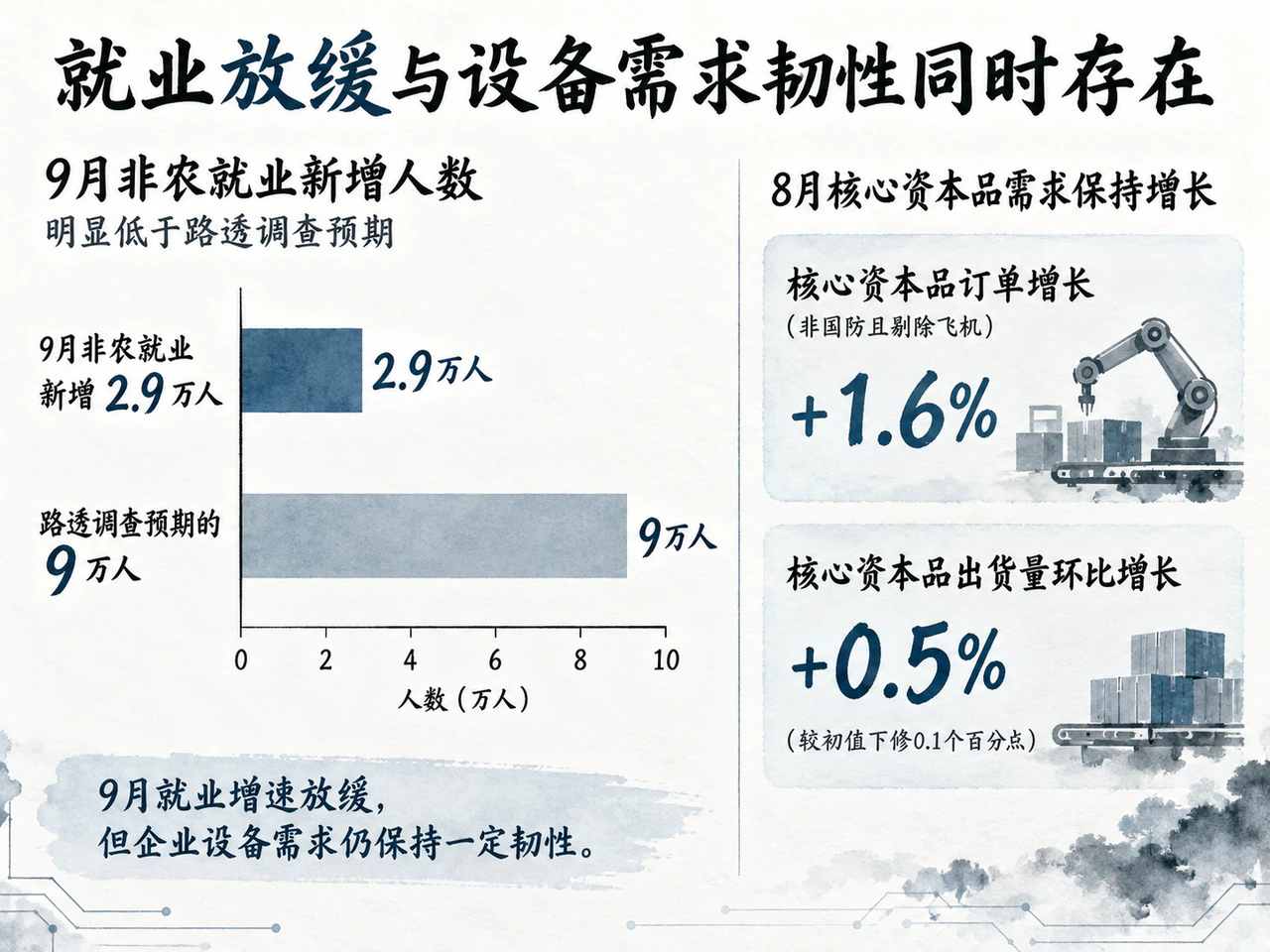
BLS data released October 2 at 8:30 a.m. US Eastern time showed September nonfarm payrolls rising 29,000, well below Reuters' 90,000 consensus. July and August gains were revised down by a combined 60,000, leaving average July–September growth around 51,000 monthly. Average hourly earnings rose 0.1% month on month and 3.0% year on year, below August's 0.3% and 3.1%. Slower hiring and pay reduce labor-cost pressure on service inflation but also weaken nominal-income support for consumption growth.
Unemployment rose from 4.1% to 4.2%, but the household survey showed employment up 406,000, labor force up 485,000 and participation rising from 61.6% to 61.8%. The slight unemployment increase mainly reflected new entrants not fully absorbed, rather than sharply greater layoffs. Establishment-survey weekly hours held at 34.4, indicating cooling rather than a cliff-edge labor slowdown.
Manufacturing demand diverged structurally. August factory orders rose 0.1% month on month to $663.5 billion, matching Reuters' forecast; July growth was revised from 0.9% to 0.8%. Civilian aircraft and parts orders fell 4.3%, the main drag. Core nondefense capital-goods orders excluding aircraft rose 1.6%, while shipments rose 0.5%, revised down 0.1 percentage points. Equipment demand remains resilient, but realized deliveries still depend on subsequent shipments.
Employment gave the Fed grounds to pause, but institutional views differed on the path ahead. Fitch's head of US economics Olu Sonola said weak hiring, moderate wages and large downward revisions left little justification for another October hike. Goldman Sachs Asset Management's Lindsay Rosner retained a baseline of one possible December increase, warning that further energy inflation could bring tightening forward.
Real rates lift the Treasury par curve; high-yield spreads widen 12 basis points
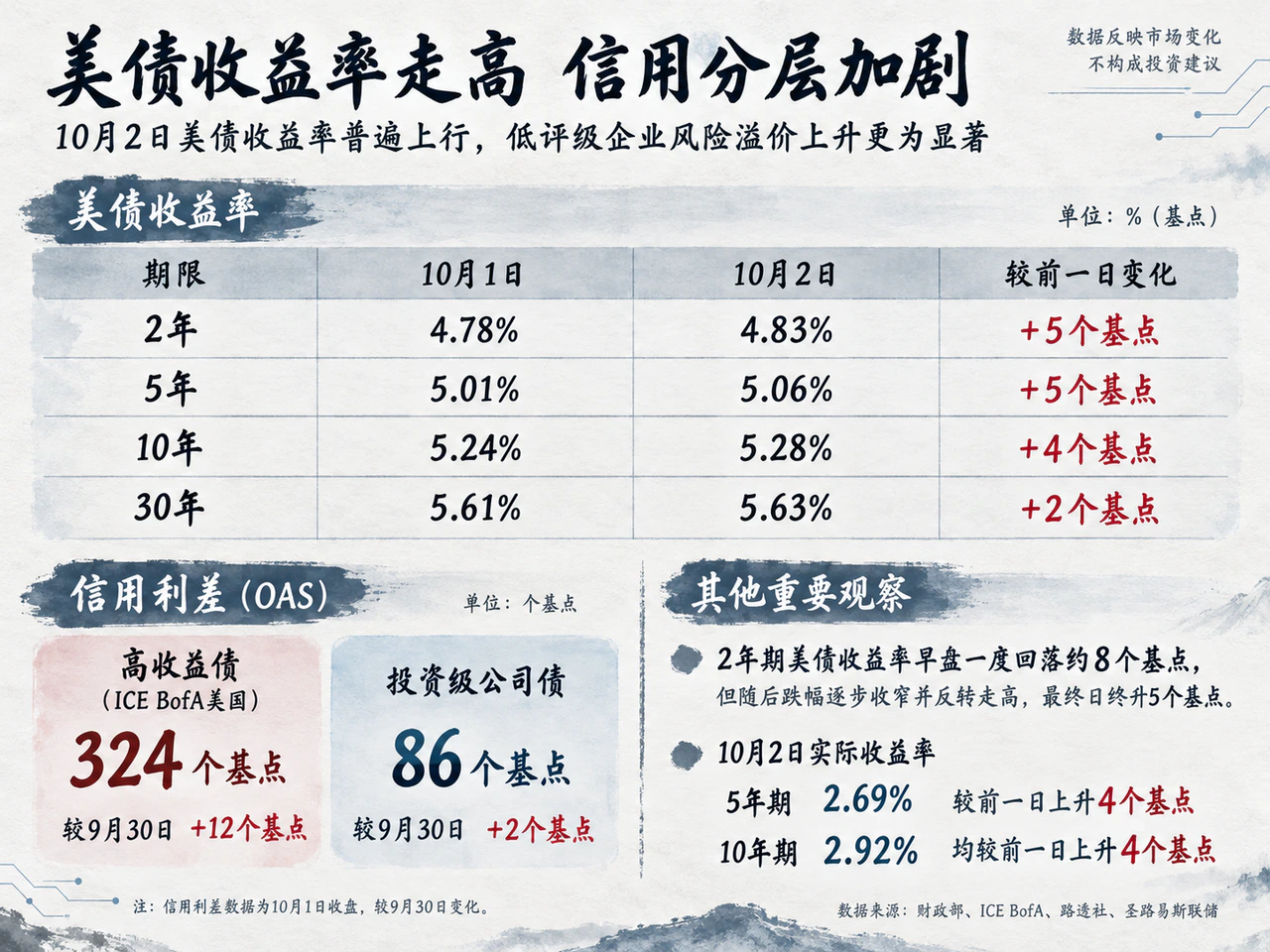
Reuters reported the 2-year yield initially falling around 8 basis points after payrolls, before reversing higher. The Treasury's consistent daily par-yield curve showed increases across maturities from October 1:
| Maturity | October 1 | October 2 | Daily change |
|---|---|---|---|
| 2-year | 4.78% | 4.83% | +5 basis points |
| 5-year | 5.01% | 5.06% | +5 basis points |
| 10-year | 5.24% | 5.28% | +4 basis points |
| 30-year | 5.61% | 5.63% | +2 basis points |
Short and intermediate yields rose more, narrowing the 10-year/2-year spread from 46 to 45 basis points. Treasury data put October 2 real yields at 2.69% for 5 years and 2.92% for 10 years, both up 4 basis points; the St. Louis Fed's 10-year breakeven held at 2.36% for a second day. The end-of-day yield rebound therefore mainly reflected real rates rather than increased inflation compensation.
Credit also showed financing-cost pressure. Latest October 1 closing ICE BofA data showed US high-yield option-adjusted spreads widening 12 basis points from September 30 to 324; investment-grade spreads widened 2 to 86. Lower-rated issuers faced larger premium increases. Higher benchmark rates and spreads jointly increased refinancing costs.
Primary funding showed rating divergence. BondbloX's October 2 morning report said DNB Bank issued $750 million of 6-year senior nonpreferred debt callable after year 5 at a 5.904% yield, 22.5 basis points tighter than initial guidance. Highly rated financials still achieved favorable primary pricing, but this local liquidity did not extend broadly to lower-rated issuers.
US rebound broadens while hardware losses and divergent automakers reveal fundamental differences
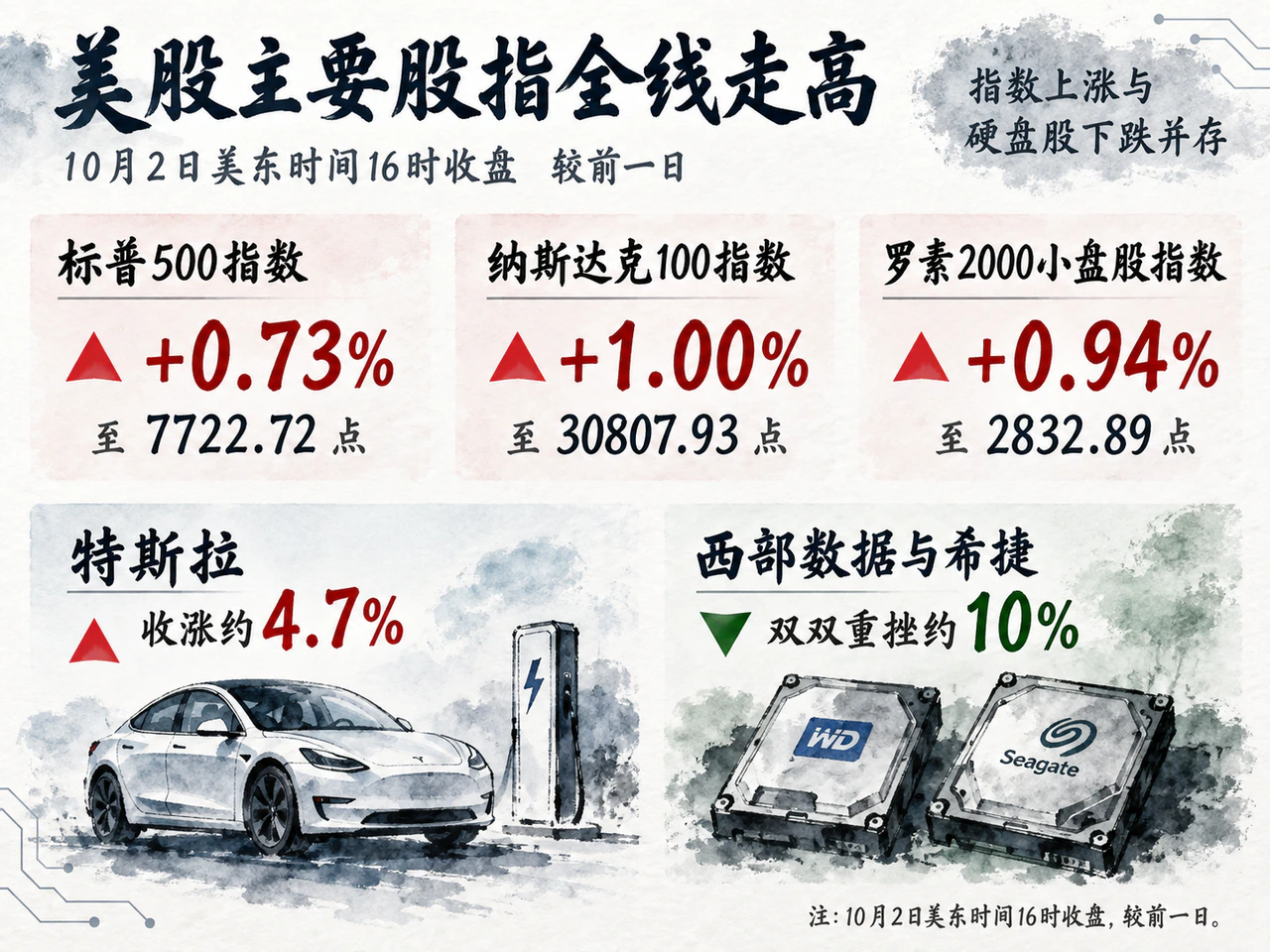
At the October 2, 16:00 Eastern close, major US indexes all rose: S&P 500 +0.73% to 7,722.72; Nasdaq 100 +1.00% to 30,807.93; Dow +0.49% to 51,176.96; Russell 2000 +0.94% to 2,832.89. VIX fell 1.08 points to 15.31. Broader buying showed large technology was not the only driver.
Market breadth nevertheless remained uneven. Reuters counted more advancers than decliners on NYSE and Nasdaq, but S&P 500 new 52-week highs/lows were 11/20 and Nasdaq's 57/224. Total volume was 16.93 billion shares, slightly below the 20-session average of 17.28 billion.
Fundamentals sharply divided sectors and stocks. Tesla's Q3 deliveries of 486,532 beat CNBC's reported 461,100 expectation, lifting shares about 4.7% and S&P 500 consumer discretionary 1.4%. Deliveries nevertheless remained below the year-earlier 497,099, and Tesla said profitability depended on average prices, costs, currencies and other variables.
Nvidia gained about 1.3%. CNBC said Morgan Stanley reiterated it as its top semiconductor pick, citing continued strong demand from cloud providers beyond the leaders. Investing.com, relaying Bloomberg, reported a Broadcom-related financing syndicate beginning to raise approximately $60 billion to support AI-chip and infrastructure purchases by companies including Anthropic. With Treasury yields rising, technology gains chiefly reflected industry fundamentals.
Storage hardware elsewhere in the AI chain suffered. Reuters reported Western Digital and Seagate each falling about 10% after news that Toshiba planned to double AI-data-center hard-disk capacity within fiscal 2027. Morgan Stanley said supply could remain tight through 2028 even with expansion, and Citi cited head and platter-media constraints, but concerns about medium-term competition and pricing power dominated that day.
Consumer stocks also diverged. Nike's fiscal 2027 Q1 report after the October 1 close showed revenue down 4% year on year to $11.21 billion, below $11.33 billion expected, with full-year revenue facing a high-single-digit percentage decline. Shares fell approximately 3.6% October 2.
G7 releases 100 million barrels; higher real rates push gold lower
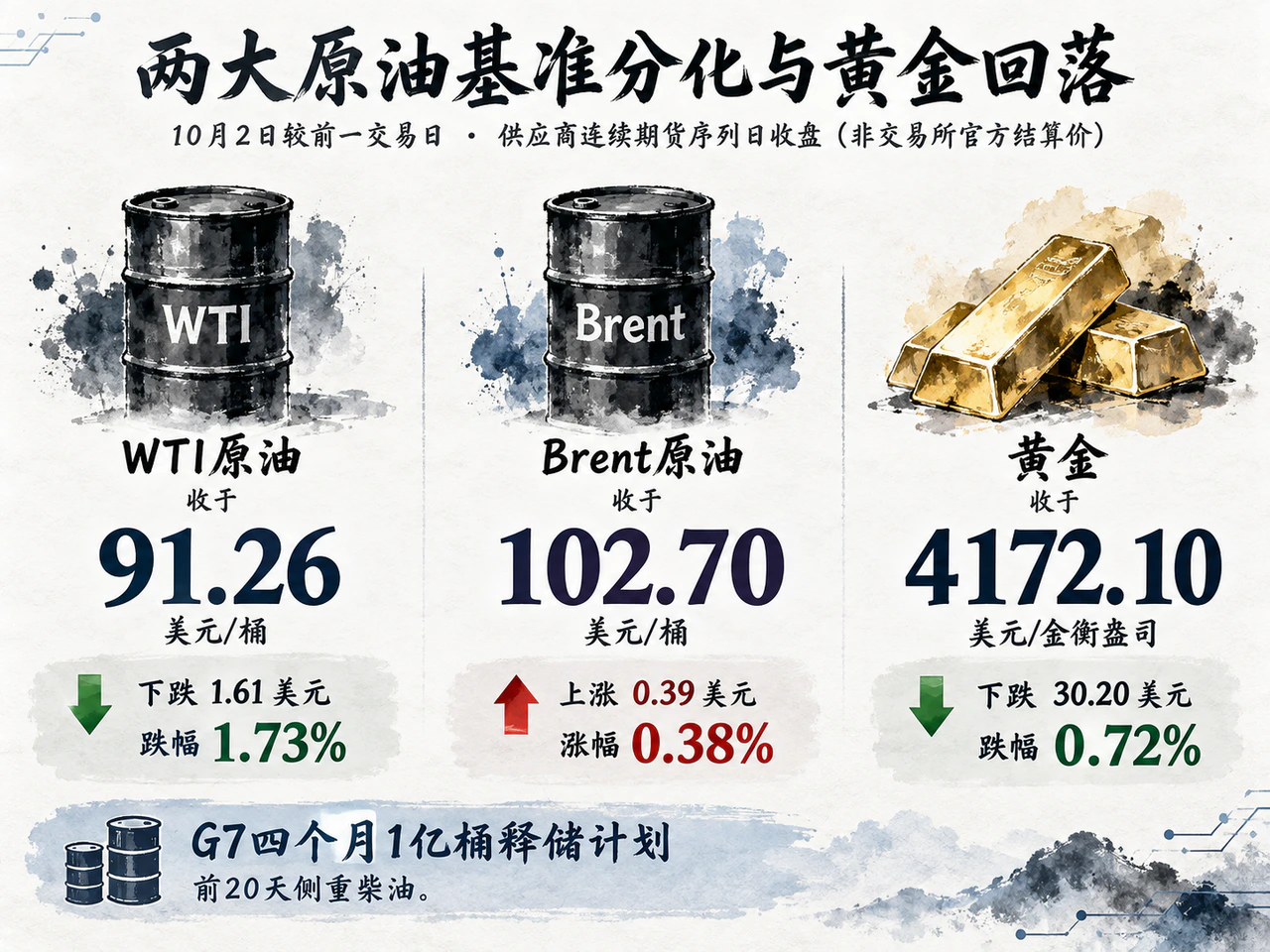
Vendor continuous-futures daily closes October 2 showed WTI at $91.26 per barrel, down $1.61 or 1.73%, and Brent at $102.70, up $0.39 or 0.38%. These divergent benchmarks use vendor closing data, not official exchange settlements.
Reuters reported the G7 agreeing to coordinate through the IEA a four-month release of 100 million barrels of oil and products, concentrating a substantial share of diesel in the first 20 days and pledging no energy-product export restrictions between members. After the US equity close, The Hill reported the president rejecting a diesel export ban, another easing signal. Views differed: Barclays cited large spot premiums and raised its Q4 Brent forecast $20 to $115 a barrel; Capital Economics said continued Middle Eastern logistics recovery and new releases could produce a modest surplus.
Gold continuous futures closed at $4,172.10 a troy ounce, down $30.20 or 0.72%. The vendor dollar index edged down 0.17% to 101.924, showing dollar appreciation was not the cause. Rising Treasury real yields increased non-yielding gold's opportunity cost and were the day's main restraint.
French sovereign premiums stay high; banking-license disputes and Asian-market divergence
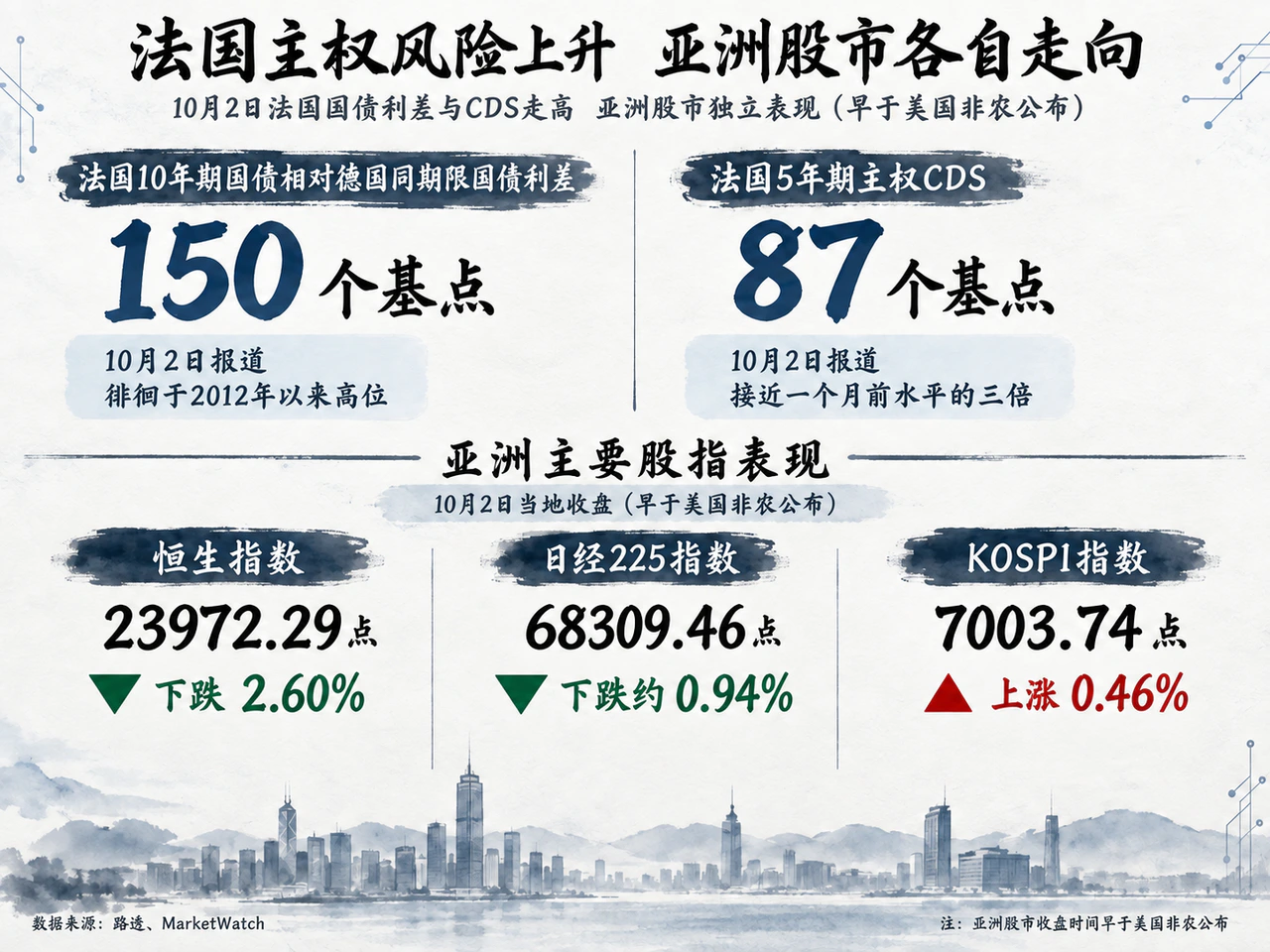
European sovereign pressure constrained the global risk recovery. Reuters put France's October 2 10-year spread over Germany around 150 basis points, near highs since 2012; 5-year sovereign CDS around 87, nearly triple a month earlier. France's 2027 budget sought about €54 billion of fiscal tightening, facing parliamentary and implementation uncertainties. Bloomberg said Sumitomo Mitsui DS Asset Management had recently exited all French government bonds for German bonds and short Japanese debt. French bank AT1 bonds, however, faced relatively limited pressure; wider sovereign spreads alone do not establish a banking crisis.
In US regulation, the Independent Community Bankers of America sued the OCC October 2, challenging national trust-bank charter rules and seeking reversal of Protego's conditional charter approval. The dispute reflects contested compliance and regulatory boundaries between expanding crypto businesses and traditional banking.
Asian trading preceded US payrolls and followed its own course. MarketWatch put October 2 Hang Seng down 2.60% to 23,972.29, Nikkei 225 down about 0.94% to 68,309.46 and KOSPI up 0.46% to 7,003.74. Toshiba's expansion supports equipment and component orders but creates potential finished-product competition; hard-disk expansion cannot simply imply more DRAM or HBM chip supply.
Chinese holiday travel also showed structural differences. Transport Ministry estimates put October 2 cross-regional trips at 308.19 million, up 2.1% year on year; October 1 reported actual trips were 329.495 million, down 1.9%. Guangdong tourism authorities estimated 4.517 million visits to provincial 4A-and-above attractions October 2, up 4.9%. Transmission from active travel to related consumer-sector revenue still requires confirmation.