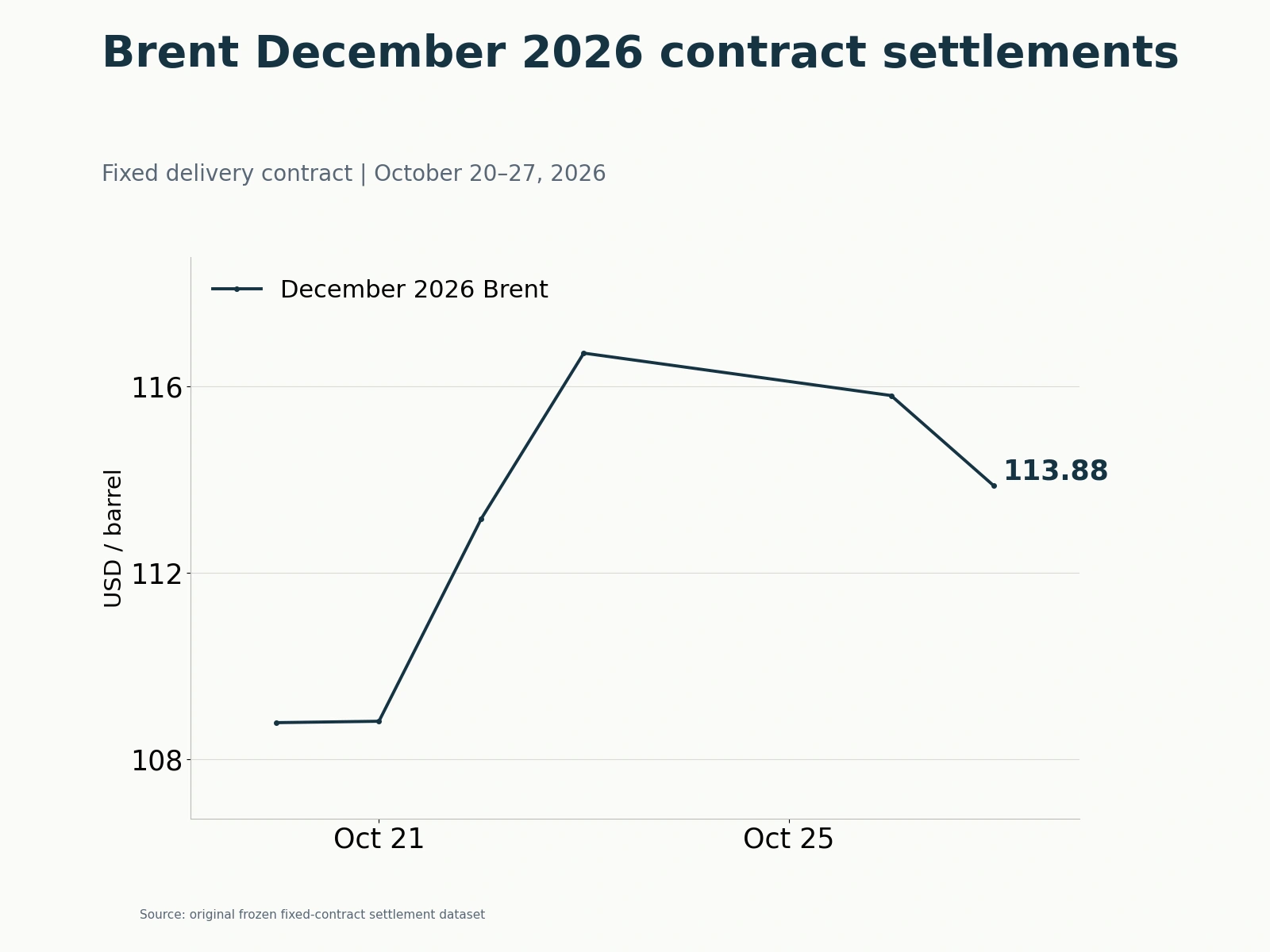
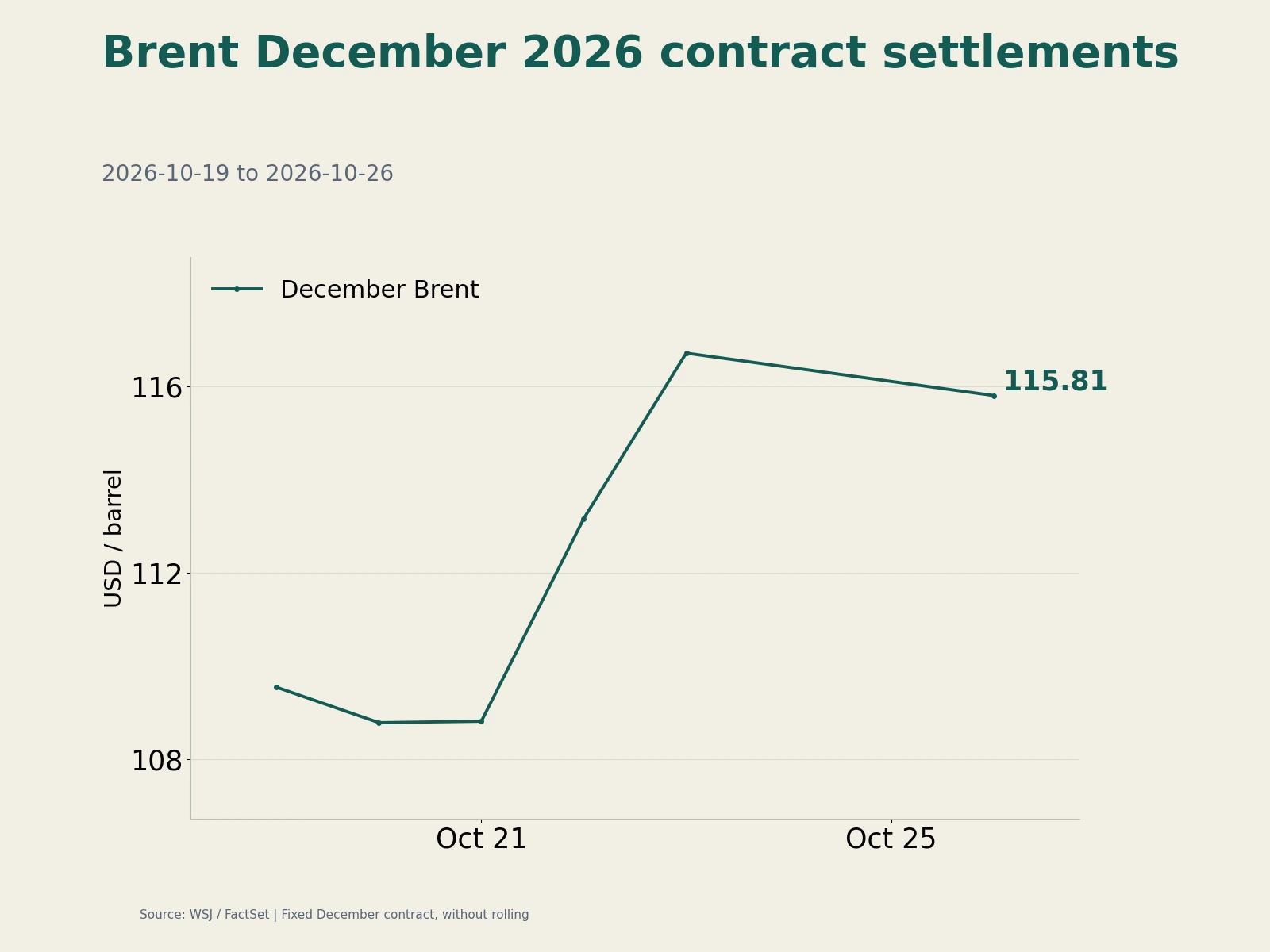
On October 2, the G7 announced an IEA-coordinated, four-month oil-reserve release totaling 100 million barrels, specifying large diesel deliveries in the first 20 days, coordinated refinery maintenance to raise utilization and a commitment against internal export restrictions. The intervention provided a policy buffer for strained fuel markets but did not eliminate fundamental divergence. Yahoo's October 2 continuous-contract provider daily closes, rather than exchange settlements for specific delivery months, showed WTI down 1.73% ($1.61) to $91.26 a barrel, while Brent rose 0.38% ($0.39) to $102.70, demonstrating differing pressures on the benchmarks.
The pace and composition of releases mattered more than their nominal total. The G7 statement did not give specific crude and diesel allocations; the previously discussed 50 million barrels of each was not final. Implementation also connected with March's commitment and could not simply be treated as net additional supply beyond it, still less as permanent new production capacity. Concentrated diesel deliveries and staggered refinery maintenance aimed to offset shortages during peak industrial and heating demand. Whether this could stabilize overall oil prices remained constrained by deeper structural imbalances.
U.S. crude builds 920,000 barrels while distillates draw 2.25 million; supply pressure concentrates in downstream fuel
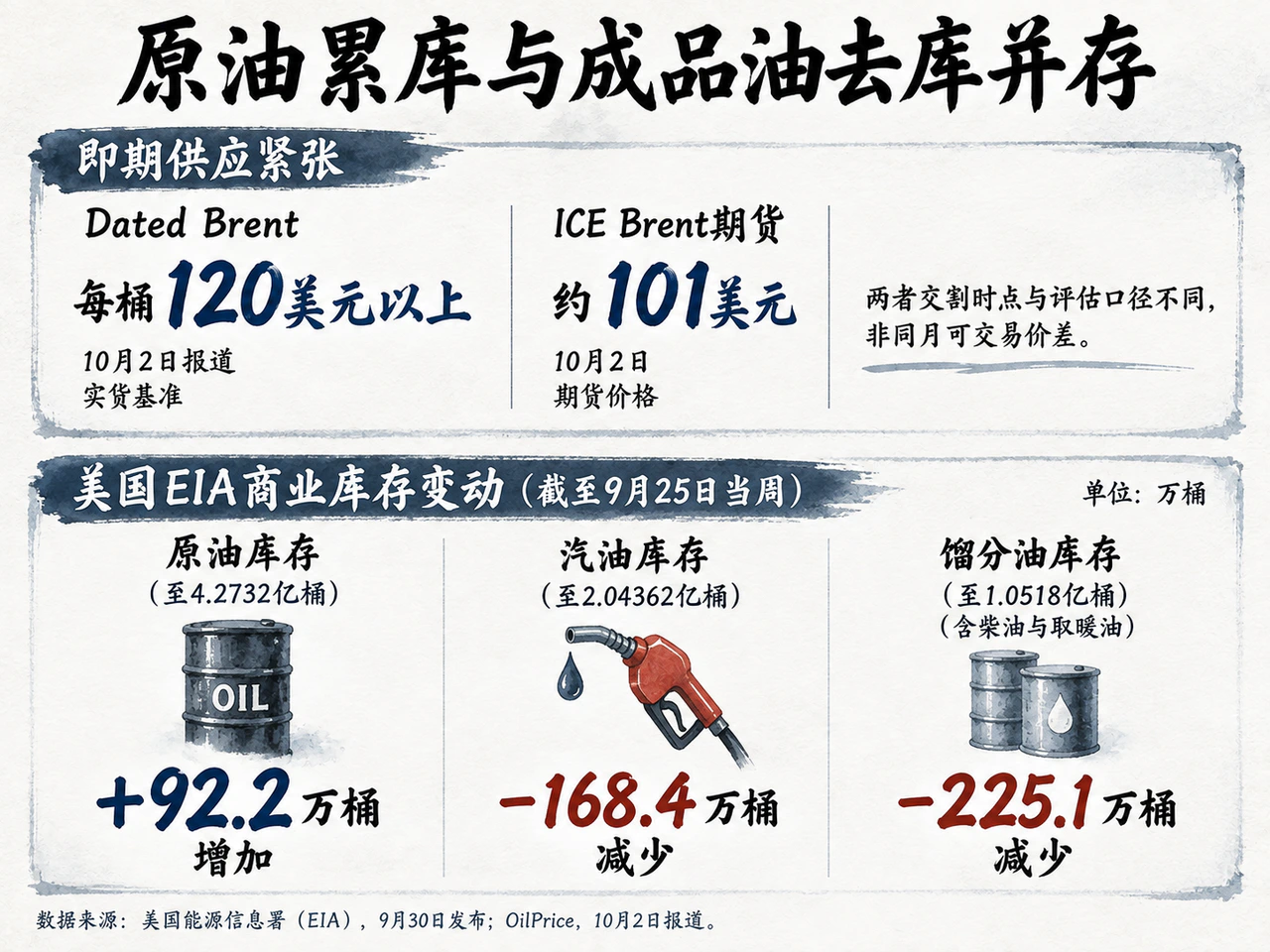
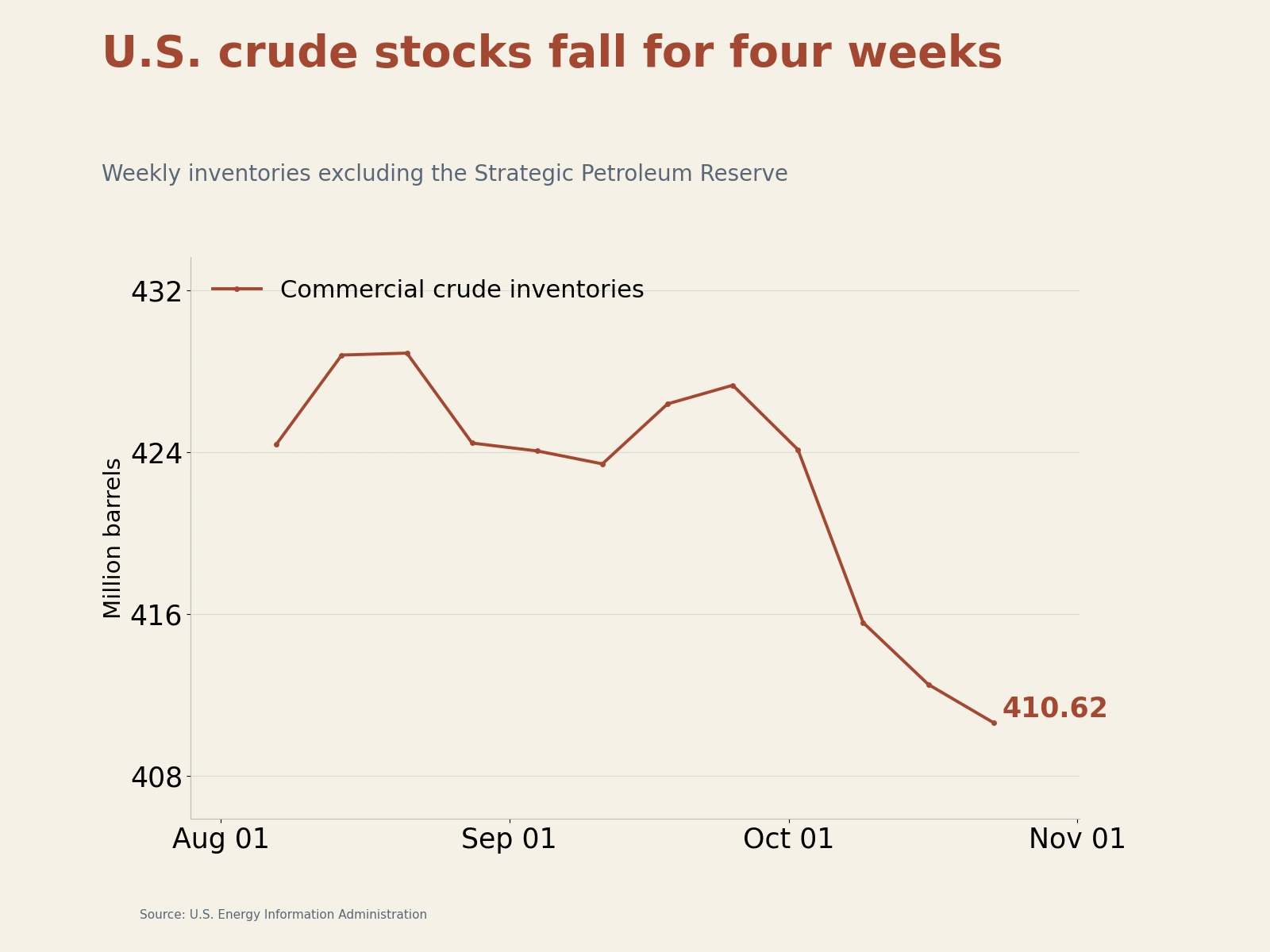
The latest U.S. inventories confirmed the upstream-downstream mismatch. EIA data released September 30 showed commercial crude inventories rising 922,000 barrels to 427.32 million in the week ended September 25. Product drawdowns accelerated, however: gasoline fell 1.684 million barrels to 204.362 million, and distillates, including diesel and heating oil, dropped 2.251 million to 105.18 million. Crude accumulation did not produce simultaneous abundance in end-use fuels.
Reuters cited Saxo Bank head of commodity strategy Ole Hansen as saying that as Middle Eastern seaborne crude shipments recovered somewhat, market pressure was shifting toward products, with Middle Eastern and Russian refining capacity and output constrained. In that setting, directly releasing diesel and raising refinery loads addressed the problem more closely than simply supplying unrefined crude.
High physical premiums also signaled prompt tightness. OilPrice reported on October 2 that physical benchmark Dated Brent had risen above $120 a barrel, well above ICE Brent futures around $101 that day. The delivery times and assessment bases differ, so this was not a tradable same-month spread. Reuters cited Barclays that day as saying prompt cargoes maintained substantial premiums over deferred contracts and global inventories were still being depleted. The bank raised its Q4 Brent average forecast by $20 to $115. Capital Economics offered a competing assumption: if the recent recovery in Middle Eastern crude flows persisted alongside strategic releases, the market could move into a small surplus. The underlying disagreement was whether recovering crude could translate smoothly into usable products.
Hormuz and alternative-pipeline flows recover to 75% of prewar levels; core OPEC+ output remains 5 million barrels a day short
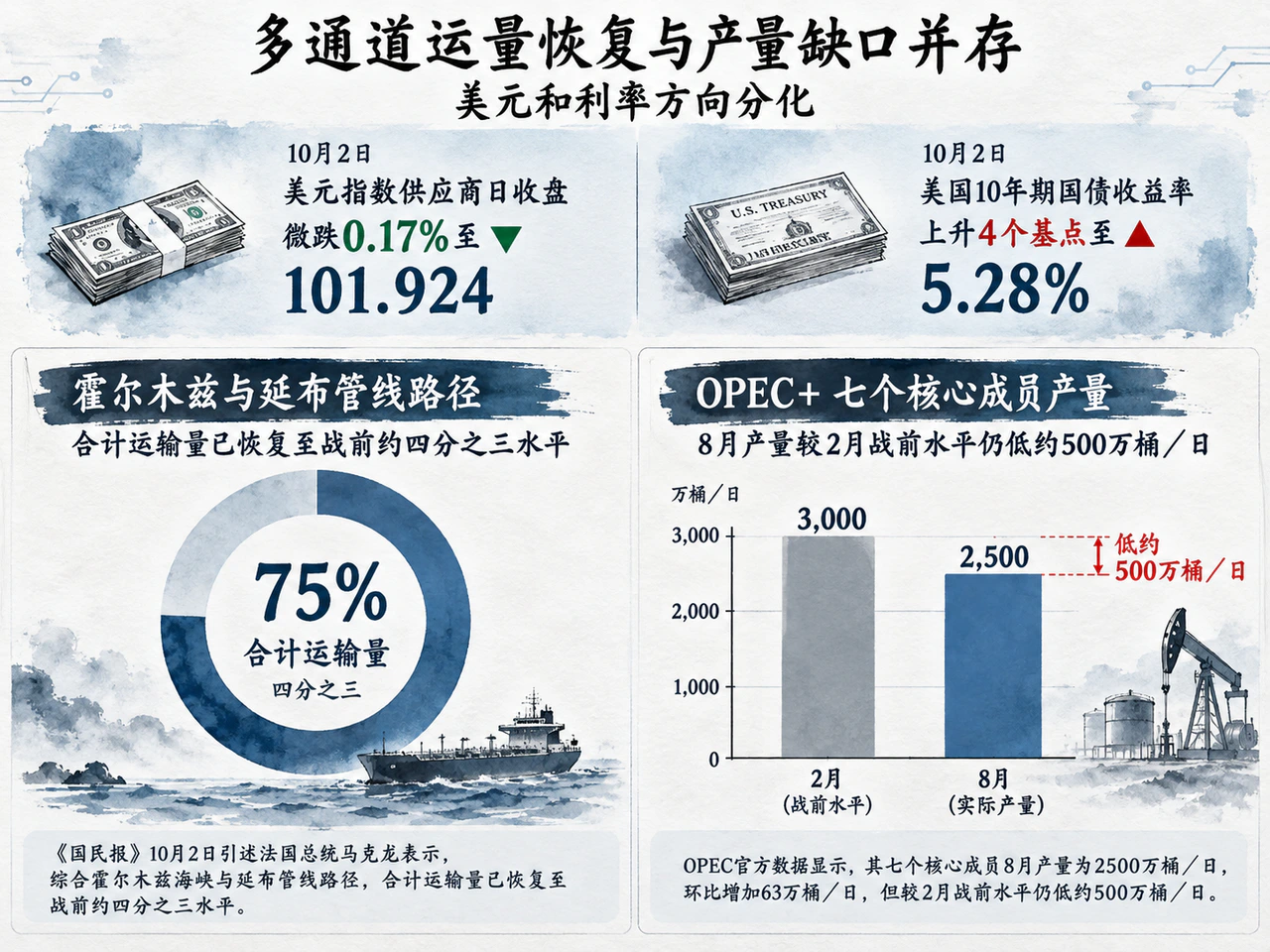
Middle Eastern transport corridors showed marginal improvement. The National reported on October 2 that French President Macron said combined flows through Hormuz and the Yanbu pipeline had recovered to roughly three-quarters of prewar levels. Recovery across multiple routes helped reduce part of the geopolitical disruption premium, but did not mean Hormuz alone had recovered to that proportion, and navigation risks had not entirely disappeared.
Producers' supply recovery differed structurally from official quotas. Reuters reported on September 30, citing people familiar with the matter, that core OPEC+ members were expected at their October 4 meeting to leave November targets unchanged. OPEC data put the seven core members' August output at 25 million barrels a day, up 630,000 month on month but still about 5 million below February's prewar level. Unchanged nominal quotas did not rule out marginal additional supply from the continuing recovery of previously damaged exports.
Medium- and long-term expansion faced greater uncertainty. Reuters reported on October 2 that conflict affecting Middle Eastern expansion projects had delayed capacity-baseline assessments for setting 2027 quotas; one source expected completion in mid-November. The delay directly affected long-term capacity planning and quota allocation rather than immediate supply. Financial conditions also sent mixed signals: the dollar index edged down 0.17% to 101.924 on the October 2 provider daily close, while the 10-year Treasury yield rose 4 basis points to 5.28%. A weaker dollar marginally eased procurement costs for non-U.S. buyers, but higher Treasury yields raised position and inventory financing costs, creating offsetting forces.
The oil market's next direction depends on four key developments:
- Actual diesel volumes delivered during the first 20 days of strategic releases, and whether the diesel-crude spread narrows significantly;
- Whether distillate inventories stop falling and stabilize in the next EIA weekly report;
- Whether Hormuz and pipeline exports sustain their recovery and compress prompt cargo premiums;
- Whether the October 4 OPEC+ ministerial meeting, despite expectations of unchanged quotas, is accompanied by a recovery in actual effective supply. The first two test whether downstream fuel shortages are effectively offset; the latter two determine whether the crude scarcity premium continues to unwind.