The U.S. August trade deficit widened sharply as imports strengthened. Although weaker net exports would weigh on third-quarter GDP in the national accounts, recovering imports themselves showed domestic spending had not cooled across the board. For the Federal Reserve, separating the accounting drag from net exports from actual domestic demand is essential to assessing rates. The latest import and demand resilience favored continued caution and observation rather than independently justifying a shift toward easing.
August deficit widens 13.7% as capital goods and materials drive a 4.3% import rebound
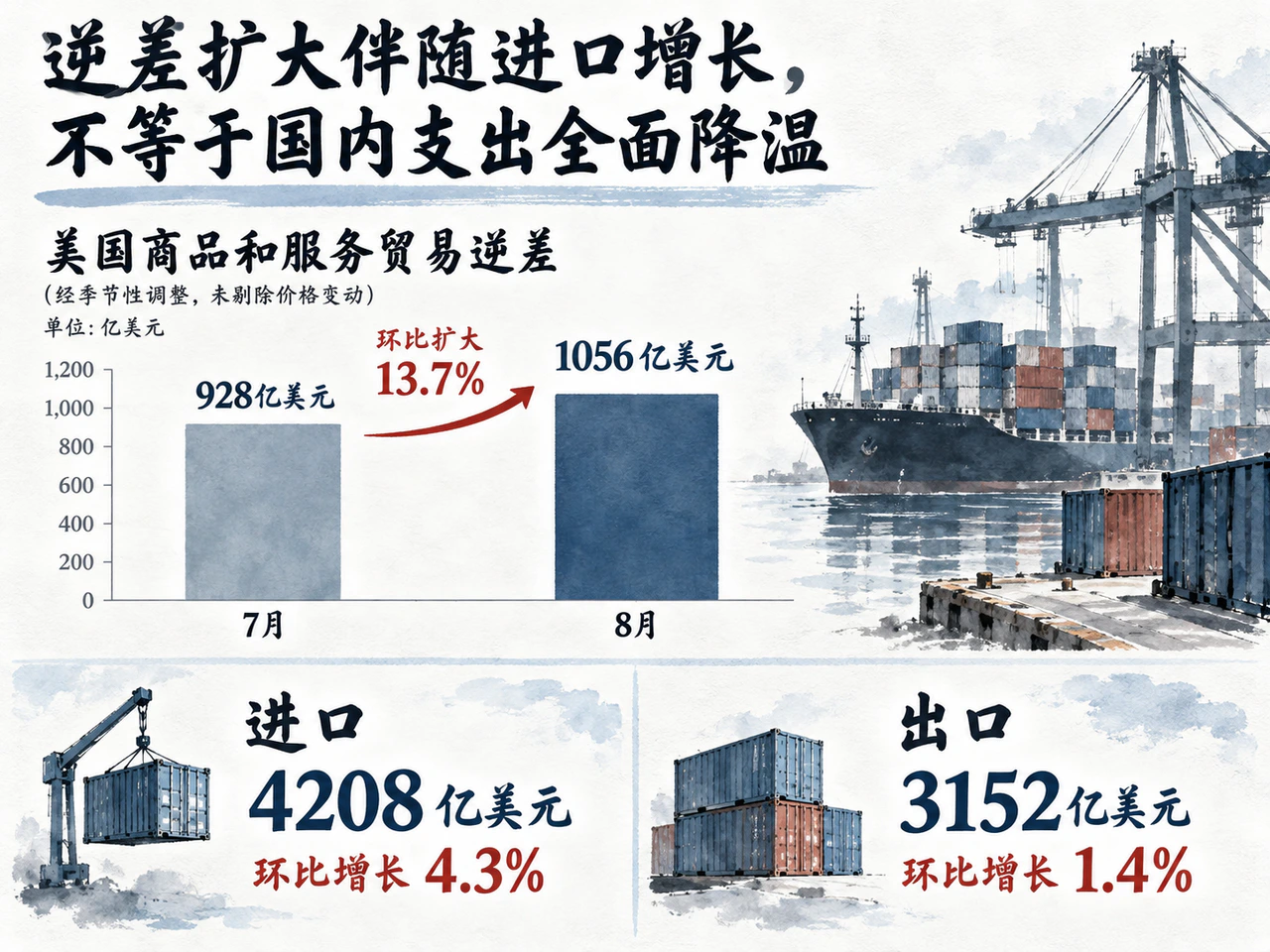
BEA and Census Bureau data showed the seasonally adjusted U.S. goods-and-services deficit, not adjusted for price changes, at $105.6 billion in August, 13.7% wider than July's revised $92.8 billion. Imports grew much faster than exports: exports rose 1.4% to $315.2 billion, while imports increased 4.3% to $420.8 billion.
The import rebound had a clear productive-demand character. On the Census basis, industrial-supply imports rose $9.1 billion in August, including increases of $3.3 billion in crude oil and $3.1 billion in nonmonetary gold. Capital-goods imports rose $6.2 billion, including $2.4 billion in semiconductors. Higher nominal spending on raw materials and intermediates neither equals simultaneous final-demand growth nor directly translates into lost output. Yet real goods imports in constant 2017 dollars rose 4.1%, showing genuine volume expansion as well. Resilient equipment and industrial-input purchases did not support a conclusion of broad demand contraction.
Policy rates remain anchored at 3.75%–4%; resilient private demand supports tightening expectations
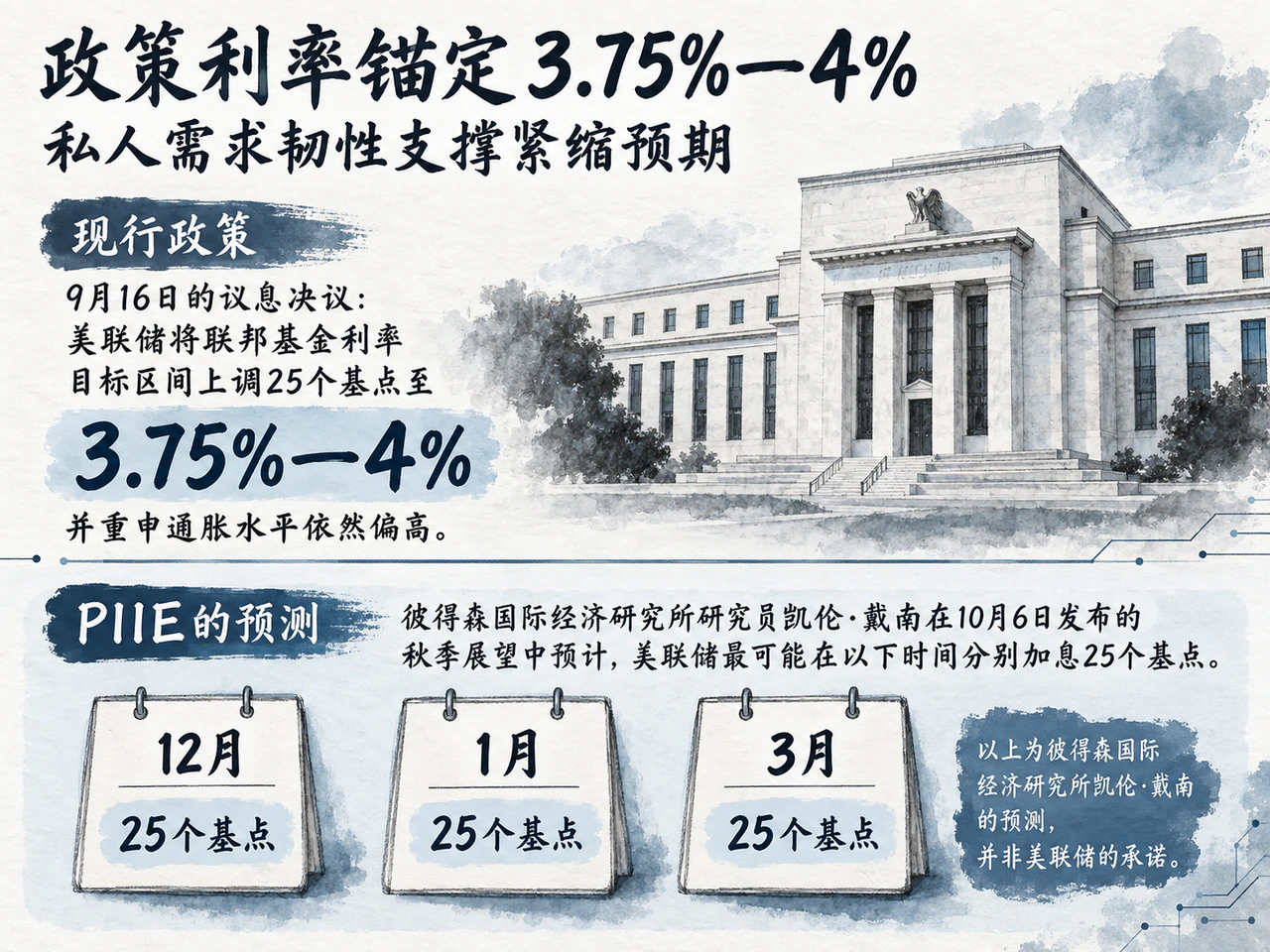
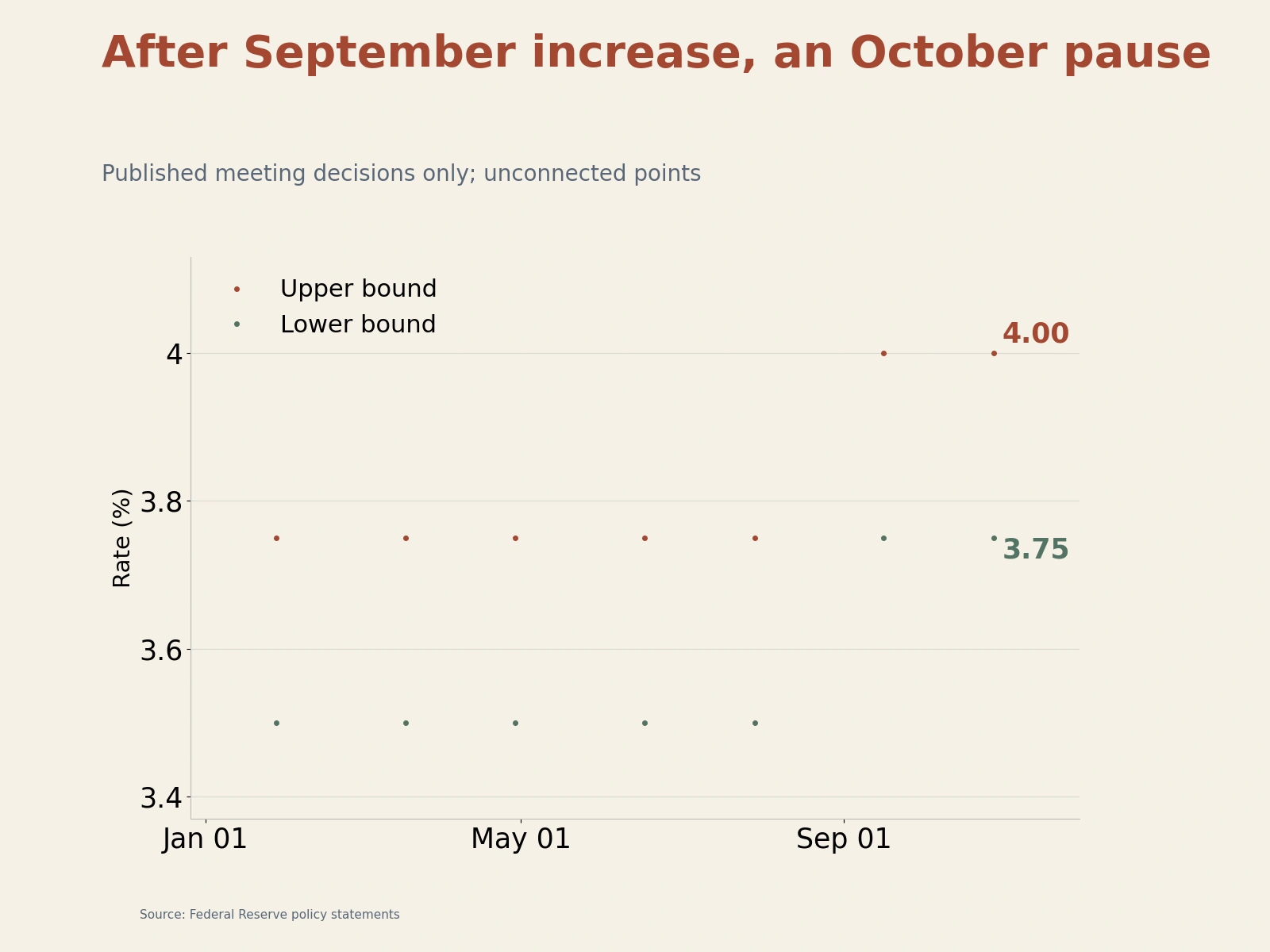
The policy benchmark remained the September 16 decision, when the Fed raised its target range 25 basis points to 3.75%–4% and reiterated that inflation remained elevated. Trade data must be read in this context: even if net exports lower reported output, strong domestic consumption and investment make disinflation harder to achieve smoothly.
In her October 6 autumn outlook, Peterson Institute researcher Karen Dynan judged that the Fed would most likely raise rates 25 basis points each in December this year and January and March next year. Her central argument was resilient private demand alongside an energy shock increasing upside inflation risks. She specified that this path assumed energy prices gradually declined. A substantial equity correction weakening the wealth effect could instead materially slow household spending. External developments could therefore still disturb the tightening path.
Supervisory restructuring does not change the monetary stance; focus turns to minutes and officials' remarks
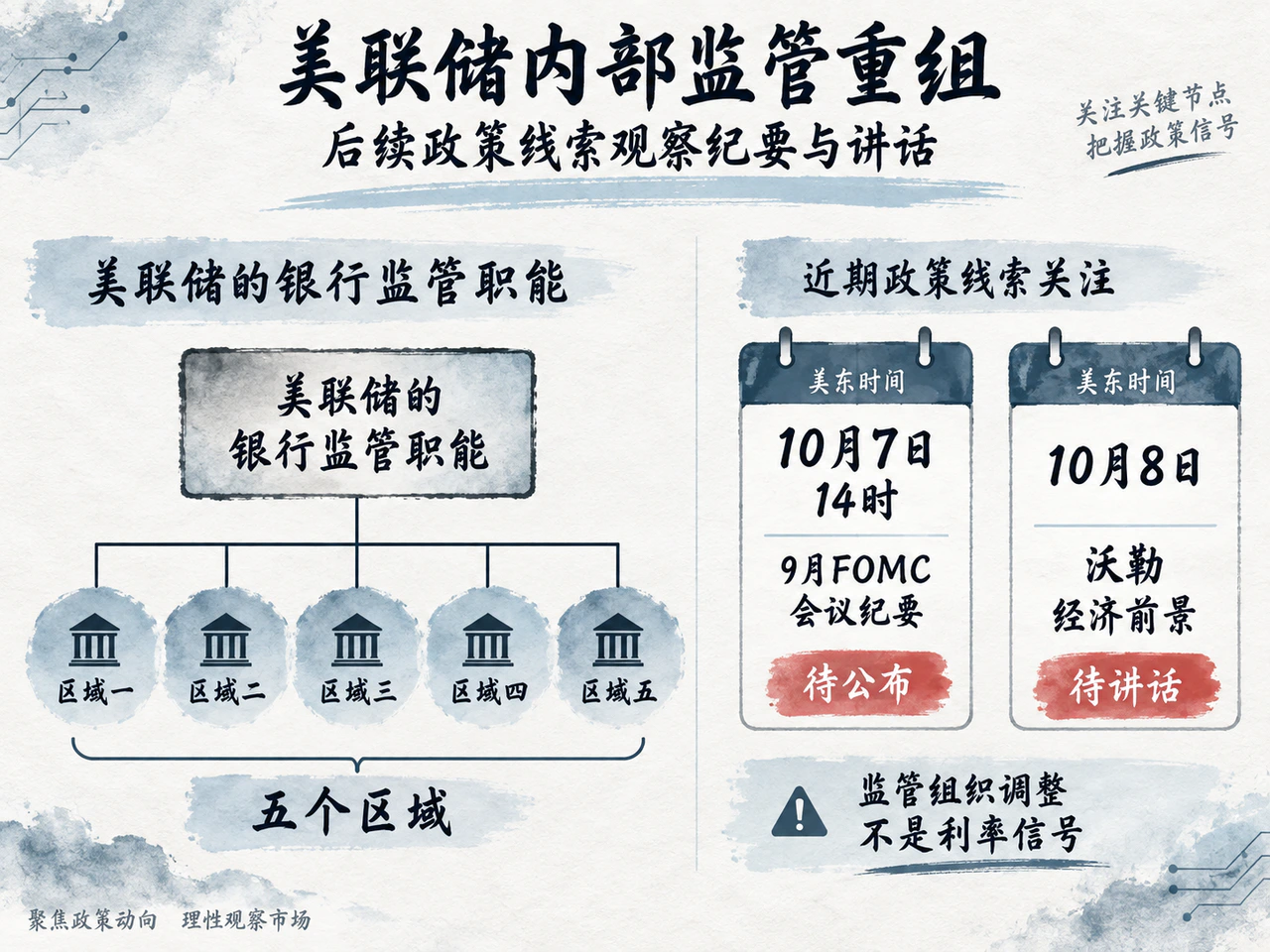
That day's official news centered on financial supervision. Vice Chair for Supervision Bowman announced at the St. Louis community-banking research conference the formal start of a reorganization consolidating Fed bank-supervision functions into five regions to clarify decision-making responsibilities. Her public remarks offered no macro outlook or new rate guidance. The organizational change therefore did not signal a monetary-policy adjustment.
Two near-term checkpoints were central: September FOMC minutes due at 14:00 Eastern time on October 7 and Governor Waller's economic-outlook speech on October 8. The former would illuminate consensus on maintaining restrictive conditions; the latter could offer senior-level interpretation of the latest August economic and trade data. If imports, consumption and investment remained resilient, the case for restrictive policy held. Only material domestic cooling and effective relief from energy pressure could meaningfully reduce the urgency of further tightening.