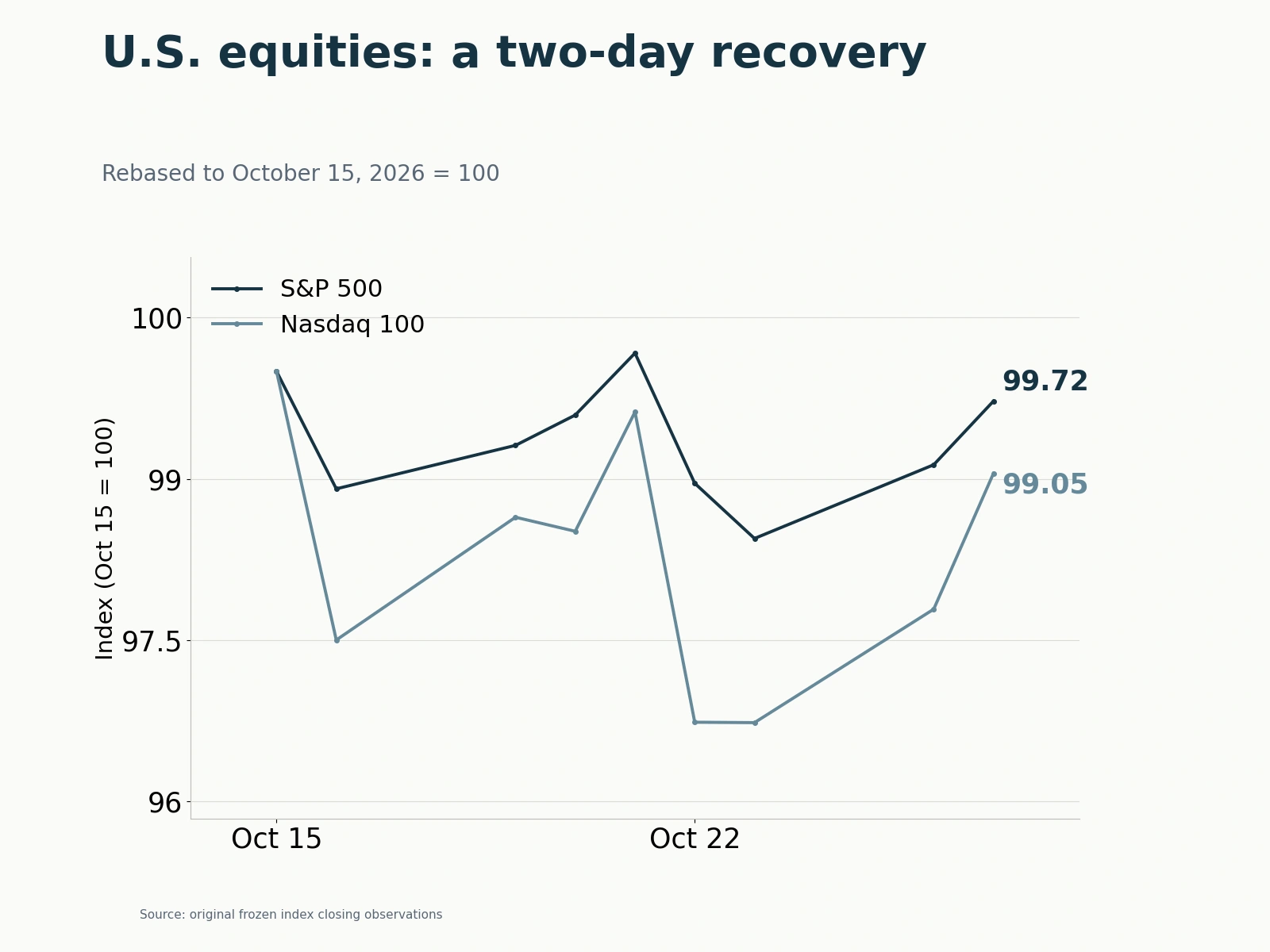
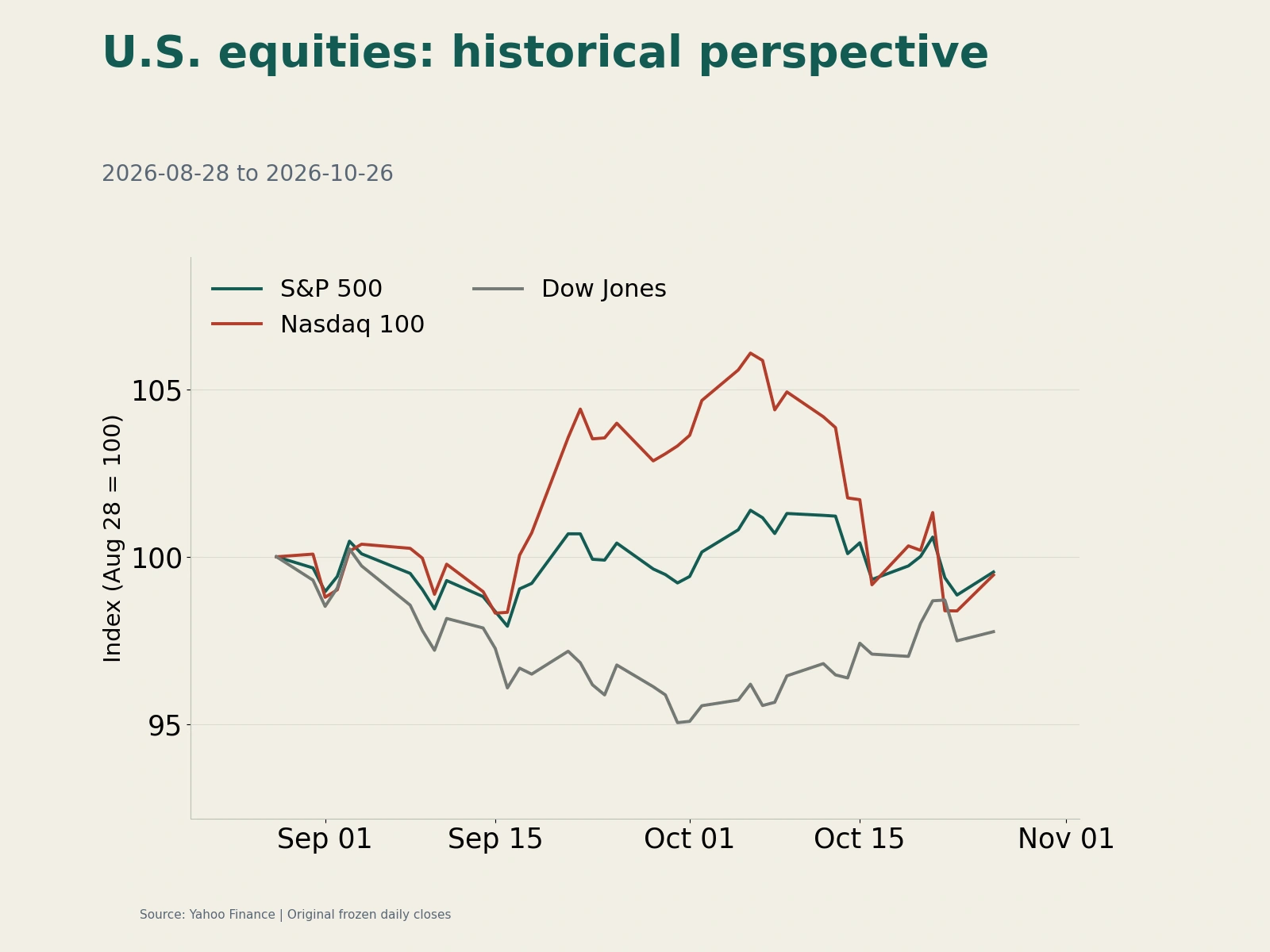
On October 8, 2026, major U.S. indices diverged: the S&P 500 fell 0.47% to 7,765.36, the Nasdaq 100 lost 1.39% to 30,725.81, and the Dow edged up 0.10% to 51,231.64. Cross-asset pricing was structurally divided. High long-term Treasury yields attracted allocation buying on weakness and brought long yields down. Equities, however, saw substantial technology selling as investors reassessed generative AI's revenue returns and enormous funding needs. Meanwhile, sudden energy supply disruptions lifted oil, and falling real yields supported gold.
By the morning of October 9 Beijing time, sector divergence was clearer: energy led on stronger crude, financials rose steadily, and technology suffered valuation reassessment. Lower long nominal yields marginally eased valuation constraints, but refinancing costs and actual profit monetization at conventional and technology companies still require evidence from subsequent cash flows and bond issuance.
Strong 30-year Treasury demand lowers long yields; hike expectations constrain the front end
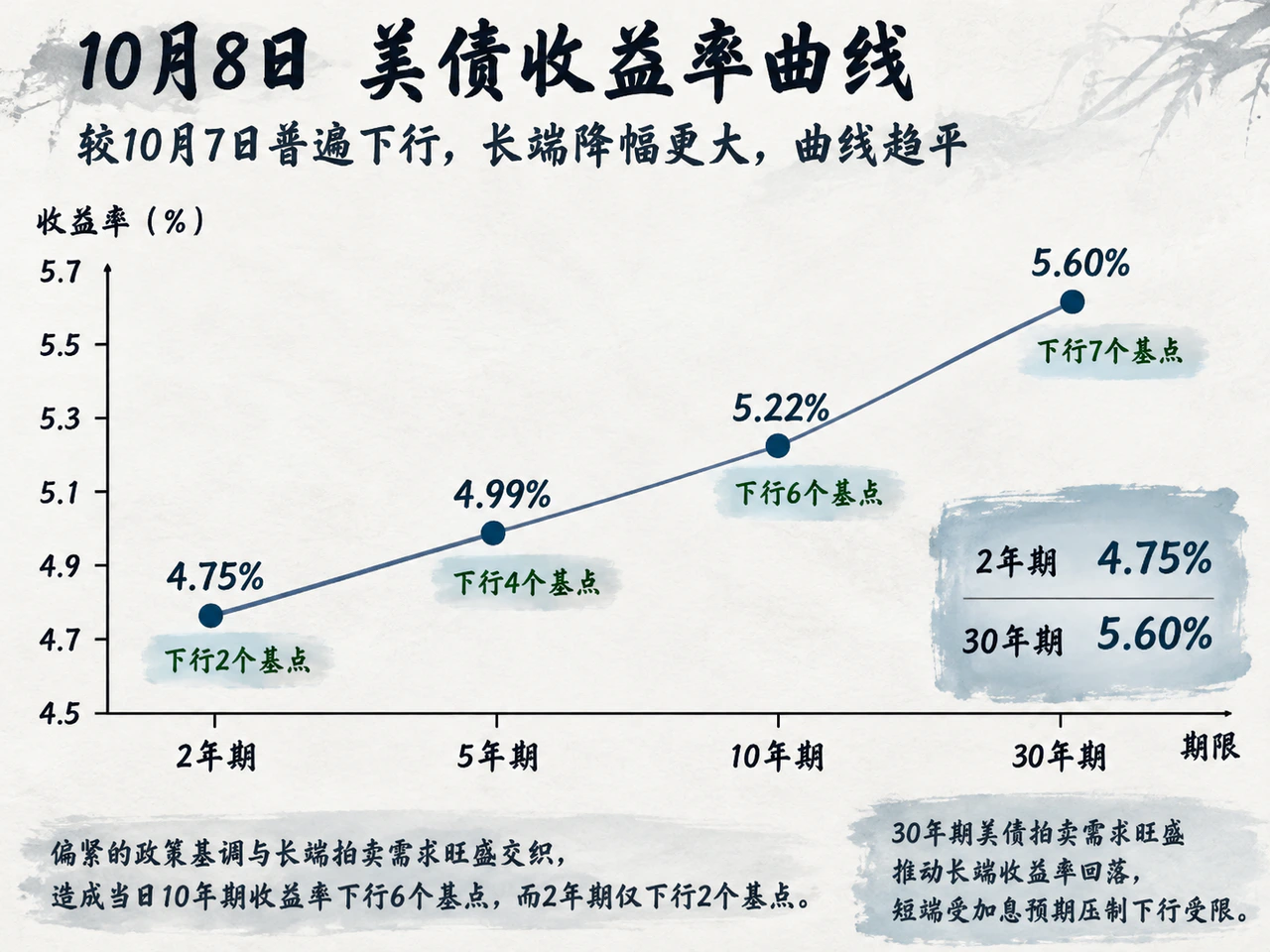
The U.S. Treasury's daily par curve showed broadly lower yields on October 8 versus October 7, with larger declines at the long end.
| Maturity | October 8 yield | Change from previous trading day |
|---|---|---|
| 2-year | 4.75% | −2 basis points |
| 5-year | 4.99% | −4 basis points |
| 10-year | 5.22% | −6 basis points |
| 30-year | 5.60% | −7 basis points |
The 10-year/2-year spread narrowed from 51 to 47 basis points in a bull flattening. Treasury prices initially fell on reinflation worries from surging oil, then rebounded broadly after a strong 30-year auction. Its high yield of 5.618% was below the market's pre-deadline expectation; bid-to-cover of 2.54 beat the previous six-auction average of 2.41, and indirect bidders took 72.3%, above the prior average of 69.1%. High coupons clearly attracted long-term allocations.
Monetary expectations limited short-yield declines. At the Istanbul Economic Forum, Fed Governor Waller said further increases in the benchmark rate would likely be needed if data evolved as expected, but pacing could remain flexible without hikes at consecutive meetings. Reuters recorded a temporary rise in the 2-year yield after his remarks. Tight policy guidance and strong long-auction demand combined to lower the 10-year by 6 basis points but the 2-year by only 2.
Fundamentals mixed resilience with cooling. Seasonally adjusted initial claims for the week ending October 3 were 197,000, below Reuters' 200,000 forecast and down 2,000 from the revised previous week. Continuing claims for the week ending September 26 rose 17,000 to 1.716 million. Alongside September's 29,000 payroll gain and 4.2% unemployment, labor remained sticky with low layoffs and low hiring. The Census Bureau reported seasonally adjusted August wholesale sales of $817.5 billion, up 1.8% monthly, and inventories of $964.2 billion, up 0.5%, below the preliminary 0.7%. The inventory/sales ratio fell from July's 1.19 to 1.18. Nominal sales outpaced inventory accumulation, indicating steady stock absorption.
BMO U.S. rates strategist Ian Lyngen warned that markets focused excessively on energy's price pass-through and insufficiently priced high oil's damage to final demand. Expensive energy lifts inflation expectations but also erodes purchasing power and corporate margins; the two channels point in different directions for long bonds.
More than 60% of Gulf crude output shut in lifts oil; falling real yields lift gold
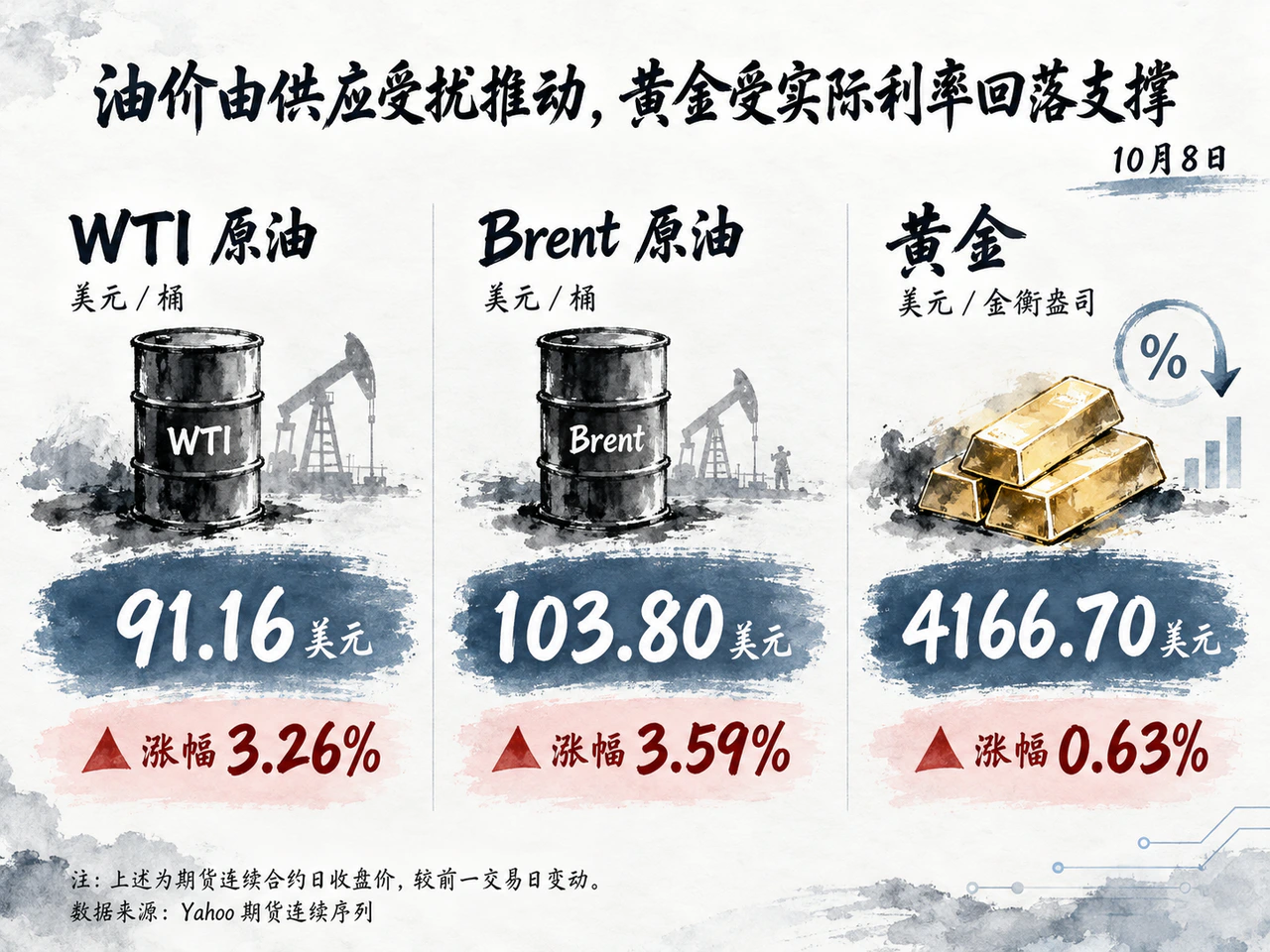
On Yahoo's vendor daily-close basis for continuous futures, October 8 WTI was $91.16 a barrel, up $2.88 or 3.26%; Brent was $103.80, up $3.60 or 3.59%.
Shutdowns in a key U.S. offshore region provided firm support. Operator reports compiled by regulators through 11:00 a.m. Central Daylight Time October 8 put storm-related Gulf of Mexico oil shut-ins at 1.2829 million barrels a day, 62.89% of expected regional production that day, sharply above the previous day's 25.08%. Undamaged platforms could resume only after safety inspections.
Iran-related shipping risk maintained geopolitical supply concerns, although Trump's statement ruling out strikes before November's midterms prompted some intraday profit-taking in oil. On the policy side, the IEA agreed October 7 to accelerate previously committed reserve releases, emphasizing diesel; about 100 million barrels represented remaining deliveries from the plan announced in March. Reserve-delivery efficiency and offshore restart speed will determine how long the shortage lasts.
Precious metals also rose, mainly on marginally easier financial conditions. The same continuous series showed gold up $26 to $4,166.70 per troy ounce, a 0.63% gain, and the dollar index down 0.12% to 102.115. Treasury data showed the 10-year TIPS real yield falling from 2.92% to 2.87%. Lower real risk-free returns reduced gold's opportunity cost, with a slightly weaker dollar also supporting gains. Oil and gold rose together for different reasons: direct supply interruption for oil, falling real rates for gold.
AI monetization and vast funding needs face scrutiny; semiconductor losses drag the Nasdaq lower
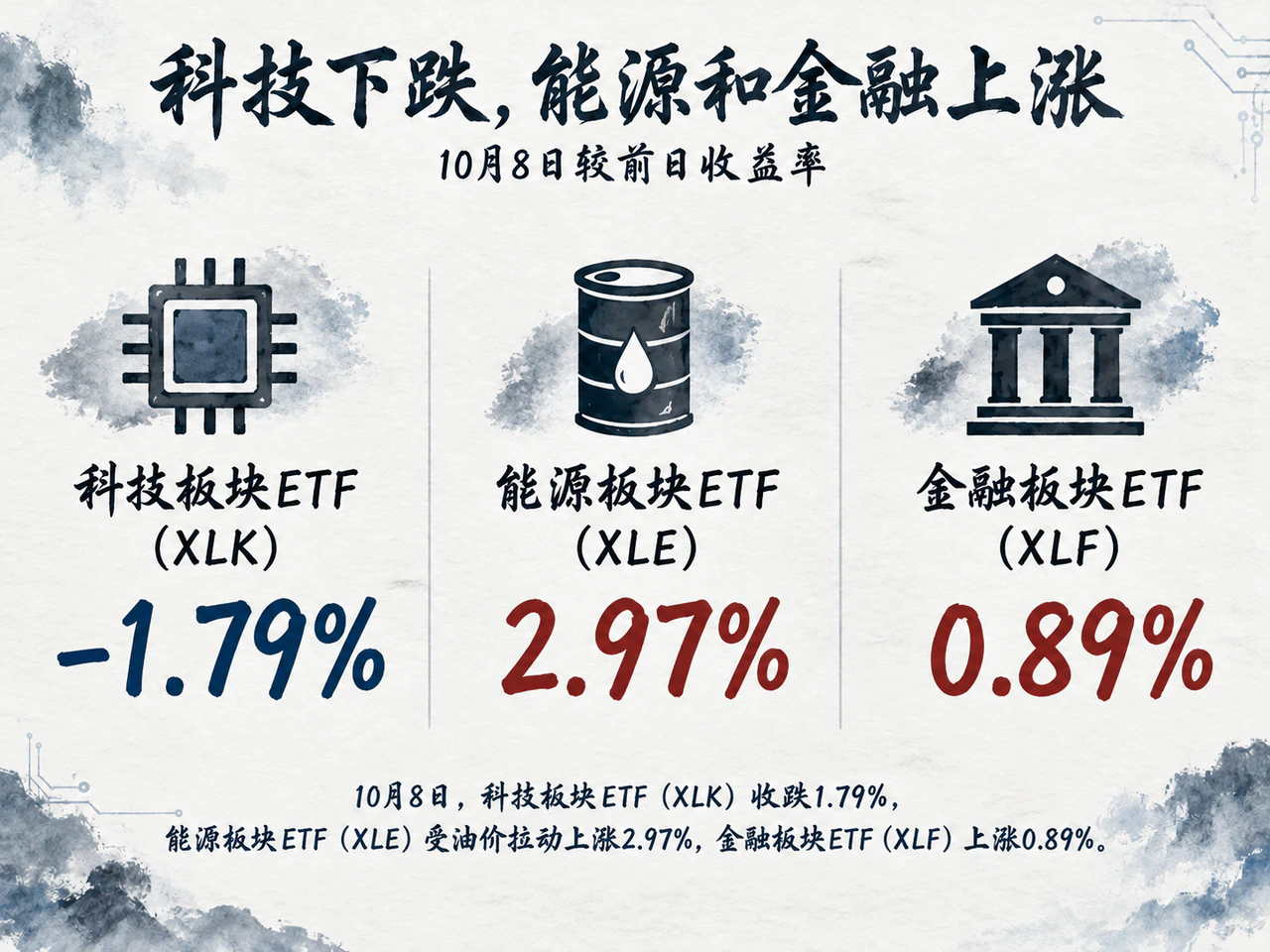
Sector divergence intensified. Technology ETF XLK fell 1.79%, energy ETF XLE rose 2.97% with oil, and financial ETF XLF gained 0.89%. NYSE advancers outnumbered decliners 1.28 to 1, while the Nasdaq had 2,050 gainers and 2,734 decliners. The VIX rose to 15.41, with selling concentrated in expensive technology and related growth assets.
AI revenue expectations and funding balances were central. Reuters cited investor documents obtained by the Financial Times showing OpenAI's annualized revenue near $50 billion at end-September, below roughly $70 billion previously circulated. The key definition difference concerned cloud-partner sales, included by Anthropic but excluded from OpenAI's calculation. The Wall Street Journal also reported Broadcom planning about $50 billion of external financing for OpenAI, while Oracle pursued large funding arrangements. Growing capex appetites and uncertain monetization prompted reassessment of customers' willingness to pay, project cash flows and discounting capital costs. Broadcom, Oracle and Micron fell 4.4%, 5.5% and 4.8%; the Philadelphia Semiconductor Index dropped 3.4%.
Individual earnings reactions further showed the importance of expectations:
- Samsung's October 8 preliminary guidance put third-quarter operating profit at KRW 107.4 trillion, above the second quarter's KRW 89.49 trillion and slightly above LSEG's KRW 106.1 trillion consensus, yet shares fell 2.4%. Reuters cited analysts forecasting only 8.2% sequential profit growth in the fourth quarter versus nearly 20% in the third; slower growth encouraged profit-taking.
- PepsiCo's premarket results for the 12 weeks ending September 5 showed revenue of $25.274 billion, up 5.6% year on year, and core EPS of $2.34, up 2%. Management cut full-year core EPS growth guidance from the low end of 5%–7% to 2.5%–3.5%, yet shares rose 3.7%. Resilient international operations, sequential improvement in North American convenient-food revenue and further structural cost cuts supported confidence despite the downgrade.
Chinese holiday consumption and liquidity support help; Asia-Pacific offshore dollar issuance remains constrained
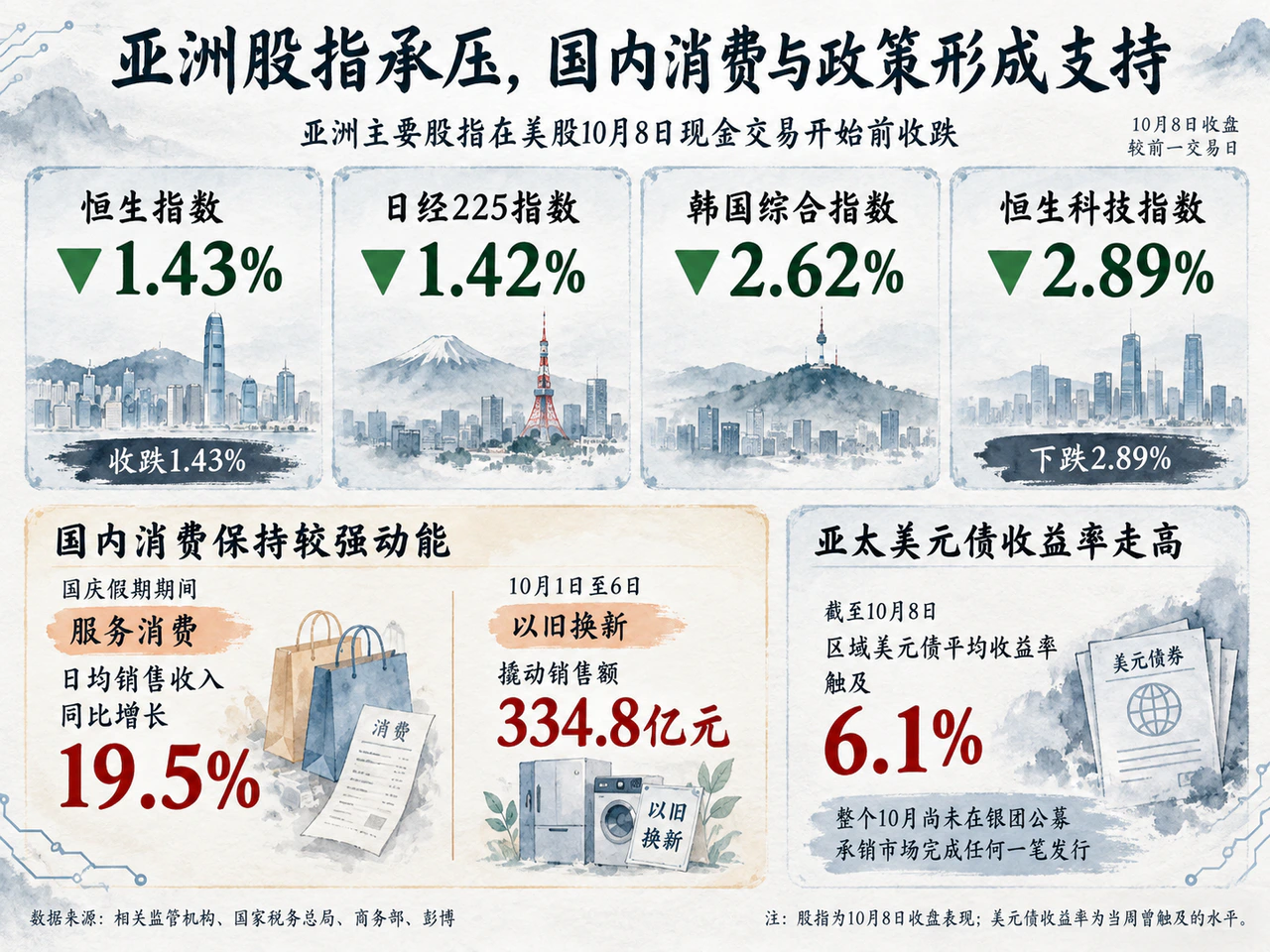
Asian indices closed lower before the October 8 U.S. cash session, affected by overnight markets and local sentiment. The Hang Seng, Nikkei 225 and KOSPI fell 1.43%, 1.42% and 2.62%, while Hang Seng Tech fell 2.89%. Subsequent U.S. technology losses added prospective valuation pressure on Japanese and Korean semiconductors and Hong Kong technology shares.
Domestic demand and liquidity tools worked together in China. Tax-administration VAT invoice data showed National Day holiday average daily service-consumption sales up 19.5% year on year, tourism and entertainment services up 23.6%, and appliances and audiovisual equipment up 40.1% with subsidies. Commerce Ministry data showed trade-in programs benefiting 6.392 million participants from October 1–6 and generating RMB 33.48 billion sales; turnover at 78 monitored major commercial districts rose 4.7%.
The central bank conducted RMB 1.2 trillion of three-month, 89-day outright reverse repos on October 8, a net RMB 200 billion injection against monthly maturities. The Finance Ministry also scheduled an auction of RMB 150 billion of five-year special bonds to recapitalize central financial institutions. The first measure improves banks' short- and medium-term liability structure; the second strengthens core capital at systemically important institutions. Credit effects still depend on fresh corporate loan demand.
Offshore dollar financing remained frozen by high rates. Bloomberg reported that through October 8, Asia-Pacific issuers had completed no syndicated public dollar-bond issue during October; regional dollar-bond yields reached 6.1%. Income Research + Management's weekly report through October 7 showed investment-grade spreads unchanged since month-start at 80 basis points and high-yield spreads down 6 to 305. Yet tracked investment-grade issuance was only $10 billion, far below expectations of at least $25 billion. High risk-free benchmarks clearly discouraged net borrowing.
Some issuers used liability management to ease liquidity pressure. New World Development proposed cash and exchange offers October 6, planning up to $600 million of new 7.375% senior secured notes due 2032 to replace about $991 million of existing notes due January and June 2027 and February 2028. Extending duration addresses near-term repayment peaks, but remaining maturities still require further liquidity management.
European fiscal discipline faces budget resistance; U.S.-Europe trade coordination adds external-demand uncertainty

Budget execution is central to European sovereign debt. Reuters reported that euro-area finance ministers and the ECB jointly urged France on October 8 to secure passage of its 2027 budget. French 10-year yields had risen nearly 80 basis points since early September, approaching 5% intraday. France planned record government-bond issuance of €340 billion in 2027, while National Assembly divisions made fiscal tightening uncertain. Issuance and widening sovereign spreads reinforced pressure.
Top-level rules also constrained support. The European Commission formally rejected Italian and Greek requests for greater fiscal flexibility for energy subsidies that day, limiting members' ability to use deficits to absorb energy-price swings.
Trade-rule expectations added exporter concerns. U.S. Trade Representative Greer said in an interview that the U.S., EU, Japan and other partners agreed to share information to coordinate responses to industrial overcapacity, but had not decided specific measures. Washington was also examining goods entering through simple processing and re-export in third countries such as Vietnam and evaluating further action. Stricter origin tracing or remedial tariffs would pressure Asian manufacturers' cross-border supply chains and capex.
SpaceX's 800MHz purchase shakes telecoms; U.S. fiscal deficit nears $2 trillion
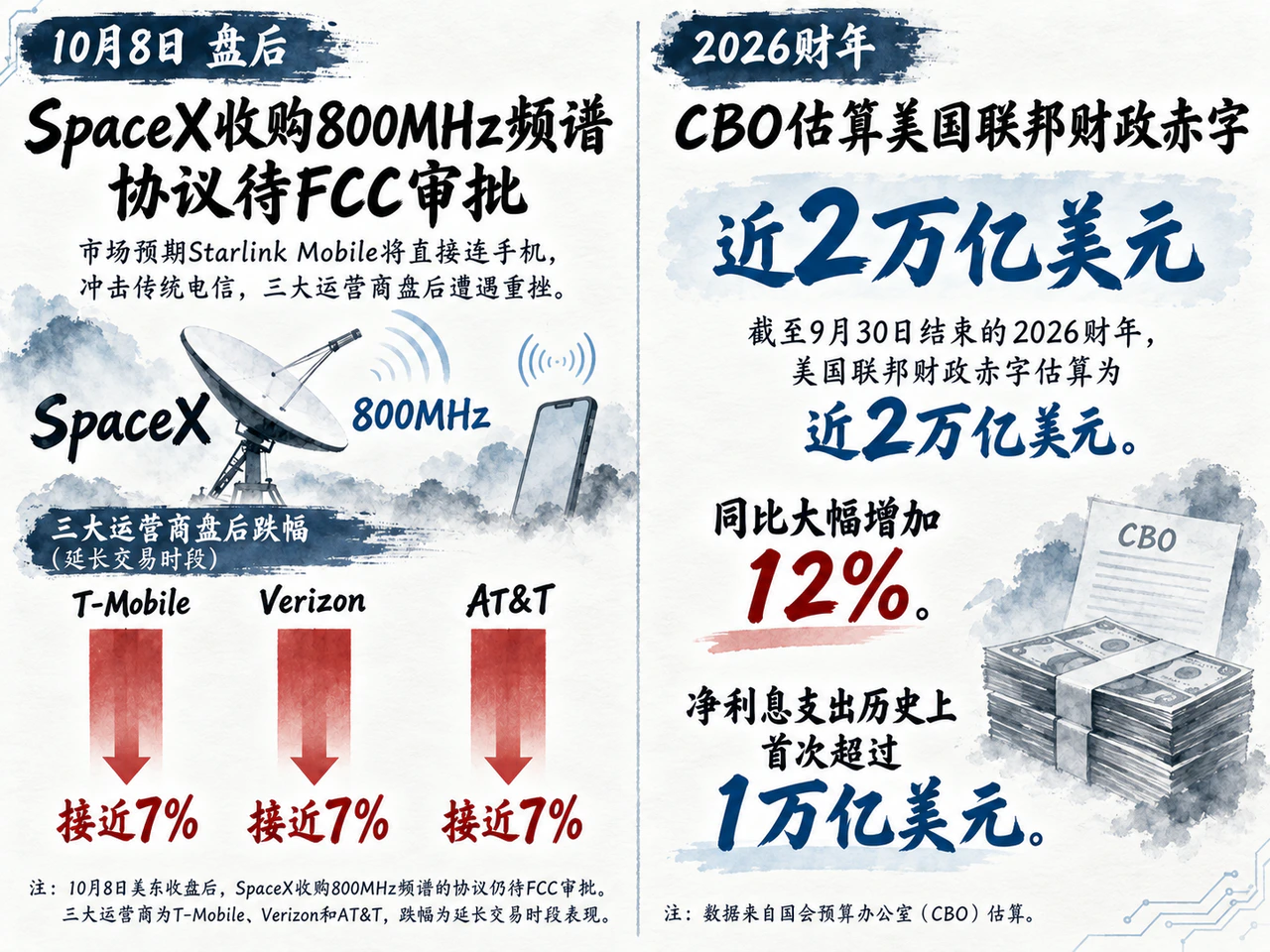
Several after-hours developments increased cross-market volatility:
- At 16:17 Eastern on October 8, Grain Management announced a definitive agreement to sell its nationwide U.S. 800MHz spectrum portfolio to SpaceX, subject to FCC approval. Low-frequency penetration and wide coverage increased expectations for Starlink Mobile direct-to-phone competition. T-Mobile, Verizon and AT&T each fell nearly 7% in extended trading.
- After the U.S. close, CBO estimates put the federal deficit for fiscal 2026, ending September 30, near $2 trillion, up $218 billion or 12% year on year. Net interest exceeded $1 trillion for the first time, up 11%. These deteriorating annual figures help explain why one stronger 30-year auction cannot fundamentally resolve concerns over medium- and long-term Treasury supply and sovereign servicing costs.
- At 16:24 Eastern, AFP reported senior U.S. and Ukrainian representatives would begin two days of closed-door Miami talks on October 9 on a new ceasefire framework, with Europe invited. Topics included security guarantees and postwar economics. A binding ceasefire or agreement protecting energy facilities would directly affect European energy premiums and geopolitical exposure.