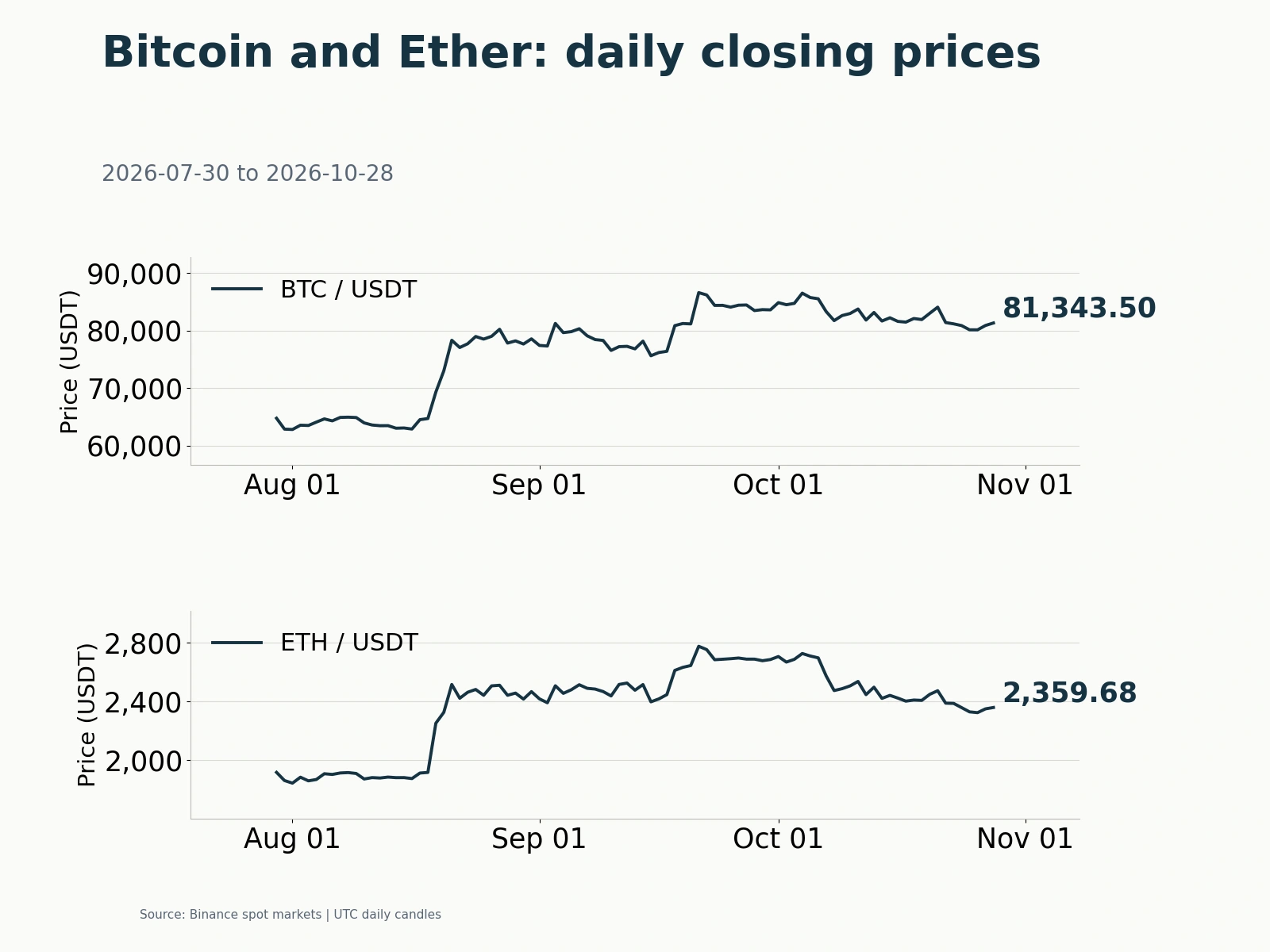
In October 2025, more than $19 billion of crypto contracts were liquidated in about 24 hours. A year later, Bitcoin had still not regained its peak, while financial institutions were accelerating blockchain adoption: by September 2026, monthly turnover on Broadridge's Distributed Ledger Repo (DLR) platform reached $7.5 trillion. The technology was maturing, but token holders were not sharing proportionately in expanding financial business.
The slump has lasted several quarters. Total crypto market capitalization fell 23.7%, 20.4% and 12.6% in the fourth quarter of 2025 and first two quarters of 2026, reaching about $2.1 trillion at the end of June 2026. A strong third-quarter rebound lifted Bitcoin roughly 42% and Ethereum 70%, yet Bitcoin traded near $83,000 intraday on October 8, about one third below its peak above $126,000 a year earlier.
This adjustment challenges three premises behind the previous rally: ETF listings did not bring continuously accelerating inflows; after record liquidations, risk-absorption capacity is still rebuilding; and growing on-chain finance has not created a stable link between business scale and native-token value. Whether institutions can buy tokens, whether financial firms adopt blockchain and whether tokens merit long-term ownership are now three separate questions.
1. The ETF wave cools as incremental institutional demand weakens
U.S. spot ETFs solved the question of how regulated capital enters. Whether it keeps adding exposure depends on different buyers' return targets and risk constraints.
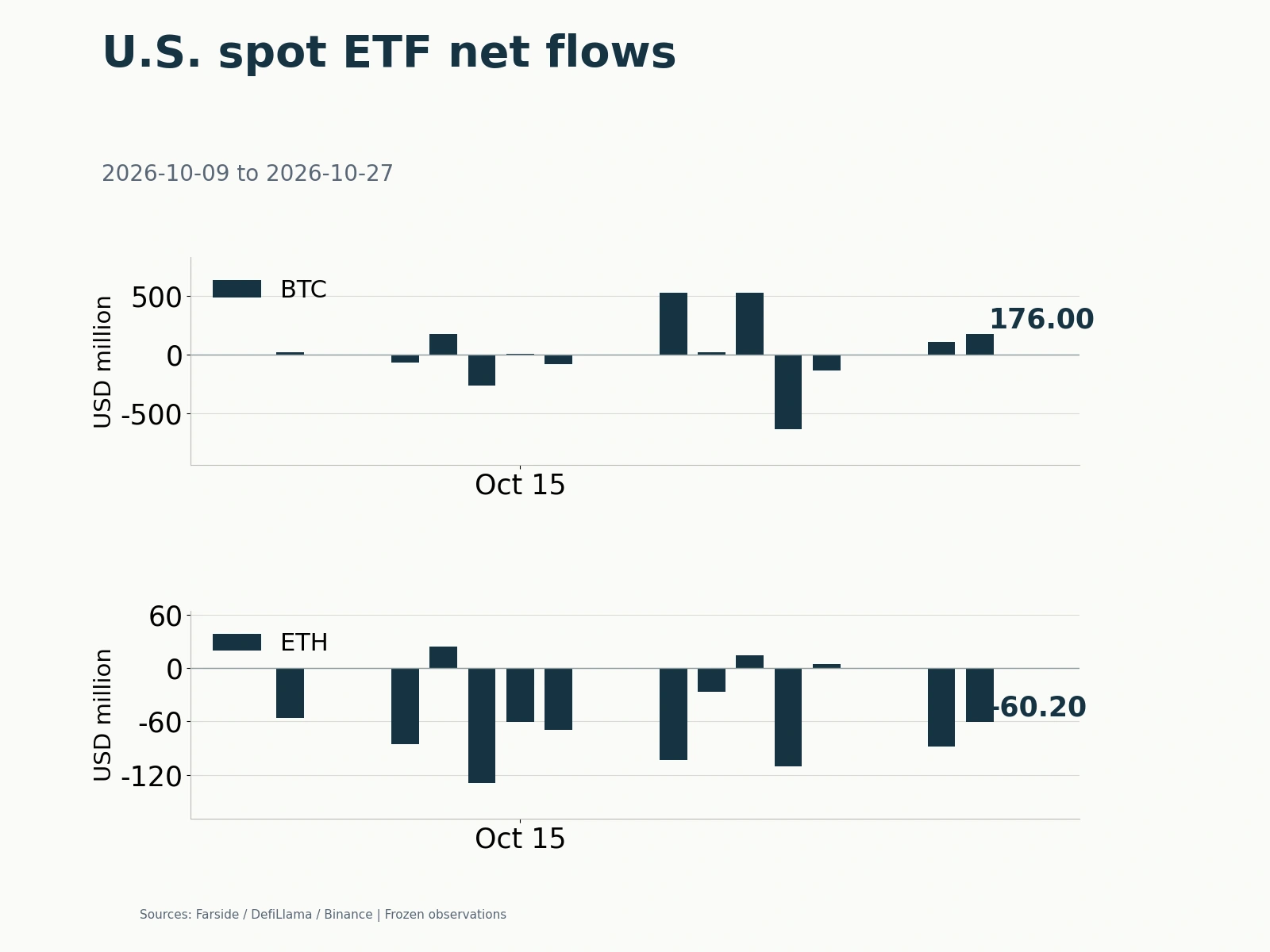
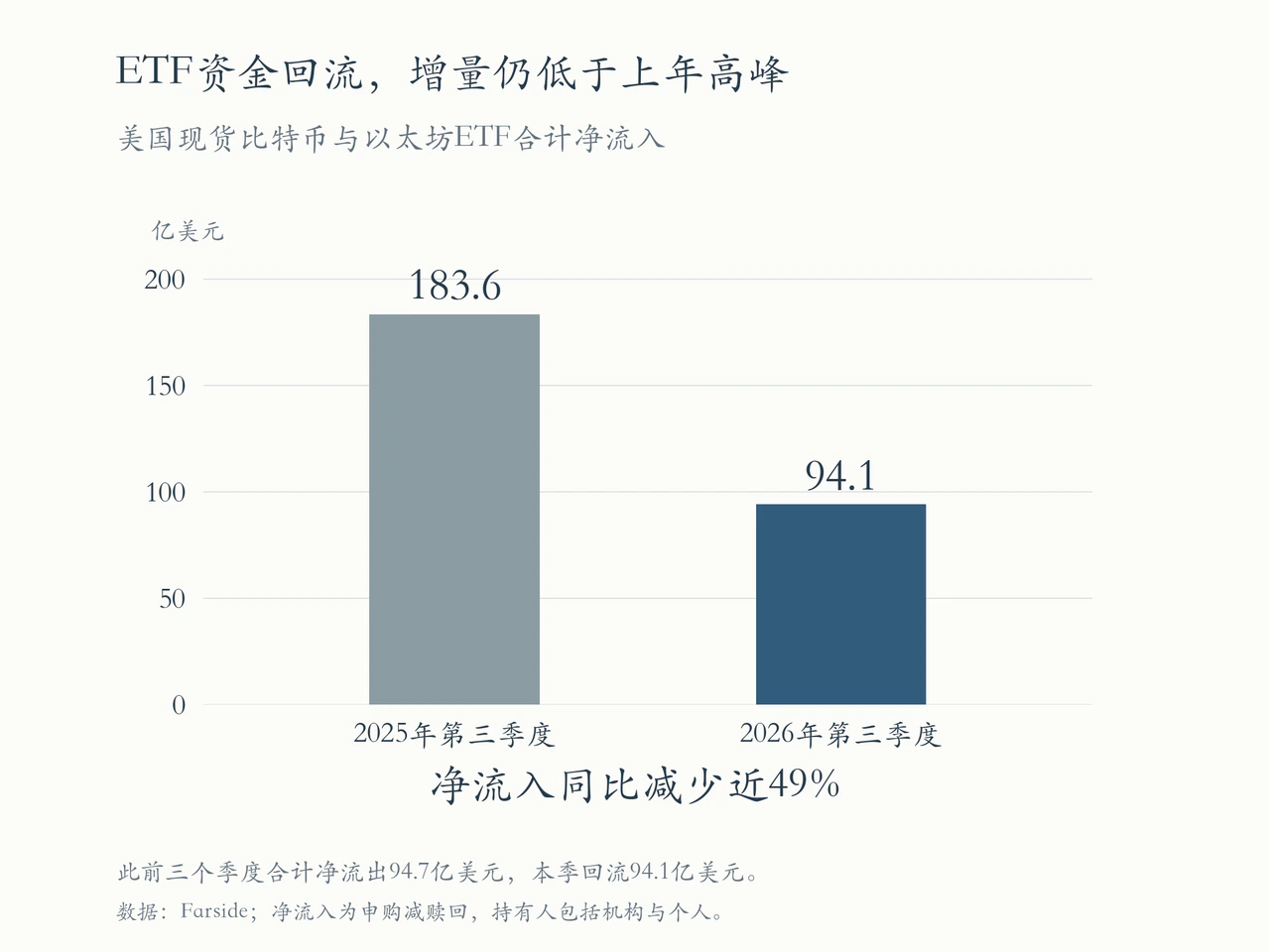
Farside data show combined U.S. spot Bitcoin and Ethereum ETF net inflows of about $18.36 billion in the third quarter of 2025 versus $9.41 billion in the third quarter of 2026, a decline of nearly 49%. The renewed inflows roughly replaced the combined $9.47 billion withdrawn from the fourth quarter of 2025 through the second quarter of 2026, with expansion much slower than at the previous peak. Holders include institutions and individuals. Actual incremental demand through this regulated channel no longer readily supports expectations that institutional entry will continually lift prices.
Safe-haven performance is an important allocation constraint. Bitcoin's capped supply and independence from sovereign credit underpin its 'digital gold' narrative. Scarcity alone does not provide crisis protection, however. Institutions seeking equity diversification must test whether it protects portfolios when stocks suffer; that objective differs from trading spreads or borrowing to buy coins.
CME historical research found daily Bitcoin correlations with the S&P 500 and Nasdaq 100 of only 0.01 and 0.02 in 2017–2019, rising to 0.40 and 0.42 in 2020–2022 and easing to about 0.30 from 2023 through April 2025. Compared with its early near-independent behavior, Bitcoin is more deeply integrated into traditional risk-asset capital cycles.
Stress-day performance in this cycle is particularly revealing. Using adjusted prices at the same New York close for Bitcoin ETF IBIT, Ethereum ETF ETHA, S&P 500 ETF SPY and gold ETF GLD, there were 26 trading days from July 1, 2025 to October 8, 2026 when SPY fell at least 1%. Both crypto ETFs fell on all 26, averaging losses of 3.46% and 5.16%, versus 1.50% for SPY and 0.72% for GLD. When investors urgently needed to reduce equity risk, crypto repeatedly deepened portfolio losses.
January 20, 2026 offers an example: the S&P 500 ETF SPY fell 2.04%, the Bitcoin and Ethereum ETFs lost 6.42% and 8.88%, and gold gained 3.78%. Around the October 2025 shock, from the October 9 close to October 14 close, the Bitcoin and Ethereum ETFs fell 7.03% and 5.27%, the S&P 500 ETF SPY fell 1.33%, and gold rose 4.20%. That interval includes after-hours liquidations, weekend trading and the subsequent rebound. Across the full adjustment, crypto still primarily represented risk exposure.
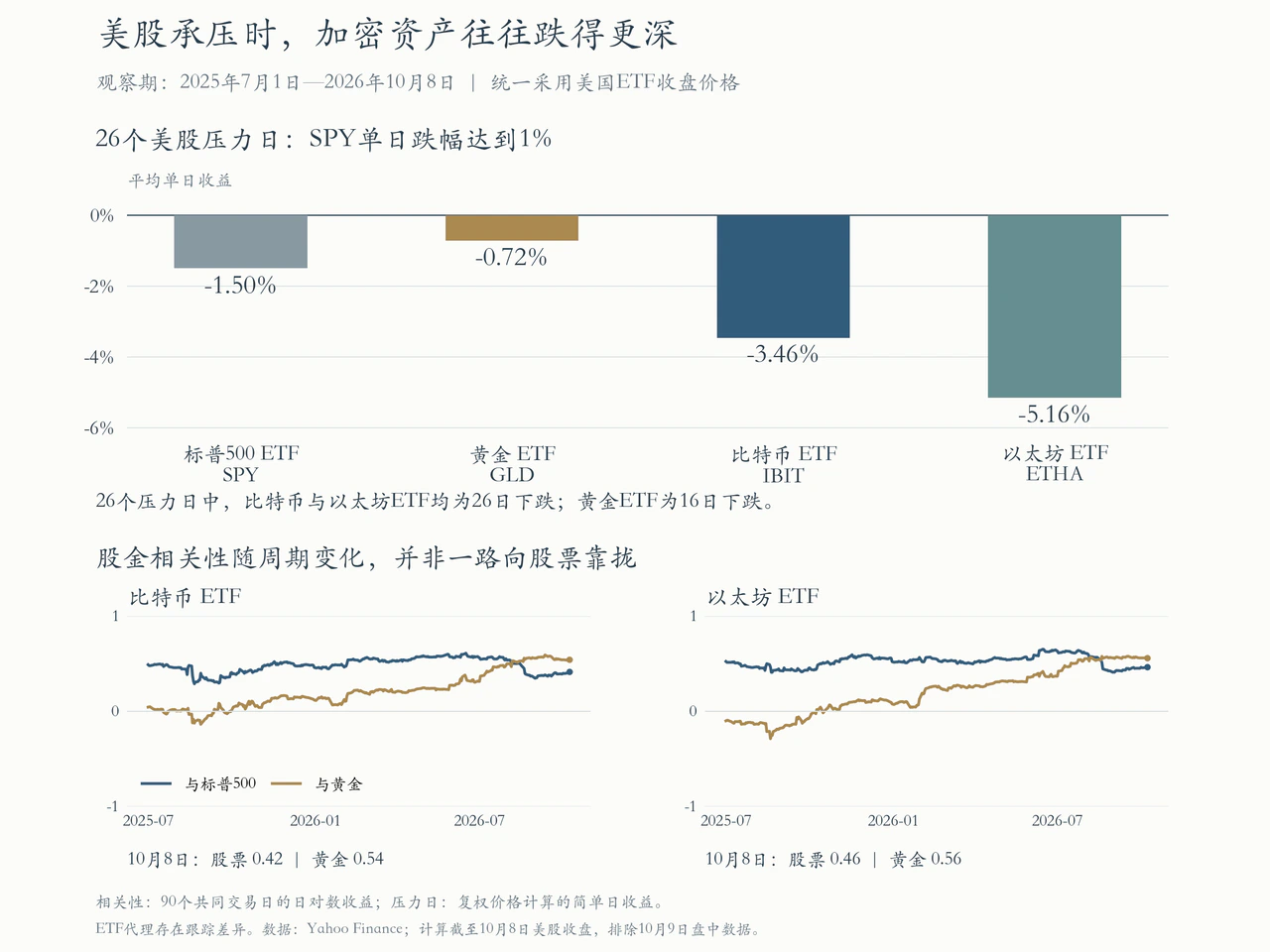
Figure: U.S.-listed ETFs proxy equities, Bitcoin, Ethereum and gold. The chart below shows rolling correlations of daily log returns over 90 common trading days.
The link has a clear funding mechanism. IMF research on crypto cycles finds that institutional participation makes crypto and equities more responsive to common risk appetite. Institutions place both within the same risk budget; when volatility rises, financing tightens or redemptions increase, deleveraging can occur across assets simultaneously. Bitcoin's supply rules have not changed, but the capital setting its price shares more constraints with equities.
This creates an institutionalization paradox: greater participation improves tradability but may weaken the diversification that originally attracted institutions. Investors already holding substantial U.S. equities need higher expected returns if BTC or ETH merely adds volatility in the same direction. The 'digital gold' label alone no longer supplies an allocation case.
Correlations change with conditions. On the same ETF basis, Bitcoin and Ethereum daily correlations with the S&P 500 were about 0.54 and 0.57 in the first half of 2026, falling to 0.38 and 0.31 in the third quarter. Over 90 trading days through October 8, both correlated more strongly with gold than with stocks. Late-summer changes show periods of stronger gold linkage and weaker equity linkage. For crisis-protection buyers, the difficulty is whether diversification appears when needed: temporarily low correlations improve portfolios, but repeated joint stress losses undermine a dependable insurance role.
ETF inflow composition also affects persistence. Some investors buy spot or ETFs and short futures to capture basis. Coinbase's review showed the 30-day annualized basis falling from about 9.8% before the October 10, 2025 crash to about 3.6% in mid-November, followed by contraction in arbitrage positions. Such holdings depend on arbitrage returns covering funding costs and require no long-term bullish price view.
Listed-company coin-purchase financing is conditional too. CoinGecko estimates these companies deployed at least about $49.7 billion to crypto purchases in 2025, roughly half in the third quarter, falling to $5.8 billion in the fourth. Issuing stock at a premium to token net asset value becomes less attractive when that premium narrows. The cycle of rising prices enabling financing and financing supporting purchases slows as valuation premiums disappear.
Institutionalization expands access but introduces stricter return comparisons and risk constraints. Crisis-protection capital faces unreliable hedging, arbitrage capital narrower returns, and listed companies changing financing premiums. The market must offer renewed reasons for these funds to remain.
2. The $19 billion liquidation shock of 2025 still reverberates as market repair continues

On October 10, 2025, Trump announced further tariffs, and escalating trade tensions caused violent global risk-asset moves. Over the next approximately 24 hours, more than $19 billion of notional crypto derivatives positions were forcibly closed, the industry's largest recorded one-day liquidation.
The damage extended into market-making and risk absorption. Market makers buying spot inventory normally hedge price risk with short derivatives. Some exchanges triggered automatic deleveraging (ADL) that day, forcibly closing even profitable protective shorts. Spot inventory remained while its hedge disappeared.
Coinbase's review said market makers deprived of short protection reduced bids, shrinking spot liquidity and worsening declines. This exposed a risk beyond price direction: even a correct market view could leave the intended hedge impossible to maintain. Failed hedges and delayed cross-platform collateral transfers require the same capital to cover larger tail losses. Restoring quotes needs more reliable hedging and funding and sufficient trading returns to compensate for those risks.
Sustained absorption of selling requires market makers to commit inventory, collateral and risk limits. Prices and those supporting conditions can recover at different speeds.
Kaiko research published March 2026 recorded average cross-platform Bitcoin depth within 1% of price falling from $8 million–$10 million before the shock to about $3 million, recovering toward $6 million over subsequent weeks. Observations through the first quarter of 2026 still showed Bitcoin, Ethereum, XRP and SOL depth below pre-shock levels. Thinner books mean the same sell order can move prices further.
Market makers' disclosures also show the difficulty. Flow Traders' first-quarter update said digital-asset activity remained subdued after October 10, 2025. Its first-half 2026 digital-asset net trading income fell 36% year on year, while traditional-asset market-making income rose 18%. When other businesses offer better returns, crypto needs enough trading income to attract risk capital; rising coin prices alone may not achieve that.
Trading recovered in the third quarter, unevenly. GSR monitoring showed perpetual-futures notional open interest around $155 billion at end-September, above February's roughly $90 billion trough, partly reflecting higher coin prices. CoinGecko's summer-liquidity analysis found SOL rising from about $75 in late August toward $100 without corresponding improvement in spot depth. Leverage and spot absorption recovered at different rates.
More recent data show both sides. CryptoRank put centralized-exchange third-quarter 2026 spot volume at $2.49 trillion, down about 14% quarter on quarter, its fourth consecutive decline. September nevertheless recovered to $973 billion, up 20% month on month. Coinbase's October 2 research also recorded improving September BTC and ETH bid depth on its exchange, with Bitcoin books nearly balanced and Ethereum bid-heavy for the first time in months.
The $19 billion event exposed weak hedge reliability and risk capital. Depth damage persisted into the first quarter of 2026, and first-half market-making returns remained weak. In the third quarter some coins' support lagged prices, while September buying in major assets improved and activity recovered from its trough. Historical damage, subsequent funding conditions and business returns jointly shaped repair. Different mechanisms are improving gradually and assets recovering unevenly. A healthy market requires capital able to absorb selling persistently; a price upturn alone cannot complete that repair.
3. The blockchain-infrastructure narrative weakens: On-chain traditional finance does not directly support native-token valuations

The proposition that larger traditional financial businesses make native tokens more valuable once on-chain was highly attractive. Actual deployment reveals missing links: financial principal, interest and service fees have established owners. BTC and ETH holders do not automatically acquire economic rights when business moves on-chain.
Financial institutions adopt blockchain first for faster settlement, less reconciliation and more flexible collateral movements. Several networks can meet those goals; public-token networks have no monopoly on the technology.
In March 2026, South Africa's FirstRand implemented intragroup cross-border dollar payments on JPMorgan's private permissioned Kinexys network, transferring funds between accounts under predefined conditions. It operates within bank deposits and requires no public-chain native token. In July, DTCC and more than 30 institutions conducted live production transactions using digital representations of DTC-custodied assets on parallel private Besu and Canton networks. Besu follows Ethereum-compatible development standards, but a separately deployed permissioned network need not use Ethereum-mainnet ETH.
Broadridge's DLR runs on Canton and handled $7.5 trillion in repo turnover in September 2026, averaging about $359 billion a day, up approximately 5.9% year on year. Canton's public synchronization service has its own native-token fee mechanism, and institutions may choose other synchronization arrangements. Trillions of business turnover neither means an equivalent amount of permanently locked assets nor directly creates BTC or ETH purchases.
Blockchain adoption expands financial institutions' choices without granting public-chain native tokens exclusive rights to charge for financial activity. Technology standards can be adopted while a particular public network is bypassed; Ethereum-compatible software can run without ETH.
Even within public-chain ecosystems, principal financial returns have explicit contractual owners. JPMorgan offers eligible institutions dollar deposit token JPM Coin on Base; customers hold a deposit claim against the bank. BlackRock's BUIDL invests in cash, short Treasuries and repo. Interest belongs to fund shareholders and service providers charge contractual fees. ETH holders do not thereby receive bank spreads, fund interest or management fees.
Ethereum earns network-resource fees. Gas is priced for computing, storage and other resources consumed, rather than as a percentage of asset face value. The same instructions can transfer different asset amounts. Growth in financial principal and turnover need not produce proportional network consumption or fees.
An entire economic transmission separates on-chain scale from token value: which network is chosen, how many resources are used, what fees are paid, and how much fee income and long-term holding demand ultimately accrue to the token. Large financial activity can translate into little token revenue or demand.
Scaling further changes transmission. Fidelity's November 2025 research found that over the preceding year Base charged users about $94 million in transaction fees and paid Ethereum mainnet about $5.2 million in blob data-availability fees. Layer-2 use gives mainnet fees only for its own service component; their charging boundaries differ. The December 2025 Fusaka upgrade changed blob fees to improve that mainnet link. As technology lowers use costs, valuation support increasingly requires evidence that new demand offsets declining unit charges.
ETH retains real economic foundations: base-fee burning reduces supply, validators stake ETH and accept slashing risk to secure the network, and ETH serves as collateral and liquidity. Business growth can add value if it increases these demands. The test is how those specific demands grow and whether they persist, rather than assigning all on-chain financial asset value to ETH's valuation.
Tokenized financial assets may also compete with native tokens in some uses. Platforms including Crypto.com and Deribit accept assets such as BUIDL as margin collateral, and whitelisted access connects them to UniswapX quoted trading. Institutions can sometimes trade using interest-bearing tokenized Treasury units, reducing reliance on volatile native-token collateral. On-chain finance brings competitors alongside business.
Blockchain is becoming financial infrastructure, but native tokens are not equity claims on those activities. Bitcoin needs its own monetary attributes and allocation demand to support price; Ethereum must convert usage into fees, burning, security and collateral demand; other tokens must explain what holders own and why long-term holding is necessary. Trillions of traditional financial activity cannot supply that value case for them.
The past year's weakness reflects liquidation-driven liquidity damage, poor market-making returns and uneven repair, as well as a reality test for valuation expectations. ETFs make buying easier without guaranteeing growing capital. Financial institutions expand blockchain use without promising returns to token holders. Recovery ultimately requires risk-bearing capital to rebuild and tokens to develop more dependable holding rationales. Technological progress can underpin new valuations only when it creates holding demand and sustainable economic value.
This article is market research only and does not constitute investment advice.