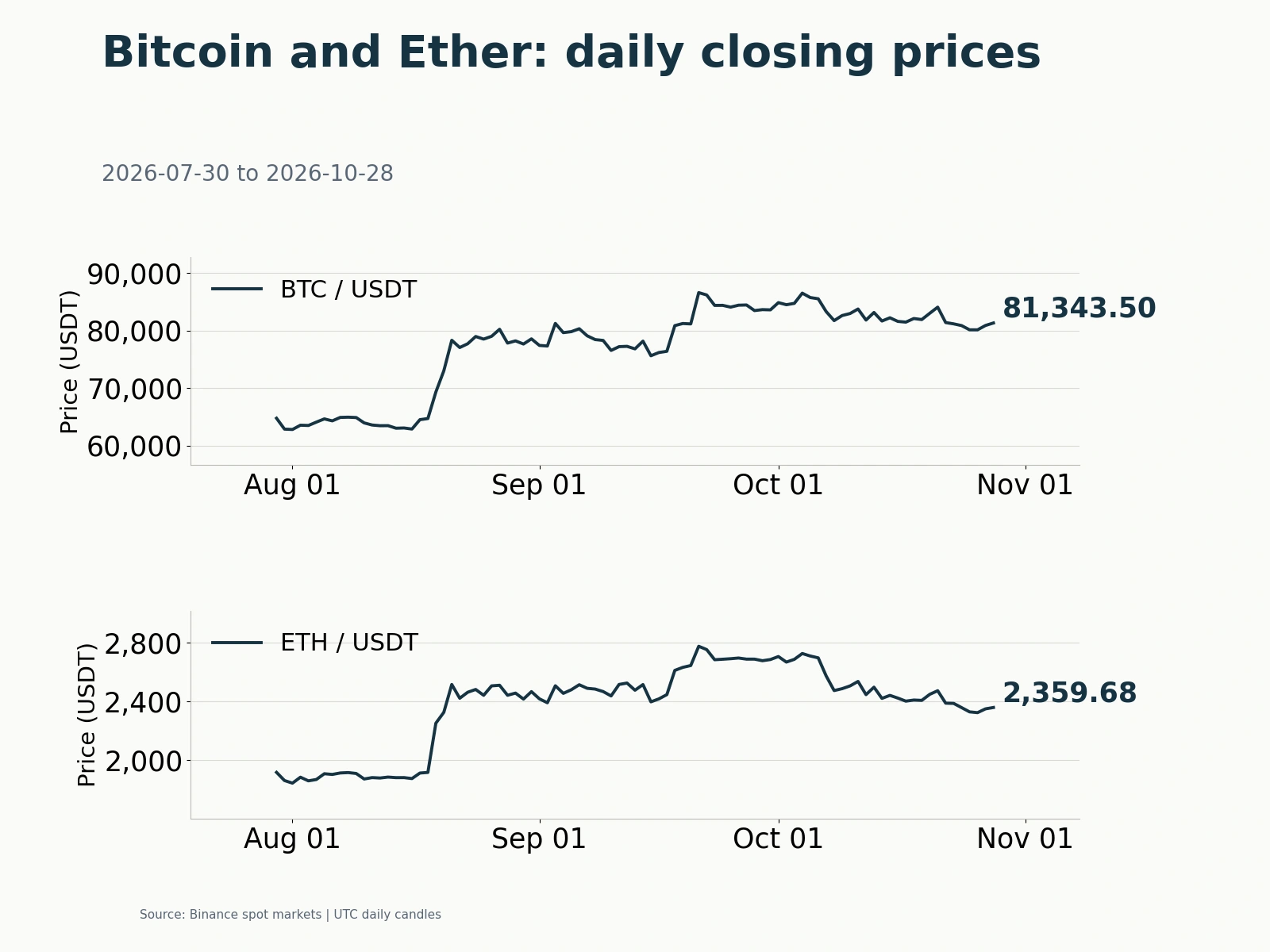
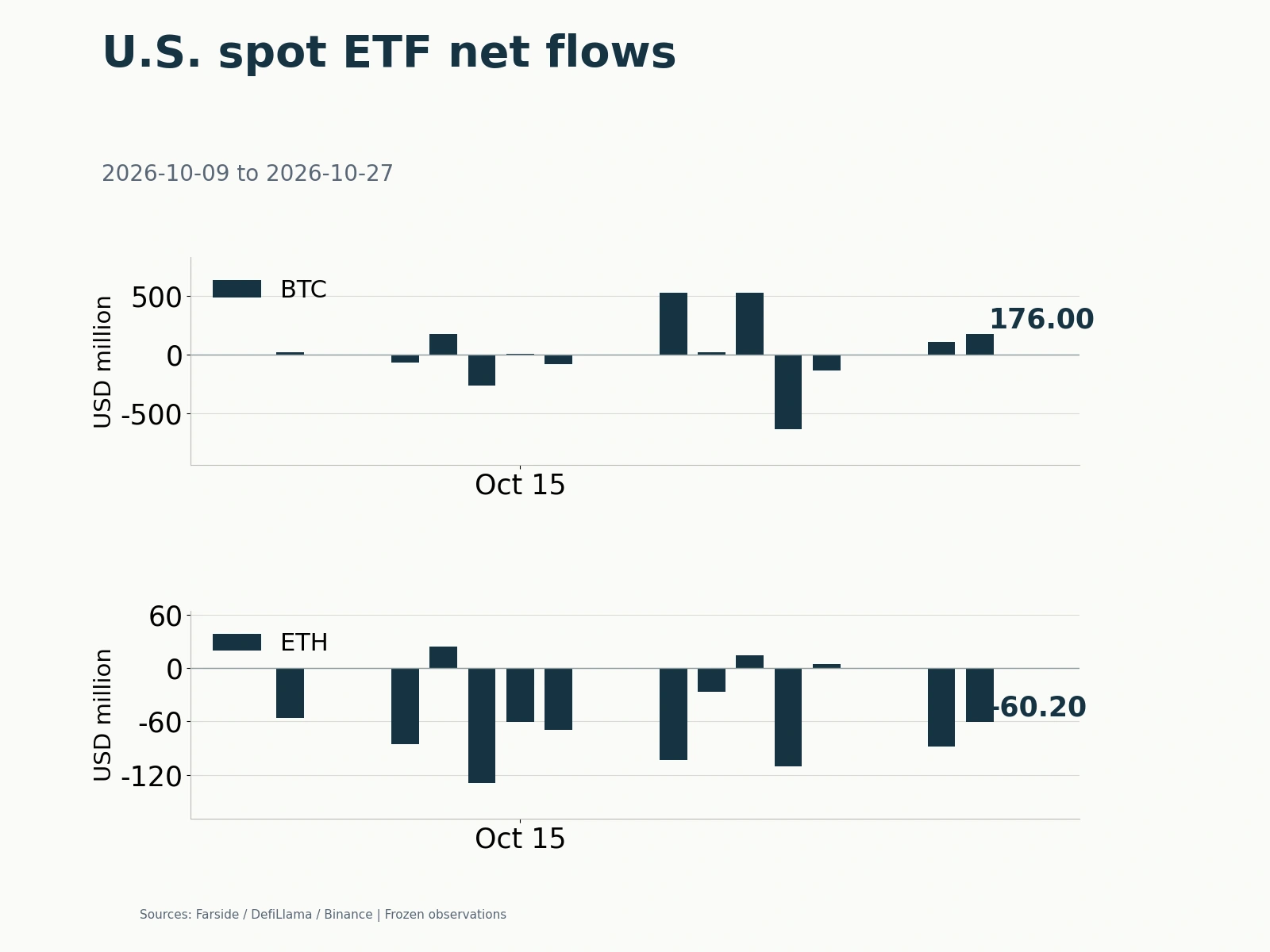
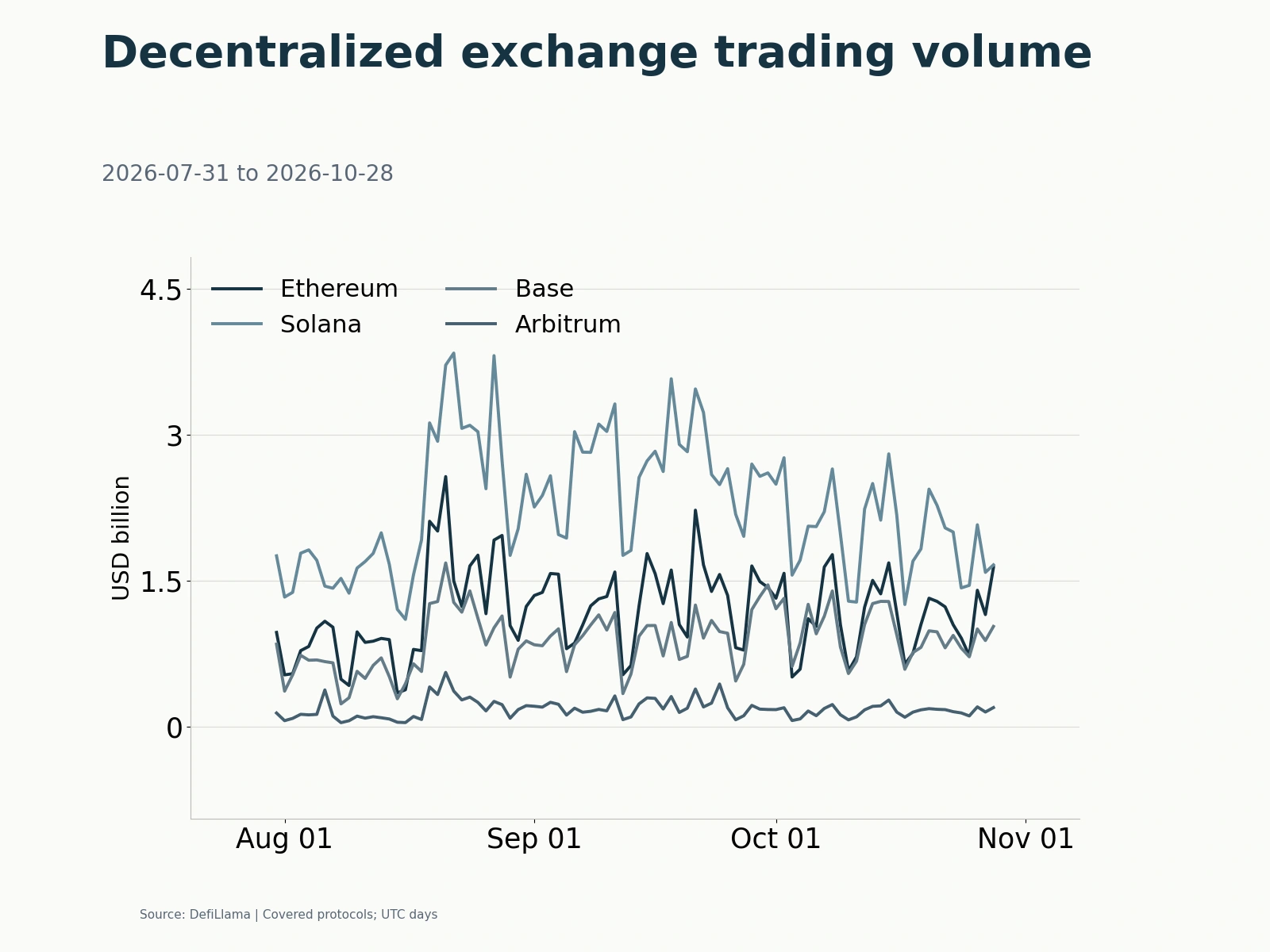
Crypto assets fell before stabilizing last week. Energy-supply risks lifted rate expectations, expectations for marginal buying narrowed, and on-chain security debates triggered concentrated midweek selling. Bitcoin proved relatively resilient, holding above 80,000 USDT, while Ethereum and highly liquid sample tokens suffered deeper drawdowns. Some coins rebounded modestly over the weekend, but all six tracked assets finished the week lower, leaving the recovery limited in strength and breadth.
This issue covers seven complete UTC trading days, October 5–11, corresponding to 08:00 Beijing time on October 5 through 08:00 on October 12. All spot prices use Binance USDT pairs, with weekly changes calculated from the Sunday close against the previous Sunday's close.
Concentrated selling sends all liquid sample assets lower; ETH/BTC falls 3.9%
Bitcoin closed the week at 83,773.12 USDT, down 3.19%, after ranging from 80,393.56 to 86,999.11 USDT. Ethereum closed at 2,536.94 USDT, down 6.97%, with a range of 2,406.11 to 2,738.00 USDT. Bitcoin's relative resilience did not prevent the broader downtrend.
All six highly liquid spot assets in the sample recorded weekly losses, with the other five clearly underperforming Bitcoin:
| Asset | Weekend close (USDT) | Weekly change |
|---|---|---|
| BTC | 83,773.12 | -3.19% |
| ETH | 2,536.94 | -6.97% |
| SOL | 111.35 | -8.43% |
| XRP | 1.4103 | -7.25% |
| BNB | 754.24 | -5.18% |
| DOGE | 0.08679 | -9.51% |
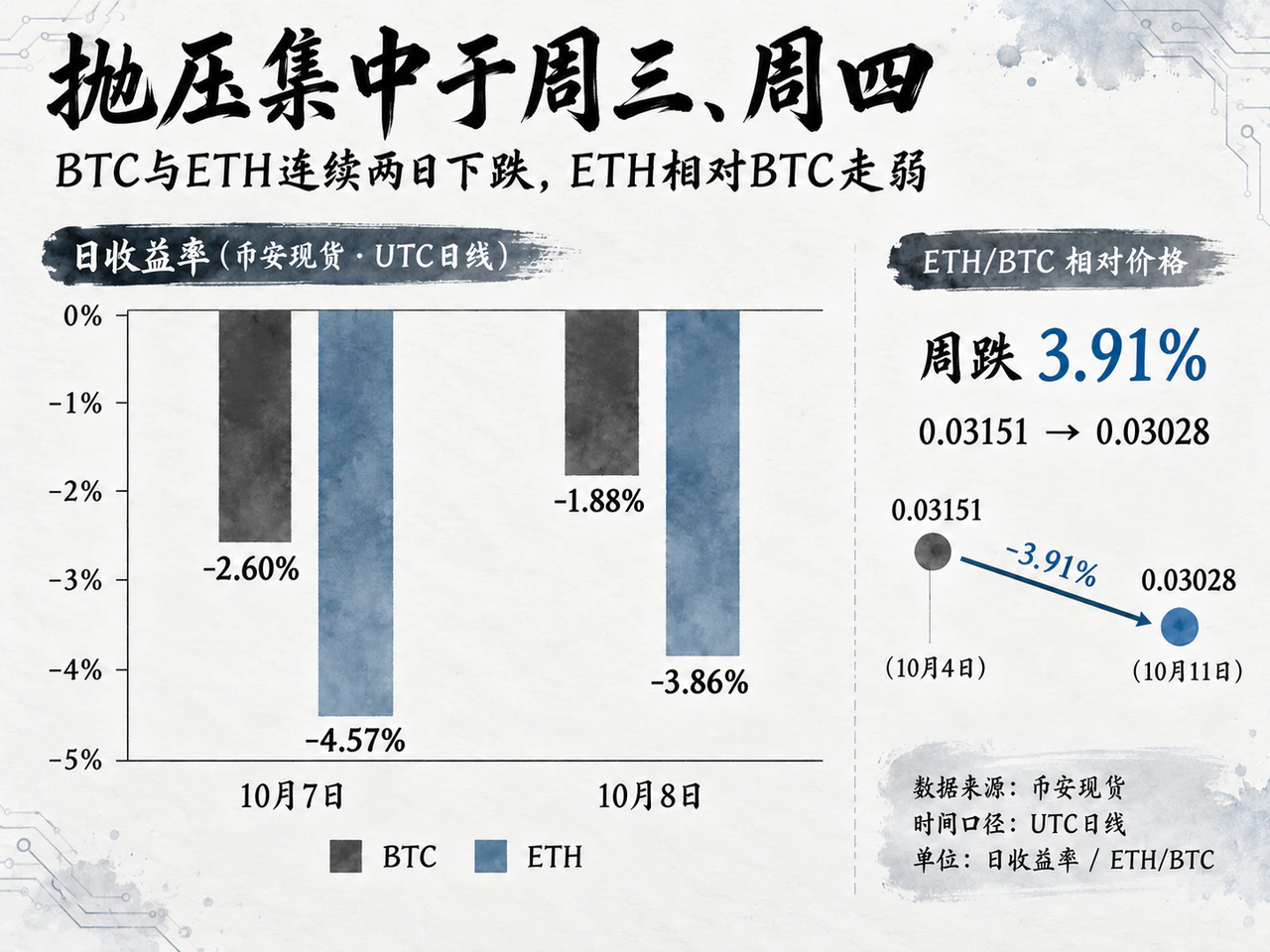
Relative prices further highlighted the defensive preference of existing capital. Using the same venue's closing prices, ETH/BTC fell from 0.03151 the previous week to 0.03028, down 3.91%. DailyForex also observed Bitcoin market dominance at 59.45% intraday on October 11. That observation preceded the final Sunday close, but indicated that market-cap weight remained concentrated in Bitcoin at that moment.
Selling was concentrated on October 7 and 8. Bitcoin fell 2.60% and 1.88% on those trading days; Ethereum lost 4.57% and 3.86%. Those two days accounted for about 43% of Bitcoin's weekly spot turnover. Total Binance spot turnover for the week was 8.213 billion USDT for Bitcoin and 4.788 billion USDT for Ethereum.
The sharp decline changed the backdrop from the start of the week. On October 5, CoinDesk had reported Bitcoin's short-, medium- and long-term moving averages were nearing a bullish alignment. But successive breaks below the recent trading range on Wednesday and Thursday quickly undermined that outlook under combined rate and geopolitical shocks.
After stabilizing on Friday, Bitcoin recovered a combined 1.38% on Saturday and Sunday, while Ethereum gained 1.98%. Ethereum's slightly stronger weekend bounce still failed to recover its relative weekday losses. Unless further recovery also lifts ETH/BTC and trading activity in other major tokens, isolated price surges will provide limited support to the broader market.
Geopolitics raises rate pressure; Ethereum's buying outlook and security debate deepen divergence

A tighter macro backdrop directly drove midweek deleveraging. CoinDesk reported October 7 that greater risk of tanker attacks in Hormuz pushed Brent to approximately $101.50 a barrel, alongside a stronger dollar index and higher Treasury yields. Reports the next day about expectations of U.S. military action against Iran lifted oil above $102. Expectations of sticky inflation weakened the easing hopes prompted by earlier soft employment data. The latest Federal Reserve minutes also showed most officials still favored another rate increase before year-end, significantly raising the cost of holding volatile assets.
Geopolitical tensions subsequently eased for a time. On October 8, Trump said the United States would not take military action against Iran before the November 3 midterm elections. Oil fell in response, and Bitcoin stabilized and rebounded from its lows. Oil's sharp swings showed the midweek incorporation of geopolitical premiums and risk compensation. Easing geopolitical risk directly triggered the weekend stabilization.
Ethereum, meanwhile, faced several additional fundamental and technical pressures:
First, expectations for long-term incremental buying changed. Bitmine Chairman Tom Lee said October 7 that the company would pause purchases after holdings reached 5% of circulating Ethereum. CoinDesk cited the company's latest disclosure of approximately 6.0164 million ETH, about 4.9% of circulation. With a major marginal buyer nearing its target ceiling, future price support required a broader source of market capital.
Second, debate over signature mechanisms raised security disagreements. Ethereum Foundation researcher Justin Drake publicly advised users to prepare for a “bunker mode,” gradually moving to fresh addresses with unexposed public keys to guard against possible future threats from AI-assisted algorithms to current signatures. Coinbase cryptography head Yehuda Lindell quickly responded that there was no evidence of a break in the longstanding elliptic-curve cryptography assumptions. Nevertheless, the discussion temporarily heightened sensitivity to distant tail risks.
Third, leveraged liquidation amplified the drawdown. Data cited by CoinDesk on October 9 put Ethereum derivatives liquidations over the previous 24 hours at approximately $356 million, above Bitcoin's roughly $298 million. Ethereum suffered more intense forced deleveraging despite its smaller market capitalization, a direct structural reason for its significantly deeper decline.
Overall, energy and rate volatility increased the compensation investors required to bear risk over the week. Ethereum-specific expectations of a buying ceiling and derivatives liquidation widened the gaps within crypto. A broader recovery required continued erosion of the geopolitical premium and, crucially, enough new spot capital to fill the gap left by departing derivatives positions and improve breadth together.
Click Read Original for more details.