Last week, October 5-11 UTC, the onchain economy showed clear structural divergence: transaction counts continued to decline on Ethereum Layer 2 networks Base and Robinhood Chain, while tokenized-asset trading and cross-chain payment and clearing channels steadily expanded. Viewed alongside 30- and 90-day periods, the core measures of onchain growth quality were gradually shifting from sheer high-frequency interaction volumes toward capital retention efficiency, users' actual willingness to pay and protocols' genuine retained revenue.
Base and Robinhood transaction counts fall more than 14% as tokenized assets and cross-chain settlement advance
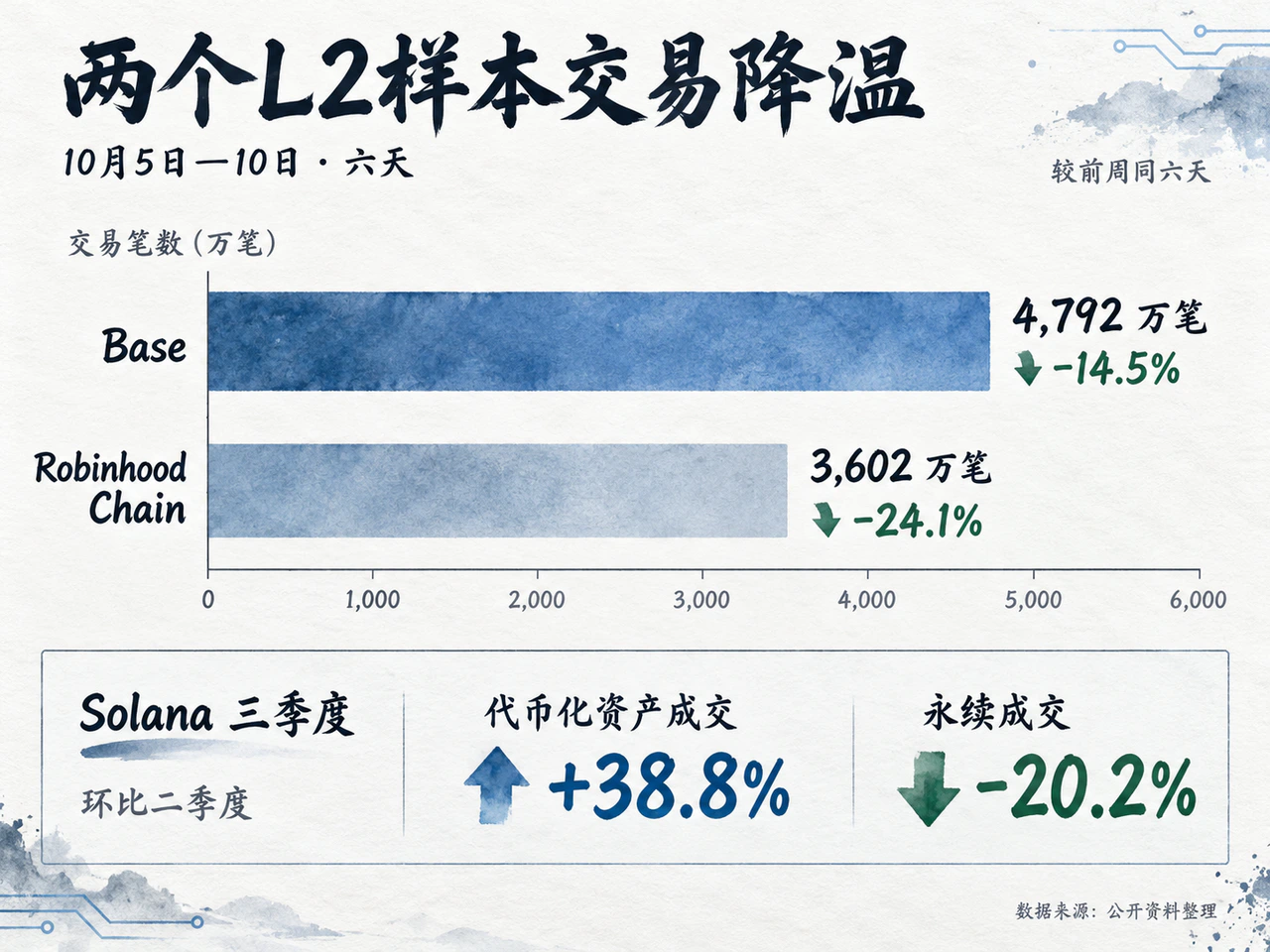
High-frequency activity on Layer 2 networks cooled during the period. According to growthepie, over the six updated days of October 5-10, Base processed around 47.92 million transactions, down 14.5% from the same days a week earlier, while Robinhood Chain processed about 36.02 million, down 24.1%. Over the 30 days through October 10, transaction counts fell 11.8% and 23.5%, respectively, against the previous period. Base's 90-day transaction count was down only 3.4%, indicating that the recent slowdown was more pronounced than the 90-day comparison.
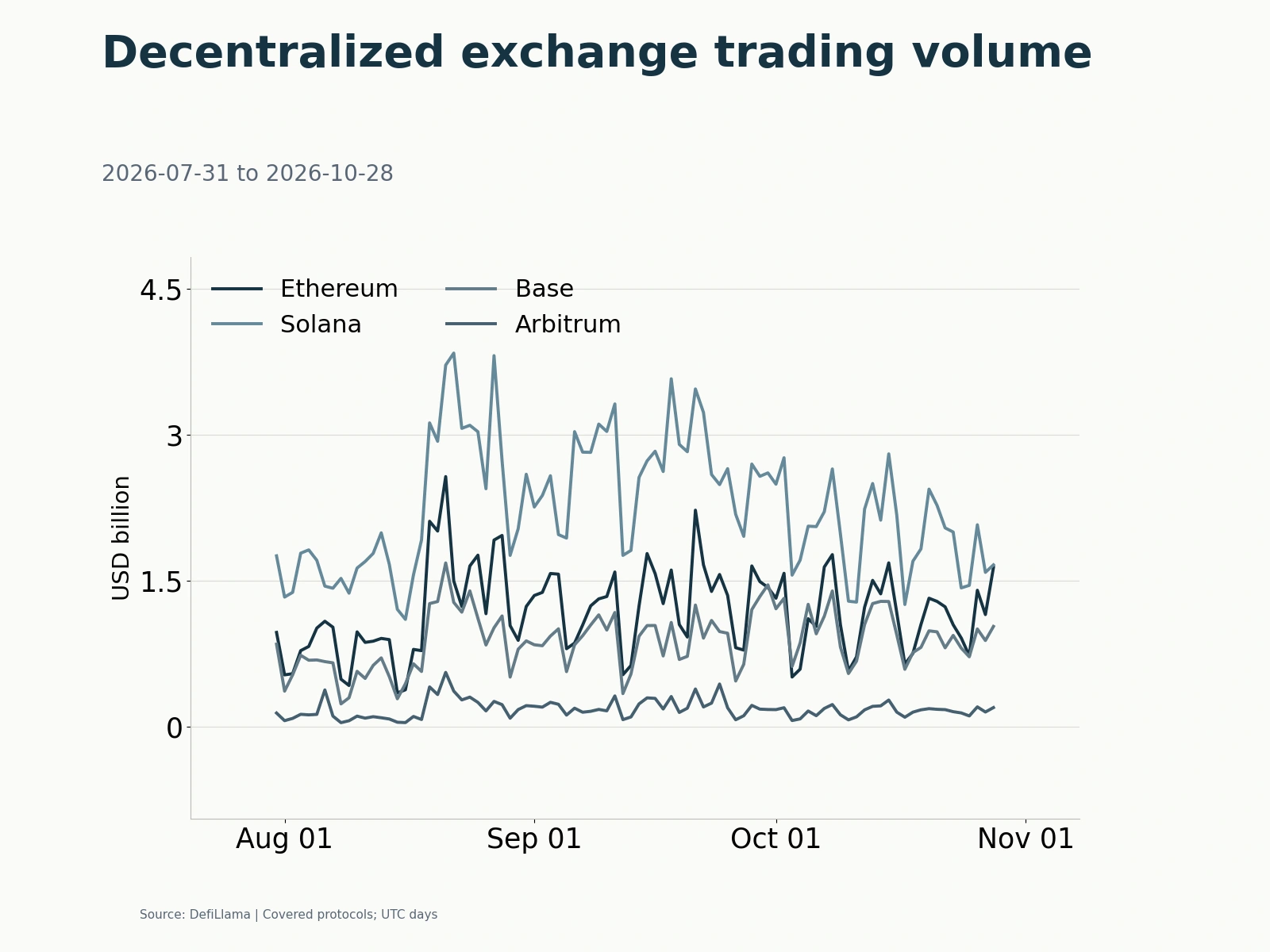
The decline in transaction frequency was not accompanied by a comparable fall in the dollar valuation of locked assets. Citing CoinDesk and DefiLlama on October 11, crypto.news said Robinhood Chain's DEX spot volume fell 21% to $7.45 billion during October 2-8, while ecosystem total value locked (TVL) edged up about 2% to $1.04 billion. The divergence suggested assets might be remaining in the ecosystem, although TVL alone cannot identify net onchain flows. It only confirms that opportunities to capture fees from high-frequency turnover had contracted accordingly. Dollar-denominated TVL is also affected by token-price changes, so its measurement differs from actual net deposits and withdrawals.
The Solana ecosystem displayed a different growth pattern in specific verticals. SolanaFloor's third-quarter review showed tokenized real-world asset (RWA) trading volume on the network up 38.8% from the second quarter, while notional perpetual-futures turnover fell 20.2% to $146.1 billion. This structural growth was driven by specific business uses: spot pairs combining equity and commodity tokens with onchain assets added trading activity to decentralized exchanges, reflecting different cyclical patterns in spot, derivatives and asset-tokenization businesses.
In settlement channels, payment infrastructure was accelerating cross-chain interoperability. Wallet-infrastructure provider DFNS announced on October 9 that it supported Circle's Cross-Chain Transfer Protocol (CCTP) on Stellar. Institutions can move native USDC from networks such as Ethereum and Base to Stellar, connecting directly with local payment channels and on/off-ramp networks. By burning tokens on the source chain and minting native tokens on the destination after Circle confirmation, the mechanism helps reduce institutions' need to prefund multiple chains. This integration materially improves treasury movement and settlement routes; its actual commercial value still depends on sustained real settlement volume.
Testing genuine retention beneath subsidies and address noise
The conversion of onchain traffic into sustainable business models was facing closer scrutiny. Robinhood Chain's recent operating data highlighted the tension between fees and subsidies: during October 2-8, average daily gas fees fell about 39% to roughly $65,000, substantially more than the 21% decline in spot trading volume. The platform currently covers network fees in full for token swaps within eligible wallets, an offer extended through year-end. Zero fees help lower the barrier for new users to try the service but also obscure their actual willingness to pay. The business model's viability will require a retention test after subsidies end.
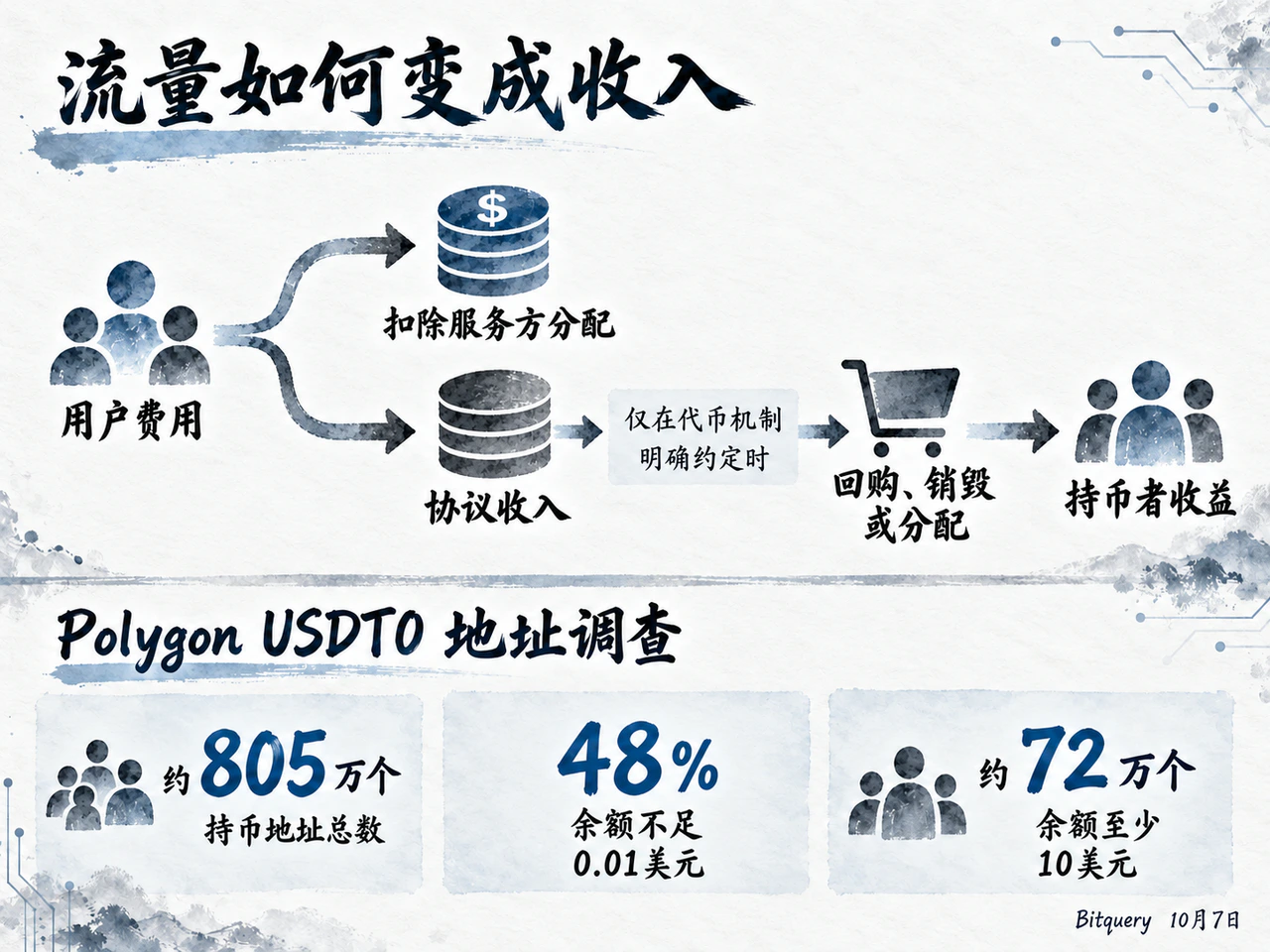
Alongside pressure on fees, the allocation of onchain proceeds determines ecosystem participants' actual returns. Under DefiLlama's accounting framework, total fees paid by end users become protocol revenue after distributions to service providers such as liquidity providers. The value ultimately captured by token holders is limited to the portion distributed through buybacks, burns or direct dividends. Spot turnover, underlying network fees and application revenue accrue to different parties and cannot be equated directly with a particular token's earning power. Substantial value is lost between these levels of retention.
Account quality is another key test of growth. An October 7 investigation by onchain analytics firm Bitquery into USDT0 holders on Polygon found that, of approximately 8.05 million verified holding addresses, 48% had balances below $0.01, while only around 720,000 held at least $10. Behavioral identification and sample screening also suggested roughly 1.1 million addresses were involved in address-poisoning activity impersonating target accounts. Dust balances, bulk distributions and automated-script noise considerably inflated the apparent number of holder addresses.
A viable commercial cycle ultimately depends on how funds are actually used and where fees are charged. Whether stablecoins remain in lending arbitrage or tokenized assets circulate through trading venues, the longer the business chain, the narrower the set of stages that can monetize reliably. Growth in Solana's tokenized assets shows that new onchain instruments can create new trading uses, while DFNS's Stellar integration opens a clearing route for funds to reach their destination. As indiscriminate expansion of high-frequency trading runs its course, the health of onchain ecosystems will hinge on genuine active retention after automated volume is excluded, willingness to pay as subsidies recede, and protocols' ability to retain recurring cash-flow revenue.
Click Read Original for full details.