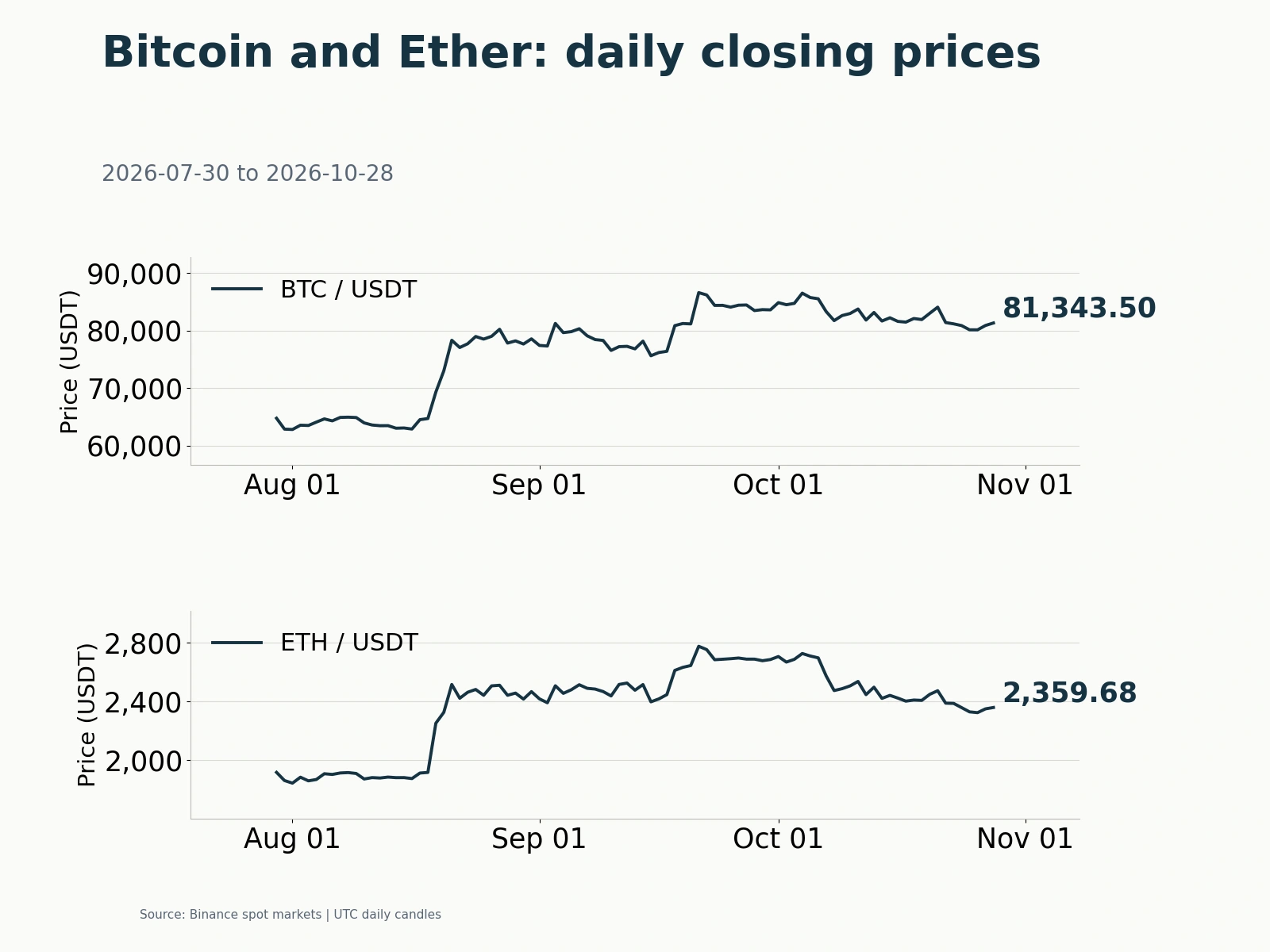
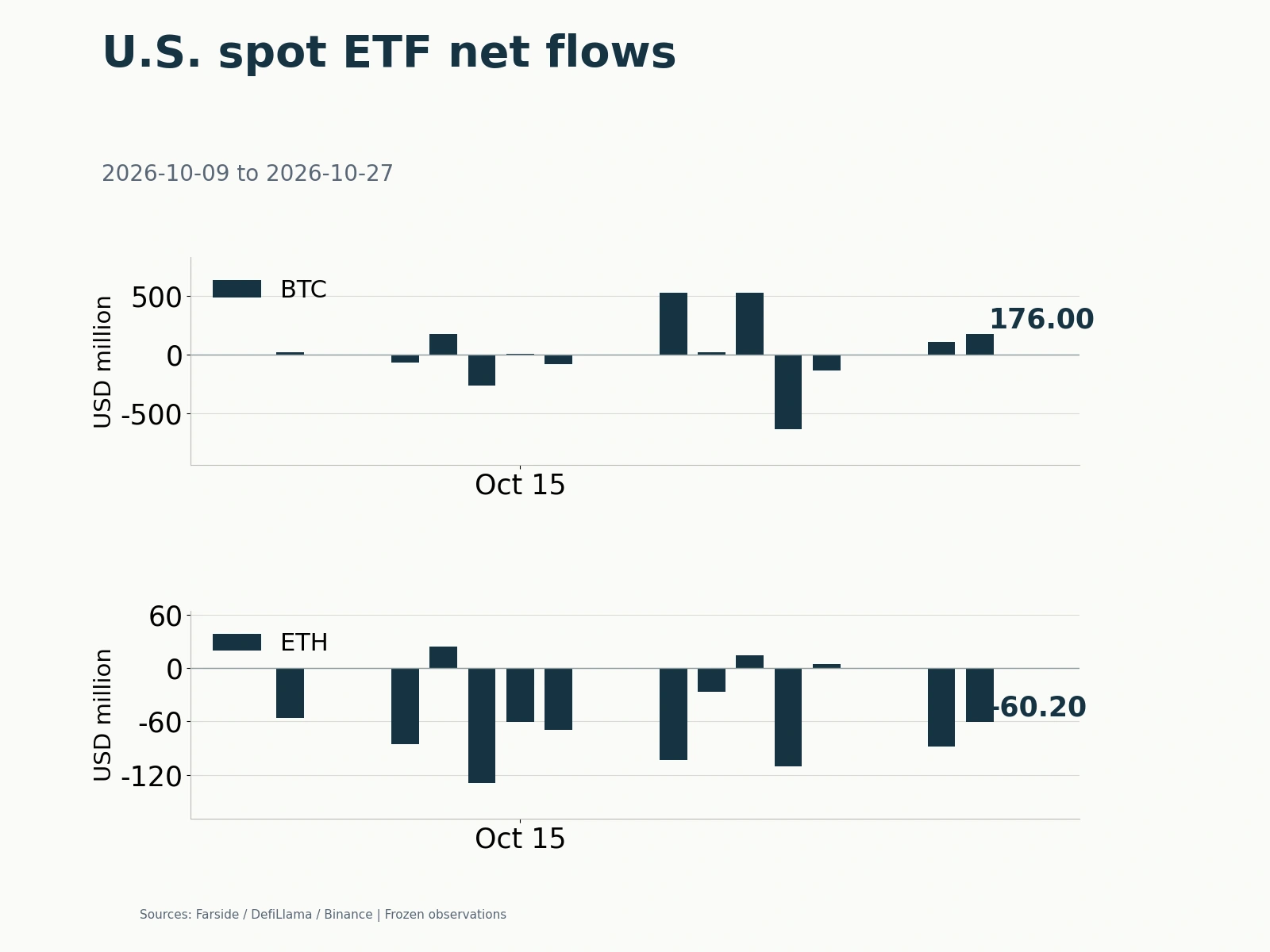
Bitcoin has fallen again, leaving the capacity of spot-market money to absorb selling central to the market's recovery. U.S. spot Bitcoin ETFs recorded net outflows of $678.9 million last week. A small inflow on the final trading day was far too little to offset earlier withdrawals. Institutional research published on October 12 showed that the preceding sharp decline had lowered the cost of holding perpetual-futures longs, but futures exposure remained large and demand for downside protection in options was increasing. Leverage pressure has eased somewhat; fresh buying still needs to take over.
By the morning of October 13, Beijing time, Binance spot USDT-quoted UTC daily candles showed Bitcoin down 2.30% and Ether down 3.54% on October 12. Another price decline made the recovery of spot demand more urgent. Whether fresh funds can keep absorbing selling will determine whether a rebound can hold.
Bitcoin ETF replenishment is limited; Ether records five straight outflow days
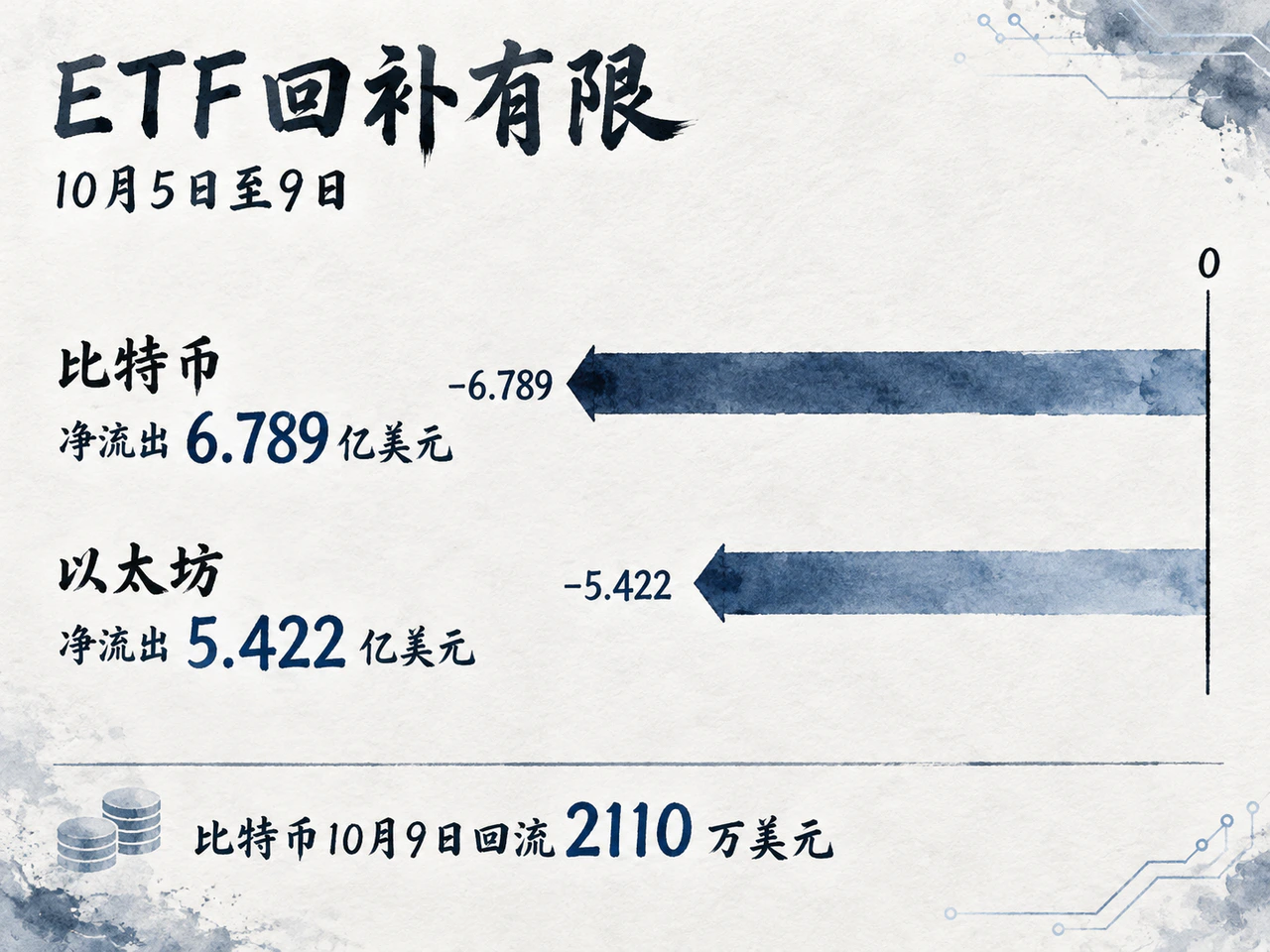
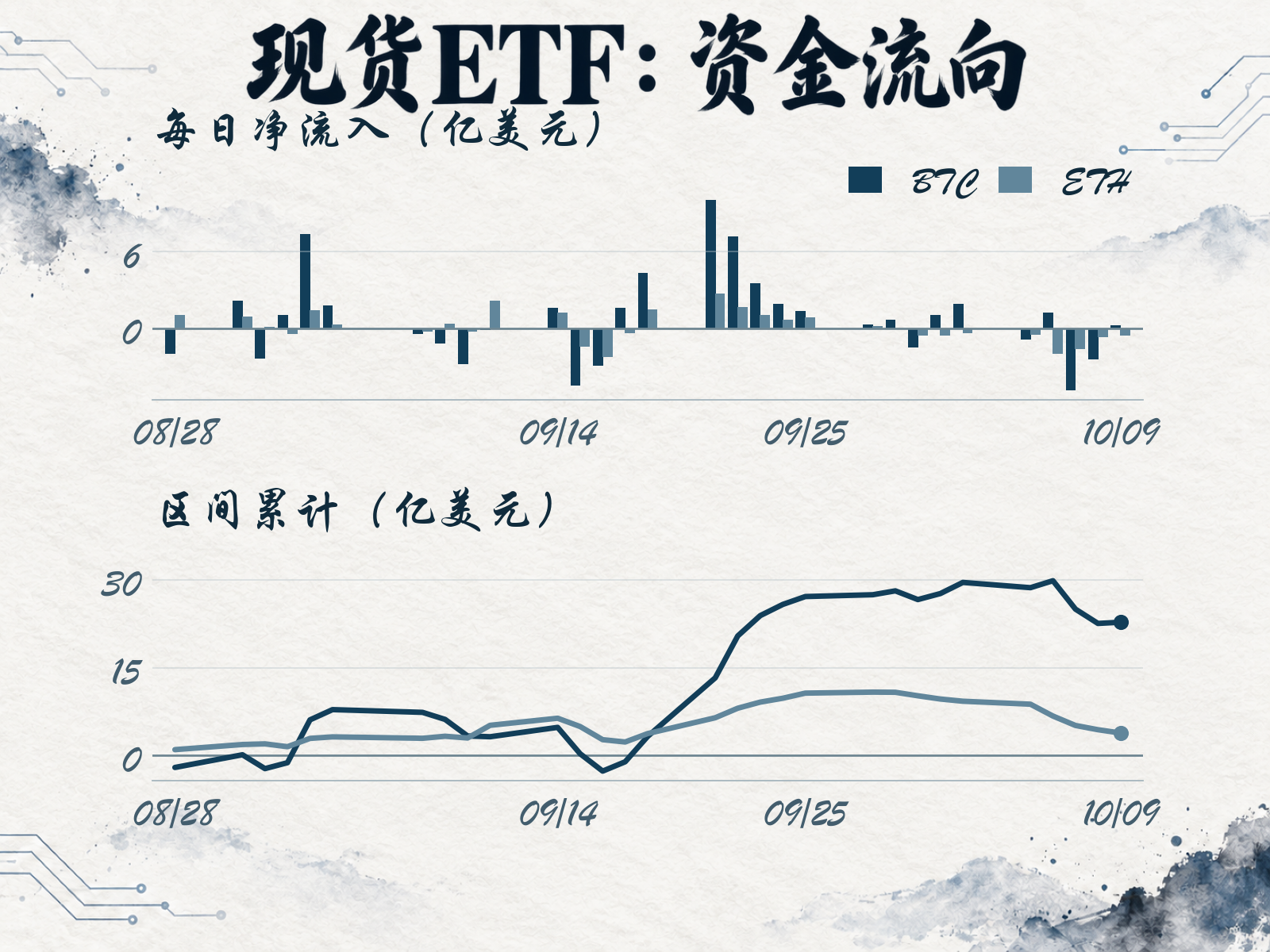
Farside data showed cumulative net outflows of $678.9 million from spot Bitcoin ETFs over the five U.S. trading sessions of October 5–9. October 7 and 8 saw outflows of $484.9 million and $244.1 million, respectively, before October 9 returned to an inflow of $21.1 million. That replenishment amounted to only 2.9% of the preceding two days' withdrawals. A single positive day had not reversed the week's retreat.
Flows also diverged among products. Fidelity's FBTC lost $380.3 million over the week and ARKB lost $207.2 million, while BlackRock's IBIT gained $1.1 million, essentially flat. Withdrawals were concentrated in certain products, reflecting allocation adjustments by different investor groups. A subsequent recovery in subscriptions across several funds would provide a firmer foundation for spot demand than inflows confined to a few products.
Ether's withdrawals were more persistent. U.S. spot Ether ETFs recorded outflows in all five sessions over the same period, totaling $542.2 million. ETHA accounted for $477.1 million, or about 88%. Bitcoin ETFs had at least one day of inflows, while Ether had yet to show the same improvement. Continued ETF withdrawals made Ether's price recovery more dependent on other spot buyers and increased the burden on demand as it underperformed.
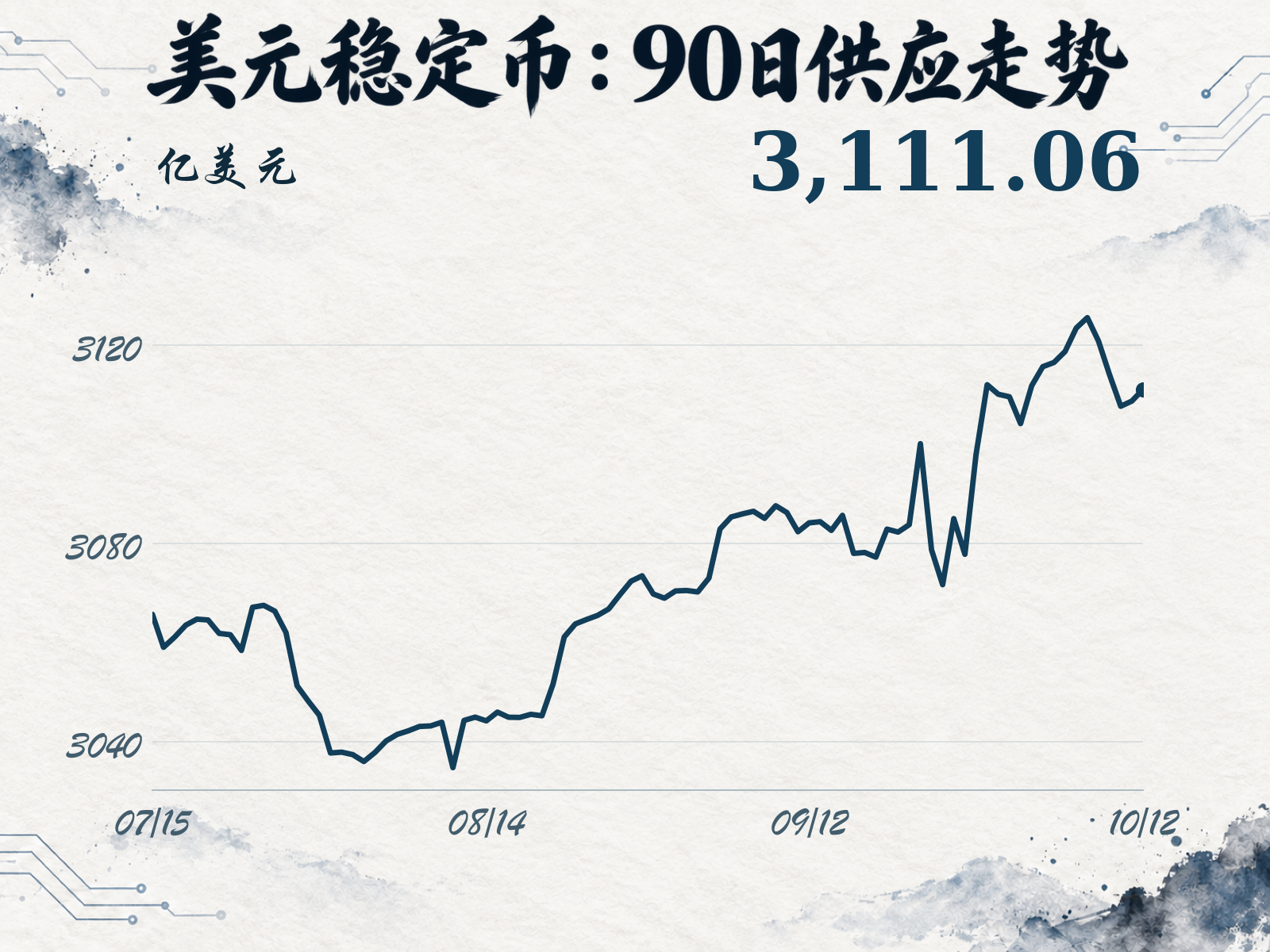
Stablecoin supply did not contract at the same time. DefiLlama's historical dollar-pegged stablecoin circulation API showed a total of about $311.106 billion at 00:00 UTC on October 12, about $236 million, or 0.076%, above the same time a day earlier. This start-of-day stock indicated a small increase in dollar-denominated funds available to the crypto market over that comparison interval.
Those funds can remain in wallets, exchange margin accounts or on-chain lending. Increased stablecoin supply becomes spot purchasing power only when holders are willing to take further price risk. ETF withdrawals alongside modest stablecoin expansion reveal a divergence between the amount of money available and willingness to allocate it: capital remains available, with the key question being when it turns toward buying.
The cost of holding longs falls as demand for option protection rises

Bitfinex's October 12 report recalled that during the October 8 plunge, market-wide liquidations reached $1.18 billion over 24 hours, including $1.05 billion in longs. The Bitcoin perpetual open interest it tracked, measured in BTC, fell about 3% during the correction. Annualized funding rates also dropped from about 6.7% on October 5 to near neutral over the weekend. Some pressured longs exited, reducing funding costs for those that remained.
Financing burdens eased, but futures risk exposure was still substantial. Glassnode's weekly report that day showed U.S. dollar-denominated futures open interest of about $36.7 billion, broadly unchanged from seven days earlier, while funding paid by longs fell 25.8%. Roughly stable positions and lower funding payments indicate less willingness to chase prices, while the remaining exposure still needs to be absorbed.
The two studies use different observation windows and measures. One tracks BTC-denominated positions during the correction; the other compares dollar exposure across a week. Together, they show that forced liquidations eased some localized crowding, while restored spot buying remains the foundation for recovery. If ETF demand stays weak and rising prices are accompanied mainly by renewed derivatives expansion, the rebound will depend more heavily on financing conditions.
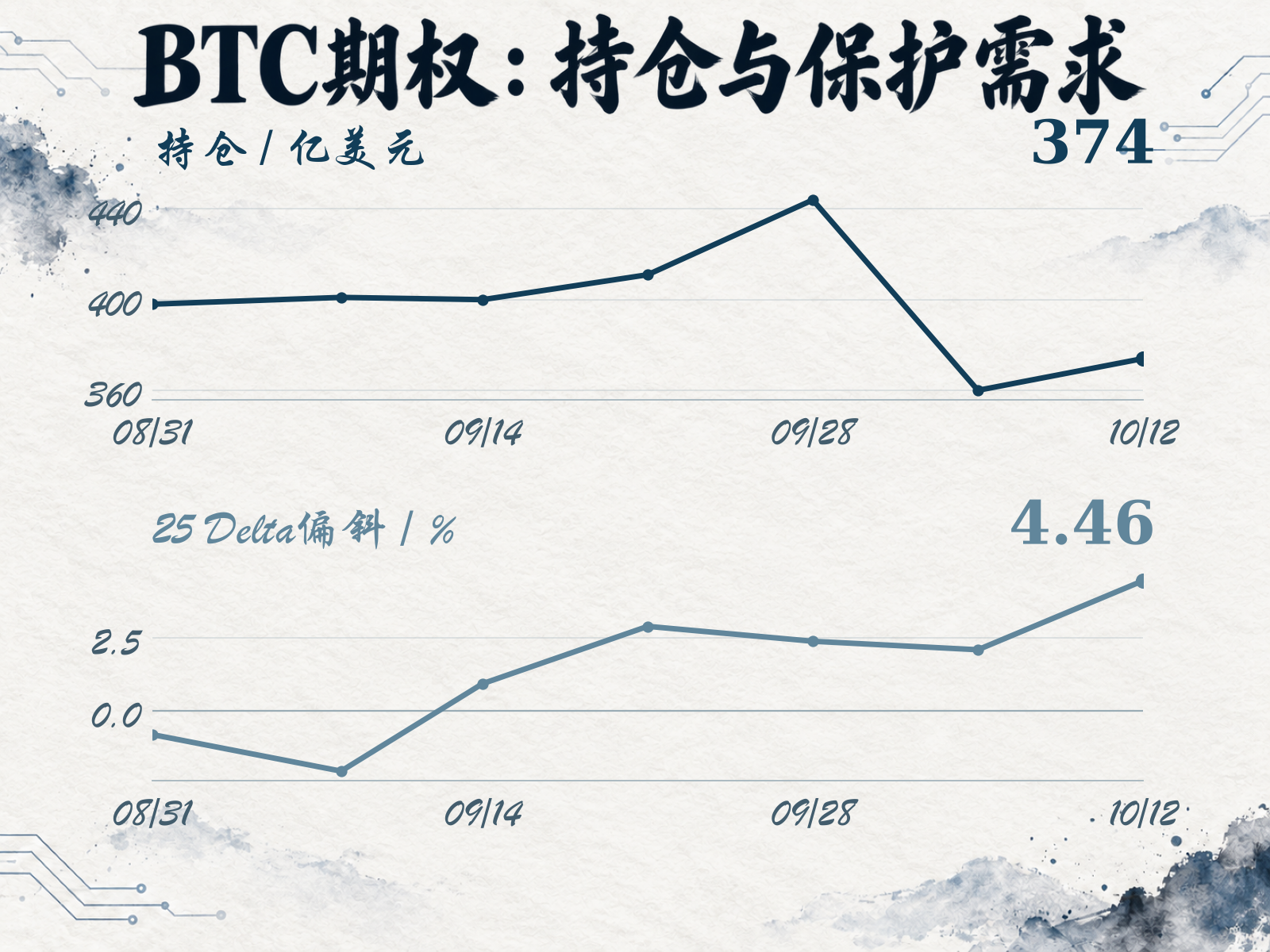
Options changes also reveal caution. In Glassnode's report, option open interest rose from $36.2 billion a week earlier to $37.4 billion, while the 25-delta skew increased from 2.1% to 4.46%, reflecting a higher relative price paid for downside protection. Growing options positions therefore include more hedging demand; bets on future gains are not the only driver.
Improving funding conditions first require Bitcoin ETFs' small inflows to persist, followed by an easing of Ether's continuous withdrawals. If spot demand recovers while funding rates and open interest move moderately, price recovery will have a stronger foundation. Lower carrying costs currently ease the burden on longs; sustained fresh buying remains the next crucial step.
Click 'Read the original' for the full details.