On October 14, 2026, U.S. September inflation exceeded expectations, reinforcing expectations of restrictive monetary policy. Technology shares and gold fell. Treasuries sold off sharply intraday before diverging by maturity: 2-year yields rose, while 10- and 30-year yields turned lower late in the session. The simultaneous long-bond rebound and technology selloff showed pricing extending beyond benchmark rates to companies' actual financing costs and capital-spending returns, with particular pressure on AI infrastructure equities and debt. Meanwhile, global oil supply was recovering but end-market inventory buffers remained thin, advanced-economy sovereign refinancing pressure was growing, and strong Chinese trade coexisted with contracting household credit. Across assets, markets were applying tighter tests to cash flows and credit quality.
September U.S. CPI reaches 3.7%, squeezing real wages as the Treasury curve flattens further
Bureau of Labor Statistics data showed seasonally adjusted September CPI rose 0.6% month on month, above August's 0.4%. Annual inflation rose from 3.4% to 3.7%, exceeding the 3.6% consensus. Core CPI excluding food and energy rose 0.3% monthly and 2.6% annually, also above expectations of 0.2% and 2.5%.
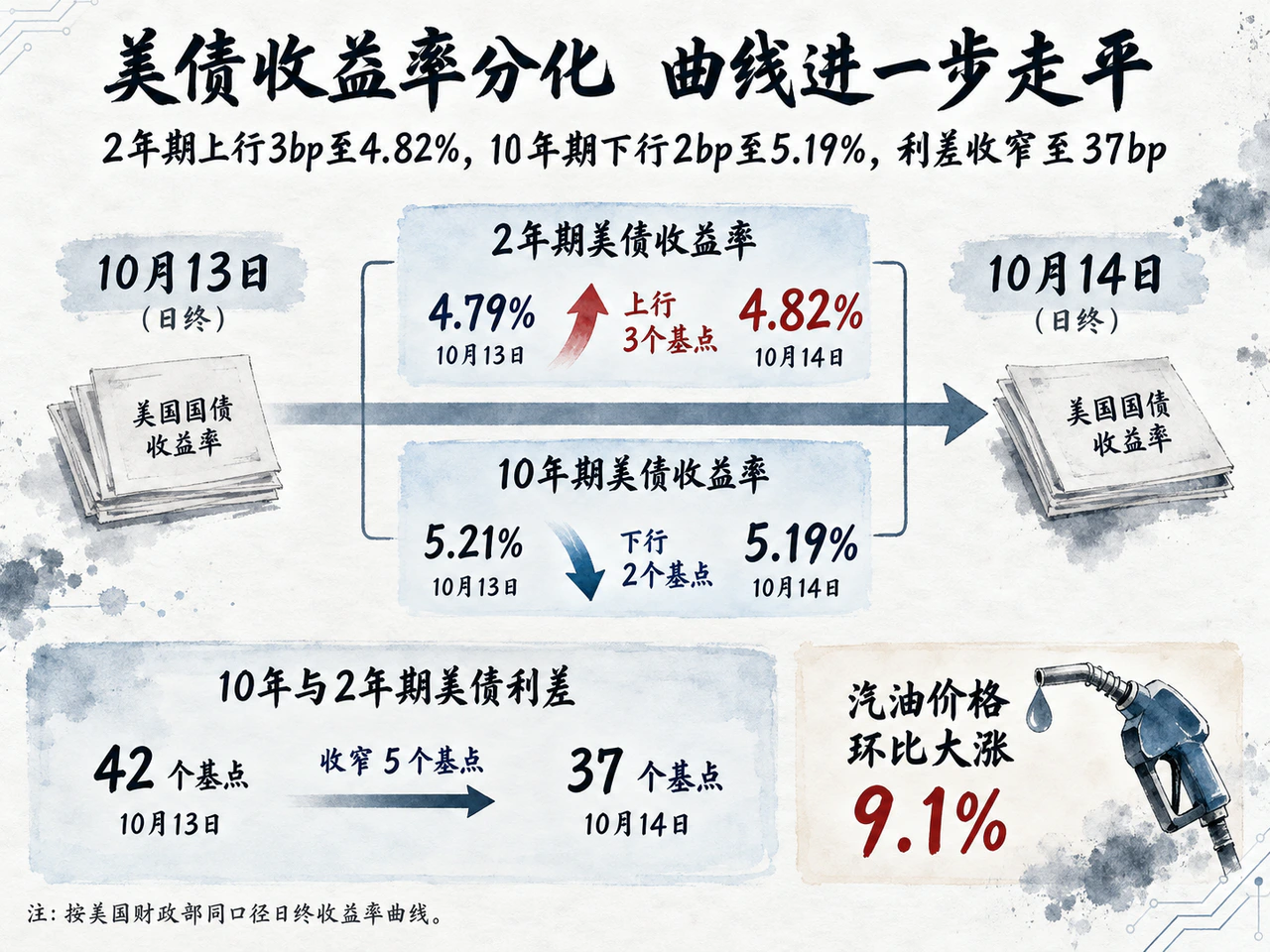
Gasoline prices jumped 9.1% month on month, contributing more than half of the headline monthly increase. Shelter and services excluding energy each rose 0.4%, indicating persistent service-cost pressure beyond energy. Food prices were unchanged overall, with food at home down 0.1%. Renewed inflation directly eroded purchasing power: in September, nominal average hourly earnings for all private nonfarm employees rose just 0.1%, while real average hourly and weekly earnings both fell 0.5%. Household spending capacity and rate-sensitive financing demand were constrained together.
The Treasury market reassessed policy after absorbing the inflation shock. Reuters reported that the 2-year yield briefly reached approximately 4.95% after CPI, while the 10-year touched about 5.33%. Recent remarks by several Federal Reserve officials favoring patience to observe the cumulative effect of earlier increases eased fears of immediate successive tightening. Long Treasuries rebounded sharply during U.S. afternoon trading.
On the Treasury's consistent end-of-day yield-curve measure, versus October 13 the 2-year yield rose 3 basis points to 4.82%, the 5-year was unchanged at 5.00%, the 10-year fell 2 basis points to 5.19%, and the 30-year fell 4 basis points to 5.52%. The 10-year/2-year spread narrowed from 42 to 37 basis points as policy expectations constrained the short end while the long end recovered. The curve flattened further. Five- and ten-year real yields fell 3 and 4 basis points to 2.64% and 2.84%. Long-term real financing costs eased slightly but remained high. U.S. September PPI, due October 15 Eastern time, would test how far energy price increases had reached production costs.
Nasdaq 100 falls more than 2% as AI stocks and bonds weaken, while ASML equipment orders remain resilient
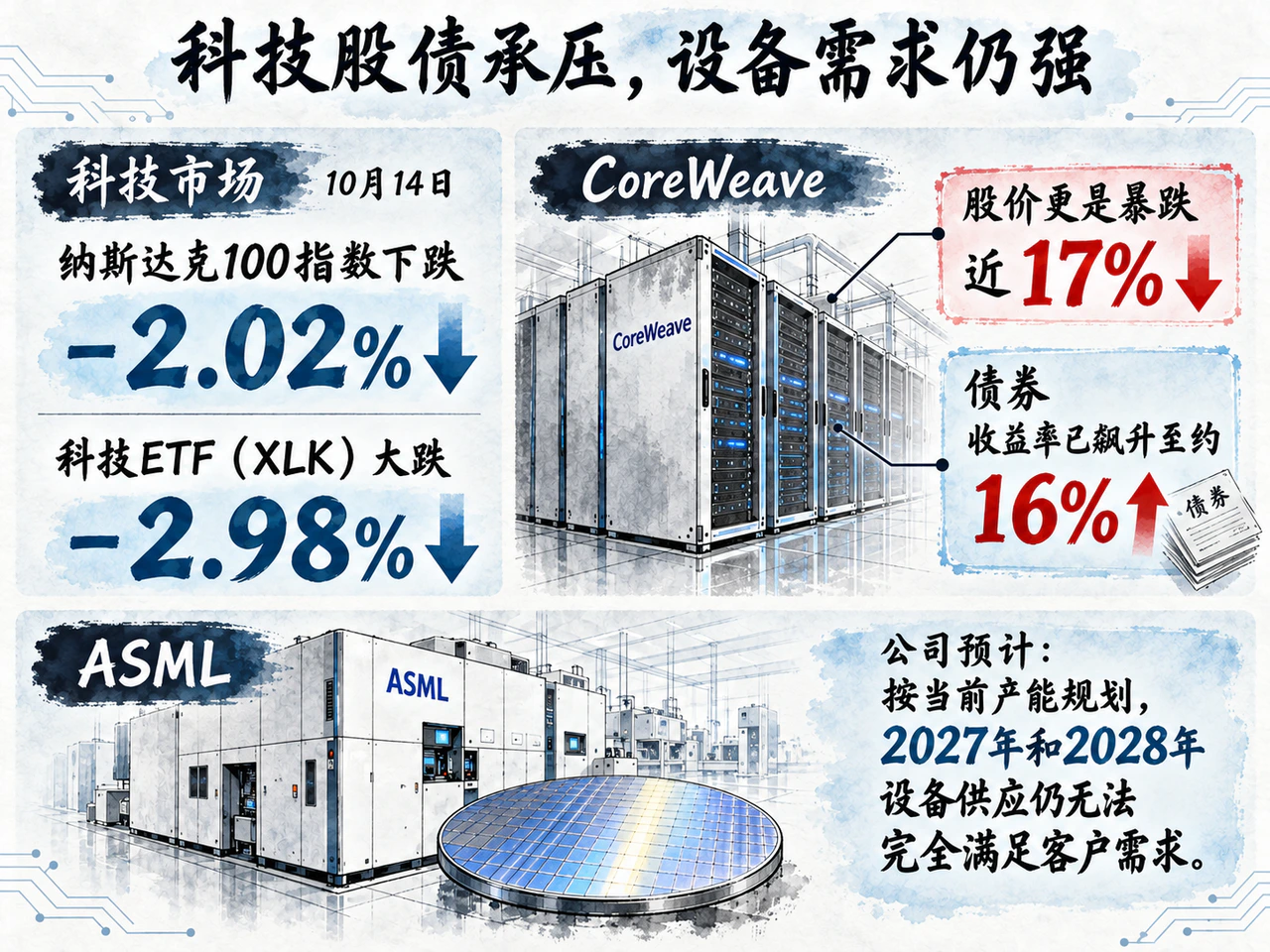
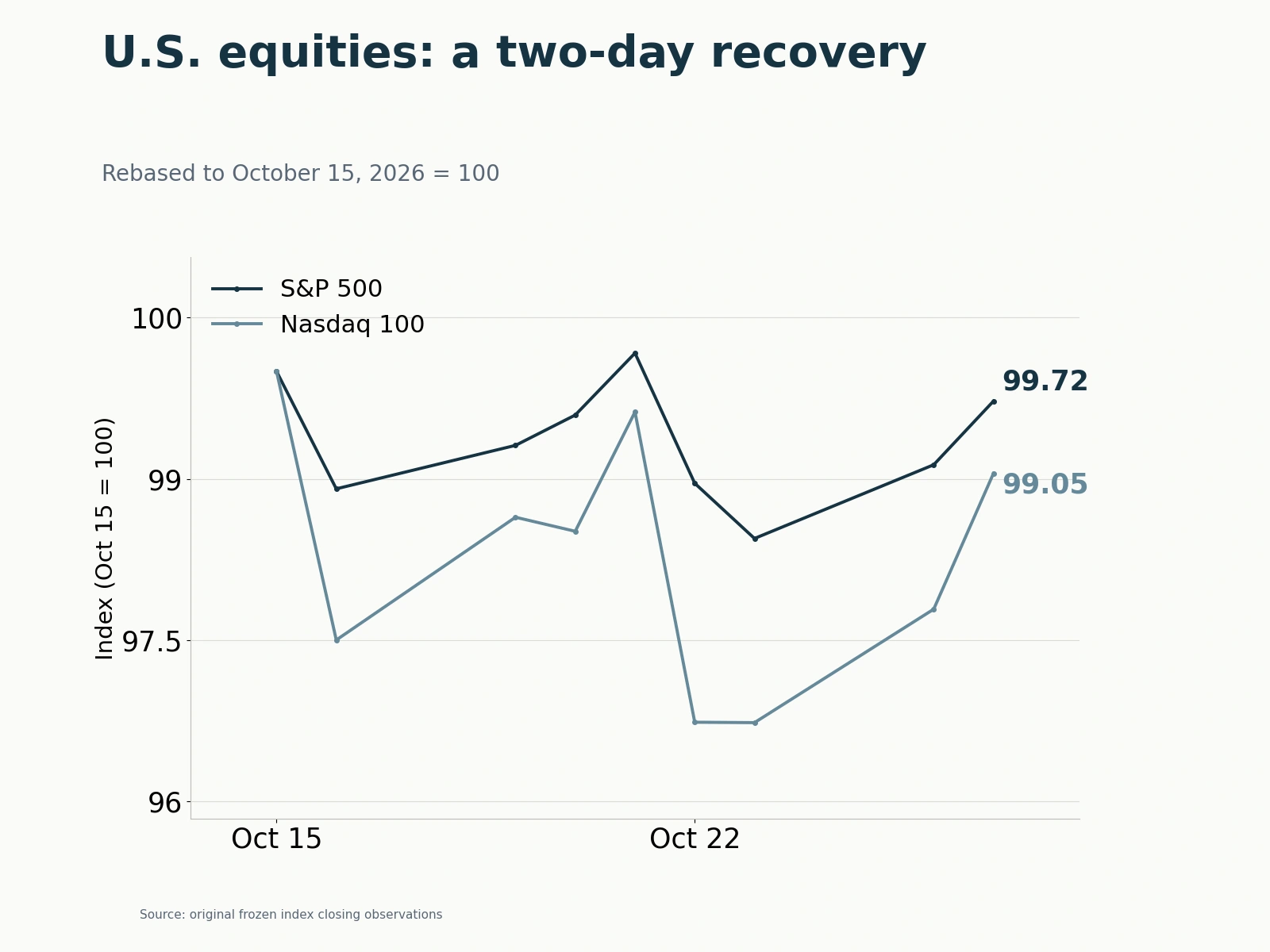
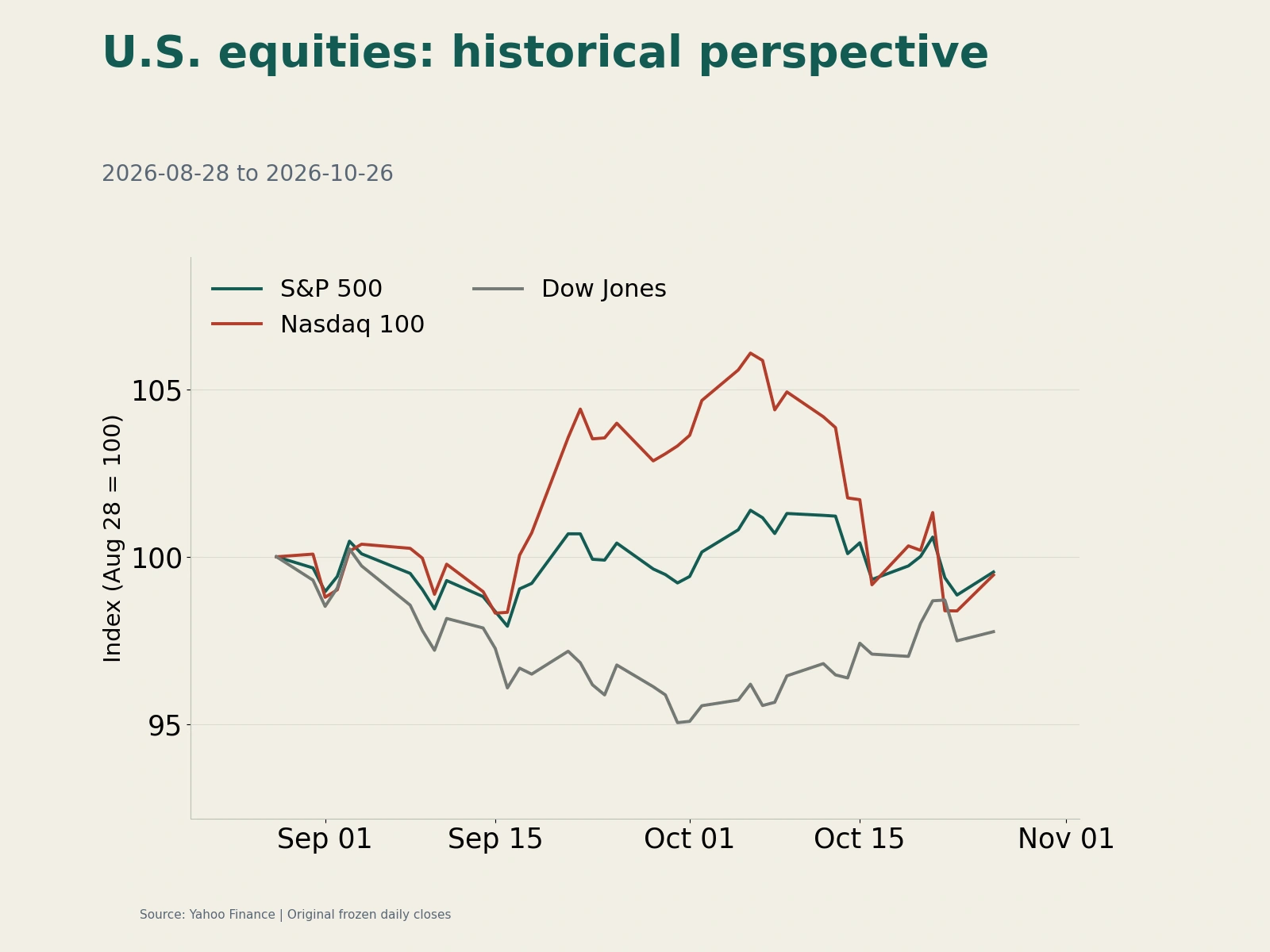
The major U.S. indexes diverged clearly at the close. The S&P 500 fell 1.11% to 7,718.94; the Nasdaq 100 fell 2.02% to 29,950.82; and the Dow Jones Industrial Average slipped 0.09% to 51,621.48. The small- and mid-cap Russell 2000 fell 1.93%, reflecting continued financing constraints on smaller companies in a high-rate environment. The VIX rose from 15.27 to 16.87 as demand for protective options hedges increased.
Among sectors, the technology ETF XLK dropped 2.98%, financials ETF XLF fell 0.55%, and energy ETF XLE rose 0.64%. Reuters noted that the Philadelphia Semiconductor Index had declined for six consecutive sessions. Although the S&P 500 was still up more than 12% for the year, its median constituent had gained only about 4%, and more than 200 constituents were down. Earlier index gains had been highly concentrated in a few AI heavyweights, making their correction a substantial drag.
AI infrastructure companies faced a dual test of equity valuations and debt financing. Nvidia and Meta each fell more than 3%, while CoreWeave plunged nearly 17%. Reuters columnist Jamie McGeever noted that CoreWeave's 9.75% coupon bond issued in July and maturing in 2031 now yielded approximately 16%, with its price at a record low. For computing infrastructure projects with large upfront spending and long cash-recovery periods, high funding costs directly raise the investment hurdle. A late decline in long Treasury yields could not quickly alleviate highly leveraged issuers' own credit risk.
Demand prospects also differed along the supply chain. Barclays downgraded Dell and HPE that day, saying higher memory prices lifted hardware revenue but enterprise AI demand had yet to reach a clear inflection point. Upstream equipment giant ASML's third-quarter results nevertheless confirmed resilient underlying capacity demand: sales were €11.662 billion, net profit €4.960 billion and gross margin 57.5%. It forecast fourth-quarter sales of €14.2 billion to €15.2 billion and said current capacity plans would still leave equipment supply short of customer demand in 2027 and 2028. Despite strong results and guidance, its U.S.-listed shares fell about 4%. Full upstream equipment order books alongside financing pressure on downstream computing projects were becoming central to diverging technology valuations.
Large-bank earnings and compliance costs unsettled financials. Bank of America reported third-quarter revenue of $30 billion, up 3% year on year but slightly below expectations. Earnings per share of $0.91 missed the $1.09 consensus, with regulatory fines reducing EPS by approximately $0.17. Its shares fell nearly 5%.
A stronger dollar pushes gold down 1.25%; observable global oil inventories fall a net 10 million barrels
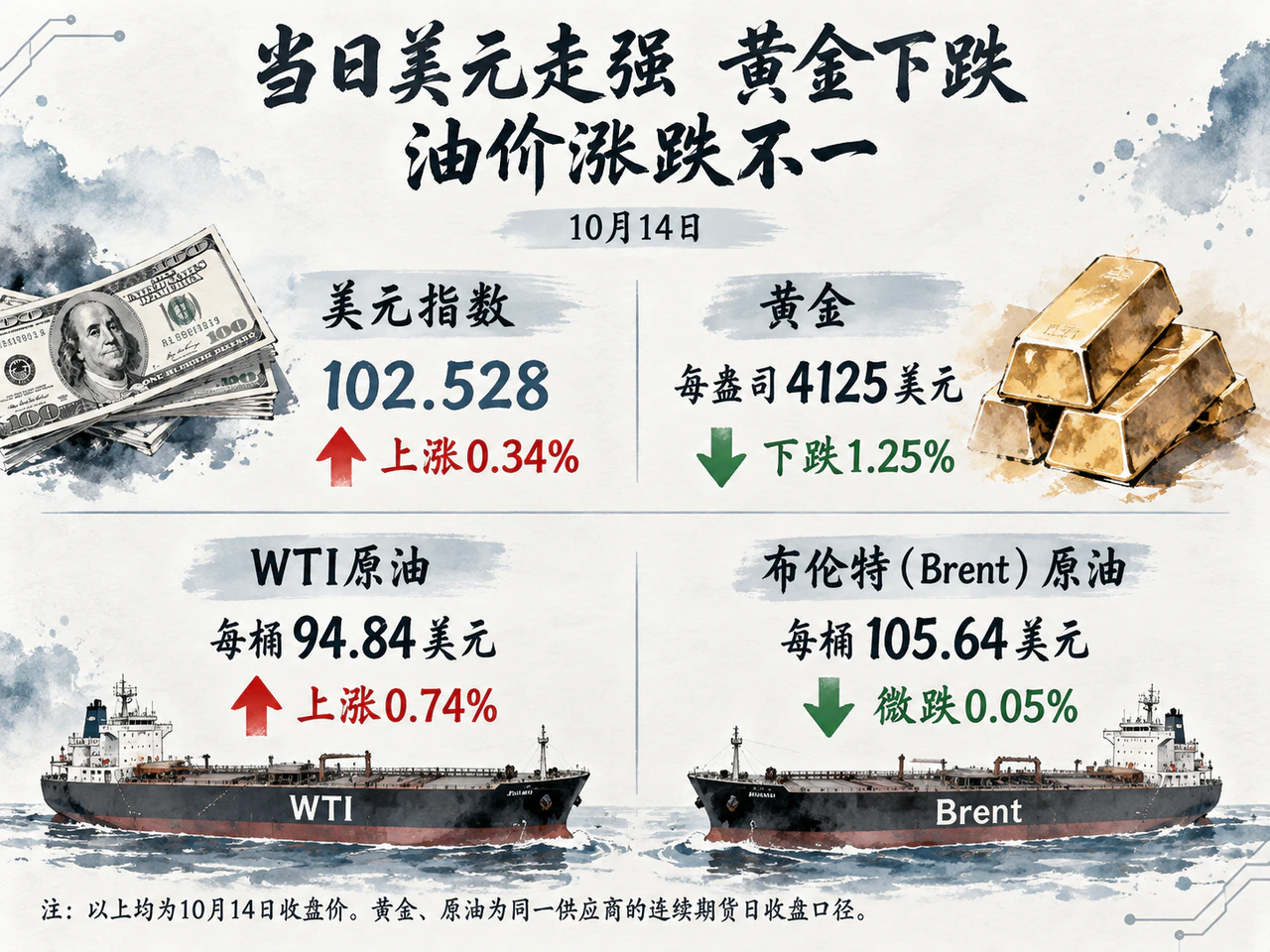
In currencies and commodities, the dollar index rose 0.34% to 102.528. Using one provider's continuous-futures daily closing measure, gold fell 1.25% to $4,125 an ounce, WTI rose 0.74% to $94.84 a barrel, and Brent slipped 0.05% to $105.64 a barrel.
Reuters cited High Ridge Futures analyst David Meger as saying CPI reinforced rate-increase expectations and lifted the dollar, the main forces weighing on gold that day. Lower long-term real Treasury yields and longer-term allocation arguments such as central-bank buying and fiscal-debt concerns remained, but in short-term trading they did not offset selling from dollar strength and rate expectations.
Oil supply was recovering while onshore stocks were being depleted. The IEA's October report estimated September global oil supply rose 2.5 million barrels a day to 102.3 million barrels a day, with Gulf crude exports restored to more than 75% of prewar levels. Yet global onshore oil inventories fell 113 million barrels in September, while oil at sea increased 103 million barrels, leaving observable stocks down a net 10 million. Much of the additional supply was still in transit; onshore buffers at consuming destinations continued to shrink, and supply recovery had not fully translated into easier end-market conditions.
For the full-year balance, the IEA expected global demand to fall 2.6 million barrels a day in 2026 and supply to fall 5.8 million, leaving a deficit before year-end. High prices restrained consumption, but supply losses limited the scope for deep price declines. The Iran conflict continued to transmit across assets through energy facilities, shipping security and transport costs. In products, Russia said October 14 it would advance deliveries under a Russia–U.S. diesel arrangement. After the U.S. stock close, the White House also reiterated support to lower fuel costs, but sanctions constraints and political differences left actual delivery timing unclear.
Nearly 30% of G7 and Spanish debt matures within a year; sovereign and corporate refinancing conditions diverge
Despite the daily decline in long Treasury yields, advanced economies' medium-term fiscal refinancing constraints kept tightening. IMF fiscal affairs director Rodrigo Valdes said October 14 that global fiscal conditions were worse than expected six months and a year earlier, with most countries still expanding spending.
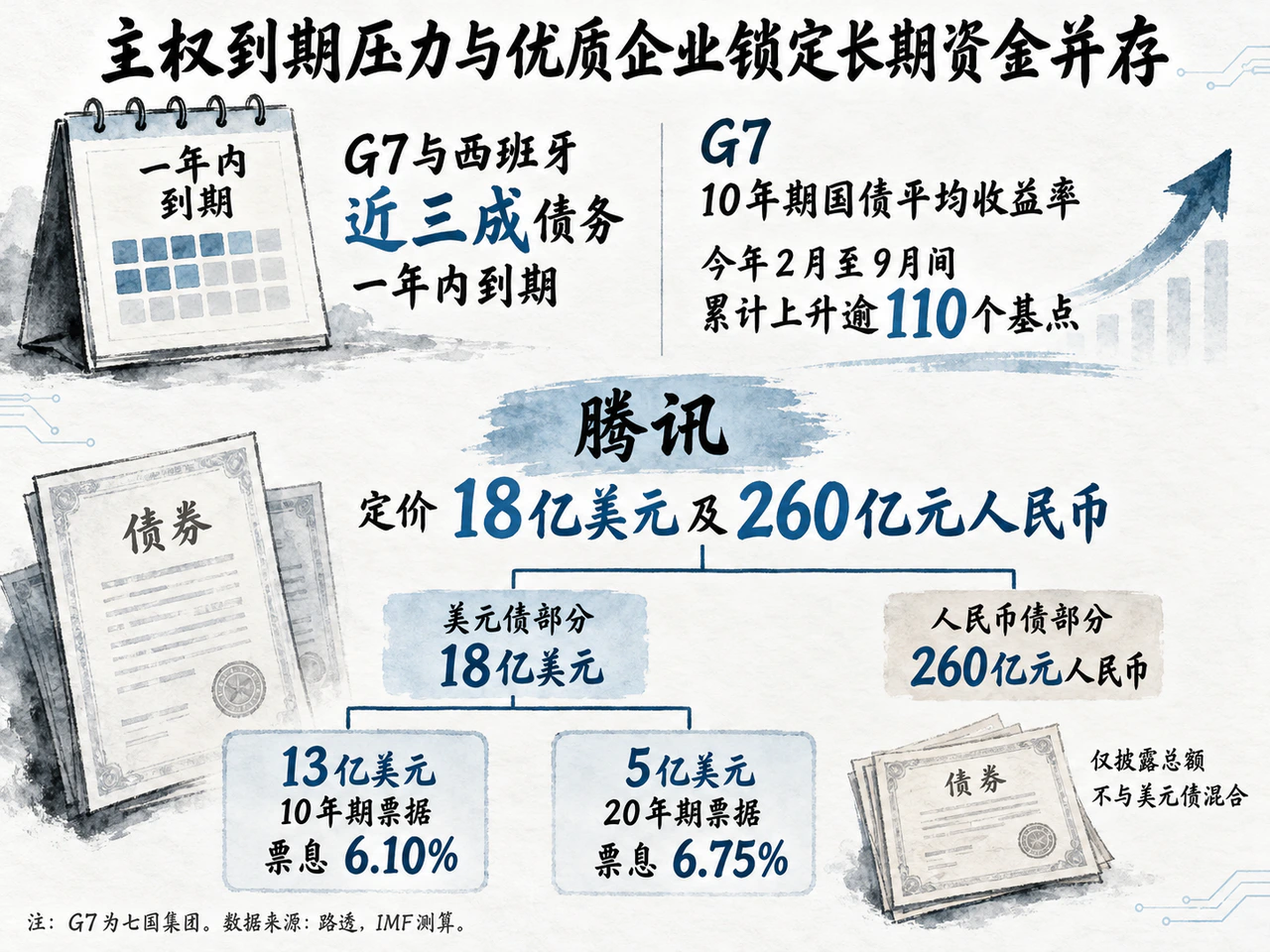
Reuters reported IMF estimates that average G7 10-year sovereign yields had risen more than 110 basis points between February and September. Nearly 30% of outstanding government debt in the G7 plus Spain would mature within a year. Energy subsidies, defense and aging-related spending complicated deficit reduction. A high short-maturity share meant high rates would feed more quickly into unavoidable government interest expenses.
European bonds already reflected concern about fiscal consolidation. At the time of reporting, France's 10-year spread over Germany was near 140 basis points. Markets were watching whether the 2027 French budget could pass parliament; it aimed to lower the deficit from an estimated 5.4% of GDP in 2026 to 5.0% in 2027. EU economy commissioner Dombrovskis said there were no signs yet of a new euro-area sovereign crisis, while longer average maturities gave governments time to adjust.
In corporate credit, issuer quality produced very different financing experiences. Tencent announced pricing on October 14 of $1.8 billion and RMB 26 billion in senior unsecured notes. The dollar portion comprised $1.3 billion of 10-year notes with a 6.10% coupon and $500 million of 20-year notes at 6.75%. Large high-quality issuers with steady cash flows could still secure long funding smoothly, contrasting with soaring borrowing costs for some leveraged AI companies.
China's September exports rise 36.3% while household credit remains weak; Asia's technology chain awaits TSMC earnings
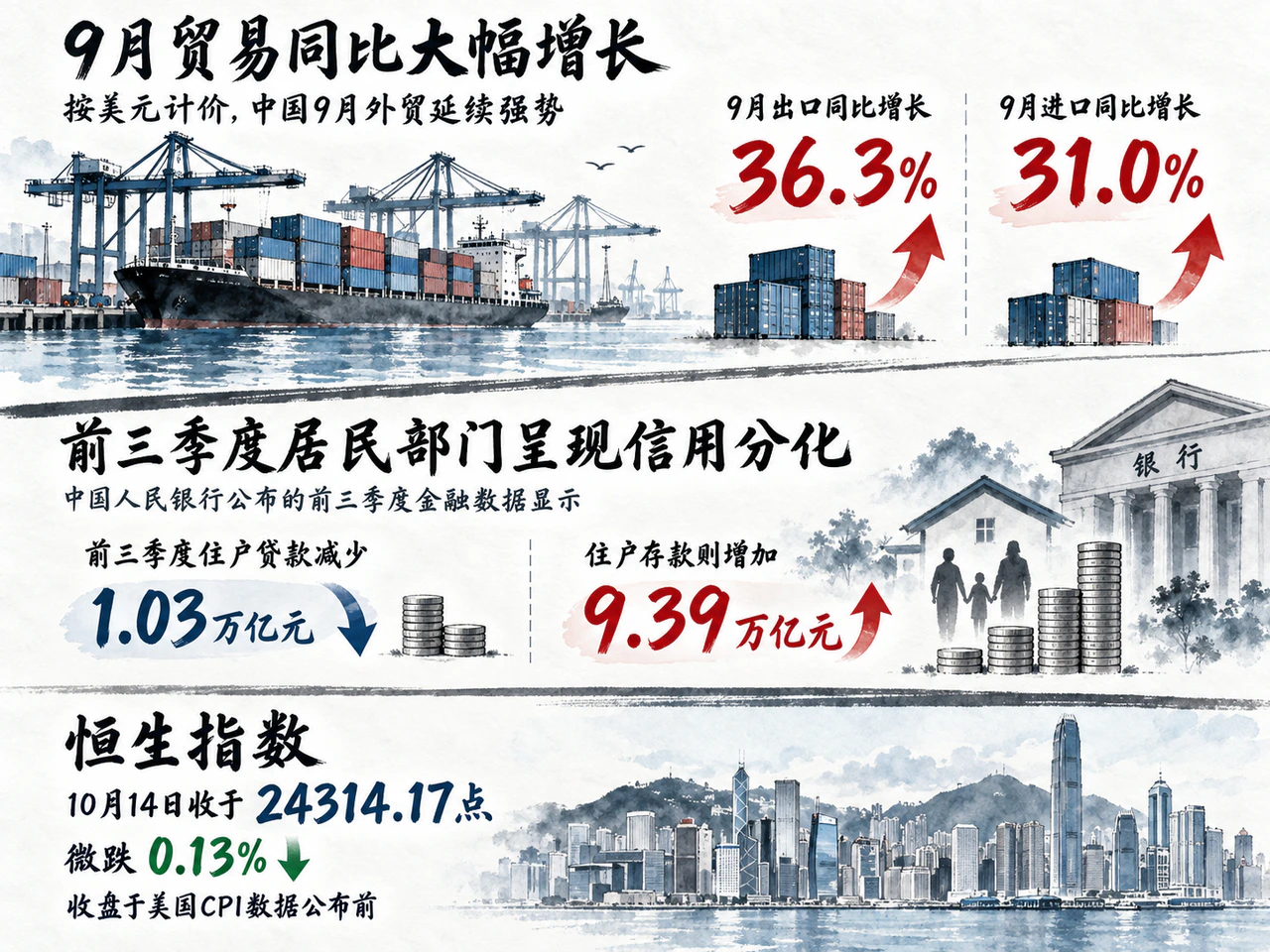
China's September trade substantially exceeded expectations. Dollar-denominated exports rose 36.3% year on year, far above August's 25.0% and the 25.5% consensus. Imports rose 31.0%, widening the monthly surplus to $133.53 billion. Reuters reported that semiconductor export value rose 108.1% in the first three quarters, while vehicle export value and volume each increased more than 50%. Machinery, electrical and technology exports continued supporting industrial production and corporate cash flow.
Compared with strong external demand, household credit expansion remained slow. People's Bank of China data showed household loans fell RMB 1.03 trillion in the first three quarters: short-term loans declined RMB 1.14 trillion, while medium- and long-term loans increased only RMB 106.2 billion. Household deposits rose RMB 9.39 trillion. Aggregate social financing increased RMB 27.46 trillion, RMB 2.63 trillion less than a year earlier. Net corporate-bond financing reached RMB 2.75 trillion, however, RMB 1.18 trillion more year on year, partly offsetting slower on-balance-sheet lending growth.
To support liquidity and bond financing, the PBOC announced a six-month outright reverse repo of RMB 700 billion for October 15. Against RMB 500 billion of equivalent maturities that day, the operation would inject a net RMB 200 billion, supporting banks' interperiod funding and corporate issuance.
Asian equities were absorbing both overseas technology valuation adjustments and industry fundamentals. The Hang Seng closed October 14 at 24,314.17, down 0.13%, before the U.S. CPI release. Overnight losses in U.S. AI infrastructure stocks and bonds could weaken Asian technology risk appetite, while ASML's strong equipment guidance supported upstream fundamentals. Markets awaited TSMC's October 15 results. Updated guidance on customer AI demand, capital spending and margins would be a key test of returns on global AI computing investment and the durability of the cycle.