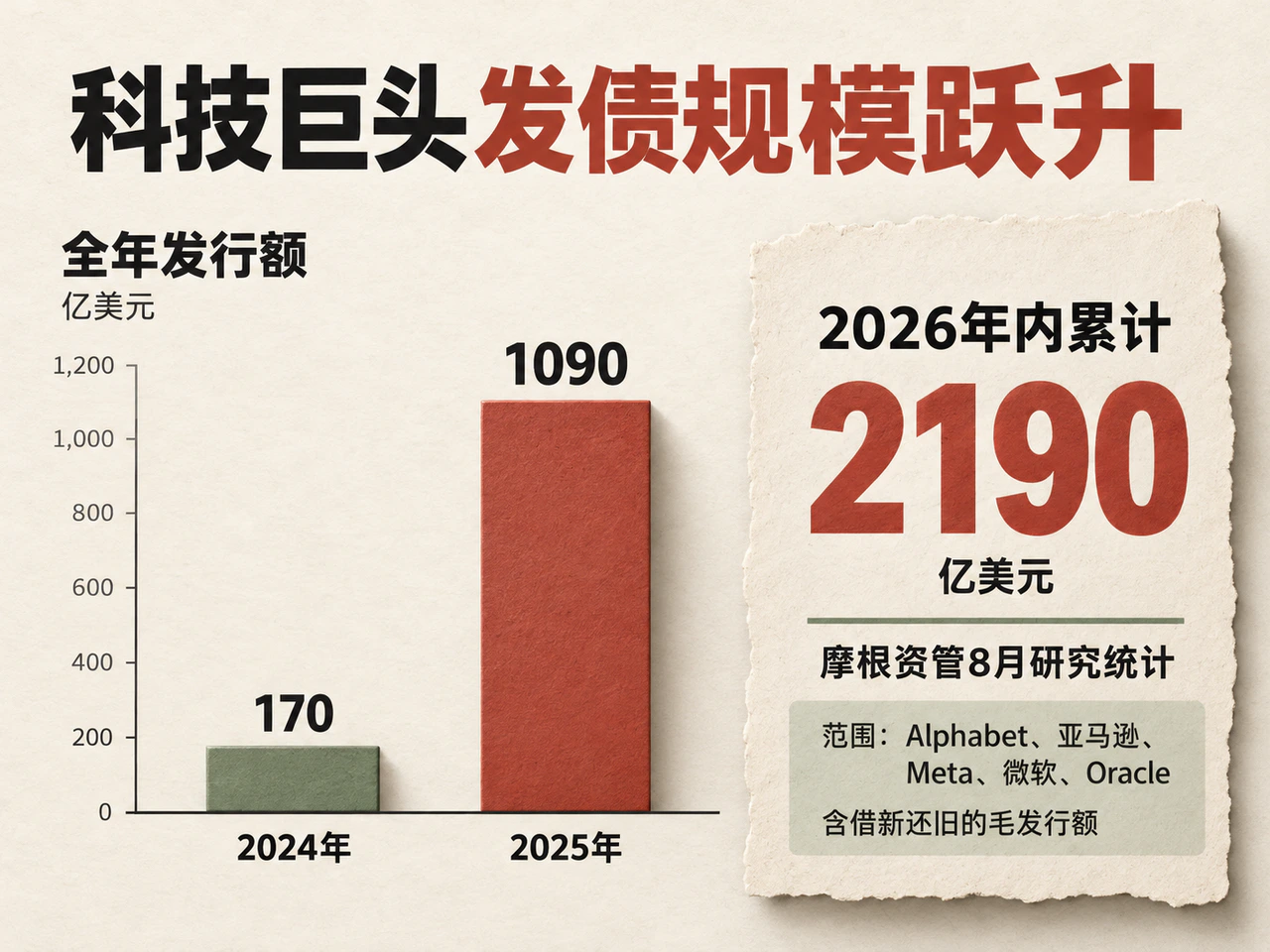
According to J. P. Morgan Asset Management, total bond issuance by Alphabet, Amazon, Meta, Microsoft and Oracle jumped from about $17 billion in 2024 to roughly $109 billion in 2025. Issuance expanded sharply again in 2026: Reuters' calculations based on London Stock Exchange Group (LSEG) data showed that Alphabet, Amazon, Meta and Oracle had issued about $194 billion of bonds by July 7. J. P. Morgan Asset Management's August figures put equivalent investment-grade issuance by all five companies at $219 billion for the year to date. Even allowing for refinancing, this gross issuance clearly shows that technology giants once renowned for strong cash generation are becoming sustained, enormous sources of demand for bond-market funding.
The immediate driver of this financing surge is rapidly expanding capital expenditure. Google parent Alphabet's cash capex rose from $32.25 billion in 2023 to $91.45 billion in 2025. It spent a further $80.6 billion in the first half of 2026, consuming about 95% of the period's $84.86 billion operating cash flow. In the second quarter alone, cash spending on property and equipment exceeded quarterly operating cash flow. Its core businesses still generate abundant cash, but infrastructure construction is clearly consuming it faster.
The intensive investment required for AI infrastructure has disrupted the technology giants' balance among investment schedules, cash returns and financing. Heavy bond issuance is intended both to fill immediate funding gaps and to secure multiyear construction funding in advance while preserving liquidity buffers. Equity issuance, adjustments to buybacks and expanded finance leasing are proceeding alongside debt financing. Behind the bond boom lies a systematic reshaping of their overall capital structures.
Capex growth far exceeds operating cash flow; Amazon and Oracle already face funding gaps
Large fixed-asset investments are familiar to the technology industry. Amazon spent heavily for years building logistics and fulfillment networks, while cloud providers have long expanded their data centers. What distinguishes this round is the abrupt increase in the intensity of investment in computing facilities, servers, networks and supporting power infrastructure. Large cash outlays are concentrated upfront, while monetization and cash returns arrive over a longer subsequent period.
Alphabet's and Meta's financial trajectories are representative. From 2023 to 2025, Alphabet's operating cash flow rose from about $101.7 billion to $164.7 billion, roughly 62%, but cash capex jumped from about $32.3 billion to $91.4 billion, approximately 184%, and approached the limit of current operating cash flow in the first half of 2026. Meta likewise faced accelerating consumption of internally generated funds: its 2025 operating cash flow rose from $91.3 billion to $115.8 billion, but cash purchases of property and equipment nearly doubled from $37.3 billion to $69.7 billion. Free cash flow under the company's definition, after finance-lease principal payments, instead shrank from $52.1 billion to $43.6 billion. Better core-business earnings and cash generation did not produce comparable growth in discretionary cash.
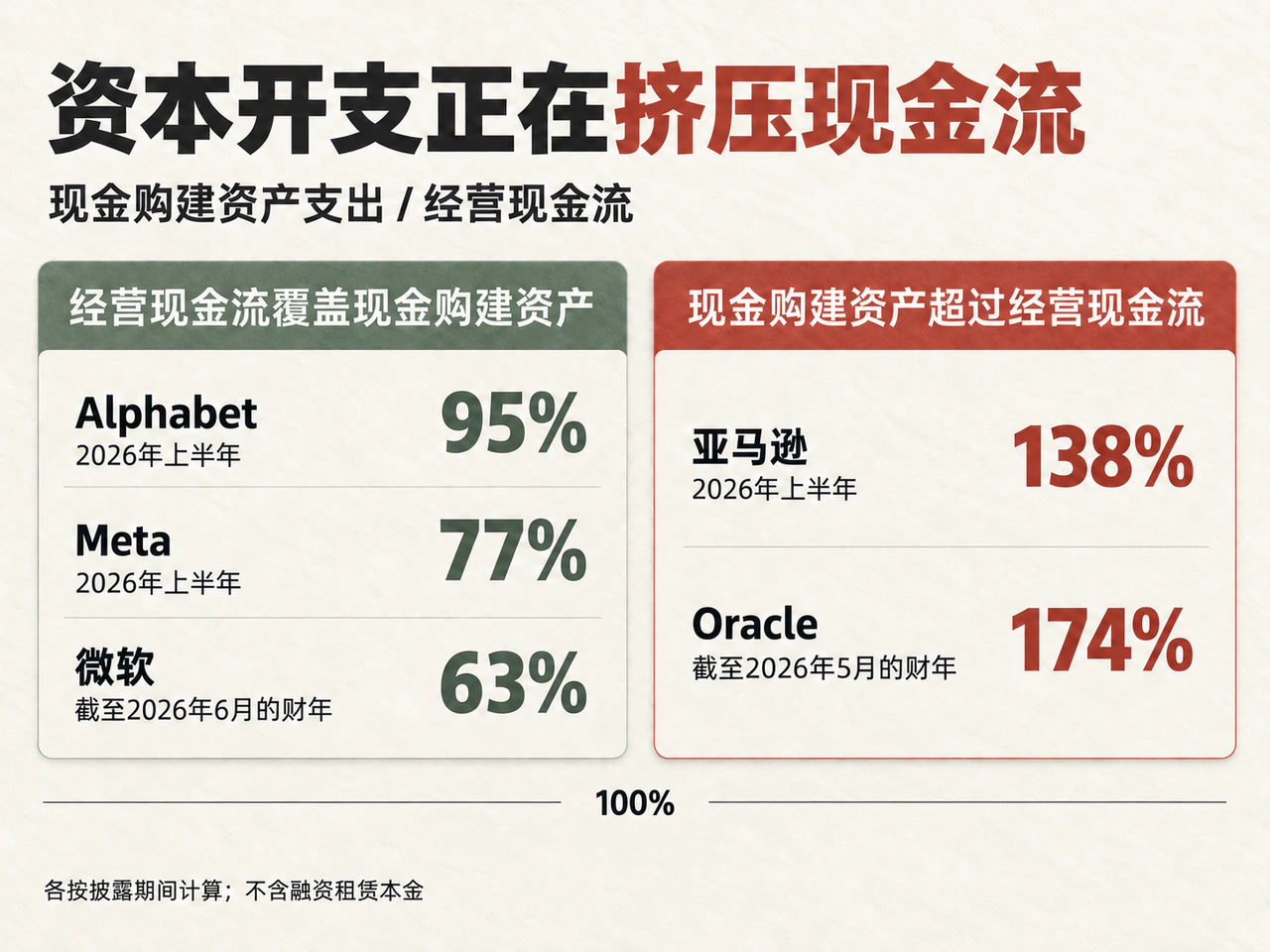
Across the five giants, cash-flow coverage now differs significantly:
| Company | Reporting period | Operating cash flow | Cash spending on property and equipment | Spending as a share of operating cash flow |
|---|---|---|---|---|
| Alphabet | First half of 2026 | 84.86 | 80.60 | 95% |
| Meta | First half of 2026 | 64.09 | 49.11 | 77% |
| Amazon | First half of 2026 | 71.42 | 98.41 | 138% |
| Microsoft | Fiscal year ended June 2026 | 182.94 | 115.95 | 63% |
| Oracle | Fiscal year ended May 2026 | 31.98 | 55.66 | 174% |
Note: Amounts are in billions of U.S. dollars; ratios are calculated from unrounded figures. Cash spending on property and equipment excludes finance-lease principal and is not adjusted for asset disposals or equipment incentives. Reporting periods differ between half-years and full years, so the figures show cash coverage for each company's own period; absolute amounts cannot be ranked across periods or added together directly.
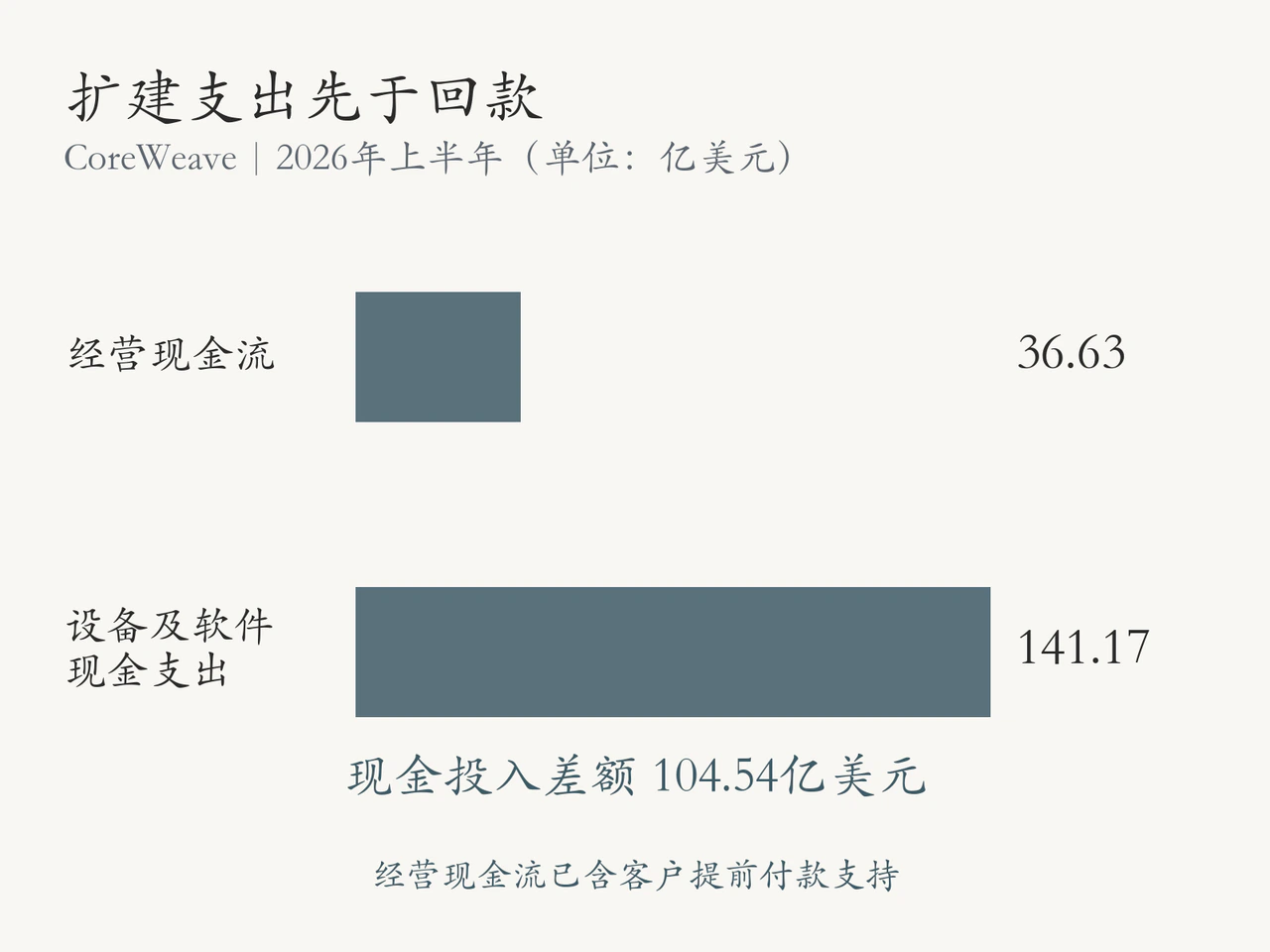
Amazon's and Oracle's current investment has exceeded the limits of internally generated cash. In the first half of 2026, Amazon's cash spending on property and equipment reached 138% of operating cash flow, in addition to outlays such as strategic investments in AI companies. Oracle's capex soared over two years from about $6.9 billion in the fiscal year ended May 2024 to $55.7 billion in the fiscal year ended May 2026, equivalent to 174% of roughly $32.0 billion in operating cash flow. For these companies, external financing now directly fills current cash shortfalls.
Microsoft, by comparison, still has ample cash-flow headroom. In the fiscal year ended June 2026, it retained about $67 billion after deducting cash purchases of property and equipment from operating cash flow, with no new cash proceeds from debt that year. It nevertheless expanded its balance sheet through other debt instruments: finance-lease-related liabilities rose from $46.2 billion at the previous fiscal year-end to $66.6 billion. Even with similar investment priorities, different cash-generating foundations determine financing pressure and instrument choice.
Shrinking internally generated cash headroom has translated directly into heavy bond financing. In the first half of 2026, Alphabet issued about $51.8 billion of new notes and Meta issued $25 billion, increasing Meta's notes outstanding from $59 billion at the end of 2025 to $84 billion at the end of June 2026. Oracle issued $25 billion of notes in February. After multicurrency financing in the first half, Amazon priced another $25 billion of bonds in July.
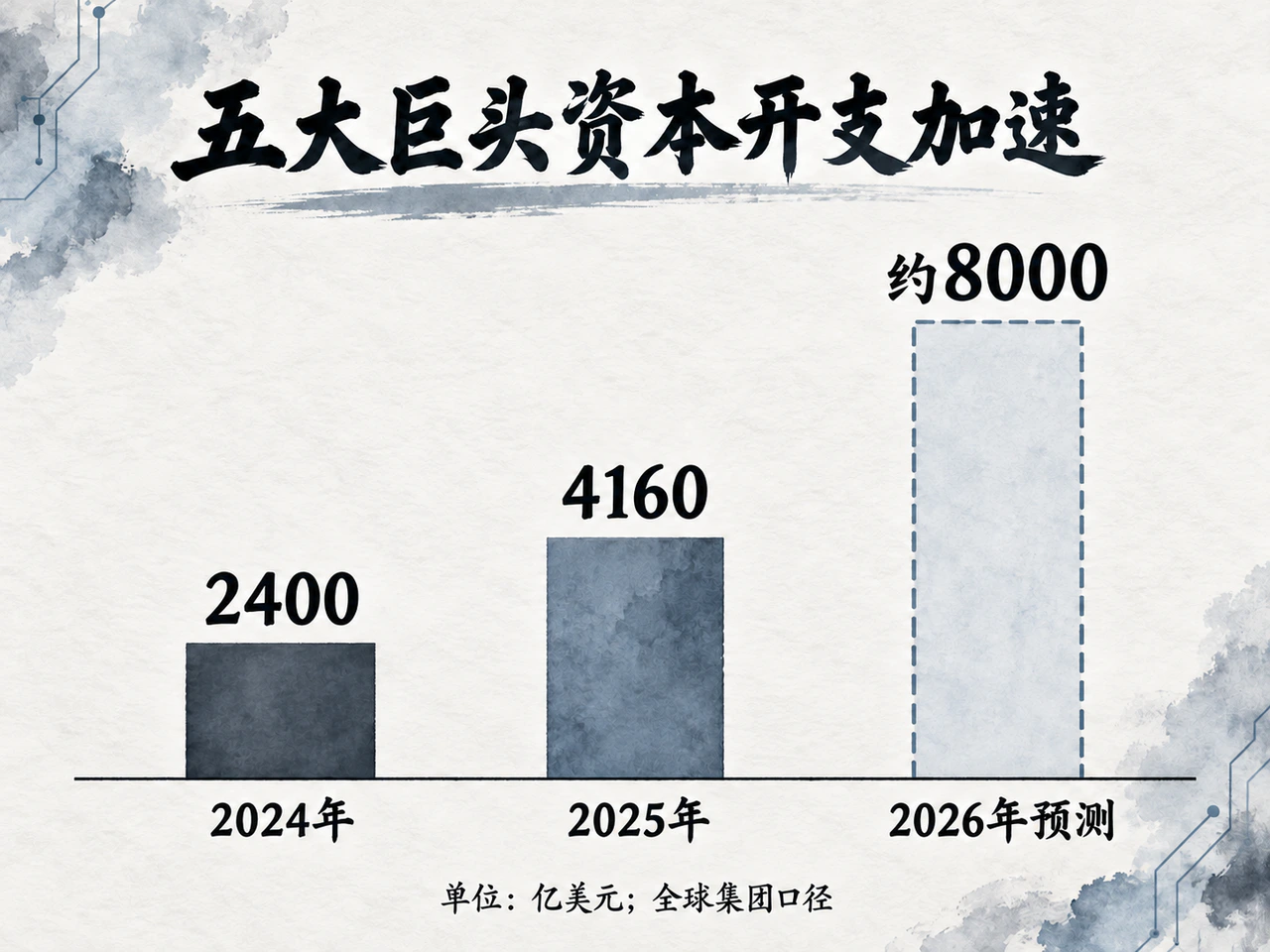
Beyond current spending, continually rising future investment plans are forcing companies to stockpile funding in advance. In July 2026, Alphabet sharply raised full-year capex guidance to $195 billion–$205 billion. Meta's contemporaneous full-year guidance, including finance-lease principal, was $130 billion–$145 billion. These budgets cover several infrastructure categories rather than exclusively AI projects, but demand for AI computing is undoubtedly the main engine of this expansion. BIS modeling of the AI investment race finds that companies seeking future market positions have an inherent incentive to expand current investment simultaneously. Amid fierce competition for computing capacity, power and customer delivery windows, securing capacity early affects market share. Delaying financing to wait for lower interest rates could directly cost a company its delivery window.
Bond-issuance motives therefore cannot be judged simply by whether a company appears short of cash. Those with investment cash deficits need external funding, while companies with remaining headroom must also reserve liquidity for equipment purchases, lease obligations, maturing debt and construction payments. Otherwise, waiting until reserves are substantially depleted to seek financing could leave construction schedules hostage to financial-market conditions at that time.
Strong core-business credit supports long-term funding: new hyperscaler bonds average about 16 years
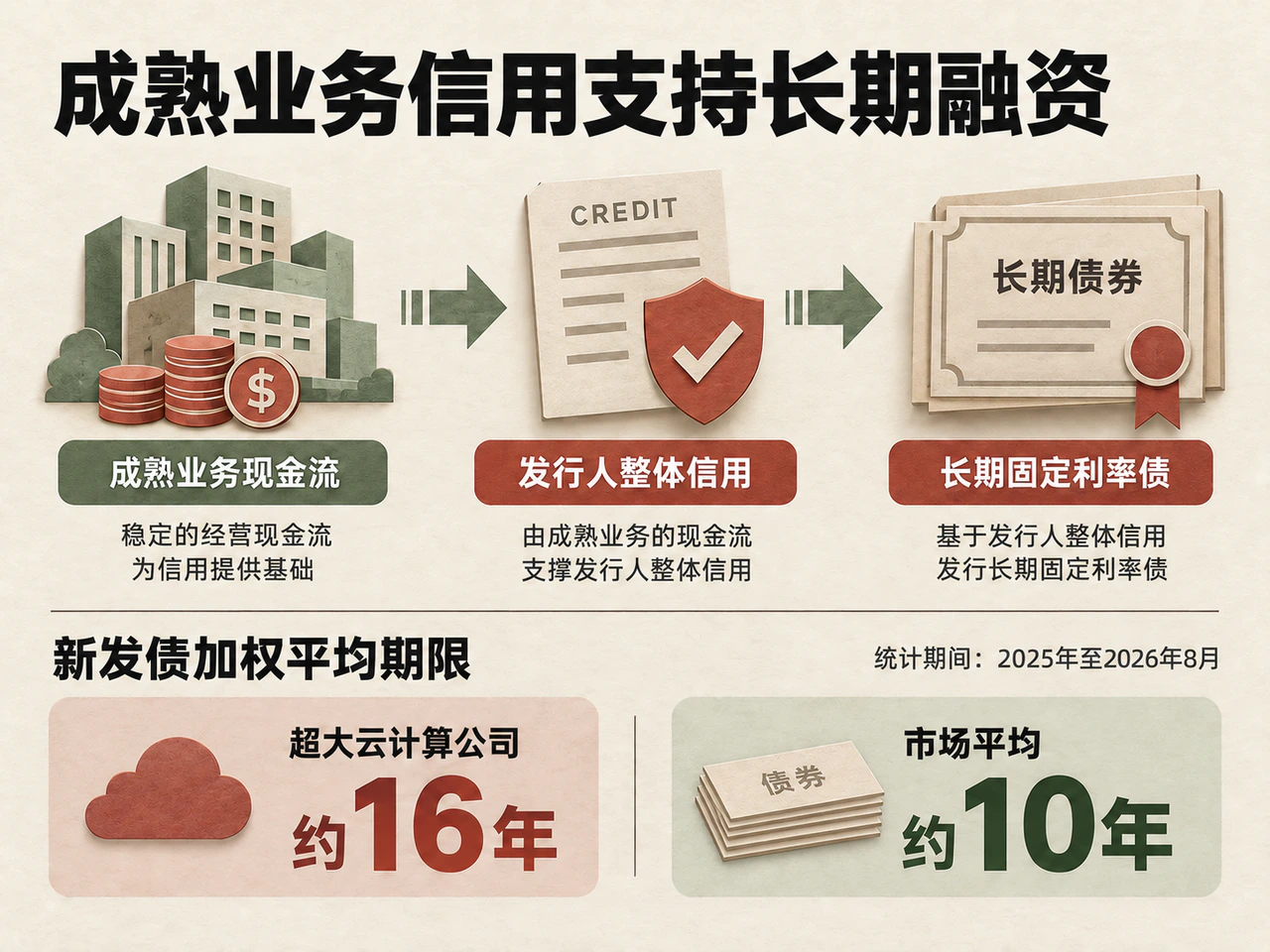
High interest rates have raised the absolute cost of borrowing without weakening leading technology companies' access to bond markets. Corporate bond pricing combines Treasury benchmark yields and credit spreads. Excellent credit quality allows the giants to lock in funding across cycles at relatively low credit premiums.
For example, Meta's $25 billion bond deal priced in late April 2026 included an approximately five-year tranche yielding 4.553%, just 53 basis points over its Treasury benchmark; an approximately ten-year tranche yielded 5.286%, a 90-basis-point spread. Even the 30-year tranche's issue yield was held to 6.310%. Creditors assess the issuer's overall ability to repay, rather than the short-term return of one new project. Large, stable cash flows from search advertising, social advertising, software subscriptions, e-commerce and existing cloud services provide strong credit support for new infrastructure investment. Even while new computing projects are under construction or developing commercial demand, parent companies can meet obligations from mature businesses. This is the central funding advantage of large platforms over emerging computing providers without stable cash flow.
This credit advantage lets technology giants arrange years of funding needs in advance. Long-term fixed-rate bonds lock in interest costs and substantially reduce the refinancing pressure of frequent renewals during construction. The Kansas City Fed's figures for newly issued investment-grade bonds from 2025 through August 2026 put hyperscalers' weighted-average maturity at about 16 years, well above the market average of around ten. Such long-dated debt matches companies' overall long-term funding needs and ongoing cash generation, rather than the depreciation life of individual hardware. Data-center buildings, power facilities and AI chips have different useful lives; long-term debt ultimately depends on future company-wide operating cash flow for repayment. Faster technological turnover in chips and other hardware makes replacement spending and residual-value risk all the more important to monitor.
Alongside longer maturities, funding has become global. J. P. Morgan Asset Management's August research said about $62 billion of the five giants' $219 billion equivalent investment-grade issuance that year came from non-dollar markets. European insurers and pension funds have large long-term liabilities, creating a natural buyer base for highly rated, long-duration bonds. Lower nominal coupons in non-dollar currencies do not automatically mean lower costs after conversion to dollars: companies must consider FX hedging costs, cross-currency basis, issuance fees and whether local overseas receipts and payments provide a natural hedge. For corporate treasurers, cross-market, multicurrency issuance offers more than price comparison; it diversifies and stabilizes funding sources and spreads the absorption burden beyond a single dollar funding pool.
Historically, debt has been a common tool for mature technology giants to optimize capital allocation, but the use of proceeds has changed materially in this cycle. In 2013, Apple announced accompanying debt financing when it raised its shareholder capital-return plan through the end of 2015 to $100 billion; it issued $17 billion of notes that May. Operating cash flow in that fiscal year was about $53.7 billion, against cash property-and-equipment spending of only about $8.2 billion. Borrowing did not fill an investment gap, but reflected a combination of buybacks and dividends, the location of overseas retained cash and the cross-border tax regime at the time. The core mission of today's heavy technology issuance is instead to support fixed-asset infrastructure expansion directly, bridging large upfront investments and delayed cash recovery.
Ratings constraints require more than borrowing: Alphabet and Oracle raise nearly $70 billion of equity as several giants halt first-half buybacks
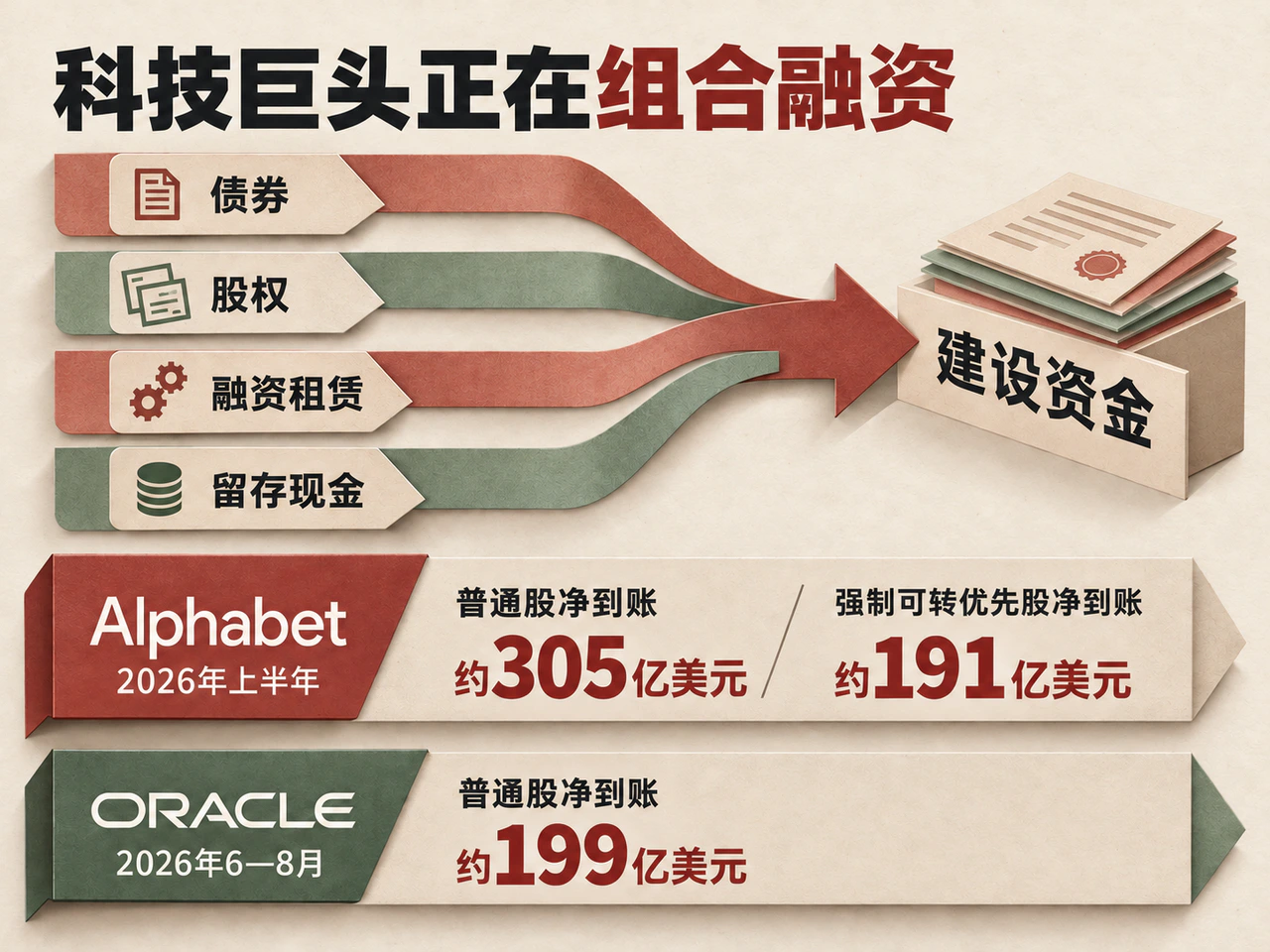
Given their strong debt-raising ability, how should the roles of debt and equity in their financing mix be understood?
In terms of capital costs and distribution rights, creditors have priority claims and generally require lower returns than shareholders bearing residual risk. Companies with stable mature-business cash flows and ample debt capacity can finance new investments with fixed-interest, fixed-principal debt, allowing existing shareholders to retain more future upside. Tax deductibility of interest—the tax shield—can further reduce the effective funding cost. For example, suppose a company issues $10 billion of debt at 5% annual interest and can deduct all interest immediately at a 21% marginal tax rate. Annual interest of $500 million would reduce income tax by $105 million, leaving an after-tax interest burden of $395 million. The $10 billion principal must be repaid separately at the end of the five-year term; the actual tax shield also depends on taxable profits, deduction limits, tax losses and minimum taxes.
The tax shield is not the sole guide to financing decisions; preserving future financial flexibility is equally crucial. A study published by Graham in 2022, based on a March 2019 corporate survey, found that 87% of respondents at large companies regarded financial flexibility as important or very important to debt decisions, compared with just 24% placing equivalent weight on interest deductions. Continually adding debt raises fixed interest obligations and residual equity risk, and can also increase future borrowing costs, tighten covenants and reduce capacity to borrow when new opportunities arise.
Consequently, equity financing and retained internal funds are becoming important components of the giants' financing mix for capex with uncertain growth prospects and long cash-payback periods. Equity's cost is the expected total return investors require for bearing residual risk, including cash distributions and changes in equity value. It cannot be measured simply by a low dividend yield, nor can expected share-price appreciation be equated directly with the cost of issuing shares. Given the same operating outlook and risk, a higher valuation means surrendering a smaller ownership share for the same proceeds. New shareholders supply cash while sharing future investment outcomes, helping protect borrowing capacity and credit ratings.
Technology giants' actual capital transactions since the start of 2026 illustrate this debt–equity trade-off:
Some have launched large-scale equity financing. In the first half of 2026, Alphabet received about $30.5 billion net from common shares and $19.1 billion net from mandatory convertible preferred shares, which ultimately convert into common shares under agreed terms. Together, nearly $50 billion had actually been raised. It also established a $40 billion at-the-market (ATM) share-sale program that remained unused at the end of June. Oracle completed a $20 billion common-share issue between June and August, raising about $19.9 billion after fees. As early as its February funding plan, Oracle directly linked maintaining a balance between debt and equity with preserving an investment-grade rating. Compared with hyperscale platforms with stronger cash coverage, Oracle began with more debt, a substantial investment cash gap and heavy long-term commitments. Continued reliance on bonds could further erode ratings headroom.
Reducing cash returns to shareholders has also become an important way to retain internal funding. Alphabet and Meta made no share repurchases in the first half of 2026, and Oracle's buyback spending has also contracted significantly in recent years. By using retained cash, bond issuance, new equity and buyback adjustments together, the giants are constructing a funding system with several sources of support.
Five giants' credit spreads widen 30 basis points as hundreds of billions in off-balance-sheet leases expand cash commitments
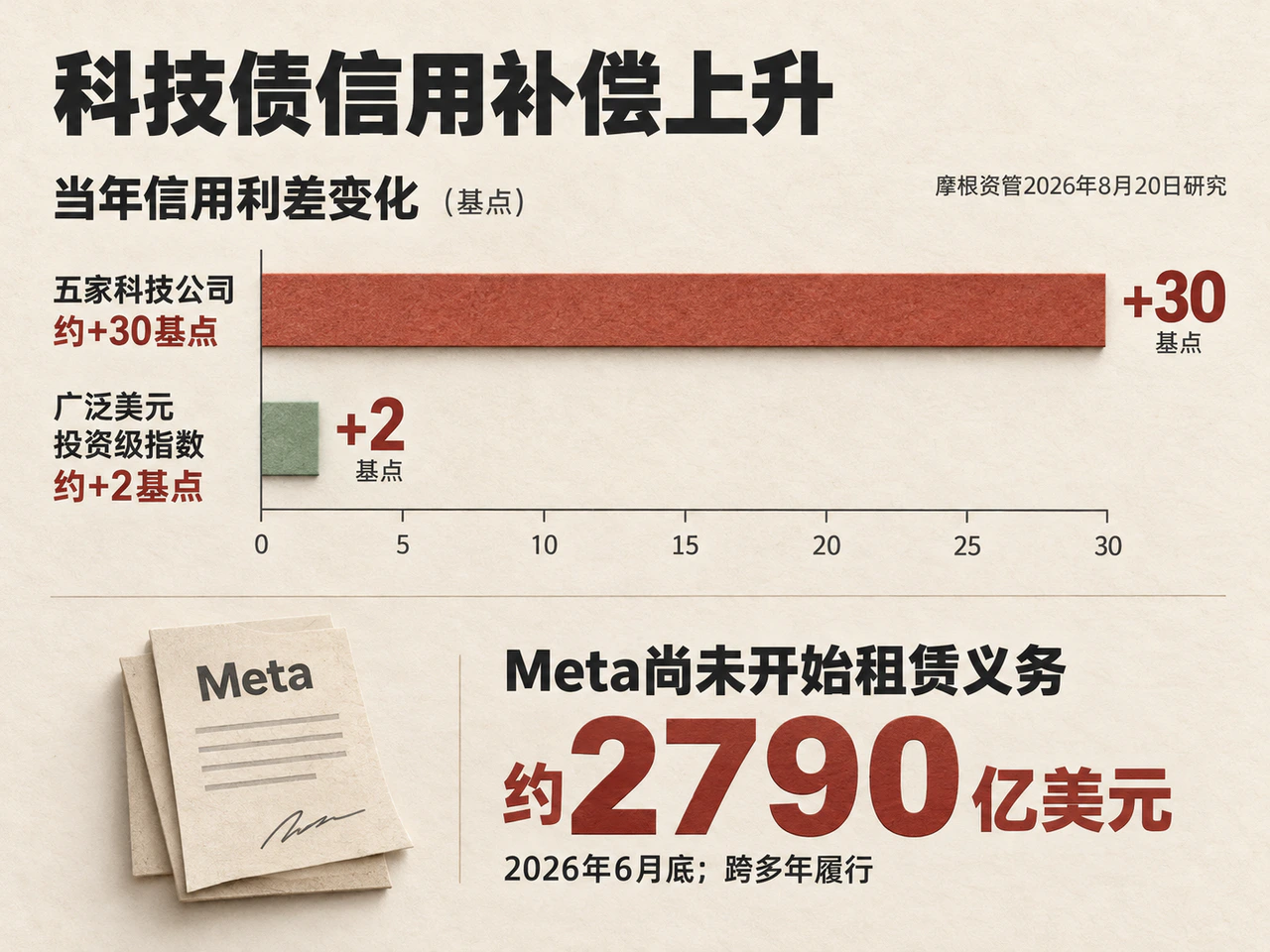
The other side of the financing expansion is that bond investors must absorb larger, longer-duration claims concentrated in the same industry chain. Technology debt is shifting from a relatively scarce, high-quality allocation to a vast source of new supply requiring continued absorption by buyers.
Compensation for technology credit risk has already risen. J. P. Morgan Asset Management's August 20 research said the five giants' credit spreads had widened by about 30 basis points that year under its tracking methodology, compared with about two basis points for the broad U.S. dollar investment-grade index. Relative widening of roughly 28 basis points shows that required credit compensation rose faster for these issuers. Markets increasingly price differences in issuer quality, maturity and cash coverage. In particular, Oracle's higher leverage and cash-flow shortfall mean its credit risk cannot be treated as equivalent to that of more highly rated hyperscale platforms.
Large off-balance-sheet arrangements further expand the actual cash commitments that require assessment. At the end of June 2026, Meta disclosed about $279 billion of leases that had not yet commenced. Microsoft and Oracle also had substantial future data-center leases. These binding, multiyear contracts are not the same as balance-sheet debt falling due immediately, but they materially reduce flexibility over future cash flows. Some computing infrastructure also proceeds through special-purpose vehicles (SPVs), private credit and parent guarantees, extending the distribution of credit risk beyond public corporate bonds.
The concentrated supply of highly rated, very long-dated technology bonds has also raised questions about competition with some sovereign and supranational debt for insurers' and pension funds' allocations. Empirical research has yet to find clear crowding out. The ECB's late-August analysis identified this potential transmission channel but had not observed significant spillovers to euro-area sovereign debt at the time. PIMCO's September short-window study of six larger-than-expected AI bond deals likewise found no statistically significant systematic increase in ten-year Treasury yields, term premiums or swap spreads. The actual effects of allocation competition remain to be seen.
From a broader macroeconomic perspective, the central variable affecting long-term rates is the real investment itself. When demand for computing equipment, power infrastructure, construction and labor expands together without a matching rise in aggregate saving, equilibrium real interest rates may face upward pressure. Whether projects are funded by bonds, new shares or existing cash, those real resources must still be committed. Financing instruments alter risk distribution and financial-asset allocation, while the enormous scale of real investment is what affects broader macroeconomic resource prices.
Hundreds of billions in infrastructure test capital returns; cash flow from new computing capacity determines whether cheap funding endures
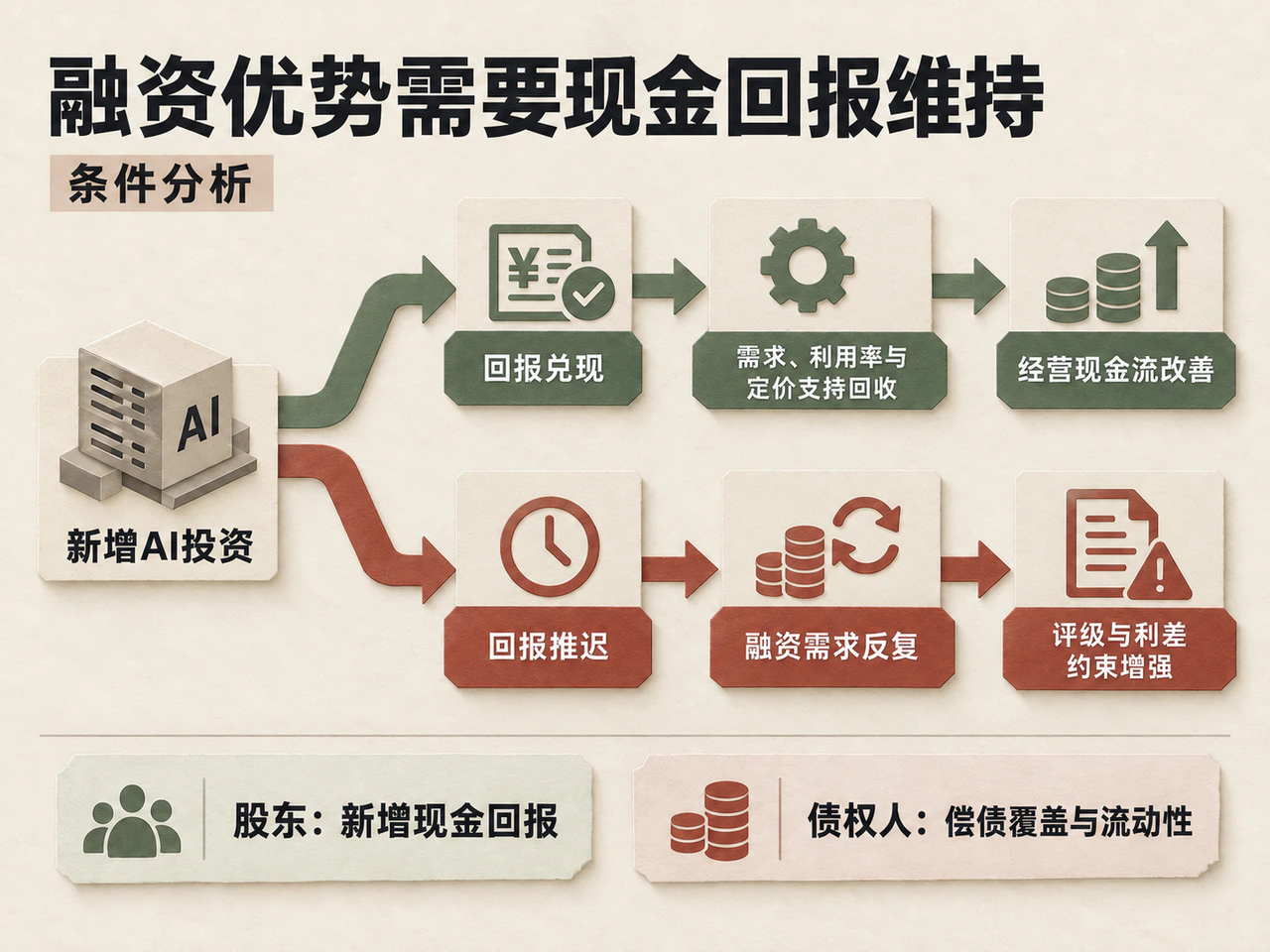
This technology-bond boom is pushing capital markets to focus more heavily on capital efficiency. Revenue, profit growth and market share remain important, but once infrastructure spending reaches hundreds of billions of dollars, growth per unit of capital and the precise timing of cash recovery directly determine shareholders' and creditors' ultimate returns.
A short-term decline in free cash flow may reflect a deliberate effort to capture a construction window. If new AI demand materializes as expected and capacity utilization and service pricing support cash recovery, stronger operating cash flow can allow debt issued now to bridge upfront investment and later returns successfully. If capex remains elevated while commercial returns are repeatedly delayed, external funding needs will recur. Ratings-downgrade pressure, wider spreads and institutional buyers' concentration limits would then become harder constraints.
Shareholders and creditors focus on different aspects of this process. Shareholders chiefly ask whether incremental cash returns adequately compensate for capital tied up and business risk. Creditors focus more on whether the company can continue servicing debt from mature-business cash flow, liquidity buffers and discretionary capex cuts even if new projects monetize more slowly than expected. Cancellation rights in long-term purchase and lease contracts, flexibility in construction schedules and the maturity profile of existing debt are therefore more informative than a single quarter's reported cash balance.
The giants' funding advantage is their ability to use operating foundations built over decades to obtain large, long-term external funding for future fixed-asset infrastructure. As capital intensity and the share of external financing keep rising, however, that credit advantage ultimately needs cash flow from new investments to sustain it. The bond boom is both a product of unprecedented AI infrastructure expansion and a sign that capital markets are applying a stricter test to investment payback and capital-allocation discipline.