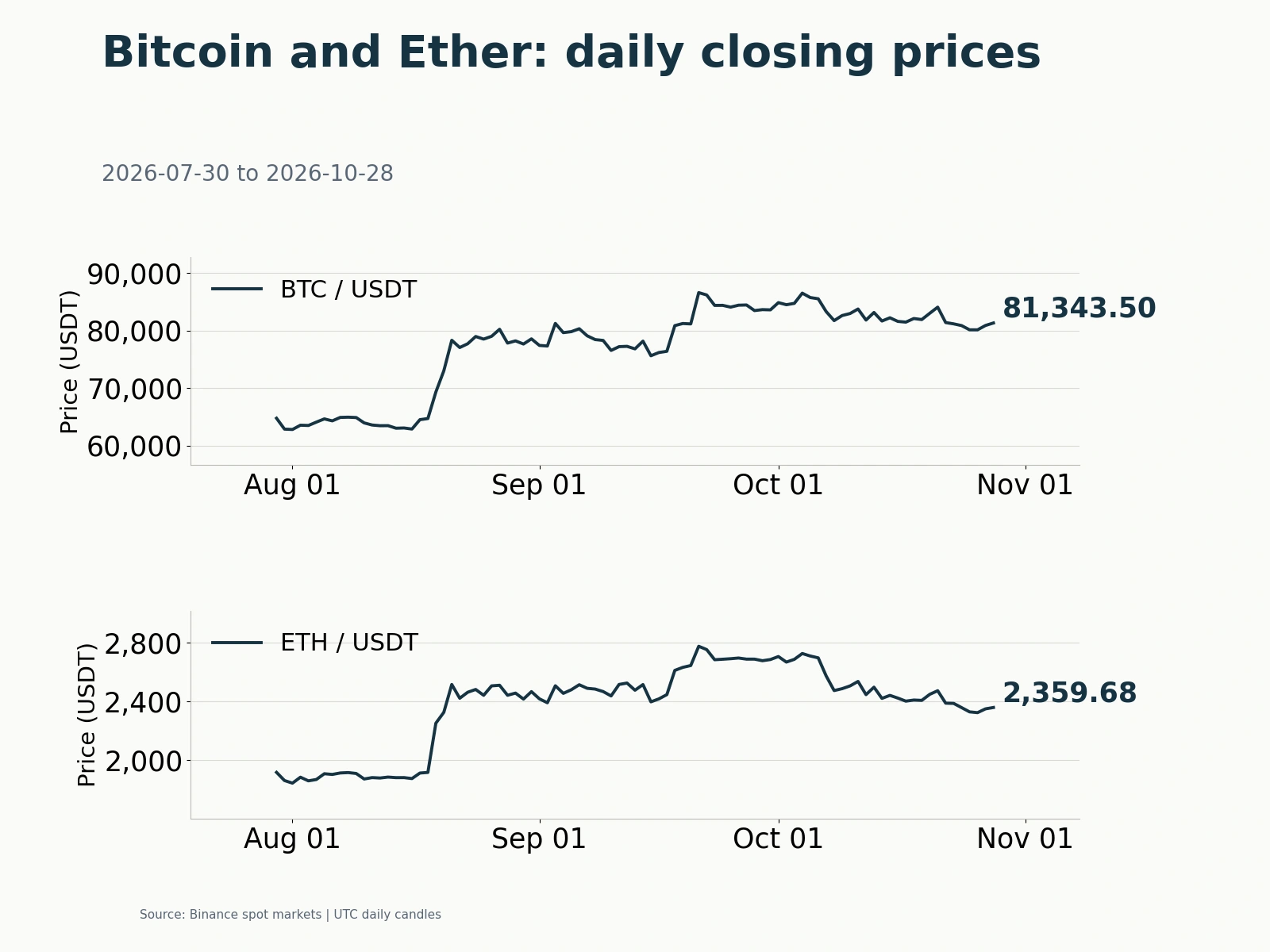
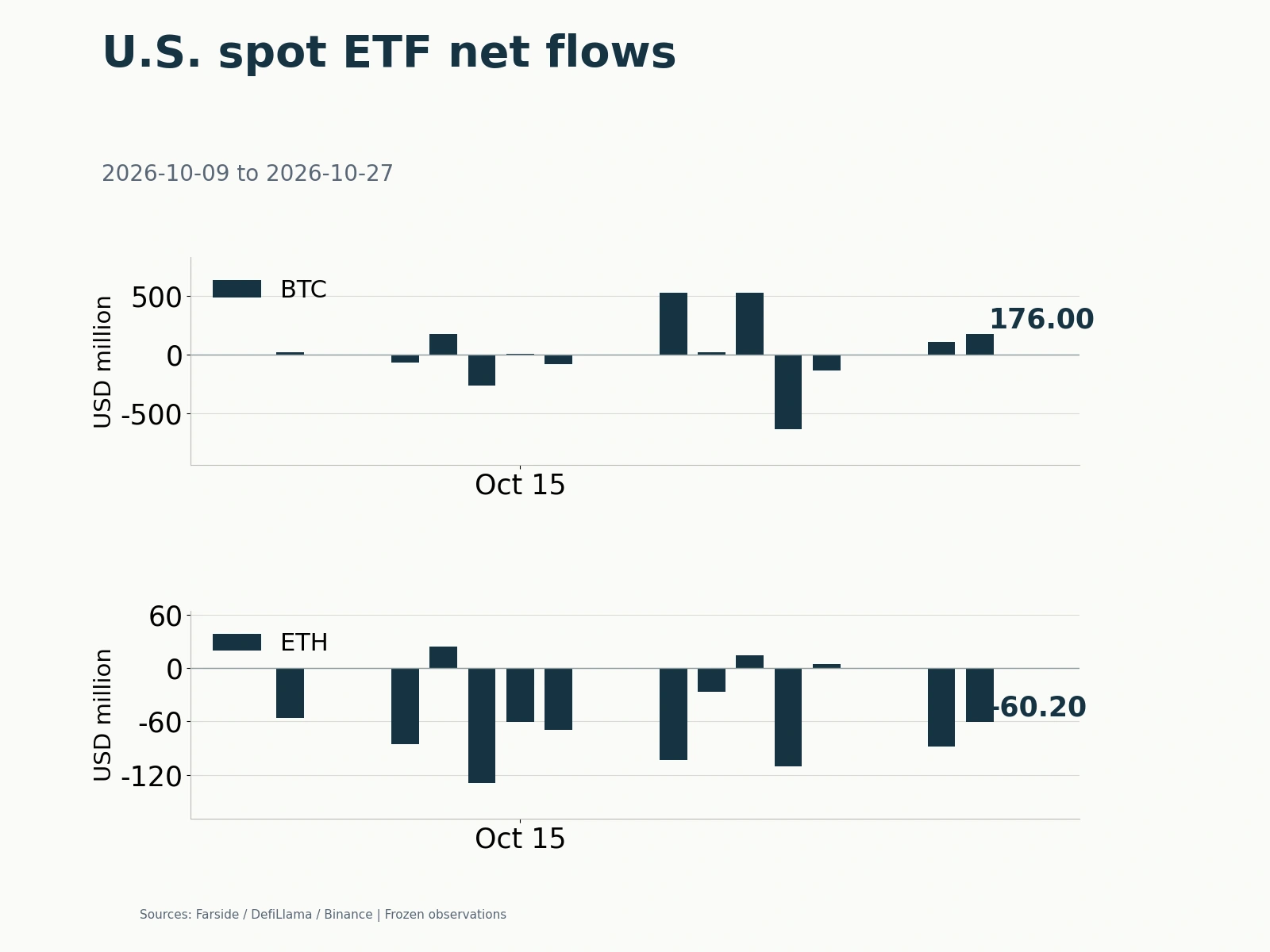
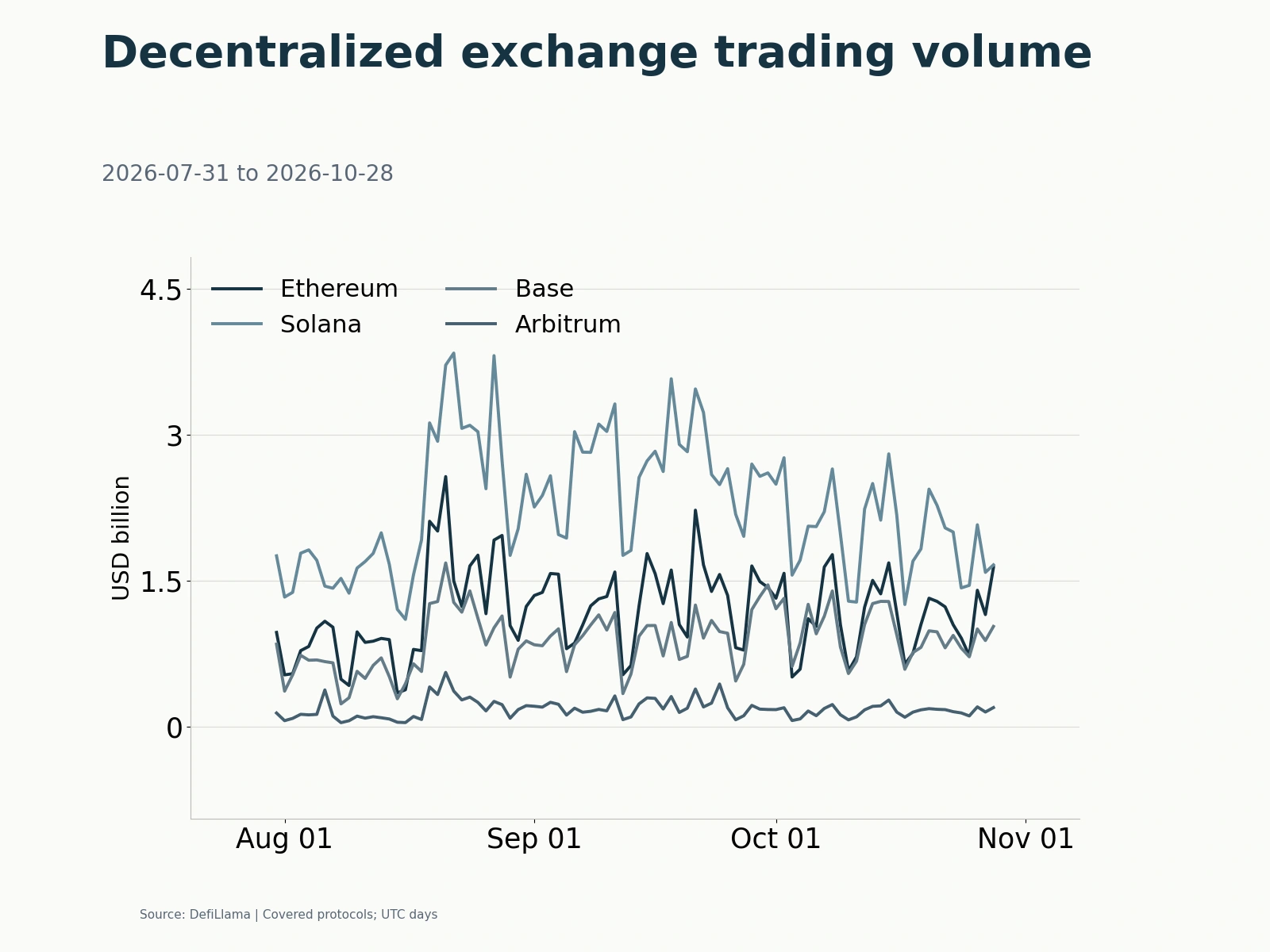
On October 17, measured as a complete UTC day throughout this article, decentralized-exchange (DEX) turnover generally declined across major public blockchains and layer-2 networks (L2s), while on-chain fees and protocol revenue fell in tandem. Within DefiLlama's DEX coverage, industry-wide daily turnover was $6.529 billion, down 21.8% from the previous day. Average daily volume over the latest seven complete days nevertheless remained slightly above the preceding seven days. As of the morning of October 18, Beijing time, the on-chain economy combined a short-term cooling in trading with diverging blockchain market shares. Applications continued expanding into payments and real-world assets (RWA), but whether new assets could generate sustained trading, borrowing and payment demand, translating into stable revenue retained by protocols and ecosystems, remained central to subsequent fundamentals.
Daily DEX turnover falls 21.8% to $6.529 billion; seven-day averages shift toward Solana
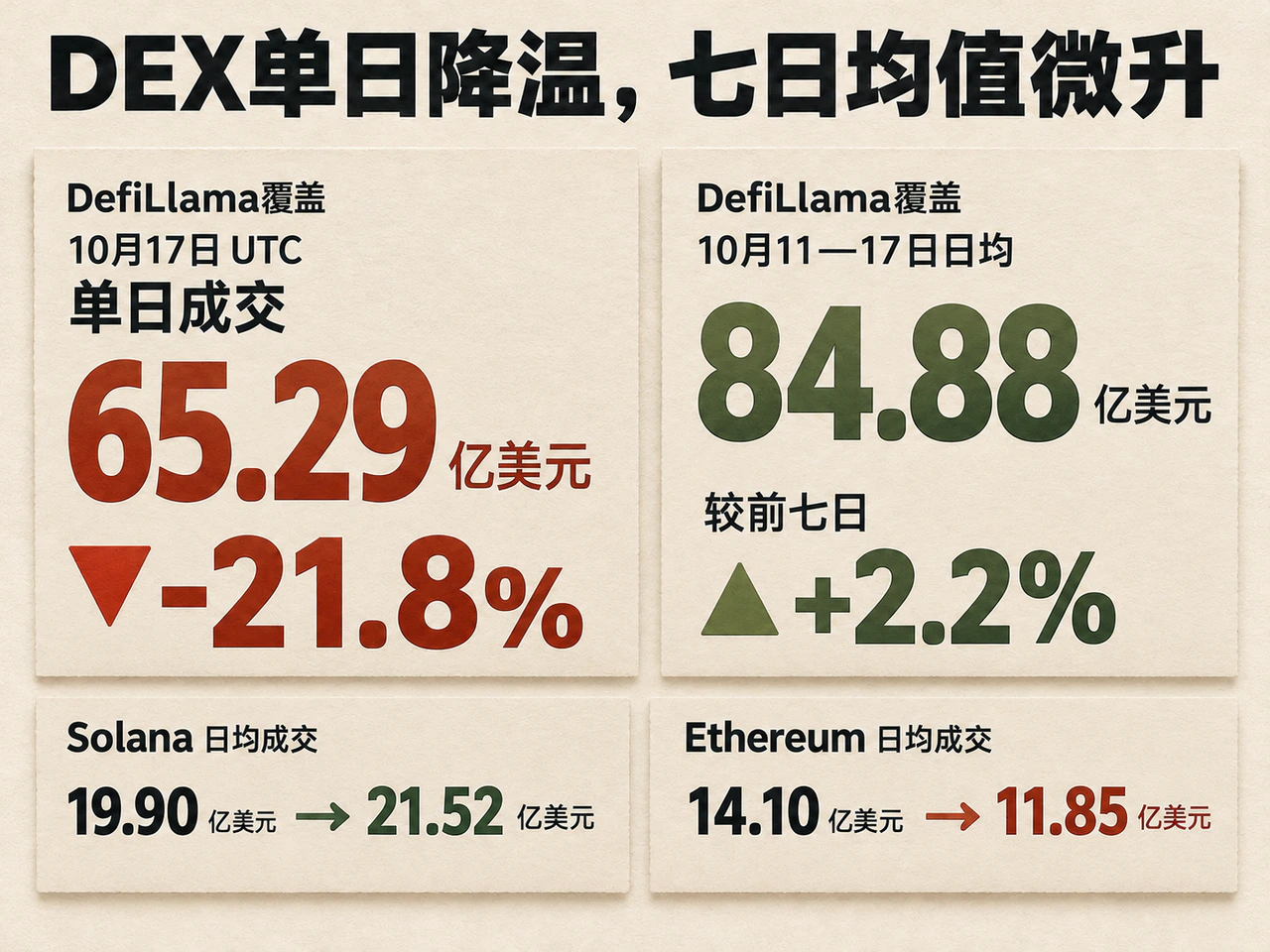
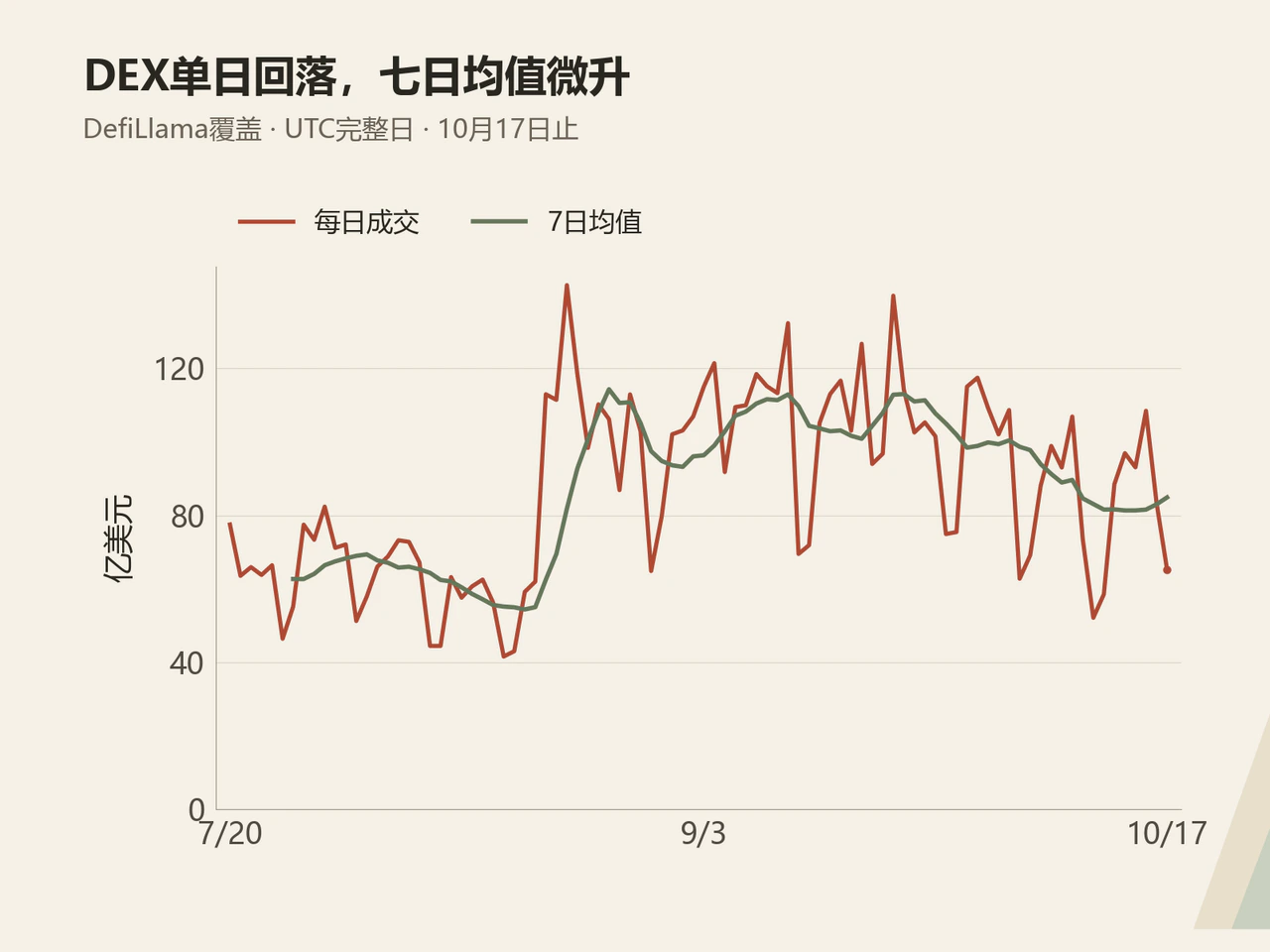
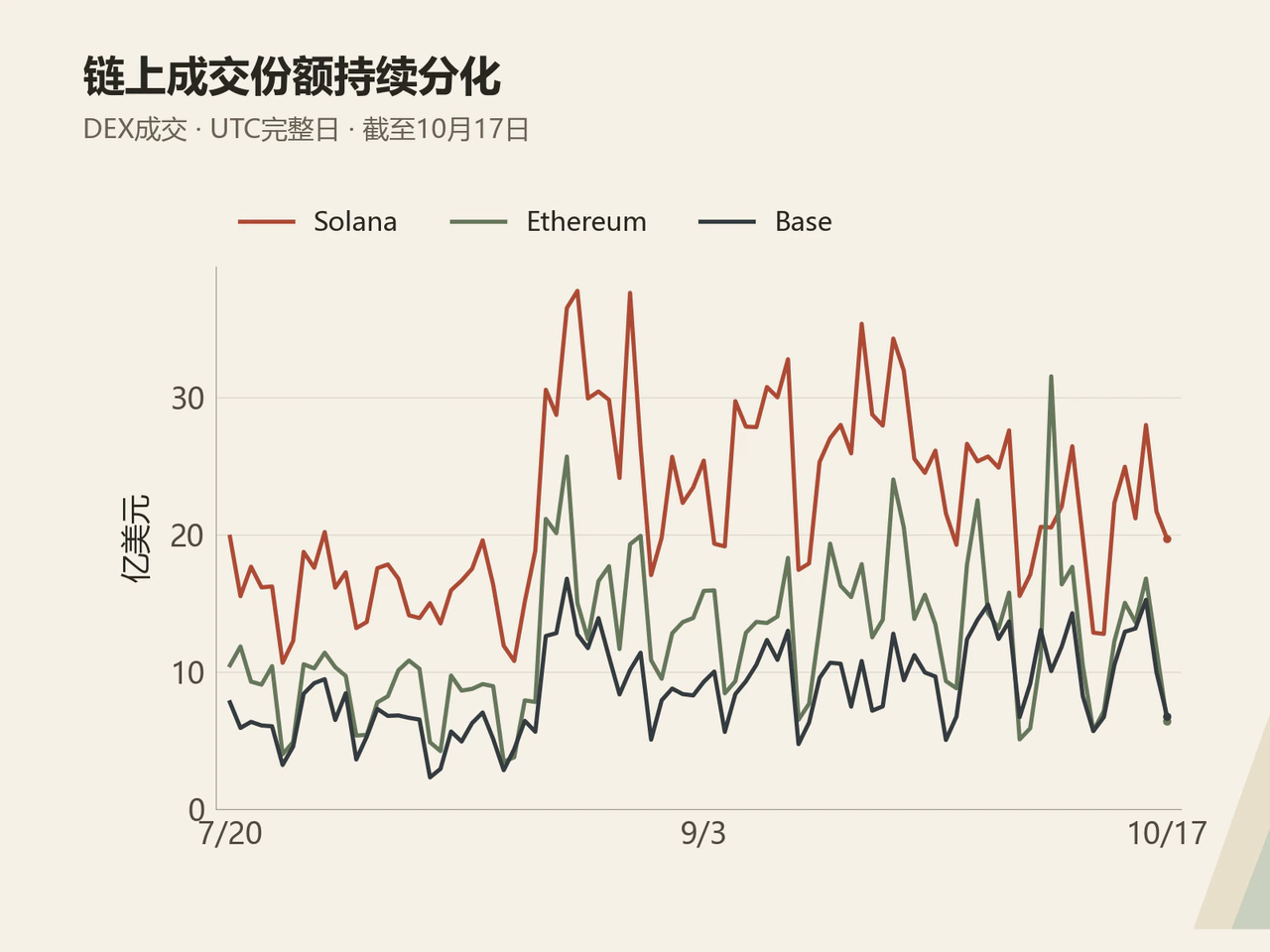
Daily declines varied substantially across leading networks. On October 17, Solana DEX turnover fell 9.1%, from $2.168 billion the previous day to $1.971 billion. BNB Chain fell 9.3%, from $1.053 billion to $956 million. Both declines were smaller than the industry average. Trading contracted more sharply in the Ethereum ecosystem: Ethereum mainnet DEX volume was $641 million, down 45.0% day on day; Base recorded $679 million, down 31.9%, still slightly above Ethereum mainnet; and Arbitrum recorded $92.43 million, down 37.6%. Tron turnover was $53.38 million, down 6.2%. Simultaneous cooling on Ethereum mainnet and its major L2s, with Base overtaking the mainnet in volume, reflects the highly dispersed distribution of current on-chain activity.
Extending the window to weekly averages shows trading shares being reallocated across blockchains. Industry-wide average daily DEX turnover for October 11–17 was $8.488 billion, up 2.2% from $8.308 billion in the preceding seven days. On the same basis, Solana's seven-day daily average rose from $1.990 billion to $2.152 billion, while Ethereum mainnet's fell from $1.410 billion to $1.185 billion.
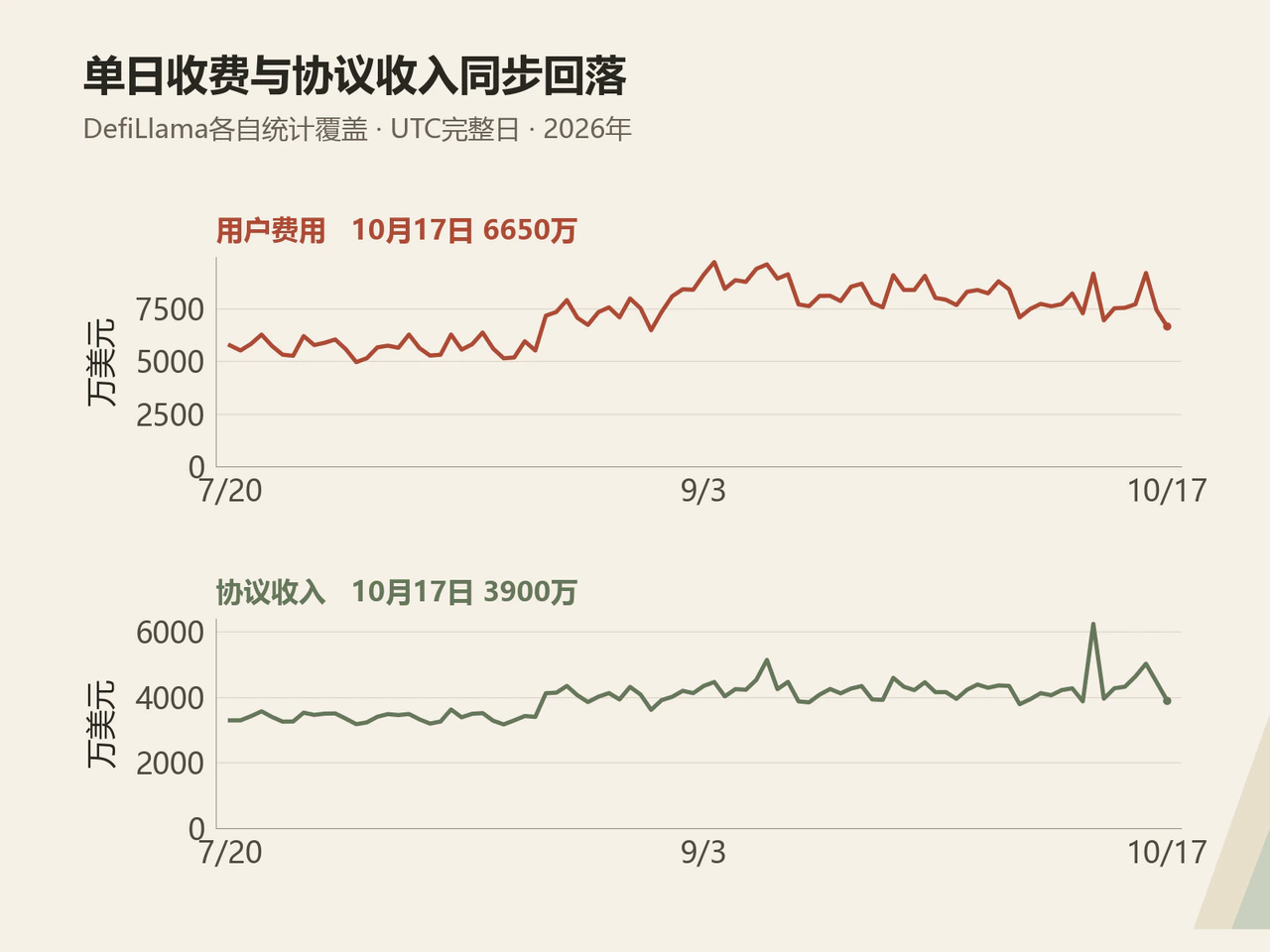
Fees declined with the daily cooling in activity, but weekly revenue retained by protocols was stable. In DefiLlama's statistics covering DEXs, lending, stablecoins and other businesses—the fee and revenue overviews cover different numbers of protocols—industry-wide on-chain fees, meaning total payments by users, were $66.50 million on October 17, down 10.5% from the previous day. Protocol revenue, the portion retained after liquidity-provider shares for treasuries, teams or token-holder distributions rather than net profit, totaled $39.00 million, down 12.6%. Over the latest seven complete days, daily average fees were $75.61 million, about 4.0% below the preceding seven days, while daily average protocol revenue was $43.63 million, essentially unchanged. Slightly higher weekly DEX volume alongside modestly lower total fees and flat protocol revenue shows that changes in the mix of businesses with different fee rates and revenue-sharing mechanisms directly affect retained income. Trading volume alone can no longer be used to extrapolate actual protocol revenue linearly.
Solana applications earn $193 million over 30 days; RWA and stablecoins extend further into lending
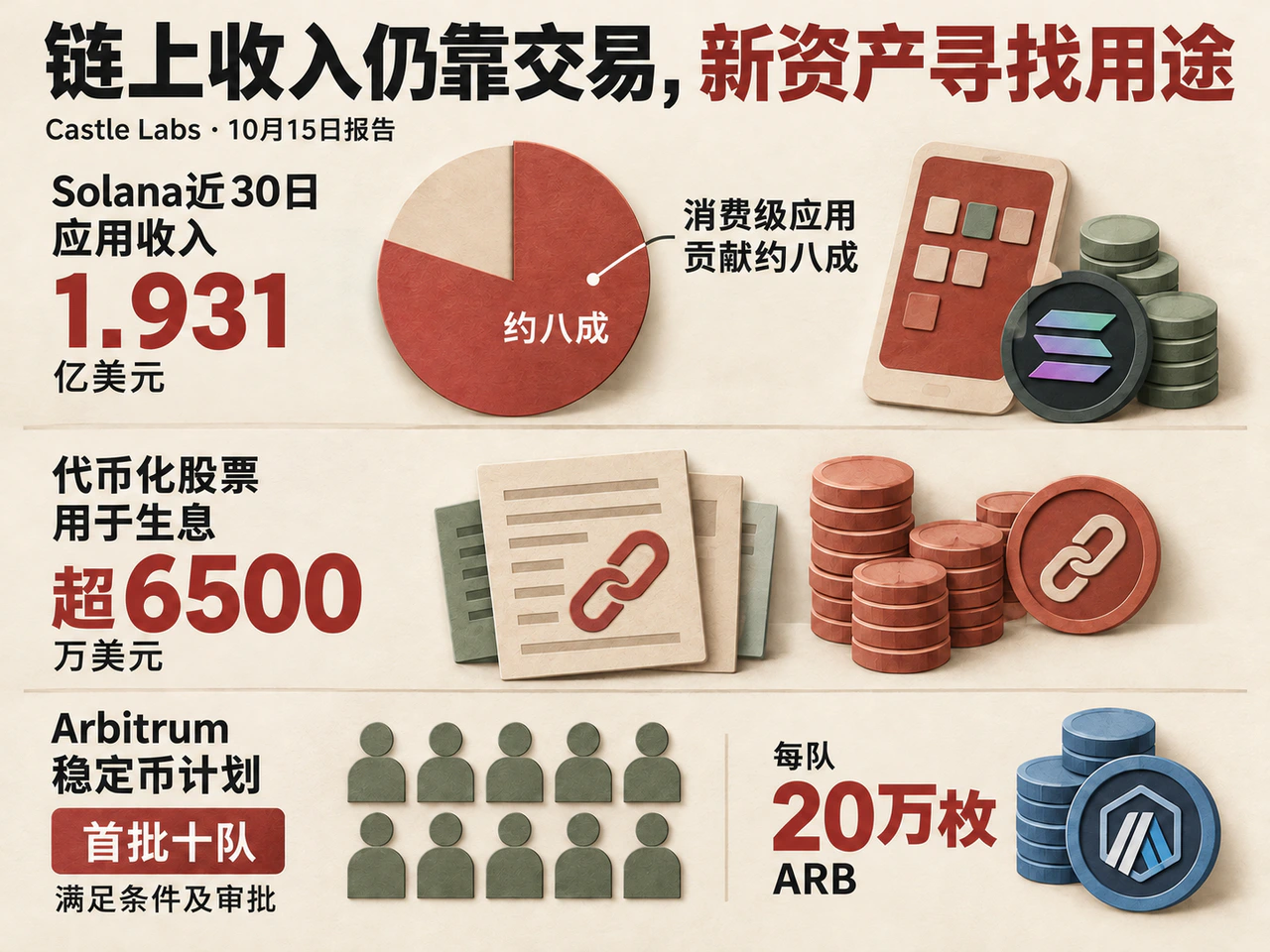
Looking at application-layer revenue, leading ecosystems still depend heavily on trading. According to Castle Labs' October 15 research report and follow-up media reports on October 17, Solana applications generated $193.1 million over the preceding 30 days on a rolling application-revenue basis, distinct from daily fees on the underlying blockchain. This exceeded Hyperliquid's $86.5 million and Ethereum's $53.8 million.
The report estimated that consumer applications such as token-launch platforms, trading terminals and collectibles contributed around 80% of Solana's application revenue. Leading applications therefore have substantial fee-generating capacity, but their performance remains closely tied to users' appetite for trading. As asset-issuance gateways expand into trading platforms and wallets evolve into trading terminals, front-end applications capture more stages of the trading process, concentrating revenue competition further at the application layer. How increased on-chain usage feeds into the value of native blockchain tokens still depends on base-layer fees, token burns, staking mechanisms and applications' own distribution rules.
Meanwhile, RWA are expanding the range of assets available for use on-chain. Castle Labs' October 15 report recorded more than $65 million in tokenized equities on Solana deployed in yield-generating uses, mainly through xStocks in lending markets such as Kamino and Jupiter Lend. Bringing these assets into collateral systems can increase on-chain borrowing demand and provide interest income for depositors. The durability of these activities depends on the alignment of collateral yields, borrowing costs and risk-management constraints.
Layer-2 networks are also competing to provide use cases for incremental assets. According to follow-up reporting on October 17, Arbitrum launched its Stablecoin Growth Initiative on October 15, covering lending, trading pools, payments and other products. Eligible protocols can apply to adopt USDG as a primary stablecoin. The first ten teams to achieve $10 million in USDG total value locked on a 30-day average basis can each receive 200,000 ARB, subject to foundation approval and review of the terms. The aim is to turn static stablecoin balances into sustained use within applications.
Overall, token subsidies can lower the initial cost of bringing new assets and use cases to market, but substantive operational improvement must show up in retained funds after incentives end, genuine borrowing demand and fee-paying transactions. On-chain trading has already attained meaningful scale, while payments and RWA continue adding asset types and uses. The most informative subsequent measure is whether these new uses produce more stable protocol and application revenue, reducing the on-chain economy's dependence on short-lived trading enthusiasm.
Click 'Read original' for full details.