Regulatory developments and institutional cases disclosed on October 16–17 showed U.S. stablecoin regulation moving from legislation toward implementing rules, while banks and payment firms in Japan and Hong Kong focused on testing cross-border corporate settlement and merchant acquiring. Whether digital assets enter mainstream money flows depends both on how regulation defines issuance and reserves and on whether compliant products fit seamlessly into existing accounts and settlement systems.
OCC expects final stablecoin rules by end-October, coordinating business boundaries with the FDIC
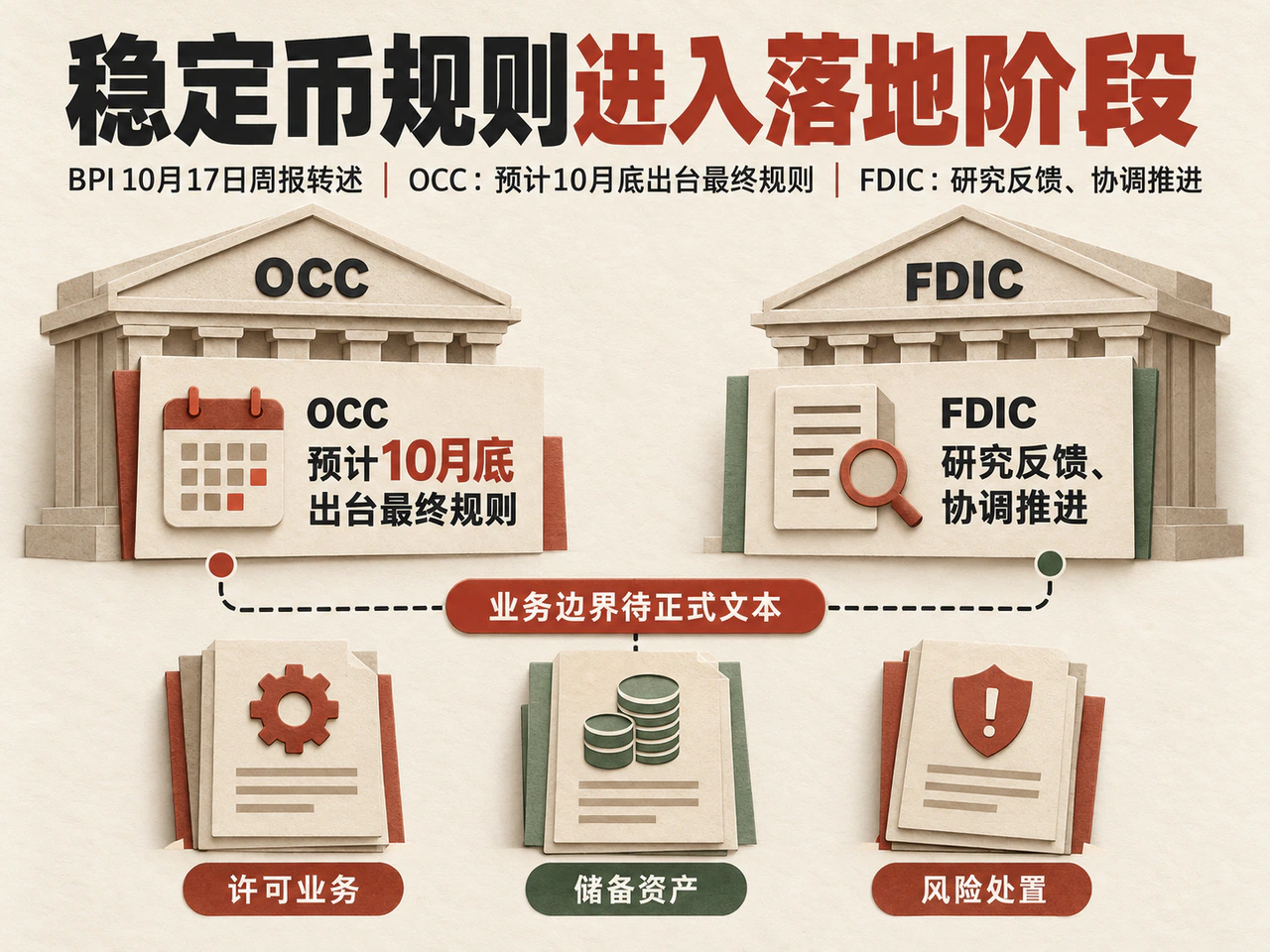
According to the Bank Policy Institute's October 17 weekly report, FDIC Chairman Travis Hill told DC Fintech Week that the agency was reviewing public feedback on issuers' permitted activities, reserve requirements, resolution arrangements and tokenized deposits as it developed final GENIUS Act rules. BPI also relayed OCC Comptroller Jonathan Gould's comments that week that the OCC expected to issue relevant final rules by the end of October. Hill said the FDIC was coordinating closely with the OCC while advancing several rulemakings in parallel.
These details directly affect issuers' business models and compliance costs. Reserve requirements determine investment flexibility and liquidity management; permitted activities define whether issuance can be combined with other banking business; resolution arrangements establish how holders recover funds if an issuer encounters distress. Consistent standards across issuance, custody, reserve management and payment access would help banks and payment firms allocate responsibilities and design products. Actual operating boundaries still awaited the formal rule texts.
Japan's three major banks complete a cross-border settlement trial; Hong Kong implements an HKDAP merchant payment
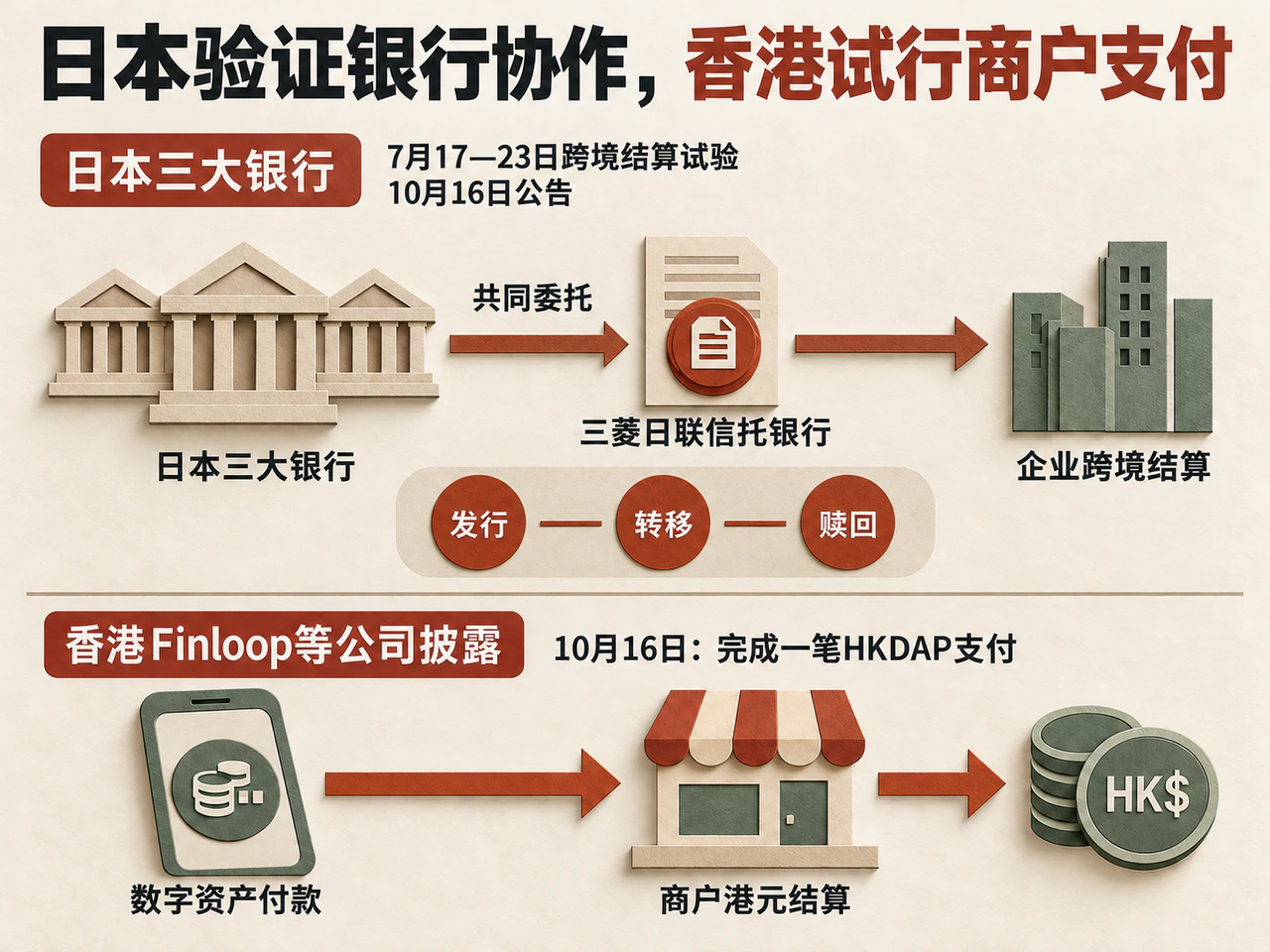
Operationally, Japanese banks conducted end-to-end tests of joint bank issuance and cross-border corporate settlement. Industry follow-up reporting on October 17 and the partners' original October 16 announcement said MUFG Bank, Mizuho Bank and Sumitomo Mitsui Banking Corporation completed a joint stablecoin trial on July 17–23. The scenario was cross-border intragroup settlement between Mitsubishi Corporation's Japanese headquarters and overseas locations.
The announcement described a trust structure jointly commissioned by the three banks, with Mitsubishi UFJ Trust and Banking Corporation as trustee. Trust assets were held and managed as bank deposits, and circulation was restricted to users who had completed bank know-your-customer checks. The trial verified the full issuance, on-chain transfer and redemption cycle, along with division of responsibilities, anti-money-laundering compliance and system integration across multiple banks. Joint issuance helps connect customer networks but also requires common back-office and responsibility standards. Participants were still assessing commercialization conditions and, under their earlier plan, studying the start of live transactions in fiscal 2026.
Hong Kong, meanwhile, produced a payment case involving an end merchant. Finloop announced on October 16 that its Finloop Finance subsidiary, licensed stablecoin issuer Anchorpoint and mobile-payment provider QFPay HK had completed a payment using the Hong Kong dollar stablecoin HKDAP. The disclosed solution allows consumers to pay with HKDAP and other compliant digital assets while retaining merchants' existing Hong Kong dollar settlement process.
Payment and technology providers handle conversion and liquidity connections in the background, allowing merchants to retain their existing Hong Kong dollar collection and reconciliation practices. This lowers the operating threshold for accepting a new payment instrument. A single successful transaction is only a starting point, however. A sustainable business model still depends on repeat usage, merchant coverage and actual settlement costs.
From U.S. GENIUS implementing rules to Japan's interbank cross-border trials and Hong Kong's merchant-acquiring tests, the central industry task is becoming end-to-end integration of issuance, compliance, conversion and fiat settlement. The precision of regulatory implementation and the efficiency of payment settlement will jointly determine stablecoins' actual penetration of corporate cash management and everyday commercial payments.
Click Read Original for more details.