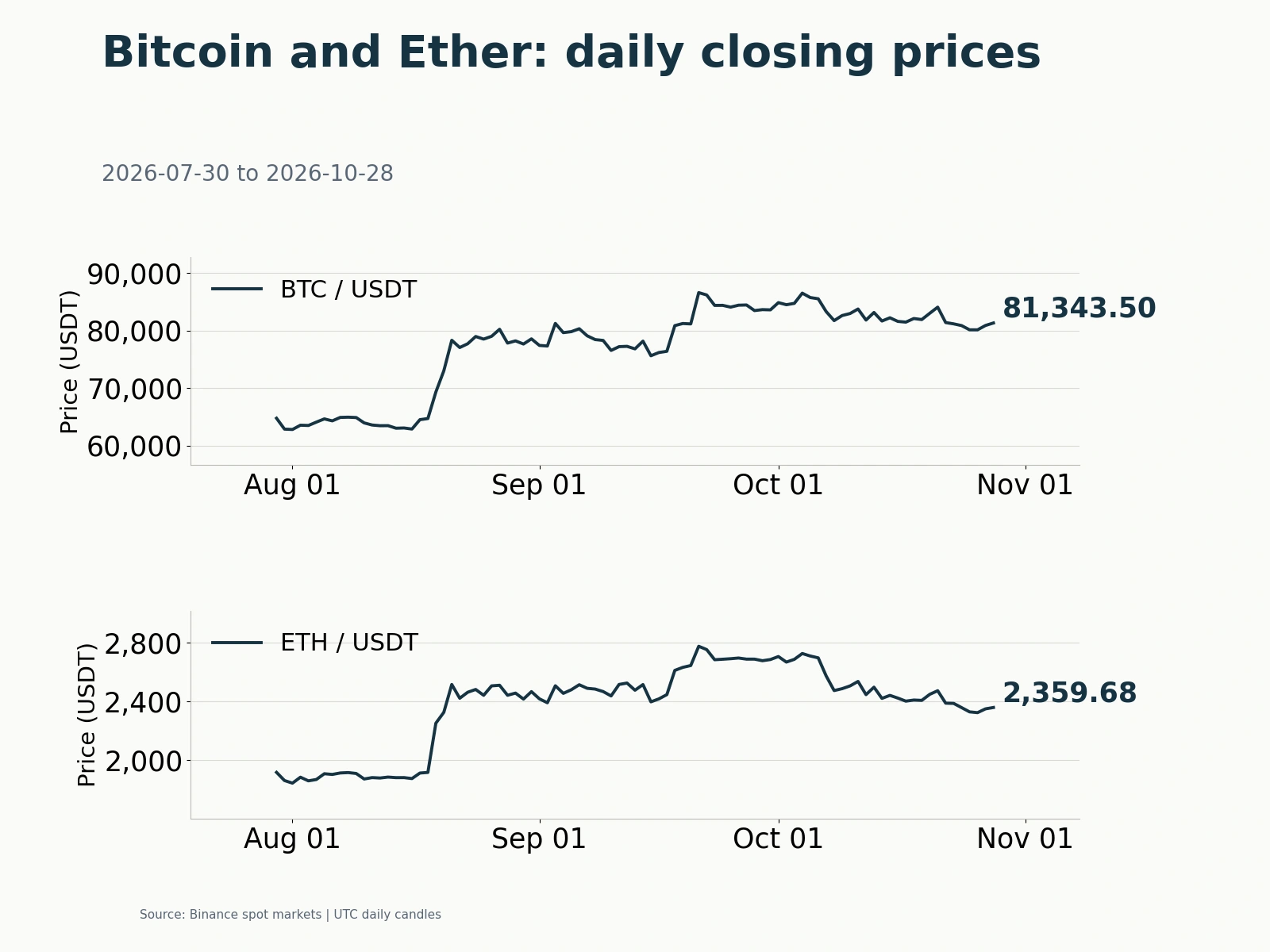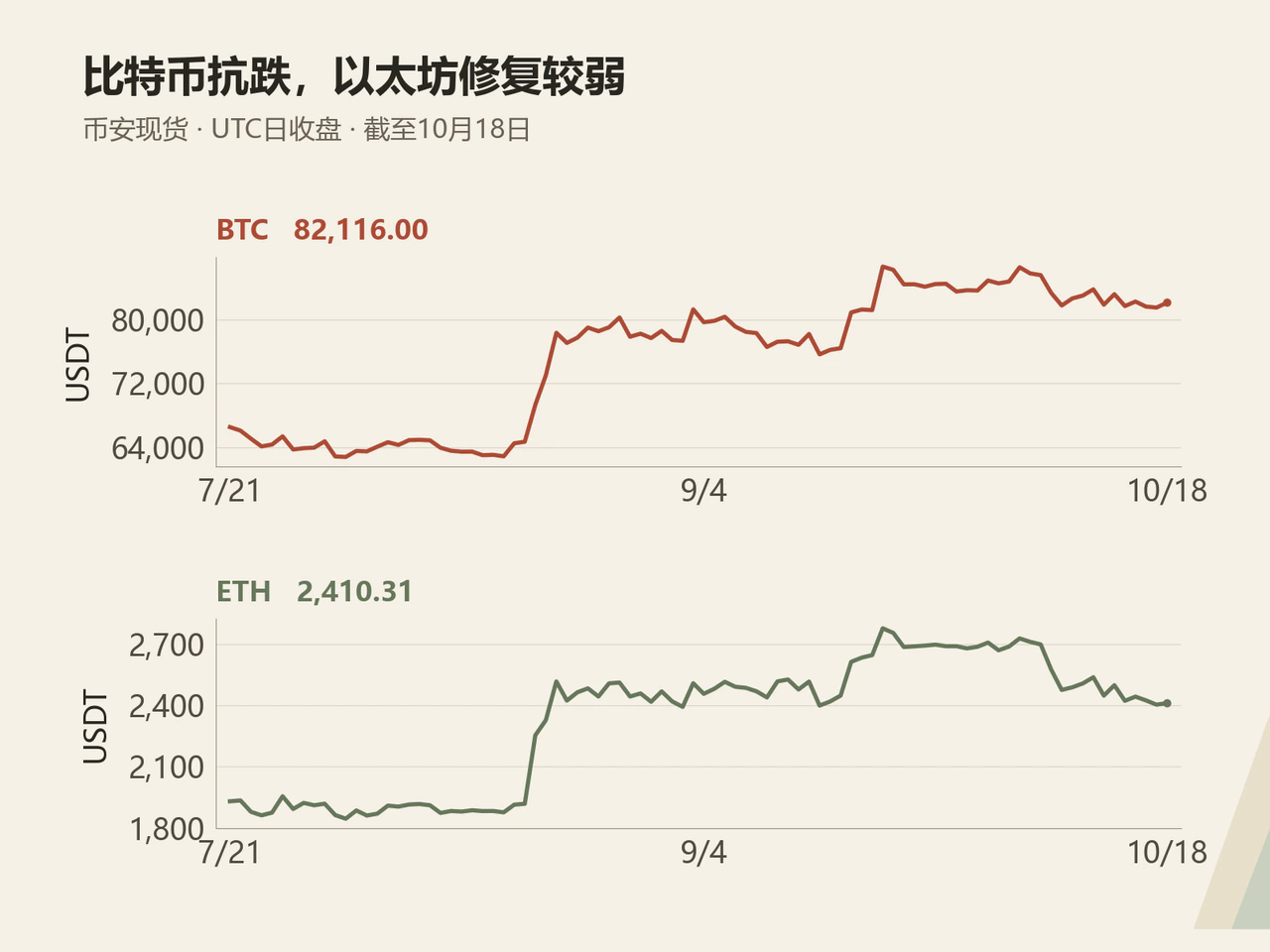
Based on Binance spot USDT prices and UTC daily candles, last week—seven complete trading days from October 12 to 18, closing at 08:00 Beijing time on October 19—Bitcoin finished at 82,116 USDT, down a modest 1.98% for the week while holding the 80,000 threshold. Ether closed at 2,410.31 USDT, down 4.99%. Nine of the fixed sample of ten highly liquid major coins declined, with TRX the only gainer. An upside US inflation surprise revived interest-rate concerns, while a pullback in US technology stocks dampened risk appetite and reinforced defensive positioning. Bitcoin remained relatively resilient, while other major coins generally underwent larger corrections.
Above-forecast US September CPI interrupts the rebound; Bitcoin stabilizes after testing 79,800 USDT
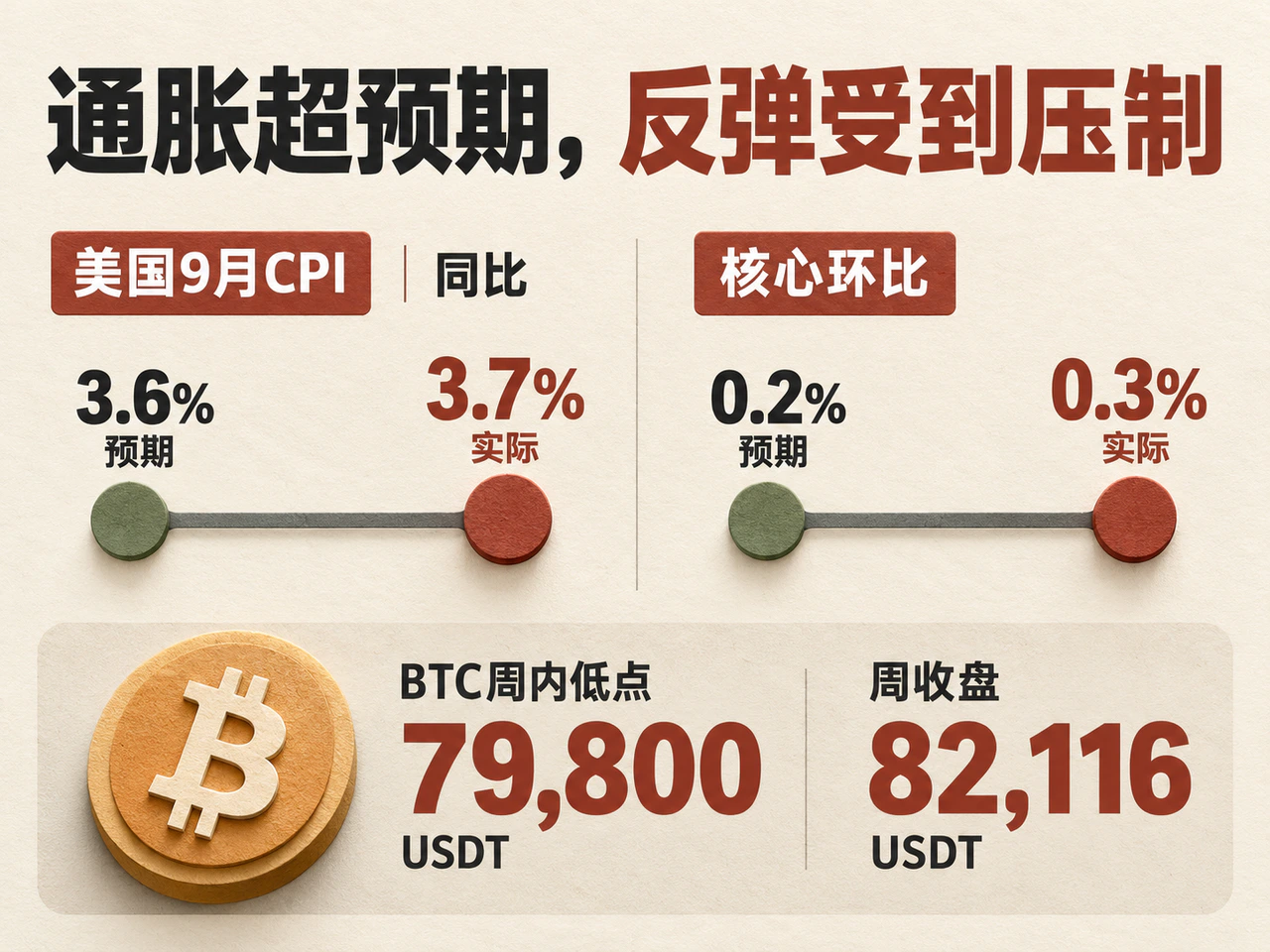
Bitcoin's week saw several reversals. It fell 2.30% on Monday, rebounded 1.61% on Tuesday and declined 1.79% on Wednesday. On Thursday it briefly touched the weekly low of 79,800 USDT before recovering quickly to close at 82,245.93. Weakness returned on Friday and Saturday. Despite Sunday's 0.77% gain, the weekly close remained below the previous weekend's 83,773.12 USDT. Ether reached a weekly low of 2,318 USDT; Sunday's recovery still left its weekly loss near 5%.
US inflation was the key variable interrupting the early-week rebound. September CPI, released October 14, rose 3.7% year on year versus an expected 3.6%. Core CPI rose 0.3% month on month, also exceeding the 0.2% forecast. CoinDesk and Nexo reported that day that Treasury yields rose after the release and Bitcoin came under pressure. Nexo researcher Iliya Kalchev said the failure of core inflation to cool as expected deepened concerns that energy costs were spreading to other prices. Although the surprise was only 0.1 percentage point, it was enough to reverse trades betting on a Fed pause and reprice the policy path across stocks, bonds and crypto. Persistent high-rate expectations both raised the opportunity cost of non-interest-bearing assets and constrained borrowed financing and position expansion.
Friday brought additional external pressure from rising oil and falling technology shares. CoinDesk reported that crude rose during US trading, the Nasdaq closed about 2.15% lower and the VIX increased sharply. Bitcoin followed equities lower intraday but did not keep extending its losses alongside technology stocks. Saturday's and Sunday's candle lows of 80,819.66 and 80,684.36 USDT were both above Thursday's low, indicating buying support above 80,000.
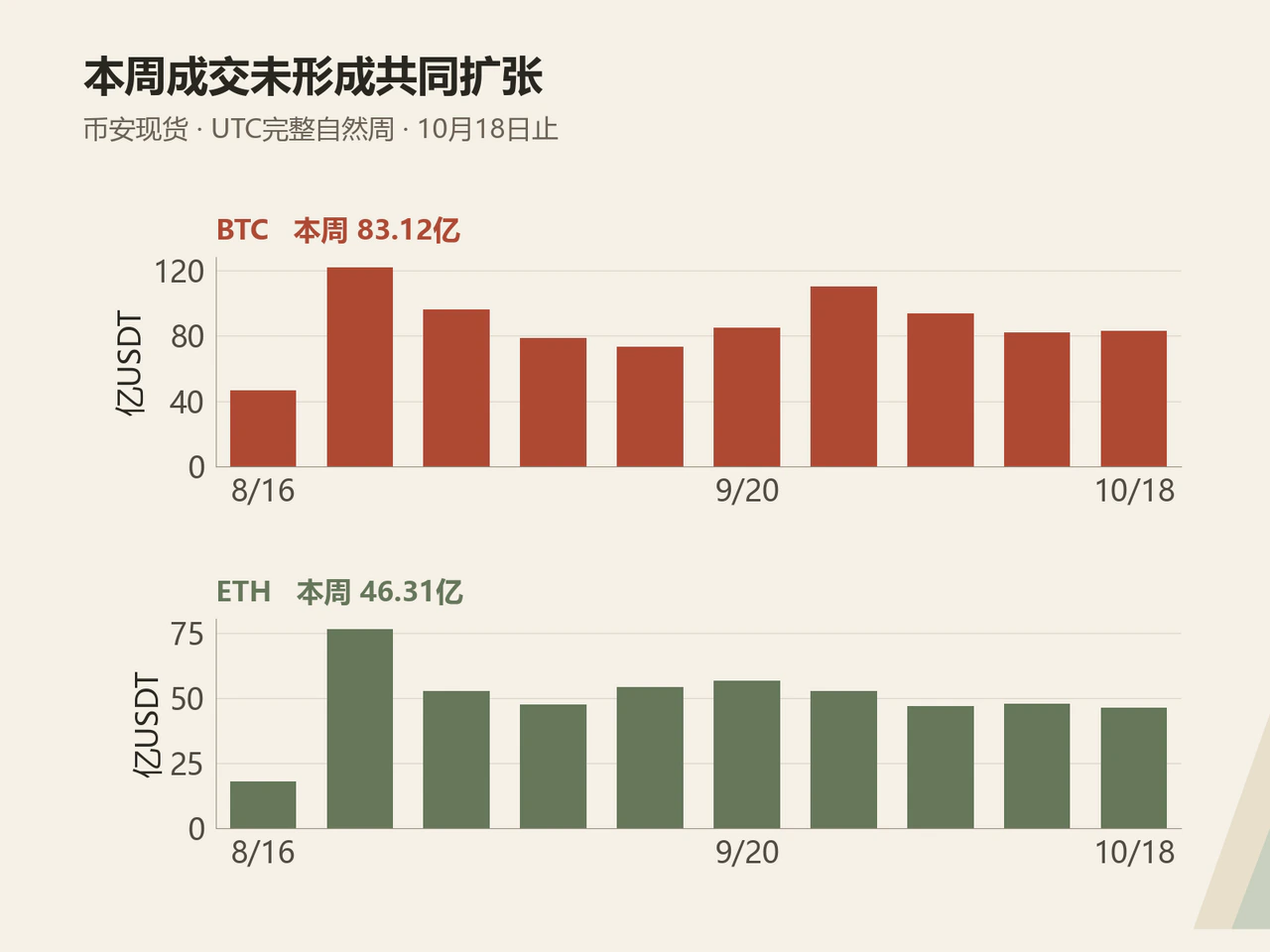
Turnover reinforced this pattern. Weekly Binance Bitcoin spot turnover was 8.312 billion USDT, only 1.21% above the previous week, while Ether turnover was 4.631 billion USDT, down 3.27%. Both coins recorded their week's peak turnover on Thursday's sharp fall and recovery, without sustained volume expansion afterward. Current support thus mainly reflected buying near the bottom of the trading range; broad incremental demand still required confirmation from volume and market breadth.
ETH/BTC falls 3.07% for the week; technical upgrades cannot offset rate pressure amid broad major-coin losses
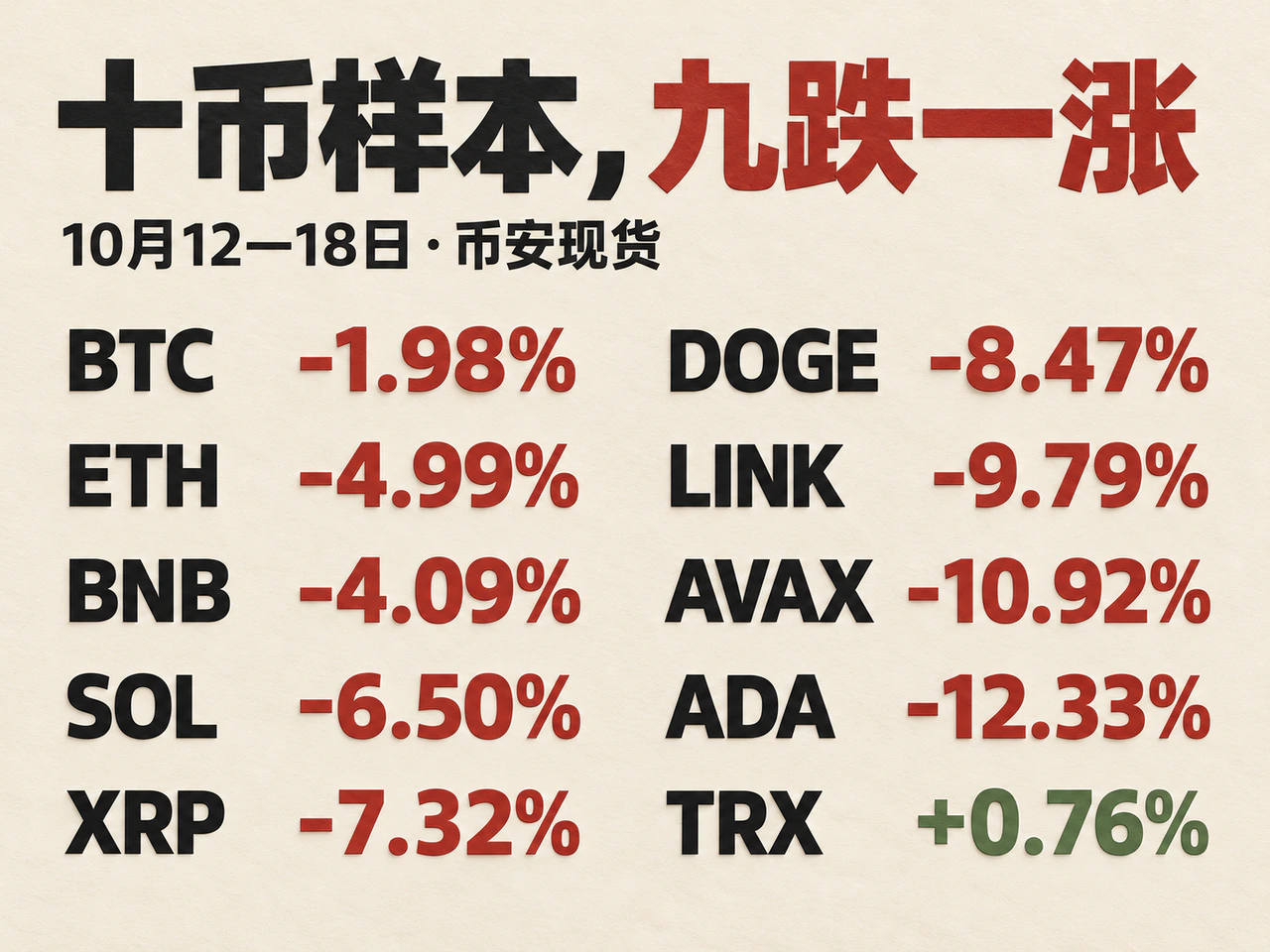
Across assets, adjustment pressure was much greater than for Bitcoin. In the ten-coin Binance spot USDT sample, excluding stablecoins and duplicate wrapped assets, only TRX rose, by 0.76%. All others declined: BNB 4.09%, SOL 6.50%, XRP 7.32%, DOGE 8.47%, LINK 9.79%, AVAX 10.92% and ADA 12.33%.
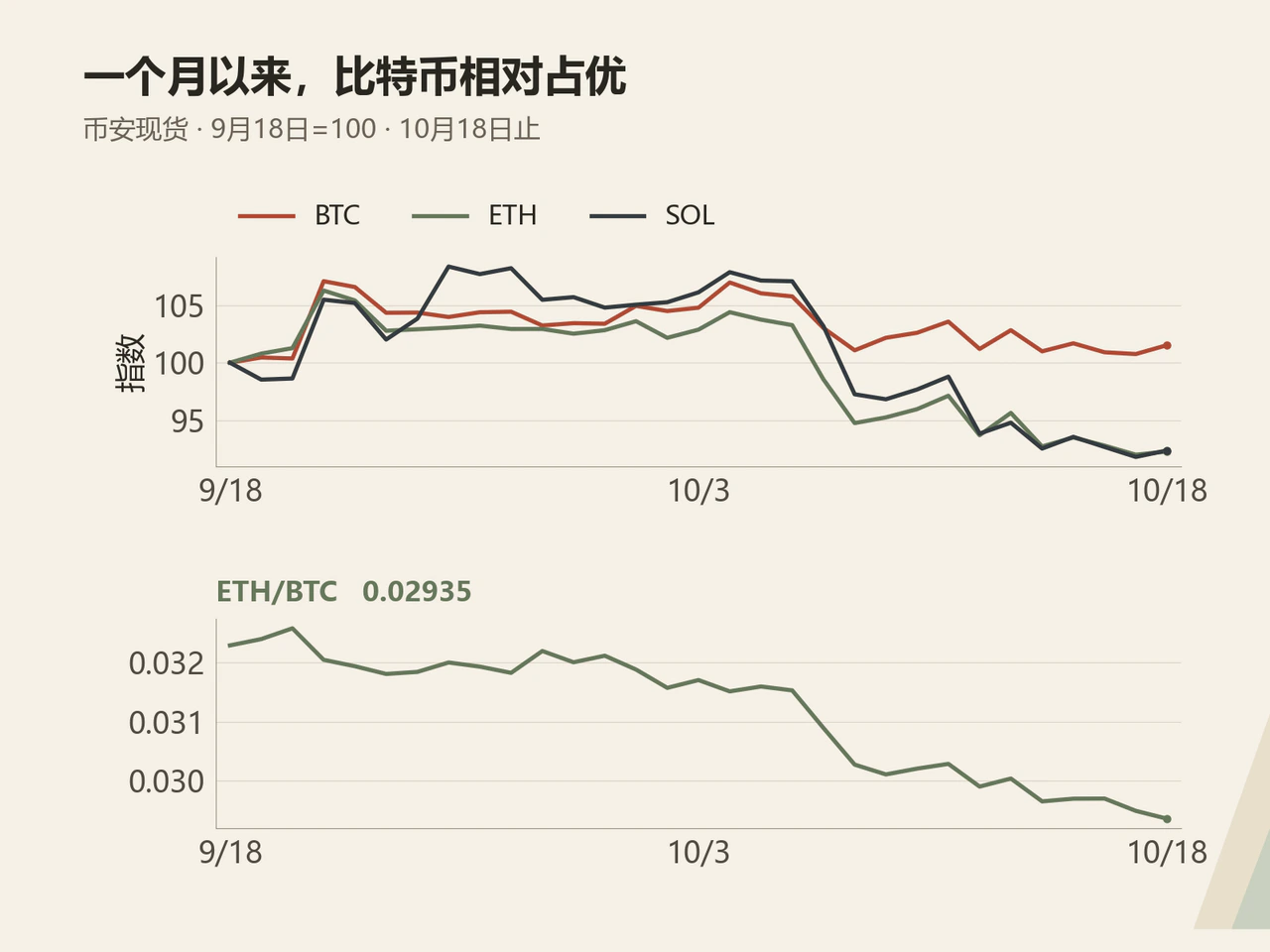
Ether's weakness relative to Bitcoin continued. Using same-day closing prices, ETH/BTC fell from about 0.03028 at the initial weekly comparison base to 0.02935, a weekly decline of about 3.07%. Over 30 days, Bitcoin gained 1.52% while Ether fell 7.73%, showing higher risk discounts on assets carrying more expectations of platform growth. CoinDesk's October 15 intraday report likewise showed only 6 CoinDesk 100 constituents rising and smaller-coin indices falling more than large-coin indices. Bitcoin's stabilization near 80,000 USDT had not spread into broad market recovery.
When rates and risk appetite dominate pricing, progress on an individual project's technology struggles to offset valuation pressure. Solana announced its Alpenglow upgrade schedule this week, with a transition planned for October 21 and a target finality time of about 150 milliseconds to reduce waits for payment and cross-chain applications. SOL nevertheless fell 6.50% over the week. Underlying performance improvements still require successful implementation, application adoption and conversion into economic returns, making them unlikely to offset macro tightening in the short term.
Institutional outlooks also focused on the contest between long-term demand and short-term funding costs. CoinDesk reported on October 18 that Bitwise research head Ryan Rasmussen expected institutional adoption and demand for hard assets to push Bitcoin above $100,000 again by year-end. LO:TECH research head Adam Morgan McCarthy offered a year-end range of $85,000–$95,000, arguing inflation and rate-hike risks would cap gains. CoinShares research head James Butterfill stressed that sustained breakout required buyers' capital to return. This week's trading showed Bitcoin's resilience, but also broad major-coin declines, a continuing ETH/BTC fall and no parallel expansion in turnover. Whether oil and rates ease external pressure, and whether recovering flows spread from Bitcoin into Ether and other major coins, will provide a better test of market strength than any single round-number threshold.
Click Read Original for full details.