From October 12–18, U.S. digital-asset regulation and payment-infrastructure acquisitions advanced together. The Commodity Futures Trading Commission (CFTC) formally published its crypto retail-trading rulemaking notice in the Federal Register, addressing platform responsibilities across trading, financing and clearing. Polygon completed its acquisition of Coinme, incorporating U.S. state money-transmitter licenses into an on-chain payments system. As derivatives regulation becomes more detailed and fiat channels consolidate, competition and compliance are extending from on-chain trading capabilities to the full chain of funding access, asset custody and fiat redemption.
CFTC consults on retail leveraged trading; at least four platforms plan securities perpetual futures this quarter
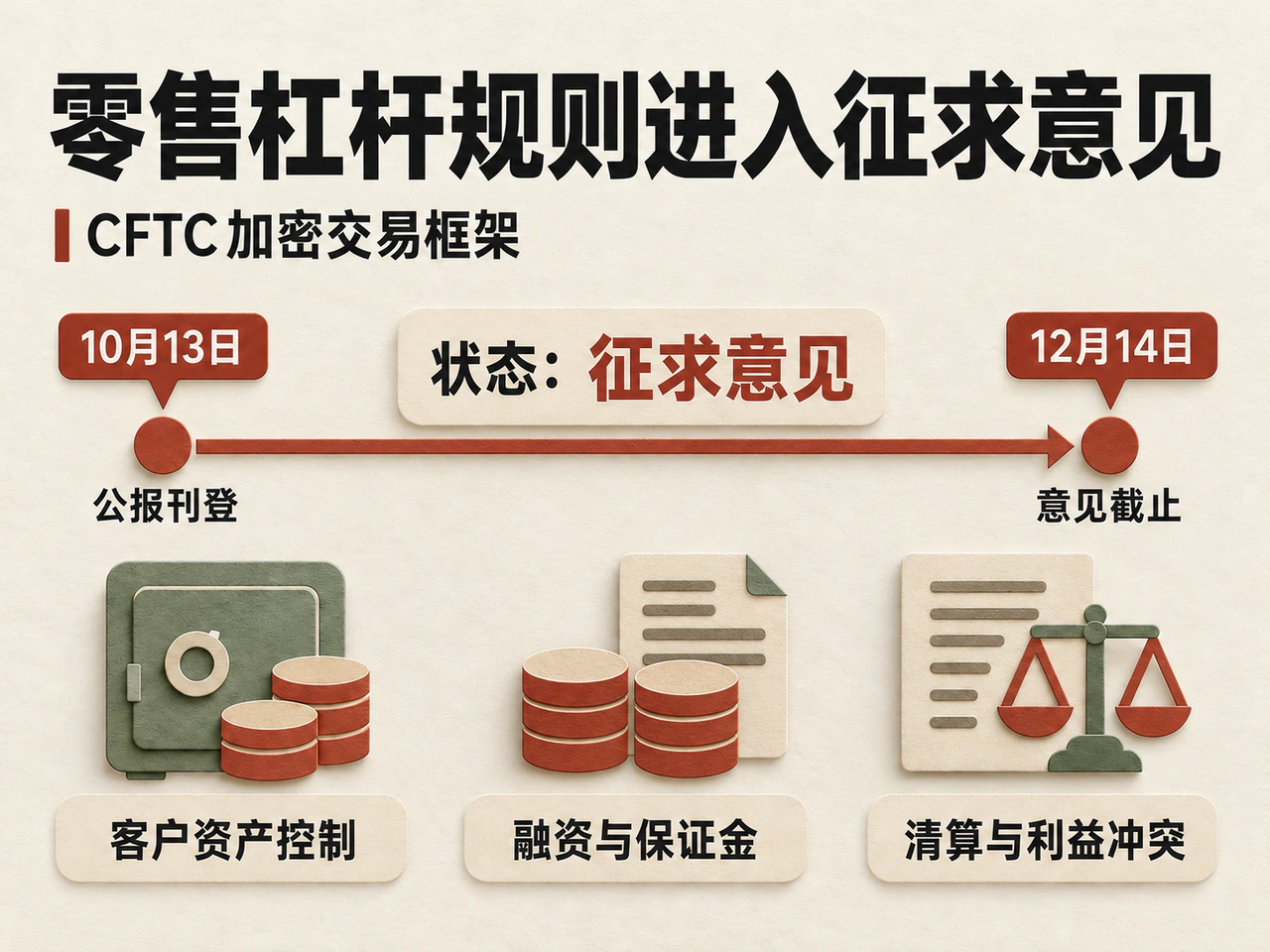
On October 13, the CFTC's advance notice of proposed rulemaking on crypto asset transactions and crypto asset markets was formally published in the Federal Register, following its October 5 announcement and initiating public consultation. The comment deadline is December 14.
The framework centers on Section 2(c)(2)(D) of the existing Commodity Exchange Act, targeting crypto transactions offered to retail customers with leverage, margin or financing. The CFTC plans to assess a dedicated registration category for crypto asset markets and seeks comments on intermediaries, clearing, margin requirements and conflicts of interest. Platforms providing financing would therefore need to specify three core mechanisms: who actually controls customer assets, who bears credit-default risk and how forced-liquidation rules operate.
If implemented, these arrangements could allow some platforms to conduct retail leveraged business within a unified federal framework. Unleveraged spot transactions involving actual delivery would remain subject to different regulatory jurisdictions, making business-model choices directly relevant to customer protections and compliance costs. The key next steps are how public comments become enforceable rules and whether trading, financing and clearing functions can achieve effective risk separation within the same business system.
Exchange-traded derivatives were also extending into traditional securities. On October 14, SEC Division of Trading and Markets Director Jamie Selway said five CFTC-registered markets—Coinbase, Kalshi, Bitnomial, NADEX and ICE Futures—had filed notice registrations as securities futures exchanges in September, with at least four expected to launch securities perpetual futures that quarter. The perpetual-contract mechanism established in crypto markets was being introduced more rapidly into regulated securities derivatives.
Polygon's Coinme deal connects payment channels in 48 states; OCC examines large-bank access for crypto businesses
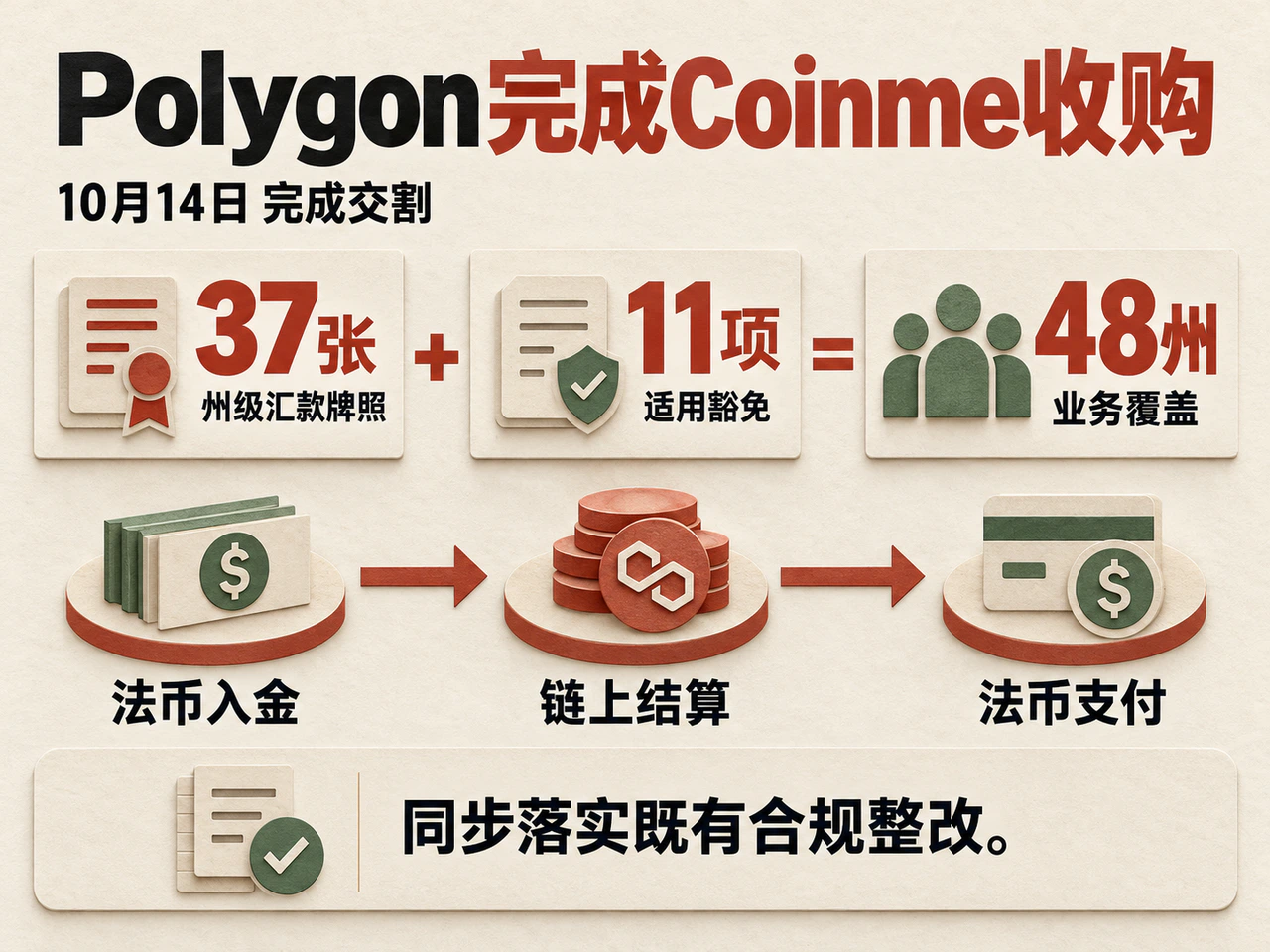
On October 14, Polygon announced the completion of its Coinme acquisition. According to the company, its U.S. payments business thereby obtained 37 state money-transmitter licenses and 11 applicable exemptions, covering 48 states, together with FinCEN money-services-business registration. These permissions allow Polygon's Open Money Stack payments architecture to connect bank transfers, cards and cash funding with wallets, on-chain settlement and fiat payments.
The company said Tazapay, Mesh, Toku and Kira were among the first institutions to connect, with uses spanning cross-border business payments, account funding, global payroll and dollar services. Combining fiat on- and off-ramps with on-chain settlement in one service can reduce the compliance and operational complexity of corporate clients connecting separately to licensed channels. Commercial success will depend on customer retention, settlement efficiency and recurring revenue.
The acquisition of licenses also brings existing remediation obligations. On October 8, regulators from 34 U.S. states had reached a $2.5 million settlement with Coinme over Bank Secrecy Act and anti-money-laundering violations. Under the agreement, Coinme must hire an independent consultant to review its AML system and exit the crypto-kiosk business by January 1, 2027, or face an additional $4 million penalty. Polygon therefore needs to complete the required legacy-business divestment and internal-control remediation on schedule while integrating its payments operations.
At the banking-services interface, the Office of the Comptroller of the Currency (OCC) published a review of nine large national banks on October 14. It found restrictions on access to banking services for certain sectors, including digital assets, and said it would assess further regulatory changes. Bank accounts and fiat-clearing networks are foundational interfaces for stablecoin payments. Large-scale conversion of on-chain payments into everyday business activity depends on effective coordination between more detailed trading rules, payment providers' AML governance and improved commercial-bank access.
Click “Read the original” for full details.