As of the morning of October 19, Beijing time, a look back at October 12–18 showed the Hang Seng Index down just 0.10% for the week, closing at 24,186.83 on October 16. Behind that quiet weekly result, however, both the range of instruments and the structure of positions in Hong Kong's options market changed noticeably. HKEX announced 12 new stock-option classes with weekly contracts available at launch, extending short-dated instruments further into semiconductor and computing stocks and technology ETFs. Meanwhile, open interest in Hang Seng Index options rose 6.4% despite the week's fluctuations.
Looking only at the closing index level at the end of the week can understate the variation in hedging costs along the way. After reaching 24,345.22 on Tuesday, the Hang Seng fell to 24,062.72 on Thursday before recovering on Friday. Option-price movements and position adjustments unfolded around this intraweek path.
HKEX adds 12 stock-option classes, extending weekly contracts to 66 underlying securities
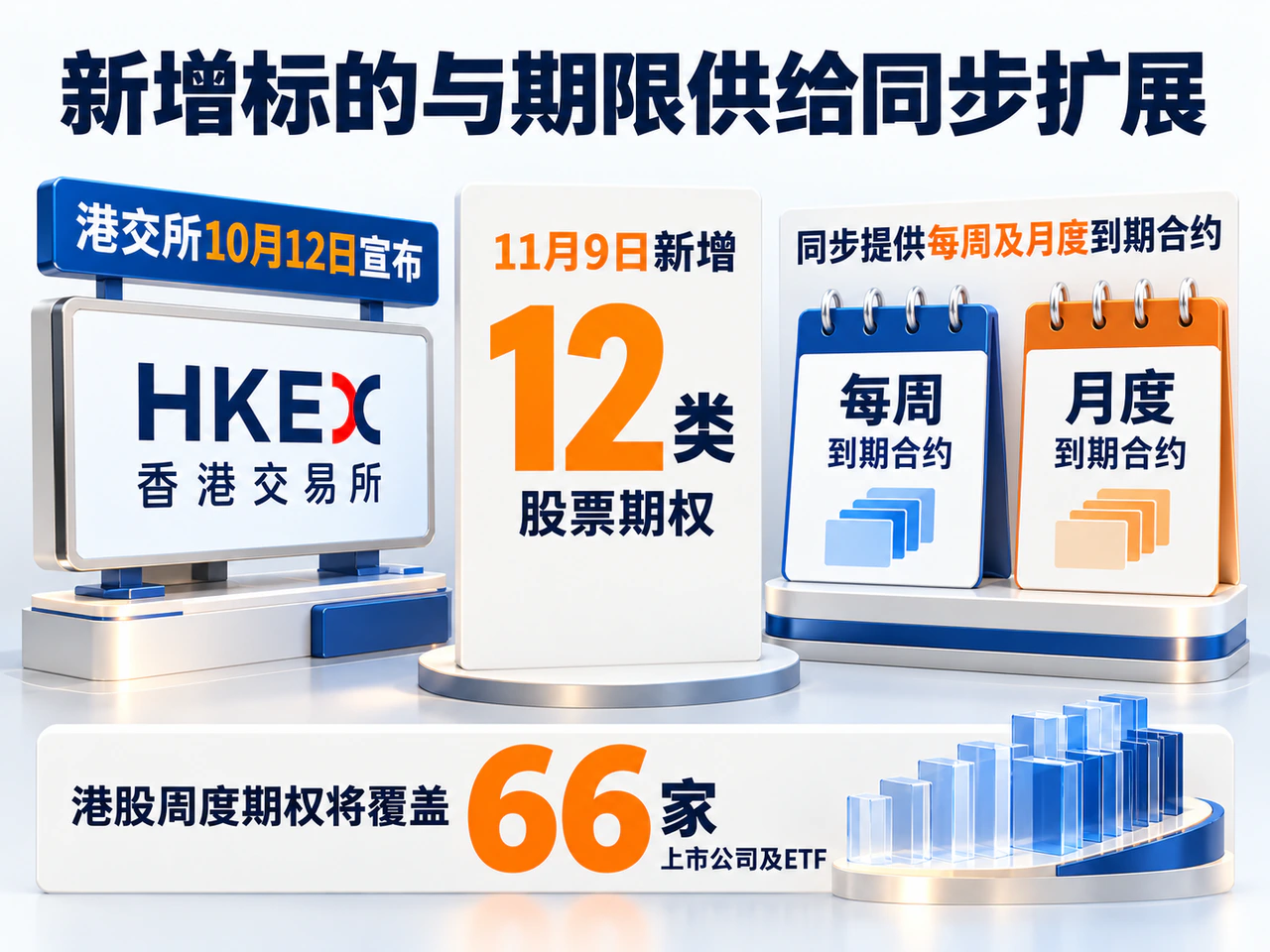
HKEX announced on October 12 that it would introduce 12 additional stock-option classes on November 9, covering semiconductor and computing-related companies including ASMPT, Kingboard Laminates, GigaDevice, Biren Technology, Cambridge Industries, Montage Technology and Iluvatar CoreX, as well as products including the CSOP Hang Seng TECH Index ETF. A defining feature of this expansion is that a full range of maturities will be available immediately: weekly and monthly expiries will be offered from the first trading day. The first tradable weekly expiry dates are November 13 and 20, alongside contracts for several monthly expiries.
A more granular maturity structure allows investors to match instruments to event windows. Investors managing positions around near-term corporate events can choose weekly contracts expiring close to the event, while medium- and long-term holders can continue to use deferred contracts. Because short-dated contracts generally become more sensitive to movements in the underlying as expiry approaches, weekly instruments also entail more frequent rolling and higher transaction costs. Including sector ETFs in the expansion also lets investors establish options positions directly on the technology sector as a whole, rather than using an individual company as a proxy.
The expansion of short-dated instruments builds on existing trading demand. HKEX reported average daily stock-option volume of 899,056 contracts in the first nine months of 2026, up 1.4% year on year and a record for the period. Since their launch in November 2024, weekly stock options have traded more than 51 million contracts, representing around 20% of turnover in the relevant stock-option products. Following this expansion, Hong Kong weekly options will cover 66 listed companies and ETFs. Since individual-stock options, ETF options and Hang Seng Index options differ in underlying assets, contract multipliers and settlement arrangements, contract counts alone cannot directly compare their risk exposure.
Hang Seng falls 0.1% for the week while open interest rises 6.4%; put quotations fluctuate with the index
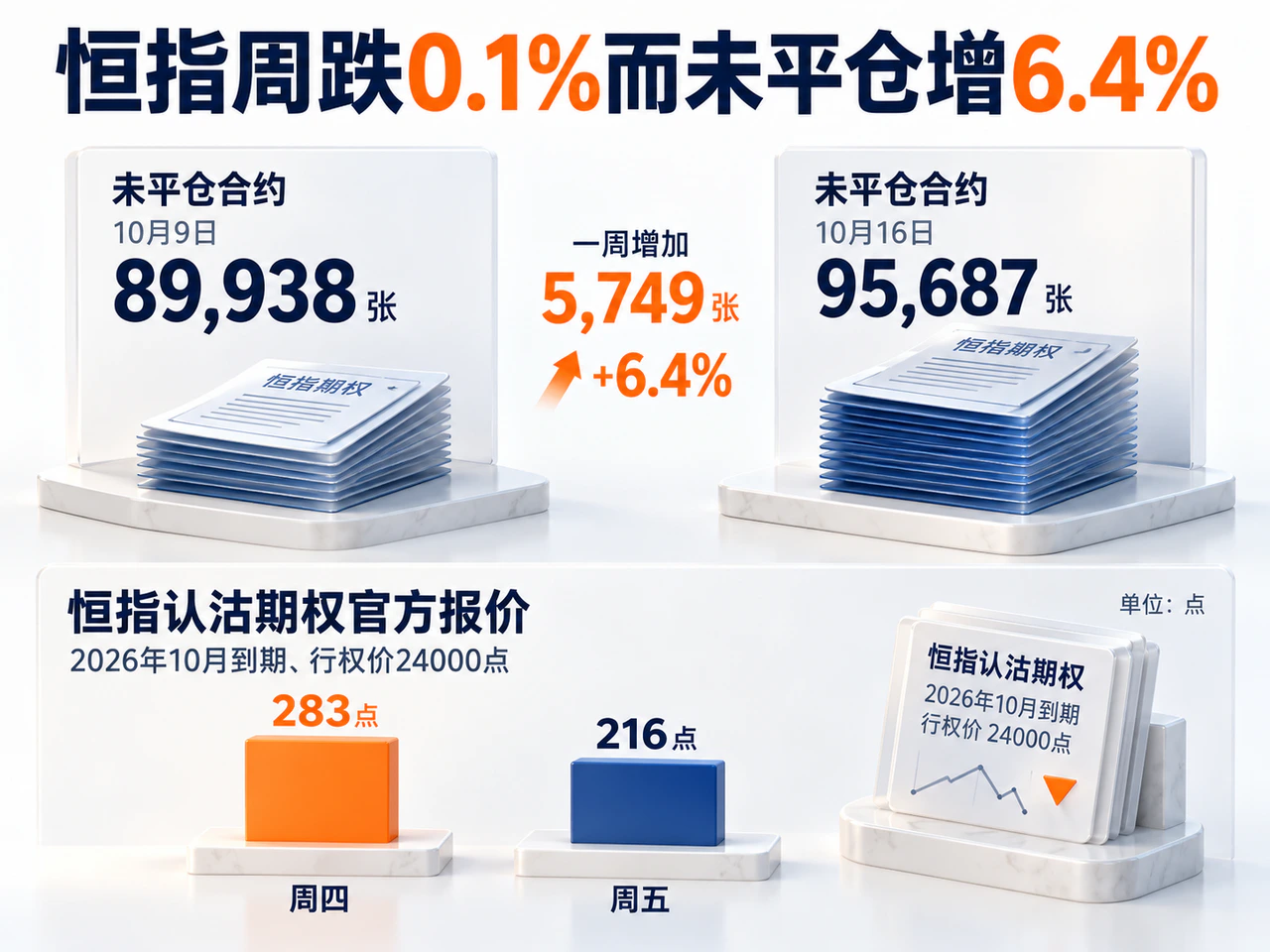
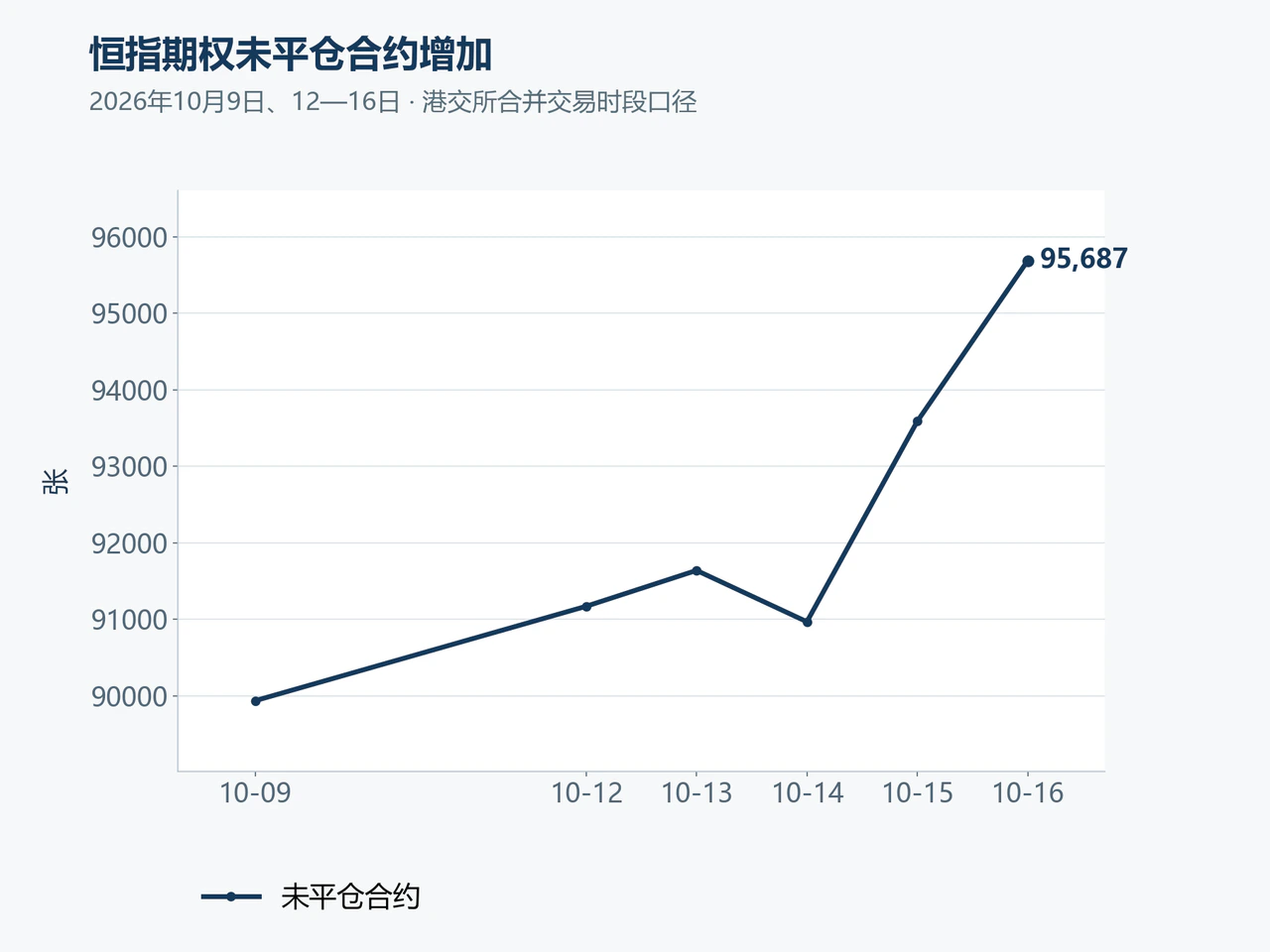
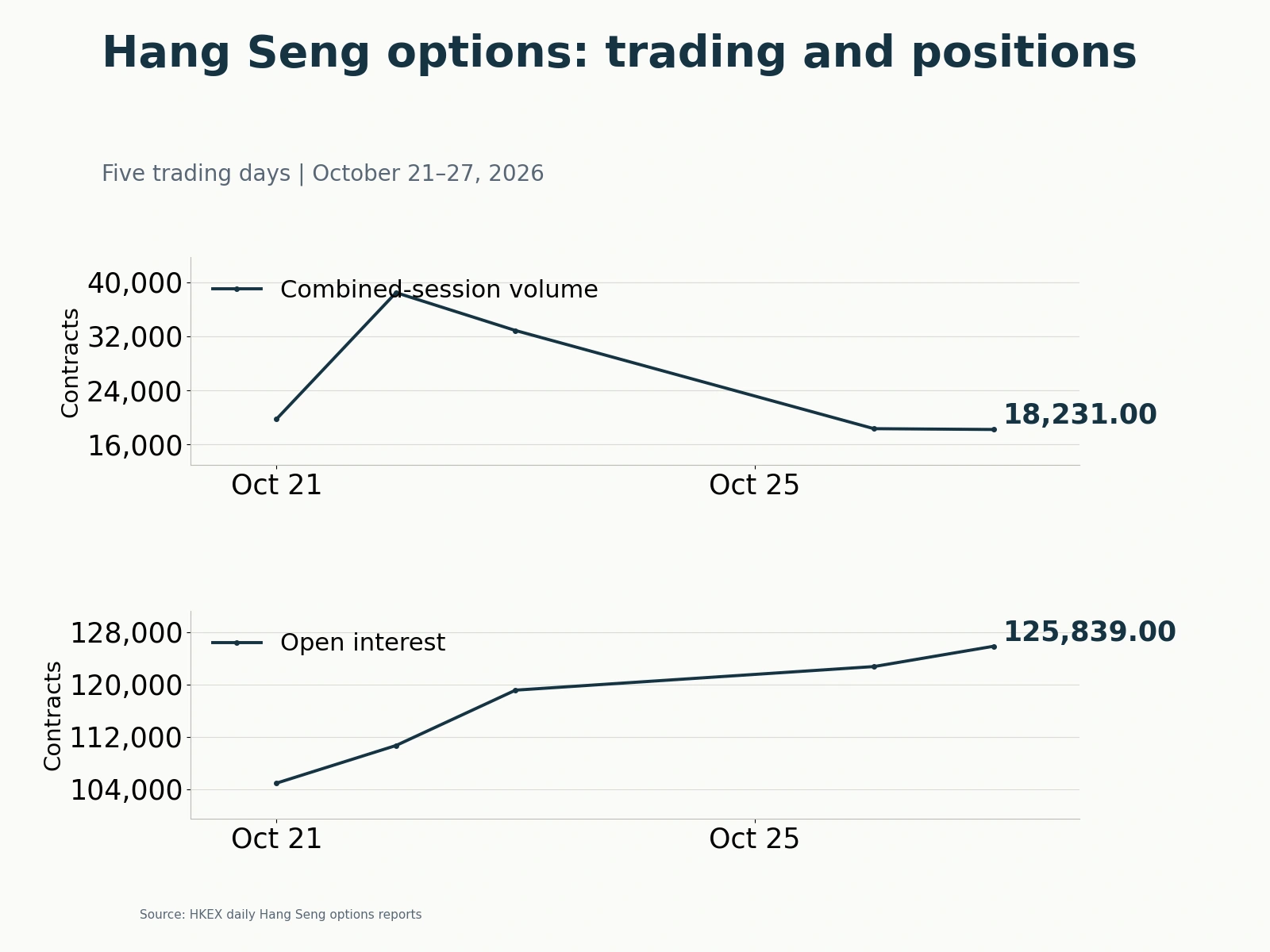
For index options, the combined-session figures in HKEX's daily Hang Seng Index options market reports show total volume of 63,668 contracts for October 12–16. Daily volume increased from 7,849 on Monday to 19,174 on Friday. Open interest rose from 89,938 contracts on October 9 to 95,687 on October 16, an increase of 5,749, or around 6.4%, over the week.
The index's nearly flat weekly close alongside increased open interest and trading activity suggests that existing positions were not comprehensively closed as the index returned to its starting level. The market retained exposure to subsequent price movements. Friday's active contracts also show that trading was not confined to one direction: the 24,600 call traded 1,919 contracts and had an official exchange quotation of 112 points, while the 23,800 put traded 912 contracts and had a quotation of 151 points. Activity at strikes on both sides of the market reflects the reallocation of strikes and maturities around the current range. New positions could include directional trades, protective hedges or combination strategies.
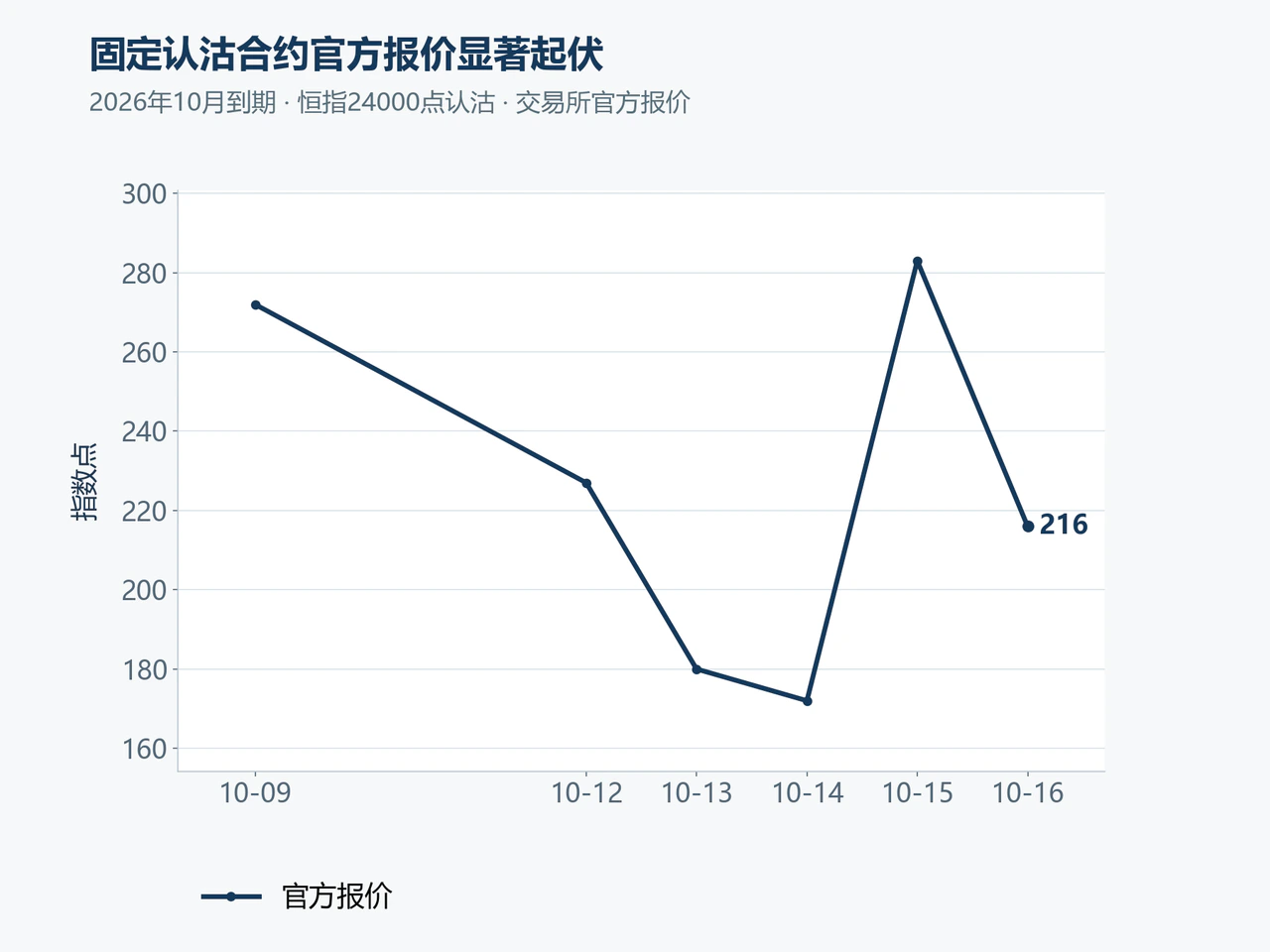
The weekly path of a specific contract illustrates more clearly how the spot index drives option prices. For the Hang Seng Index put expiring in October 2026 with a 24,000 strike, the official exchange quotation fell from 272 points the previous Friday to 227 on Monday, 180 on Tuesday and 172 on Wednesday. On Thursday, as the Hang Seng closed at 24,062.72, approaching the 24,000 threshold, the put jumped 111 points in a day to 283. It fell back to 216 on Friday as the index recovered.
Exchange reports show that this 24,000 put's implied volatility remained mainly between 15% and 16% during the week. With implied volatility relatively stable, the substantial premium swings primarily reflected changes in the distance between spot and strike and the shortening time to expiry, rather than a sudden shift in volatility expectations. These official quotations are suitable for comparisons on a consistent basis; actual execution costs still depend on intraday bids and offers. If the Hang Seng continues to move within its range, time decay will keep eroding short-dated contract prices. A breakout would instead rapidly amplify the price sensitivity of positions nearing expiry.
Covered-call ETF sells weekly calls against 98.4% of NAV; distributions and total returns diverge
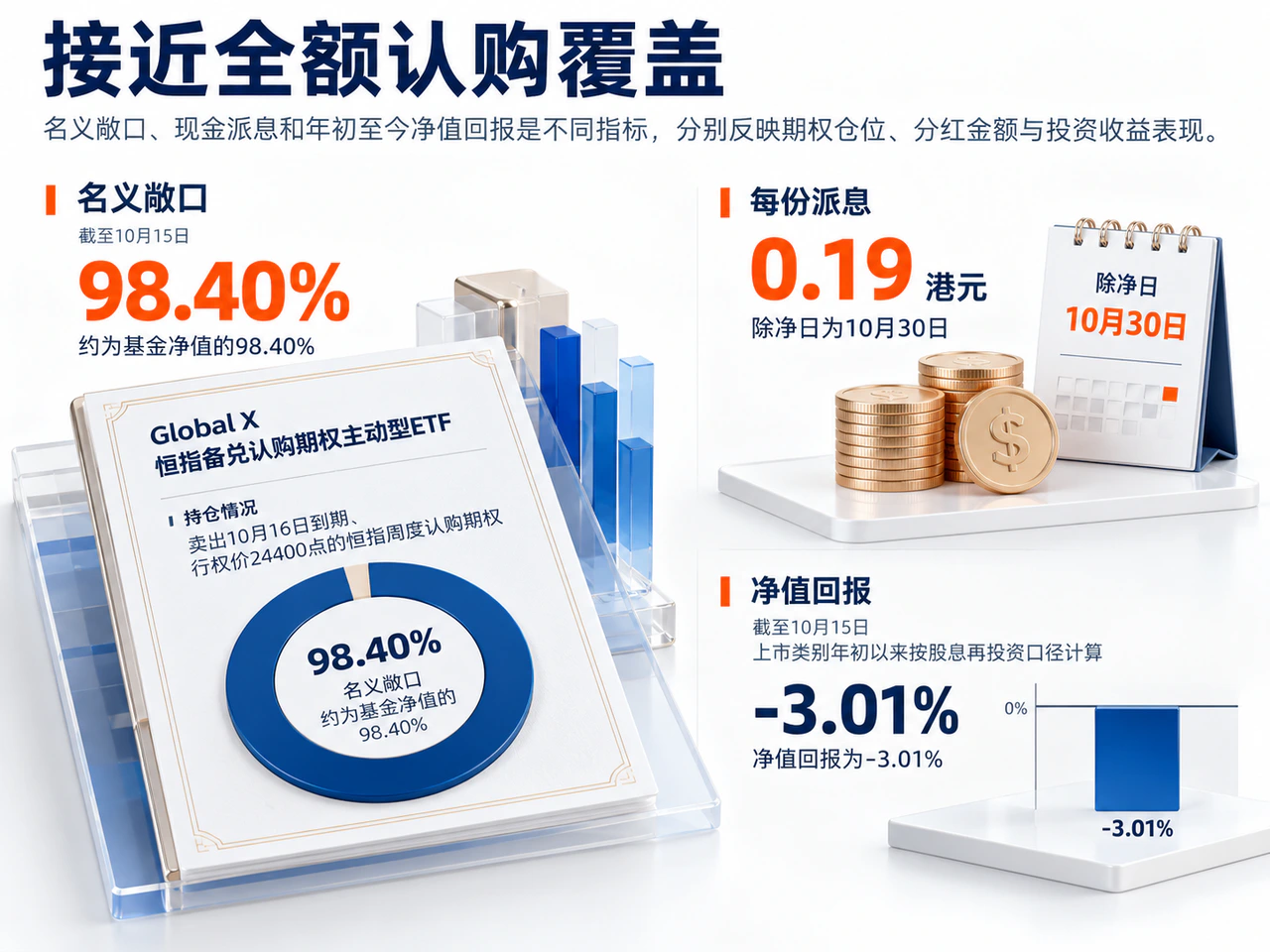
The Hang Seng's rise, decline and rebound during the week also directly affected the operation of covered-call strategies, often described as 'collecting rent.' According to the Global X Hang Seng Index Covered Call Active ETF, as of October 15 the fund held short weekly Hang Seng calls expiring October 16 with a 24,400 strike, representing notional exposure of approximately 98.40% of NAV. Based on that day's Hang Seng close of 24,062.72, the issuer listed upside to the strike of 1.40%.
Call coverage close to the fund's entire NAV means giving up most participation in the upside in exchange for premiums. When the index fluctuates moderately, premium income helps cushion declines in the underlying assets. If it rises quickly through the strike, the short calls cap part of the portfolio's gains. Although short-dated contracts allow strikes to be reset more frequently, each roll requires a fresh trade-off between premium income and upside at prevailing market levels. Intraweek index changes therefore also make the timing of the roll a direct determinant of each period's profit or loss.
These return characteristics mean that covered-call products must be assessed using NAV and total return alongside distributions. The issuer's page showed a distribution of HK$0.19 per unit, with an ex-dividend date of October 30. As of October 15, however, the listed share class's year-to-date NAV return with dividends reinvested was -3.01%. Cash distributions provide current cash flow and may include capital; a single distribution cannot be extrapolated directly into a sustainable future yield. NAV return with dividends reinvested fully captures the combined effects of underlying asset prices, option gains and losses, fees and distributions. Assessing these strategies requires considering coverage, distance to strike, roll frequency and returns including dividends together.
Cboe adds premarket and after-hours US equity-option trading, including Alibaba and TSMC
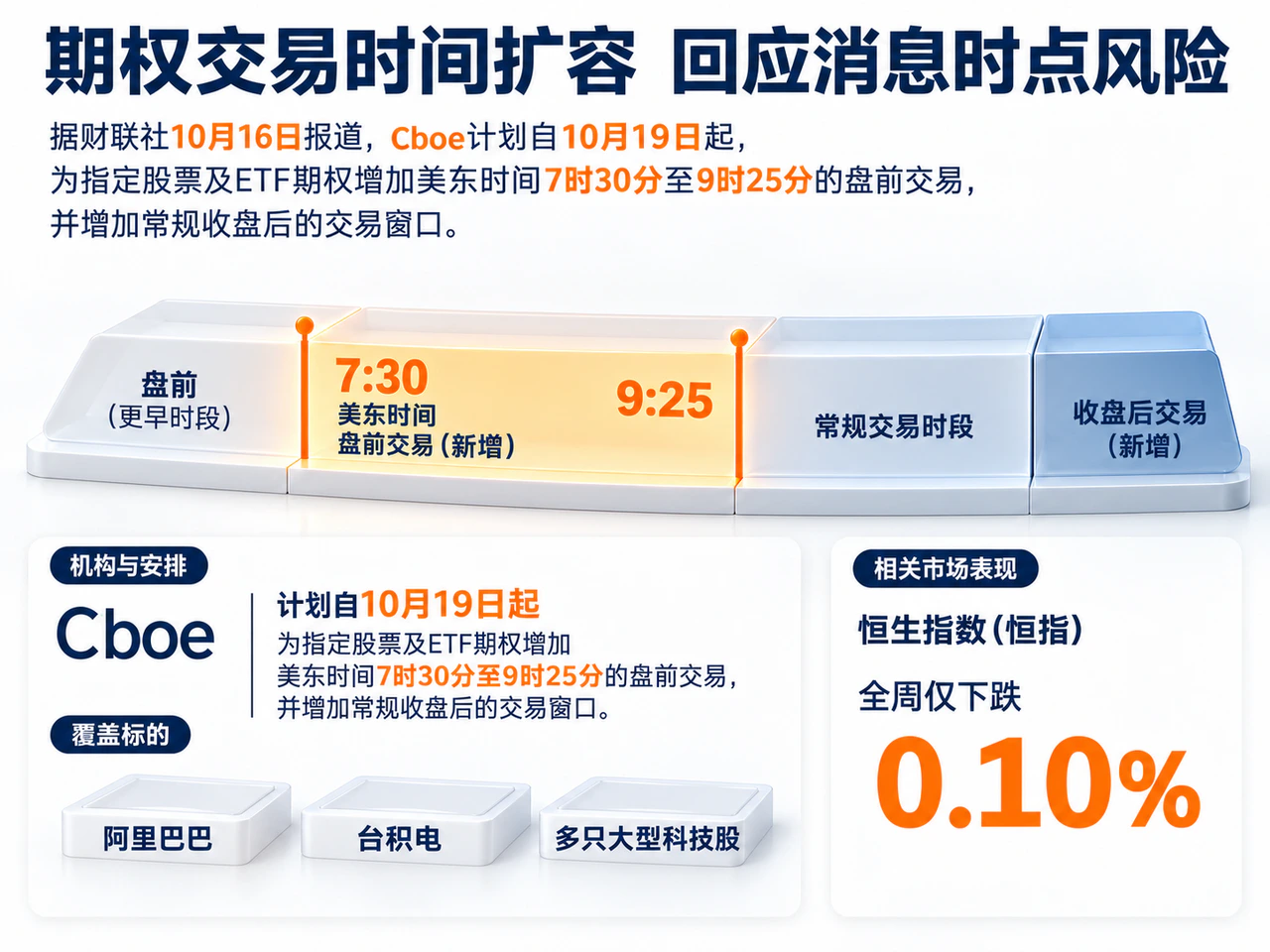
Overseas markets also expanded trading hours that week. Cailian Press reported on October 16 that, from October 19, Cboe planned to add premarket trading from 7:30 a.m. to 9:25 a.m. US Eastern time for selected stock and ETF options, along with a trading window after the regular close. Alibaba, TSMC and several large technology stocks were included. For investors following both Hong Kong shares and US-listed Chinese companies, this creates a window to adjust option positions promptly after news released before the US open.
HKEX's wider range of weekly-option underlyings and Cboe's longer trading hours address the same need: aligning risk management more closely with the date and time news occurs. Commenting on the US market on October 16, Saxo options strategist Koen Hoorelbeke observed that rotation among constituents could suppress headline index volatility while individual-stock risk remained concentrated. That observation also applies to Hong Kong: a weekly Hang Seng decline of just 0.10% does not capture the divergent risks across technology stocks, corporate events and different option expiries.
Hong Kong's market is closed on October 19 and resumes trading on October 20. The central questions after the holiday are how existing Hang Seng option positions adjust once cash trading resumes, and whether the new weekly stock options develop continuous quotations and effective trading after listing.