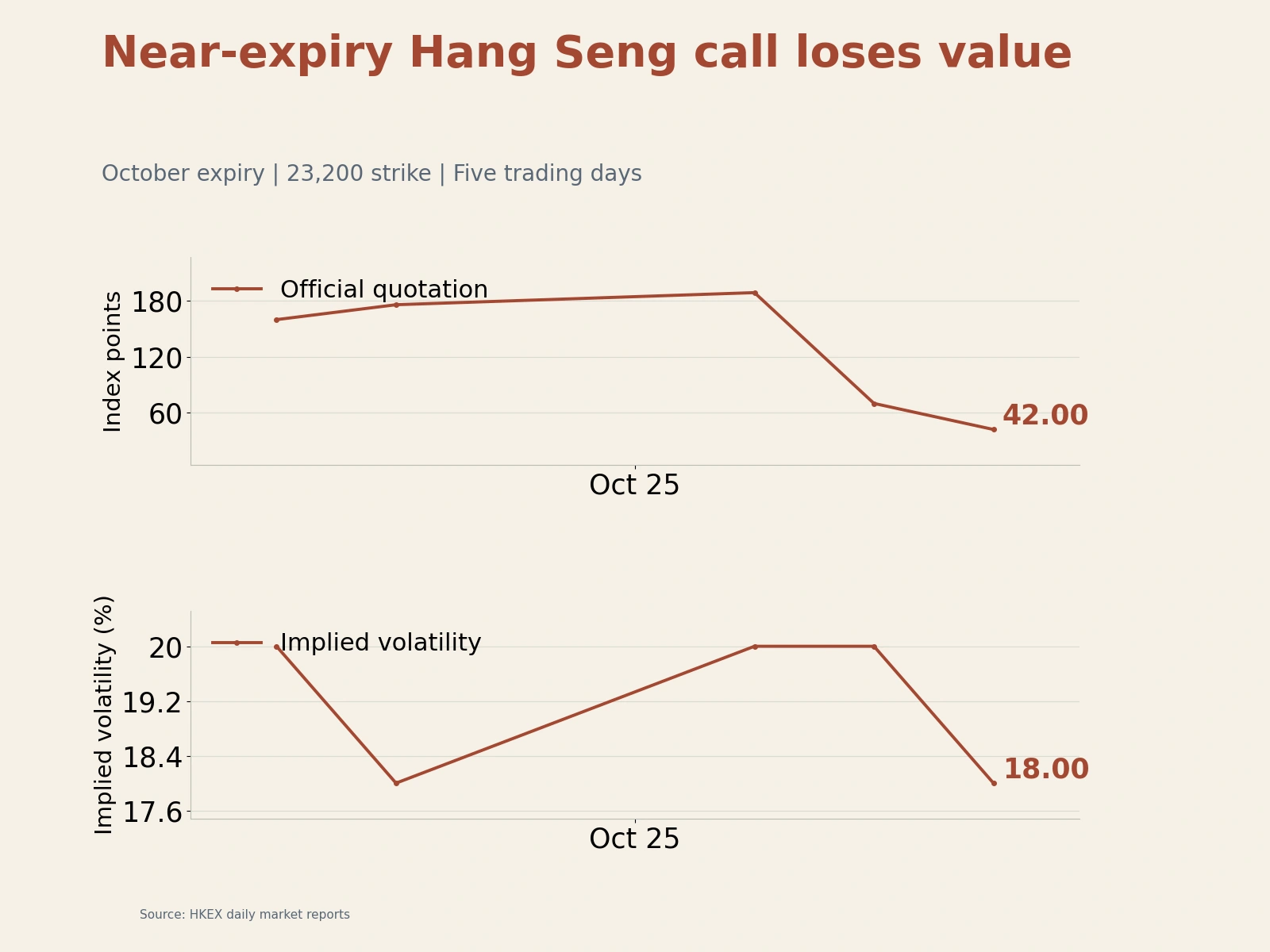
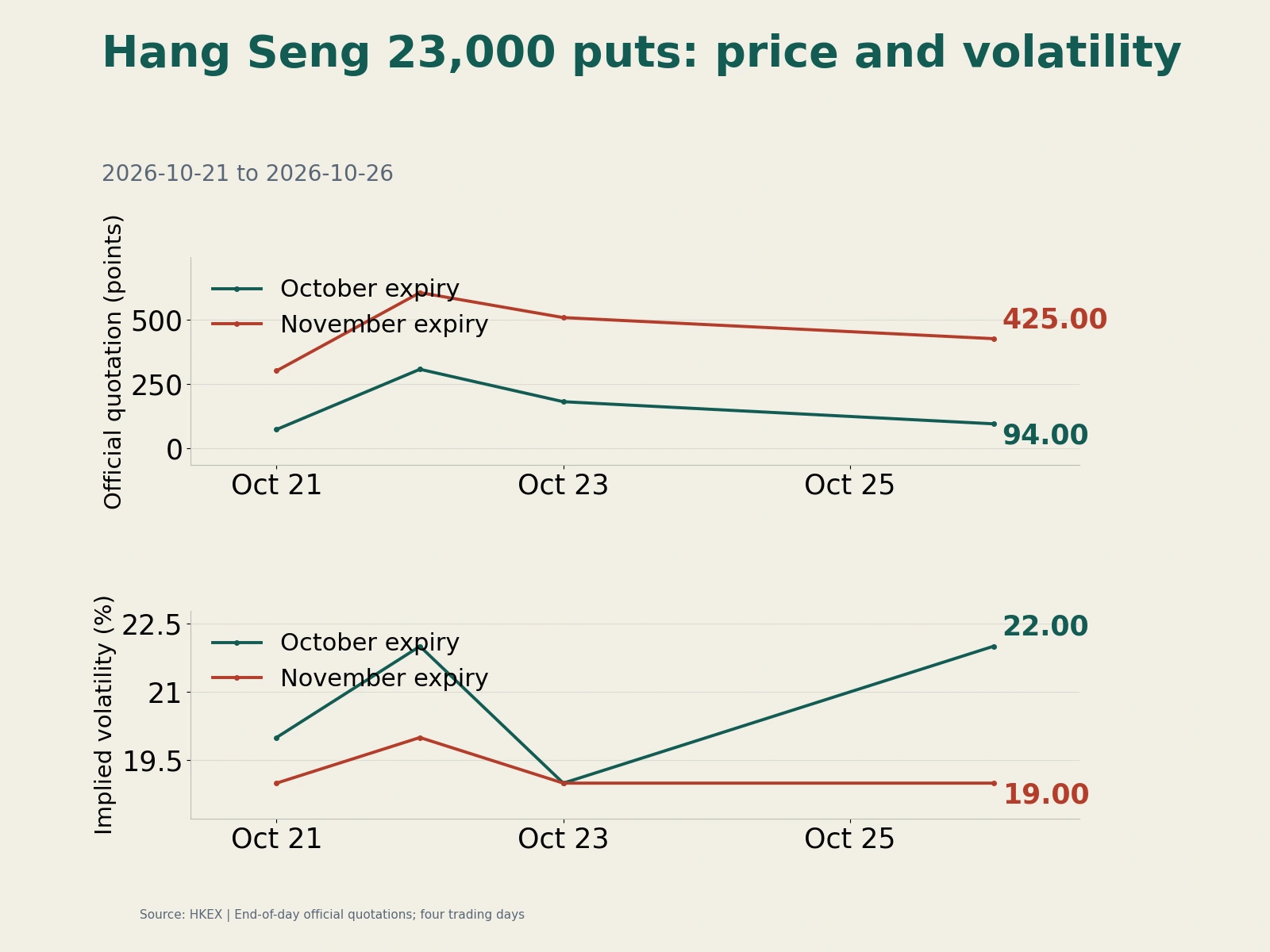
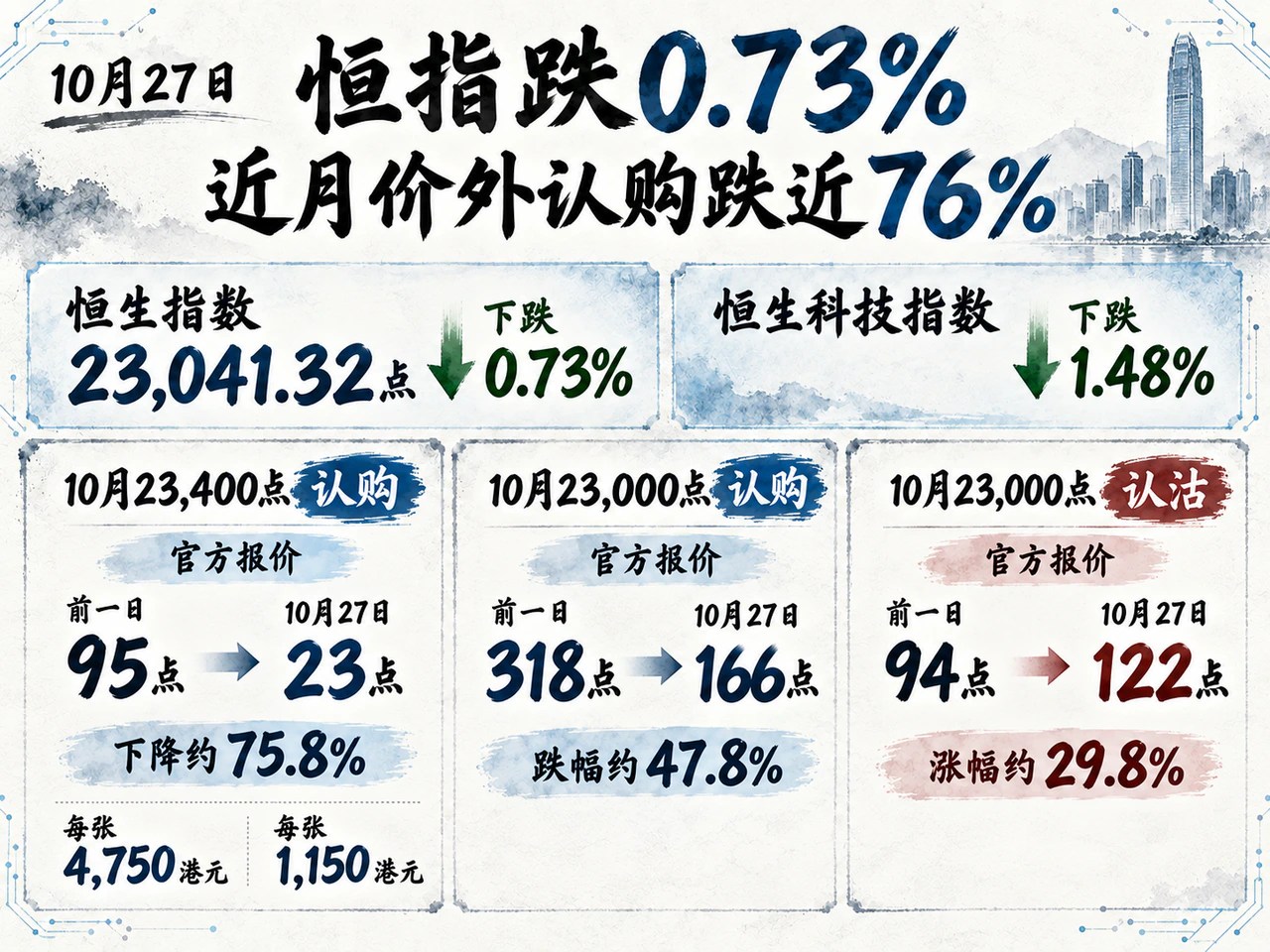
On October 27, 2026, the Hang Seng Index fell 0.73% to close at 23,041.32, while the Hang Seng Tech Index declined 1.48%. With the October 29 monthly Hang Seng option expiry approaching, the spot-market decline quickly affected near-month contracts: the official quotation for the October 23,400 call dropped from 95 to 23 points. Meanwhile, November contracts absorbed approximately four-fifths of the day’s new open interest. Pressure on near-month rebound trades alongside continued accumulation of next-month positions was the clearest change in the options market that day.
Hang Seng falls 0.73%; near-month out-of-the-money call loses almost 76%
Hong Kong shares opened higher before retreating. Technology stocks were weak, while HSBC’s afternoon decline also weighed on the Hang Seng. In its October 27 derivatives commentary, Société Générale described Tencent as hovering at low levels and Alibaba’s short-term trend as weak, remaining cautious about positioning for a rebound. As expiry approaches, both the spot-market path and remaining time affect option value. With the rebound yet to arrive, near-month calls came under pressure first.
Pressure on bank stocks also reflected revenue expectations. Proactive reported that day that HSBC’s third-quarter adjusted pretax profit was broadly in line with expectations, but revenue and net interest income were each about 2% below market expectations. UBS and Jefferies maintained Neutral and Hold ratings, respectively, with differing assessments of future revenue growth. Technology weakness combined with a reassessment of banks’ revenue prospects; stabilization in a few individual stocks had yet to reverse the broader market’s direction that day.
HKEX’s daily Hang Seng options report showed that the October 23,400 call traded 1,759 contracts, making it the most active individual contract in that report. Open interest increased by 411 contracts to 1,260, yet the official quotation fell 72 points to 23, down approximately 75.8% from the preceding day’s 95. The spot Hang Seng declined only 0.73% over the same period, so the near-month out-of-the-money call lost far more in percentage terms than the index.
At a contract multiplier of HK$50 per index point, the 23-point official quotation represented HK$1,150 per contract, compared with HK$4,750 at the preceding day’s 95 points. This comparison uses official quotations; executable transaction prices depend on bid and ask quotes. The 23,400 strike was about 1.56% above that day’s Hang Seng close, with very little time left for a spot rebound.
The nearer-the-money October 23,000 call also saw its official quotation fall from 318 to 166 points, a decline of approximately 47.8%. The put at the same strike rose from 94 to 122 points, up about 29.8%. For the same expiry and strike, the changes on the two sides clearly reflected the effect of lower spot prices. Falling call quotations coexisted with rising open interest, indicating continued differences among traders. Every new open position has both a buyer and a seller; its directional significance depends on the specific trade.
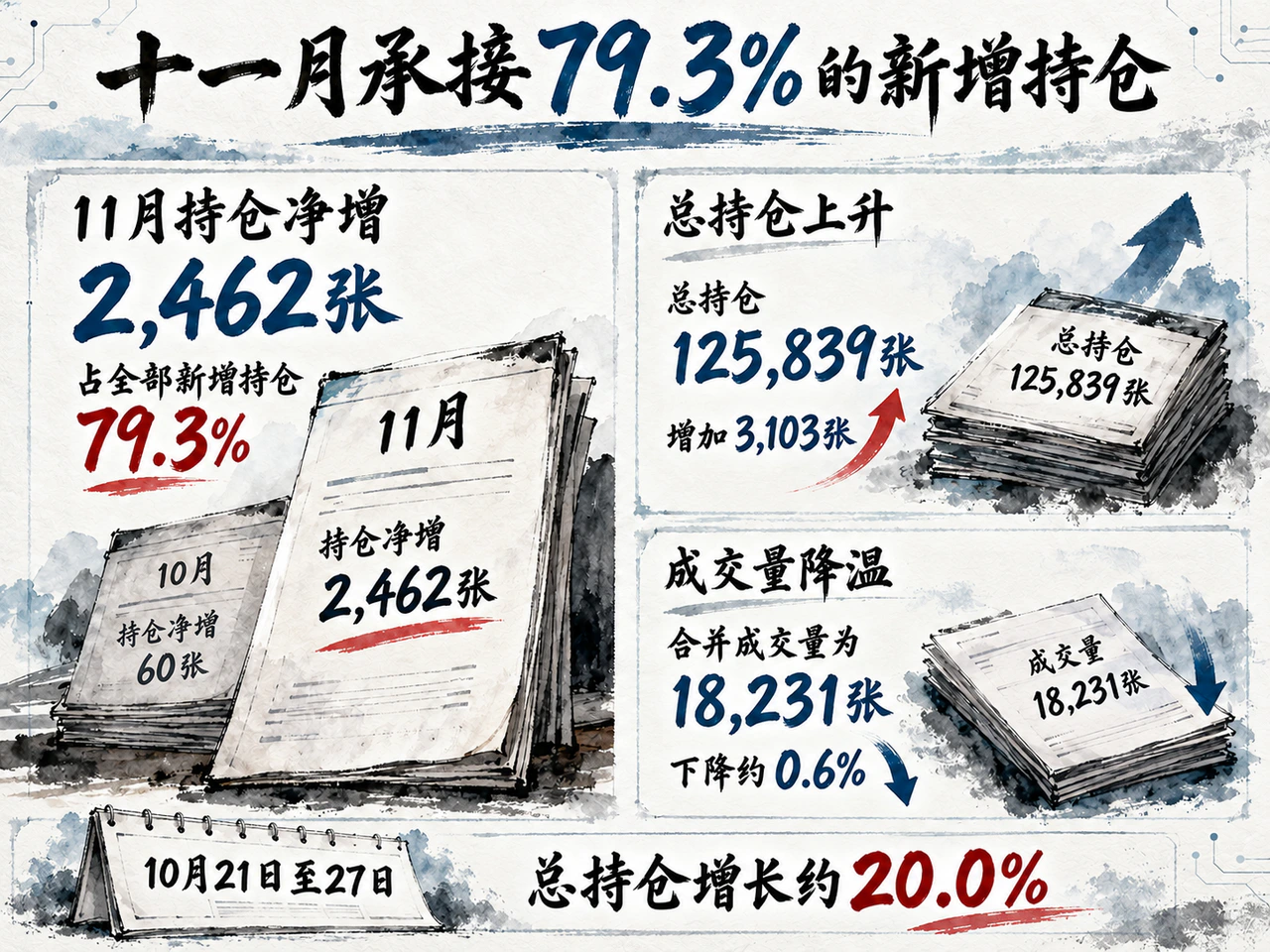
November absorbs 79.3% of new open interest
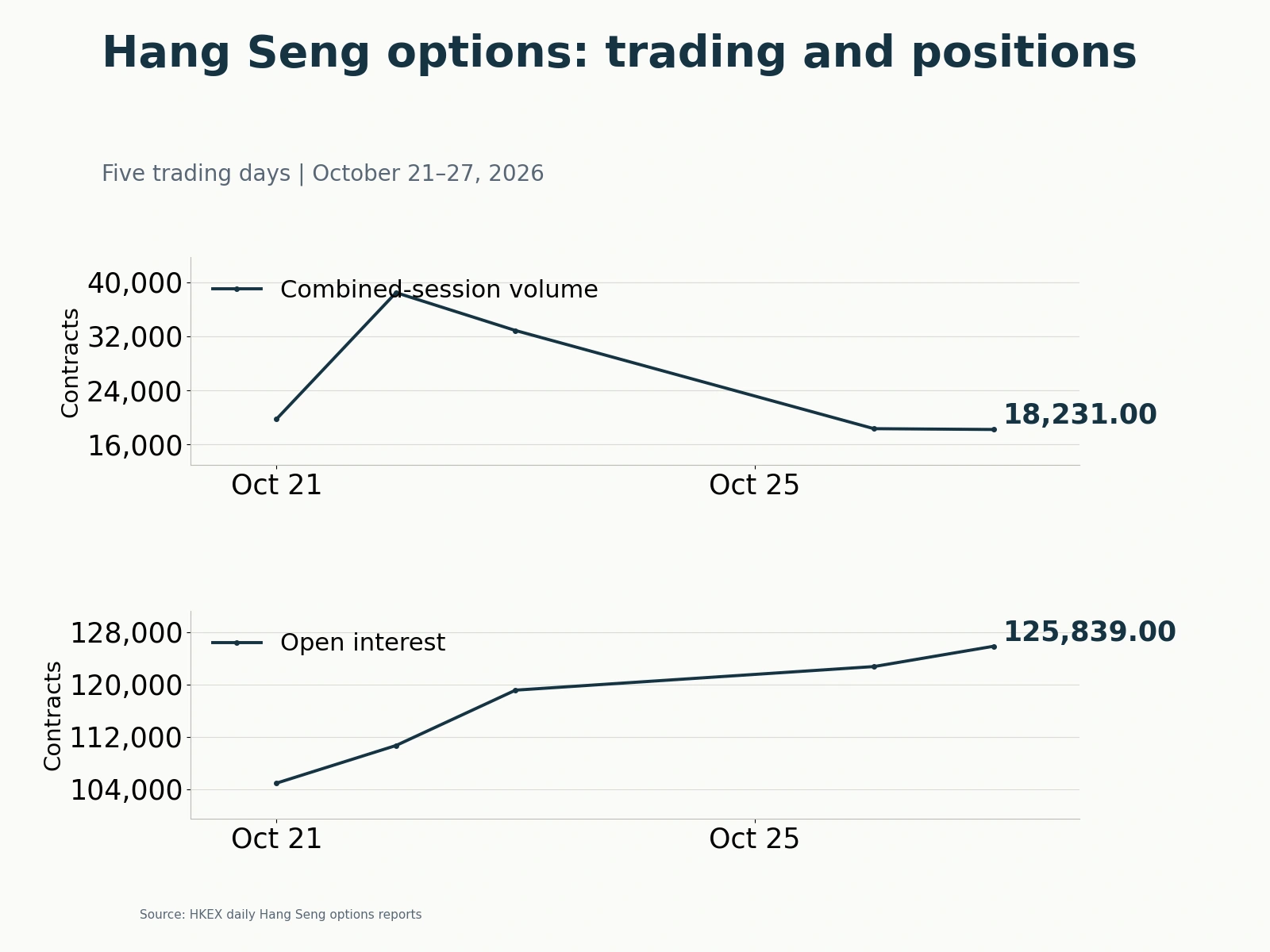
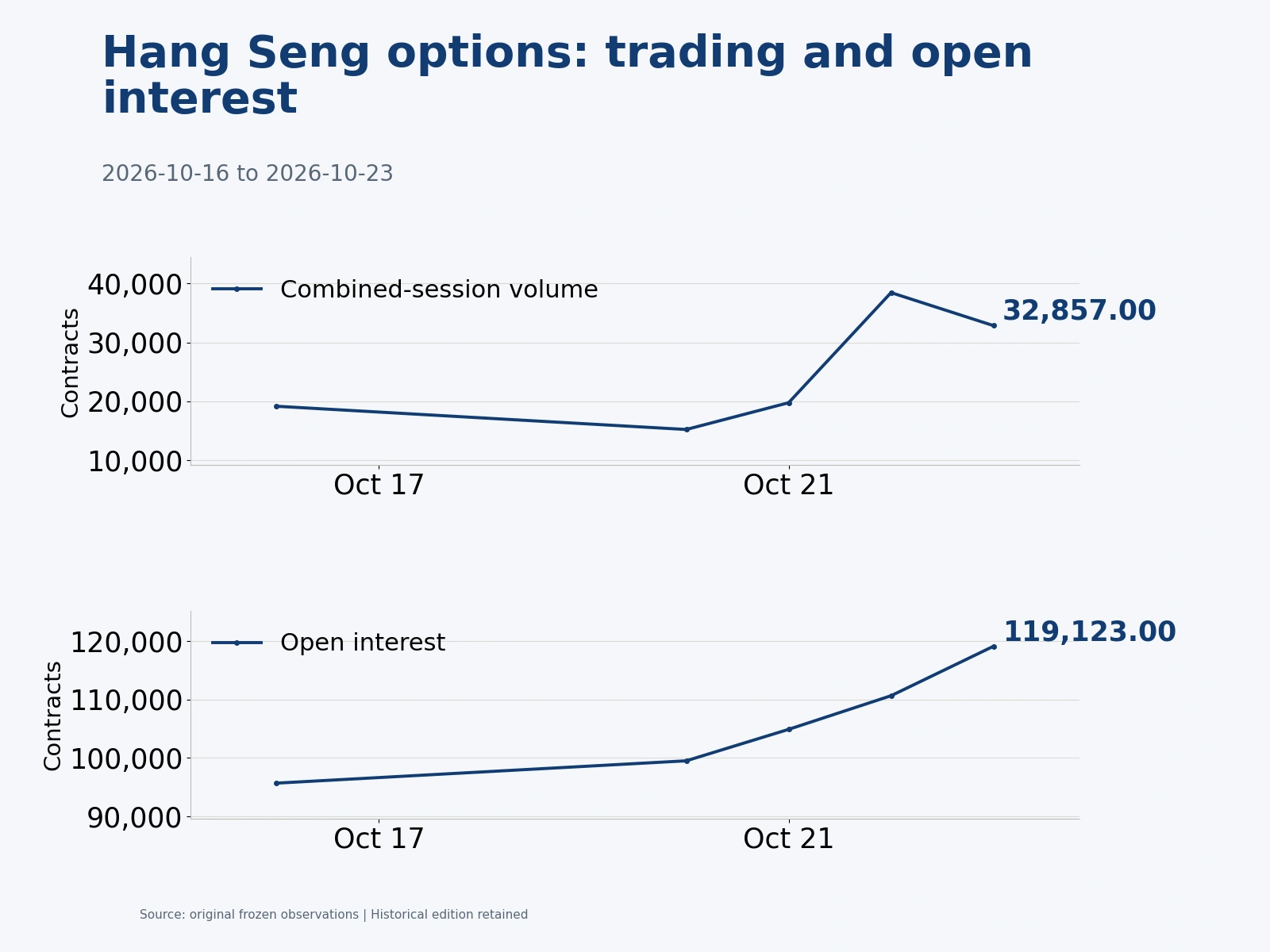
Near-month contracts remained actively traded, but aggregate turnover had declined from the previous week’s highs. On October 27, combined-session Hang Seng options volume within the report’s scope was 18,231 contracts, down about 0.6% from 18,350 on October 26 and below 38,454 on October 22 and 32,857 on October 23. Total open interest nevertheless increased by 3,103 contracts to 125,839.
Across the five trading days from October 21 through October 27, total open interest rose from 104,896 to 125,839 contracts, an increase of approximately 20.0%, while volume retreated after surging on October 22. Outstanding contracts continued to accumulate as short-term turnover cooled. The day’s put-to-call volume ratio was 1.18, unchanged from the preceding day and below 1.66 on October 22 and 1.49 on October 23.
The expiry distribution provided further insight into positioning. October contracts traded 11,859 lots, approximately 65.0% of the report’s total volume, but open interest increased by only 60 contracts. November traded 5,015 contracts and added 2,462 in open interest, accounting for about 79.3% of all new open interest. Much of the trading remained concentrated in the near month, while new positions were mainly established in the next month.
The November 22,400 put stood out. Its volume rose from 93 contracts on the preceding day to 933, open interest increased from 616 to 1,283, a gain of 667 contracts, and its official quotation rose from 239 to 273 points. The strike was approximately 2.78% below that day’s Hang Seng close, concentrating some next-month downside trading at that level.
These changes were consistent with some risk-management arrangements extending into November. Put positions can reflect purchased protection, short puts, spreads or other adjustments; their specific purpose depends on the portfolio structure. Total October open interest did not fall materially that day. The changes therefore mainly represented additional next-month positioning and had yet to show a large-scale migration through closing near-month positions and opening later expiries.
Hang Seng Tech and China Enterprises trading diverges; both add next-month puts
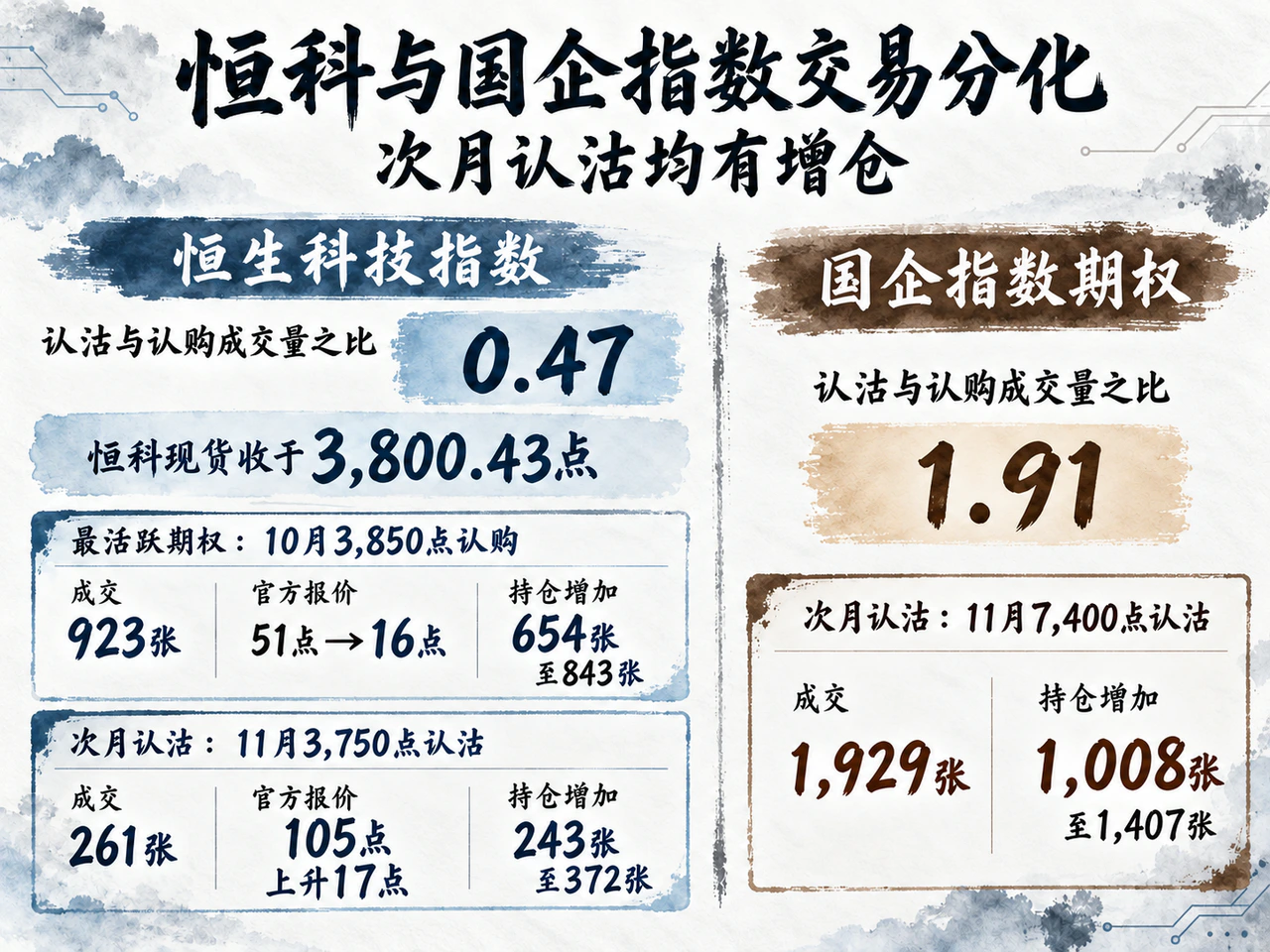
The Hang Seng Tech Index suffered the larger decline that day, yet the put-to-call volume ratio in its daily options report was only 0.47. The corresponding ratio for Hang Seng China Enterprises Index options was 1.91. Index declines and option volume ratios do not correspond mechanically; specific expiries and strikes provide more information about what traders are positioning for.
The most active Hang Seng Tech option that day was the October 3,850 call, with 923 contracts traded. Its official quotation fell from 51 to 16 points, while open interest increased by 654 contracts to 843. With the spot index closing at 3,800.43, the call was out of the money. Trading concentrated in this contract even as its value fell sharply alongside the weaker spot market.
Next-month Hang Seng Tech puts also added positions: the November 3,750 put traded 261 contracts, open interest rose by 243 to 372, and the official quotation increased by 17 points to 105. In China Enterprises Index options, the November 7,400 put traded 1,929 contracts and added 1,008 in open interest to reach 1,407. Both markets added next-month put positions, while differences in trading bases, index composition and activity in other contracts produced widely differing aggregate put-to-call volume ratios.
As expiry approaches, losses in near-month calls and the accumulation of next-month positions are occurring together. The former reflects the combined pressure of lower spot prices and diminishing time; the latter shows trading arrangements extending into the next expiry. If spot prices recover, whether near-month calls regain value and whether next-month puts continue to add open interest will provide two ways to assess positioning. If spot prices remain weak, the distribution of volume and open interest across lower next-month strikes will give a clearer picture of how risk is being reallocated.