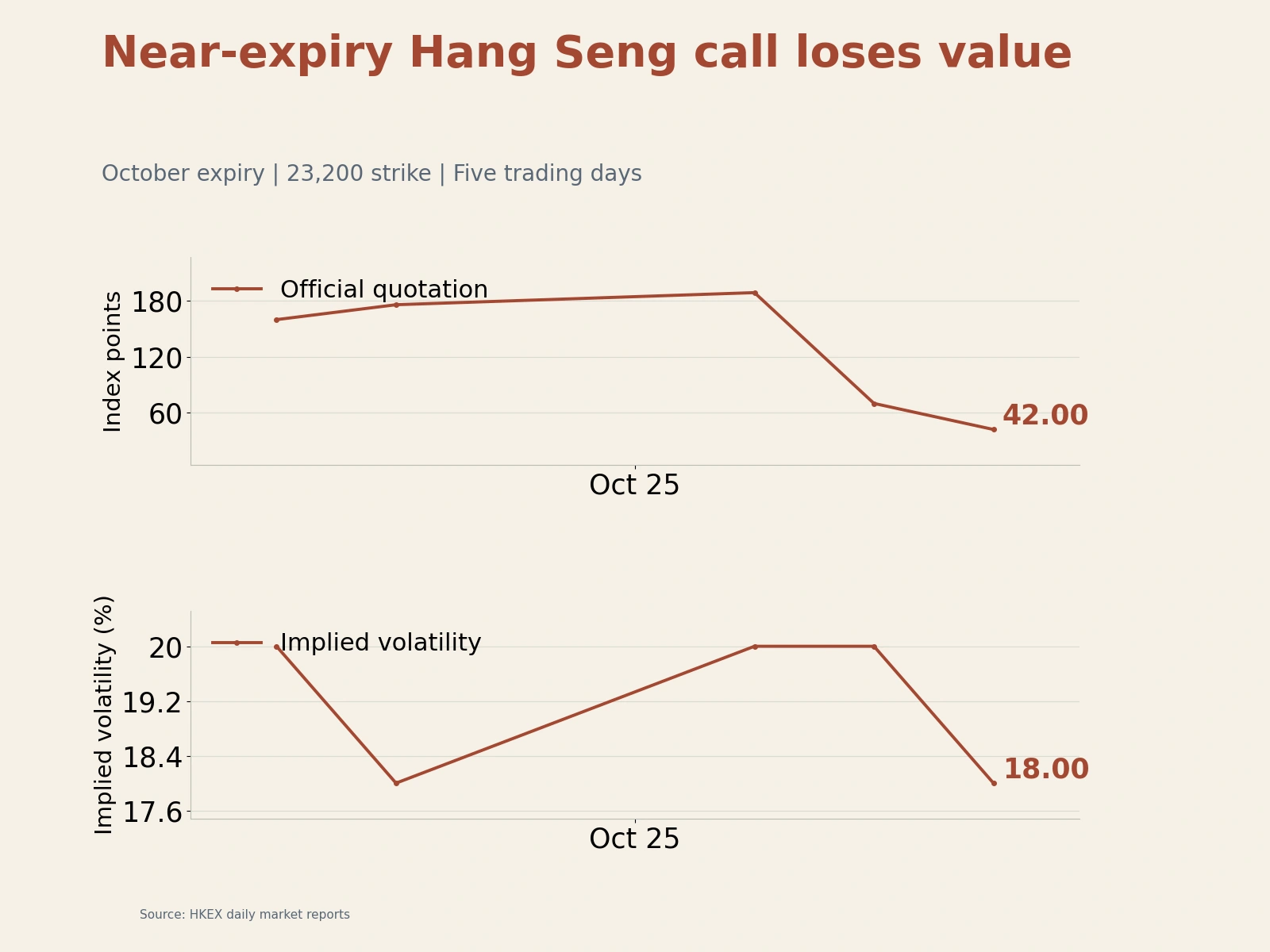
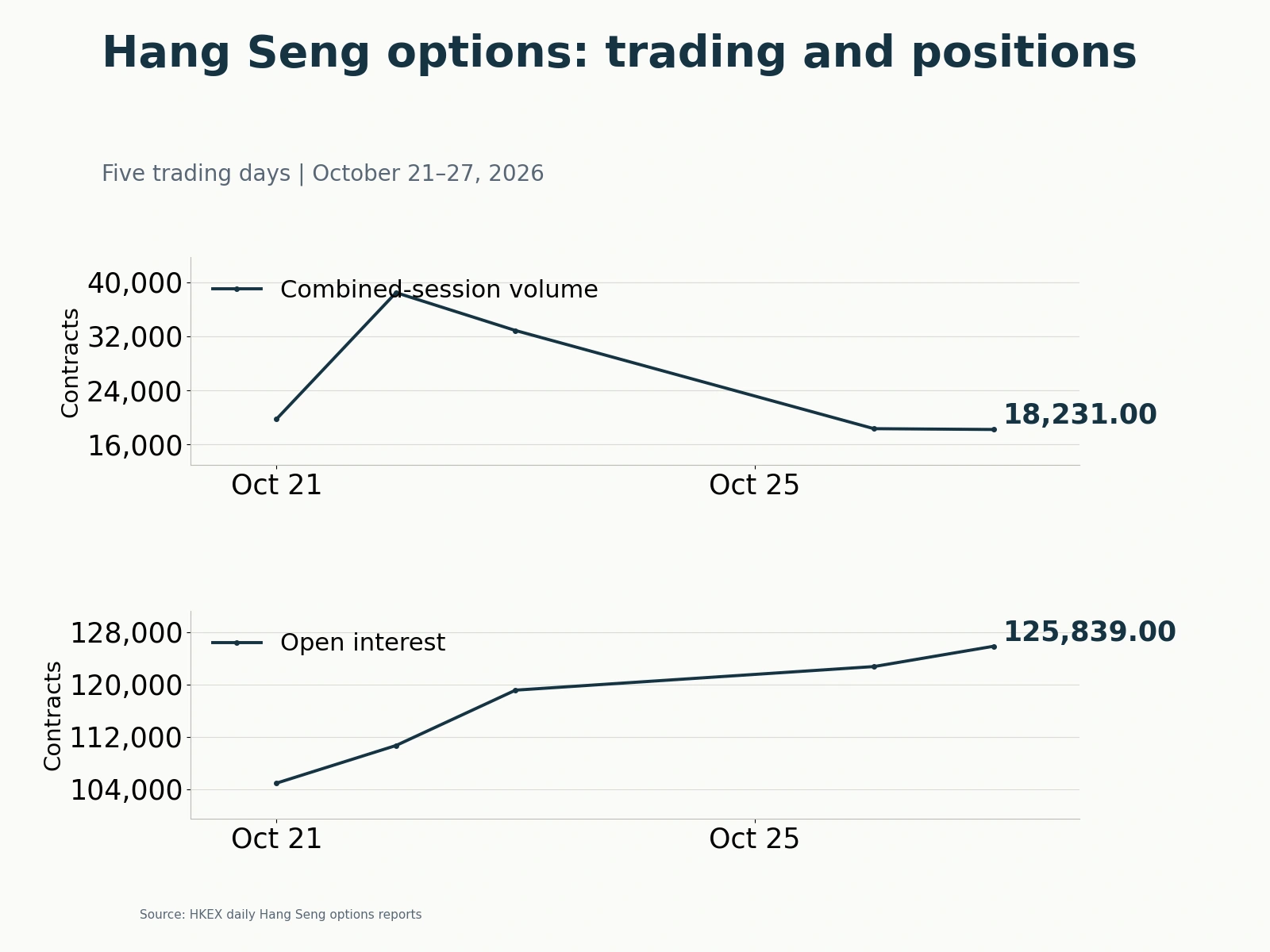
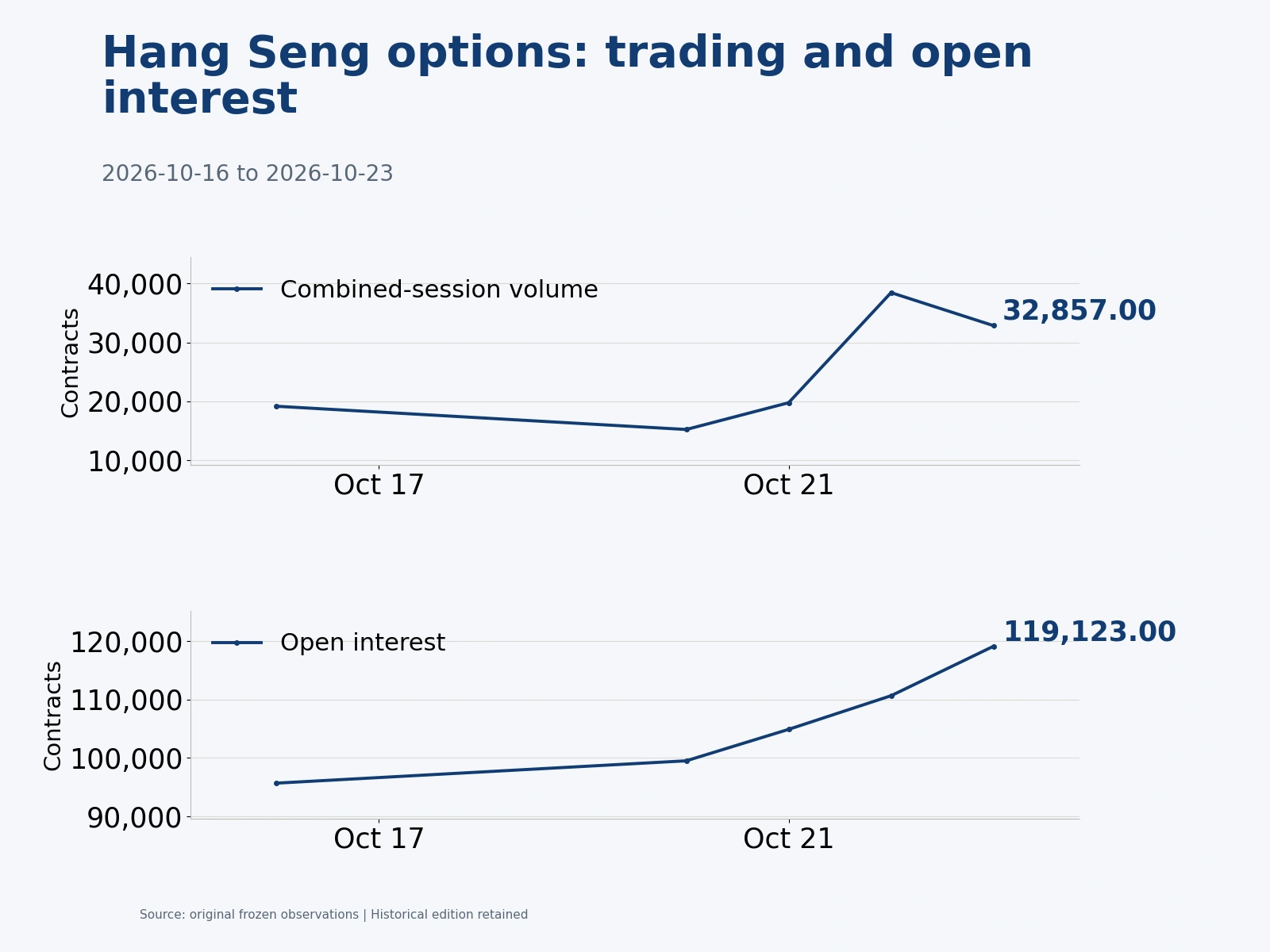
HKEX’s October 26 daily Hang Seng options report showed a split in the market after the previous week’s sharp selloff. As observed on the morning of October 27 Beijing time, quotations for core near-month protection had fallen substantially, while extremely out-of-the-money tail contracts remained actively traded close to expiry. The October-expiry 23,000 put’s end-of-day official quotation (O.Q.P.) dropped from 180 points on Friday, October 23, to 94. The day’s most-traded contract was instead the October 19,000 deep-out-of-the-money put, with combined-session volume of 1,867 contracts and an official quotation of only one point.
The change followed a significant Hong Kong equity correction the previous week. Phillip Securities director Huang Weijie’s October 26 market commentary noted that the Hang Seng had lost about 4.5% over the week and the Hang Seng Tech Index approximately 5.8%. With major Hong Kong companies entering a concentrated earnings-reporting period, a sustained rebound would require both corporate earnings and external risk appetite to cooperate. Against that backdrop, option price and positioning changes might reflect repricing of short-term sharp-decline risk and adjustments across expiries around subsequent event windows.
October 23,000 put quote nearly halves, while implied volatility rises to 22%
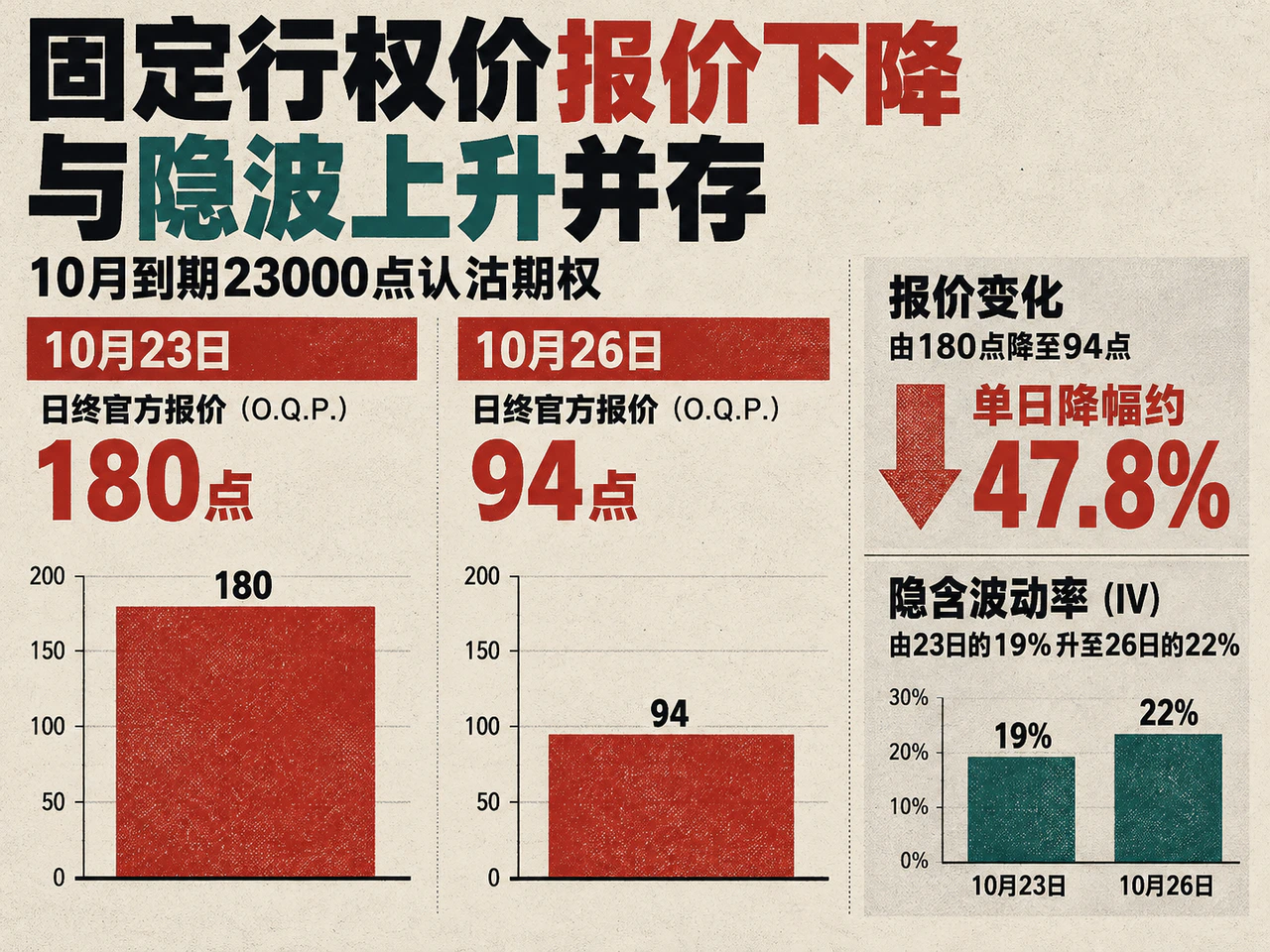
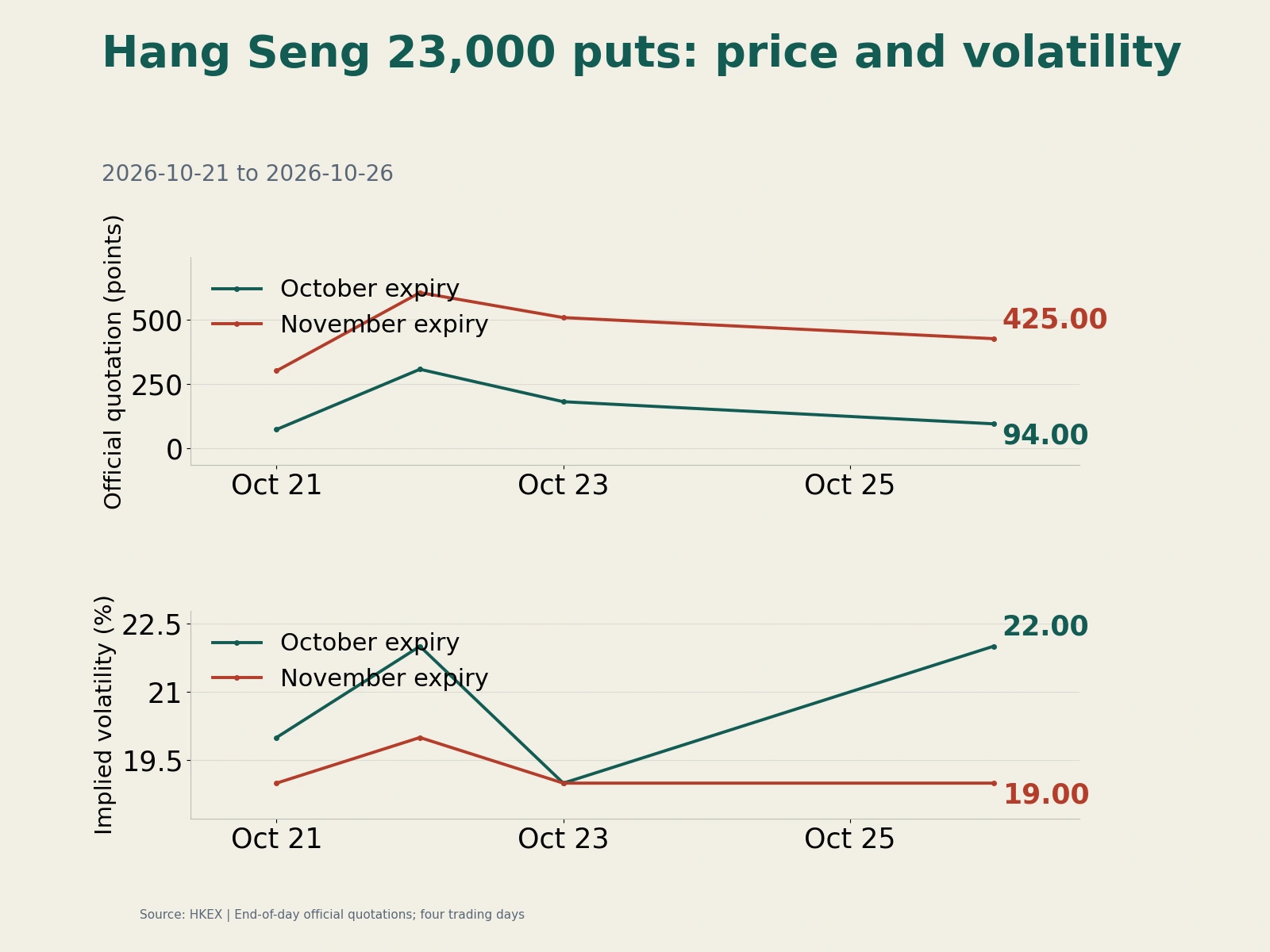
The October 23,000 put’s short-term quotation path recorded the previous week’s shock and subsequent recovery. Its end-of-day official quotation was 72 points on October 21, jumped to 306 on October 22, then fell to 180 on October 23 and 94 on October 26. Across those four trading days, the option had given back a substantial part of its October 22 peak over the latest two sessions. At the Hang Seng option multiplier of HK$50 per point, its value per contract fell from HK$9,000 on October 23 to HK$4,700 on October 26, a daily decline of approximately 47.8%.
The sharp premium decline was not accompanied by lower implied volatility. The report showed the 23,000 put’s implied volatility rising from 19% on October 23 to 22% on October 26, moving in the opposite direction to its premium. As the underlying index rebounded, an already out-of-the-money put at a fixed strike moved further out of the money, reducing the probability of finishing in the money. With the October contract nearing expiry, remaining time value also decayed faster. Both mechanisms could lower the premium. A fixed-strike option’s premium can therefore be affected by underlying-price movement and time decay, allowing a sharply lower quotation to coexist with a higher implied-volatility reading.
The October 23,000 put traded 977 contracts on October 26 on a combined-session basis, including the preceding trading day’s night session and the current day session. Open interest fell by 124 contracts to 695. Active trading alongside the exit of some existing positions suggested that the changes could relate to adjustments in short-dated protection after the recovery from the sharp selloff.
One-point 19,000 put leads trading; total volume cools while open interest keeps rising
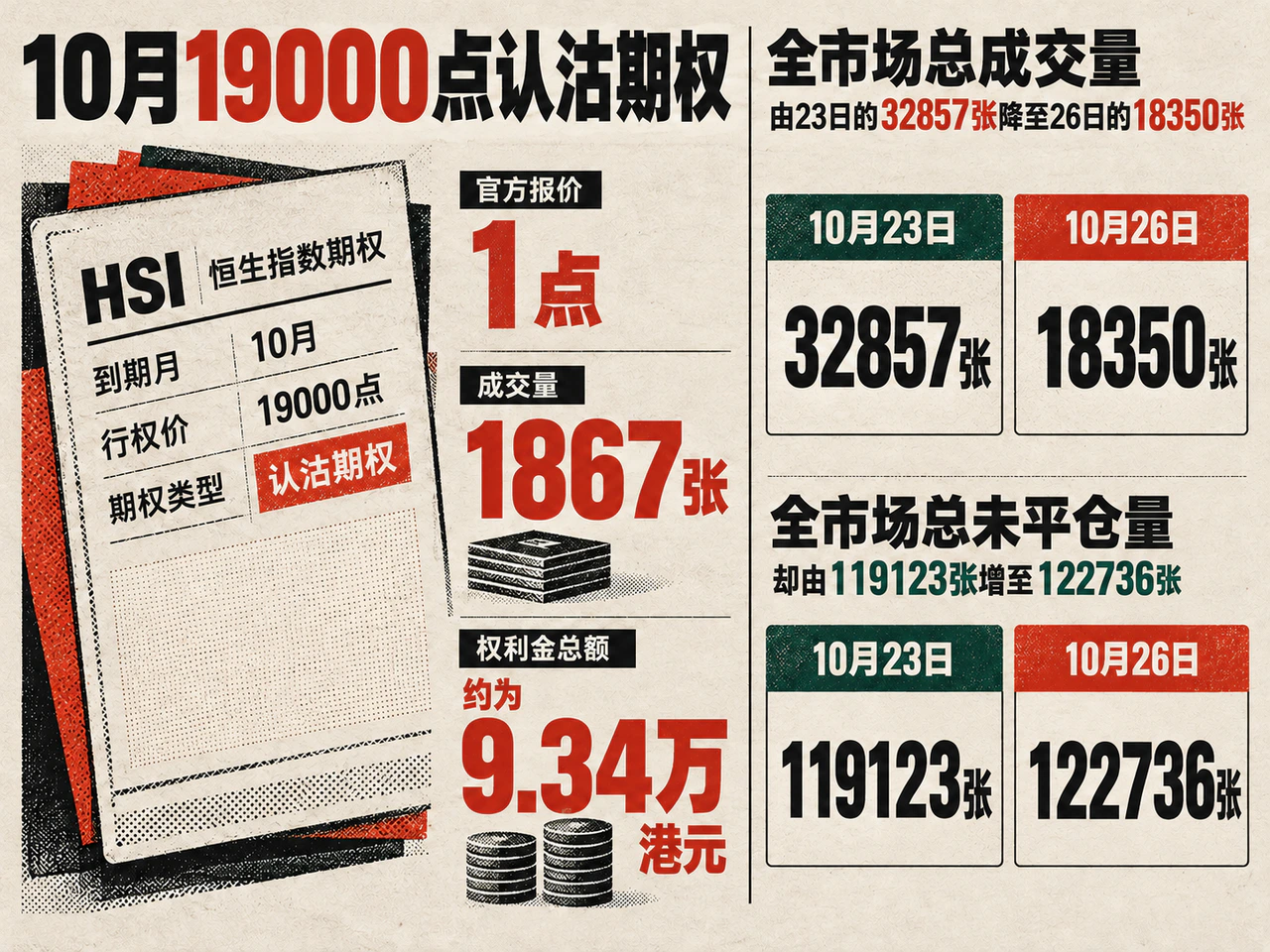
Unlike the declining price and open interest in the 23,000 contract, the October 19,000 put, which led Hang Seng option volume on October 26, added positions. Combined-session volume was 1,867 contracts, approximately 10.2% of total Hang Seng option volume of 18,350. Open interest rose by a net 1,860 contracts to 2,006.
Assessing the actual capital involved in this tail trade required attention to its very low price. Both the highest and lowest day-session trade prices on October 26 were one point, or HK$50 in premium per contract. Excluding transaction costs, 1,867 contracts represented approximately HK$93,400 of total premiums, a different order of magnitude from conventional protection nearer the market worth thousands of Hong Kong dollars per contract. The report also showed implied volatility of 78% for the 19,000 put, well above the 23,000 put’s 22%. For a near-expiry, deeply out-of-the-money contract priced at the tiny level of one point, a minimum price increment corresponds to a very large implied-volatility change. The 78% reading was therefore heavily affected by the contract’s extreme moneyness and quote precision, rather than representing a benchmark expectation for overall Hang Seng volatility. The sharp increase in open interest could reflect low-cost tail protection, portfolio management or other new positions. Contract counts alone should not be read as a large one-way bearish wager.
Across the market, trading had eased noticeably from the preceding Friday. Combined-session Hang Seng option volume fell from 32,857 contracts on October 23 to 18,350 on October 26, down approximately 44.2%. The put-to-call volume ratio declined from 1.49 to 1.18. Total open interest nevertheless rose from 119,123 to 122,736. Lower daily volume, a smaller put share and more outstanding contracts together suggested that short-term trading intensity had cooled while existing hedging or positioning arrangements might still be continuing.
November declines are closer to 16%; technology-stock options focus on earnings and the Fed window
The expiry distribution could further reflect attention to later event risks. On October 26, October-expiry Hang Seng options traded 11,604 contracts, approximately 63.2% of total market volume. November-expiry options traded 5,437, or about 29.6%. Although trading remained centered on the expiring near month, almost three-tenths of volume had moved into November contracts covering a longer risk window.
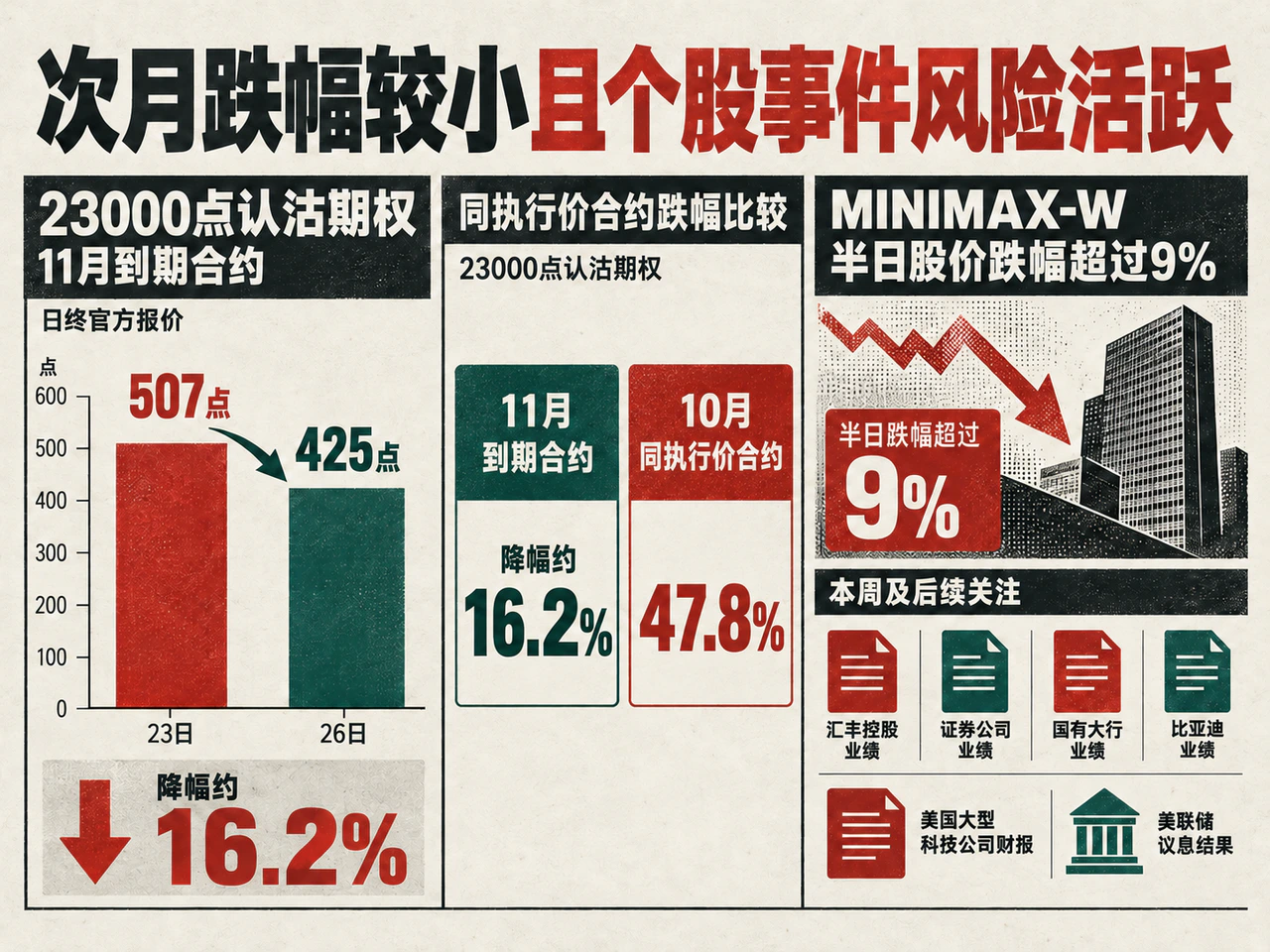
The comparison across expiries also showed a retained risk buffer further out. At the same 23,000 put strike, the November contract’s end-of-day official quotation fell from 507 points on October 23 to 425 on October 26, approximately 16.2%, much less than the October contract’s 47.8% decline. November had more time remaining, retained more time value and covered a wider future price range, producing a milder quotation decline.
Beyond the index recovery, individual-stock option activity and price performance remained markedly divergent. Tiger’s October 26 midday figures showed more than 370,000 Hong Kong stock-option contracts traded in the half day, including nearly 52,000 in Tencent, over 31,000 in Alibaba and over 26,000 in MINIMAX-W. At midday, the Hang Seng and China Enterprises indices were higher, while Hang Seng Tech remained lower and MINIMAX-W shares were down more than 9%. Broad indices combine gains and losses across constituents and can therefore appear relatively stable. Individual stocks respond directly to earnings, valuation and financing expectations, keeping stock-specific option risk trading active.
The expiry and underlying-asset structure closely matched the week’s key calendar. As Huang noted, Hong Kong attention centered on results from HSBC Holdings, securities firms, large state-owned banks and BYD, alongside spillovers from major U.S. technology earnings and the Fed decision. Options participants might be using near-month positions to address immediate volatility and November contracts and leading stock options to address potential adjustments around those events. The next questions were whether lower short-dated protection prices would extend into the following expiry and whether actively traded stocks would receive earnings support. If indices stabilized while stock-level divergence widened, risk management would rely more on underlying selection. If major earnings reports again challenged shared valuation assumptions, index-level protection demand could strengthen.