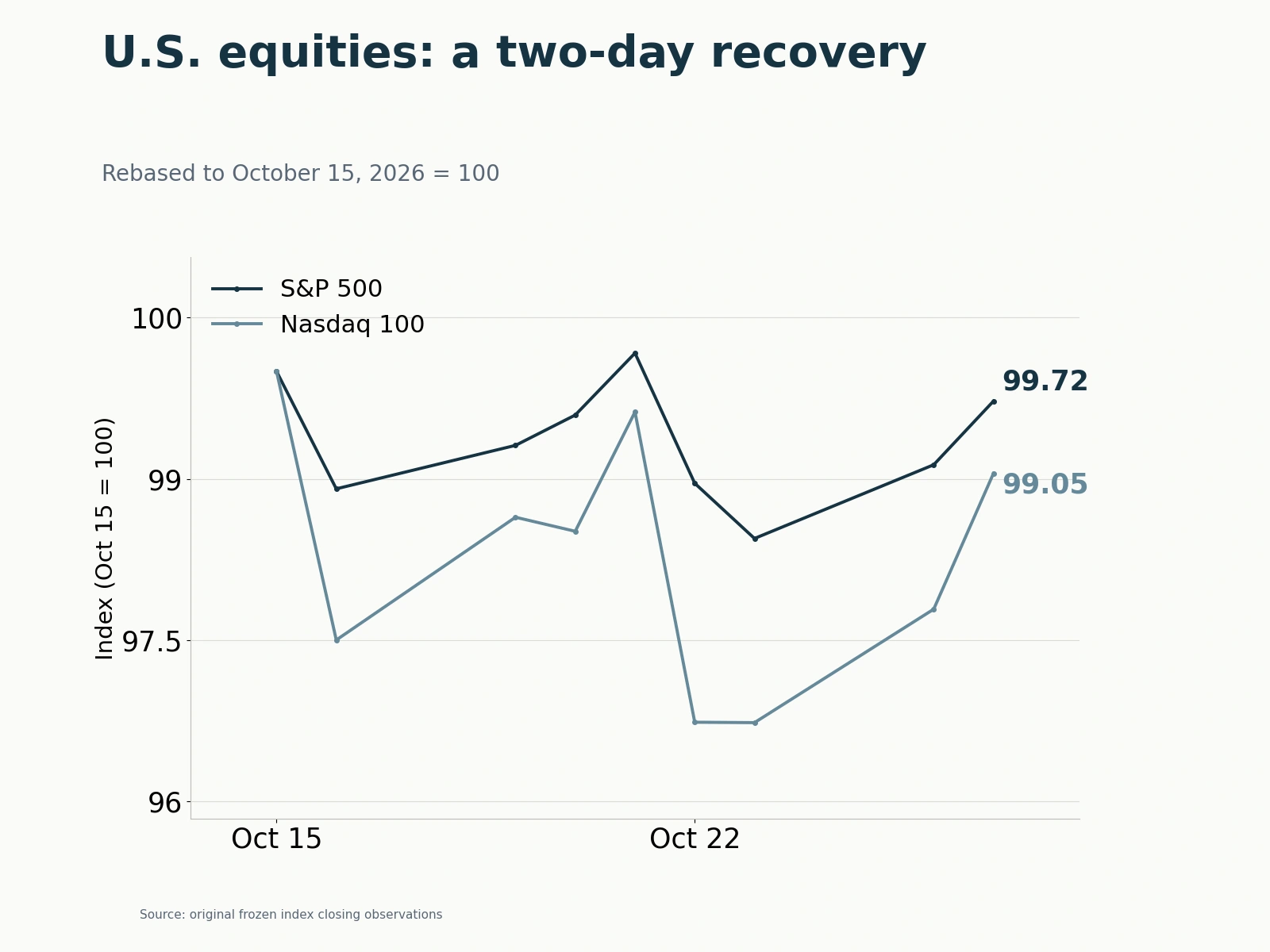
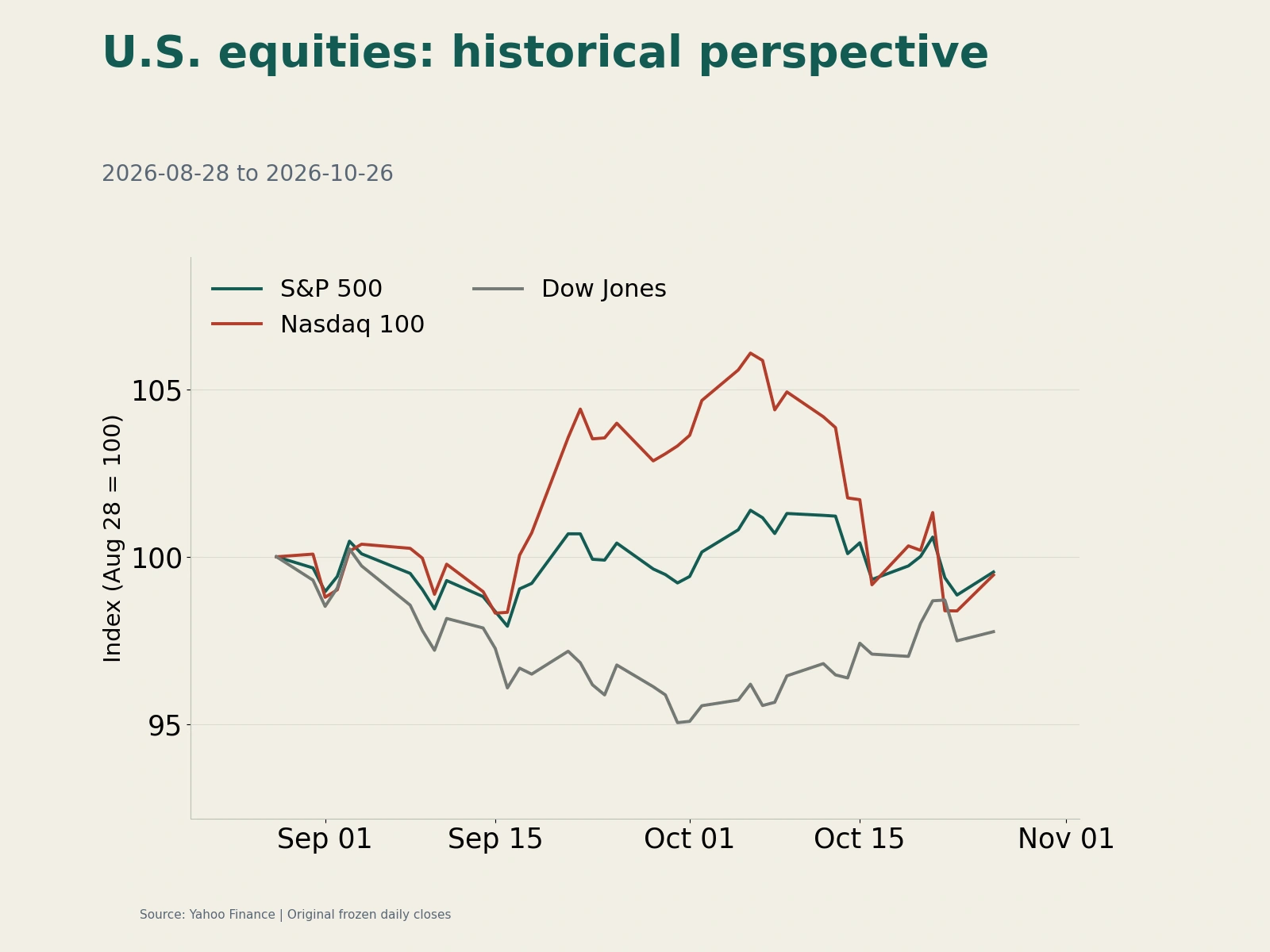
On October 19, 2026, technology stocks led a recovery in US equities, but Treasury yields rose across maturities and gold surrendered early gains to finish lower. US exemptions from new Russia-related energy sanctions and a recovery in Gulf oil supplies eased the energy shock, yet higher real rates and wider credit spreads continued tightening corporate financing conditions. After the previous week's correction, money returned to leading cloud-computing and semiconductor companies with clear earnings paths, while remaining cautious toward computing providers expanding through expensive borrowing.
At the October 19 close, the S&P 500 was up 0.41% at 7,690.73, the Nasdaq 100 rose 1.17% to 29,529.34, and the Russell 2000 gained 0.25% to 2,728.30. The Dow slipped 0.07% to 51,966.03.
Amazon Gains About 5% to Lead Technology Stocks as CoreWeave's Debt Cost Reaches 15%, Highlighting Divided AI Financing

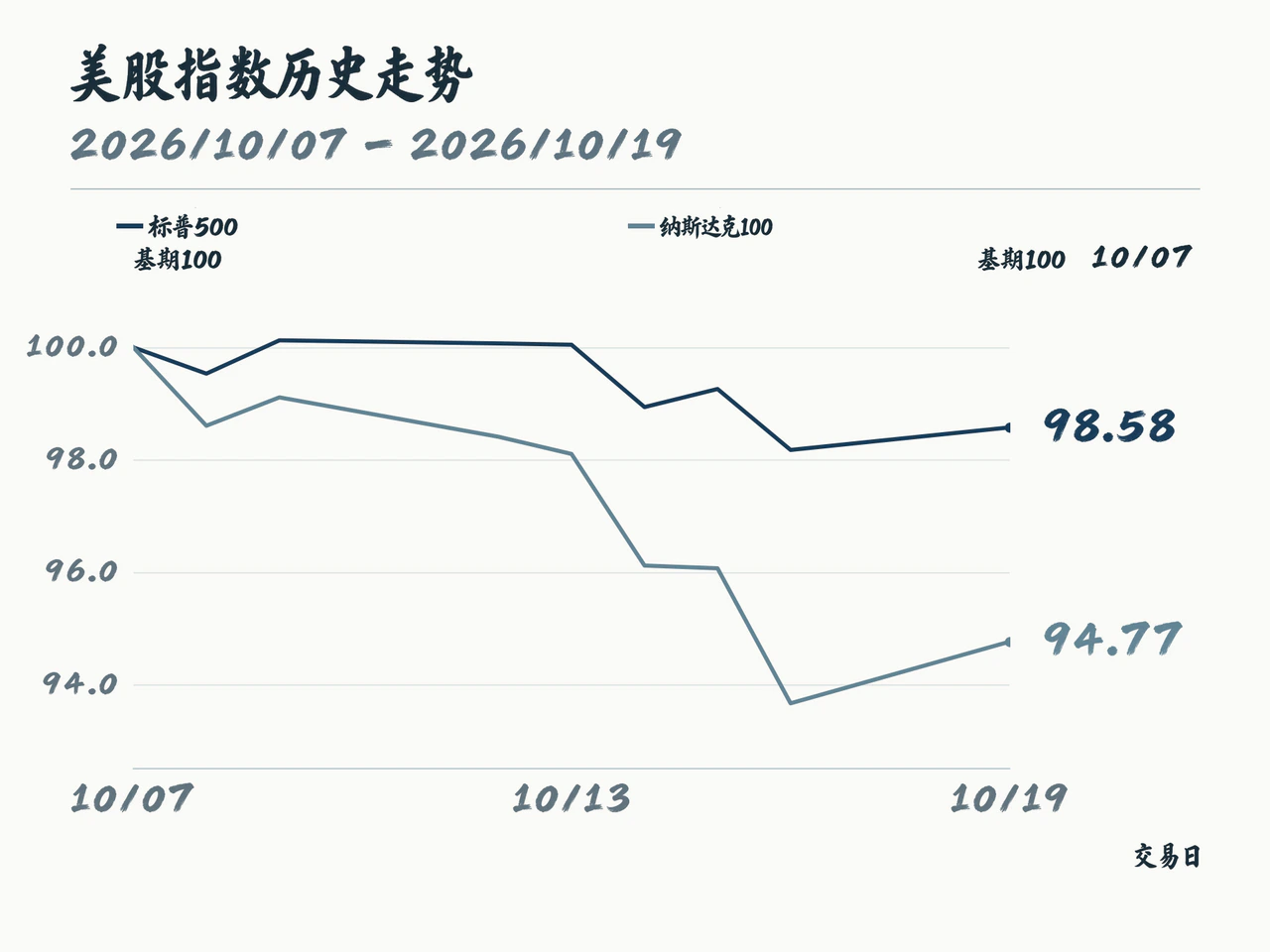
The technology-sector ETF XLK rose 1.36% on Monday, while the financial-sector ETF XLF and energy-sector ETF XLE fell 0.83% and 0.64%, respectively. The S&P 500 volatility index, VIX, declined from Friday's 19.99 to 18.44. The rebound nevertheless remained a recovery from earlier heavy losses: relative to October 9, the Nasdaq 100 and XLK were still down about 4.39% and 6.45%, respectively, while VIX remained above its then level of 14.84.
Broker upgrades and higher earnings expectations directly catalyzed technology gains. Morgan Stanley named Amazon a top pick, citing AWS cloud revenue growth and its contribution to profits, and raised its price target from $335 to $350. Amazon gained about 5% that day. JPMorgan upgraded Intel from Underweight to Neutral while maintaining an $85 target, judging risk and reward more balanced following the share-price decline and noting better operating execution. Chip stocks also rose: the SOXX semiconductor ETF gained nearly 2%, and Nvidia rose almost 1.5%.
Within the same AI supply chain, differences in financing models and balance sheets are driving valuation gaps. CNBC reported that computing-capacity provider CoreWeave closed about 0.4% lower on Monday despite a Goldman Sachs upgrade, extending weakness after a decline of more than 25% the previous week. Goldman had become more positive on its contract economics but also lowered its price target, reflecting the constraints that debt burdens and investment returns still place on valuation.
Bond markets revealed the funding pressure on leveraged computing providers more directly. In an October 19 commentary, asset manager Muzinich noted that CoreWeave's funding cost in public US-dollar bond markets had at one point reached 15% during the week ended October 16. With GPU replacement cycles, the timing of customer revenue and borrowing costs all imposing constraints, companies more dependent on external financing need new orders to translate into cash receipts promptly. Cash-rich mature cloud platforms and highly leveraged computing providers can no longer readily share a single valuation framework.
The 10-Year Treasury Yield Rises to 5.15% as US Housing Sentiment Falls to Its Lowest Since 2012
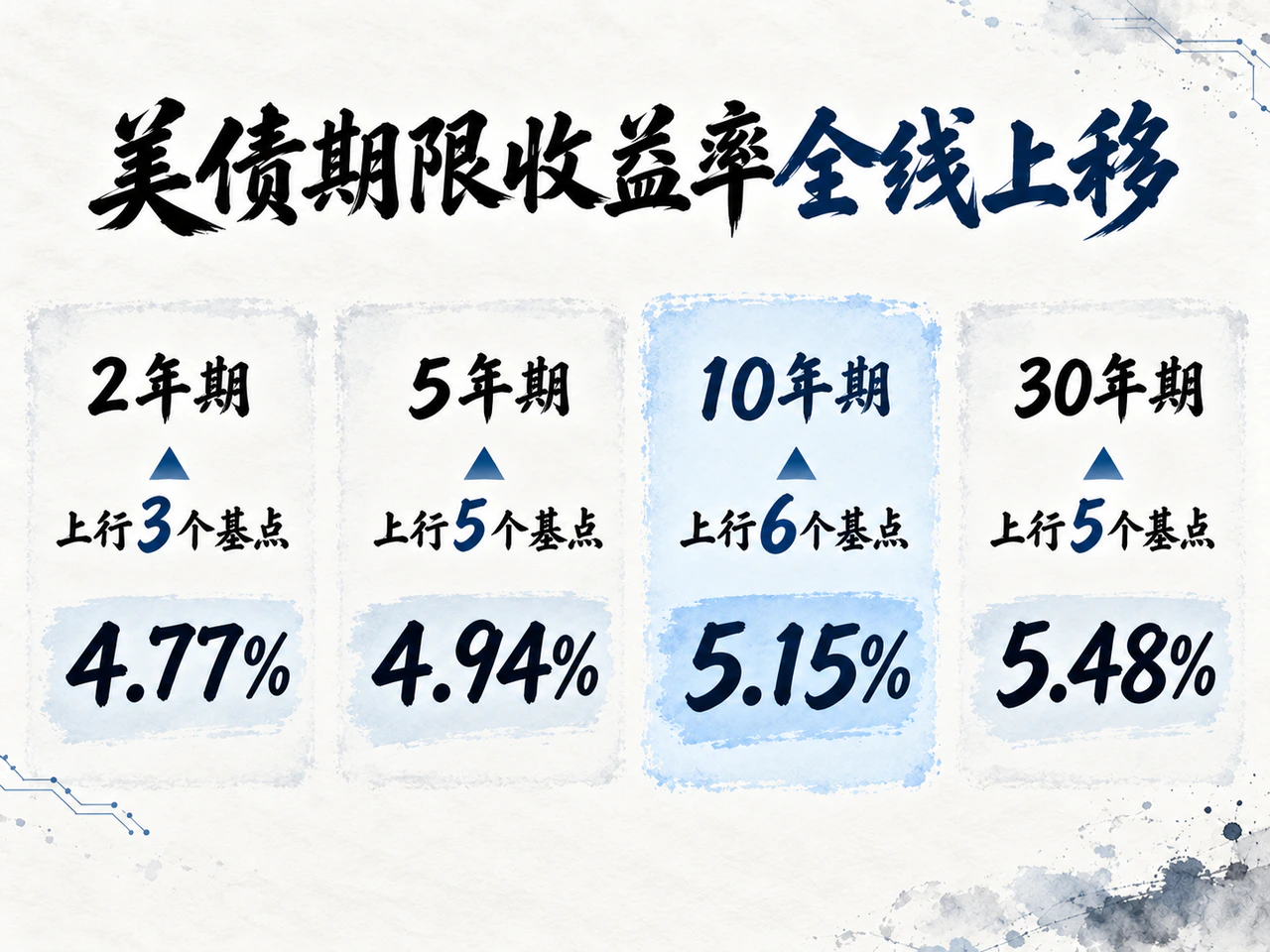
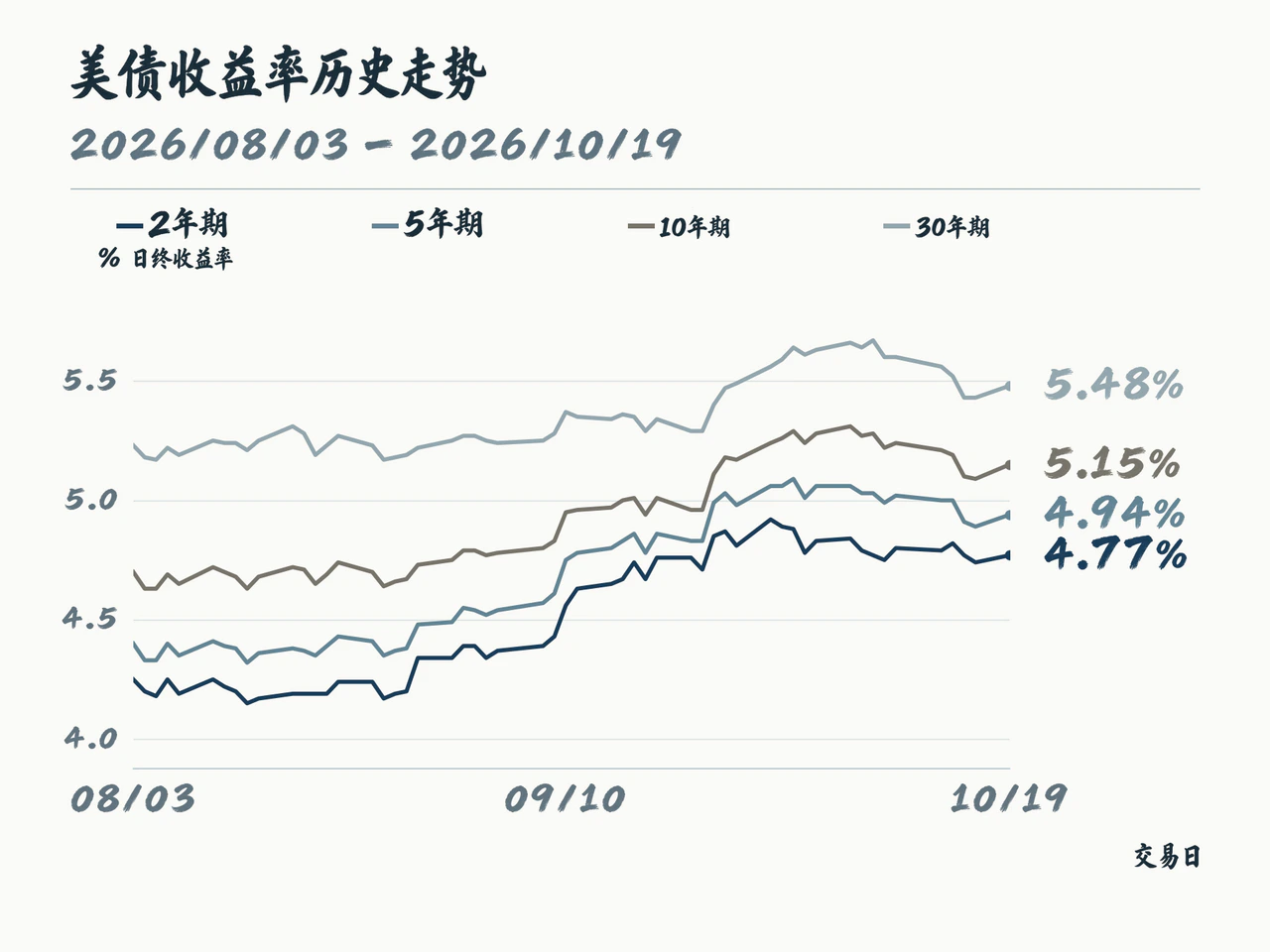
As risk appetite recovered in US equities, Treasury yields previously depressed by safe-haven buying rebounded across the curve. The US Treasury's end-of-day curve shows that on October 19, compared with October 16, the 2-year yield rose 3 basis points to 4.77%, the 5-year rose 5 basis points to 4.94%, the 10-year rose 6 basis points to 5.15%, and the 30-year rose 5 basis points to 5.48%. The 10-year–2-year spread widened from 35 to 38 basis points, with the intermediate and long end adjusting more. Over October 9–16, the 10-year yield had fallen from 5.24% to 5.09%, while the 2-year fell from 4.80% to 4.74%. Both rebounded on Monday but remained below their October 9 levels.
Real rates drove most of the day's nominal-yield increase. On October 19, the Treasury's 10-year real yield rose from 2.74% to 2.80%, also an increase of 6 basis points. The simple difference between nominal and real curves stayed at 2.35 percentage points, adding to the discount-rate pressure on distant cash flows. On monetary policy, Dow Jones reported during Monday's session that markets were reassessing the direction of the month-end meeting. BMO rates strategists argued that even if the Fed paused at that meeting, its communication would still need to preserve expectations of later rate increases.
High rates have already put substantial pressure on housing. The National Association of Home Builders reported that the October NAHB/Wells Fargo Housing Market Index fell from 32 to 29, its lowest since June 2012. The current-sales index declined to 33, expectations for sales over the next six months to 32, and prospective-buyer traffic to 18. The association said mortgage rates were recently well above 7%, while construction-loan, material and diesel costs were also rising. Higher monthly payments and building costs were simultaneously squeezing affordability and development margins. The survey showed 43% of builders cutting prices by an average of 6%, and 65% using sales incentives, yet buyer traffic continued weakening.
Corporate credit markets also showed increasing differentiation. The ICE BofA US High Yield option-adjusted spread reached 331 basis points on October 16, 8 basis points wider than October 15 and above the 311 basis points recorded on October 12. Investment-grade spreads, by contrast, stood at 84 basis points on October 15, versus 83 on October 9. The additional compensation demanded from weaker borrowers was increasing more visibly. Concerns over AI-company financing were unfolding within this macroeconomic backdrop.
Treasury supply continued shaping long-term financing conditions. Figures released the previous week put the US fiscal 2026 deficit, for the year ended September 30, at approximately $2 trillion, above the previous year's roughly $1.8 trillion. Institutional analysis on Monday returned to the large deficit and interest burden. Persistent borrowing needs form the supply backdrop for long-end rates. This Wednesday's 20-year Treasury reopening and Thursday's 5-year TIPS auction will test demand for long-duration debt and inflation protection, respectively.
Prompt Brent Falls to $117 as Higher Real Yields Push Gold Down 0.67%
In commodities, policy exemptions and recovering physical supply from the Middle East brought spot oil down from elevated levels. President Trump signed an executive order on October 16 exempting new Russia-related taxes and several sanctions provisions under the relevant law; Russia sanctions under other earlier executive orders remained in place. The move eased pressure on buyers of Russian energy to change procurement sources. Secretary of State Rubio said he wanted 60 days to assess the economic effects, while the order itself specified that the exemptions would last until otherwise determined. Energy Secretary Wright also said Gulf oil flows had recovered to about 80% of pre-conflict levels. Bloomberg reported prompt Brent at approximately $117 a barrel on Monday, nearly $16 below a week earlier. Iranian risks nevertheless continued influencing markets through Hormuz shipping security and energy-transport costs: recovering exports coexisted with transport constraints.
Crude futures differed sharply by delivery month. The November WTI contract, due to expire on Tuesday, rose $2.25 on Monday to settle at $103.66 a barrel. The more actively traded December contract fell $0.48 to $98.54. The front month stood $5.12 above the following month, reflecting a continuing premium for near-term delivery. Continuous Brent futures closed at $109.28 a barrel, down 0.53%.
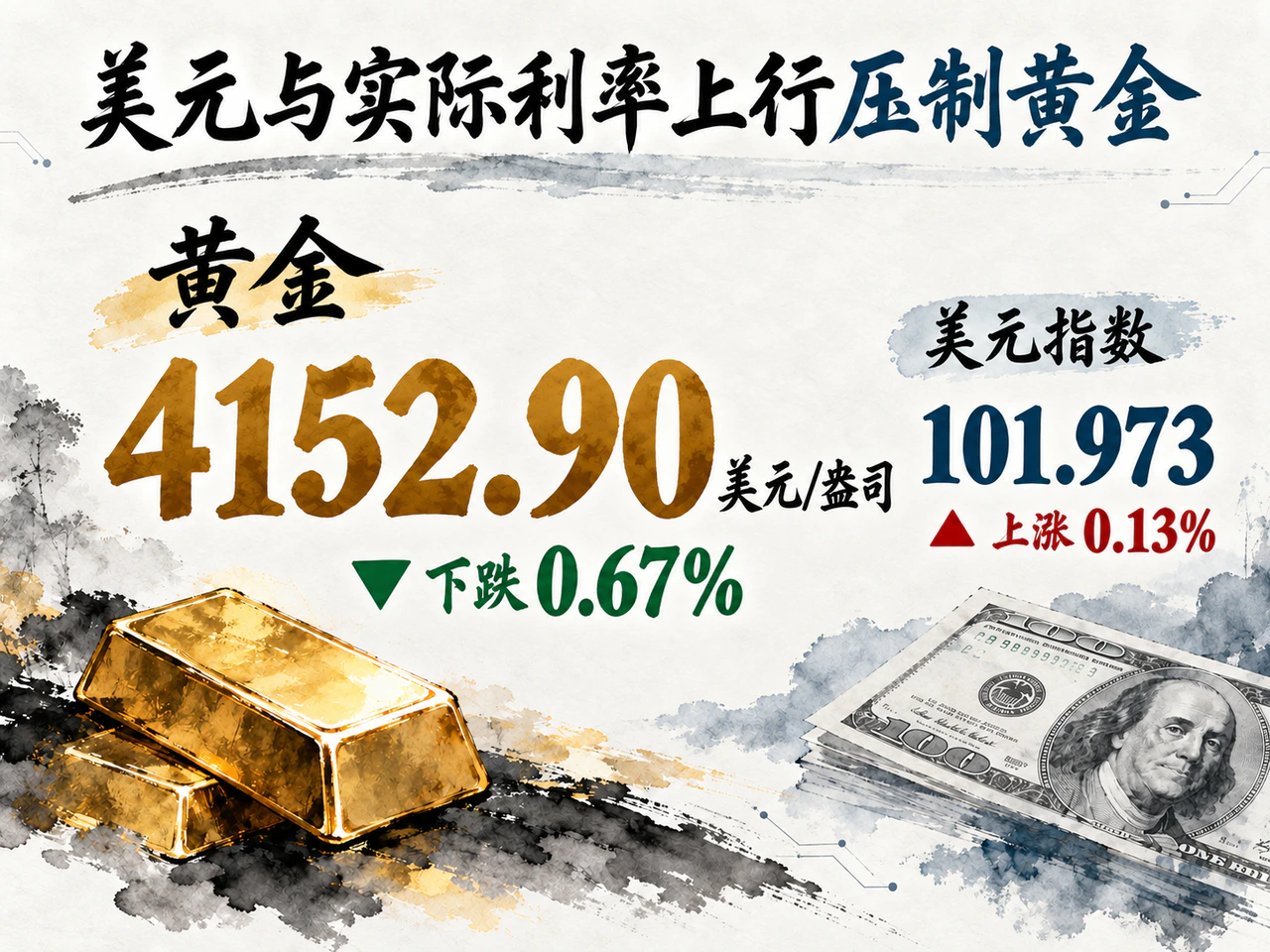
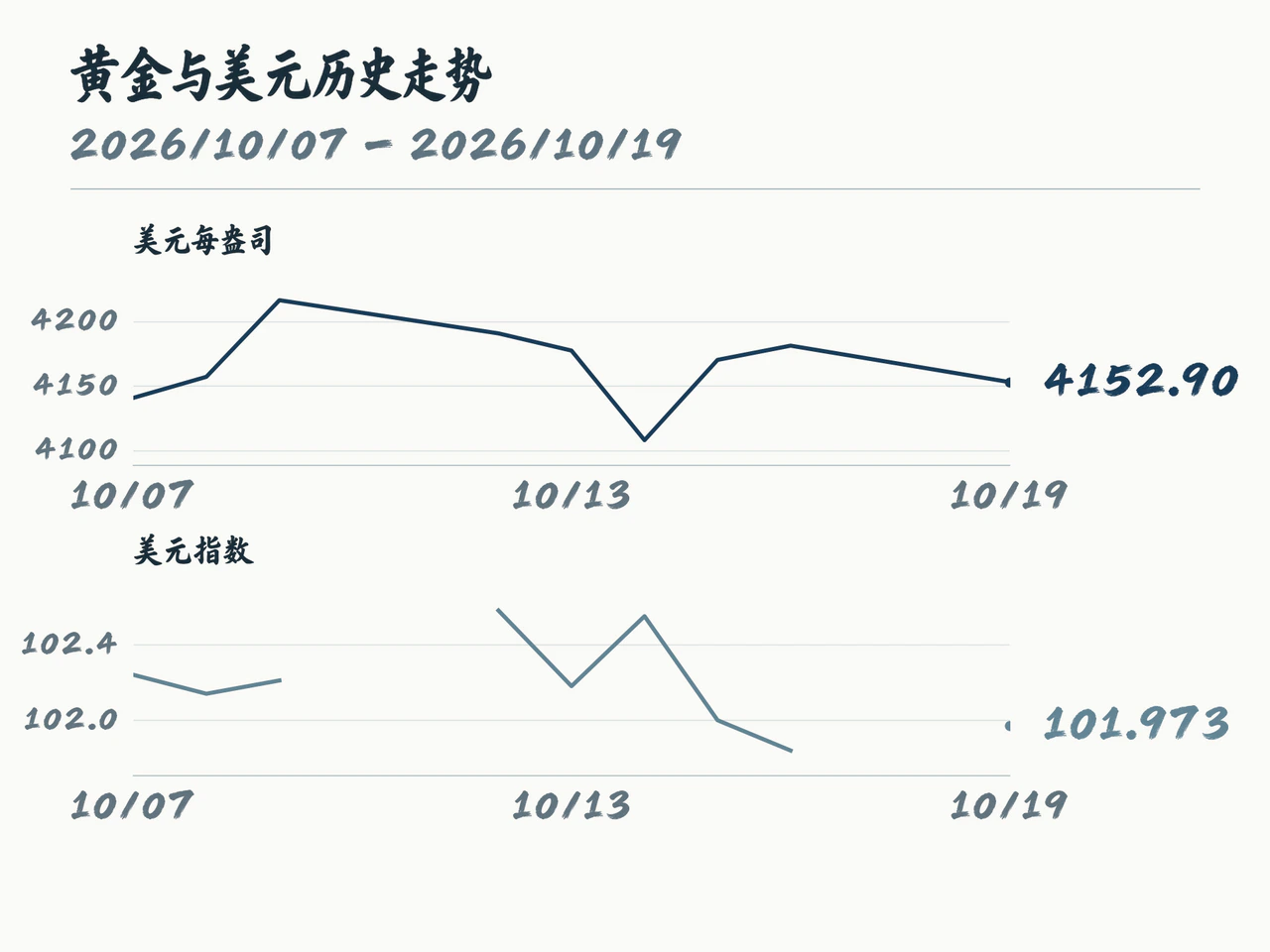
In precious metals, continuous gold futures closed Monday at $4,152.90 an ounce, down 0.67%. Gold initially rose as falling oil eased inflation concerns, but failed to retain its gains. The dollar index closed 0.13% higher at 101.973, rising alongside real Treasury yields and increasing gold's opportunity cost. Recovering equities and lower volatility also reduced some safe-haven buying.
China's Third-Quarter GDP Growth Beats Expectations at 4.5%; Battery Stocks Lift Korea by 1.76%
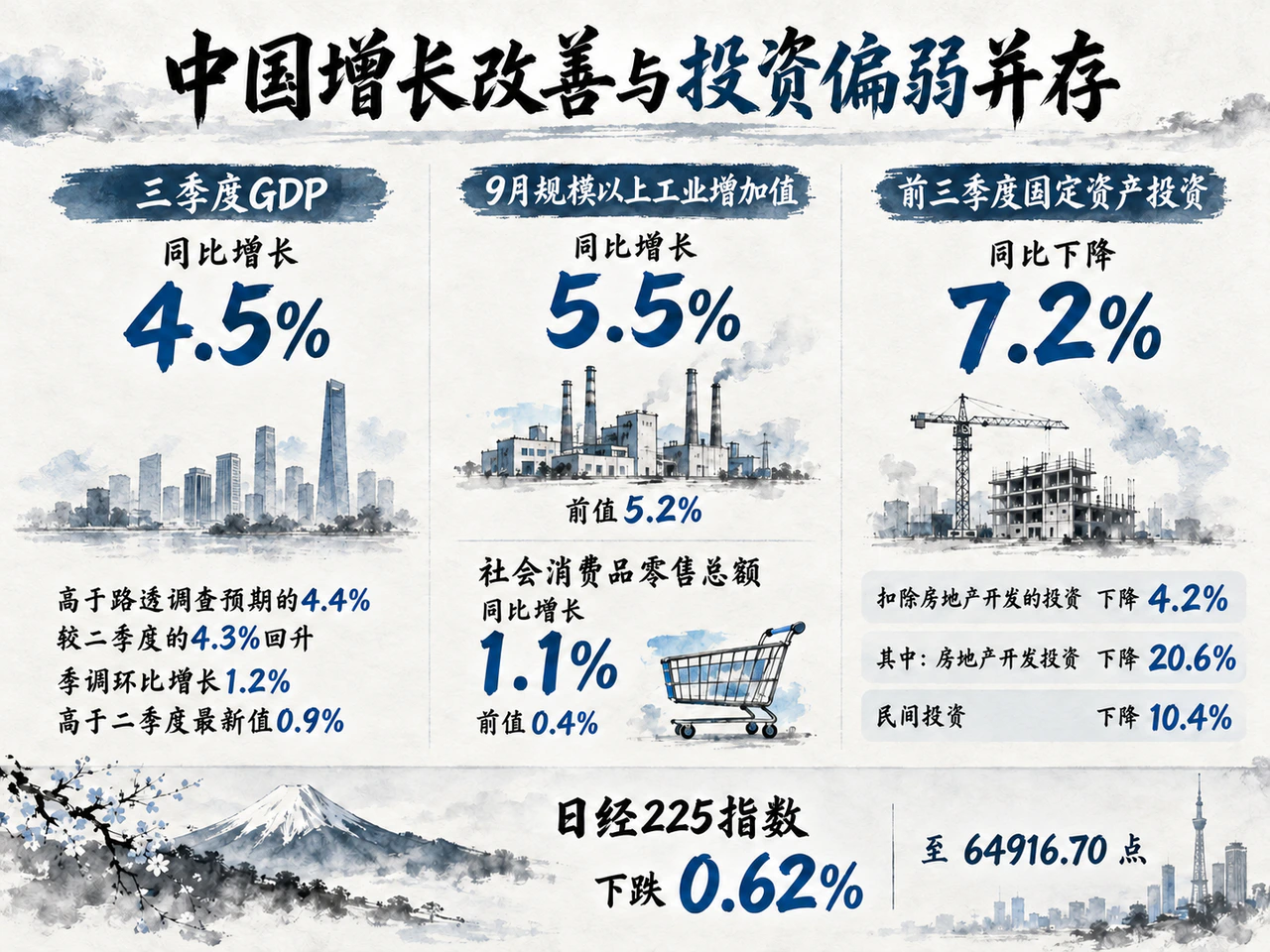
Data released on October 19 showed China's third-quarter GDP growing 4.5% year on year, above the 4.4% expected in a Reuters survey and up from 4.3% in the second quarter. Seasonally adjusted quarter-on-quarter growth was 1.2%, above the second quarter's latest reading of 0.9%. GDP grew 4.6% over the first three quarters, easing near-term downward pressure on growth.
The breakdown showed stronger production and service consumption, while goods retail and investment recovered more slowly. Industrial value added at enterprises above the designated size rose 5.5% year on year in September, versus 5.2% previously, and total retail sales of consumer goods rose 1.1%, versus 0.4%. Over the first three quarters, value added in equipment manufacturing and high-tech manufacturing increased 10.2% and 14.3%, respectively; retail sales of services rose 5.0%, and goods sales rose 1.0%. Investment remained a weak part of the growth mix. Fixed-asset investment fell 7.2% year on year in the first three quarters, while investment excluding property development fell 4.2%. Property-development investment declined 20.6%, and private investment fell 10.4%. Real per-capita disposable income rose 4.4%, while real per-capita consumption expenditure increased 2.7%, indicating that improving production had yet to translate fully into parallel growth in household spending and corporate investment.
Financial policy was also seeking to improve transmission. CLS reported on October 19 that the People's Bank of China would study shifting the main open-market operation to an overnight maturity when appropriate, making the overnight repo rate the main policy rate, while promoting more diverse loan-pricing benchmarks. Relevant authorities would also establish a liquidity-support tool for large redemptions at nonbank institutions. The proposals aim to improve control of short-term rates and cushion the transmission from redemption pressure into concentrated bond selling.
Major Asian equity markets were mixed on Monday. On October 19, Korea's KOSPI rose 1.76% to 5,768.01, Japan's Nikkei 225 fell 0.62% to 64,916.70, and Hong Kong's stock market was closed for the holiday following the Chung Yeung Festival. In Korea, institutions bought a net KRW 575.6 billion while foreigners sold a net KRW 18.7 billion. Samsung SDI surged 10.75% and LG Energy Solution rose 5.96%, with battery stocks substantially outperforming major memory-chip shares. The overnight recovery in US chip and cloud stocks provided external sentiment support for related Asian technology assets. Further gains still depend on local corporate earnings, capital flows and recovering demand for renminbi assets. With US benchmark rates rising, refinancing requirements and cash-flow quality also remained key dividing lines among Chinese US-dollar bond issuers.
France–Germany 10-Year Spread Widens to 144 Basis Points; Four European Telecoms Plan a Joint Satellite-Spectrum Bid
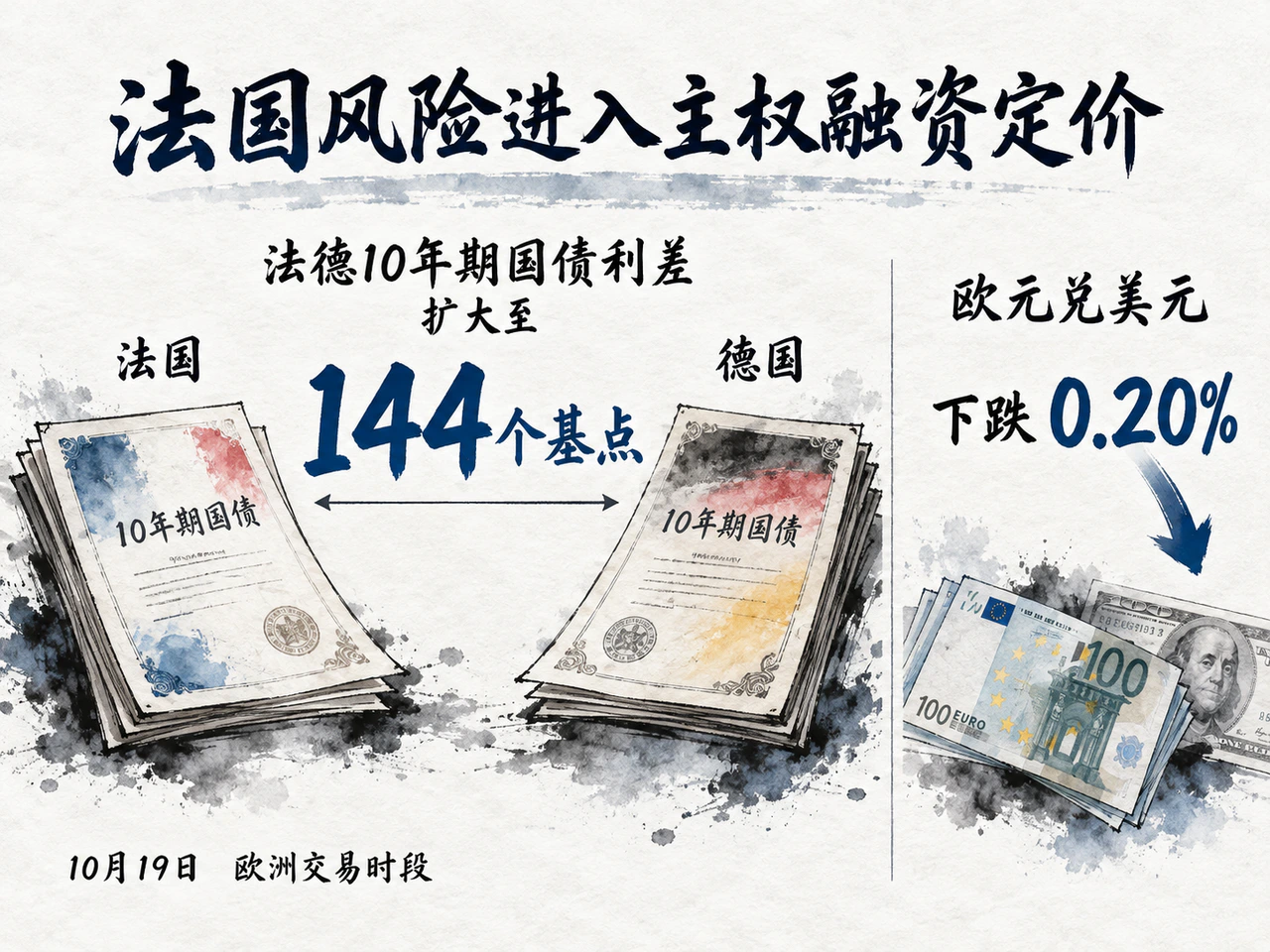
In Europe, French political risk continued transmitting through sovereign spreads. Following weekend protests and clashes, Prime Minister Lecornu called on Monday for localized curfews in some areas. Reuters reported that during European trading, the French 10-year sovereign spread over Germany widened about 2 basis points to 144 basis points, while the euro was down 0.20% against the dollar at 1.1218. In early October, the spread had widened roughly 40 basis points over several days and exceeded 150 basis points, showing that domestic risk was already persistently affecting sovereign funding prices.
Industrial policy was also changing expectations for European companies' market access. Deutsche Telekom, Orange, Telefónica and Vodafone signed a memorandum of understanding on October 19 to explore a joint bid for European mobile-satellite-services spectrum and advance direct-to-device satellite services. The four plan to build ground networks and coordinated monitoring facilities; a satellite partner has yet to be selected, and they do not plan to invest directly in a satellite constellation. Meanwhile, media accounts of a Financial Times interview quoted the US ambassador to the EU warning that restrictions on US companies' access to the spectrum could provoke retaliation. The cooperation remains at the memorandum stage. Subsequent spectrum arrangements will directly affect European telecom operators' new businesses, the allocation of satellite-company orders and transatlantic market access.