By the morning of October 21, Beijing time, Hong Kong's stock-option market was showing sharp divergence among individual names despite a decline in overall volume. On October 20, Pop Mart shares closed down 4.08% at HK$136.40. Its options traded 118,500 contracts during the day, nearly 2.9 times the previous session's volume on October 16, lifting its share of total stock-option turnover to 14.5%. Disagreement over third-quarter sales expectations, combined with concern about potential funding needs at the shareholder level, pushed risk pricing into November expiries. The stock's correction was reflected both in a lower cash price and higher option-implied volatility.
Sales disagreement and potential share-supply concerns lift Pop Mart's share of option volume to 14.5%
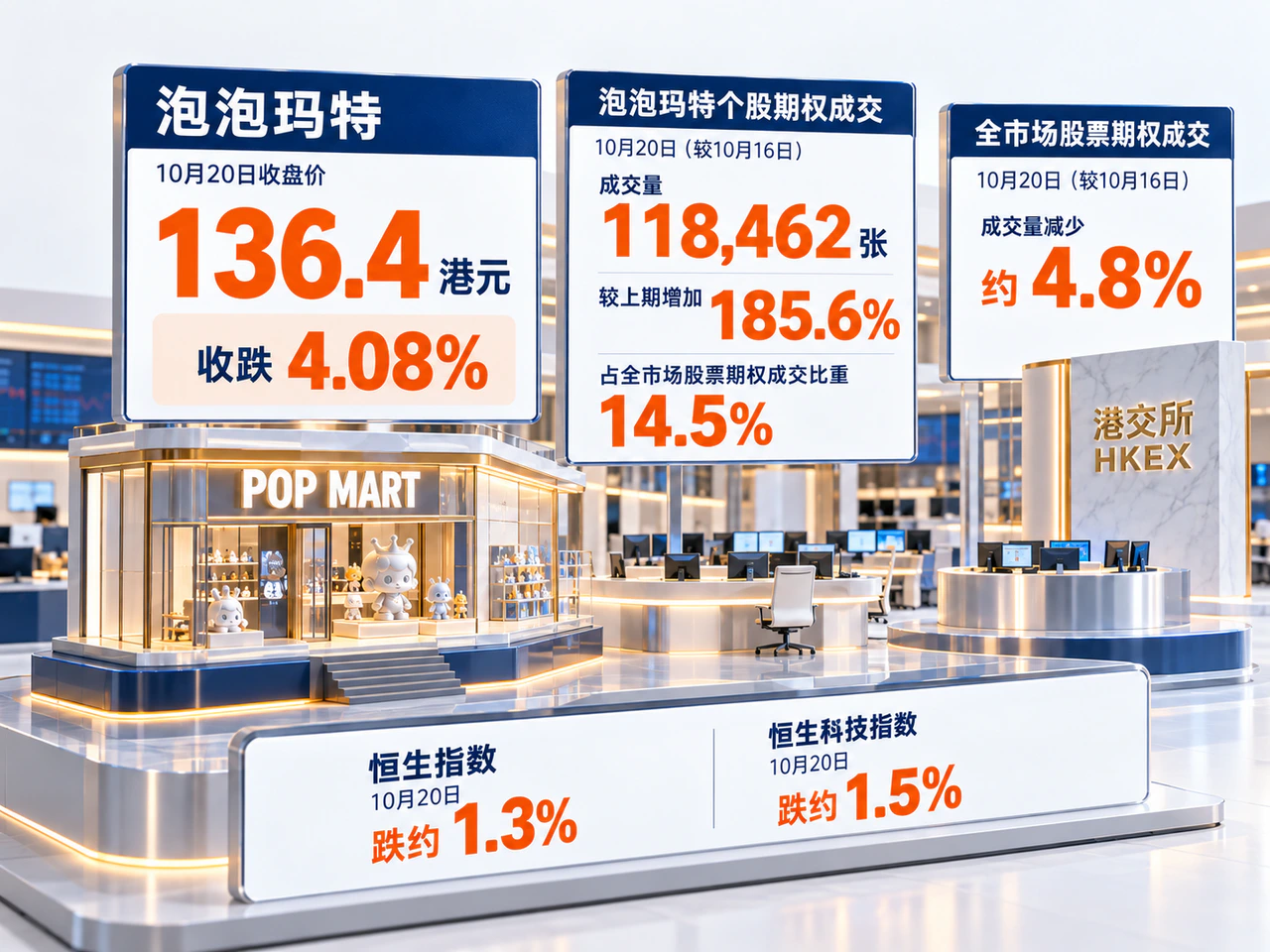
Hong Kong's ET Net reported that technology and internet stocks generally came under pressure on October 20, with the Hang Seng Index down about 1.3% and the Hang Seng Tech Index down about 1.5%. Pop Mart closed at HK$136.40, underperforming the broader market substantially. An afternoon report by Bastille Post said concerns centered on the third-quarter sales outlook and possible shareholder funding needs arising from offshore trust tax arrangements. The reports did not confirm that the founder had sold shares for this reason; the latter issue remained a market concern about potential share supply.
The main fundamental uncertainty was the substantial disagreement among institutions about third-quarter sales. According to Bastille Post, a Morningstar analyst using third-party monitoring data estimated that Pop Mart's third-quarter sales might have fallen more than 50% year on year. The report also cited Citi's earlier forecast for a decline of about 35% in revenue. Before the company's formal third-quarter disclosure, the gap between these estimates showed that the market was confronting both an expected slowdown and uncertainty over how severe the decline might be.
Company-specific events were reflected particularly clearly in options trading. HKEX daily statistics showed total stock-option volume of 818,074 contracts on October 20, about 4.8% below the 859,454 contracts traded on October 16. Pop Mart option volume, however, surged about 185.6%, from 41,472 to 118,462 contracts. Its share of total stock-option volume jumped from about 4.8% to 14.5%. The increase was therefore concentrated in a risk event affecting a single underlying, rather than a general expansion in the options market. Pop Mart's volume that day comprised 49,463 calls and 68,999 puts, with puts accounting for about 58.2%.
Two leading November put strikes add 9,436 contracts, extending the pricing horizon to late November
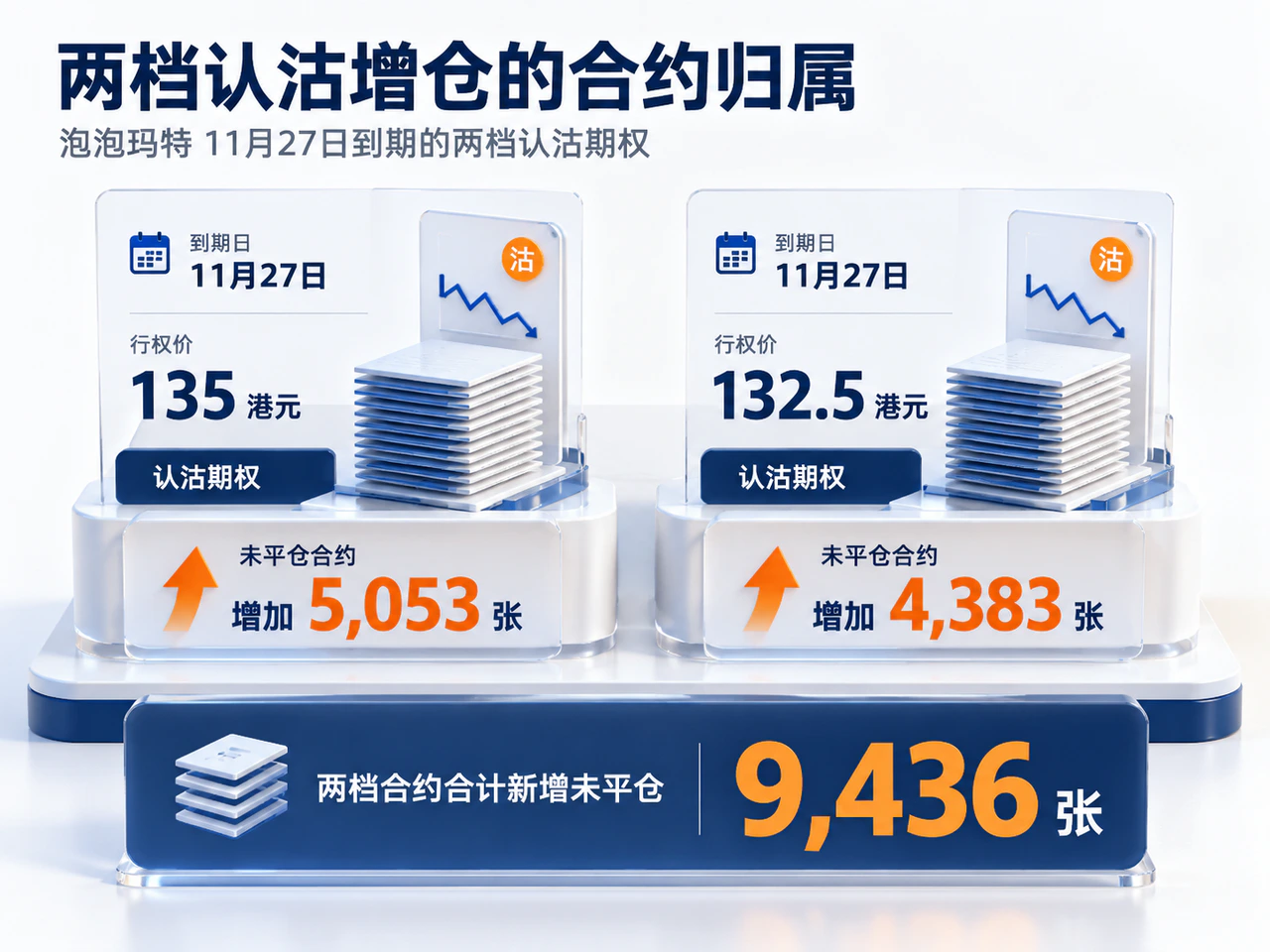
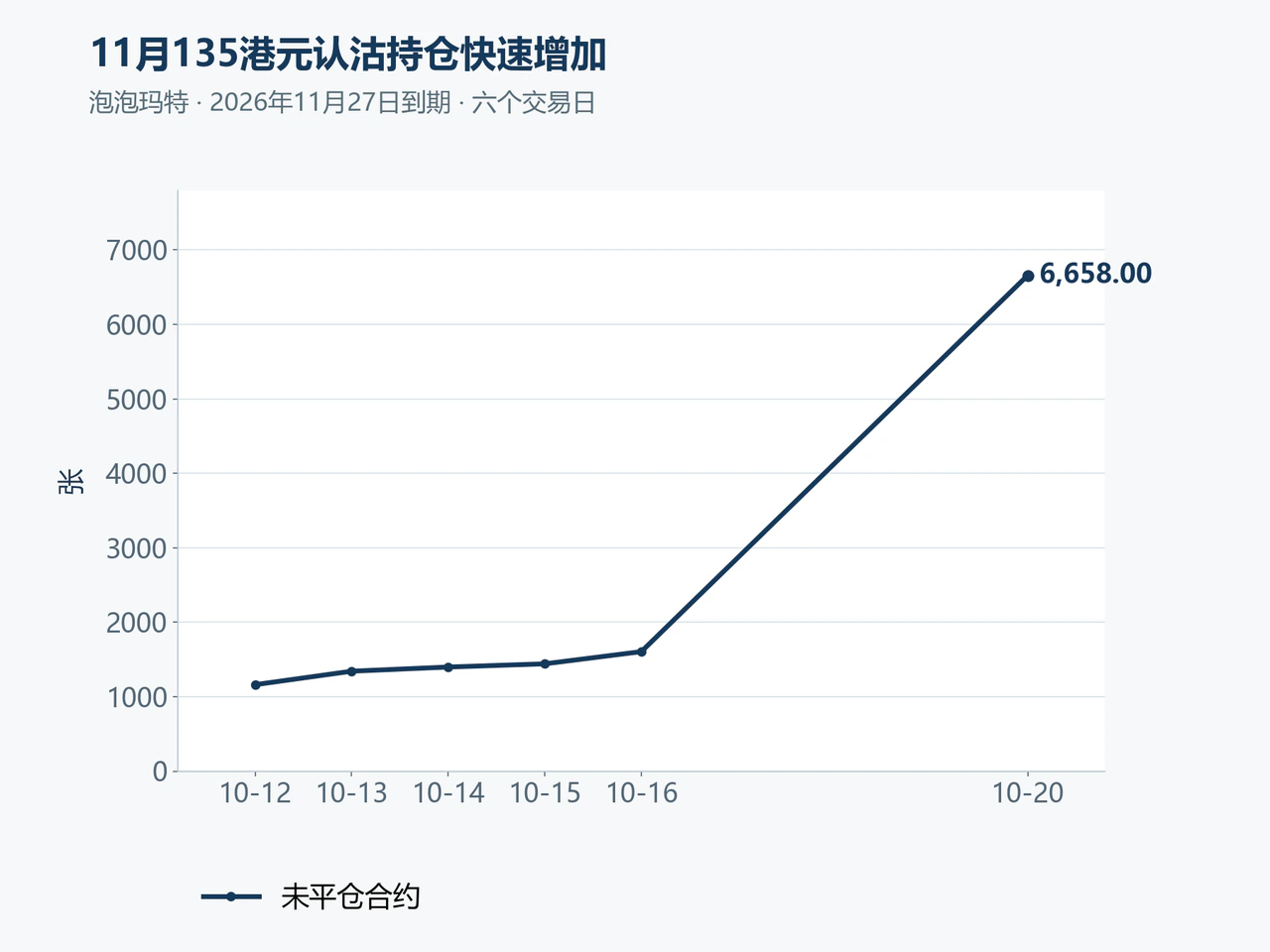
At the individual contract level, new positions accumulated in November puts. On October 20, Pop Mart's HK$135 put expiring November 27 traded 6,662 contracts. Open interest rose from 1,605 contracts in the previous session to 6,658, an increase of 5,053 in one day. The HK$132.50 put with the same expiry traded 5,976 contracts, and its open interest increased by 4,383 to 6,037. Together, the two strikes traded 12,638 contracts and added 9,436 contracts of open interest.
The combination of heavier volume and sharply higher open interest shows that risk transfer around these two strikes was not entirely unwound within the day; it became outstanding positions. Whatever the counterparties' specific purposes—protecting shareholdings, earning premiums, closing positions or adjusting portfolios—the significant expansion in open interest means that buyers extended downside protection for the coming weeks, while sellers assumed the corresponding obligation risk should the shares fall further over the same period.
The HK$135 strike was only about 1% below the October 20 closing share price of HK$136.40. As the underlying fell from HK$142.20 on October 16, this contract moved from relatively out of the money toward the at-the-money area. Each further decline in the shares consequently had a larger effect on the put's value, making the area around this strike a key place to monitor demand for protection and willingness to absorb risk. Activity was not confined to contracts expiring that week. The buildup in November puts extended the observation window, leaving room to price the timing of third-quarter sales disclosure, the gap between actual results and institutional forecasts, and whether concerns about potential share supply would materialize.
The HK$135 put's settlement price more than doubles in a day as implied volatility reaches 31%
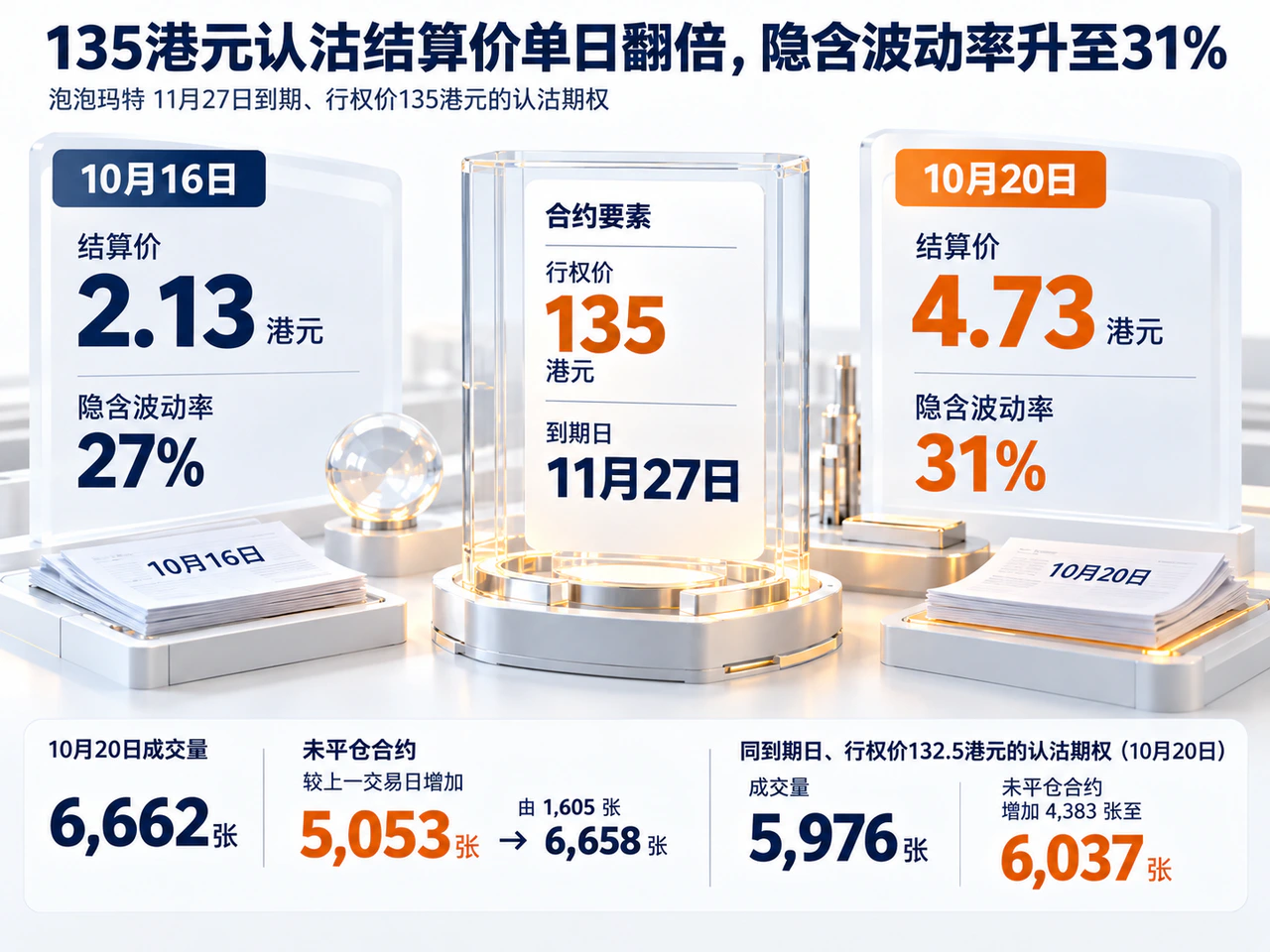
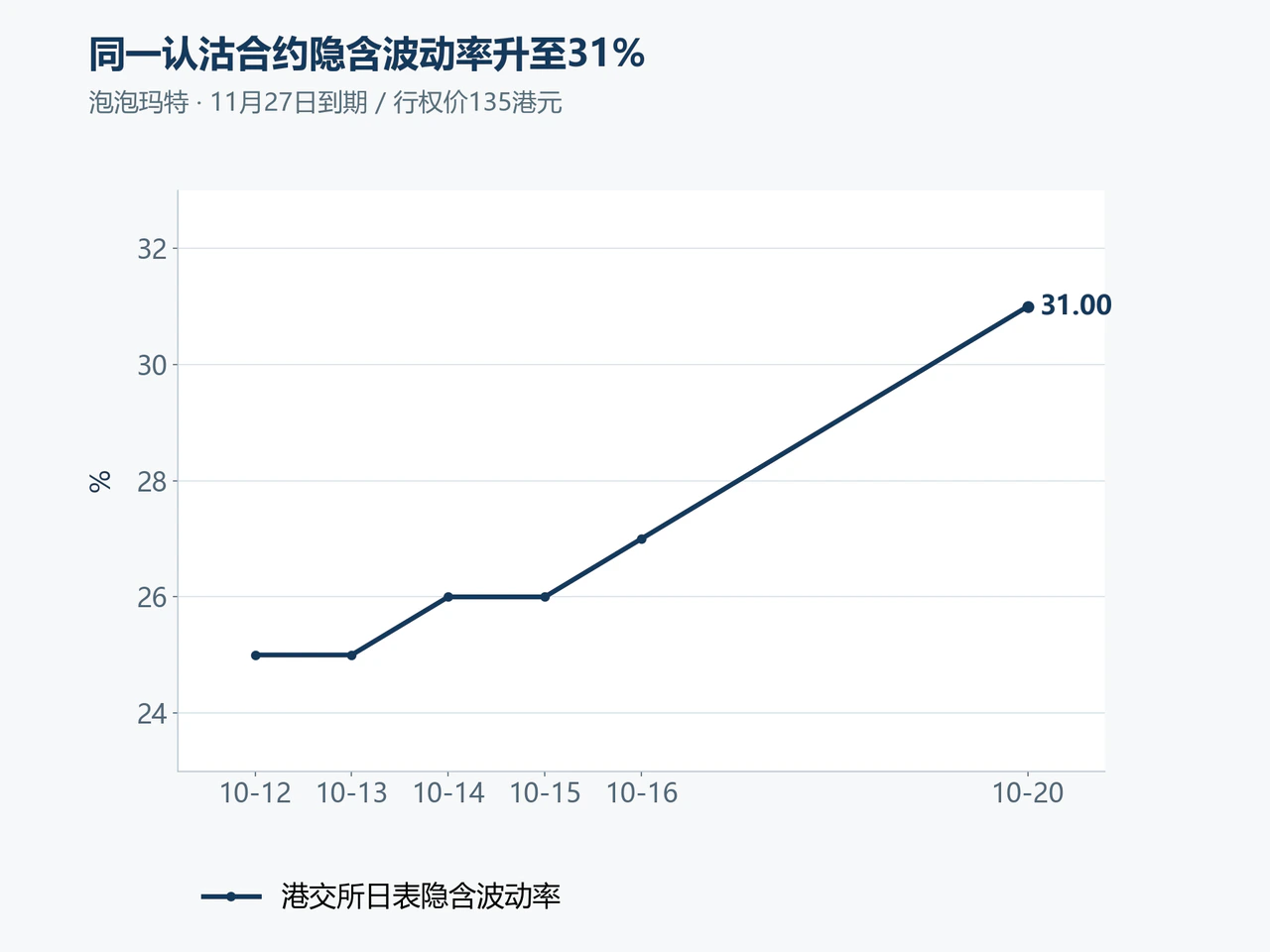
The repricing of risk appeared in both the lower share price and higher option volatility. For the HK$135 put expiring November 27, HKEX daily statistics listed settlement prices of HK$0.78 on October 12, HK$2.13 on October 16 and HK$4.73 on October 20. Corresponding implied volatility was 25%, 27% and 31%, respectively. Over the six trading sessions from October 12 to October 20, Pop Mart's closing share price fell from HK$149.60 to HK$136.40, while the contract's implied volatility rose overall.
On October 20 alone, this contract's settlement price rose HK$2.60, more than doubling. Both the underlying's move and volatility pricing drove the change. The share price approaching the strike directly increased the put's value, while the rise in implied volatility from 27% to 31% showed that options were simultaneously pricing greater future fluctuation. The contract's gain therefore reflected both the falling share price and a higher volatility premium.
The repricing was accompanied by a wide intraday trading range. On October 20, the contract actually traded between HK$3.02 and HK$6.75, with a closing settlement price of HK$4.73 used for valuation. That broad range means that even correctly anticipating a decline would not remove the substantial effect of entry timing and execution price on final profit or loss. In strategy terms, selling puts can earn a larger premium to compensate for downside risk when option prices and volatility rise. But with the underlying nearing the strike, further share-price declines would increase both losses and the funding required to meet obligations. A covered-call strategy offers only a limited premium cushion against falling shares and, if a sharp rebound follows, involves the trade-off of capped upside.
Lower index volatility cannot conceal company-specific shocks; watch third-quarter disclosure and HK$135
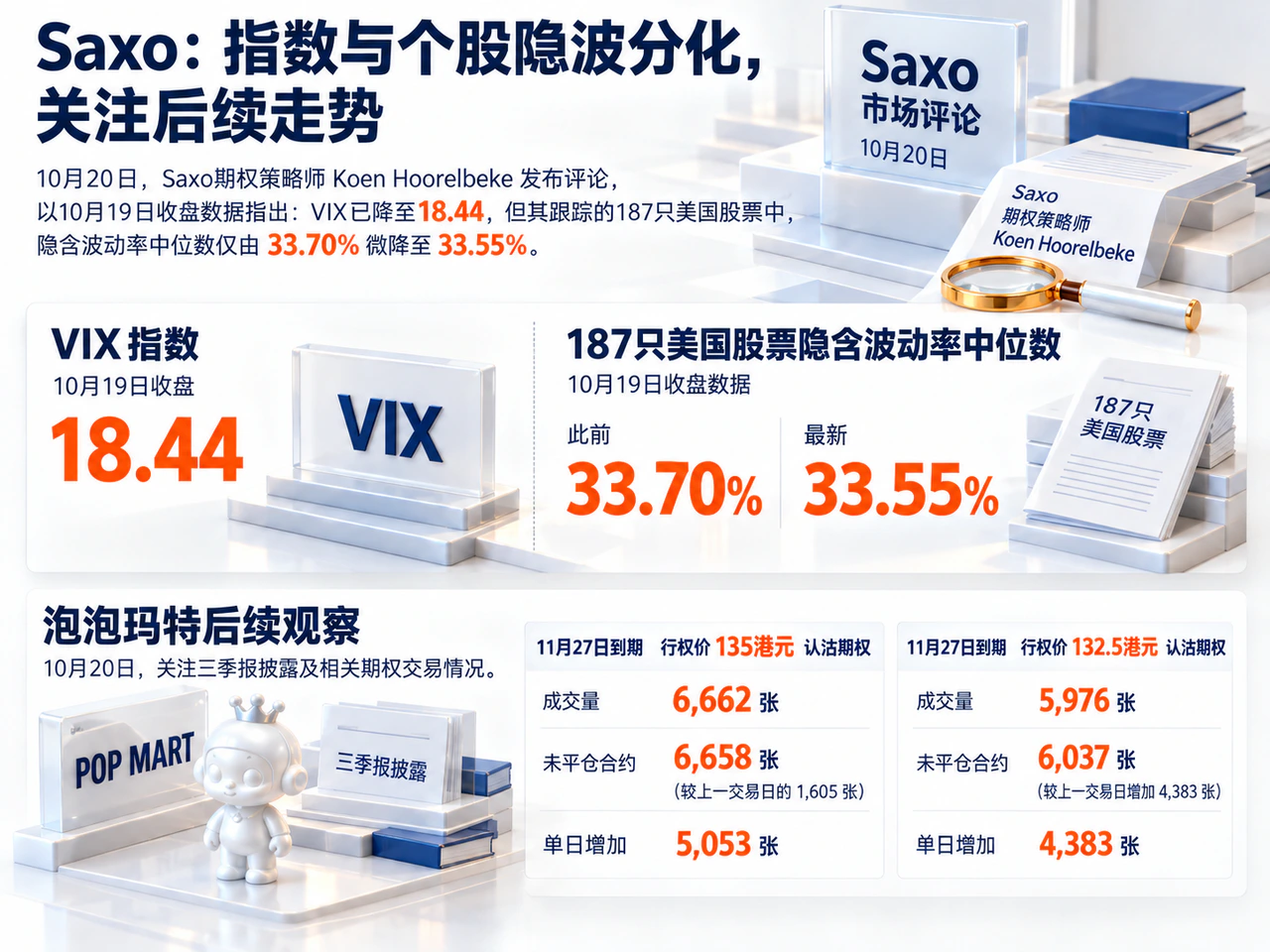
Recent U.S. market behavior also illustrates the divergence between index and single-stock volatility. In commentary published on October 20 using October 19 closing data, Saxo options strategist Koen Hoorelbeke noted that the VIX had fallen to 18.44, while median implied volatility among the 187 U.S. stocks he tracked had edged down only from 33.70% to 33.55%. He argued that changes in correlation had caused index volatility to fall much more than volatility in a typical individual stock. Easing common market risk can therefore coexist with persistent company-specific risk.
Index options absorb the shared movement of a basket of stocks, while single-stock options must also price company-specific events, allowing their risk premiums to move in different directions. Pop Mart's rising volume and implied volatility amid a decline in overall Hong Kong option trading show that disagreements over company sales and concerns about potential share supply can independently raise a stock's volatility, even as external or broad-market fear indicators ease.
Assessing whether Pop Mart's risk premium is easing will require continued attention to these November puts: whether company disclosures narrow the disagreement over third-quarter sales; how the cash share price moves around HK$135; and whether implied volatility and open interest in November puts subsequently fall. If the shares stabilize but implied volatility remains high, event uncertainty is still embedded in option prices. If fundamental information becomes clearer, the share price and volatility may absorb the news through adjustments of differing magnitudes.