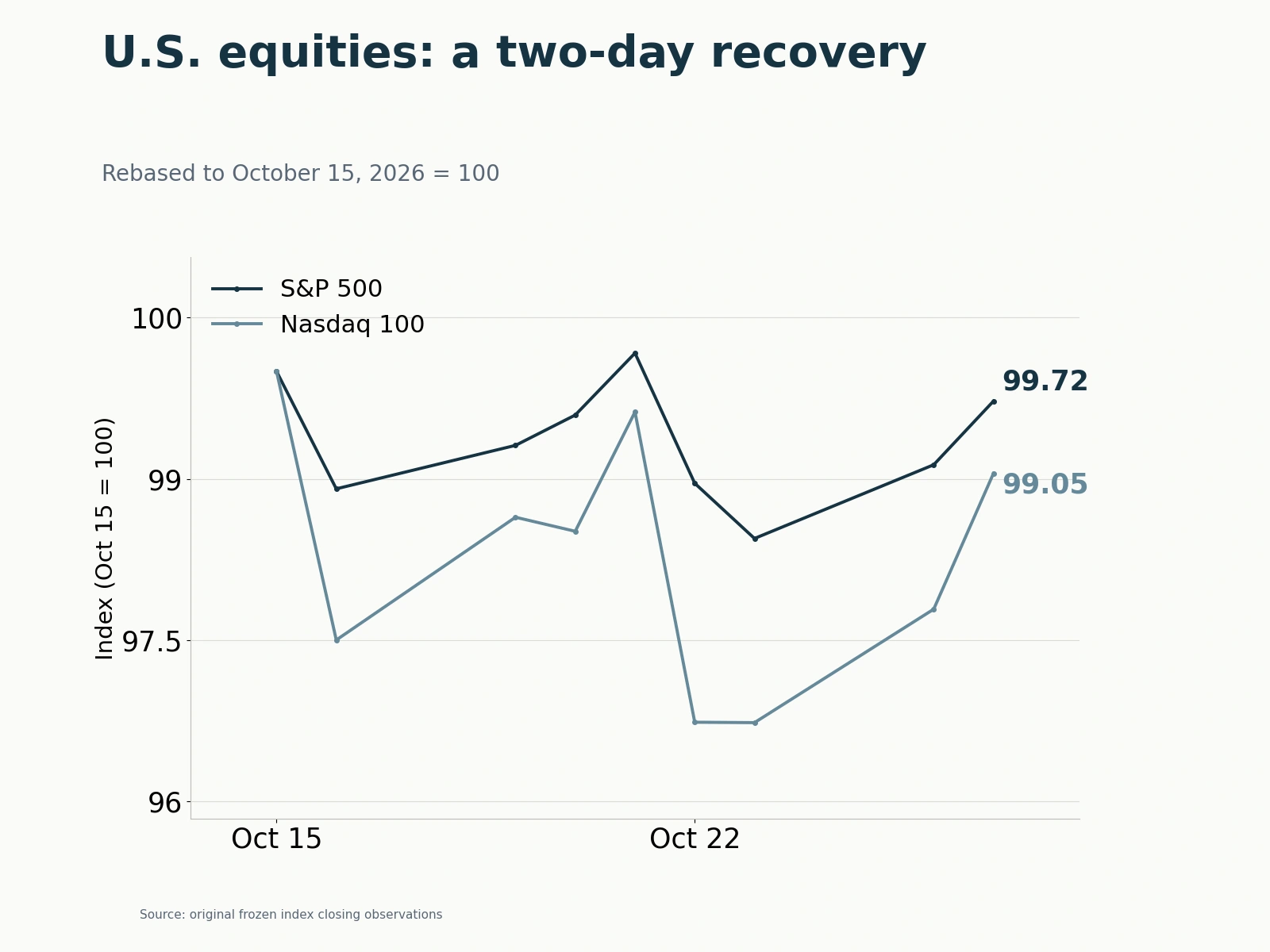
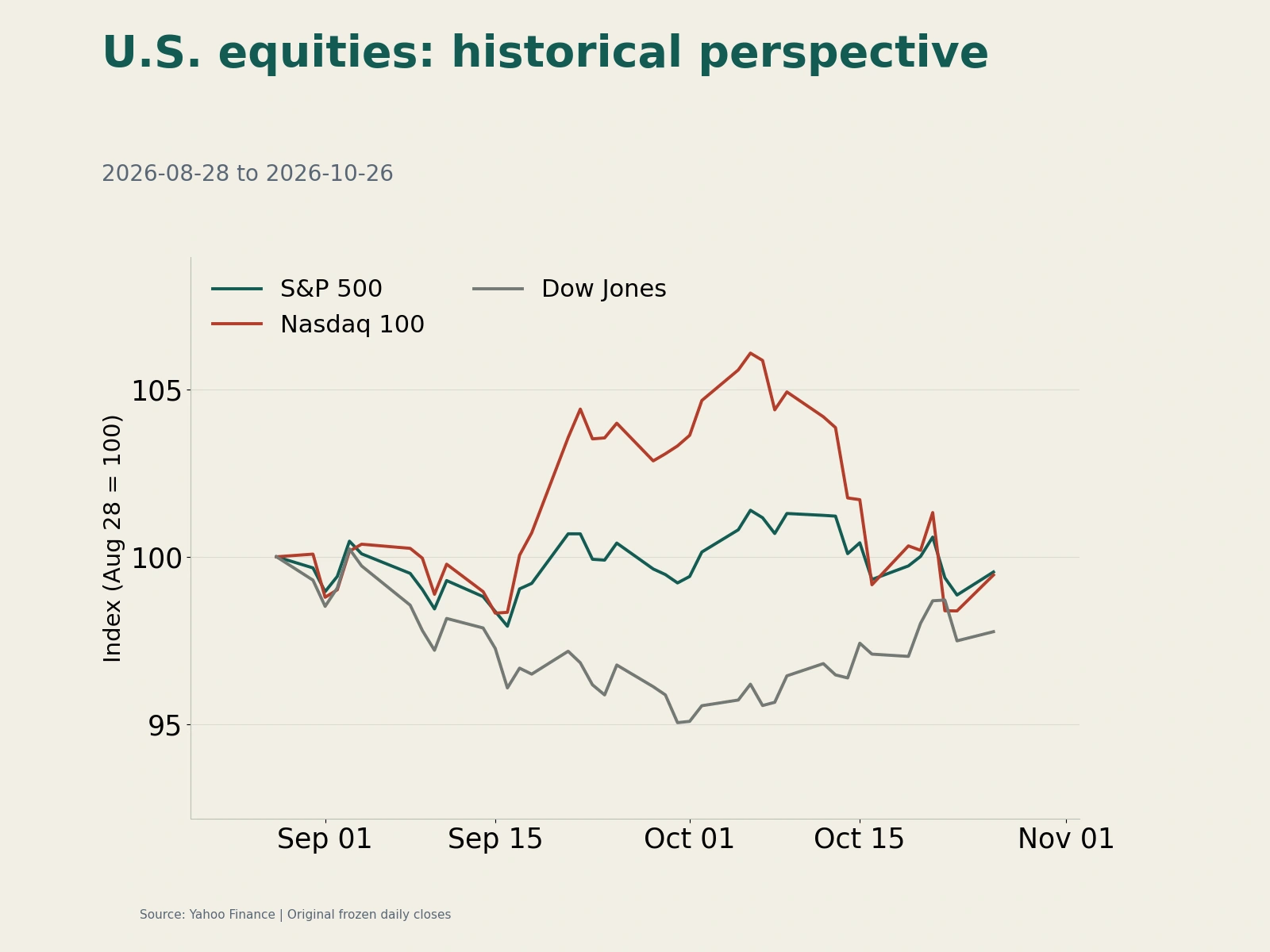
On October 21, 2026, U.S. equities rebounded on revenue growth at technology companies, while bond markets continued to price high interest rates. The Nasdaq 100 gained 1.13%, and U.S. 2-year and 10-year Treasury yields rose to 4.81% and 5.13%. Mortgage applications continued to decline, oil remained expensive and gold was broadly flat. Growth from technology demand was pulling against financing and energy costs, sustaining divergence across assets and industries.
By the morning of October 22 Beijing time, investors were focused on whether revenue growth could keep pace with investment. Computing demand improved technology earnings expectations, but heavy capital expenditure also created a continuing need for finance. Households and businesses remained under pressure from high interest rates and energy prices. This contrast ran through the day's stock and bond performance and changes in real-economy demand.
Nasdaq 100 gains 1.13% as technology financing pressures diverge

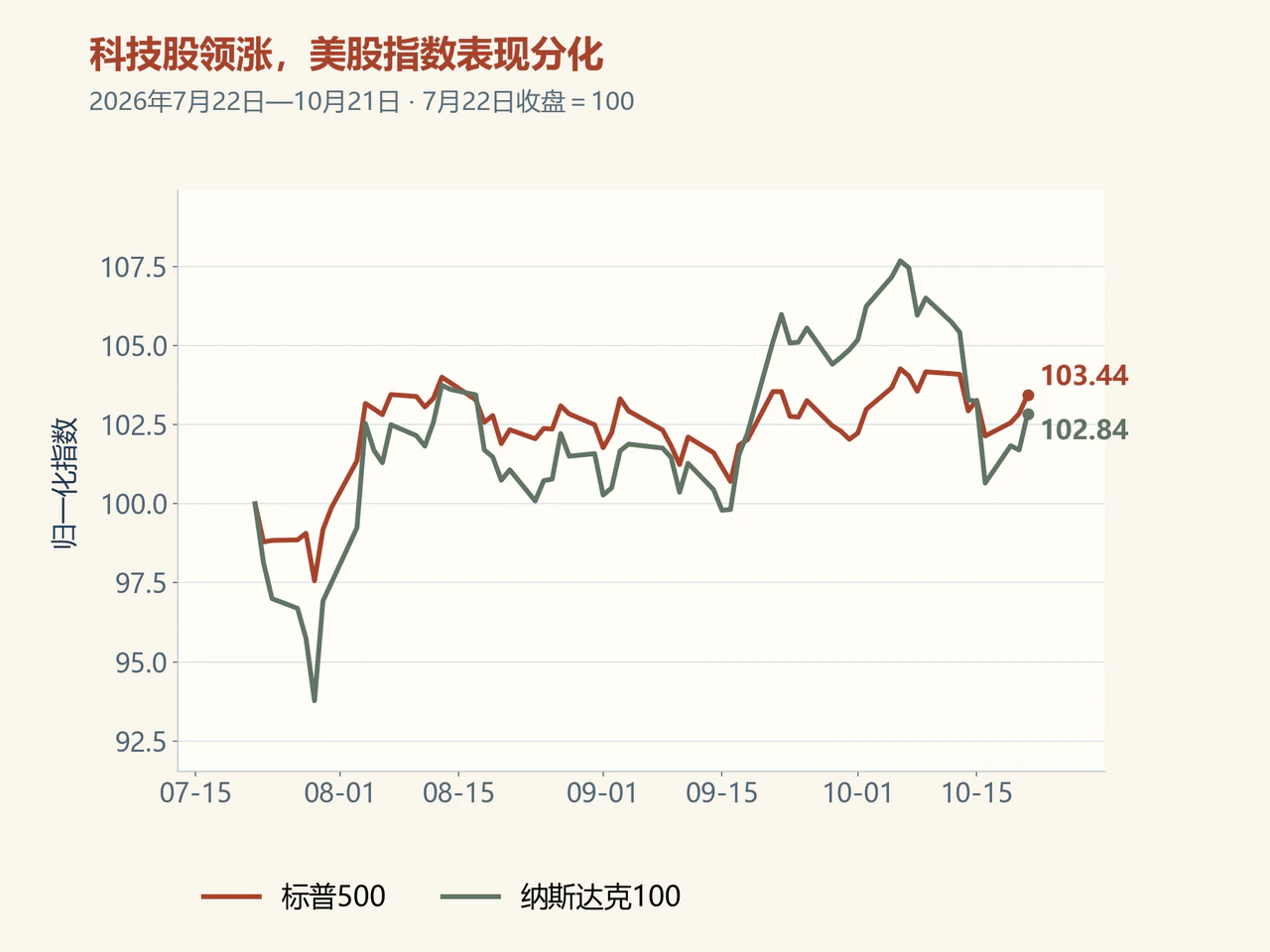
The S&P 500 closed October 21 at 7,757.17, up 0.58%; the Dow rose 0.69% to 52,856.09; and the Nasdaq 100 closed at 29,822.52, outperforming the Russell 2000's 0.27% gain. Technology ETF XLK rose 1.67%, while financial and energy sector ETFs gained 0.57% and 0.28%. The VIX fell from 17.31 to 16.68, suggesting some easing in near-term demand for protection.
Operating figures supported technology buying. CNBC reported that SpaceX's third-quarter revenue rose 161% year on year to $14.58 billion, with artificial-intelligence revenue reaching nine times its year-earlier level. SpaceX and Tesla each formed special committees to discuss a possible merger. The Associated Press closing report showed SpaceX up 7.8%, Tesla up 3.4% and Nvidia up 2.5%; Nvidia was the largest contributor to the S&P 500's advance. Super Micro Computer said stronger AI-platform demand would lift quarterly revenue above its earlier forecast; its shares rose 9.5%.
Capital-intensive companies did not perform uniformly. CoreWeave, which borrows to buy chips and rents out computing capacity, closed down 0.5%. Debt financing also drew attention in credit markets. Zhitong Finance reported on the morning of October 21 that Oracle's CDS had reached 343 basis points intraday on October 20, while Meta's credit-risk measure had risen as much as 6.3 basis points to 114.8 basis points. PIMCO multi-asset credit strategist Lotfi Karoui linked rising protection costs to the scale of debt needed for AI construction and uncertainty over issuance after earnings season. Revenue expansion improves equity earnings expectations; continuing borrowing adds bond supply and repayment pressure.
Other earnings-season reactions showed that the next stage of growth also matters for share prices. Netflix beat earnings expectations but issued fourth-quarter revenue growth guidance below analysts' forecasts; its shares fell 5.3%. AT&T also beat quarterly earnings expectations yet fell 6.4%, as investors focused more on its full-year guidance for growth in an underlying earnings measure. The S&P 500 rose for three consecutive trading sessions from October 16 to 21, gaining about 1.28% in total but remaining below its October 9 level of 7,811.54. The recent rally reflected both earnings validation and recovery after a selloff.
Asian markets had already diverged before that evening's U.S. rebound. On October 21, the Nikkei 225 gained 0.85% to 64,621.24, South Korea's KOSPI rose 3.29% to 5,735.66, and the Hang Seng fell 0.90% to 23,651.87. The latest operating information from U.S. technology companies offered a demand reference for Japanese equipment makers, Korean memory producers and related Hong Kong technology assets. Lasting support still needs to appear in their own orders, margins and financing costs.
Treasury curve flattens slightly; mortgage applications keep falling
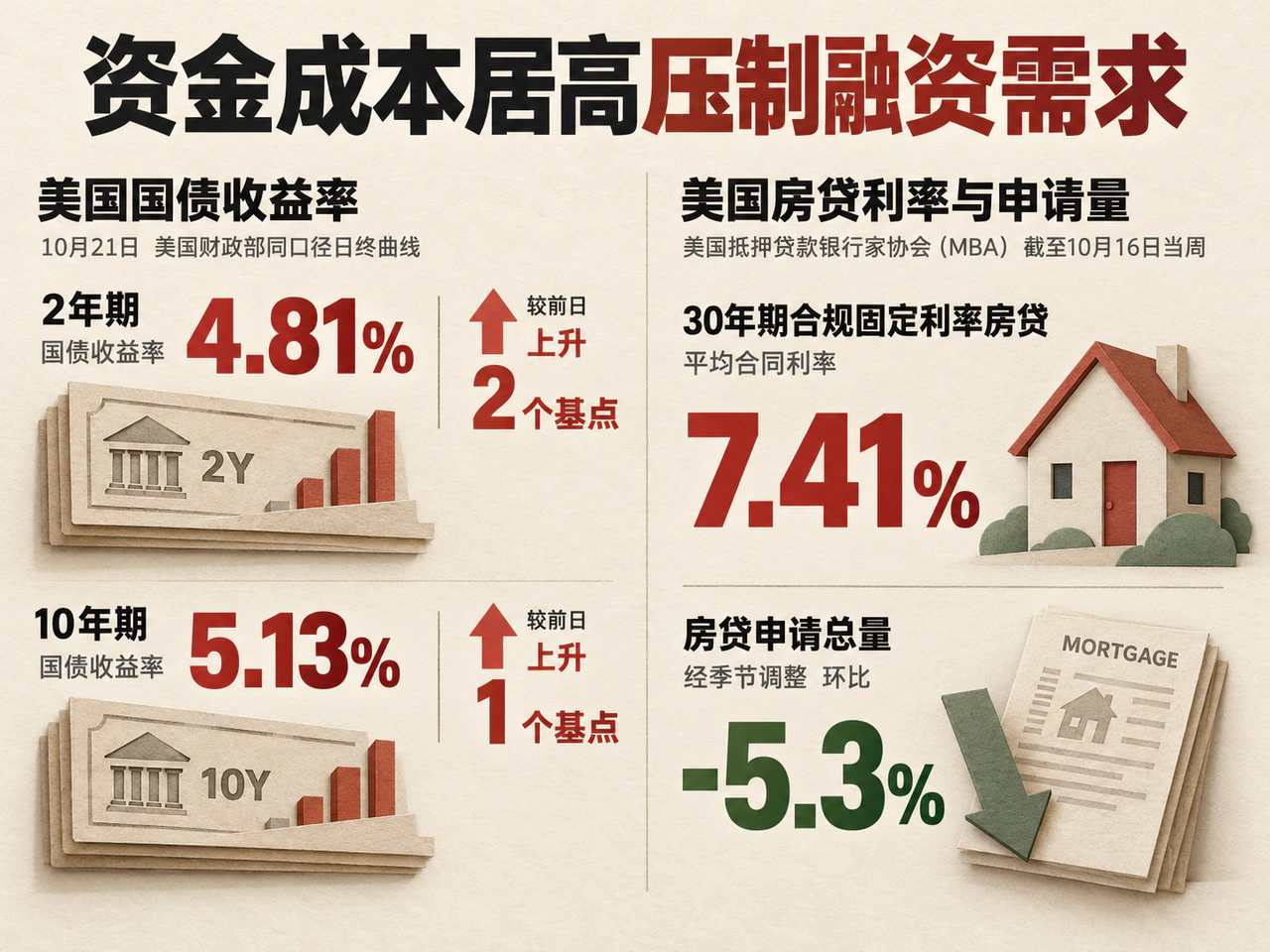
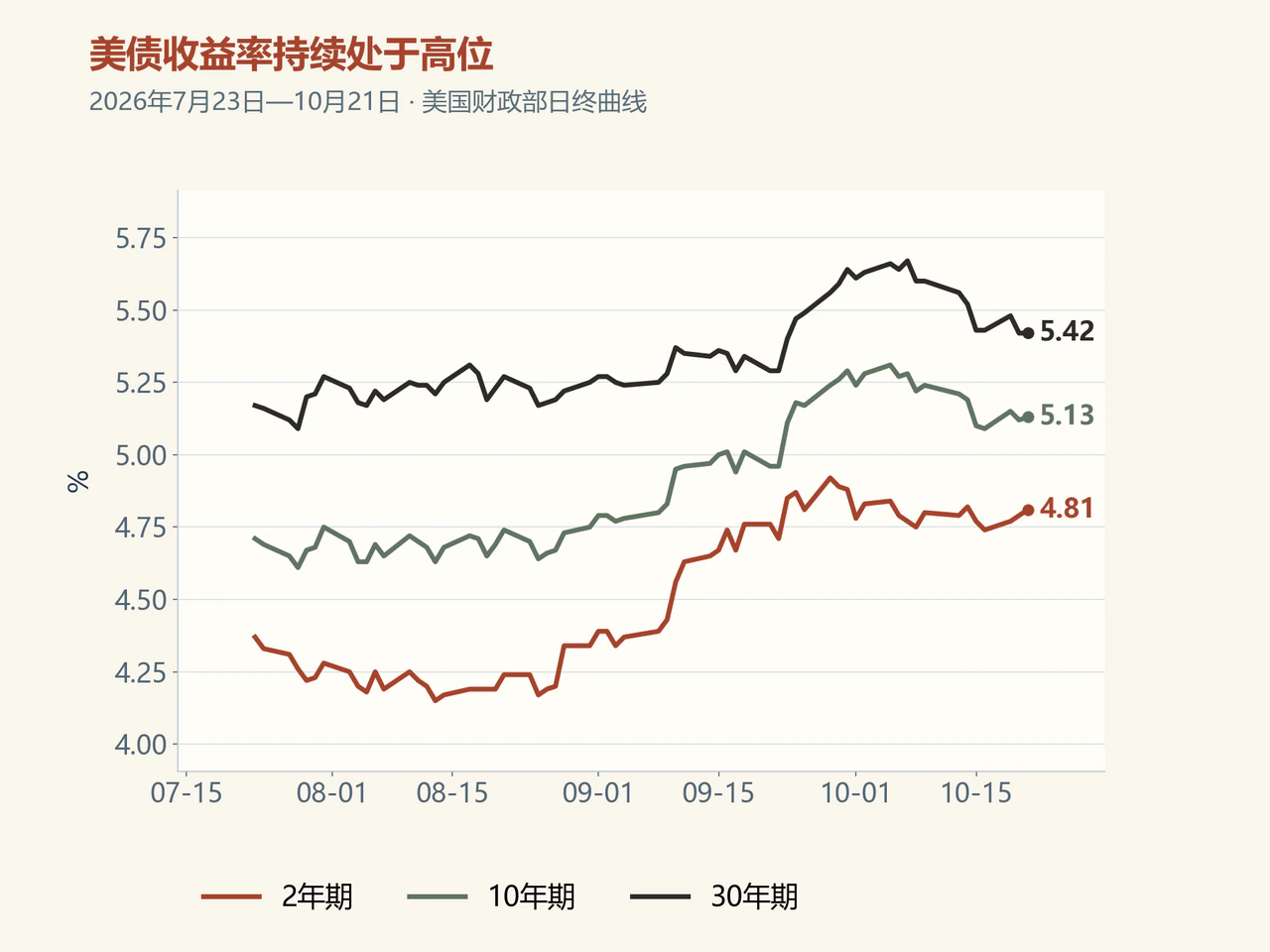
The U.S. Treasury's consistently defined end-of-day curve showed the 2-year yield at 4.81% on October 21, up 2 basis points; the 5-year at 4.95%, up 1 basis point; the 10-year at 5.13%, up 1 basis point; and the 30-year unchanged at 5.42%. The 10-year/2-year spread narrowed from 33 to 32 basis points, a slight flattening.
Markets distinguished between the imminent meeting and the subsequent policy path. The Wall Street Journal's market review after the October 21 U.S. close cited LSEG as showing an approximately 85% money-market probability of unchanged rates on October 28, while still pricing three increases over the next 12 months. That expectation supported short-dated yields, while weak rate-sensitive demand gave longer-dated bonds some support.
The day's $13 billion reopening of 20-year Treasuries showed that supply required a price concession, alongside improved demand. The auction yield was 5.469%, 1 basis point above the when-issued yield at auction time; bid-to-cover rose from 2.57 to 2.73. Oxford Economics analyst John Canavan considered the result weaker than expected but better than the notably weak auction the previous month. Long-dated yields rose less than short-dated yields.
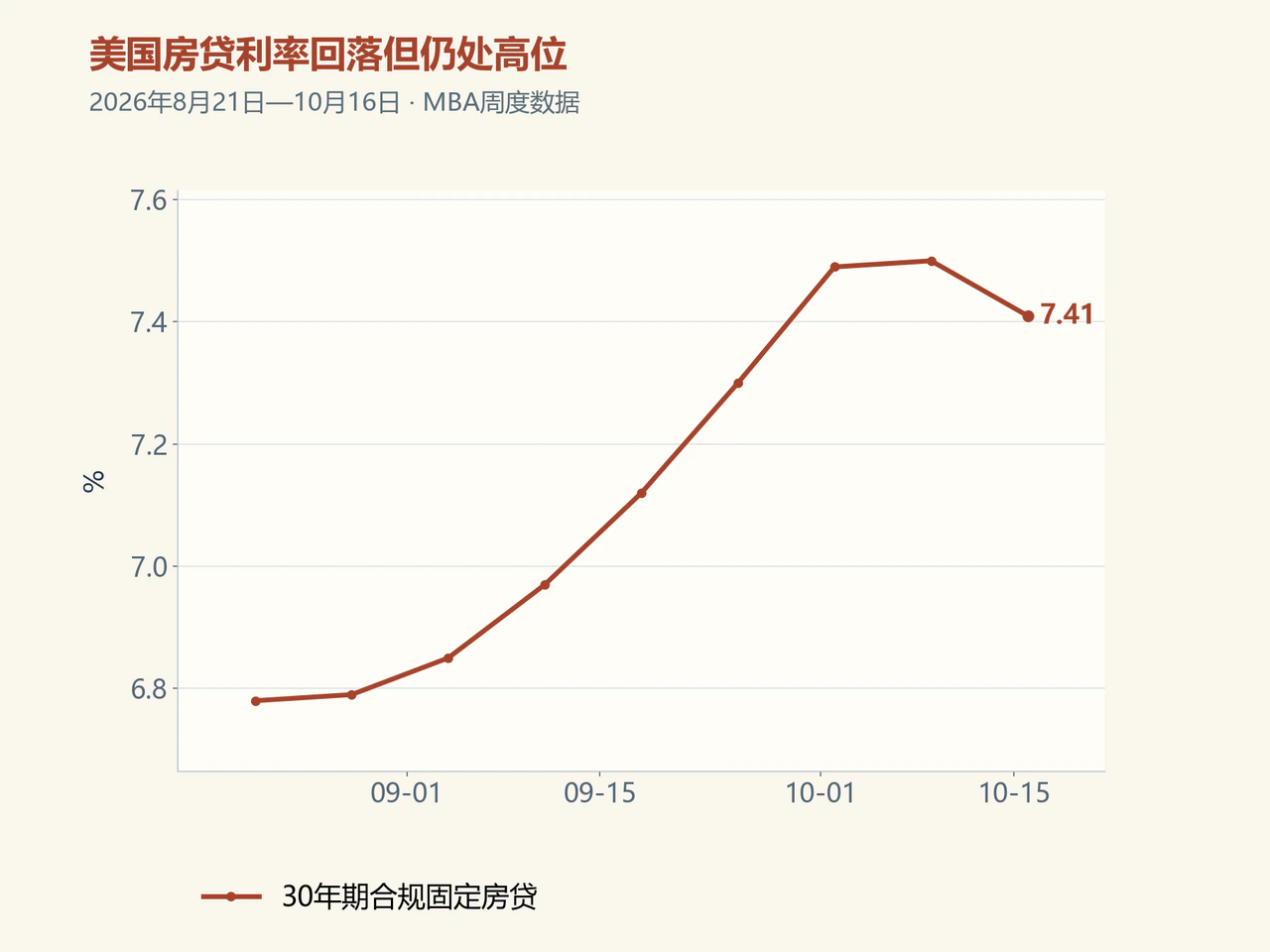
Mortgage data made the effect of high rates on real demand clearer. The Mortgage Bankers Association reported on October 21 that, for the week ending October 16, the average contract rate on 30-year conforming fixed-rate mortgages fell from 7.50% to 7.41%. Yet seasonally adjusted total mortgage applications still fell 5.3% week on week and purchase applications dropped 7%. Unadjusted purchase applications were down 18% year on year, and refinancing applications were down 59%.
One week's rate decline had not removed the accumulated burden. On the same definition, mortgage rates had risen from 6.79% in the week ending August 28 to 7.50% on October 9; the latest level was still 62 basis points above late August. Monthly-payment pressure on new buyers and limited willingness among existing low-rate borrowers to move jointly constrained housing transactions and related renovation demand. Previously released initial jobless claims for the week ending October 10 were 199,000, with employment still supporting income. The new claims release on October 22 would help establish whether housing pressure was beginning to combine with broader income risks.
Crude inventory draws support oil; high rates constrain gold
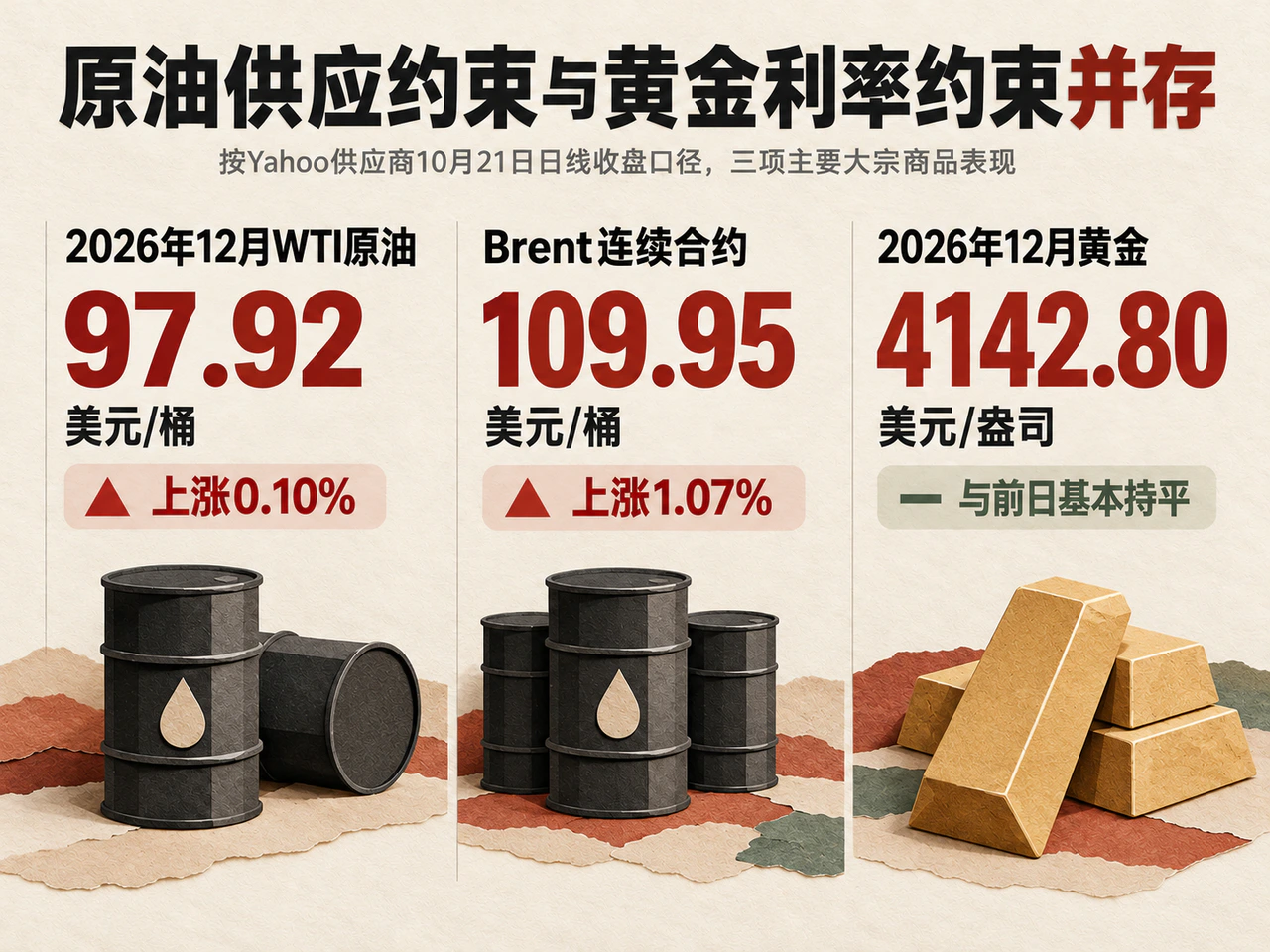
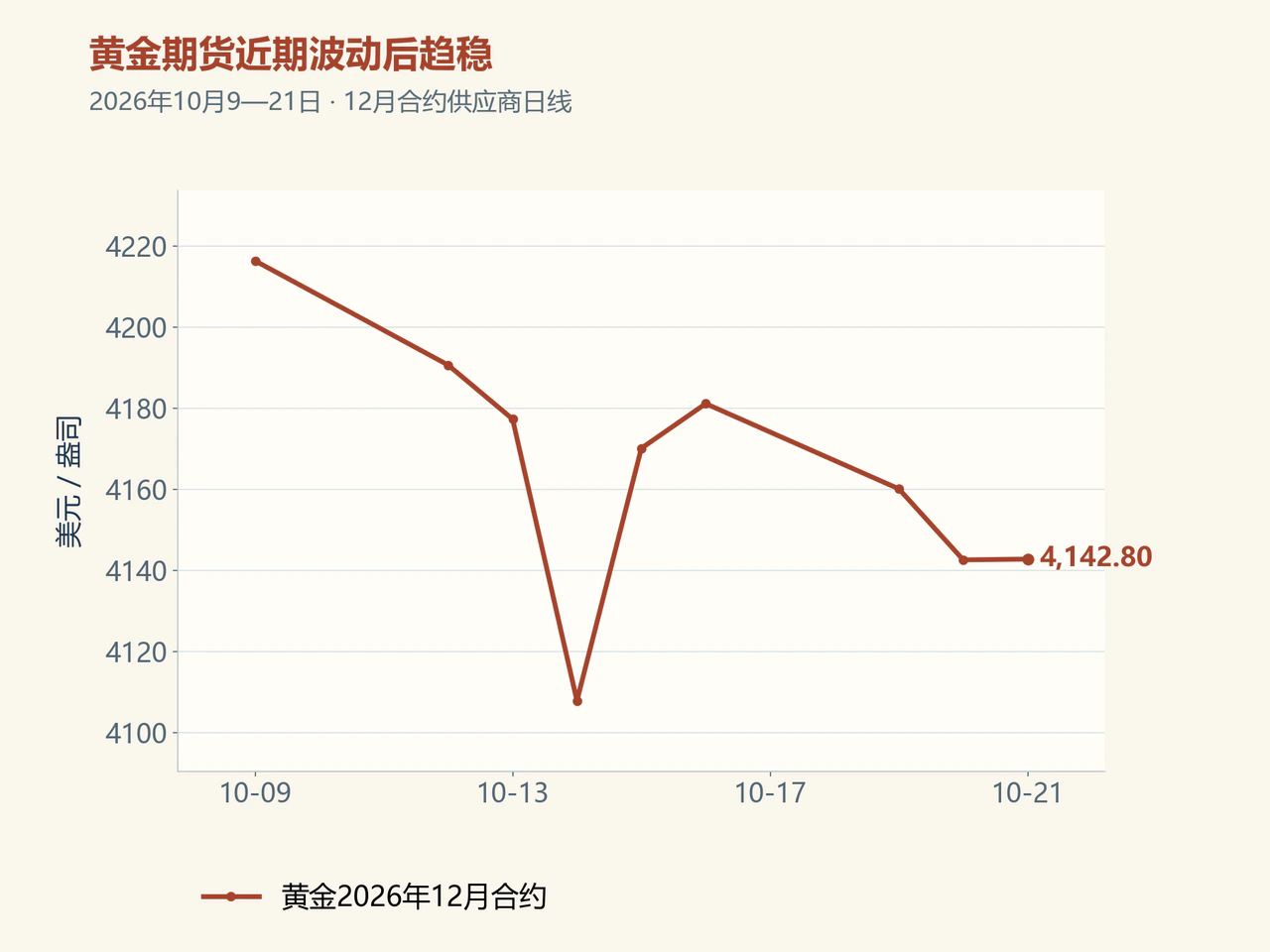
On Yahoo's vendor daily-close basis for October 21, NYMEX December 2026 WTI settled at $97.92 a barrel, up 0.10%; the Brent continuous contract was $109.95, up 1.07%; and COMEX December 2026 gold was $4,142.80 an ounce, broadly unchanged. The same December WTI contract was about 7.59% above October 9, while December gold had fallen about 1.74% over that period. Their divergence over nearly two weeks was clearer than the one-day moves.
Inventory support for oil came mainly from crude and gasoline. Reuters cited EIA figures released October 21 showing U.S. commercial crude stocks down 3.06 million barrels to 412.5 million in the week ending October 16, a larger draw than the 820,000 barrels expected in a survey. Gasoline stocks fell 2.95 million barrels. Distillate stocks, however, rose 1.68 million barrels against an expected 1.16 million-barrel decline, and Cushing stocks increased 987,000 barrels. Crude and gasoline draws supported prices, while accumulation in diesel and other distillates eased some shortage pressure.
Diplomacy was also changing expectations for refined-product supply. AP reported that Russia agreed in principle on October 21 to resume Russia-Ukraine-U.S. talks after November 10. Reuters quoted BOK Financial trader Dennis Kissler as saying progress toward peace could ease tight global diesel supply. The United States proposed lending part of its emergency heating-oil reserve that day, adding a supply buffer. Meanwhile, new U.S. Treasury sanctions on Iran's shipping-services network continued to raise transaction and transport compliance costs; shipping risk still supported energy prices.
Interest rates were the main restraint on gold. The dollar index fell about 0.04% to 101.691, offering limited support, while Treasury yields remained elevated. UBS analyst Giovanni Staunovo observed buying below $4,100, but also argued that inflation pressure from the Middle East conflict limited gold's upside. Higher energy prices raise fuel costs and, through policy-rate expectations, increase the opportunity cost of holding non-interest-bearing gold, weakening the lift from safe-haven demand.
China adds liquidity tools; companies weigh financing across currencies
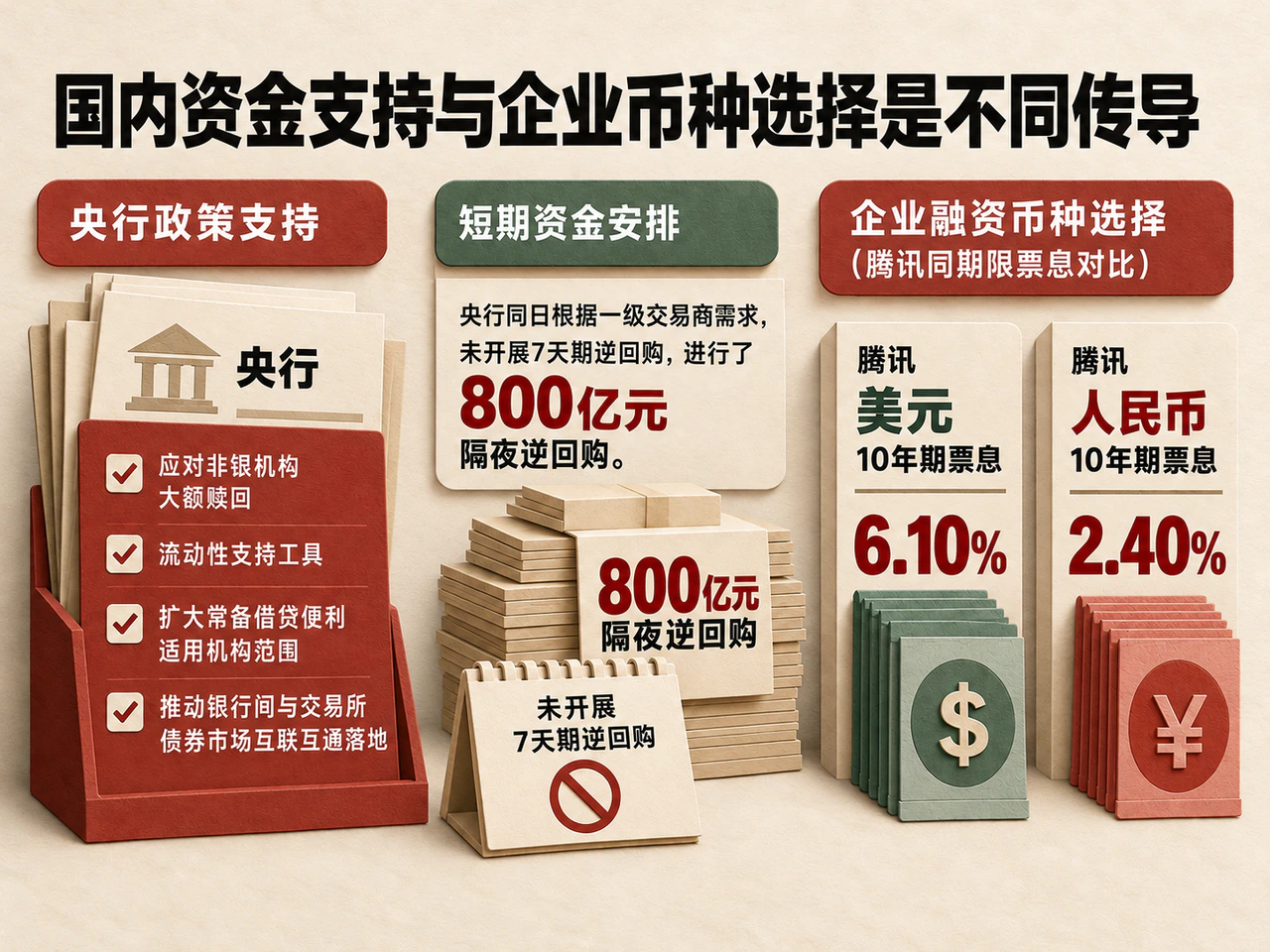
China's policy announcements on October 21 aimed to improve liquidity management and funding channels. CCTV.com reported that evening that the central bank would introduce a liquidity support tool for large redemptions at non-bank institutions, broaden the institutions eligible for the standing lending facility, and implement connectivity between interbank and exchange bond markets. These measures address forced bond selling caused by concentrated redemptions and the movement of funds and securities between venues, helping limit transmission of liquidity shocks.
In response to primary dealers' demand, the central bank conducted no 7-day reverse repos that day and instead supplied RMB 80 billion through overnight reverse repos, aligning shorter-term funding more closely with immediate needs. Structural support was also extending to private small and medium-sized firms with high research and development spending. Proposed pilots in international science and technology innovation centers would bring eligible firms within the relending support for technological innovation and equipment upgrading. Liquidity tools serve market stability, while relending serves business finance; their effects will emerge as eligibility rules, usage and projects develop.
Offshore companies were choosing funding sources across different currency-rate environments. Tencent's October 14 announcement said it had priced $1.8 billion and RMB 26 billion in bonds on October 13 New York time, with issuance planned for October 21 New York time. Its 10-year dollar coupon was 6.10%, against 2.40% for 10-year renminbi debt. The 3.70-percentage-point coupon gap for the same issuer and maturity highlights the effect of currency interest-rate environments on financing. Use of proceeds, revenue currencies and foreign-exchange hedging costs together determine the final choice.
Canada expands industrial support; European budgets face spending reallocations
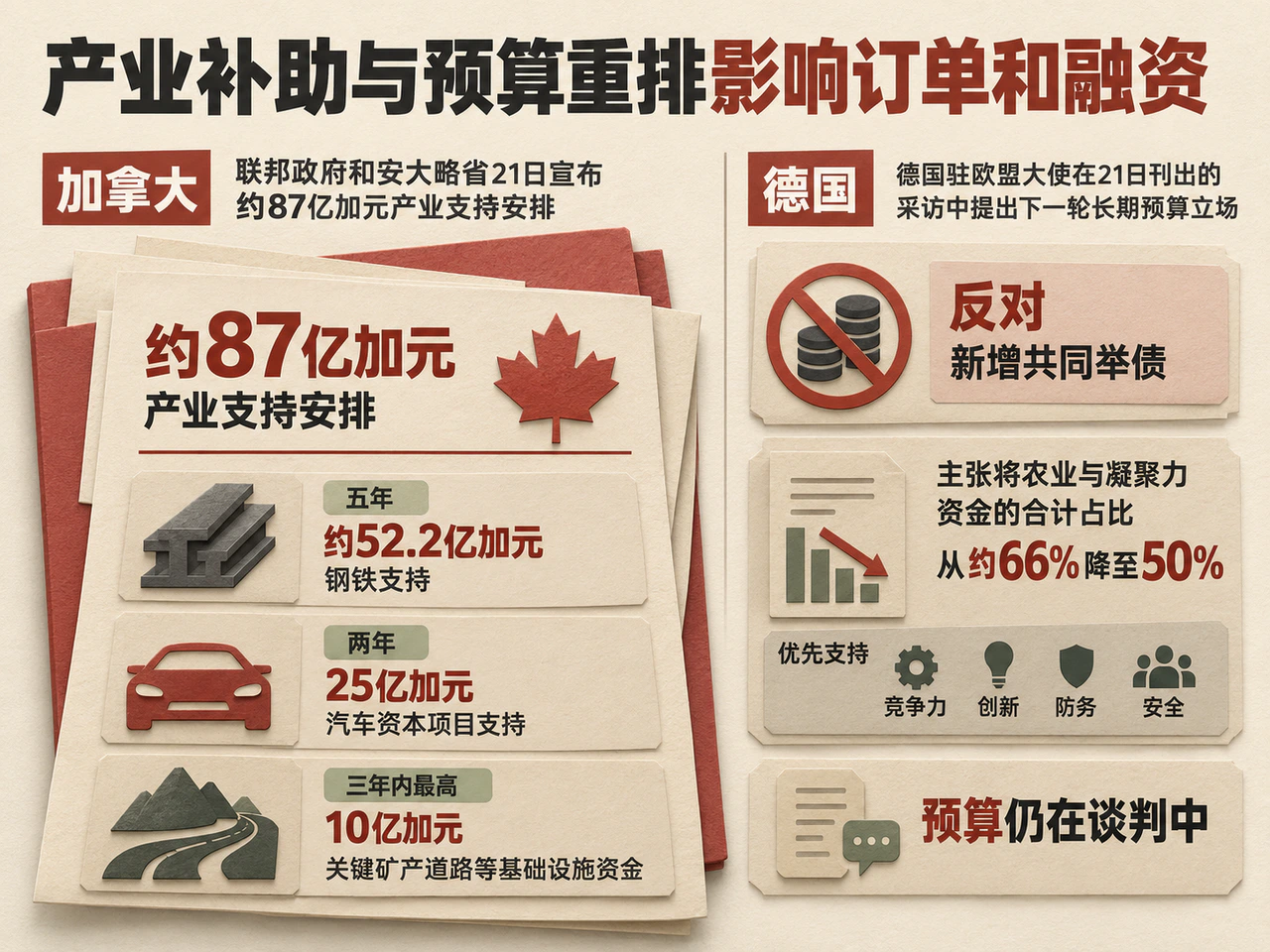
In a high-cost environment, industrial support has a more direct influence on investment and orders. On October 21, Canada's federal government and Ontario announced about C$8.7 billion in industrial support, including approximately C$5.22 billion for steel over five years, C$2.5 billion for automotive capital projects over two years, and up to C$1 billion in federal funds over three years for critical-mineral roads and other infrastructure. Public procurement would prioritize Canadian steel, and automotive fleet-average emissions standards were proposed to remain at 2026 levels through 2029. Grants, procurement and regulatory flexibility together cushion tariff pressure on cash flow and production.
Europe faced a choice between spending priorities and common financing. In an interview published October 21, Germany's ambassador to the EU called for further cuts to the next long-term budget, opposed new common borrowing and advocated reducing agriculture and cohesion funding's combined share from about 66% to 50%, prioritizing competitiveness, innovation, defense and security. Budget negotiations continued. Under this proposal, new strategic spending would rely more heavily on reallocating existing uses, also affecting future common-bond supply and orders across industries.
Technology demand powered the equity rebound, while high interest rates and energy costs required companies to turn growth into cash flow faster. Chinese liquidity tools and overseas industrial support can ease some financing and operating pressure, but benefits vary. Whether companies deliver revenue, control investment and obtain appropriate funding remains central to understanding this market divergence.