By the morning of October 22, Beijing time, Tencent had fallen below HK$400, accompanied by a sharp increase in options trading. On October 21, Tencent closed at HK$393.8, down 4.04%. HKEX recorded 211,764 Tencent stock-option contracts traded, 2.51 times the previous day's volume. Put volume slightly exceeded call volume, yet put open interest fell by the end of the day. As the shares declined, new protection, the closing of existing positions and adjustments across maturities combined to produce a divergence between turnover and open interest.
The selloff also brought the trade-offs of Hong Kong equity income strategies into sharper focus. Premiums received from selling calls can offset some losses, while holders retain the downside risk of the underlying shares. If subsequent call writing follows the share price lower by using lower strikes, the gains retained in a rebound also change.
Tencent breaks below HK$400, triggering sharp repricing in short-dated contracts

Tencent's share price fell from HK$410.4 on October 20 to HK$393.8. The Hang Seng TECH Index declined 1.26% on the same day, closing at approximately 3,995. Technology stocks were broadly under pressure, while Tencent's larger drop coincided with concerns about how quickly its earnings would materialize.
According to an October 21 report by The Paper, UBS expected Tencent's third-quarter revenue to grow 7% year on year, AI-related operating expenses to reach RMB 16 billion, and adjusted operating profit to fall 2% to RMB 71 billion. GF Securities expected revenue growth of approximately 9% and a 4% decline in adjusted operating profit to RMB 70 billion. The two institutions differed on revenue growth but both linked near-term profit pressure to AI investment. Tencent had yet to release its third-quarter results; all these figures were institutional forecasts.
The lag between investment and returns was the main tension confronting the valuation. Sustained spending could support subsequent growth in products and cloud services, while depreciation, research and development, and operating costs appeared in the income statement first. Options prices adjusted with the falling share price and also reflected uncertainty surrounding forthcoming earnings information.
On October 21, the exchange settlement price of Tencent calls expiring October 23 with a HK$400 strike fell from HK$12.38 the previous day to HK$2.28. Puts with the same expiry and strike rose from HK$1.46 to HK$8.11. This comparison uses exchange settlement prices; actual execution prices also depend on intraday market conditions and bid-ask spreads.
Once the shares fell below the strike, the calls moved out of the money and the puts moved into the money. Proximity to expiry amplified the changes in contract prices. The settlement implied volatility of the HK$400 call was approximately 40%, compared with approximately 31% for the same-strike call expiring November 27. In this cross-section, short-dated options reflected greater immediate uncertainty, while each maturity covered different risk events and amounts of remaining time.
Volume reaches 1.89 times the 20-day average as put open interest falls
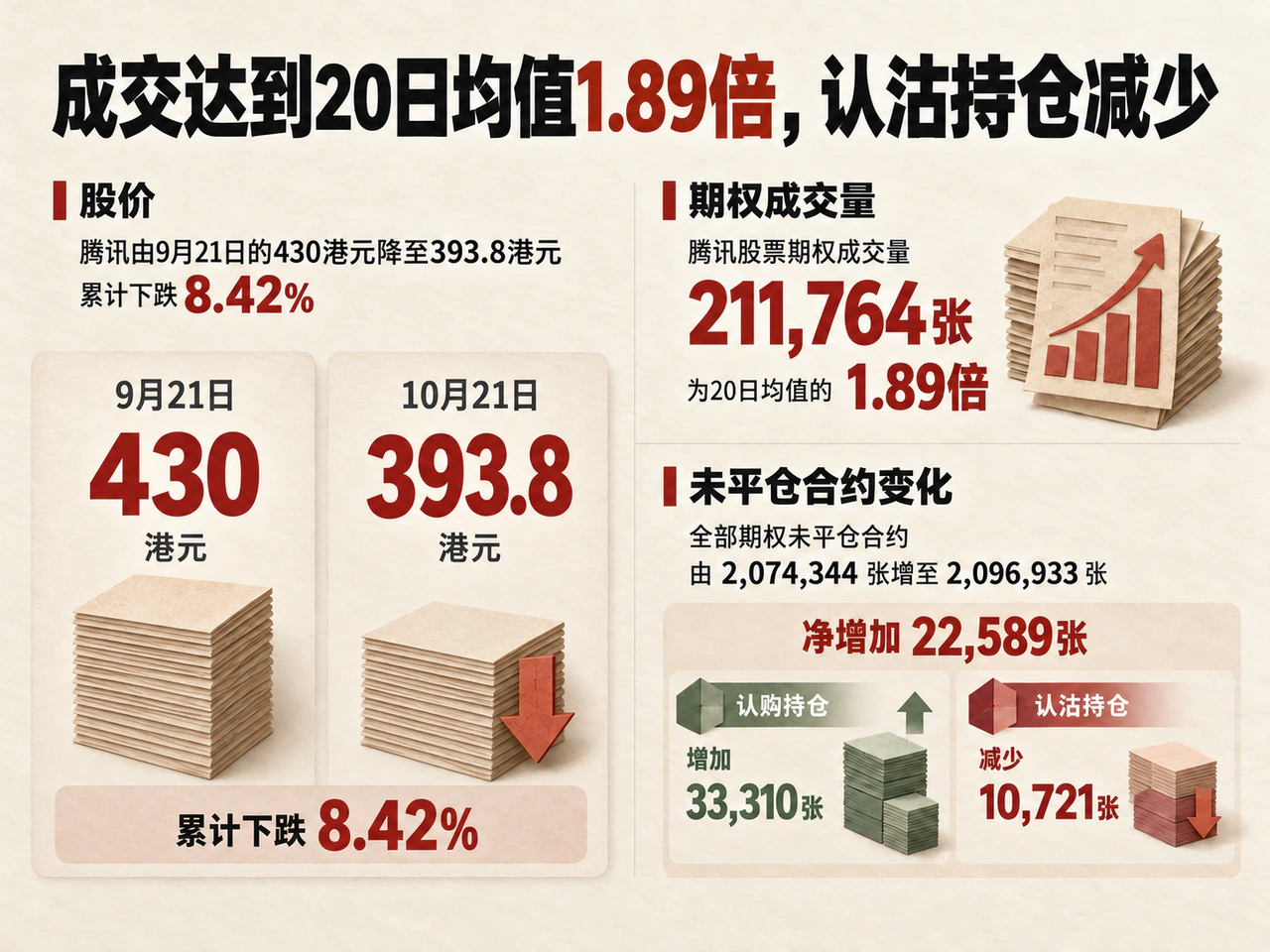
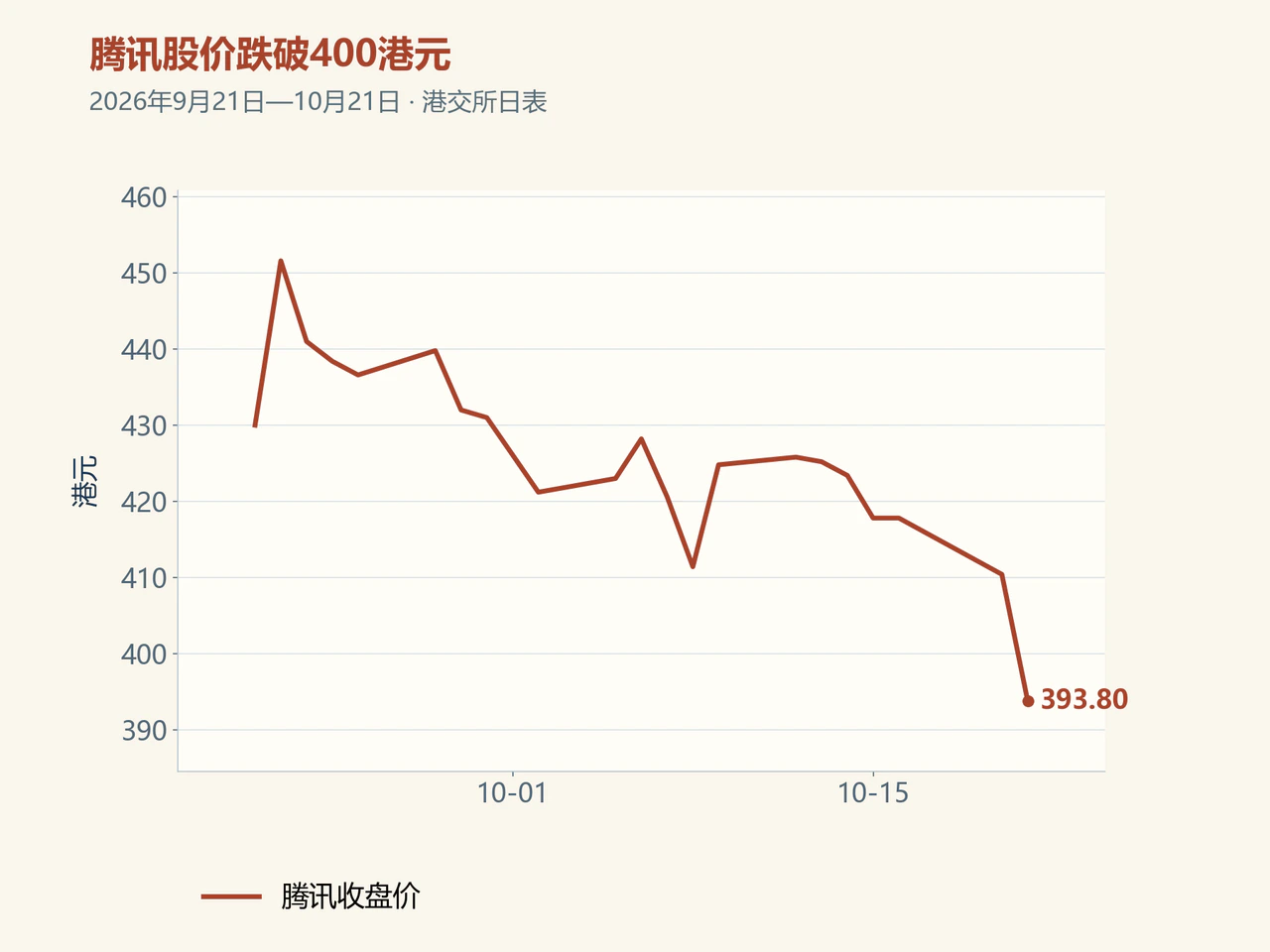
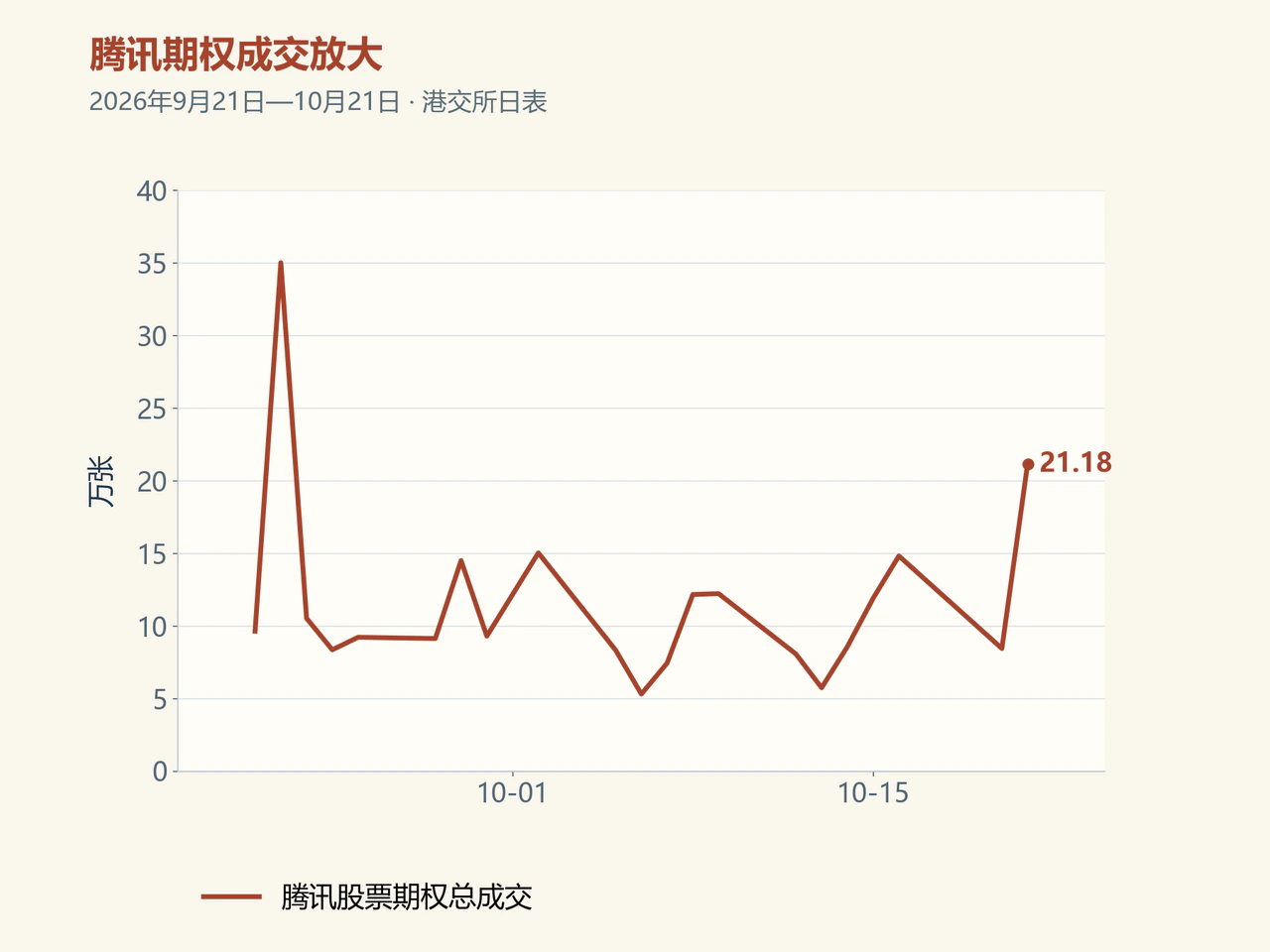
The increase in trading followed a sustained decline in Tencent shares. Over the 20 Hong Kong trading days from September 21 to October 20, Tencent options averaged approximately 111,875 contracts a day; October 21 volume reached 1.89 times that average. The share-price series extended through October 21 showed a fall from HK$430 on September 21 to HK$393.8, a cumulative decline of 8.42%.
On October 21, 103,256 Tencent call contracts and 108,508 put contracts changed hands. Against total volume of 211,764 contracts, total options open interest rose only from 2,074,344 to 2,096,933 contracts, a net increase of 22,589. Call open interest increased by 33,310 contracts, while put open interest decreased by 10,721.
Heavy trading with a limited net increase in open interest indicates substantial closing activity, turnover of existing positions and portfolio adjustments. Put volume was slightly higher, but outstanding positions declined. This could involve profit-taking on protective positions as well as migration across strikes or maturities. Whether sustained new demand for protection was emerging required examination of open-interest changes by expiry and strike.
Two HK$400 put contracts illustrated that difference. The October 23 expiry traded 5,412 contracts and its open interest rose by 1,621 to 2,392. The October 29 expiry traded 4,851 contracts, but its open interest fell by 1,806 to 24,031. Position building in the near-expiry contract occurred alongside position reductions in the monthly contract, indicating different risk arrangements across maturities within put trading.
For shareholders, the effectiveness of protection also depends on when it is purchased, the strike and the premium paid. Existing puts may compensate for a falling share price, while investors buying protection after the decline must accept prices that have already changed. Volume must be considered alongside open interest, prices and portfolio purpose to understand the transfer of risk during this selloff.
Hang Seng TECH covered calls approach full coverage, combining a cushion with limited upside
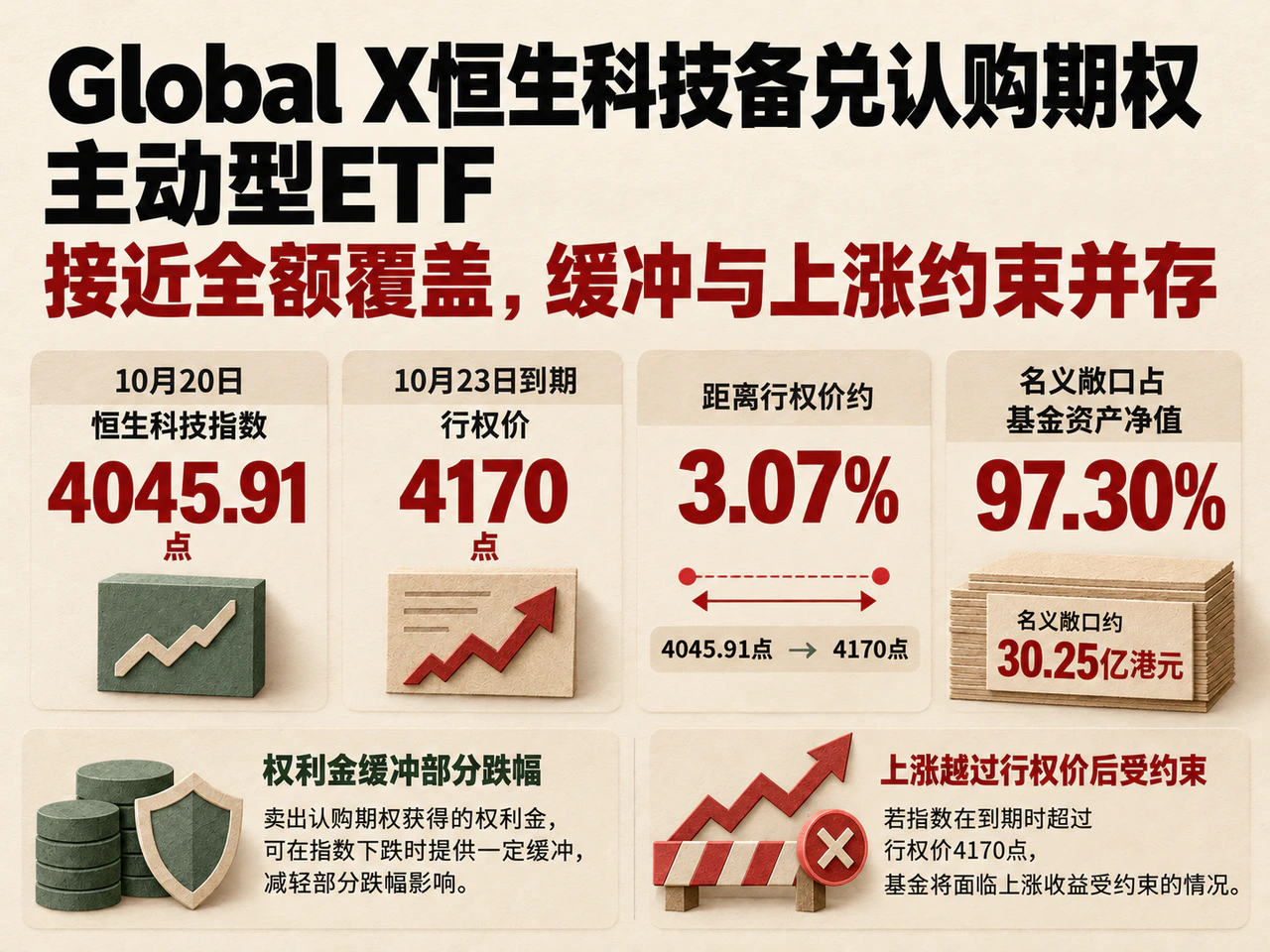
The Global X Hang Seng TECH Covered Call Active ETF provided a concrete example of an income strategy during the same selloff. The issuer disclosed that, as of October 20, the fund had sold Hang Seng TECH weekly calls expiring October 23 with a strike of 4,170. Their notional exposure was approximately HK$3.025 billion, equivalent to 97.30% of the fund's net asset value. The index closed that day at 4,045.91, with the strike approximately 3.07% above that level.
These written calls provided nearly full notional coverage. If technology shares continued to weaken, the calls would generally lose value, benefiting the seller. The fund's long positions in stocks, ETFs and futures would still suffer losses. Premiums offer a limited cushion; even a high coverage ratio does not eliminate the underlying assets' market risk.
If the index rebounded quickly above 4,170 before expiry, the written calls would increasingly offset further gains in the underlying assets. The 4,170 strike applied to this set of short-dated contracts disclosed as of October 20. After expiry or rebalancing, the next round's return profile would depend on the new strike, maturity and sale price.
This trade-off becomes particularly evident after a prolonged decline. To maintain premium income, subsequent call writing may use lower strikes as the market falls. If share prices then rebound sharply, the fund's NAV recovery may lag a stock portfolio without written-call constraints. Premium income is more readily beneficial in a gradual recovery or a range-bound market. The path prices take to expiry directly affects the strategy's outcome.
The issuer also disclosed a planned ex-dividend date of October 30 and payment on November 5 of HK$0.16 per unit. Assessing holding-period returns requires considering distributions, NAV changes and total return including dividends over the same period. A distribution is a cash payment and option premiums are strategy income; they are not equivalent. The fund may pay distributions from capital, and a single distribution cannot establish the return for the coming full year.
After Tencent fell below HK$400, short-dated contracts repriced rapidly and put volume diverged from open interest. Hang Seng TECH covered-call products showed that the premium cushion always comes with the surrender of some upside. Position migration after short-dated contracts expire, and the pace at which technology-company earnings materialize relative to investment growth, would be central to the next stage of options pricing.