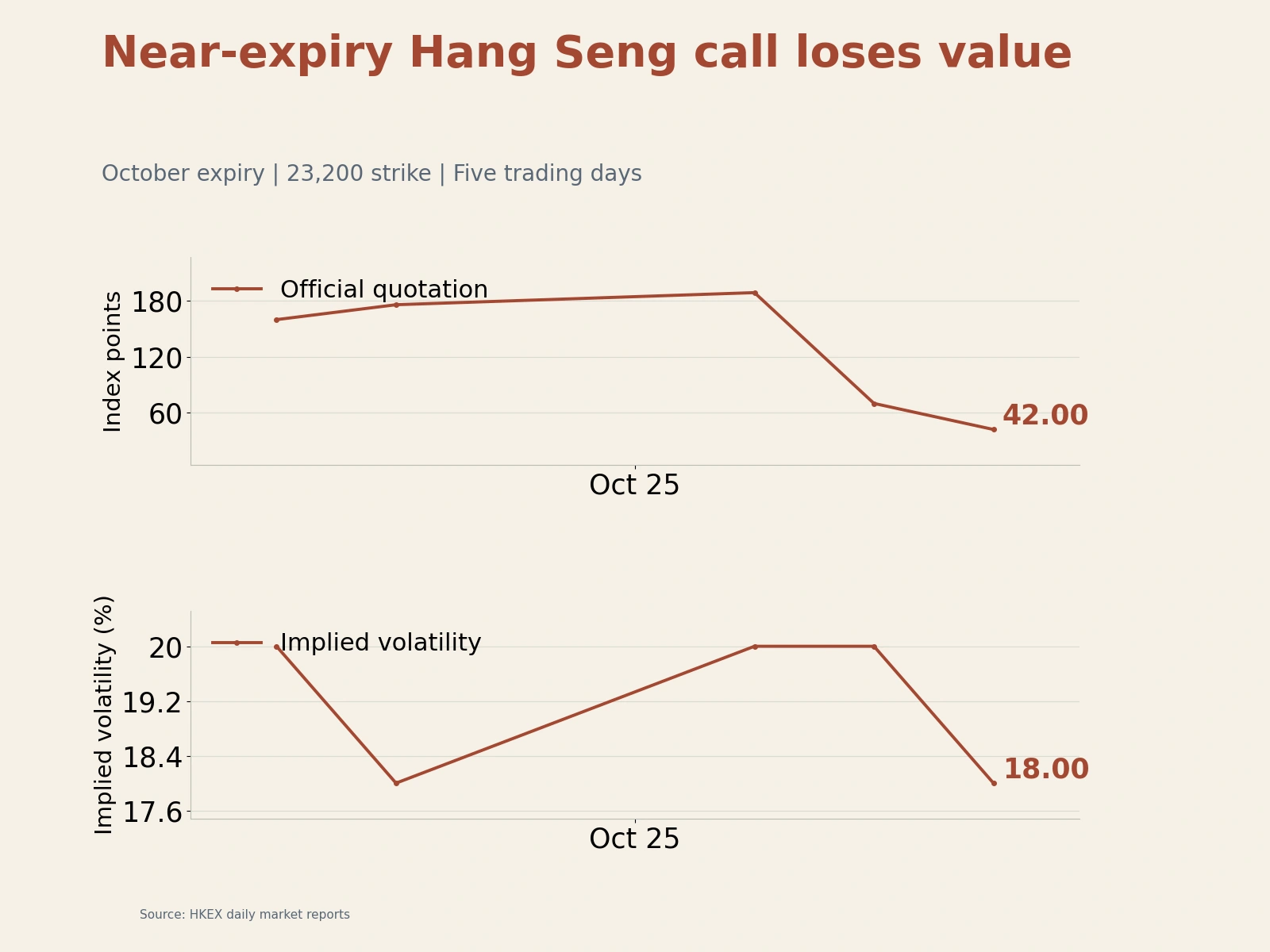
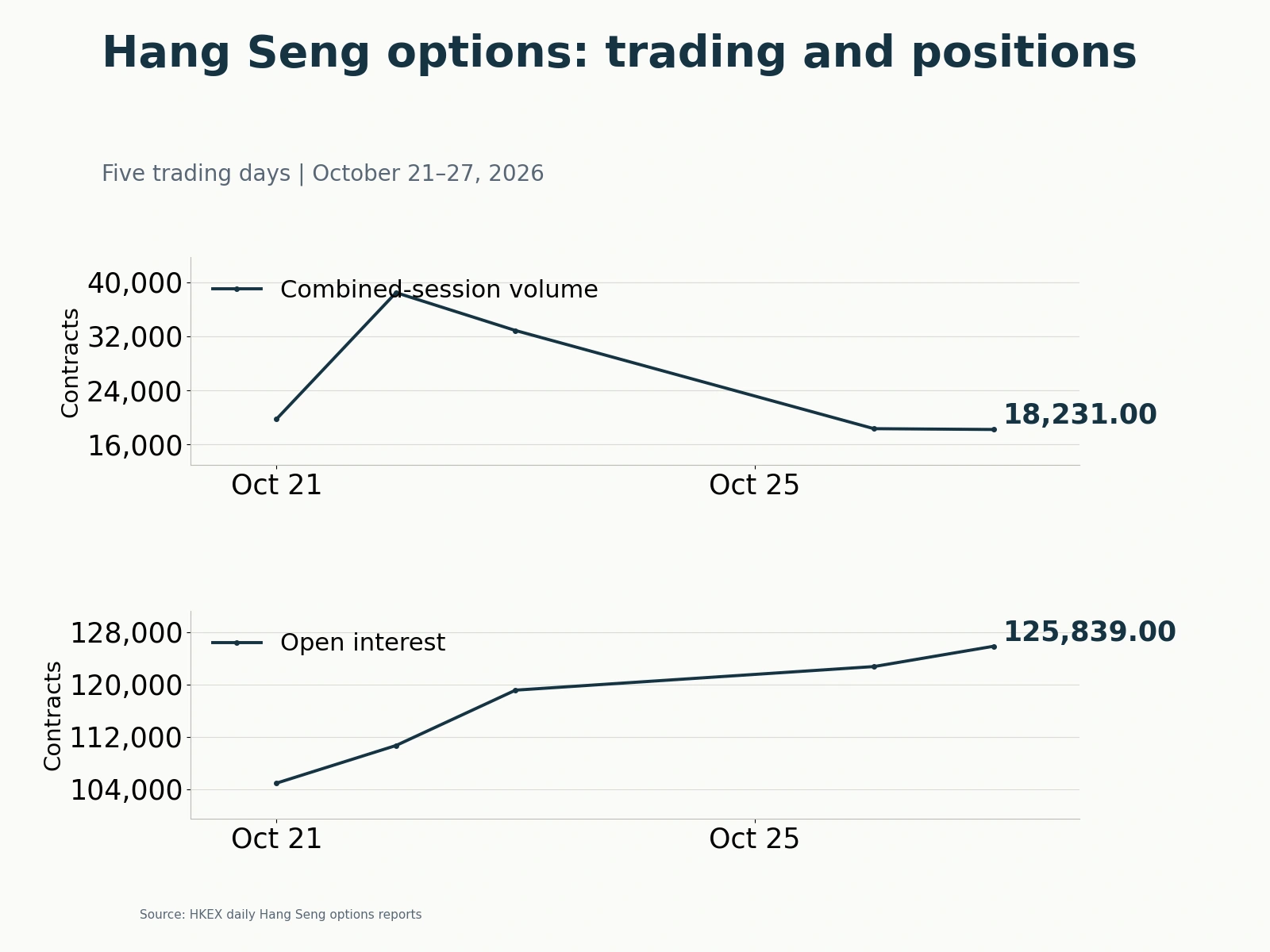
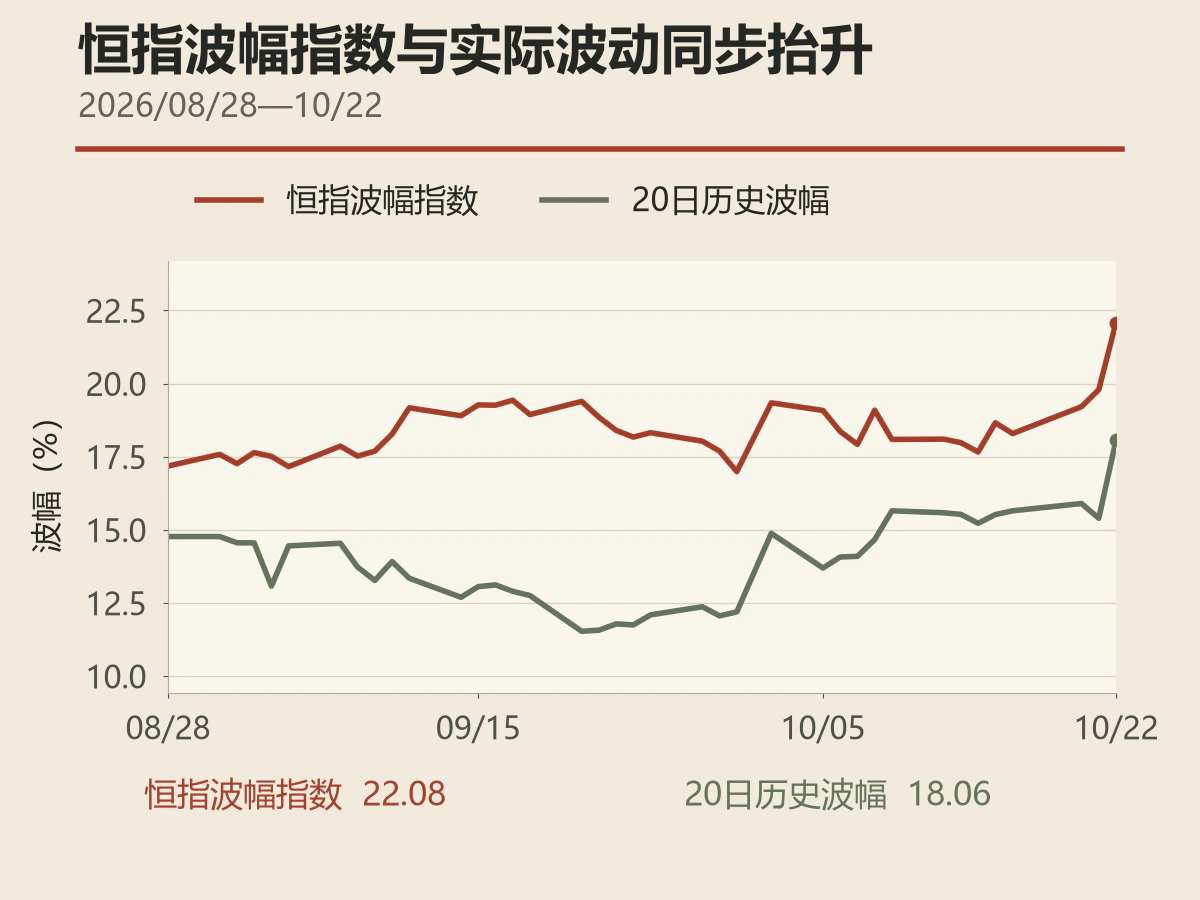
As of the morning of October 23 Beijing time, Hong Kong's sharp stock-market decline was prompting simultaneous adjustments in option prices and the distribution of positions. On October 22, the Hang Seng Index closed at 22,934.68, down 717.19 points, while the Hang Seng Tech Index fell 5.03% to 3,793.93. The Hang Seng Volatility Index rose from 19.79 to 22.08. Trading in monthly Hang Seng options across all maturities totaled 38,454 contracts, up 94.5% from the previous day. As spot losses deepened and put trading intensified, the cost of buying protection increased.
Tencent and Alibaba together accounted for about 35.2% of HKEX stock-option contracts traded. Tencent's HK $400 puts rose sharply in price even as open interest fell, while positions in the lower-strike HK $370 puts increased substantially. The differing changes in price, volume and open interest reveal the process of existing contracts being closed and lower-strike positions being added during the selloff.
Hang Seng breaks below 23,000 as volatility rises to 22.08
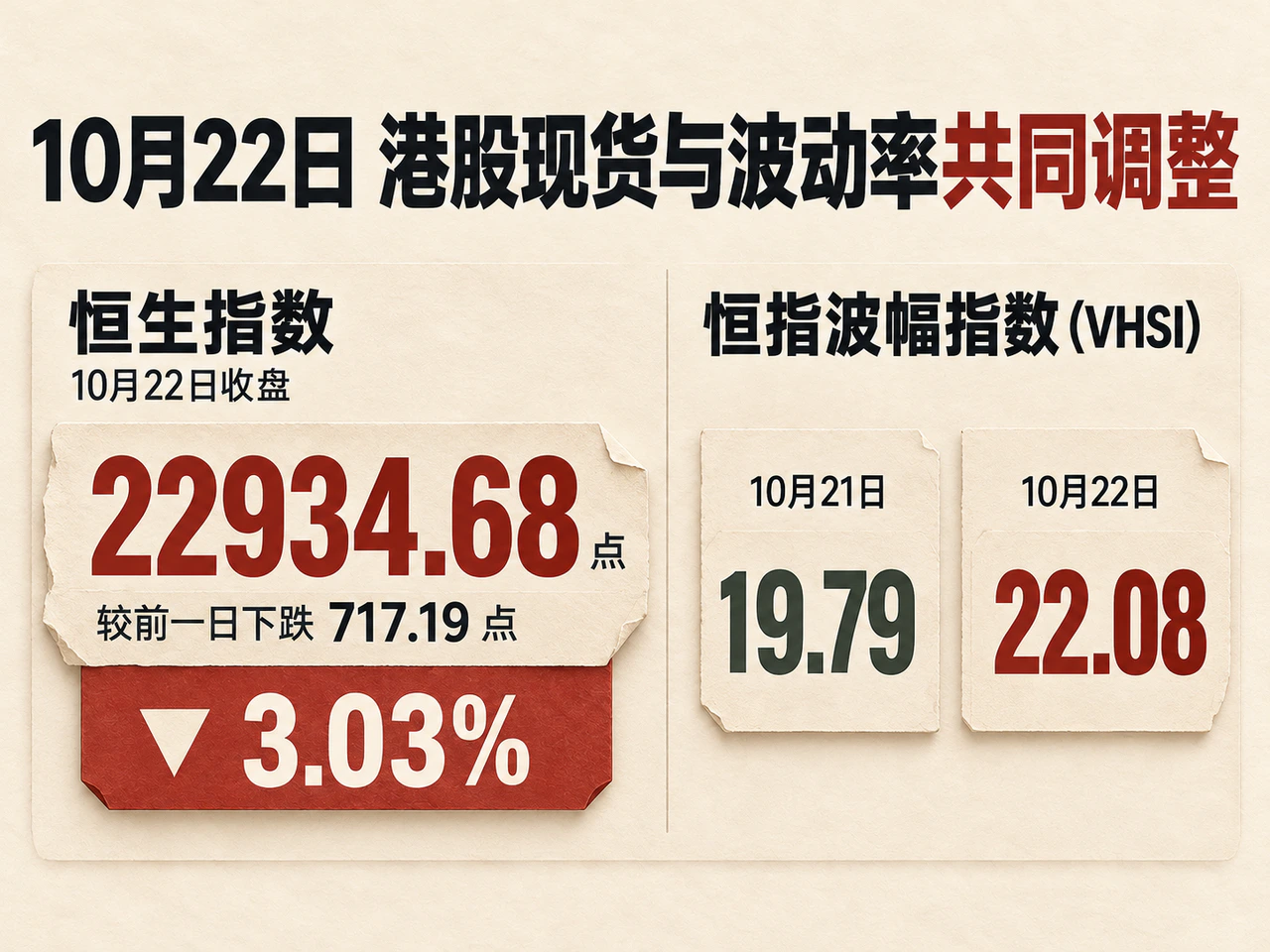
On October 22, the Hang Seng fell 3.03% and the Hang Seng China Enterprises Index lost 3.20%, with technology shares suffering deeper declines. According to Hong Kong Economic Journal quotes, Tencent closed at HK $382.40 and Alibaba at HK $97.35; Lenovo and Hua Hong Semiconductor fell about 10.9% and 9.5%, respectively. Simultaneous declines across major sectors drew attention to index-level protection demand.
In a signed commentary that morning, etnet and trading platform chief adviser Leung Yip-ho judged market conditions unfavorable for bulls and identified 23,230, the bottom of the Hang Seng's daily descending channel, as a possible support level. The index subsequently closed below that level, failing to hold the support anticipated by technical analysis. As the market moved into a lower price range, option positions built around the old levels also faced adjustment.
Volatility had begun rising before this sharp decline. The series updated on Leung's website showed the Hang Seng Volatility Index at 17.66 on October 14, 18.29 on October 16, 19.21 on October 20, 19.79 on October 21 and 22.08 on October 22. The final day's increase was 2.29 volatility points, or about 11.6%. In the same analytical table, 20-day historical volatility for the Hang Seng also rose from 15.394% to 18.056%, indicating wider actual price fluctuations.
More intense spot-market volatility went hand in hand with more expensive option protection. For option sellers, higher premiums also meant larger price swings to absorb and greater pressure to adjust positions.
The 22,800 put quote more than quadruples, driven by the spot decline
HKEX's October 22 Hang Seng options daily report showed that the three most actively traded contracts were all October puts, at strikes of 22,400, 22,800 and 22,600, with volumes of 1,827, 1,776 and 1,657 contracts. The previous day's most active contract had been the October 24,400 call, with 1,709 contracts traded. Activity had shifted to puts at lower strikes.
The report's combined turnover includes the preceding trading day's night session and the current day session. On that basis, monthly Hang Seng options volume across all maturities increased from 19,772 to 38,454 contracts, and the put/call volume ratio rose from 0.87 to 1.66. October contracts accounted for 23,420 contracts: 14,985 puts and 8,435 calls, showing a clear short-term tilt toward puts.
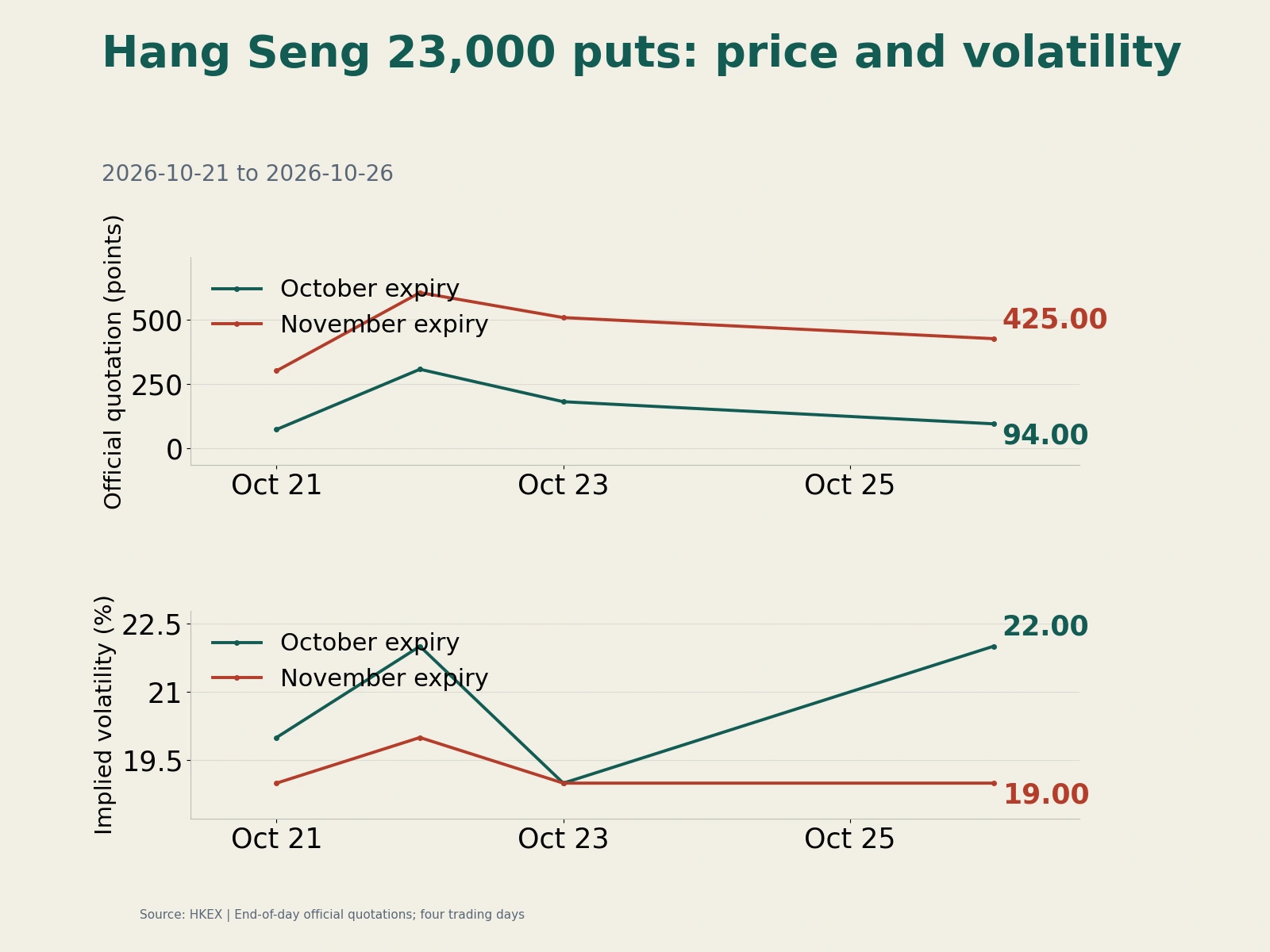
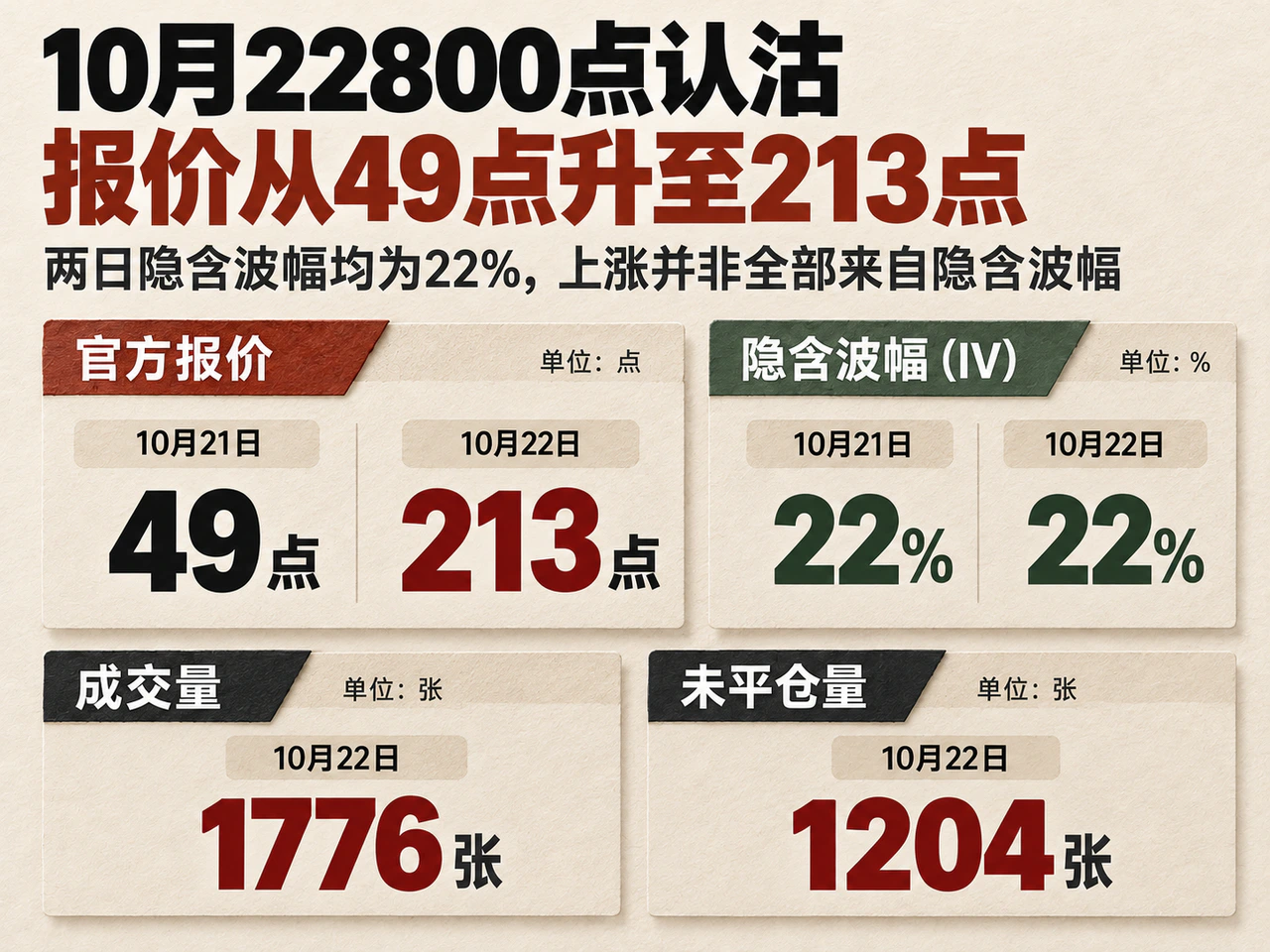
The official quote for the October 22,800 put rose from 49 to 213 points, volume increased from 223 to 1,776 contracts and open interest grew from 620 to 1,204. At the contract multiplier of HK $50 per index point, the quoted premium per contract rose from HK $2,450 to HK $10,650; actual transaction prices still depend on bid-ask spreads and execution times.
The key driver was the spot index's rapid approach to the strike. The Hang Seng fell from 23,651.87 to 22,934.68, bringing the previously distant out-of-the-money 22,800 put close to spot. The daily report listed implied volatility at 22% on both days, unchanged at the published whole-percentage precision. The large premium increase primarily reflected the narrowing distance between spot and strike.
The 22,400 put showed a similar pattern: its official quote rose from 24 to 103 points, while listed implied volatility was 24% on both days. The lower market brought these low-strike contracts closer to the money and made their prices more sensitive to further declines. Portfolios already protected by puts gained more hedging contribution, while those seeking new protection after the selloff had to pay higher premiums for the same notional exposure.
Tencent HK $400 put positions shrink while HK $370 put positions grow
Single-stock options activity also expanded. Total HKEX stock-option volume rose from 859,043 contracts on October 21 to 1,334,925 on October 22. Tencent traded 286,063 contracts and Alibaba 184,386, totaling 470,449, or about 35.2% of the market. Alibaba volume was about 4.5 times the previous day's 41,031 contracts.
Tencent's HK $400 put expiring October 29 traded 13,131 contracts that day. Its settlement price rose from HK $10.63 to HK $20.09 per share, about 89%. Tencent spot fell from HK $393.80 to HK $382.40, taking the contract deeper into the money, while listed implied volatility rose from 30% to 40%.
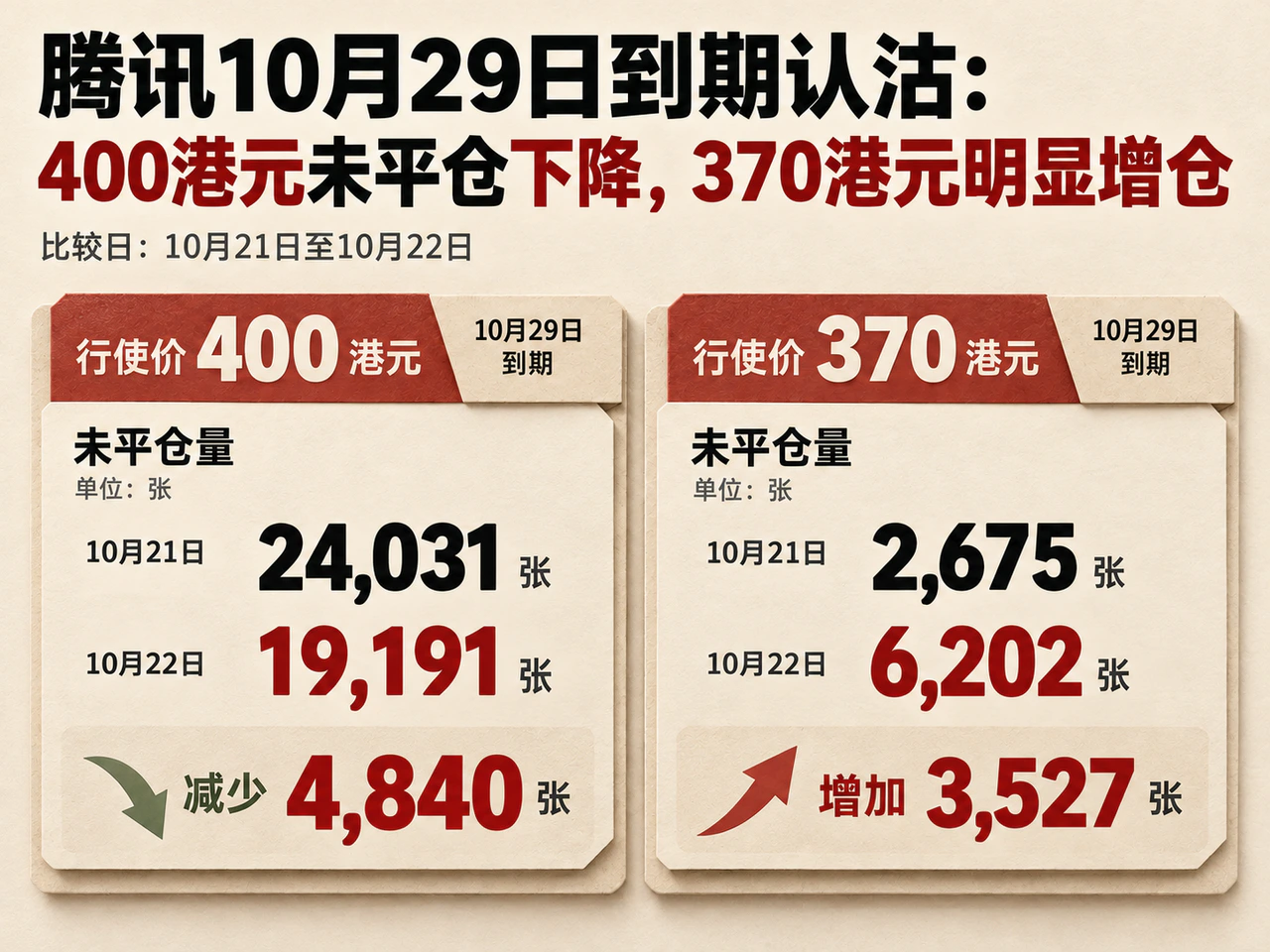
Despite the sharp price increase, open interest in this contract fell from 24,031 to 19,191 contracts, a reduction of 4,840. Active trading accompanied a shrinking stock of outstanding contracts, indicating that closing positions was an important part of this activity.
Positions in the HK $370 put with the same expiry increased: volume rose from 1,939 to 6,370 contracts and open interest from 2,675 to 6,202. The settlement price rose from HK $1.37 to HK $3.16 per share, and listed implied volatility from 37% to 38%. Falling open interest at HK $400 and rising open interest at HK $370 show a shift in the distribution toward lower strikes. Public data do not disclose links between accounts, so it remains impossible to identify whether the same investors were rolling their positions.
New contracts can support various strategies, including buying protection, selling puts and combination trades. Across these two strikes, outstanding positions were shrinking at the higher strike and growing at the lower one. Buyers' protection demand and sellers' willingness to take risk were being matched again at new price levels.
Night futures rebound; watch for stabilization in both spot and volatility
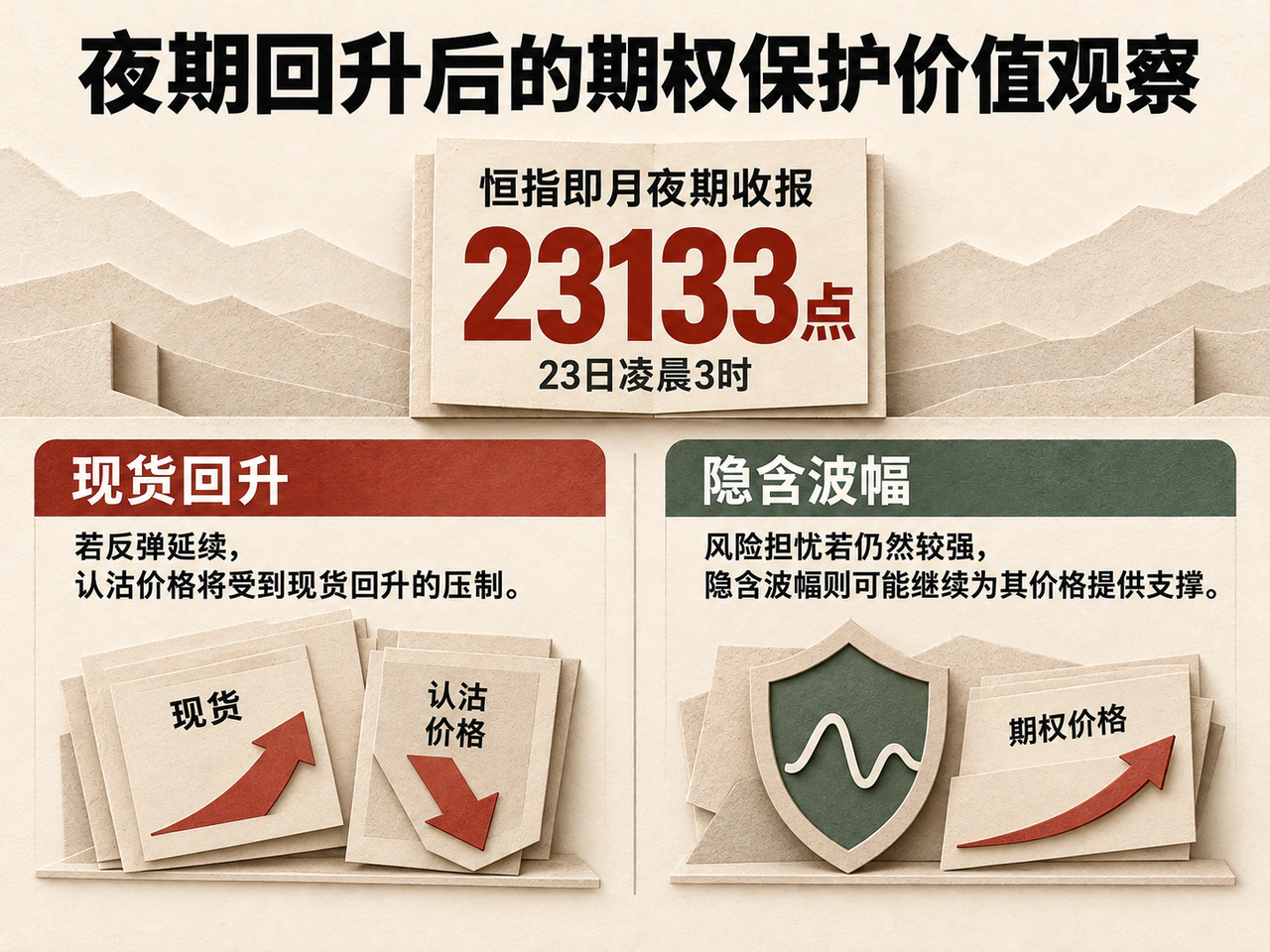
Hong Kong's October 22 night session saw some recovery. Hong Kong Economic Journal showed front-month Hang Seng night futures closing at 23,133 at 3 a.m. on October 23. If the rebound continues, higher spot prices will weigh on put prices; if risk concerns remain strong, implied volatility may continue to support them.
Protection buyers need to assess whether contracts cover their actual portfolio risk, whether strikes still match their exposure and whether the remaining tenor spans the events they fear. For put sellers, higher premiums after a sharp decline come with spot closer to strike and the risk of further losses. These must be weighed together with potential future stock or cash obligations.
Whether spot finds support in the lower range, whether the volatility index falls as the market stabilizes and whether open interest in Tencent's lower-strike puts keeps growing will jointly determine protection costs and position adjustments. If spot rebounds while volatility stays elevated, protection prices will retain support. If spot moves lower, lower-strike puts will approach the money faster and sellers' risk-management pressure will rise.