By the morning of October 24 Beijing time, stablecoins had made substantive progress in both commercial deployment and regulation. HSBC announced its Hong Kong dollar stablecoin RedCoin through the PayMe wallet, while the U.S. Office of the Comptroller of the Currency (OCC) published its final GENIUS Act implementation rule in the Federal Register. The former connected a licensed bank’s stablecoin directly to an existing retail payments network; the latter specified operating standards for issuer authorization, reserves and redemption. Competition was increasingly concentrating on customer access, asset protection and actual payment uses.
HSBC opens RedCoin access to PayMe’s 3.3 million users, starting with retail payments

HSBC announced RedCoin, ticker RCHKD, on October 23 and said it would open in-app stablecoin-wallet activation to more than 3.3 million PayMe users over the following days. It would support transfers to friends and family and payments at more than 100,000 PayMe merchants. Embedding stablecoins in an established, frequently used payments app removed the need for consumers to register separately with a crypto trading platform, while merchants could accept settlement through their existing collection network.
The 3.3 million figure was PayMe’s existing user base. HSBC paired the launch with transaction discounts and rewards to encourage initial adoption. How many existing users became active wallet users would need to be assessed through retention after promotions ended. Continued use in everyday retail payments ultimately depended on ease of operation, settlement speed and the experience of holding and redeeming tokens.
For asset protection, RedCoin was denominated in Hong Kong dollars and redeemable 1:1 into the currency. HSBC had received a stablecoin issuer license from the Hong Kong Monetary Authority in April. Product materials said RedCoin was backed by high-quality, highly liquid segregated assets held by HSBC Digital Asset Custody. Integrating issuance authorization, reserve custody and payment access within one banking group could simplify users’ understanding, but the token’s precise legal nature and asset protections still depended on the product contract.
HSBC also planned to integrate the stablecoin wallet into its Hong Kong mobile banking app before year-end, allowing RedCoin subscriptions to tokenized investments, including a planned new share class of a Hong Kong dollar money-market fund. Corporate and institutional uses would be expanded gradually. Establishing retail payments first, then extending into investment subscriptions and institutional settlement, would determine whether RedCoin evolved from a promotion-driven transfer tool into an enduring funding channel.
OCC final rules require at least 1:1 reserves; third-party rewards still require individual assessment
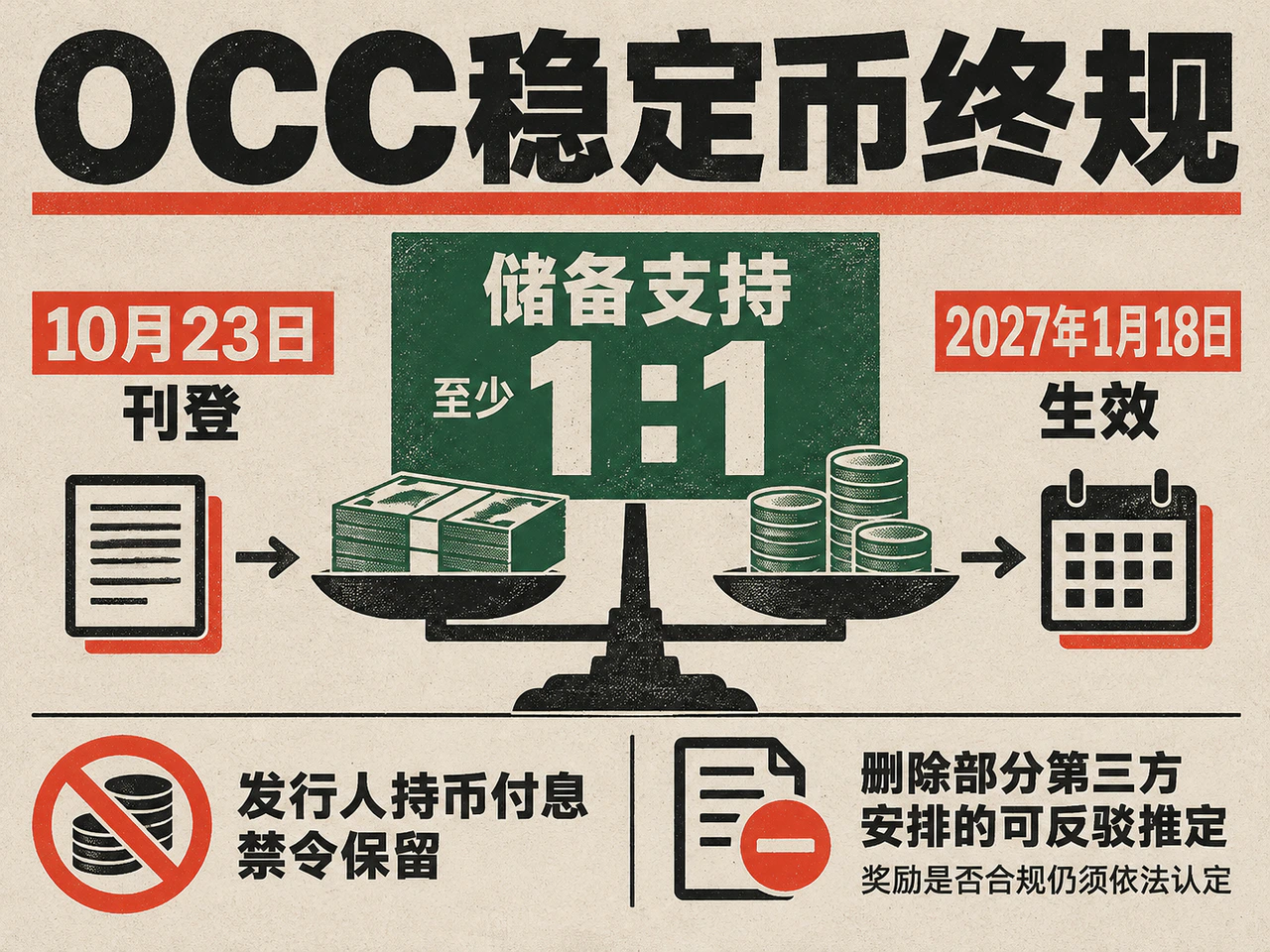
The OCC implementation rule published on October 23 would take effect on January 18, 2027, applying to payment stablecoin issuance and related activities under its jurisdiction. It covered authorization, reserve management, redemption, capital adequacy and operational risk controls. Payment stablecoins had to be backed by reserves of at least 1:1, explicitly constraining issuers’ liquidity management and ongoing compliance costs.
The central dispute concerned returns on holdings and third-party rewards. The final rule retained the statutory ban on issuers paying interest or yield solely because a user held, used or retained a payment stablecoin. It removed the draft’s rebuttable presumption for some affiliated and related third-party arrangements. Removing that presumption did not make all third-party rewards automatically compliant: funding sources, payment relationships and commercial terms would still affect regulatory determinations.
Crypto In America reported that some crypto firms welcomed the OCC’s clarification of legal boundaries, while groups including the American Bankers Association worried that third-party rewards could draw deposits out of banks. The actual effect on bank deposits depended on where reserve funds ultimately went. After money became stablecoins, issuers could place some reserves with commercial banks or allocate to other permitted assets. This could change the distribution of deposits across banks, funding costs and credit availability. Growth in total stablecoin supply alone could not establish which types of bank would face actual funding pressure.
Hong Kong’s retail launch and the U.S. final rule advanced institutionalized stablecoin operations from the application and compliance sides, respectively. For licensed institutions, the central post-issuance test was keeping payments, redemptions and reserve management stable, while establishing whether investment and corporate settlement uses generated self-sustaining demand. The quality of future growth would increasingly be reflected in genuine transaction frequency and customer retention.
Read the original article for full details.