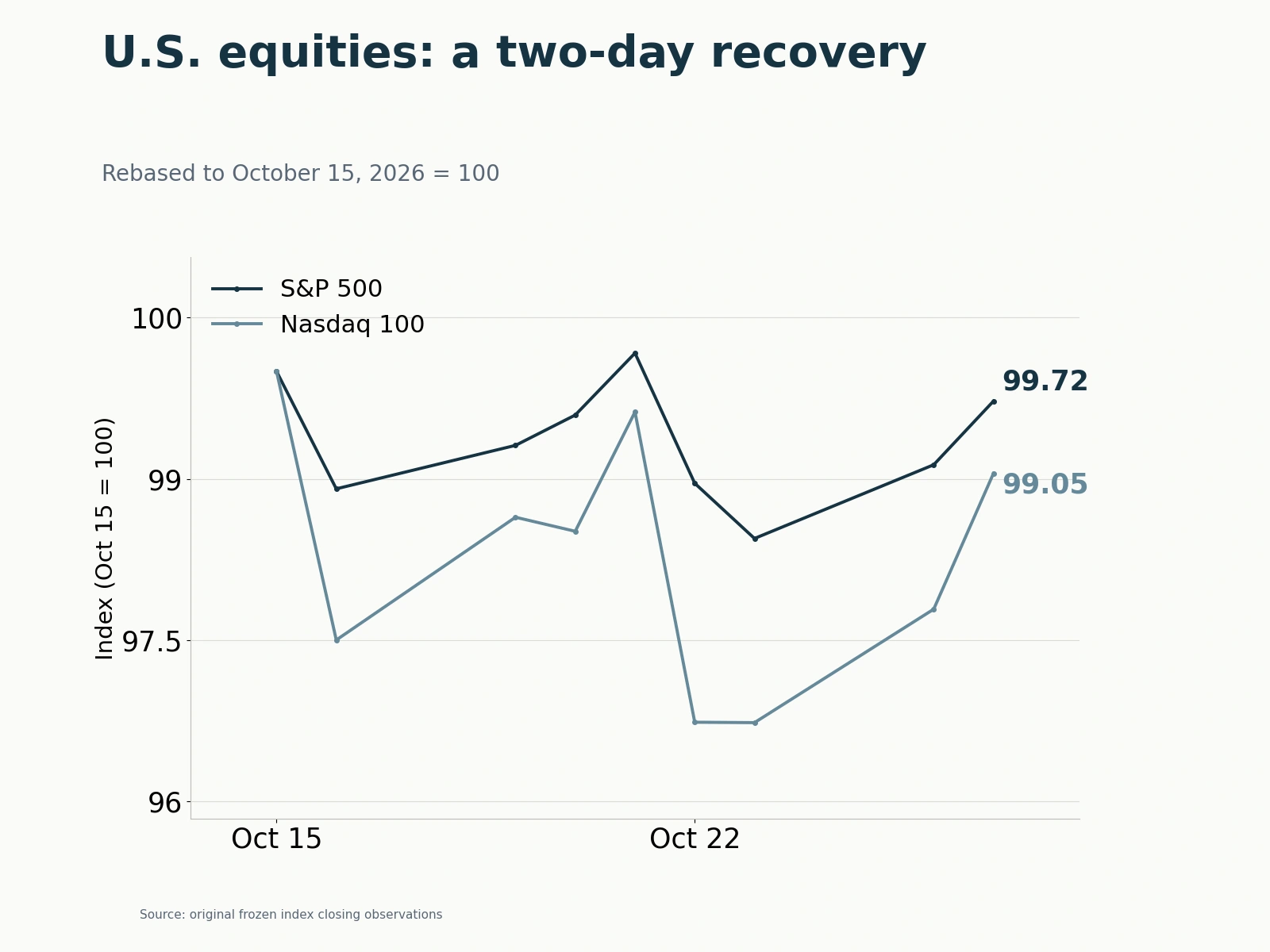
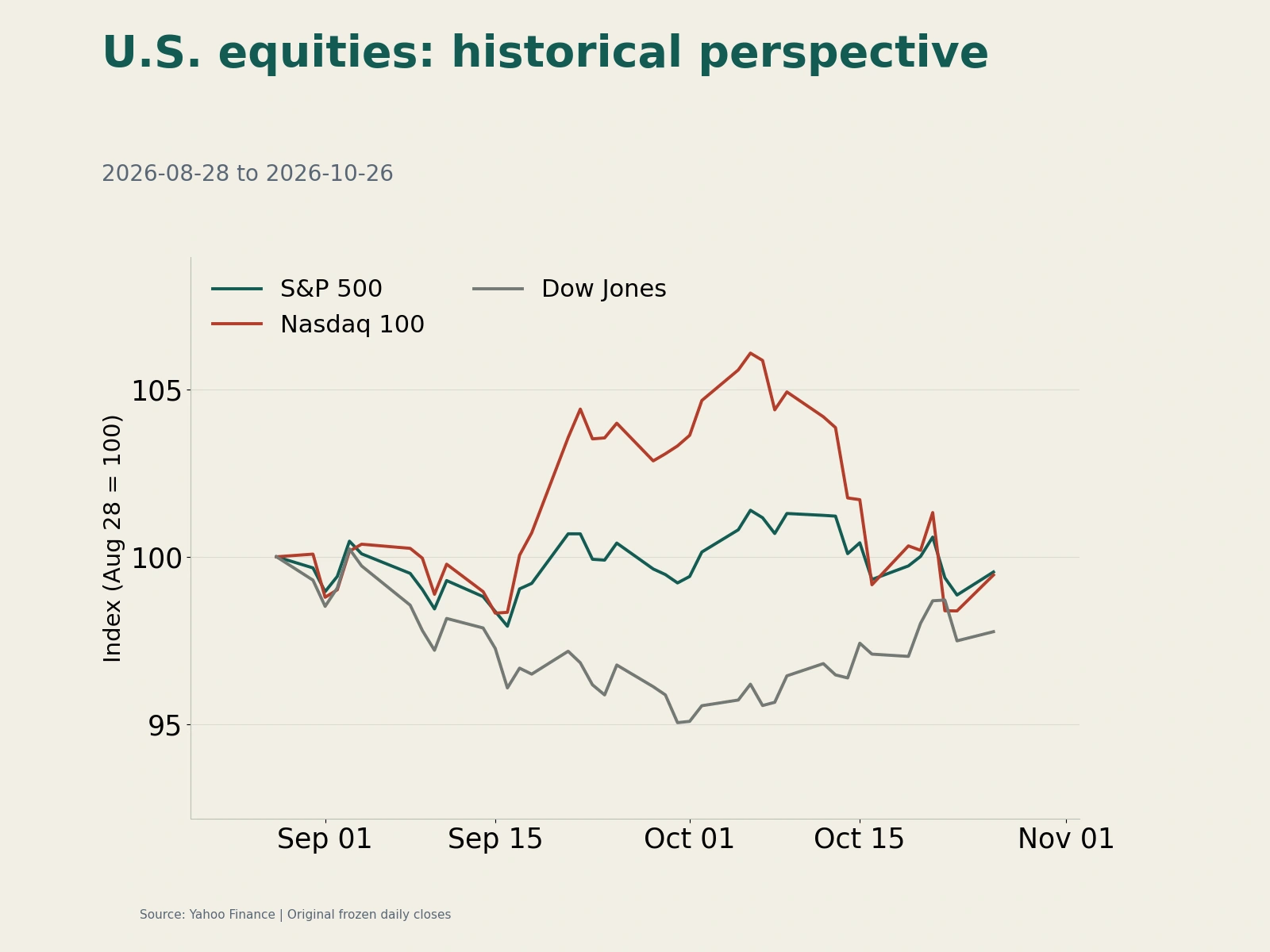
On October 23, 2026, rising energy prices and financing costs continued to dominate global market pricing. The US 10-year Treasury yield returned to 5.00%; the S&P 500 and Dow Jones Industrial Average fell 0.52% and 1.23%, respectively, while the Nasdaq 100 was essentially unchanged. Crude strengthened and gold retreated. Within equities, parts of technology recovered while financials and industrials extended their declines. US corporate orders and employment continued expanding, but cost pass-through and high interest rates intensified concerns over household purchasing power. The modest slowdown in economic growth was still insufficient to ease financial conditions. By the morning of October 24, Beijing time, the adjustment had spread from equity valuations to corporate credit: global corporate bond risk premiums reached their highest since May 2025, while Asian dollar bond spreads also widened.
Higher US corporate output prices and a more than 3% oil rally: Rising inflation expectations weigh on gold
The flash S&P Global US composite PMI for October came in at 57.6. Although slightly below September's 58.4, it was still the second-highest reading since March 2022. The services activity index fell from 58.8 to 57.9, while manufacturing PMI edged up from 55.9 to 56.0. New orders rose marginally from 58.1 to 58.2. Companies continued hiring, with overall employment growth second only to September's and the second-fastest since June 2022. Alongside resilient demand, supply-chain constraints intensified price transmission: the manufacturing suppliers' delivery times index fell from 40.9 to 38.1, indicating further delivery delays, while the composite output prices index rose from 58.4 to 59.8, its highest since August 2022. Higher energy, fuel and freight costs, together with increased service-sector wages, utility bills and insurance expenses, were reaching end customers through order backlogs and corporate price increases.
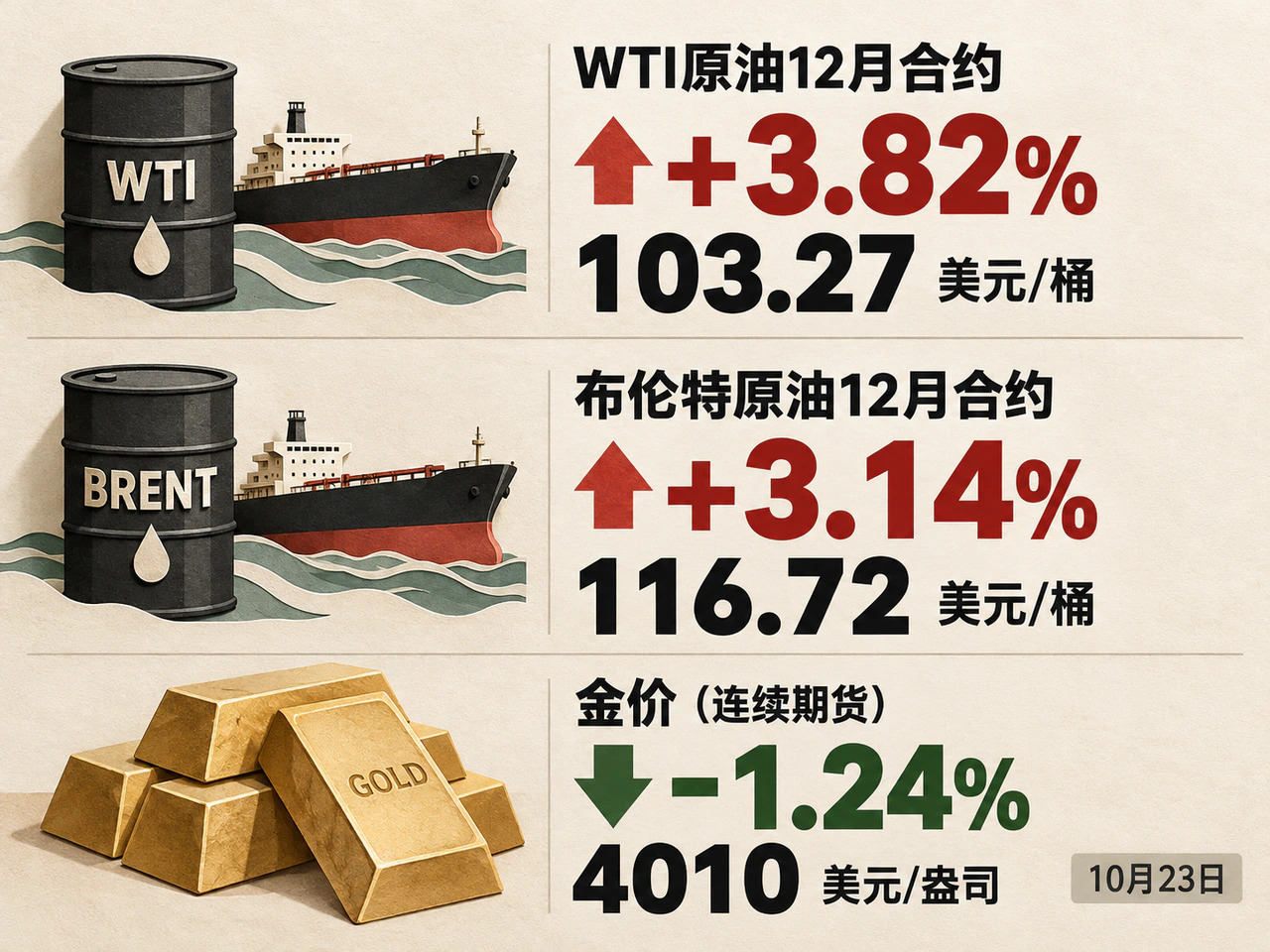
The day's sharp oil rally added to upstream cost pressure. According to Xinhua, New York WTI December crude settled 3.82% higher at $103.27 a barrel, and London ICE Brent December crude rose 3.14% to settle at $116.72 a barrel. Risks to Middle Eastern energy facilities and shipping continued to disrupt near-term supply expectations. The head of Libya's National Oil Corporation separately confirmed to Reuters that pipeline valve closures had reduced production at the Hamada and Tahara fields. Higher oil directly supported energy companies but squeezed margins in industries dependent on fuel and logistics.
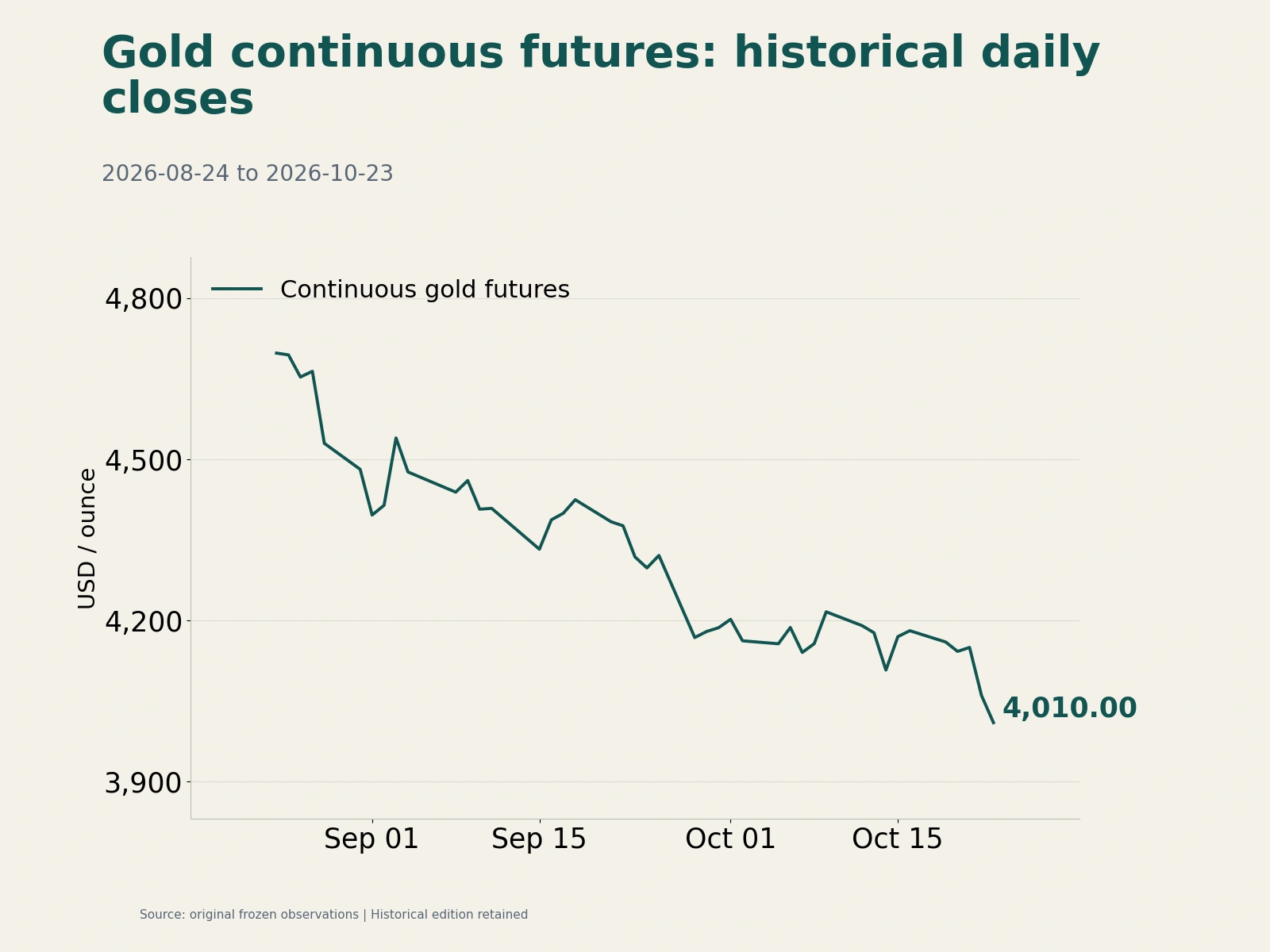
Gold weakened under the combined pressure of interest-rate expectations and liquidity needs. On the continuous-futures provider's daily closing basis, gold fell 1.24% to $4,010 an ounce, down about 4.09% cumulatively from October 16. The dollar index rose 0.14% to 101.752 over the session. Reuters cited American Gold Exchange analyst Jim Wyckoff as saying that energy inflation constrained central banks' room to ease, while margin calls triggered by the technology stock sell-off encouraged some investors to liquidate precious metals to raise cash. Increased festival buying in India and higher local physical premiums nevertheless provided a partial buying cushion.
Households felt the strain of high prices and interest rates more acutely than the corporate sector's steady expansion suggested. The final October University of Michigan consumer sentiment index was 48.0, revised up from the preliminary 46.3 but still slightly below September's 48.1. The durable-goods buying conditions index fell 18% from the previous month, weighed down by high interest rates and affordability pressures. Meanwhile, one-year inflation expectations rose from 4.6% to 4.7%, and long-term expectations from 3.4% to 3.5%, both increasing for a second consecutive month. Persistent high costs eroded households' real purchasing power, while companies retained some ability to pass costs into final selling prices, making disinflation more difficult.
The 10-year Treasury yield returns to 5%; global corporate bond spreads widen to 129 basis points
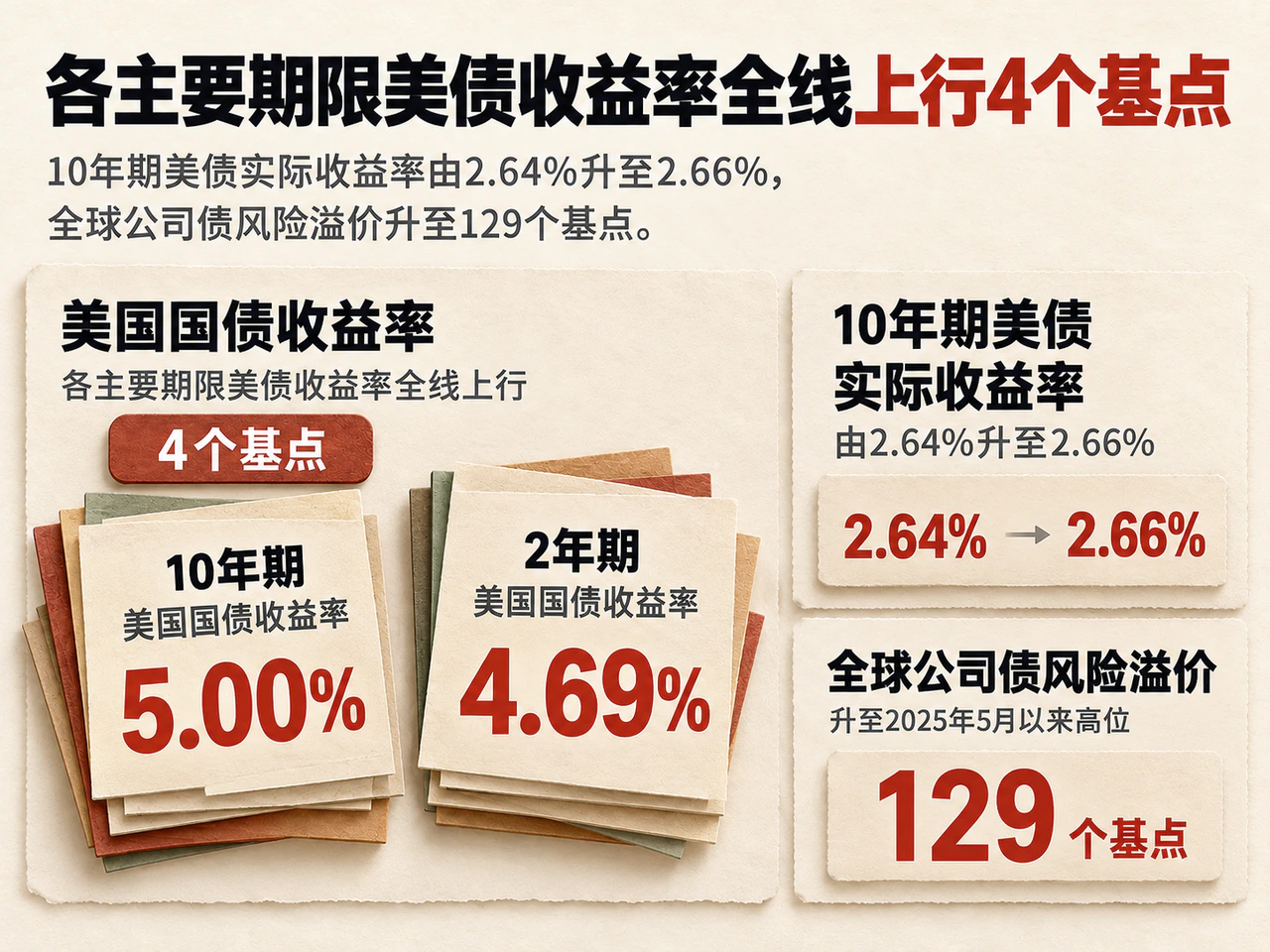
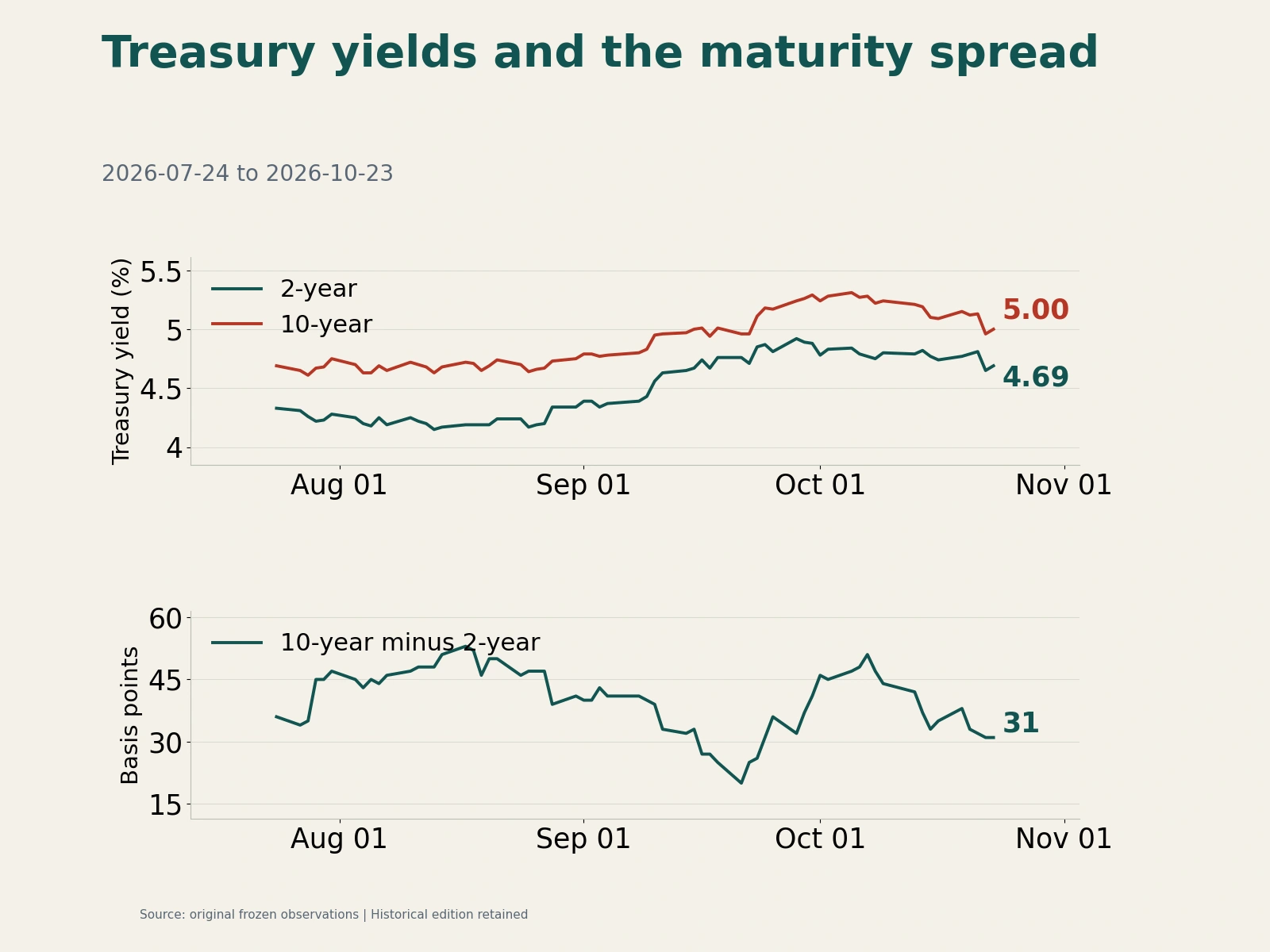
The US Treasury's comparable end-of-day yield curve showed yields across major maturities rising 4 basis points on Friday. The 10-year/2-year spread stayed at 31 basis points as the whole curve shifted upward.
| Maturity | October 22 | October 23 | Daily change |
|---|---|---|---|
| 2-year | 4.65% | 4.69% | +4 basis points |
| 5-year | 4.78% | 4.82% | +4 basis points |
| 10-year | 4.96% | 5.00% | +4 basis points |
| 30-year | 5.29% | 5.33% | +4 basis points |
In the previous session, safe-haven buying had driven 2-year and 10-year Treasury yields down 16 and 17 basis points, respectively. Friday reversed only part of those safe-haven gains. Although weaker risk assets continued to create some demand for bonds, resilient corporate expansion and output-price pressure limited the scope for a sustained decline in yields.
Breaking down the move, the 10-year real Treasury yield rose from 2.64% to 2.66%, while the gap between nominal and real yields widened from 2.32 to 2.34 percentage points. On this approximate measure of inflation compensation, roughly half of Friday's 4-basis-point rise in the nominal 10-year yield came from higher real rates, and the other half from wider inflation compensation, which includes risk-premium and liquidity effects. CNBC, citing CME FedWatch data that day, reported that markets expected the Federal Reserve to hold its policy rate at 3.75%–4.00% the following week, but assigned about a 71% probability to a 25-basis-point increase in December. Policy expectations remained closely tied to inflation constraints.
Credit-market pressure became more apparent in the high-rate environment. Bloomberg reported that global corporate bond risk premiums rose to 129 basis points, their highest since May 2025, while spreads on higher-rated Asian corporate dollar bonds widened to their highest since July 2025. Early Friday in Asia, Chinese technology dollar bond spreads widened 3–5 basis points, and Chinese investment-grade dollar bond spreads widened as much as 5 basis points. For offshore dollar bond issuers, wider credit spreads in Asian trading raised the additional financing premium; the subsequent rise in Treasury yields during US trading lifted the benchmark as well. Disagreement over the cash-recovery cycle for AI capital expenditure also grew: Citadel founder Ken Griffin warned of bubble risk, while Blackstone president Jon Gray emphasized continuing strong demand. Investors' scrutiny of long-term corporate spending was increasingly being expressed through debt growth, cash flow and financing maturity.
Nearly three-quarters of S&P 500 stocks fall: A chip rebound cannot mask pressure on financials and industrials
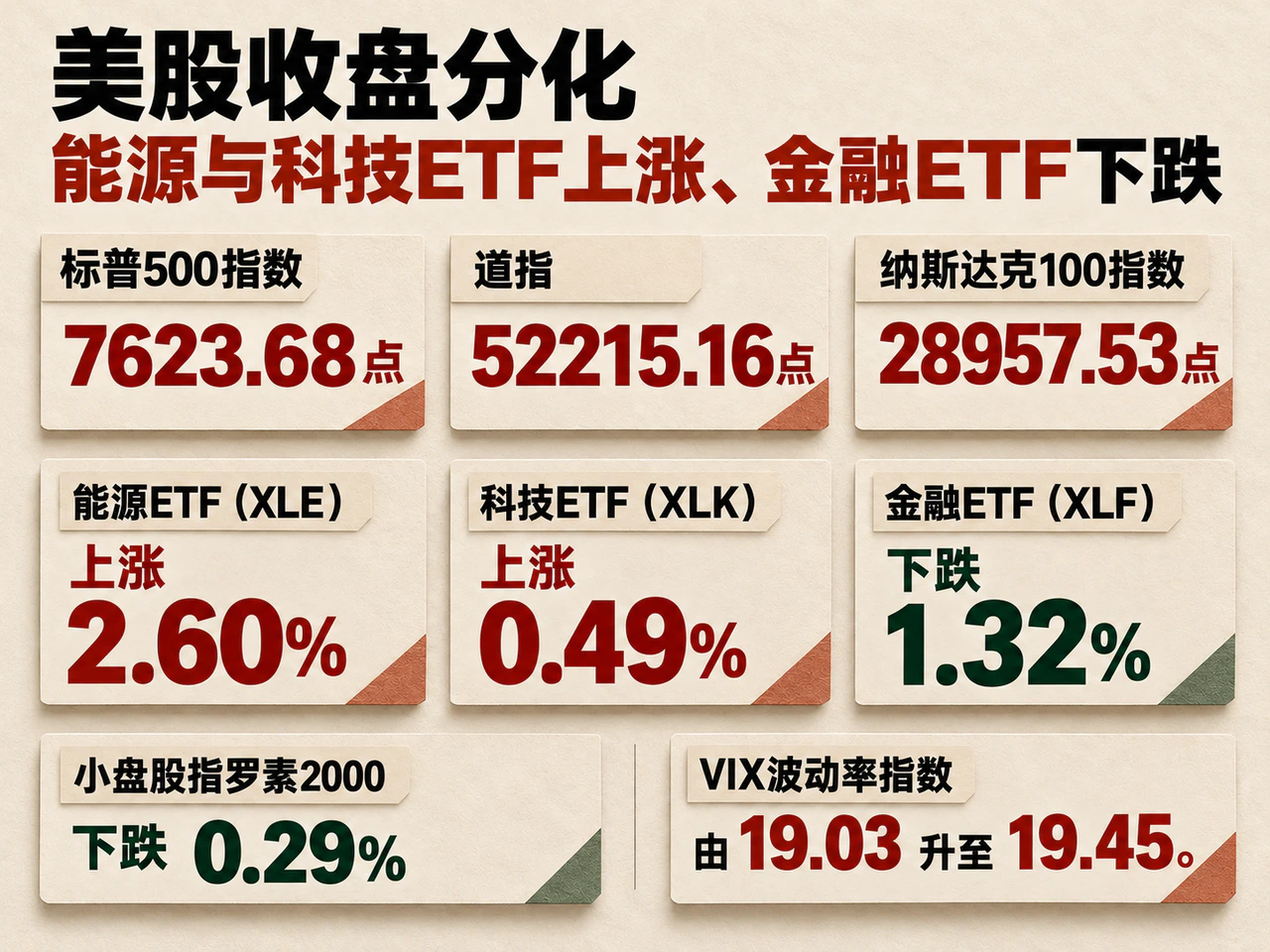
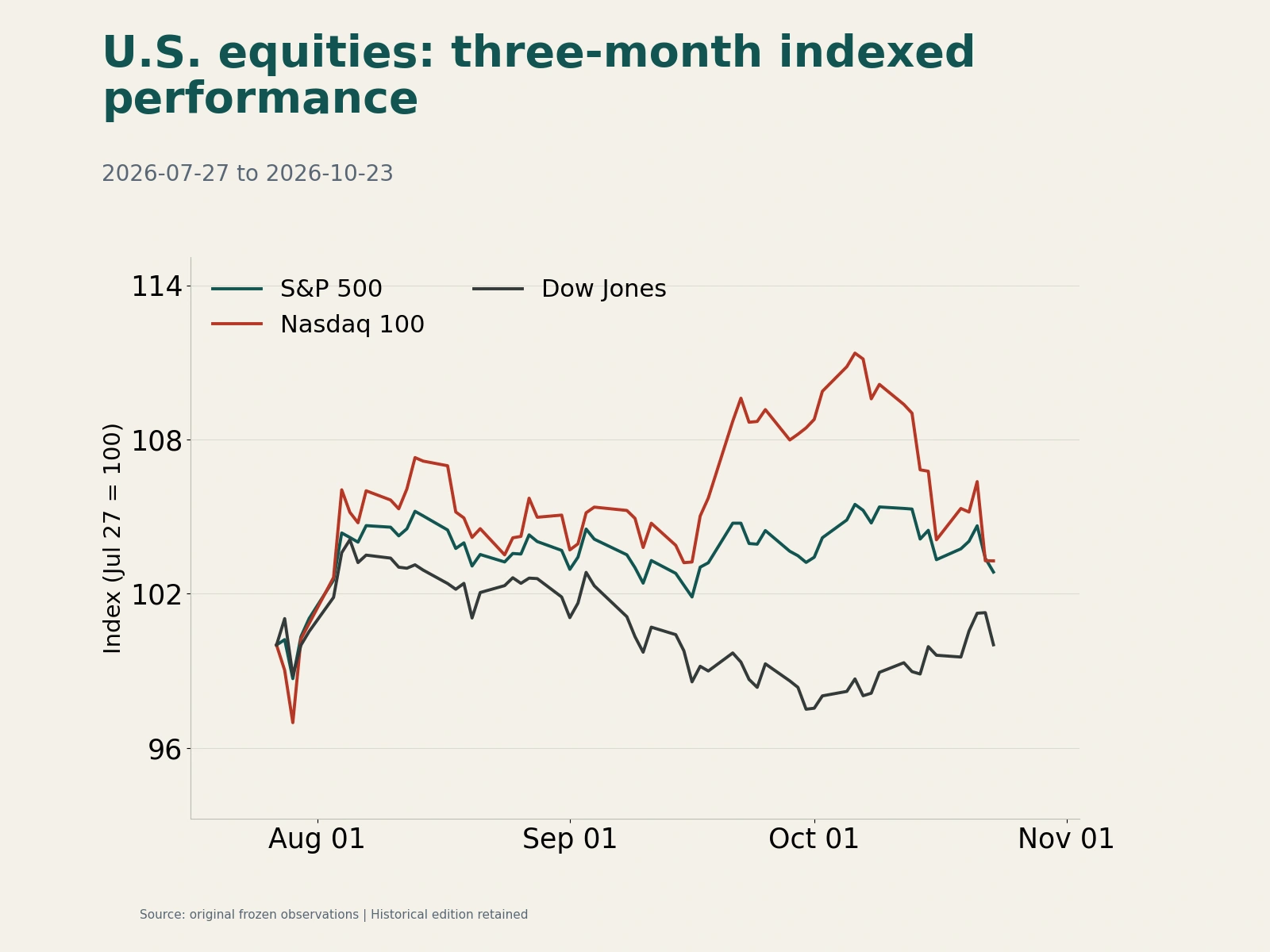
US equities closed mixed on Friday: the S&P 500 finished at 7,623.68, the Dow at 52,215.16 and the Nasdaq 100 at 28,957.53. The small-cap Russell 2000 fell 0.29%, while the VIX rose from 19.03 to 19.45. According to the Associated Press's closing report, nearly three-quarters of S&P 500 constituents declined, indicating that stabilization in large technology stocks had yet to lift most shares. Comparable closing data showed the energy ETF XLE rising 2.60%, supported by oil; technology ETF XLK gained 0.49%, while financial ETF XLF fell 1.32%. Micron rebounded 2.5%, Intel and AMD each rose 1.7%, and Microsoft gained 0.7%. Caterpillar fell 2.4% and American Express 3.7%, as financials and industrials continued to face the twin constraints of financing costs and the demand outlook.
American Express's results illustrated investors' close scrutiny of earnings quality. Third-quarter revenue net of interest expense rose 9% year on year to $20.06 billion, adjusted earnings per share increased 13% to $4.68, and the company raised full-year adjusted EPS guidance to $17.60–$17.90. But it also announced a roughly 5% workforce reduction, affecting about 4,000 people, and booked $336 million in restructuring charges. Although spending by high-income customers continued to provide support, expense growth and organizational changes kept markets cautious. Earnings growth and higher guidance failed to prevent the share-price decline.
Asian markets, which closed before the US session, were mixed on Friday. The Hang Seng rose about 0.69% to 23,093.37, still below its October 16 level of 24,186.83. South Korea's KOSPI rose 0.30%, with SK Hynix gaining 4.42%, while the Nikkei 225 fell about 0.34%. The one-day recoveries in Hong Kong and South Korea followed recent corrections. Hong Kong growth stocks were influenced by both global discount rates and local liquidity, Korean memory-chip stocks benefited more directly from AI equipment demand, and Japanese technology stocks also faced currency effects on export earnings. In the next trading session, companies' specific disclosures about revenue, capital expenditure and cash recovery would provide a better test of the recovery's durability than a rebound in a single index.
China's fiscal-financial coordination supports more than RMB 28 trillion in credit in the first three quarters; first-home mortgage subsidies begin
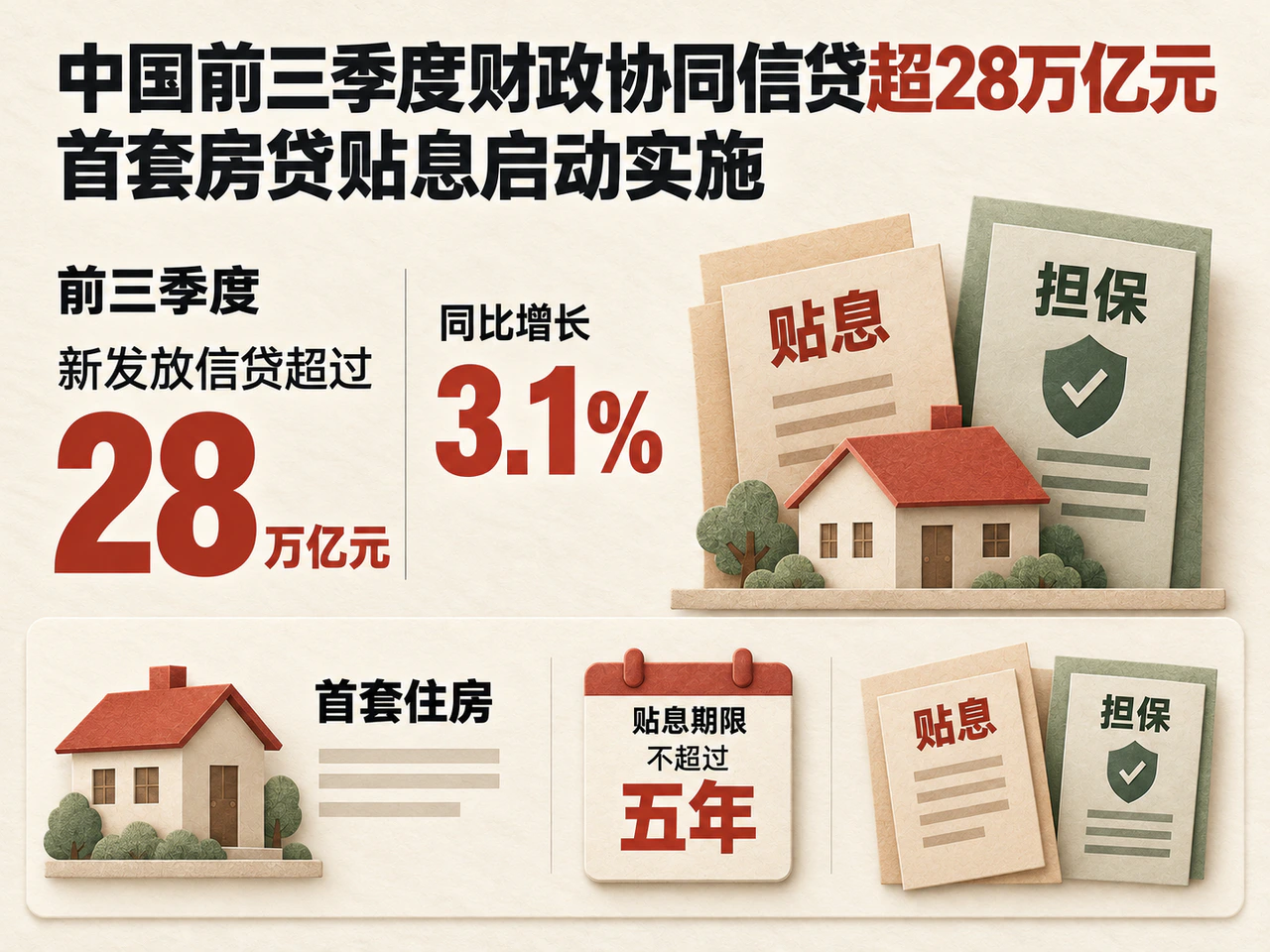
Against a backdrop of tight overseas financing conditions, Chinese policy continued to support domestic demand through interest subsidies, guarantees and bond funding. The Ministry of Finance announced on October 23 that national general public budget revenue in the first three quarters was RMB 17,229.2 billion, up 5.1% year on year, while general public budget expenditure was RMB 21,019.9 billion, up 1%. Government-managed fund budget revenue fell 18.6% over the same period, including a 27.9% drop in revenue from sales of state-owned land-use rights. Falling land-related revenue continued to constrain local funding arrangements.
Fiscal-financial coordination policies supported more than RMB 28 trillion in new lending to relevant sectors in the first three quarters, up 3.1% year on year. Since working-capital loans were included in the interest-subsidy program for micro, small and medium-sized enterprises in August, more than RMB 1.8 trillion of new loans had been supported within two months. By sharing interest costs and credit risk, fiscal policy encouraged banks to lend to these sectors. Its impact on final demand depended on whether business borrowing translated into actual operations and investment, and whether household income expectations improved alongside it.
Housing support also entered implementation. According to the Ministry of Finance, the home-purchase mortgage interest-subsidy policy announced on September 29 took effect on October 1 for an initial one-year implementation period. It covered eligible buyers with essential housing needs purchasing smaller, lower-priced first homes, including both new and existing properties. Subsidies would last no more than five years, be settled on an actual-cost basis and deducted monthly, directly reducing eligible buyers' monthly mortgage interest burden.
Government bond issuance also accelerated. New special-purpose bond issuance reached RMB 3,560.8 billion in January–September, completing 81% of the annual quota. September alone saw RMB 633.9 billion issued, an increase of RMB 214.8 billion year on year. The Ministry of Finance said it would move quickly to allocate part of the 2027 new local-government debt quota in advance, aiming to begin issuance as early as possible in January next year. The People's Bank of China separately announced a RMB 700 billion one-year MLF operation for October 26. Subsequent fiscal disbursements, the conversion of projects into actual investment and the provision of matching bank finance would jointly determine how quickly policy support reached domestic demand.
Moody's affirms France at Aa3 as the US adjusts Canadian tariffs and advances outbound-investment restrictions

After the US cash equity market closed, Moody's affirmed France's Aa3 sovereign rating and negative outlook. French government bonds had already faced substantial selling: on October 22, the 10-year yield touched 5.14%, its highest since July 2002. Early Friday in Europe, the 10-year French-German yield spread briefly widened to 176 basis points before narrowing. The affirmation eased immediate downgrade pressure, but France's fiscal consolidation still depended on budget implementation. The government planned to reduce the deficit from 5.4% of GDP in 2026 to 5% in 2027, while parliament had already removed some spending cuts. With debt-financing costs and budget execution constraining each other, bond investors still had to assess whether the deficit-reduction target could be met.
North American trade and cross-border investment policies were also redistributing corporate costs. The White House announced changes to the Canadian product tariff list on the 23rd. From October 30, plywood, certain paper products, some machinery and refrigeration equipment would be removed from Section 338 tariffs, while certain valves, carpets, waste and other products would be added. Covered products would remain subject to the tariff even if they met USMCA rules of origin, and the charge would be added to Section 232 tariffs. Import-cost changes would vary by product category and alternative supply chain. Meanwhile, the US Treasury was advancing a proposal to expand restrictions on outbound high-technology investment to more technology areas, including biotechnology. It was at the public-comment stage. According to the Associated Press, the proposal excluded many financial investments such as stock purchases, with its direct effects concentrated on relevant cross-border project investments, due diligence and compliance arrangements.