By the morning of October 24 Beijing time, the previous Hong Kong session’s rebound had sharply increased Xiaomi option activity. Xiaomi closed October 23 at HK$26.80, up 3.88%. Its HK$28 call expiring October 29 traded 6,363 contracts, approximately 9.5 times the previous day’s volume, yet total open interest fell about 24%. A recovering share price alongside shrinking positions showed intense turnover in near-month options during the rebound.
HK$28 call volume jumps to 6,363 contracts, while open interest falls
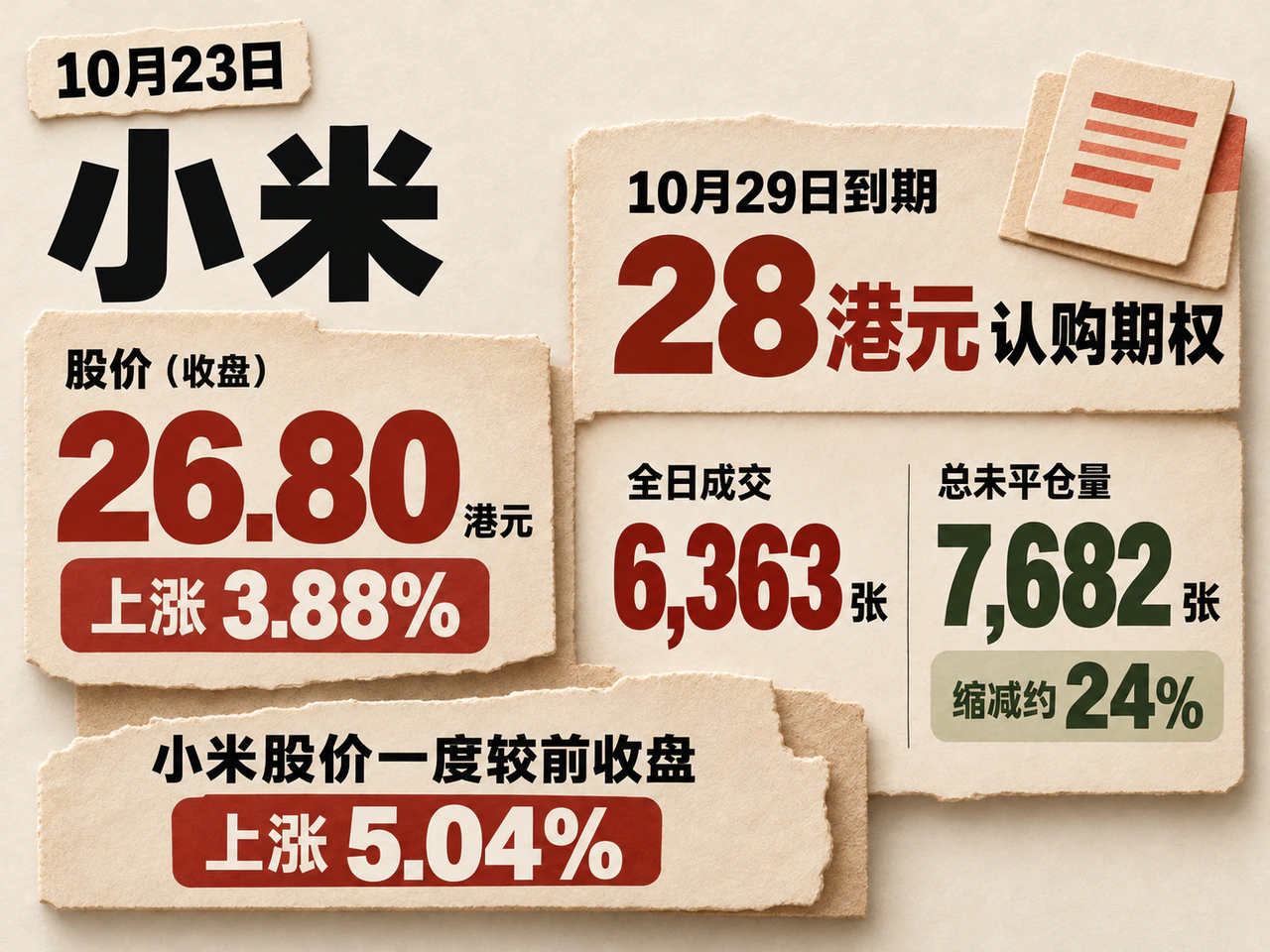
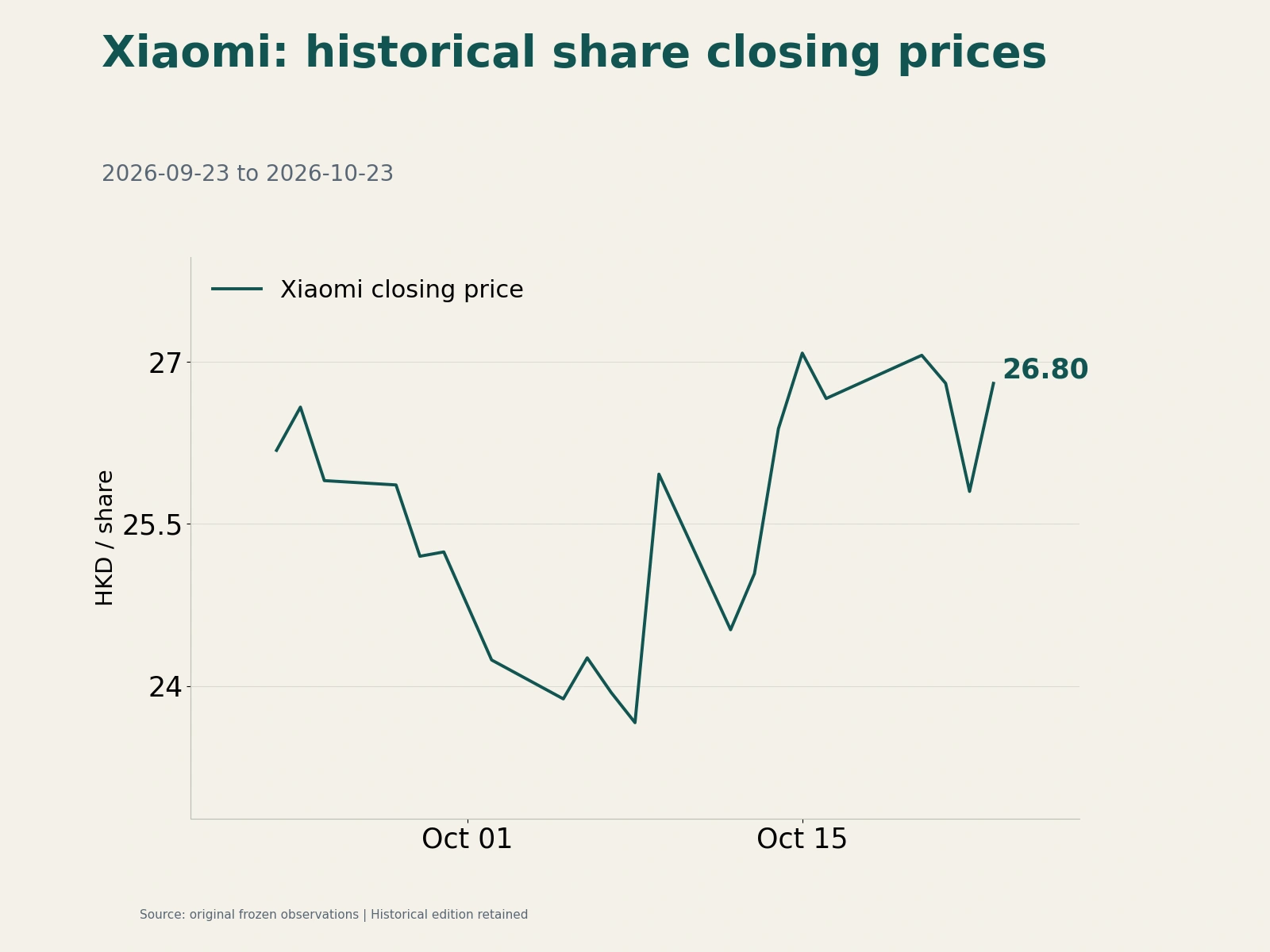
Xiaomi rose as much as 5.04% from the previous close during the morning of October 23. Tiger Brokers’ Hong Kong options report put half-day Xiaomi option volume at 32,587 contracts, behind Tencent and Alibaba. The October 29 HK$28 call traded 4,349 contracts by midday, making it Xiaomi’s most active option during that observation window.
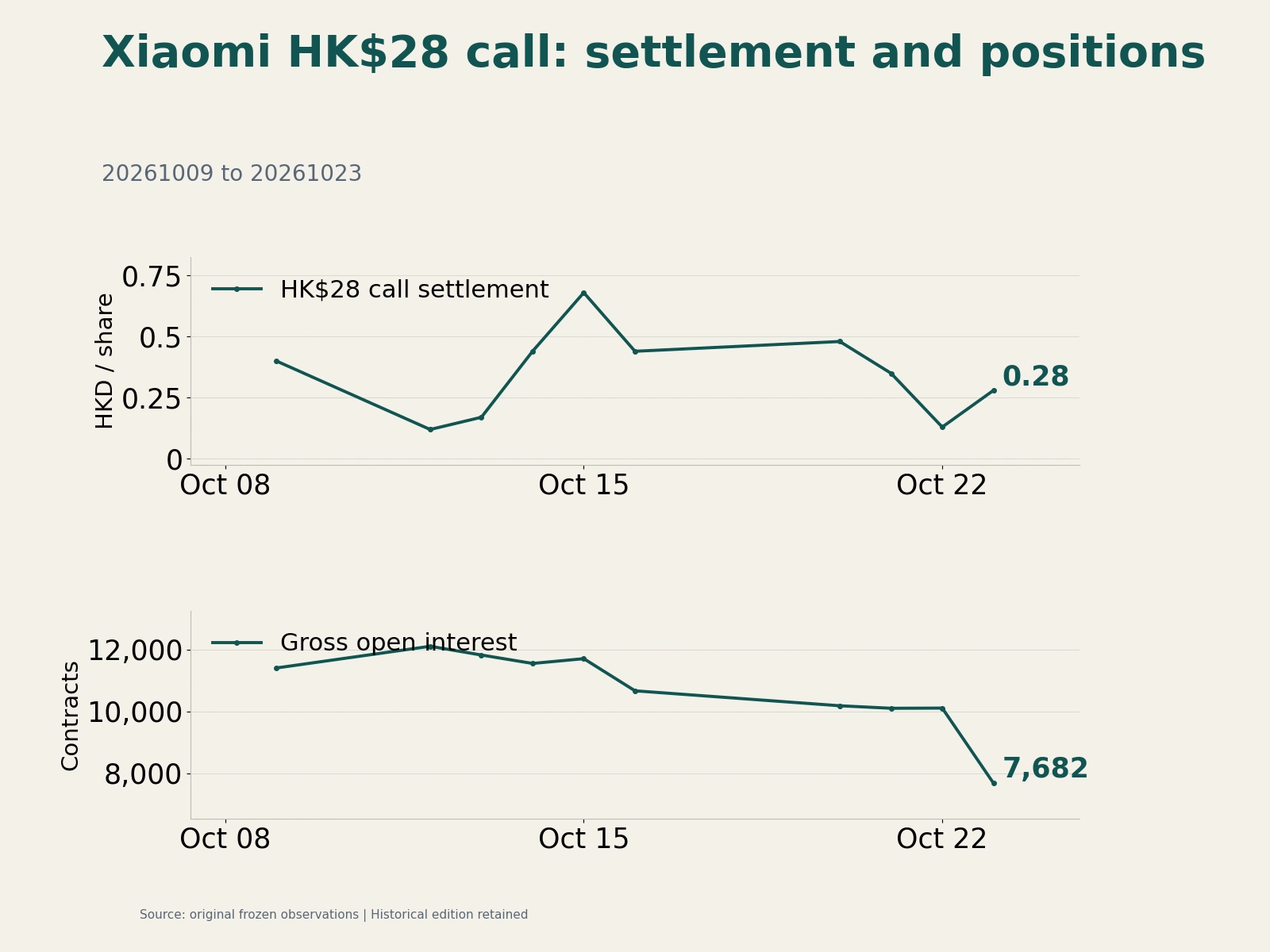
HKEX full-day clearing data confirmed the surge in activity. Call volume jumped from 667 contracts on October 22 to 6,363, the number of trades rose from 40 to 149, and the settlement price increased from HK$0.13 to HK$0.28 per share. The cash-market rebound raised the call’s valuation and substantially revived trading.
Outstanding positions after the session nevertheless contracted markedly. Total open interest fell from 10,109 to 7,682 contracts, down 2,427 in one day. Net open interest after participant-level netting also declined from 8,302 to 5,939. Falling gross and net positions showed that heavy trading involved exits or reallocations of existing exposures, rather than simply one-way additions by new money chasing the rally.
Under HKEX’s position statistics, volume includes opening, closing and transfers of positions. Near expiry, closures and rolls can likewise produce higher volume with lower open interest. Activity in this contract could include call buyers taking profits, sellers covering, or adjustments across strikes and months. The central feature was concentrated handling of existing positions.
Time runs down during cash-market swings; near-month call valuation shrinks and positions fall by a third
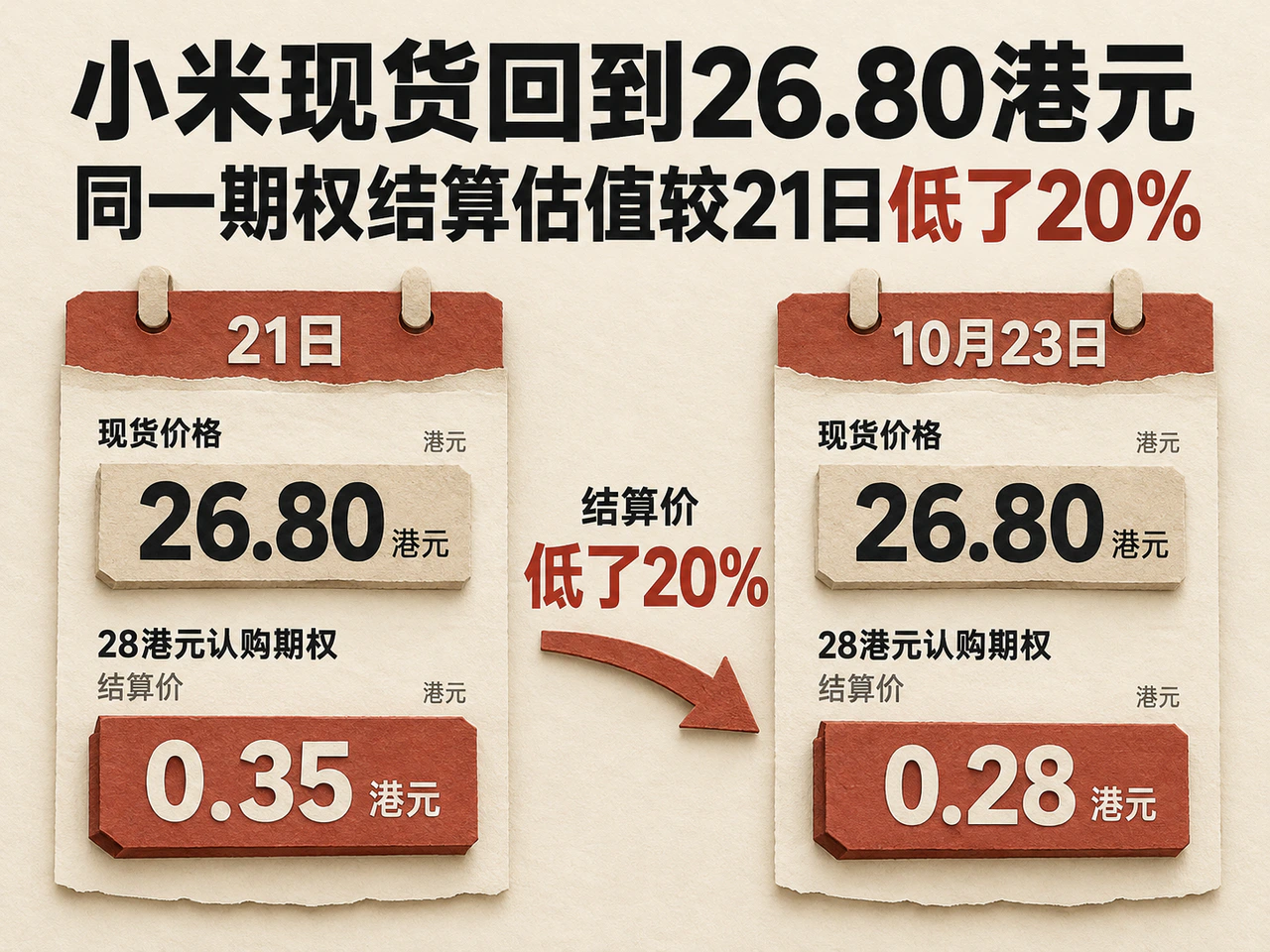
Time passing during share-price fluctuations, together with other pricing inputs, continued to weigh on the near-month call. Xiaomi fell 3.73% on October 22 and rose 3.88% on October 23, returning to its October 21 close of HK$26.80. Yet the same HK$28 call’s settlement price fell from HK$0.35 on October 21 to HK$0.28 on October 23. The underlying returned to its starting point while the option was worth 20% less, a gap jointly caused by less time remaining and other pricing factors.
The convergence in valuation and positions was clearer over a week. Xiaomi closed October 15 at HK$27.08, only about 1% above October 23’s HK$26.80. The HK$28 call’s settlement price nonetheless declined from HK$0.68 on October 15 to HK$0.44 on October 16, HK$0.48 on October 20, HK$0.35 on October 21 and HK$0.13 on October 22. The rebound to HK$0.28 on October 23 still left it far below a week earlier. Out-of-the-money calls near expiry require both sufficient price appreciation and speed. A slow recovery or repeated swings keep narrowing the time available to realize a payoff.
At the October 23 share close, the HK$28 strike remained about 4.48% out of the money. For a buyer holding to expiry, shares needed not only to exceed HK$28 but also to cover the actual premium and trading costs to break even. The HK$0.28 clearing settlement price reflected the contract’s valuation change; each investor’s breakeven depended on their own acquisition cost.
Against that background, total call open interest fell from 11,707 contracts on October 15 to 7,682 on October 23, a contraction of approximately one-third. October 23 volume was the highest of the ten trading sessions from October 9 through October 23. As expiry approached, trading became more concentrated while fewer positions remained, consistent with traders using the rebound to accelerate management of expiry risk. The popular HK$28 strike represented positions with different costs, directions and horizons, rather than a unanimous share-price target.
HK$25 put prices more than halve but open interest edges higher as Xiaomi gives back part of its intraday rally
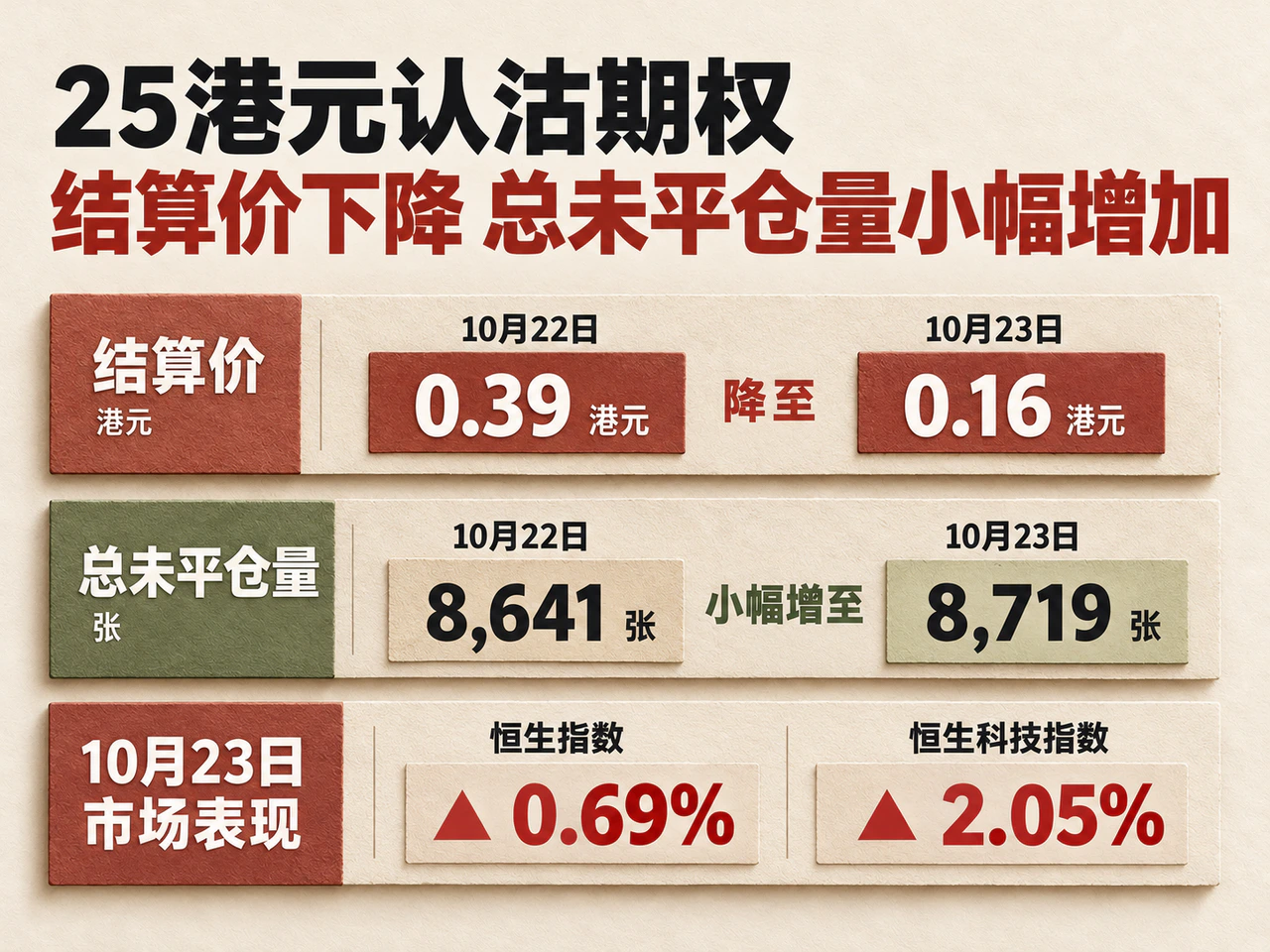
Put positioning offered a comparison. The HK$25 put with the same October 29 expiry traded 2,217 contracts on October 23, below the preceding day’s 3,590. Its settlement price fell from HK$0.39 to HK$0.16. The share rebound put the HK$25 strike approximately 6.72% below the closing price, reducing the valuation of near-term downside protection.
Total open interest in that put nevertheless edged up from 8,641 to 8,719 contracts. The HK$28 call combined higher volume with fewer positions, while the HK$25 put combined lower volume with a lower price. The market was reducing short-term upside trading positions while maintaining outstanding HK$25 puts.
This pattern matched the pace of recovery in Hong Kong equities and Xiaomi shares. On October 23, the Hang Seng gained 0.69% and the Hang Seng Tech Index rose 2.05%. Zhitong Finance cited Industrial Securities as saying earnings, valuations and capital flows had not yet reinforced one another, leaving short-term opportunities centered on rebounds and structural changes. Company-level buying and selling also coexisted. Securities Times’ Databao, using company announcements, said Xiaomi repurchased 4.086 million shares on October 22 at HK$25.70–25.92 for approximately HK$105 million, yet its shares fell 3.73% that day. On October 23 the stock reached HK$27.40 intraday but eased to HK$26.80 at the close, giving back a meaningful part of the rally. Support such as buybacks would have to become sustained share-price appreciation to improve short-dated call outcomes at expiry.
Xiaomi’s progress toward HK$28 and the disposition of the remaining 7,682 call positions would be more informative than a single day’s most-active list. If shares continued toward HK$28, near-term calls’ price sensitivity would change materially with the underlying level and time remaining. If the stock stayed in the HK$26–27 range, time-value decay would continue to weigh on the contract.