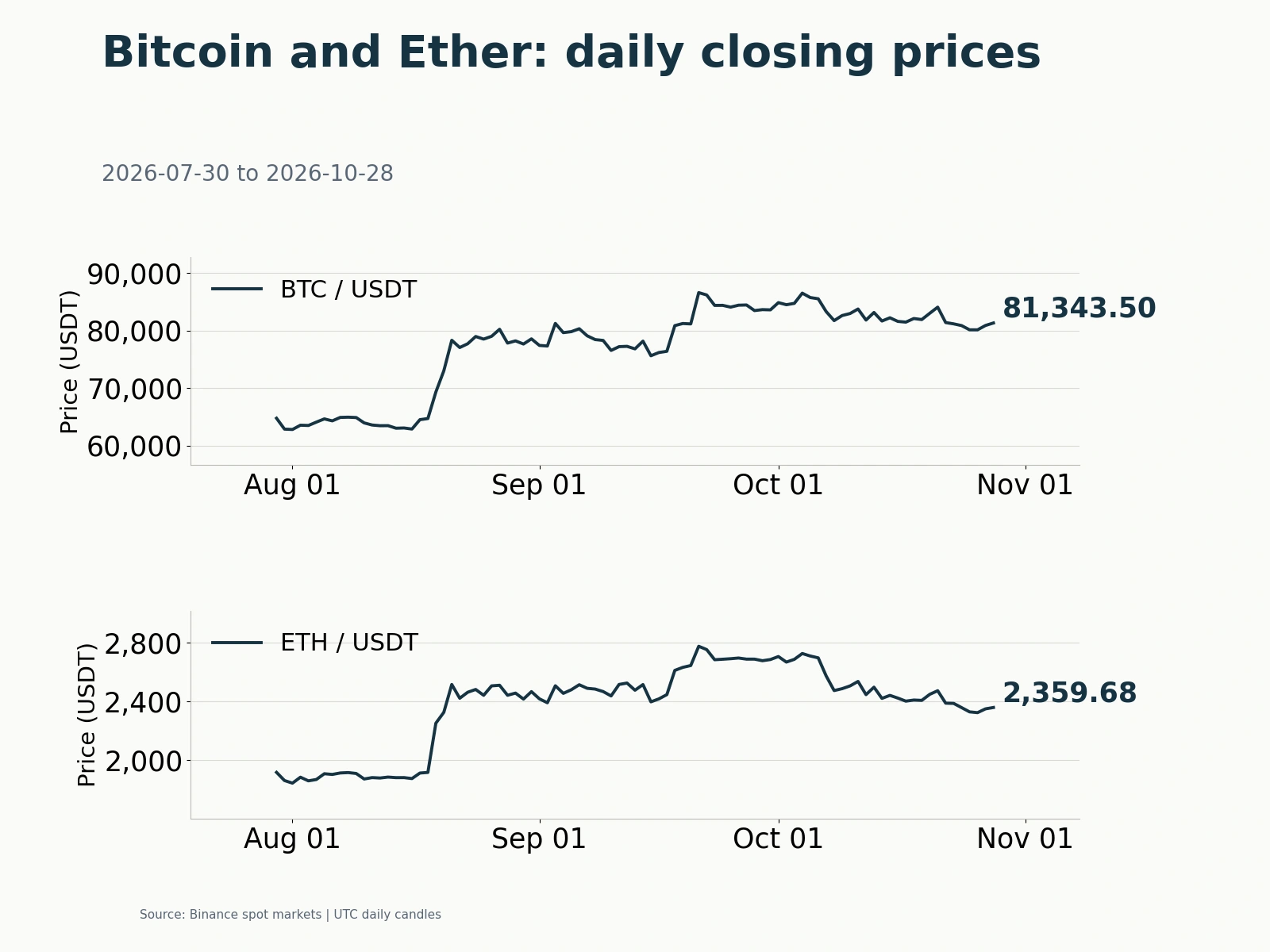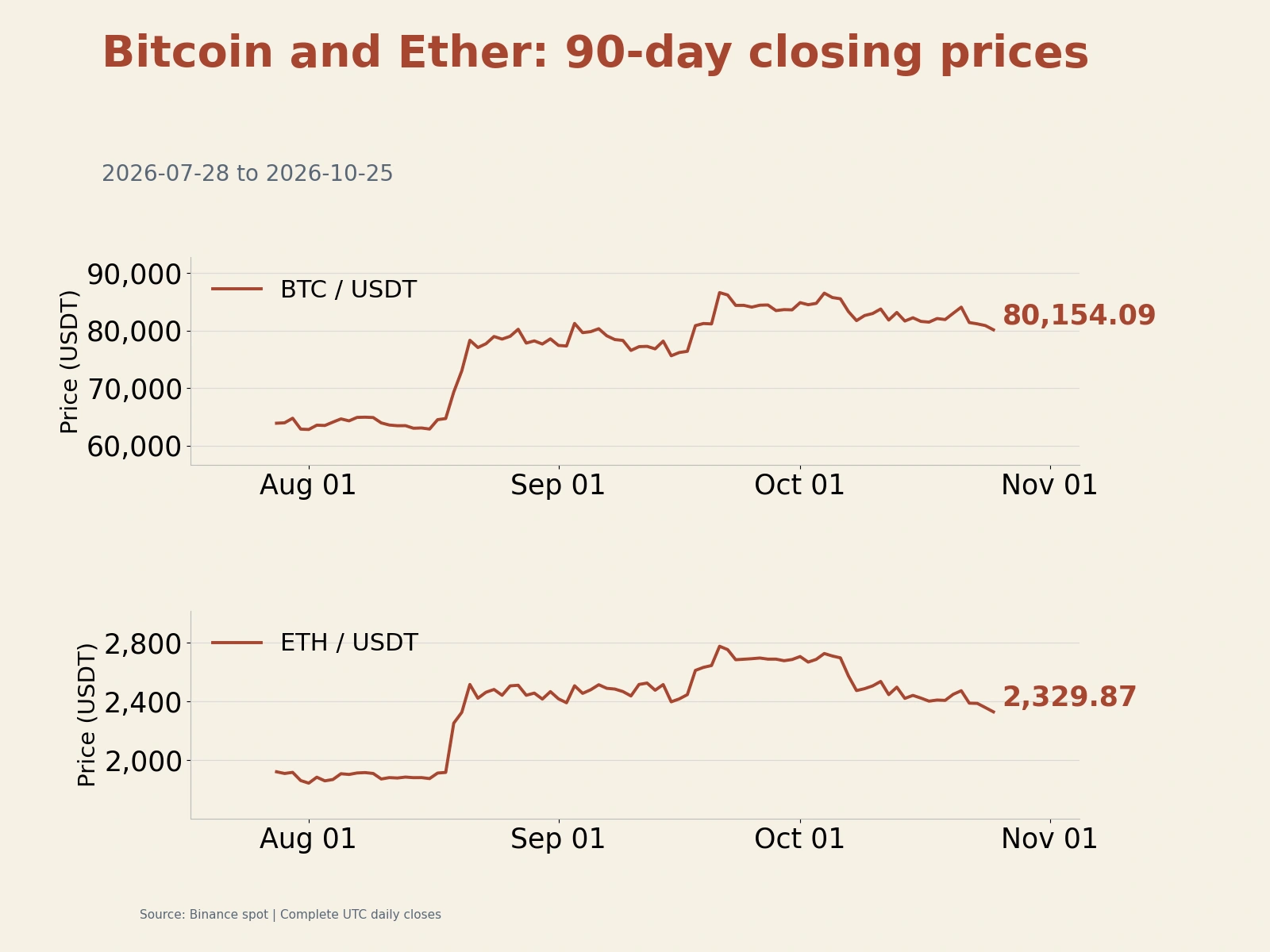
Over the seven complete trading days from October 19 through October 25, Binance spot UTC daily candles showed Bitcoin approaching 85,000 USDT before technology-stock weakness and a weekend escalation in Middle East tensions pushed it lower. It finished at 80,154.09 USDT, down 2.39% for the week. Ether’s rebound was larger and its reversal deeper, ending at 2,329.87 USDT, down 3.34%.
Spot ETF buying continued to provide underlying support for Bitcoin, and traditional asset managers were beginning to include it in long-term research frameworks. Short-term buying support remained insufficient, however, and the recovery failed to broaden into general gains across major coins.
Technology weakness and Middle East tensions reverse Bitcoin’s approach to 85,000
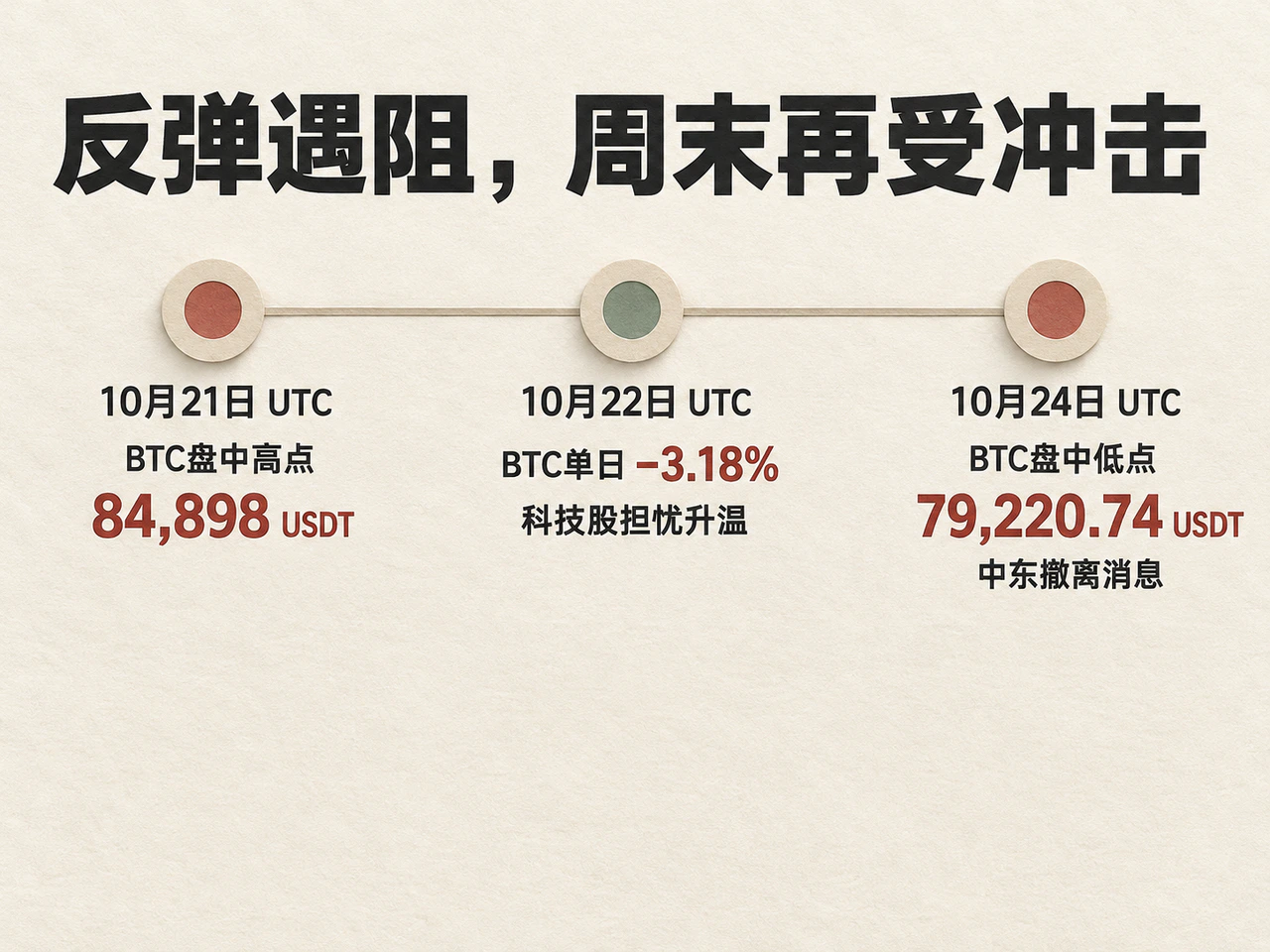
The market attempted a recovery early in the week. Bitcoin rose 1.33% on Tuesday and 1.28% on Wednesday, reaching an intraday Wednesday high of 84,898 USDT. Ether also rose for two days and reached a weekly high of 2,526.62 USDT. Measured from the preceding Sunday’s close, both had gained approximately 2.4% by Wednesday’s close.
The turn came on Thursday, when Bitcoin fell 3.18% and Ether 3.42%, wiping out the preceding two days’ gains. CoinDesk reported that Tesla’s lower capital-expenditure outlook and weak guidance from Lam Research intensified technology concerns. Meta’s increased AI spending plans also failed to reverse falling Nasdaq futures. Crypto and technology shares weakened together, showing that lower equity-market risk appetite could still transmit quickly into digital assets.
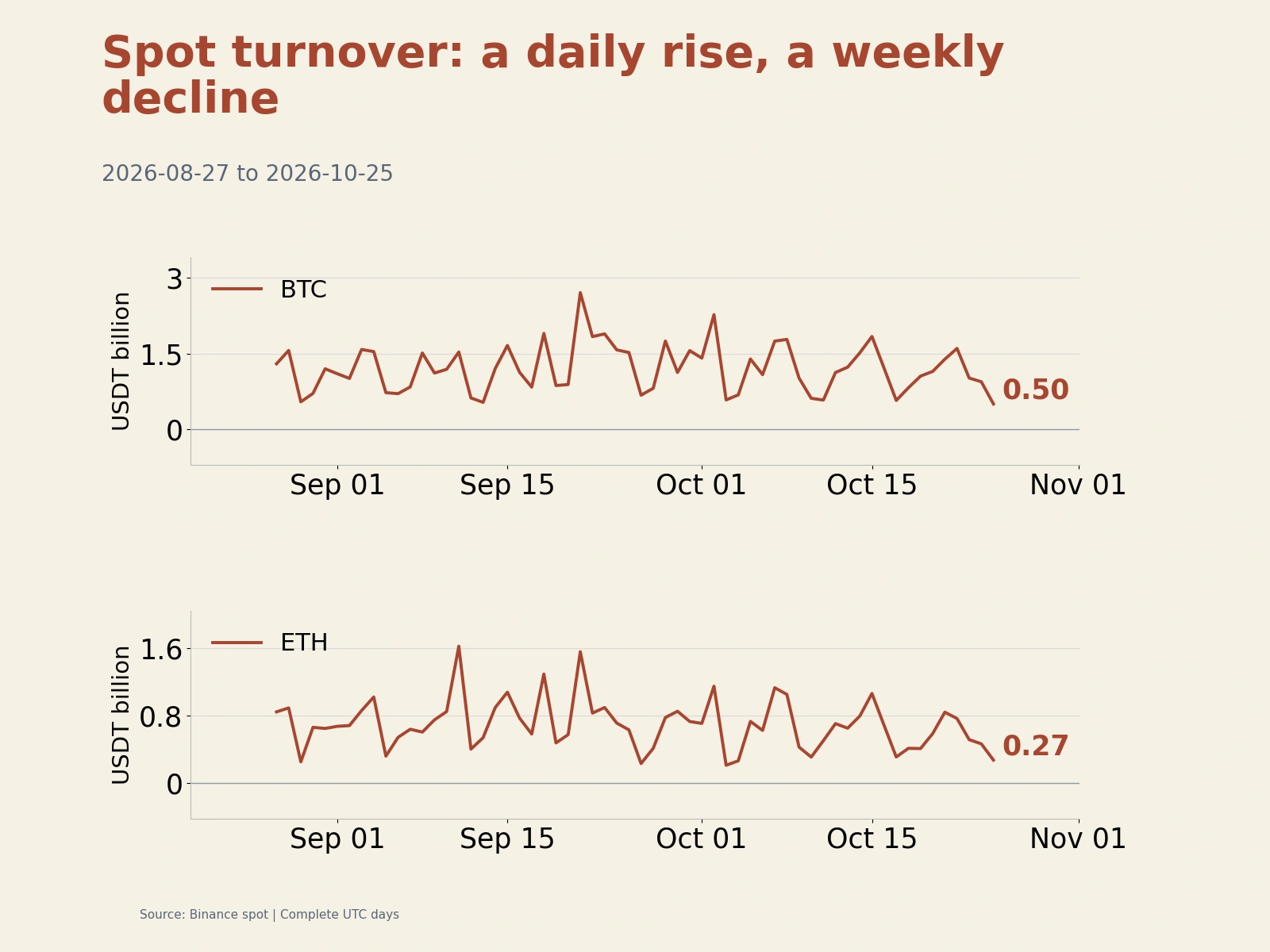
Thursday’s Bitcoin spot turnover on Binance reached the week’s high of 1.601 billion USDT, approximately 15% above Wednesday. Falling prices on higher volume indicated meaningful selling pressure below 85,000 USDT. Ether’s Thursday turnover was lower than Wednesday’s, but its price also reversed quickly, giving back the earlier rebound.
Bitcoin still closed Friday at 81,189.43 USDT, before Middle East tensions intensified again over the weekend. On October 24, CoinDesk cited The Wall Street Journal reporting that the United States was accelerating staff evacuations from some Middle East embassies and military bases. Heightened security concerns did not translate into support for coin prices; crypto continued to behave mainly as a risk asset. During Saturday, Bitcoin fell as low as 79,220.74 USDT and Ether to 2,282.46 USDT, both weekly lows. They recovered some ground but continued lower on Sunday. Combined weekend losses were 1.28% and 2.42%, respectively, with Bitcoin’s Sunday close more than 1,000 USDT below Friday’s.
Weekly Binance spot turnover totaled 7.653 billion USDT for Bitcoin and 3.867 billion for Ether, down 7.9% and 16.5% from the preceding week. Lower weekly turnover alongside Thursday’s high-volume decline showed concentrated selling during the correction and insufficient later buying to sustain the midweek breakout attempt. By Sunday, Bitcoin’s daily turnover had declined to 504 million USDT, while its price remained below Friday’s level. The market entered the new week without the combination of sustained price recovery and expanding volume.
Only BNB gains among eight major coins; new buying concentrates in Bitcoin spot ETFs
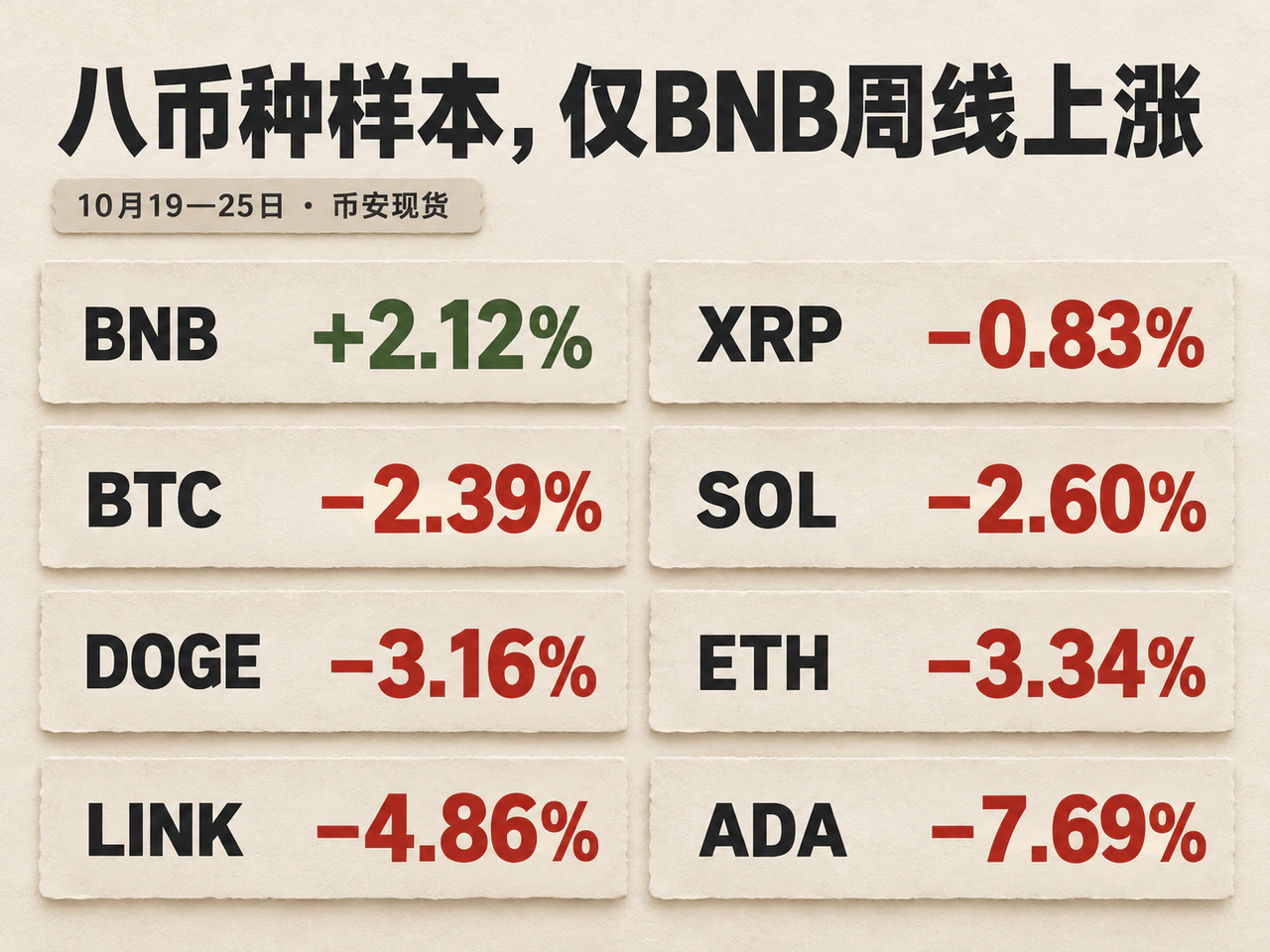
Among the fixed eight-asset liquid spot sample of BTC, ETH, BNB, SOL, XRP, DOGE, ADA and LINK, only BNB posted a weekly gain, rising 2.12%. The others generally retreated: XRP was relatively resilient with a 0.83% decline; SOL and DOGE fell 2.60% and 3.16%, LINK lost 4.86%, and ADA fell 7.69%.
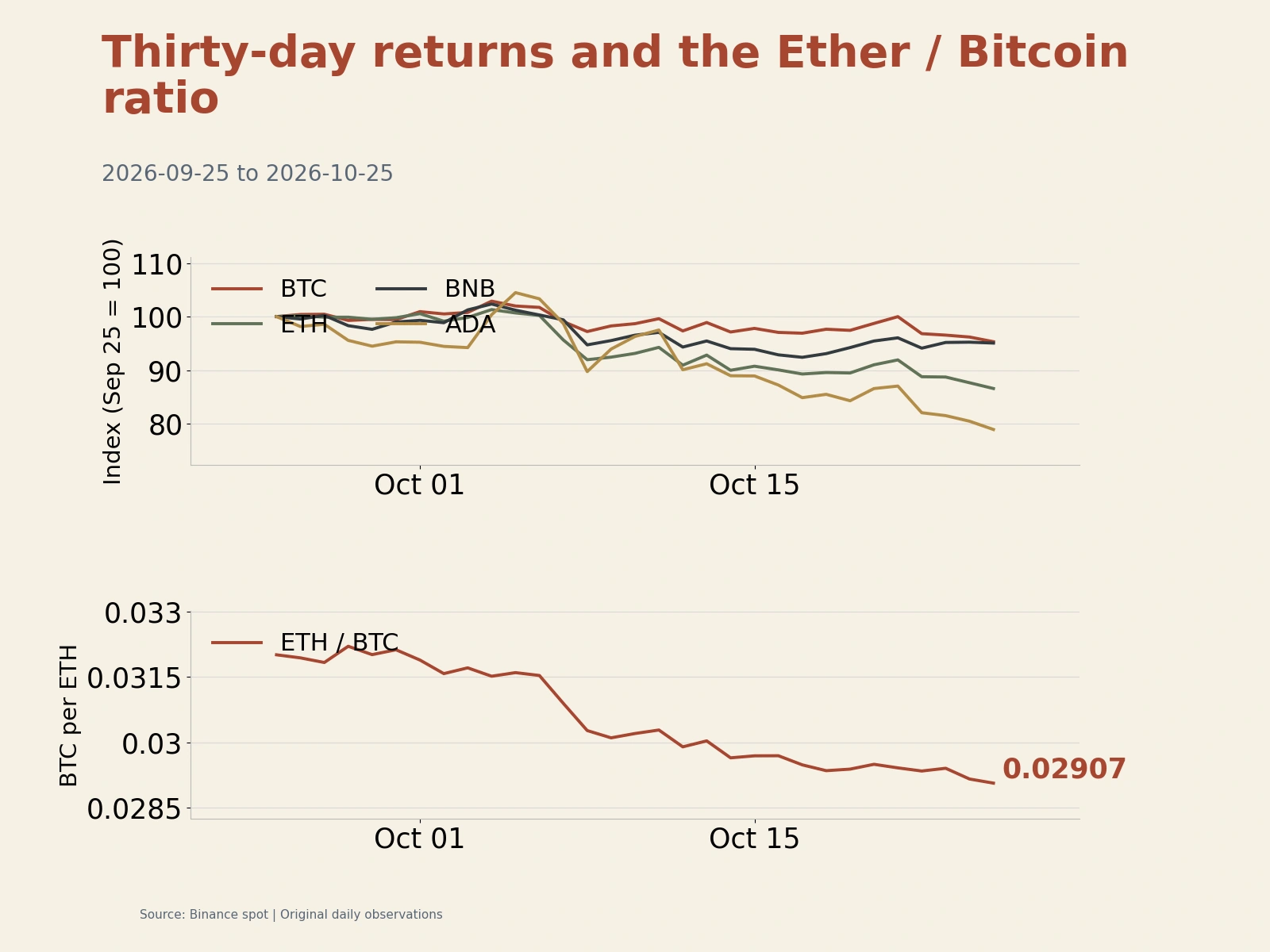
Differences became more pronounced over 30 days. Bitcoin fell 4.69% and Ether 13.44%; SOL, XRP and LINK each lost around 17%, while DOGE and ADA fell more than 20%. The ETH/BTC price ratio declined a further approximately 0.97% during the week to 0.02907, indicating continued weak buying support for higher-beta coins. The brief midweek rebound did not reverse that pattern.
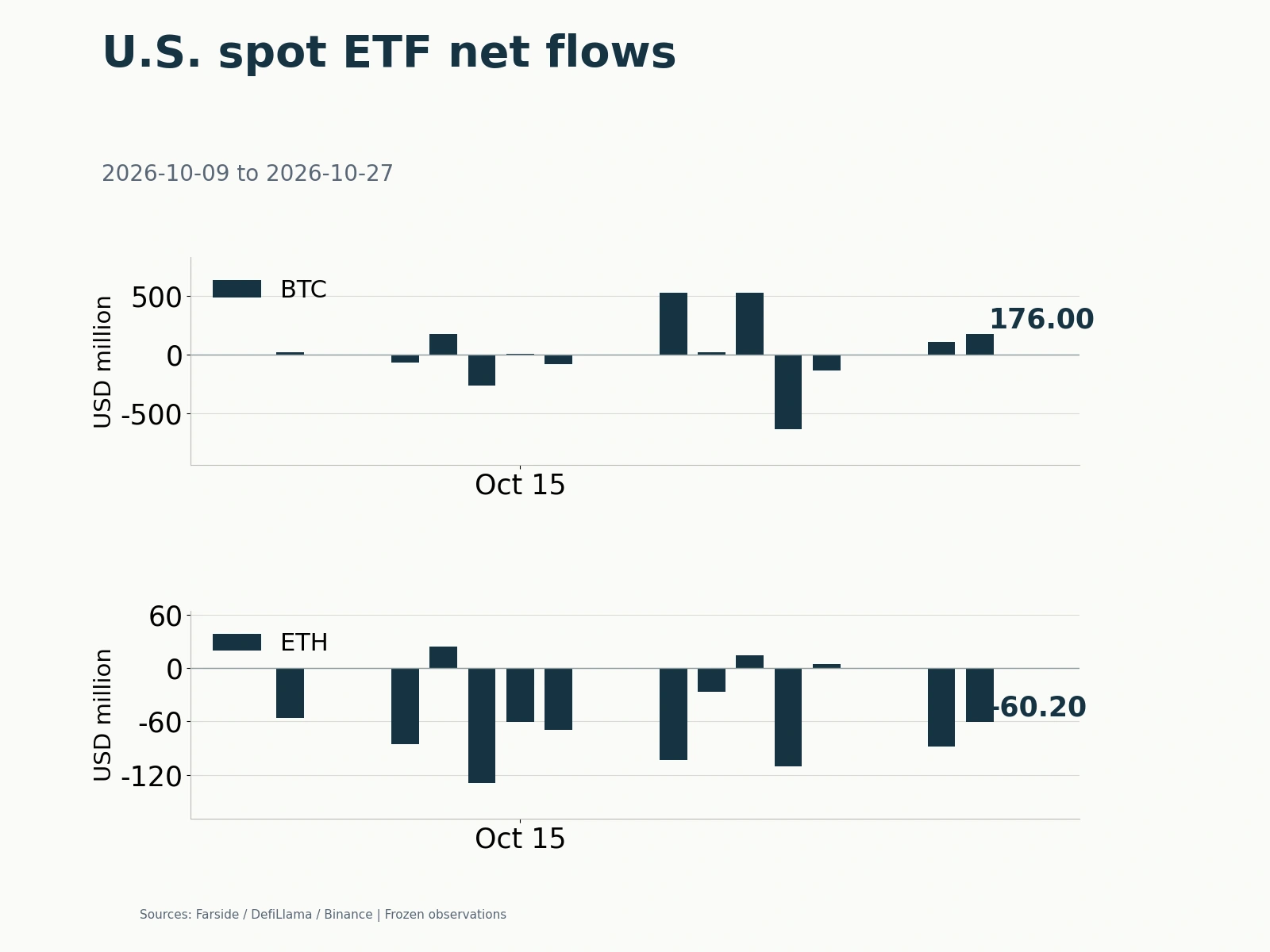
Institutional flows helped explain Bitcoin’s relative resilience. Coinbase’s October 23 weekly review said spot ETFs had replaced corporate treasuries as the primary source of incremental Bitcoin demand since August, with buying highly concentrated in BlackRock’s IBIT. Limited follow-through from crypto-native capital and corporate buyers meant this concentrated ETF demand could support the core asset but was unlikely to spill naturally into the wider token market.
Participants differed on the outlook. LMAX strategist Joel Kruger told CoinDesk that crypto’s earlier relative strength had faded and it was moving more closely with equities while waiting for a new industry catalyst. Coinbase regarded the overall structure as constructive and identified US$80,000–US$82,000 as an important Bitcoin range to watch. With prices returning to that area over the weekend, the support zone faced a fresh test.
Long-term institutional research continued despite limited short-term buying. On October 19, J.P. Morgan Asset Management released its 2027 Long-Term Capital Market Assumptions, including Bitcoin return-range analysis for the first time. Its official explanation also made clear that Bitcoin had not been included in actual allocation portfolios. Broader research coverage provided a basis for future allocation discussions, while implementation remained constrained by volatility, correlations and liquidity. That longer-term process differed markedly from weekly prices driven by technology shares, geopolitics and spot buying.
Breaking out of weak, range-bound trading depended on whether demand concentrated in Bitcoin could spread and whether sustained buying emerged after risk shocks. If Bitcoin stabilized while ETH/BTC continued falling and most fixed-sample assets remained weak, the market would retain a pattern of isolated resilience in the core asset. A recovery supported by broader participation and higher turnover would provide a firmer foundation.
Follow the original-article link for further details.