By the morning of October 26 Beijing time, the preceding week’s Hong Kong options trading showed volume surging during the decline and positions continuing to grow during the rebound. The Hang Seng Index ended the week at 23,093.37, down 4.52% from October 16. Open interest in monthly Hang Seng options rose by 24.5%, from 95,687 to 119,123 contracts. Thursday’s sharp selloff drove up near-month put prices. Some protection contracts quickly surrendered gains when cash equities rebounded on Friday, but substantial risk positions remained outstanding. Individual-stock rebounds also revived short-dated call trading. With month-end expiry approaching, underlying price changes, implied volatility and time remaining jointly drove option repricing.
The final two days account for almost 70% of weekly volume; open interest reaches 119,000 contracts during the rebound
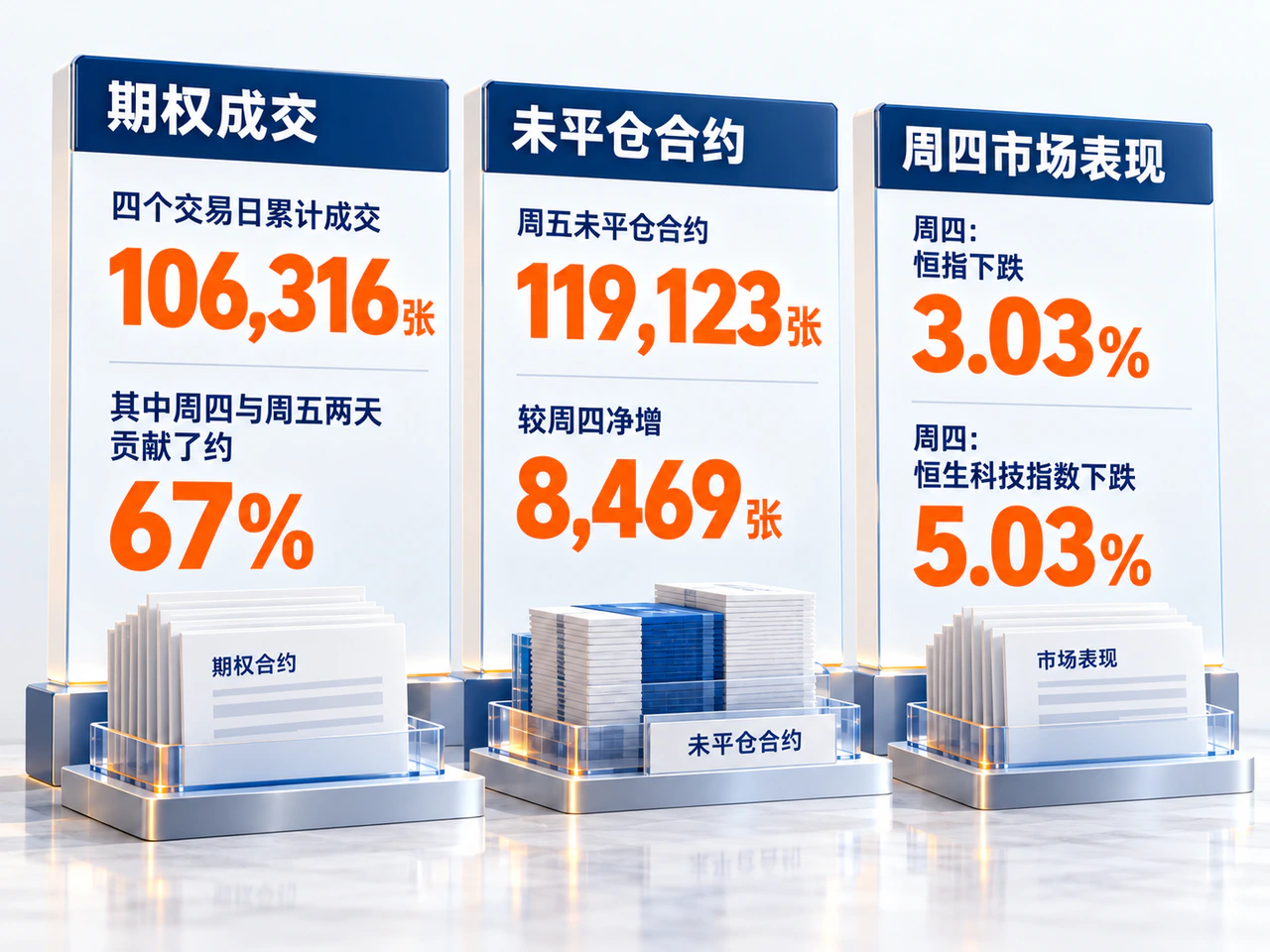
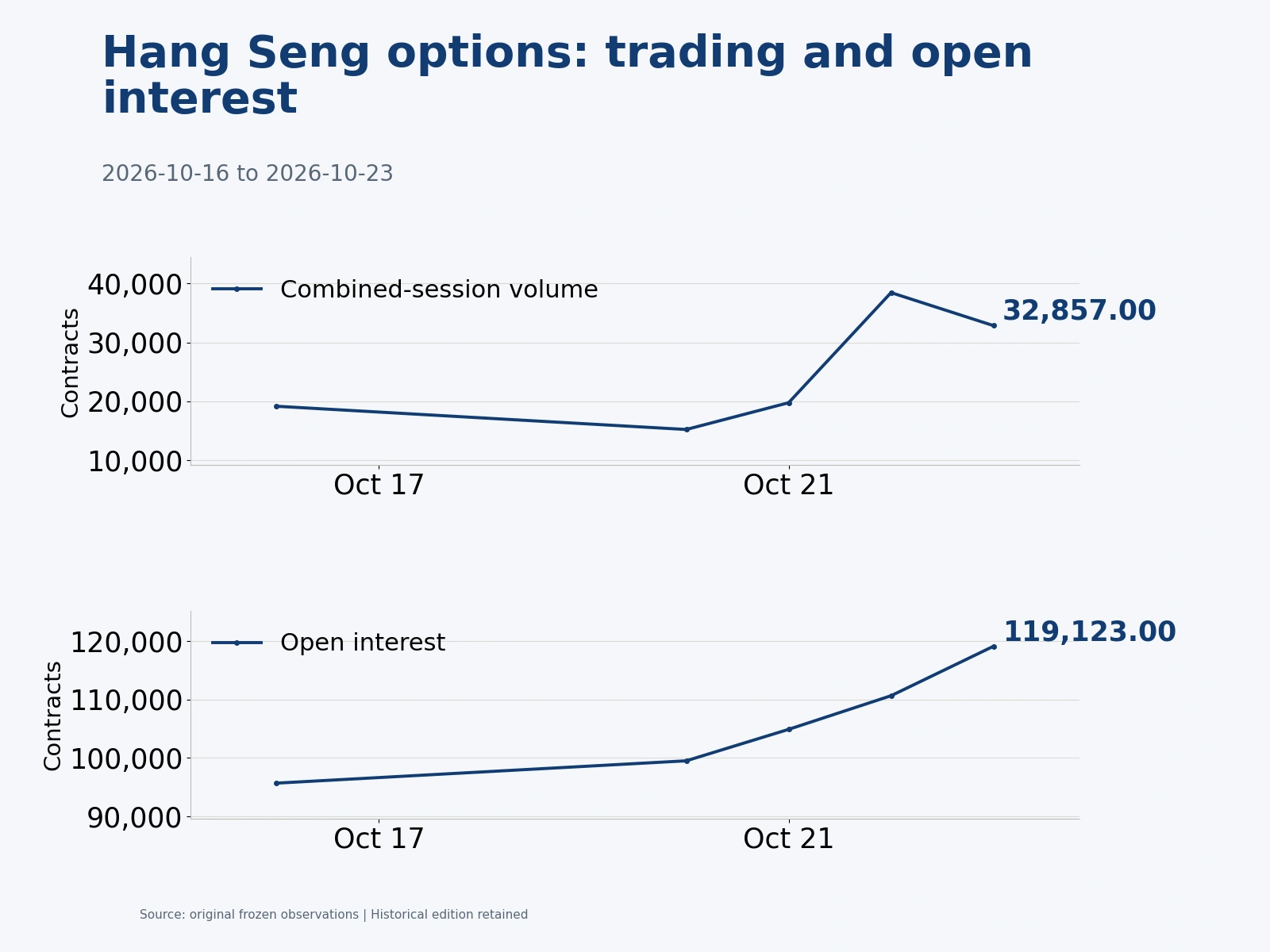
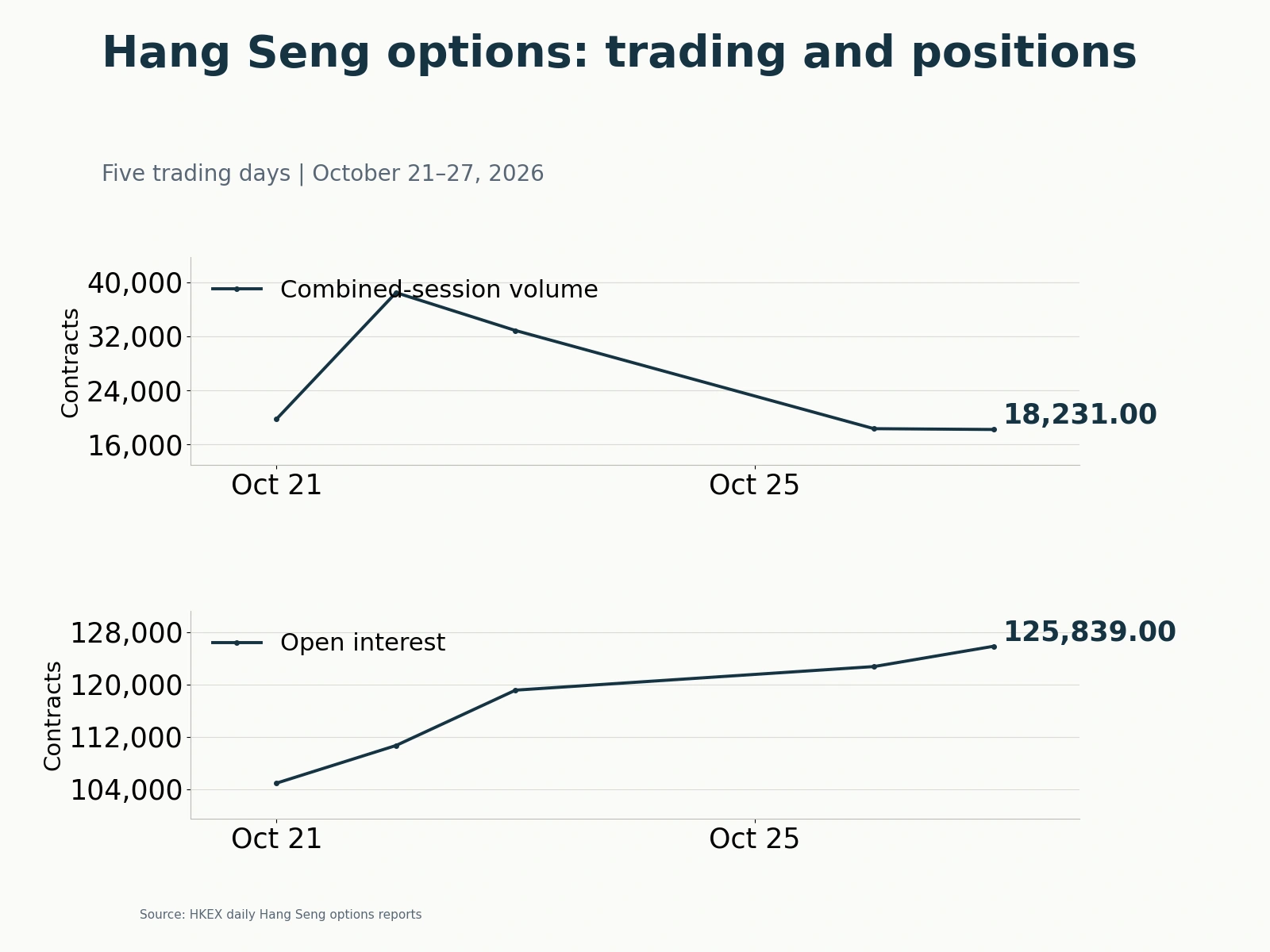
Hong Kong’s October 19 holiday following the Chung Yeung Festival left four trading days, October 20–23. HKEX’s daily monthly Hang Seng options reports use combined-session volume, including the preceding evening session assigned to that business date and the day session. Across all expiries, volume rose from 15,233 contracts on Tuesday and 19,772 on Wednesday to 38,454 on Thursday, before easing to 32,857 on Friday. The four sessions traded 106,316 contracts in total, with Thursday and Friday accounting for approximately 67%.
The surge in activity began on Thursday, when the Hang Seng fell 3.03% and the Hang Seng Tech Index lost 5.03%. Tencent closed at HK$382.4 and Alibaba at HK$97.35. In an October 23 commentary, Hong Kong Financial Times columnist Zhang Zhiwei attributed the preceding run of declines primarily to escalating geopolitical risks, higher oil prices and their implications for inflation and policy expectations, with large technology stocks a major source of weakness. The rapid cash-market decline changed existing contracts’ moneyness, hedge ratios and margin requirements. Protection purchases, closing trades and rolls concentrated in the same session, lifting monthly Hang Seng option volume 94.5% from Wednesday and pushing the put/call volume ratio from 0.87 to 1.66.
The Hang Seng rebounded 0.69% on Friday and option volume fell 14.6% from Thursday, but total open interest increased by 8,469 contracts to 119,123. The put/call volume ratio remained elevated at 1.49. Falling volume alongside expanding positions showed that risk exposures had not exited en masse with a single day’s rebound. Since transactions include both buyers and sellers, the direction of positions still required examination of individual contracts’ price and positioning changes.
October 23,000 puts surrender 40% after a spike; 24,000 calls fall to 11 points
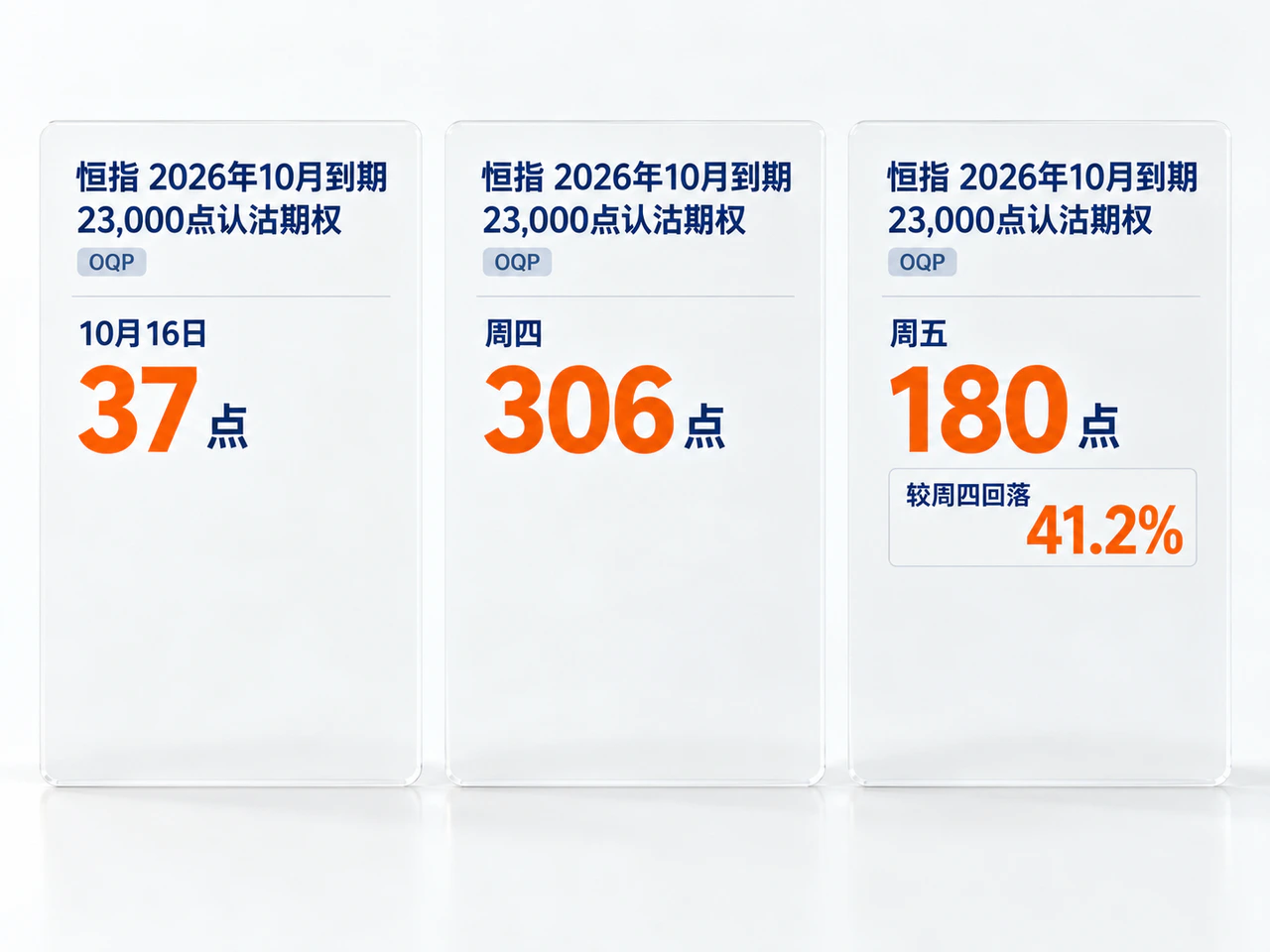
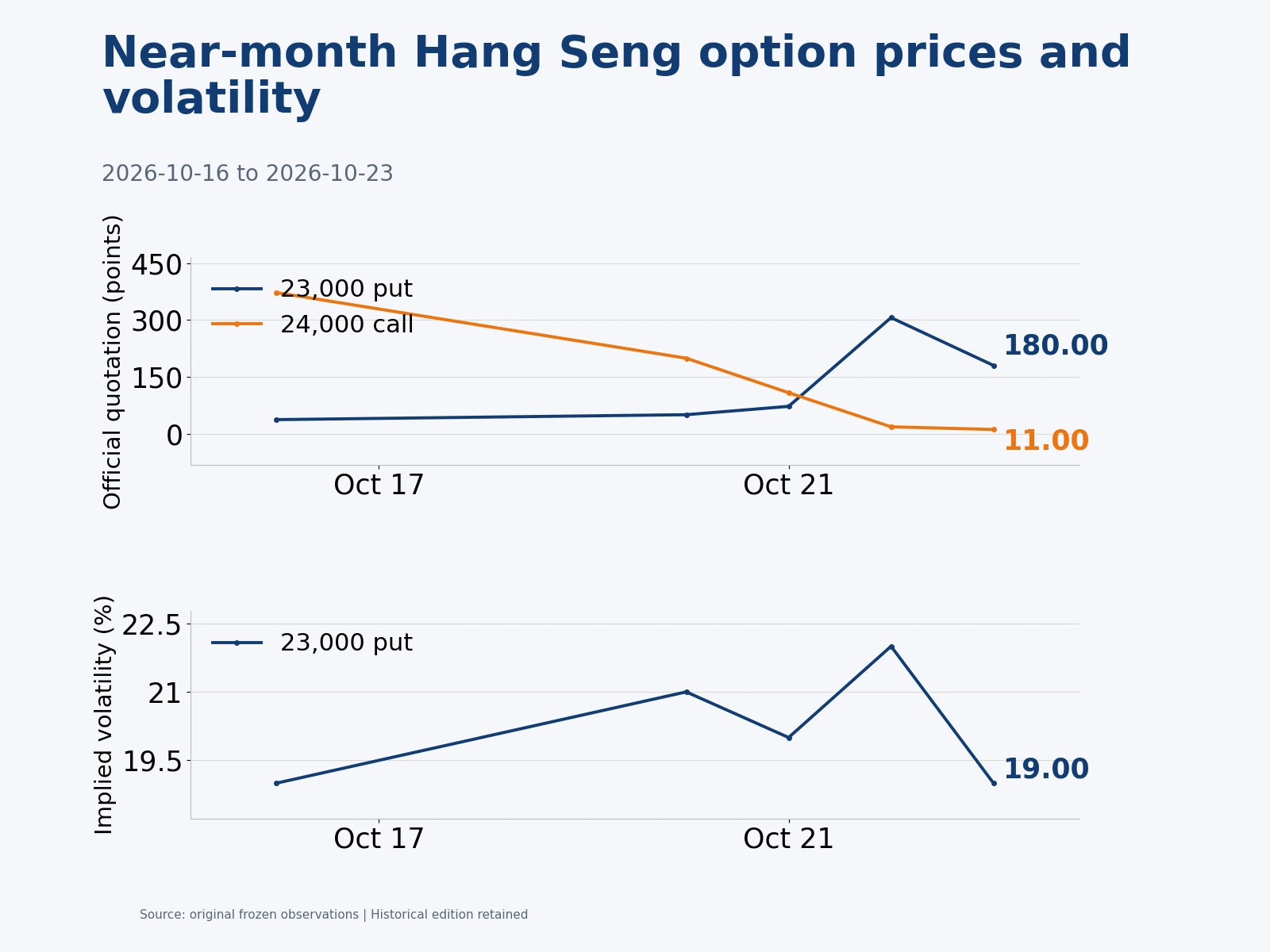
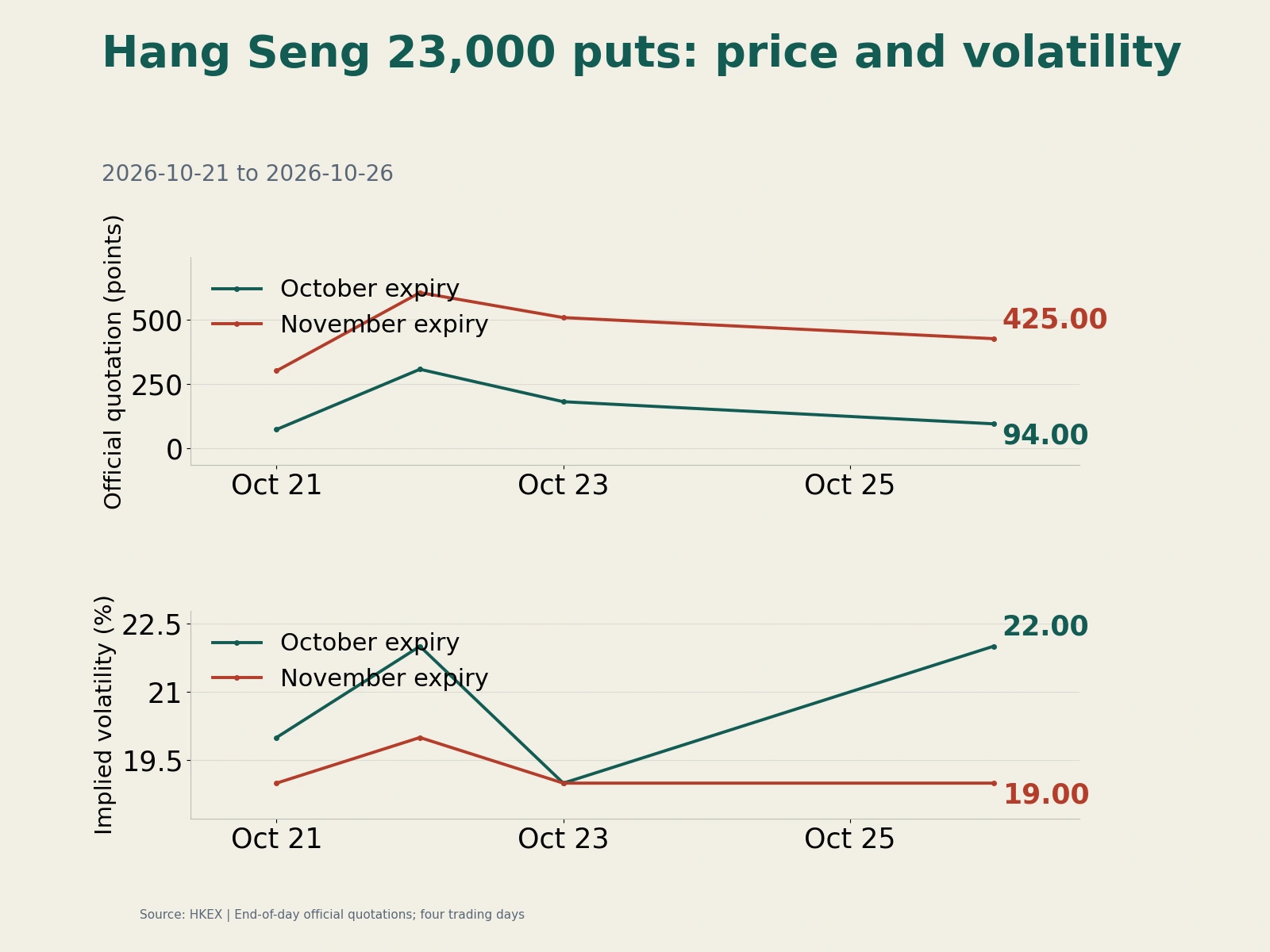
The October 2026 Hang Seng 23,000 put clearly illustrated the week’s repricing of downside risk. Its exchange-published end-of-day official quotation (OQP) rose from 37 points on October 16 to 50 on Tuesday and 72 on Wednesday, jumped to 306 on Thursday, then fell to 180 on Friday. At the HK$50 per index point contract multiplier, the corresponding value per contract increased from HK$1,850 at the preceding week-end to HK$15,300 on Thursday and fell to HK$9,000 on Friday. Despite a 41.2% retreat from Thursday, it remained substantially above the previous week-end. Protection purchased before the selloff fulfilled its insurance role on Thursday; investors buying only after the sharp drop faced a rapid mark-to-market reversal during Friday’s rebound.
The same put’s reported implied volatility rose from 19% at the previous week-end to 21% on Tuesday, eased to 20% on Wednesday, climbed to 22% on Thursday and returned to 19% on Friday. Although Friday’s implied volatility was back at its starting level, the quotation remained nearly five times the previous week-end value. The Hang Seng had moved closer to 23,000, briefly fallen below it and then recovered. The lower underlying index level and shorter remaining maturity jointly dominated the price change.
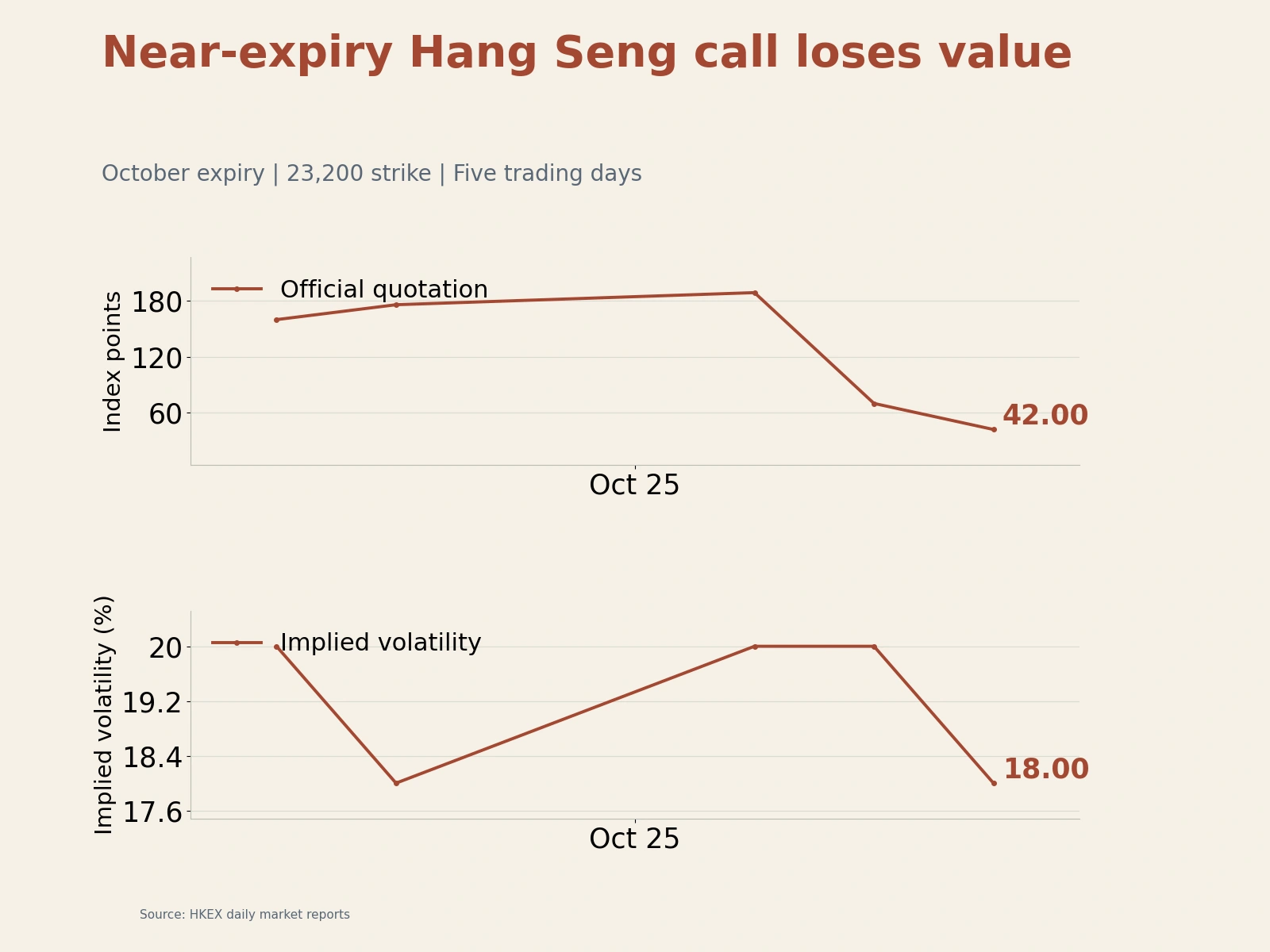
Calls faced pressure from both the lower underlying and time-value erosion. The October 24,000 call’s OQP fell from 372 points at the previous week-end to 108 on Wednesday, 18 on Thursday and 11 on Friday. Even with Friday’s index rebound, the cash index remained far below the 24,000 strike. A modest recovery could not offset the time decay of a short-dated contract approaching expiry.
Xiaomi’s rebound boosts 28-dollar calls; Tencent and Alibaba show mixed option activity
With the index under pressure, company-specific events and valuation differences generated different option trading patterns. Zhitong Finance, citing Xiaomi’s announcement, reported that the company repurchased 1.9 million shares on October 21 for HK$50.951 million at prices between HK$26.76 and HK$26.84. After falling with the market on Thursday, Xiaomi rebounded strongly on Friday morning.
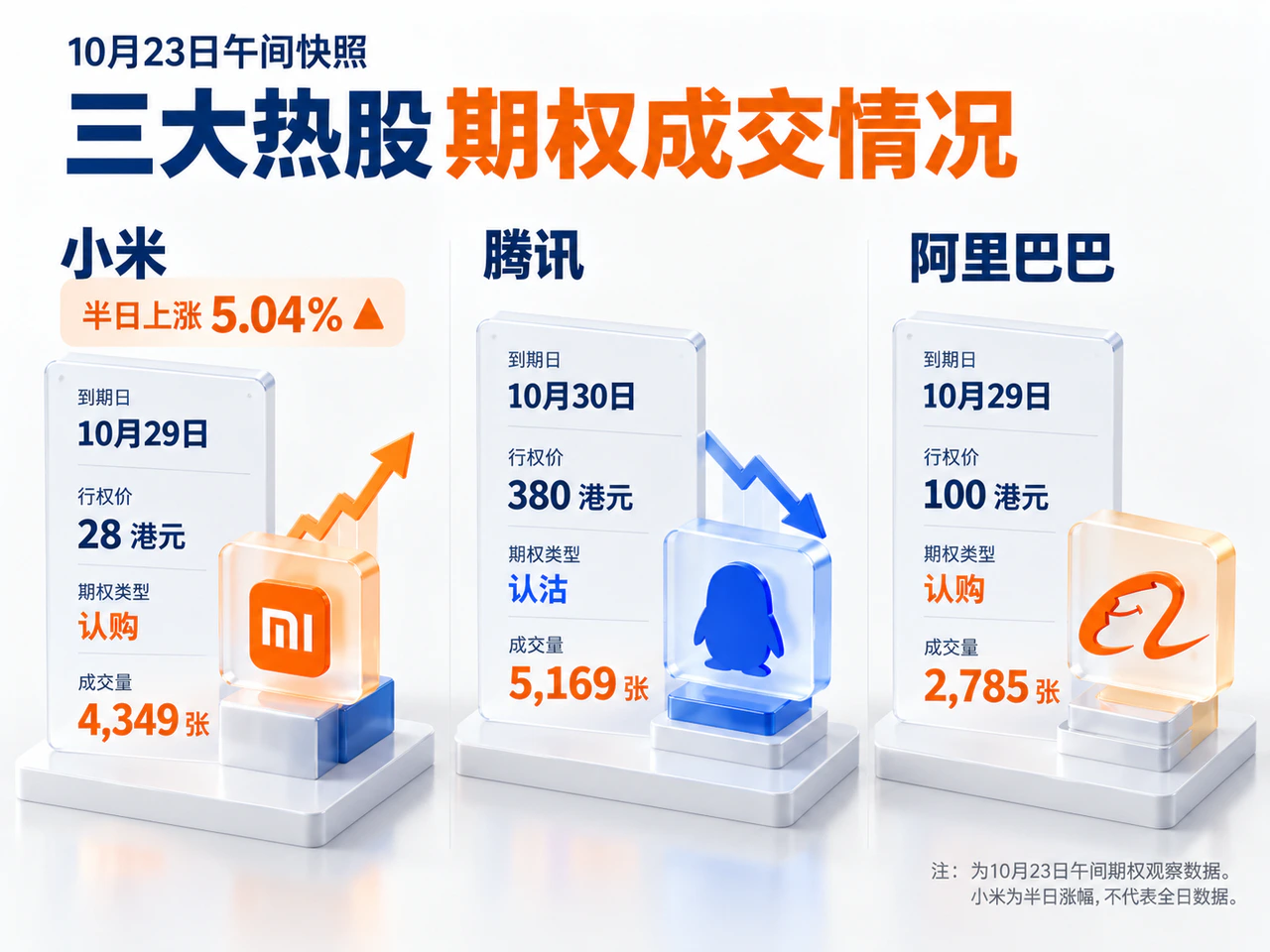
Tiger’s October 23 midday options review showed Xiaomi up 5.04% over the half-day. Its HK$28 call expiring October 29 traded 4,349 contracts, the stock’s most active option at that time. Meanwhile, the HK$22 put expiring November 27 traded 1,743 contracts and the HK$25 put expiring October 29 traded 1,730. Calls seeking a short-term rebound coexisted with downside-risk trades across different maturities on the same stock.
During the same midday observation window, Tencent and Alibaba shares were still slightly lower, but option activity had different focal points. Tencent’s HK$380 put expiring October 30 traded 5,169 contracts; Alibaba’s HK$100 call expiring October 29 traded 2,785. Protection demand in Hang Seng options primarily addressed systematic portfolio risk. Individual-stock options focused more on each share price, company events and short-term trading considerations, so a broader rebound did not produce uniform flows across stock options.
October contracts exceed 70% of Friday’s volume as near-month put positions diverge across strikes
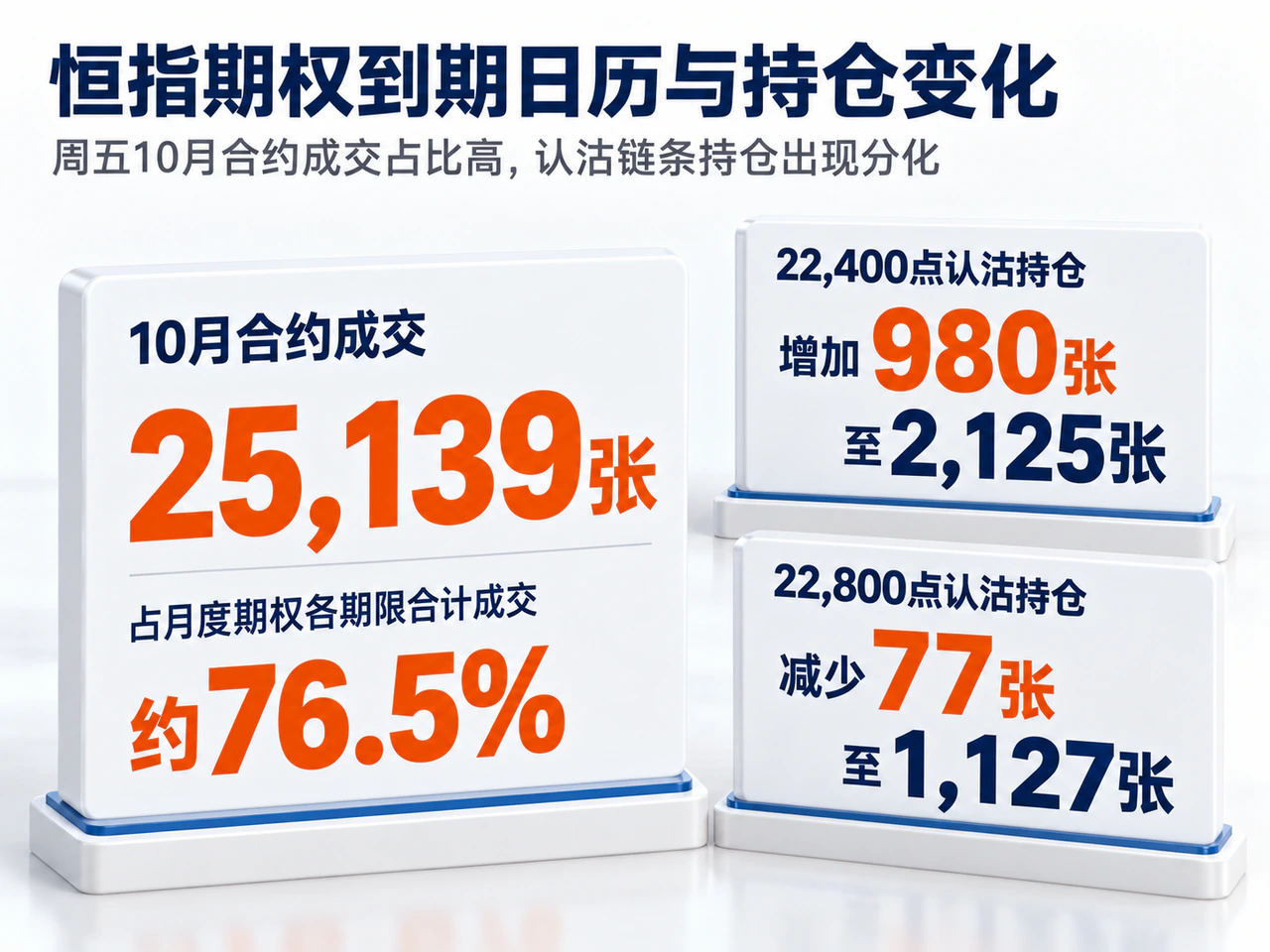
As month-end expiry approached, short-dated contracts became the main vehicle for trading. October-expiry Hang Seng options traded 25,139 contracts on Friday, approximately 76.5% of monthly option volume across all expiries. That short-dated concentration allowed cash-market moves to pass rapidly into option quotations. Within the October put chain, nearby strikes already showed different position changes. The 22,400 put traded 1,936 contracts and its open interest increased by 980 to 2,125. The 22,800 put traded 1,992 contracts, but open interest fell by 77 to 1,127. New positions at a lower strike thus appeared alongside closing or rolling of existing exposures.
The week combined a lower Hang Seng, near-month protection prices that rose and then retreated, further growth in total option positions and renewed rebound trading in some individual stocks. A one-day recovery reduced the price of short-term insurance, but large outstanding positions showed that exposures had not exited together. If the cash market continued to recover while near-month put quotations and implied volatility fell together, the urgency of defense could ease further. If equities weakened again while open interest remained high, hedging and rolls ahead of expiry could continue to amplify option activity.