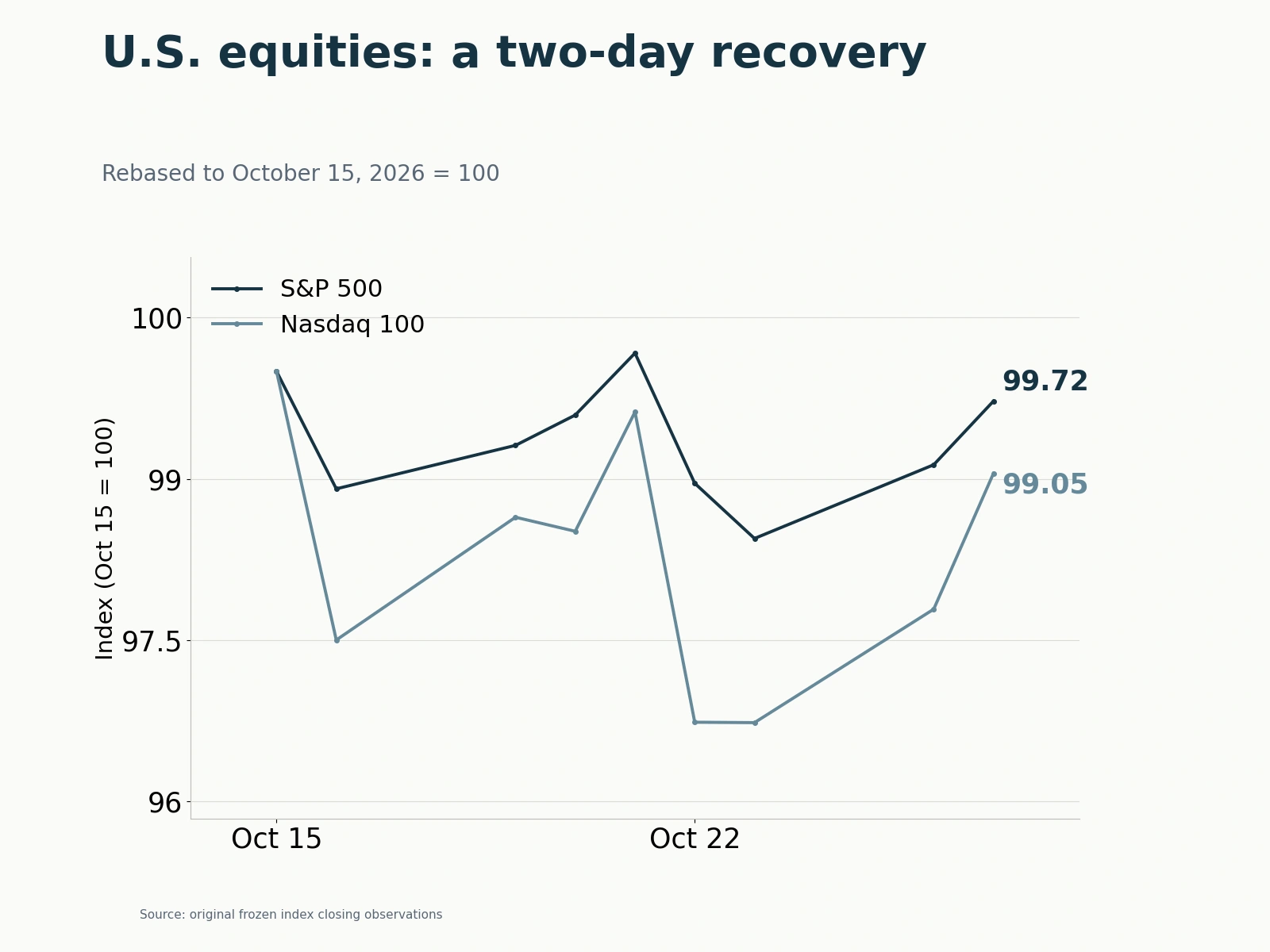
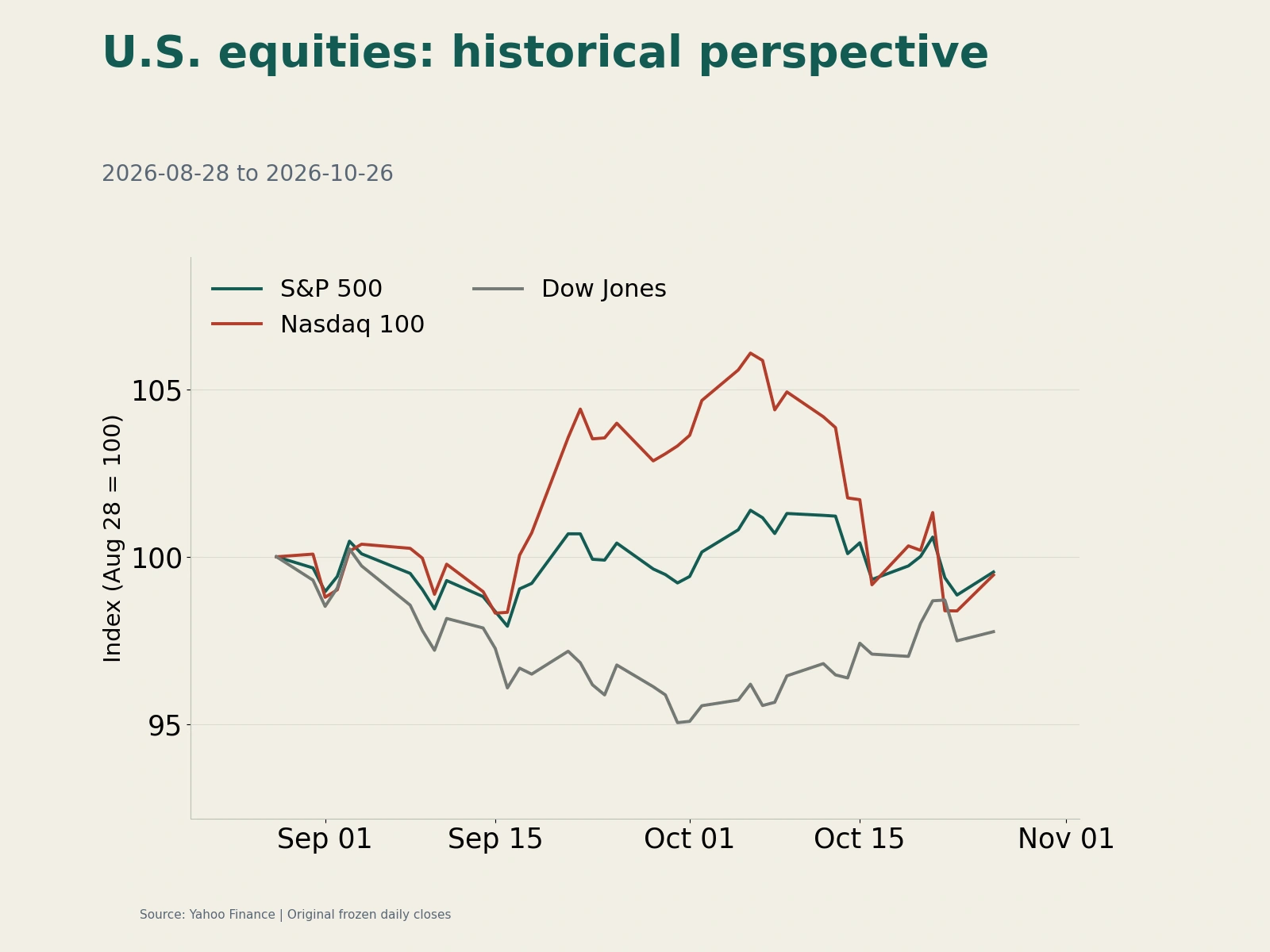
On October 29, 2026, US economic growth accelerated in the third quarter, but large technology stocks fell under pressure from earnings results and capital spending, driving safe-haven flows into Treasuries and taking the 10-year yield back below 5%. US equities saw a marked rotation: the Nasdaq 100 fell 1.38%, the Russell 2000 rose 1.01%, and financials strengthened. In currencies and commodities, the dollar index declined, while oil and gold both closed slightly lower. Together, the macroeconomic data and corporate results pointed to a shift in the market’s focus. Although US aggregate demand and AI investment continued to expand, households faced slower purchasing-power growth at the end of the quarter, while investors’ scrutiny of companies shifted from revenue growth alone toward free cash flow, funding costs and the speed at which investment translates into earnings.
Cloud giants’ heavy spending squeezes free cash flow; Nasdaq 100 falls 1.38%
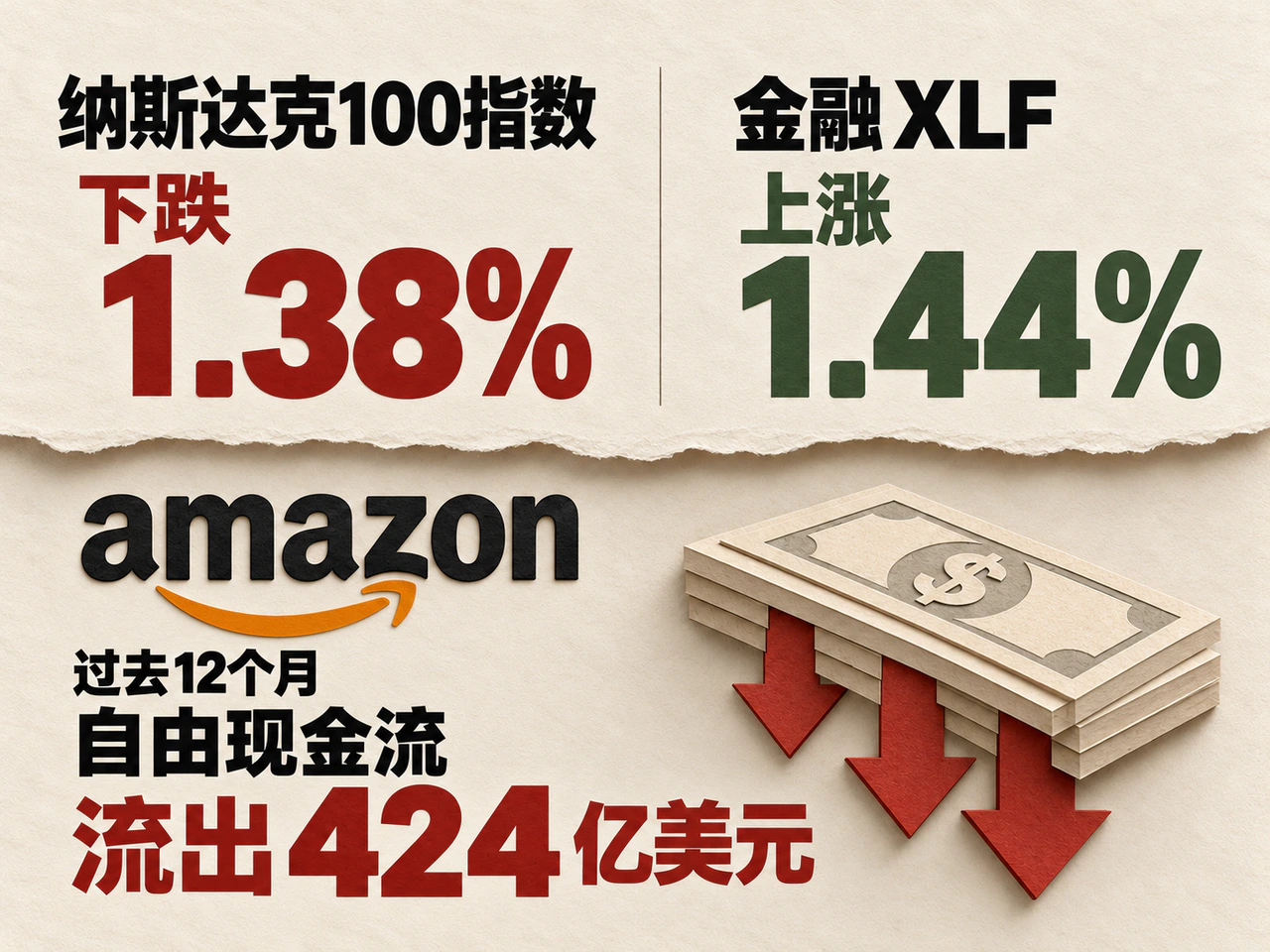
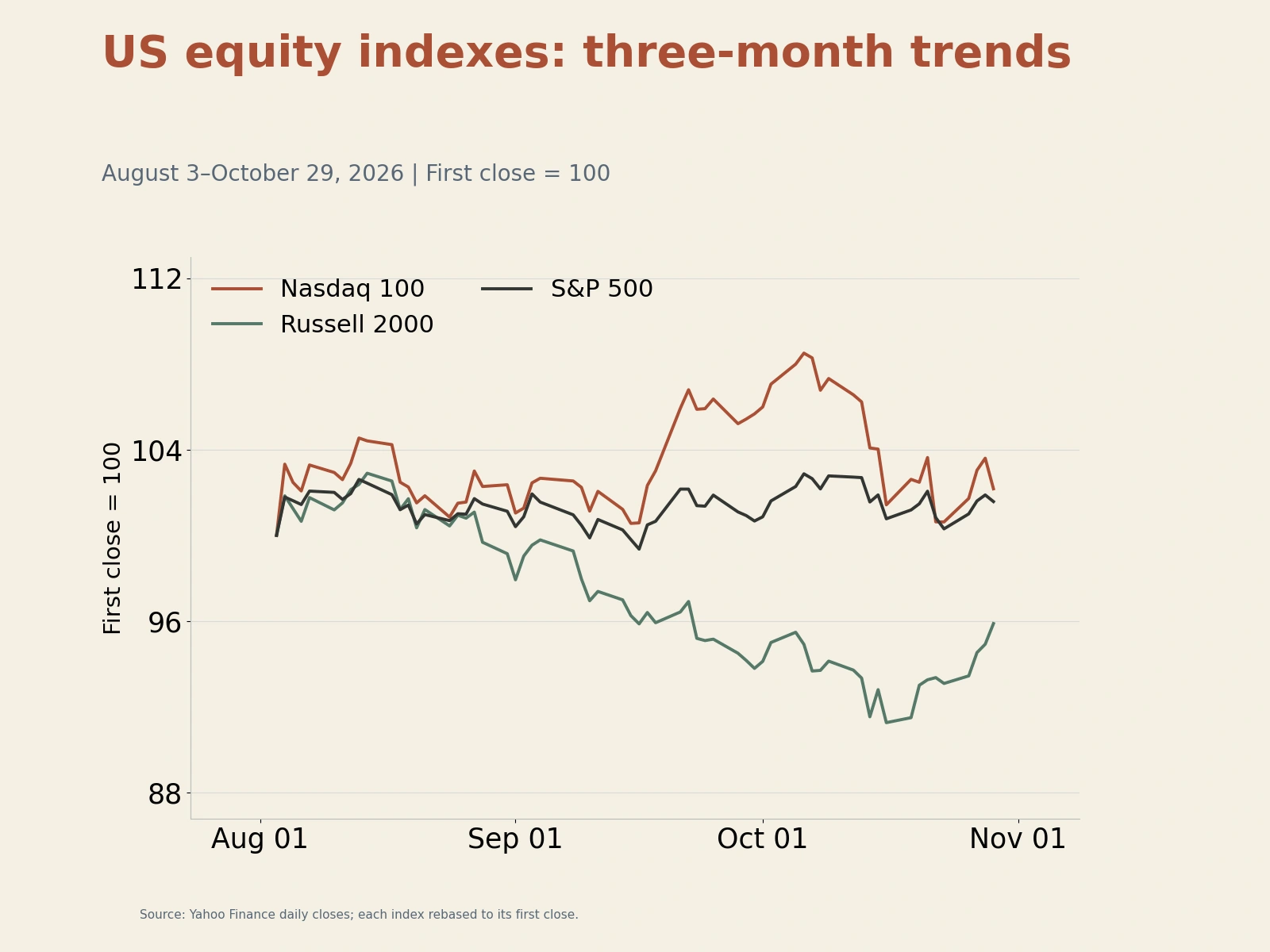
Major US stock indexes diverged. The S&P 500 closed at 7,720.39, down 0.30%; the Nasdaq 100 finished at 29,402.51, down 1.38%; and the Dow Jones Industrial Average ended at 52,342.56, down 0.25%. The Russell 2000, meanwhile, rose 1.01% to 2,859.22. Among sector ETFs, technology fund XLK fell 1.18%, while financials fund XLF and energy fund XLE gained 1.44% and 0.38%, respectively. The VIX edged up from 16.91 to 17.20, still below its October 23 reading of 19.45, indicating that other industries absorbed some investment flows as heavyweight technology stocks came under pressure.
The gap between technology giants’ capital spending and cash returns became a dividing line in earnings season. According to CNBC, Alphabet shares plunged about 12% after third-quarter adjusted earnings per share and revenue both missed expectations and quarterly free cash flow came in at negative $9.07 billion. The company nevertheless maintained its full-year capital spending plan of $195 billion to $205 billion: its expanding cloud business and computing investment have yet to generate matching cash flow. Microsoft’s fiscal first-quarter revenue and earnings beat expectations, supported by Azure growth, but its shares reversed an opening gain to finish slightly lower. CNBC noted that computing providers CoreWeave and Nebius each fell about 5%, as Microsoft’s capital spending commitments came in below market expectations and infrastructure partners faced longer lead times to deliver data center capacity.
After the US market closed on October 29, Eastern Time, results from Amazon and Intel intensified scrutiny of capital returns and end demand. Amazon’s third-quarter revenue rose 12% year on year to $201.9 billion, including AWS revenue of $46 billion, up 39.3%. Although operating cash flow over the past twelve months increased 29% to $168.3 billion, equipment investment pushed free cash flow from an inflow of $14.8 billion a year earlier to an outflow of $42.4 billion. The company also maintained its expectation for approximately $220 billion in cash capital spending in 2026. Intel, meanwhile, forecast fourth-quarter revenue of $15 billion to $16 billion, below market expectations of about $17 billion. According to Yahoo, Amazon shares initially fell 10% in after-hours trading before paring losses, while Intel fell more than 20% at one point after the close.
Shares in other industries also diverged in response to earnings guidance. Software company Fortinet cut its full-year services revenue guidance; both it and ServiceNow posted double-digit declines after their results. Caterpillar reported third-quarter adjusted earnings per share of $7.20 and revenue of $20.68 billion, slightly above market expectations, but its shares closed more than 9% lower as construction sales fell slightly short of forecasts. By contrast, strong demand for obesity and diabetes drugs led Eli Lilly to raise its full-year revenue guidance from $85 billion–$87 billion to $91 billion–$92 billion, lifting its shares.
US third-quarter GDP growth accelerates to 3.4%, but September real consumption is almost flat
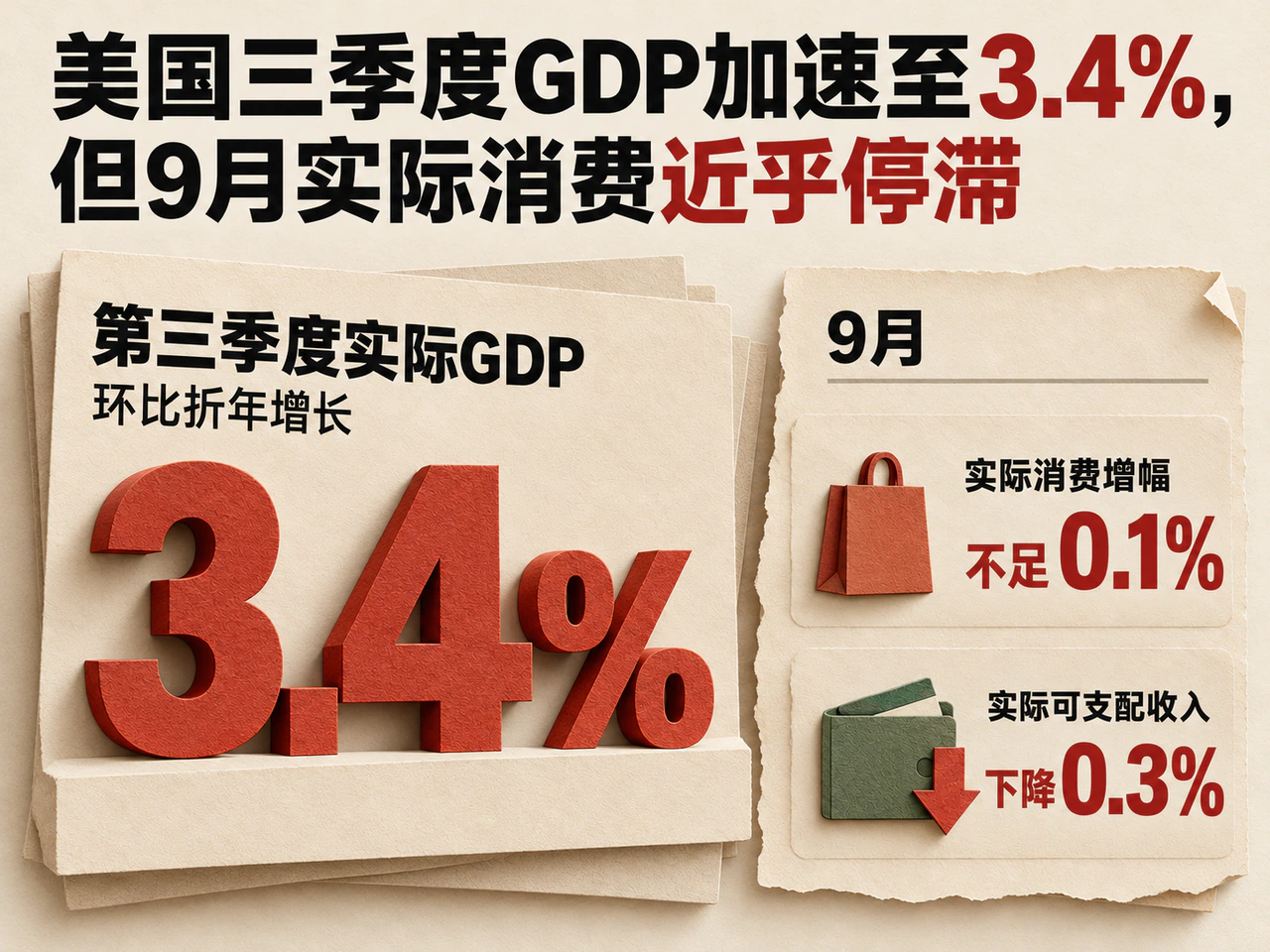
The US Bureau of Economic Analysis reported the same day that real GDP grew at an annualized quarter-on-quarter rate of 3.4% in the third quarter, up from 2.2% in the second quarter and above the 3.2% expectation listed by Investing.com and Hammerstone Markets. Faster investment growth and a return to growth in government spending provided the main support, while declining exports and rising imports were drags. Within equipment investment, information-processing equipment increased markedly, led by computers and peripheral equipment, illustrating the boost that technology infrastructure construction is providing to aggregate demand.
Private demand was also robust after excluding the direct effects of inventories and government spending. Real final sales to private domestic purchasers, which comprise consumer spending and private fixed investment, rose at an annualized quarter-on-quarter rate of 4.9% in the third quarter, up from 4.6% in the second. This provided fundamental support for corporate revenue and credit quality while reducing the need for a rapid shift toward monetary easing. The government component also included an accounting change stemming from lower sales from the Strategic Petroleum Reserve. Reserve sales are deducted from government consumption expenditures in the national accounts, so lower sales increase recorded spending in that component. Offsetting entries in other components, however, mean that this change has no direct net effect on GDP.
Quarterly and monthly inflation presented different pictures. The PCE price index rose at an annualized quarter-on-quarter rate of 2.1% in the third quarter, down from 5.0% in the second quarter and below the 2.6% expectation listed by Hammerstone Markets. Annualized quarterly core PCE inflation slowed from 3.3% to 2.5%. In September, at the end of the quarter, however, headline PCE prices rose 0.5% month on month, up from 0.3% in August, and 3.6% year on year. Core PCE prices maintained their 0.3% monthly increase and rose 3.1% year on year.
The monthly rise in prices directly squeezed household purchasing power. Nominal disposable income increased just 0.2% month on month in September, while real disposable income fell 0.3%. Although nominal consumer spending rose 0.5%, real spending increased by less than 0.1% after adjusting for prices, a marked slowdown from August’s 0.5%. The saving rate was 3.8%. The labor market, meanwhile, remained resilient. Seasonally adjusted initial jobless claims totaled 194,000 in the week ended October 24, down 1,000 from the previous week’s revised 195,000, while the four-week average fell to 196,750. Continuing claims declined to 1,701,000 in the week ended October 17. The coexistence of low layoffs and stagnant real consumption suggests that the current constraint on spending comes mainly from high prices eroding purchasing power. If employment stays firm while monthly core inflation remains elevated, monetary policy will have to wait longer for inflation to subside.
10-year Treasury yield falls to 4.98%; Microsoft plans roughly $25 billion bond sale
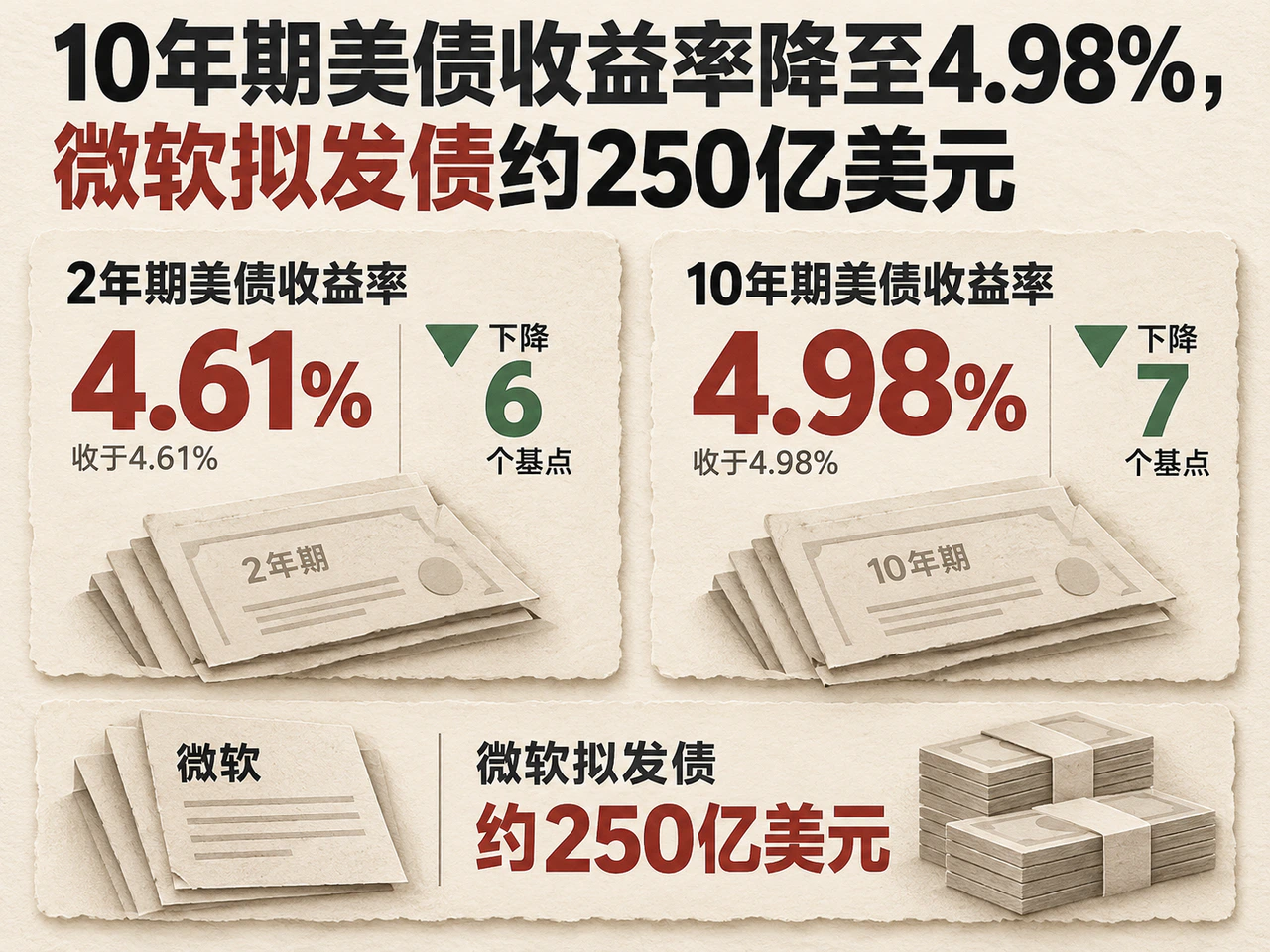
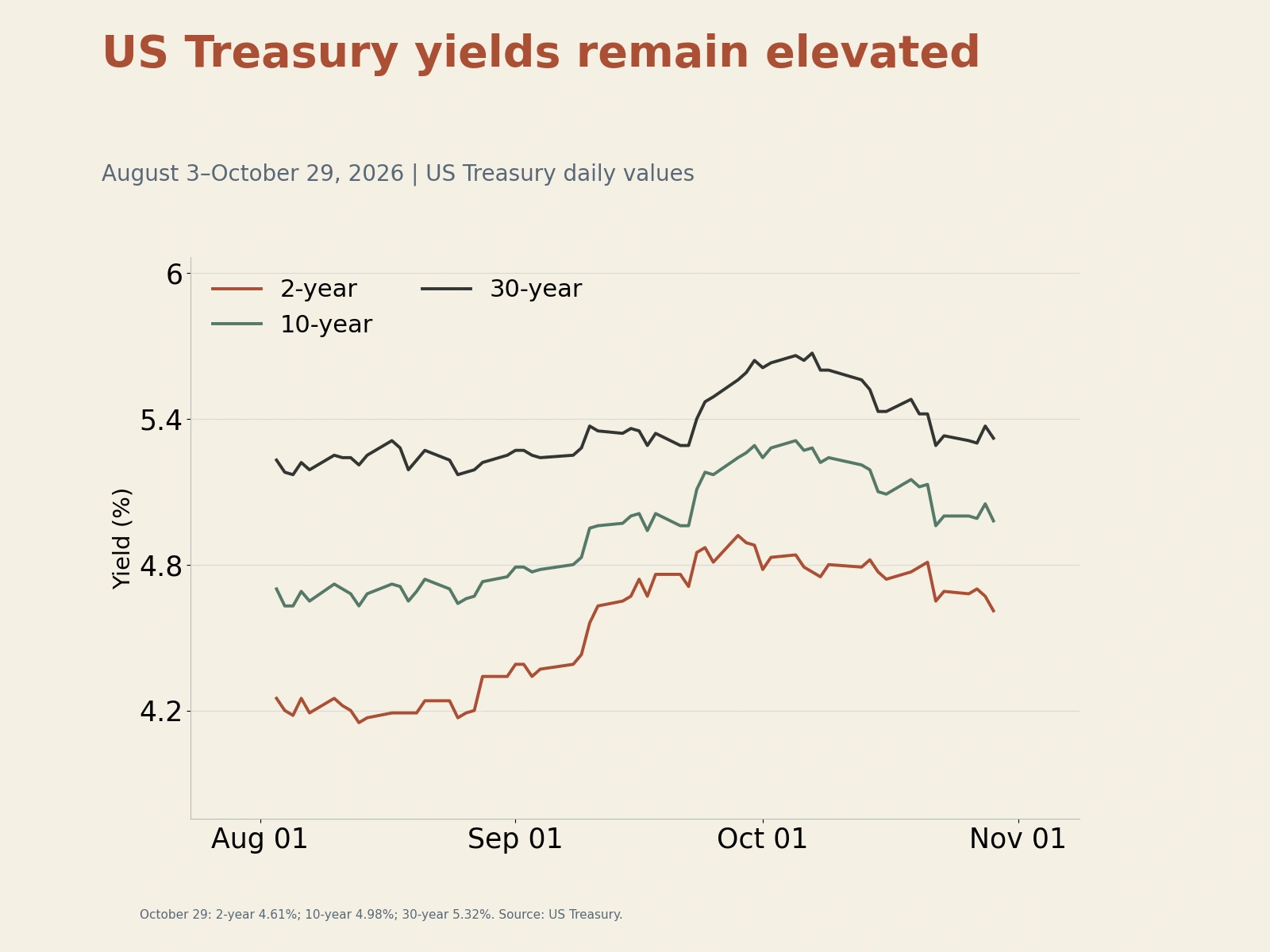
Treasury yields fell across the curve, supported by safe-haven buying prompted by the technology stock pullback and a smaller-than-expected quarterly increase in PCE prices. The US Treasury’s end-of-day curve showed the 2-year yield at 4.61%, down 6 basis points from the previous trading day; the 5-year at 4.78%, down 7 basis points; the 10-year at 4.98%, down 7 basis points; and the 30-year at 5.32%, down 5 basis points. Intermediate-maturity Treasuries slightly outperformed. The 10-year/2-year spread narrowed from 38 to 37 basis points, while the 30-year/5-year spread widened from 52 to 54 basis points. Real yields also declined, with the 5-year falling from 2.36% to 2.31% and the 10-year from 2.67% to 2.63%. The simple gaps between nominal and real yields narrowed by 2 and 3 basis points, respectively, showing that lower real rates and reduced inflation compensation jointly supported the bond market’s recovery.
Primary-market demand for Treasuries remained firm, but technology giants’ expanding financing needs are adding pressure to corporate bond supply. The day’s $44 billion auction of 7-year Treasuries cleared at a high yield of 4.894%, matching the when-issued yield at the time of the auction, while the bid-to-cover ratio rose from 2.42 at the previous auction to 2.46. According to The Wall Street Journal, however, Microsoft’s announcement of a large bond issuance plan briefly pushed Treasury yields higher before they resumed their decline. Reuters, citing people familiar with the matter, reported that Microsoft planned to raise about $25 billion through its first US investment-grade bond offering in more than nine years, with the size still subject to demand. A regulatory filing confirmed the issuance but did not disclose its size. Microsoft also expected free cash flow to remain positive in the fiscal year ending June 2027. Daniel Siluk of Janus Henderson argued that AI construction continues to add corporate bond supply and could require higher credit spreads as compensation.
Secondary-market credit spreads are broadly stable for now, with some regional divergence. As of October 28, the ICE BofA US high-yield spread was 3.14 percentage points, below 3.40 percentage points on October 22. An October 29 report from Hang Seng Investment Services, with the relevant charts dated October 27, put Asian investment-grade US dollar bond yields at about 5.6%, with spreads widening from approximately 50 basis points in early June to around 70 basis points. Falling Treasury yields have improved the interest-rate component of dollar bond valuations first, while limited net supply within the region and institutional demand for income help ease spread pressure.
Oil and gold both finish lower; sticky inflation and rate-hike expectations weigh on gold
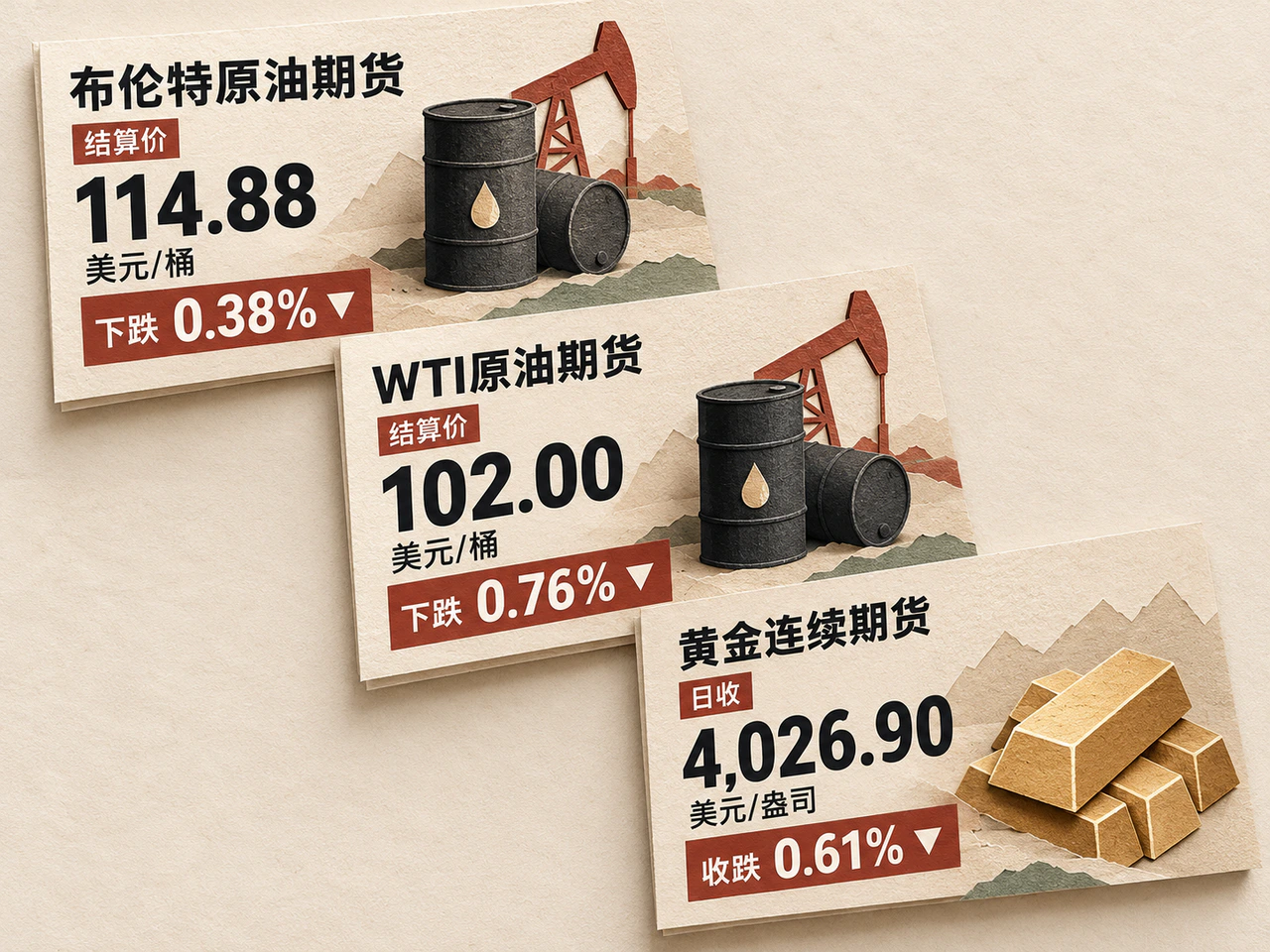
According to Reuters’ closing report, Brent crude futures settled at $114.88 a barrel, down 0.38%, while WTI crude futures settled at $102.00, down 0.76%. Both had fallen more than $2 intraday before recovering some of their losses. US-Iran diplomatic contacts reduced the supply risk premium, while unilateral claims of renewed attacks on Gulf energy facilities revived supply concerns. Trump characterized Vance’s contacts with Iran as assistance involving medical supplies; a resumption of peace talks had not been confirmed. There were signs of a cushion on the refined-fuel supply side. Reuters, citing people familiar with the matter, reported that Russia was preparing to extend its diesel export ban through year-end while raising its November export quota to 2 million tonnes from October’s 500,000 tonnes, with a new order expected in early November. Together with a recovery in Russian refinery throughput, this would help replenish fuel supplies.
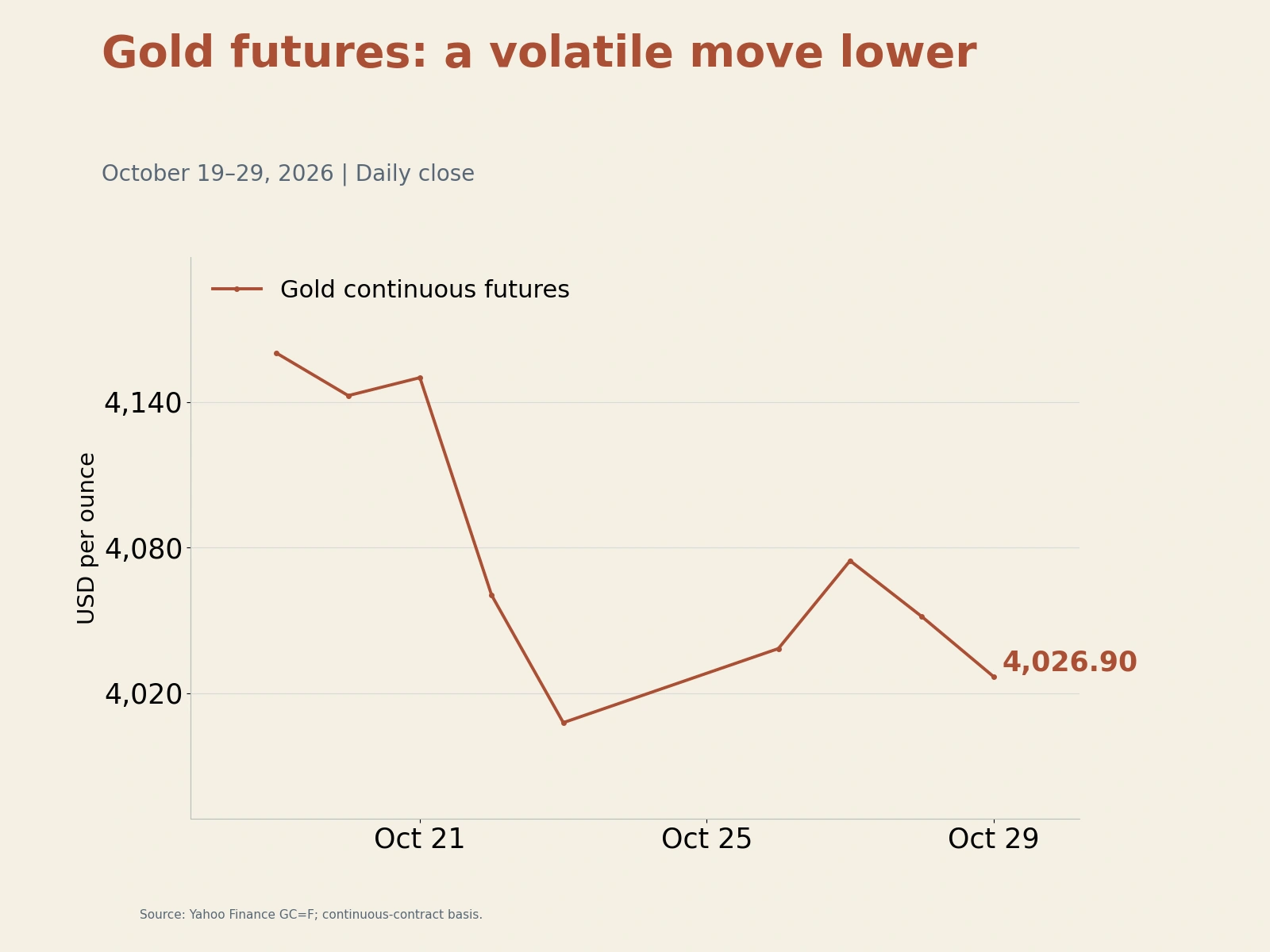
In precious metals, gold continuous futures still closed 0.61% lower at $4,026.90 an ounce, despite a 0.33% decline in the dollar index to 101.854 and a 7-basis-point fall in the nominal 10-year Treasury yield. Gold had dropped from $4,160.10 on October 19 to $4,007.90 on October 23, rebounded to $4,074.60 on October 27, and then weakened again. Reuters’ report that morning linked the pressure on gold to sticky inflation and expectations of further Federal Reserve rate increases. Although high oil prices generate safe-haven demand through geopolitical risk, energy inflation also prolongs the restraint imposed by tight monetary policy.
ECB holds rate at 2.50%; Asian stocks diverge on semiconductor earnings
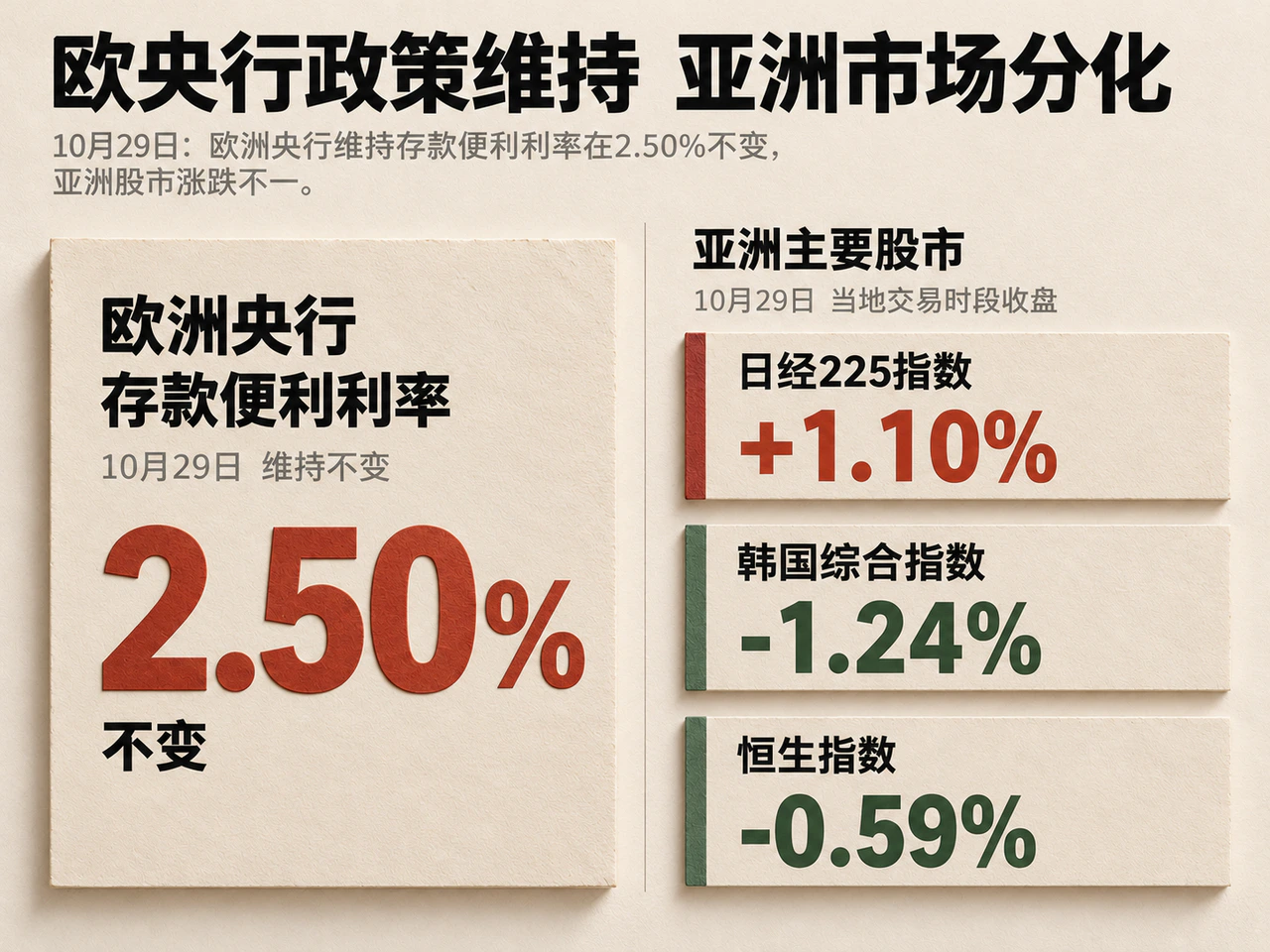
The European Central Bank held its deposit facility rate at 2.50% on October 29. Lagarde said average European 10-year sovereign yields had risen about 35 basis points from the cutoff used for the September projections, and that tighter long-term financing conditions supported a pause in rate increases at this meeting. With the energy shock pushing prices higher and funding costs restraining demand, France’s budget impasse and rising financing costs brought fiscal sustainability into market focus. The ECB reiterated that it had tools to respond if unwarranted, disorderly market movements threatened policy transmission, although activation of the Transmission Protection Instrument remained subject to specific conditions. BBVA Research continued to expect one final ECB rate increase in December followed by a pause. Lagarde also announced that day that she would leave office early in February 2027, bringing succession arrangements onto the market’s radar sooner.
Cross-regional trade and industrial cooperation continued to advance. India’s commerce minister said a nearly completed first-phase agreement with the United States would protect sensitive interests, including farmers, but the agreement had not yet been signed. The European Union and Canada discussed deeper cooperation in artificial intelligence, energy and security. A draft statement seen by Reuters referred to increasingly close ties and proposed a joint feasibility study of Canadian liquefied natural gas exports to Europe.
Asian equities had already diverged during their local trading sessions on October 29. The Nikkei 225 rose approximately 1.10% to 64,659.47, the KOSPI fell about 1.24% to 5,937.66, and the Hang Seng Index declined roughly 0.59% to 22,958.65. Earnings across the semiconductor supply chain were mixed. Advantest’s fiscal second-quarter net sales grew more than 81% year on year, and it raised its full-year outlook, signaling strong demand for AI testing equipment. Samsung also expected robust demand for AI-related memory, but its semiconductor profit missed market expectations. AWS’s accelerating growth, cloud providers’ cash burn and Intel’s weak revenue guidance, released after the US close, will further test the ability of Japanese semiconductor equipment makers, Korean memory-chip producers and Hong Kong technology assets to turn orders into business results.
China’s policy focus remained on stabilizing month-end funding and lowering business operating costs. On October 29, the People’s Bank of China conducted RMB 115 billion in 7-day reverse repos and RMB 1 trillion in overnight reverse repos. The Ministry of Commerce disclosed trade facilitation measures for Hainan, while the protocol upgrading the China-Peru Free Trade Agreement was set to take effect on November 1. Markets were watching the official manufacturing PMI release on October 31 to gauge how liquidity support and measures to stabilize demand were feeding through to production and new orders.