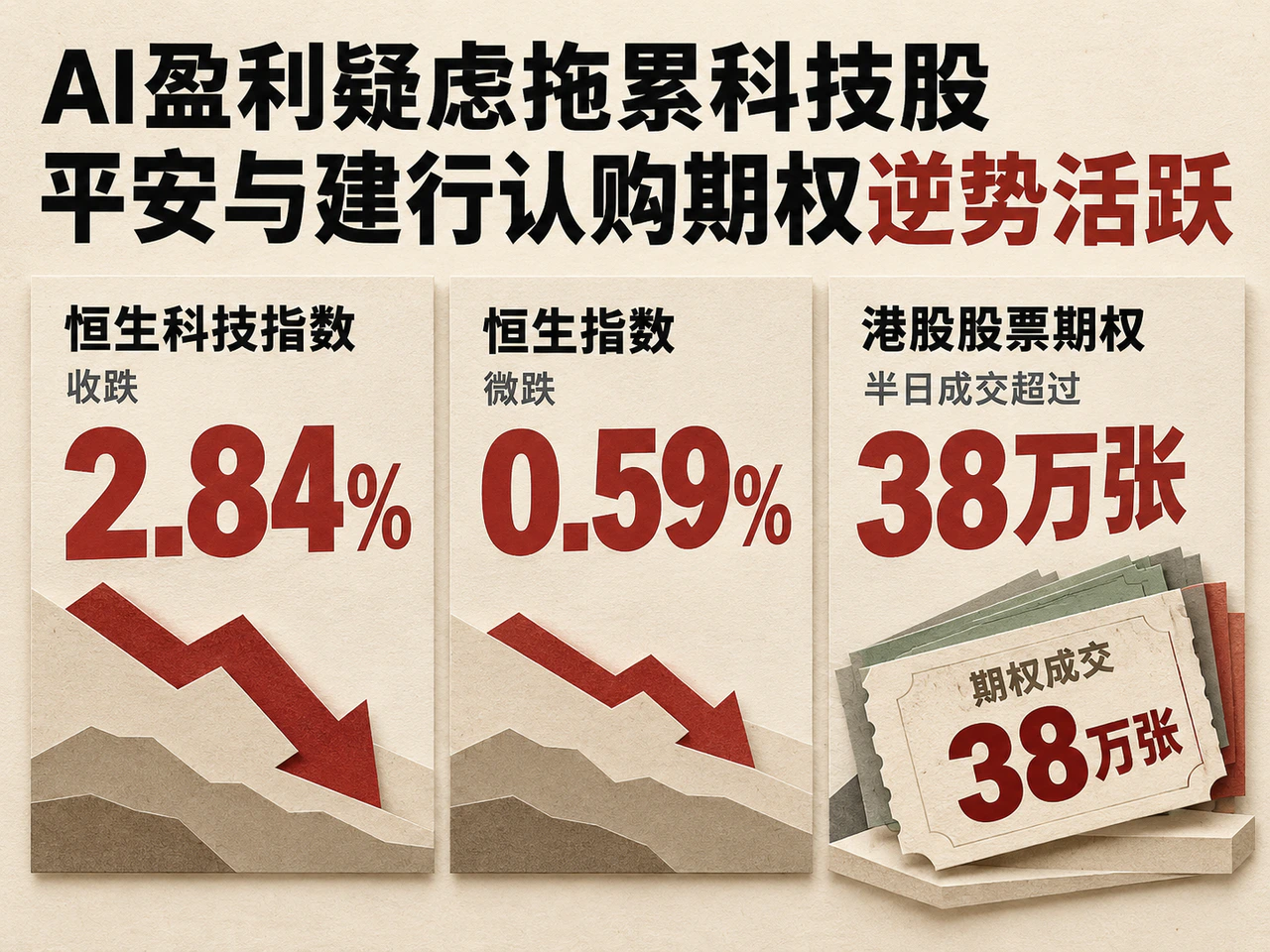
On October 29, 2026, Hong Kong technology shares weakened again. The Hang Seng Tech Index closed down 2.84%, underperforming the Hang Seng Index's modest 0.59% decline. The session was also the last trading day for October contracts in Hong Kong's major monthly equity-index futures and options. As doubts over technology companies' ability to deliver earnings coincided with derivatives rollover, the options market showed a clear shift in maturity: with October contracts moving into settlement, trading and new open interest in November Hang Seng Tech options rapidly concentrated at a handful of key strikes. Pricing and positioning in the new contract month were sending clearer risk signals.
Doubts over AI earnings weigh on tech shares as Ping An and CCB calls draw active trading
According to China Fund News' closing-market report that day, technology sectors including optical communications and semiconductors came under broad pressure, while New Oriental fell more than 14% after its results. Banks and insurers were relatively strong, widening the performance gap between the Hang Seng Index and Hang Seng Tech. Investors' scrutiny of technology assets is shifting from the pace of business expansion to how efficiently capital spending translates into profits.
In an October 29 report, CNBC cited Tai Hui, chief Asia market strategist at J.P. Morgan Asset Management, as saying that investors wanted to see how technology companies would convert spending on artificial intelligence into actual earnings. The report also noted that some strategists believed lower valuations had made the sector more attractive. The disagreement is fundamentally a mismatch in time horizons: valuations can become cheaper quickly in a sell-off, whereas earnings delivery and improving demand take longer to confirm. Options markets trade the time value of that waiting period while also pricing potential jumps in the underlying share prices along the way.
The divergence between cash-market sectors was directly reflected in options trading. Tiger's midday market roundup showed that more than 380,000 Hong Kong stock-option contracts traded in the morning session, including over 57,000 on Tencent, over 32,000 on Alibaba and over 30,000 on Pop Mart. As technology shares weakened, calls on financial stocks entered the most-active rankings, revealing two distinctly different trading horizons. Ping An's HK$57.5-strike call expiring on November 27 traded 1,686 contracts in the morning, reflecting positioning around the stock's path over almost the next month. China Construction Bank's HK$10-strike call expiring that day traded 4,424 contracts, focusing much more narrowly on the expiry-day contest around the strike.
November Hang Seng Tech calls and puts each add over 2,000 contracts; the 3,700 put's quote surges 49%
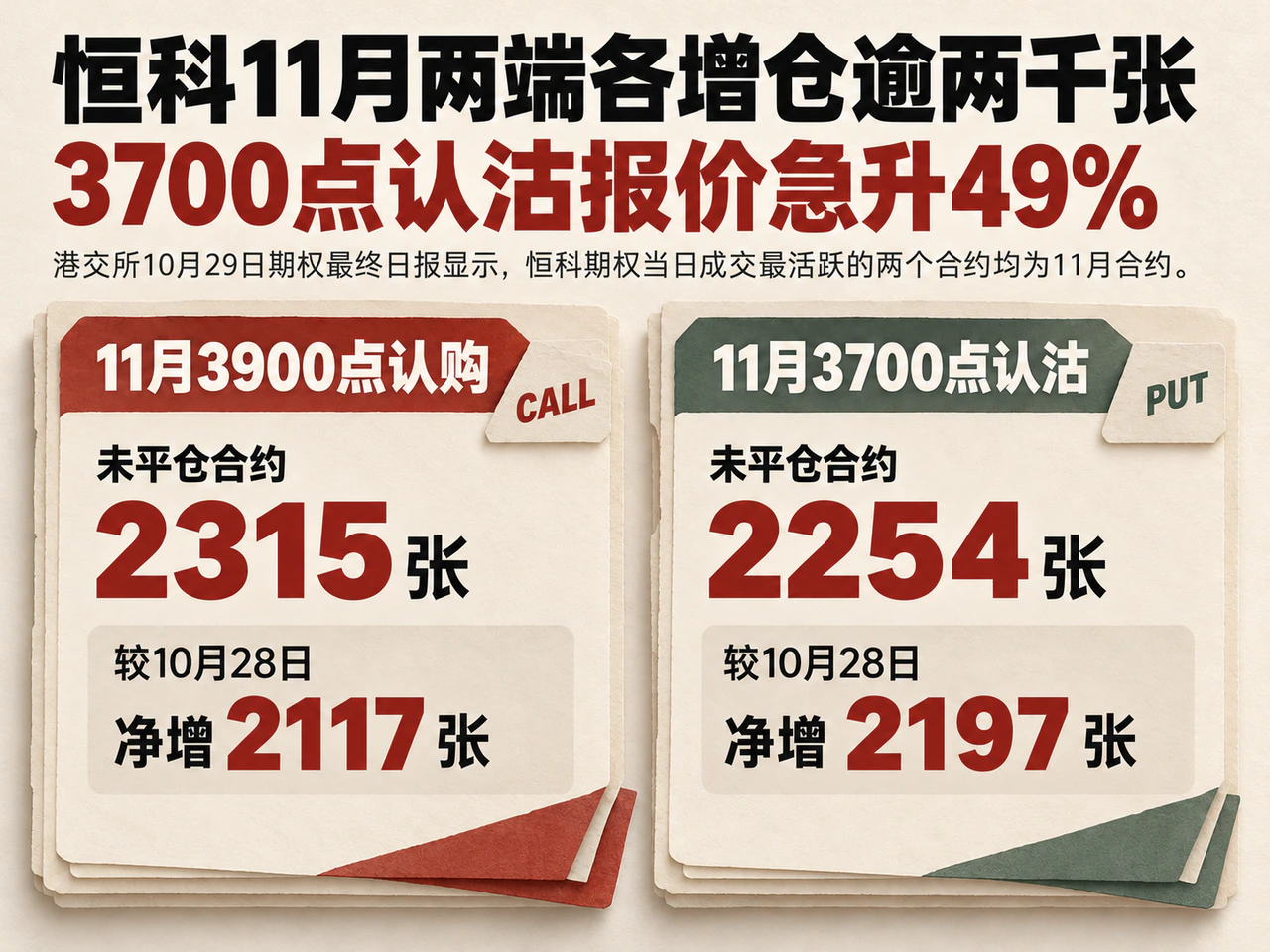
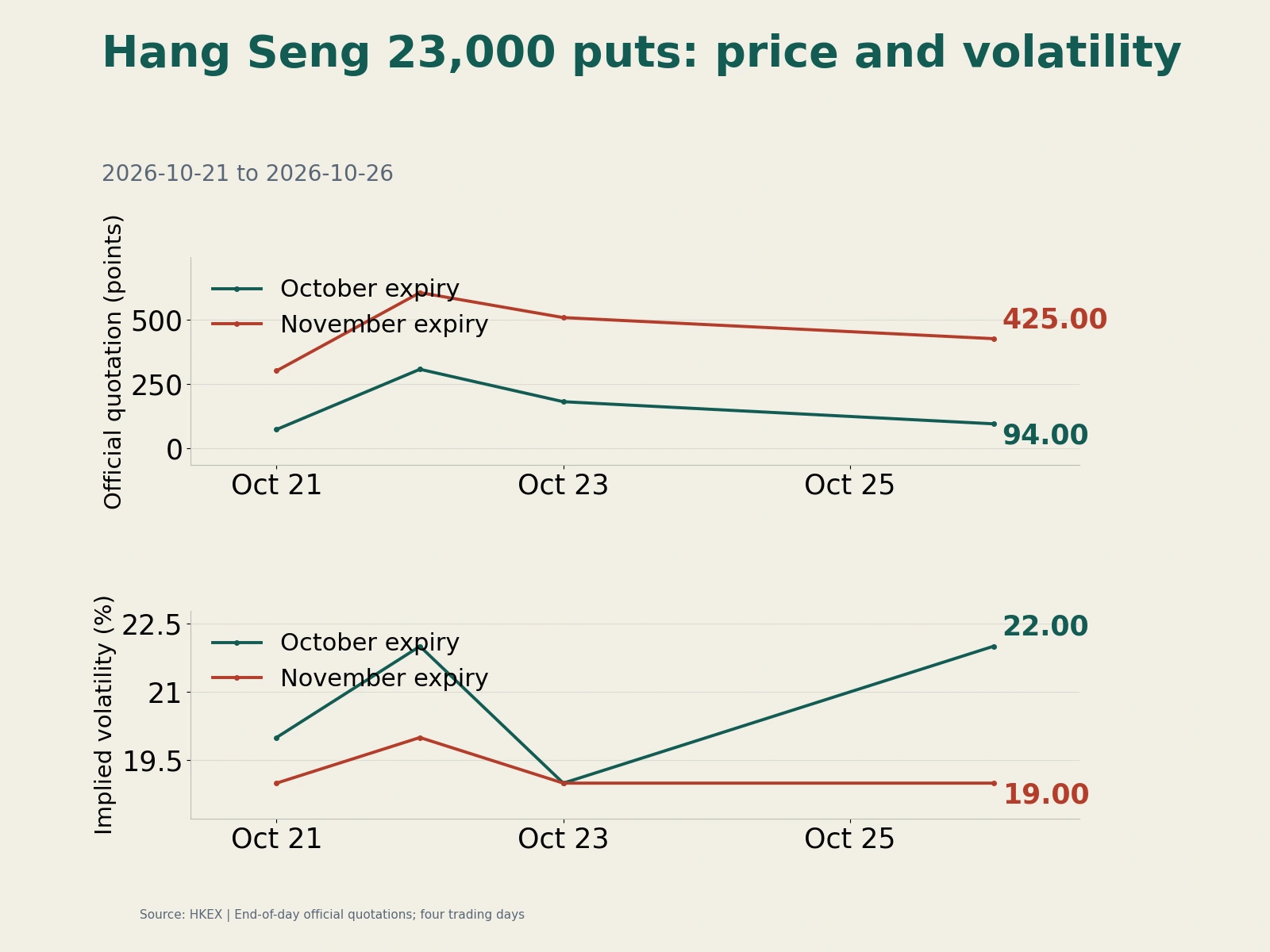
HKEX's final options daily report for October 29 showed that the two most actively traded Hang Seng Tech option contracts were both November maturities. The November 3,900 call traded 2,335 contracts, with open interest surging from 198 on October 28 to 2,315, a net increase of 2,117. The November 3,700 put traded 2,220 contracts, with open interest jumping from 57 to 2,254, a net increase of 2,197. New positions associated with rollover quickly concentrated at the 3,700 and 3,900 strikes, with large additions at both the lower and upper strikes.
The price changes suggested particular urgency around protection against downside risk. On HKEX's official quotation basis, with both contracts carrying a multiplier of HK$50 per index point and excluding fees, the November Hang Seng Tech 3,900 call fell from 100 points in the previous session to 63 points, a 37% decline. The October 29 quote was equivalent to HK$3,150 per contract. The 3,700 put for the same month jumped from 63 to 94 points, an increase of about 49.2%, equivalent to HK$4,700 per contract.
The direction of the underlying index and volatility jointly drove this repricing. The daily report showed that implied volatility on the 3,900 call stayed at 27% on both days. Its falling quote primarily reflected the index decline, which pushed the call further out of the money. By contrast, implied volatility on the 3,700 put edged up from 28% to 29%, adding a volatility-related uplift to the benefit from the fall in the underlying index. Although an increase in open interest cannot by itself reveal trade direction, the relationships between positions in a strategy, or the identities of participants, substantial risk positions were being established at both the upside and downside strikes for the coming month on a day when the index fell, while the price of downside protection rose markedly.
Total Hang Seng Tech open interest falls as November positions build, with rollover moving faster than in Hang Seng Index options

Under the schedule in HKEX's trading calendar, October 29 was the last trading day for monthly index futures and options including those on the Hang Seng Index, Hang Seng China Enterprises Index and Hang Seng Tech Index. October 30 was the final settlement day, while weekly index options had a separate October 30 expiry. The last trading day for November monthly contracts is November 27.
Looking only at market-wide totals can easily obscure the concentration of risk in the new month when aggregate open interest is falling. On HKEX's combined-session basis, which includes the previous trading day's after-hours session and the current day's daytime session, total Hang Seng Tech options volume rose from 8,021 contracts on October 28 to 9,240 on October 29, an increase of about 15.2%. Over the same period, total open interest fell from 225,015 to 223,555 contracts, a net decline of 1,460. Viewed alongside the sharp increase in open interest in key November contracts, the fall in aggregate positions shows that existing capital was shifting the maturity and distribution of its risk across contract months.
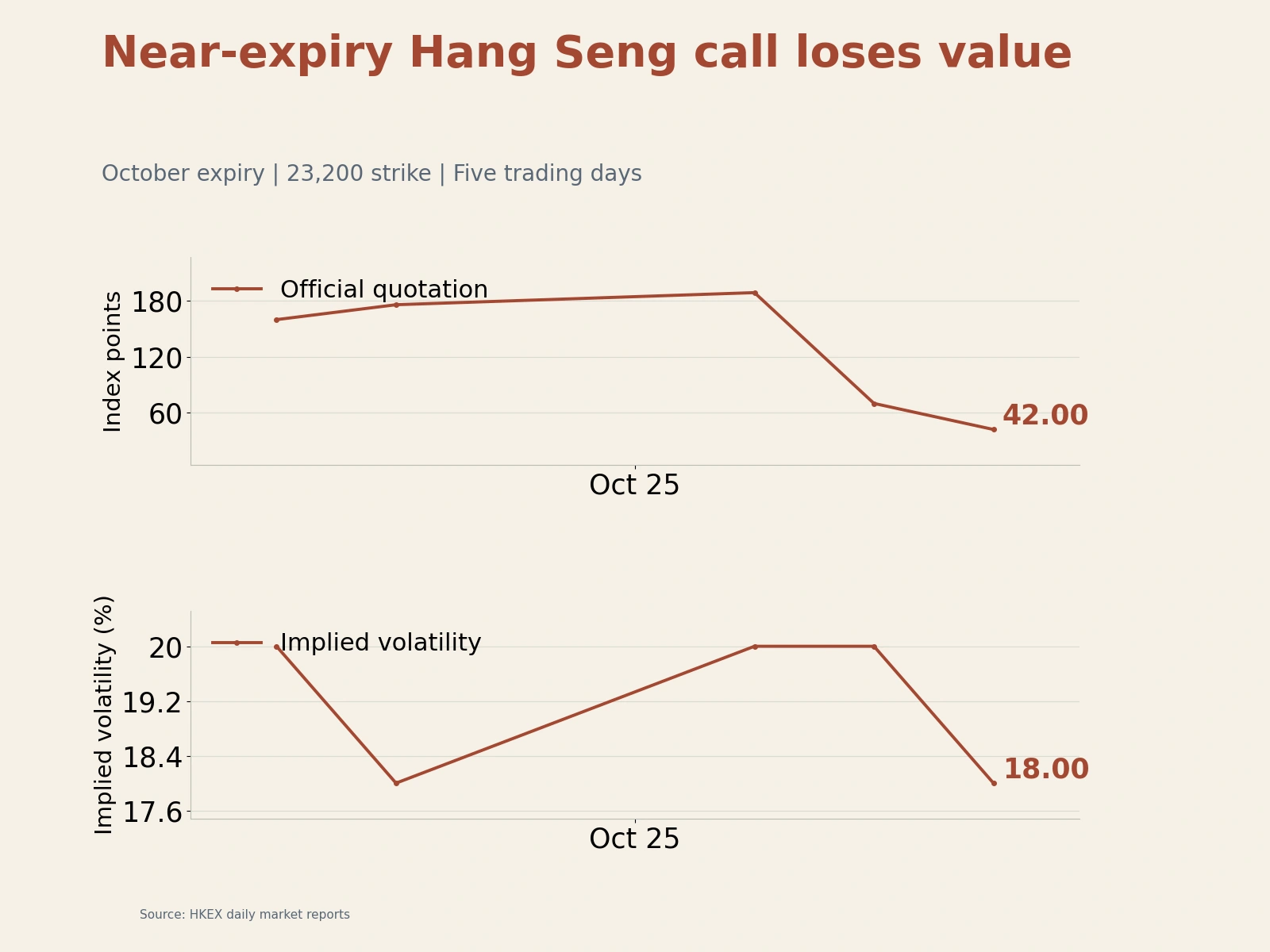
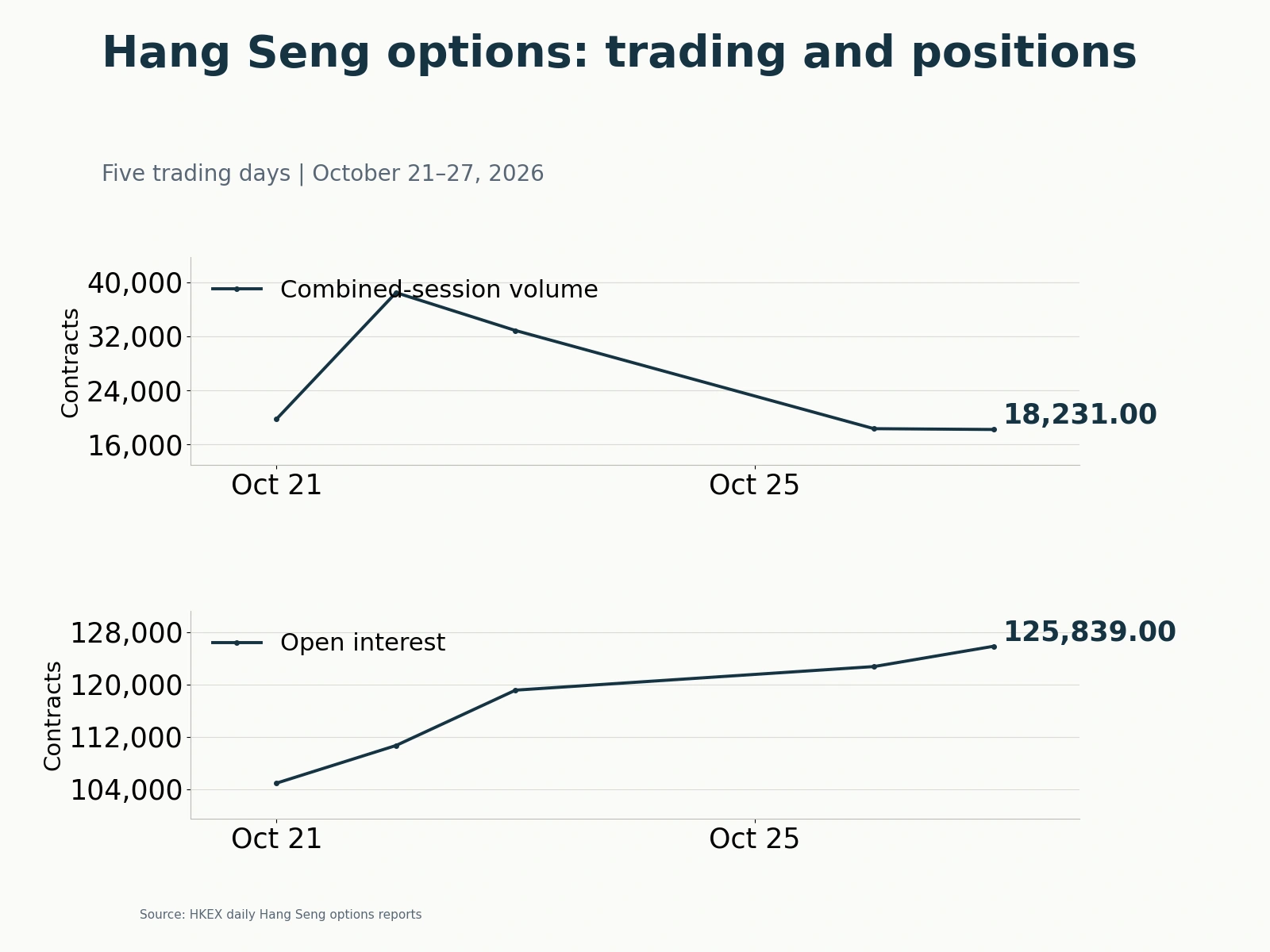
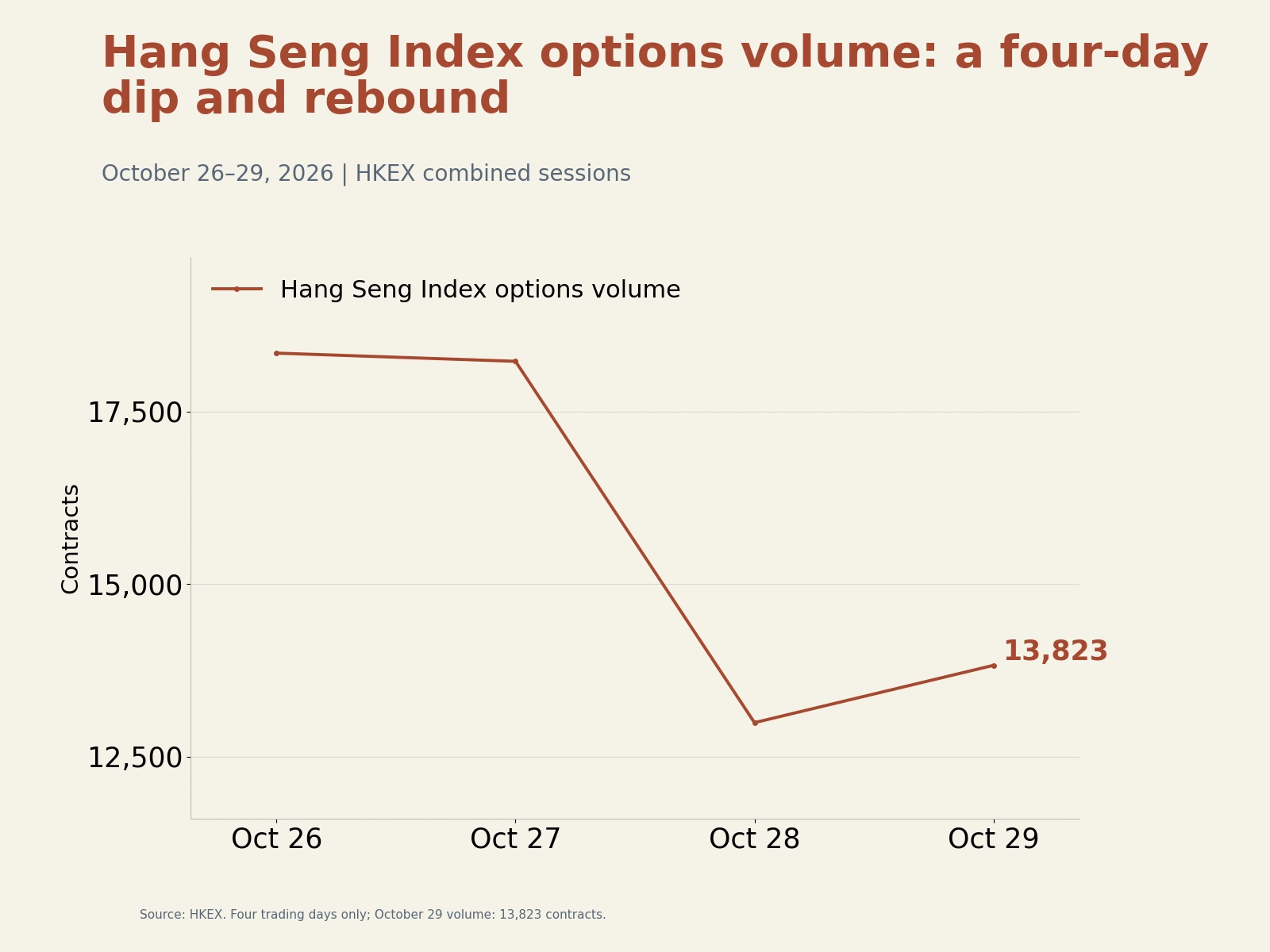
By comparison, rollover in Hang Seng Index options was somewhat slower. On the same combined-session basis, volume from October 26 through October 29 was 18,350, 18,231, 12,992 and 13,823 contracts, respectively. Although October 29 volume rebounded by about 6.4% from the previous day, it remained below the levels seen at the start of the week. The day's most-active rankings were still dominated by the October 23,200 call and 23,000 put approaching settlement, while the November 23,200 call traded just 476 contracts. With technology shares leading the market lower, Hang Seng Tech options participants shifted their trading focus to November earlier.
Hang Seng Tech call quote shrinks 37%, forcing covered-call rollovers to balance income against capped upside
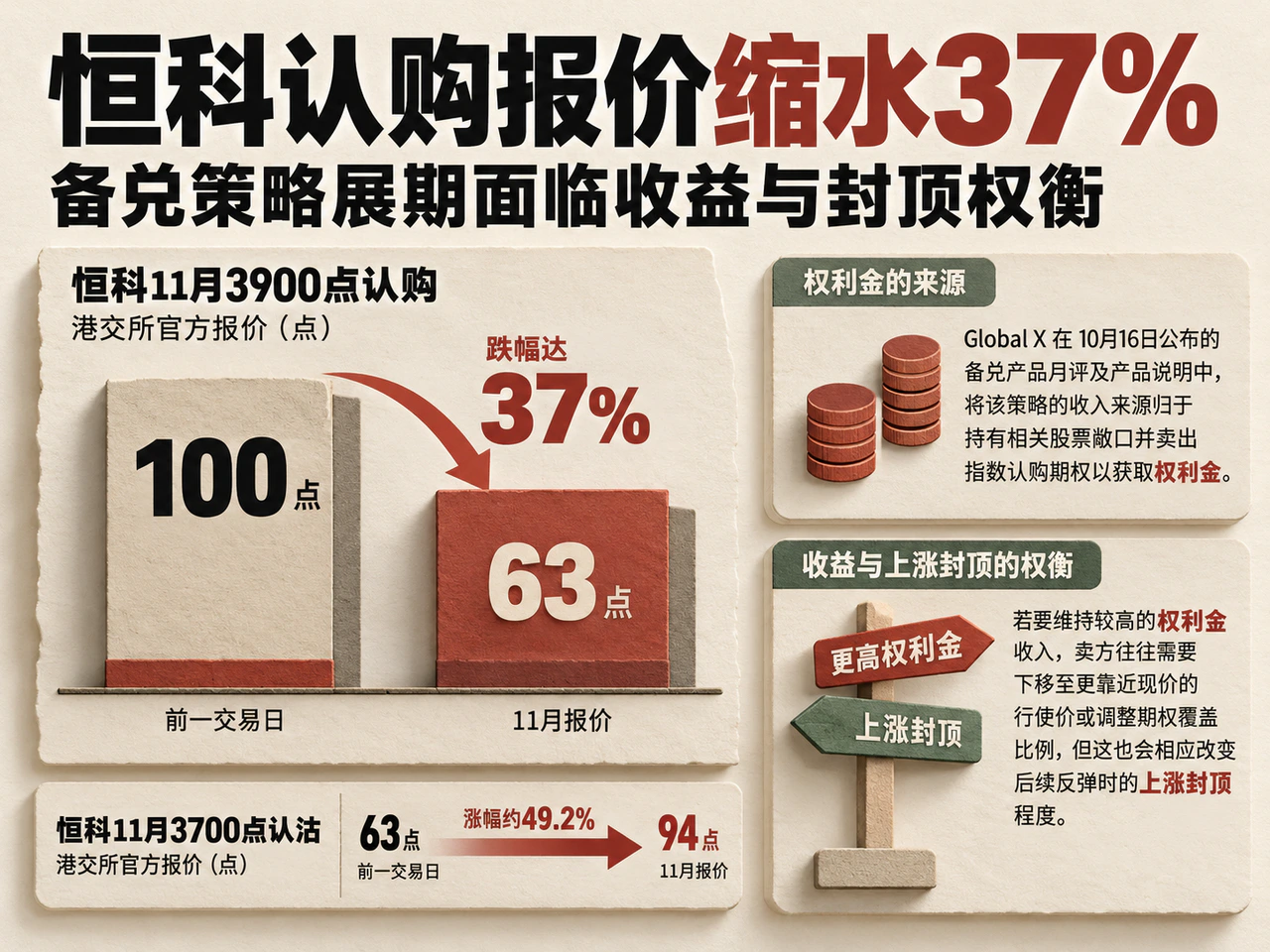
The combination of a falling underlying market and unchanged call implied volatility also altered the conditions for rolling covered-call strategies. In its covered-call product monthly commentary and product information released on October 16, Global X described the strategy's income as coming from holding exposure to the relevant equities and selling index calls to collect option premiums. In a market such as Hang Seng Tech, which has fallen sharply but can also rebound quickly, option sellers face two asymmetric risks: premiums provide only a limited cushion on the way down, while part of any upside must be surrendered to call buyers once a rebound takes the market above the strike.
The drop in the November Hang Seng Tech 3,900 call's official quote from 100 to 63 points on October 29 illustrates the specific constraint at rollover. With the market falling and implied volatility at the same strike showing no material increase, continuing to sell that strike generates substantially less premium. To sustain a higher premium income, sellers often need to move to a lower strike closer to the current market level or adjust the proportion of the equity exposure covered by options. That also changes how much upside is capped in a subsequent rebound. When assessing such strategies, distributions, premium income and total return including changes in net asset value still need to be considered separately.
As the old October contracts move into settlement, derivatives pricing has shifted its focus fully to November. The next questions are whether positions in key November Hang Seng Tech contracts continue to accumulate, whether the implied volatility of downside protection keeps rising, and whether technology-company earnings can ease concerns over returns on AI spending. If the underlying market stabilizes, elevated put-protection prices could retreat. If technology shares continue to fall, both the newly established options positions and the premium cushion of covered-call strategies will face a substantive test.