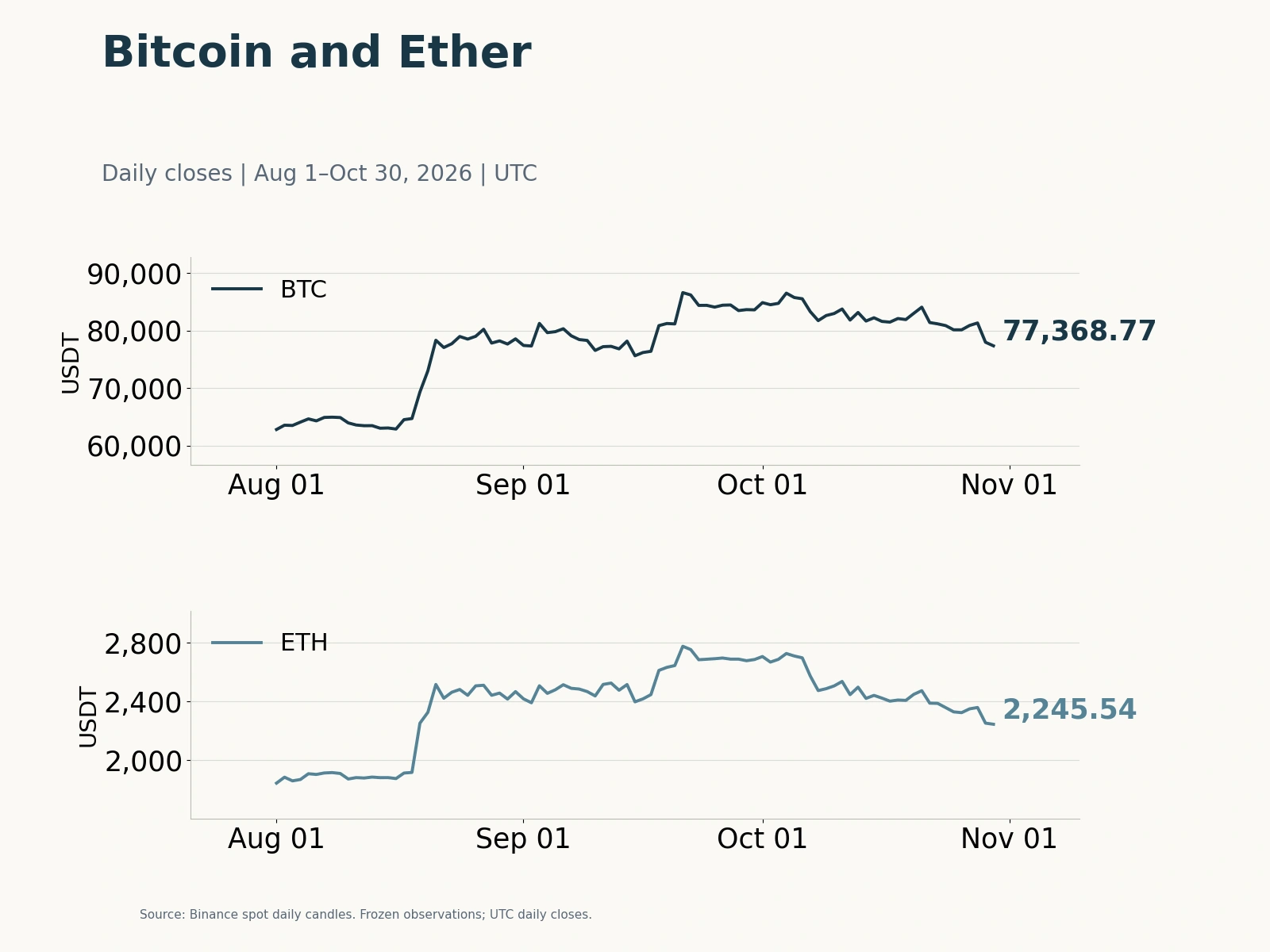
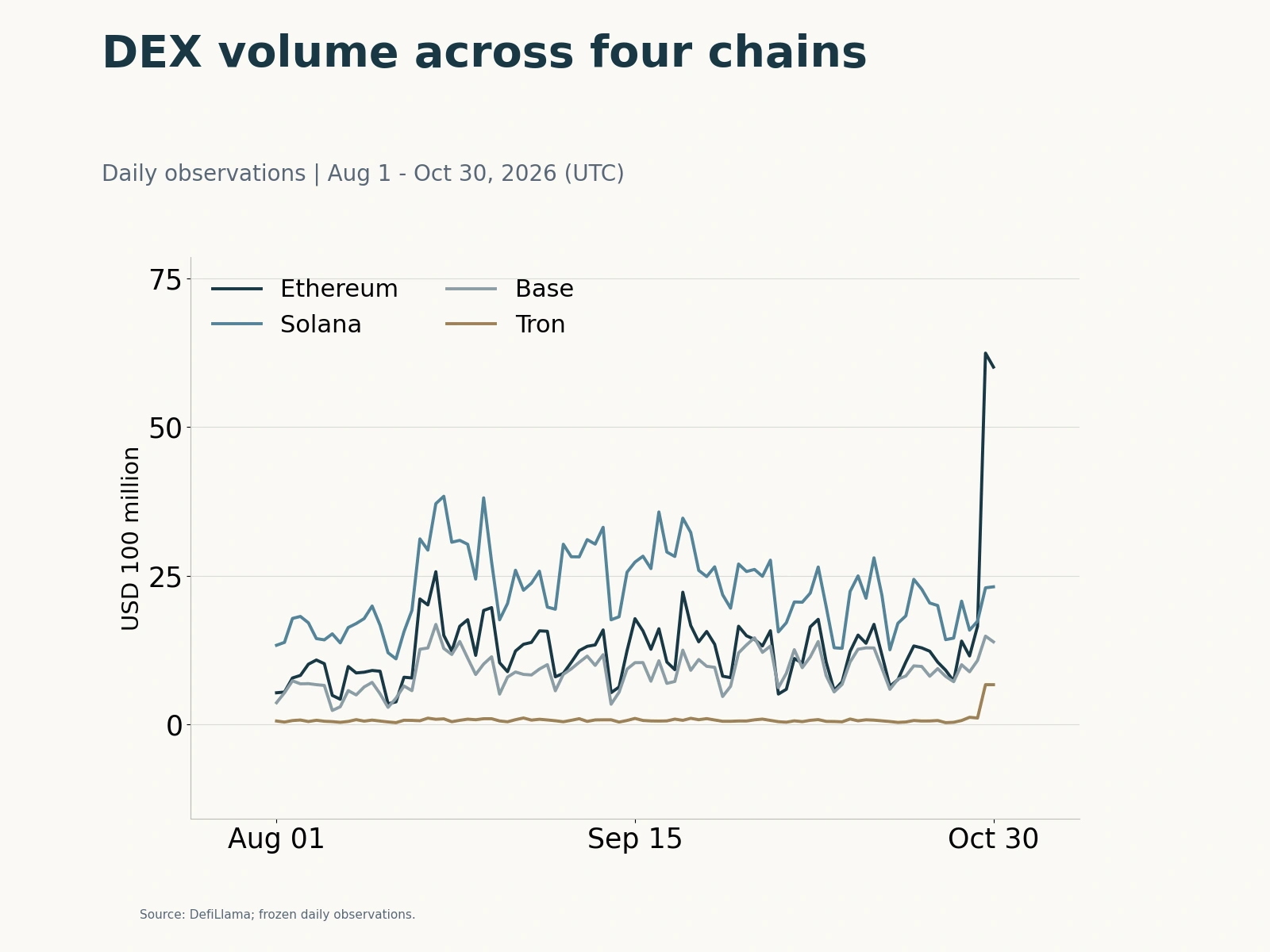
On October 30, 2026, funding rates on Binance’s Ether USDT perpetual contract were negative at all three settlements—00:00, 08:00 and 16:00 UTC—while Bitcoin’s were positive at each. Ether shorts were now paying funding to longs; by the end of the UTC day, open interest measured in the underlying coins had also increased in both markets. Following the price decline, the market did not deleverage across the board. Exposure was being redistributed between contracts.
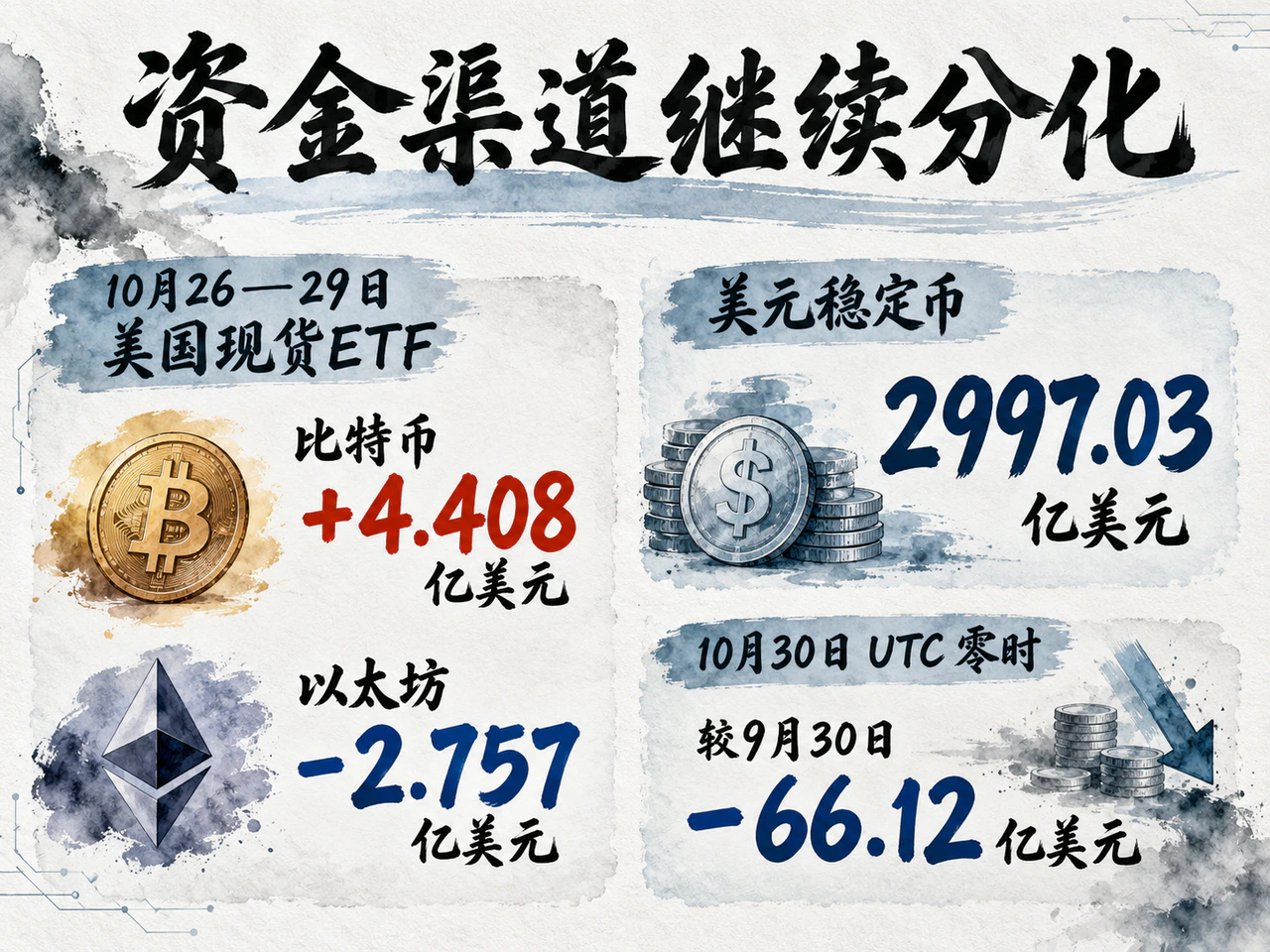
The same divergence appeared in spot allocation channels. Over the four trading days from October 26 to 29, US spot Bitcoin ETFs recorded cumulative net inflows of $440.8 million, while spot Ether ETFs saw cumulative net outflows of $275.7 million. Meanwhile, the circulating supply of dollar stablecoins continued to fall: on-chain dollar liquidity was not expanding alongside ETF demand.
Bitcoin ETFs take in $440.8 million over four days as stablecoin supply keeps shrinking
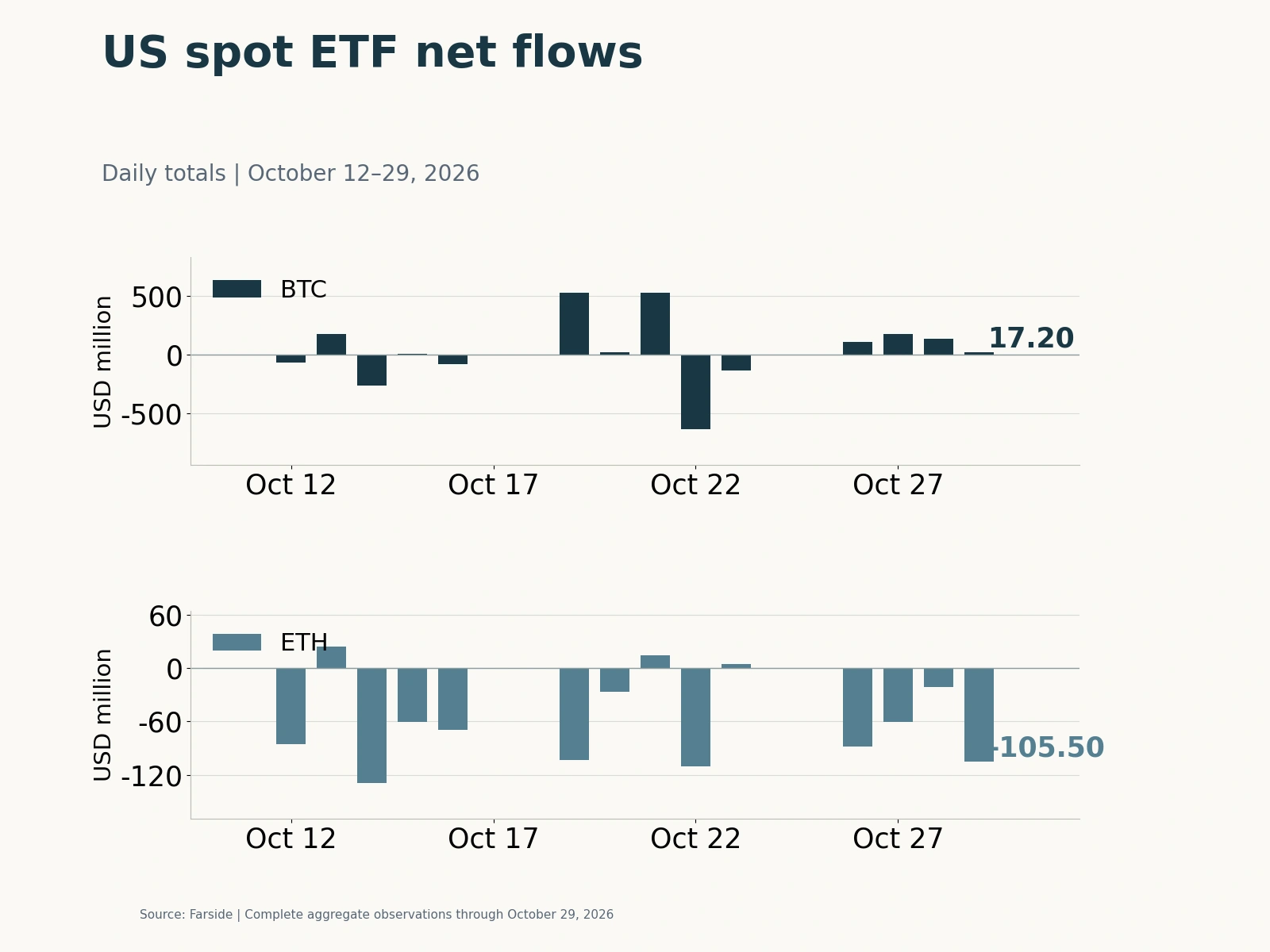
Farside data show that Bitcoin ETFs recorded net inflows of $110.3 million, $176.0 million and $137.3 million on October 26–28, respectively, before inflows slowed to $17.2 million on October 29. Ether ETFs, by contrast, posted net outflows on all four days, with withdrawals widening again to $105.5 million on October 29. This divergence in allocation demand has persisted for several trading days and should not be treated as a chance fluctuation in a single day’s creations and redemptions.
Fresh redemption pressure also emerged on the Bitcoin side. Among the October 30 figures disclosed so far, ARKB, GBTC and BITB recorded net outflows of $129.5 million, $53.3 million and $25.7 million, respectively—a combined $208.5 million. These are partial results for the products that had reported; the day’s overall net flow still awaits complete data. Aggregate inflows over the preceding days had not eliminated differences in redemption pressure across funds, and it remains to be seen whether fresh money will absorb those withdrawals at month-end.
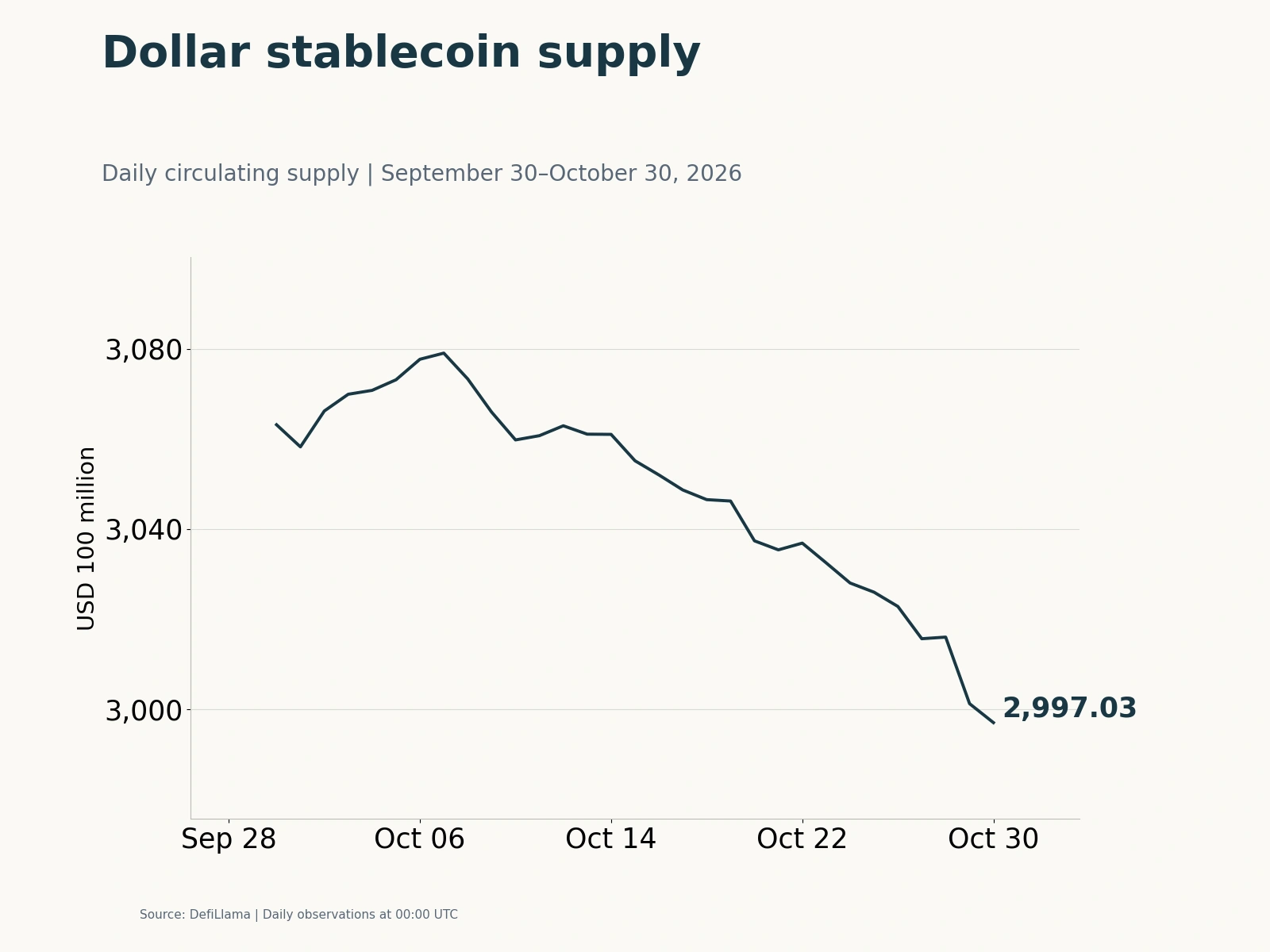
Stablecoins provide another perspective. DefiLlama’s daily circulating-supply series for dollar-pegged stablecoins put outstanding supply at $299.703 billion at 00:00 UTC on October 30, down $421 million from the previous day, $3.546 billion from October 23 and $6.612 billion from September 30. The decline from October 23 to 30 accounted for more than half of the total contraction since September 30.
ETF creations and redemptions and outstanding stablecoin supply represent two distinct funding channels. The former measures net demand for the relevant products held through securities accounts; the latter reflects the supply base of dollar-denominated assets on-chain. Bitcoin ETF inflows can therefore coexist with a decline in total stablecoin supply. The current combination shows allocation demand concentrated in Bitcoin while on-chain dollar supply has yet to expand, rather than fresh capital entering all channels together.
A shrinking stablecoin stock reduces the base of dollar assets available for trading, collateral and settlement. Its effect on prices still depends on how quickly the remaining funds circulate and how they are used. To judge whether a rebound can last, the next questions are whether ETF inflows spread beyond Bitcoin to other assets and whether stablecoin supply stops falling. If the two channels continue to diverge, the market will become more dependent on a narrow set of buying sources.
Ether open interest rises as shorts pay funding; Bitcoin futures basis falls to 5.25%
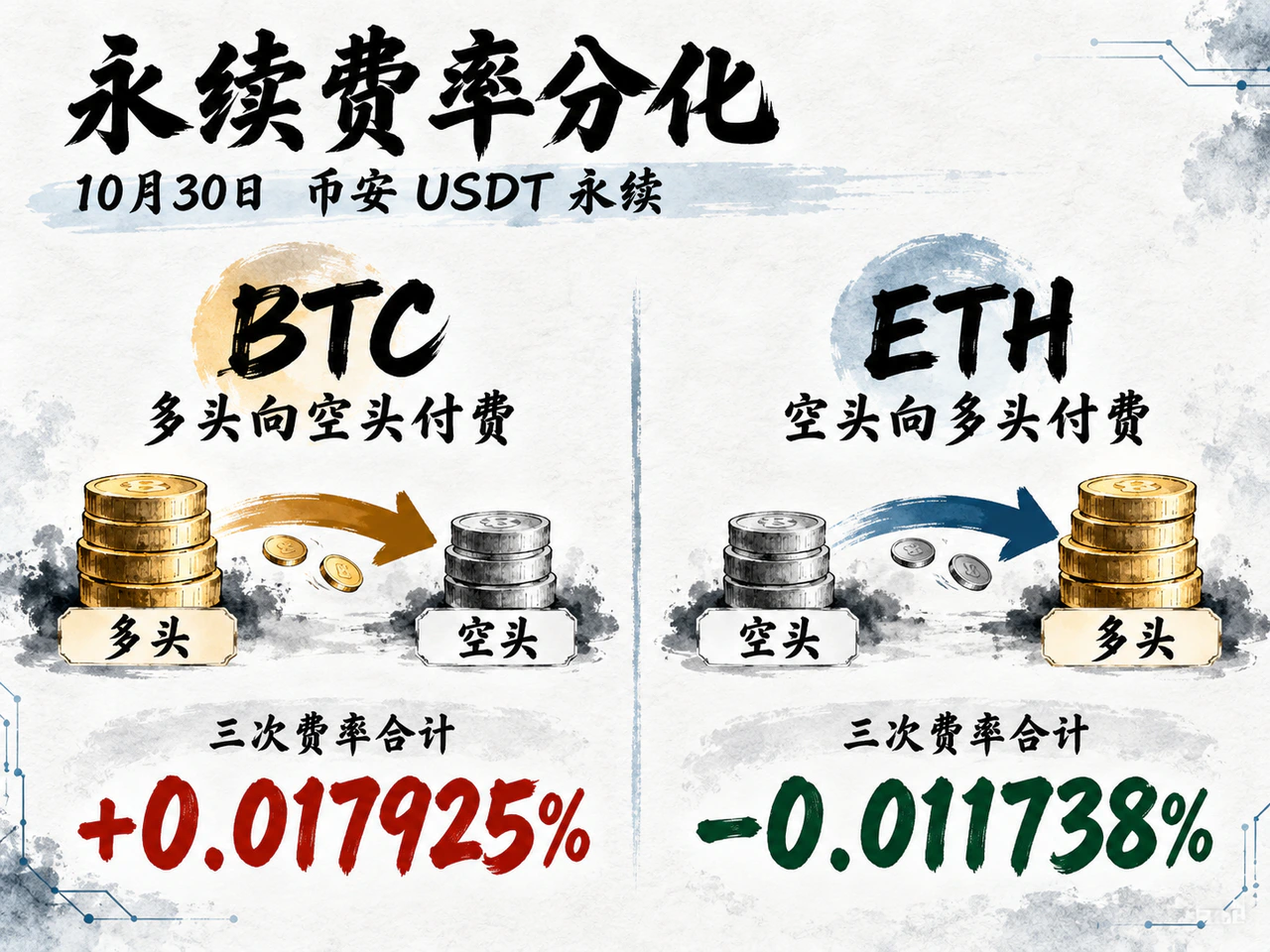
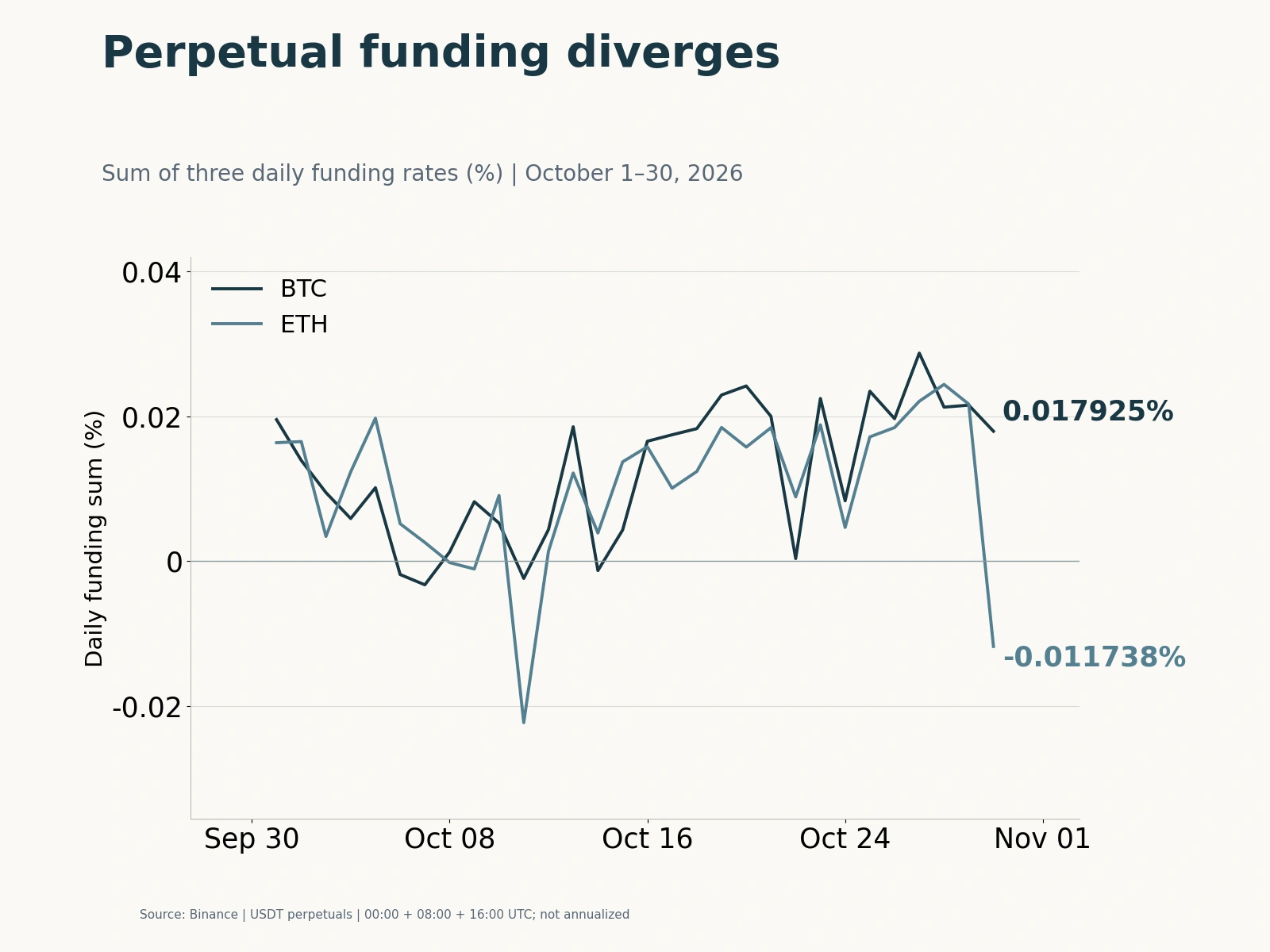
Binance data show that Bitcoin perpetual funding rates at 00:00, 08:00 and 16:00 UTC on October 30 were 0.003619%, 0.004306% and 0.010000%, respectively, totaling 0.017925% across the three settlements. Ether’s rates were -0.004294%, -0.003223% and -0.004221%, totaling -0.011738%. On the preceding trading day, Ether’s three rates had still summed to a positive 0.021664%. The shift from positive to negative, with all three settlements below zero, reflects relatively stronger selling and hedging demand in that exchange’s Ether perpetual market.
Between 00:00 UTC on October 30 and 00:00 UTC on October 31, open interest in Bitcoin USDT perpetuals rose from approximately 94,800 BTC to 96,300 BTC, an increase of 1.62%. Ether open interest rose from approximately 2.3220 million ETH to 2.3369 million ETH, up 0.64%. The recovery in open interest measured in coins indicates that new contracts were still being opened during the price decline. Viewed alongside funding rates, new Ether positions were being established in an environment where shorts paid funding, while Bitcoin longs continued to bear the funding cost. This comparison describes a structural difference between Binance’s two contract markets.
Fixed-maturity contracts remained at a premium. The annualized basis on Binance’s current-quarter Bitcoin contract was 5.25% at 00:00 UTC on October 30, down from 5.67% a day earlier. The futures premium over spot and the corresponding carry return narrowed, indicating some cooling in the premium leveraged traders were willing to pay.
Month-end options expiry concentrated position adjustments further. Bloomberg reported on October 29 that approximately $11 billion in notional Bitcoin options on Deribit were scheduled to expire on October 30, representing roughly one-third of the platform’s Bitcoin options open interest. A concentrated expiry brings position closures, rolls and hedge adjustments, but its directional effect on prices still depends on the composition of positions and counterparties’ hedging behavior.
Spot allocations favoring Bitcoin, declining stablecoin supply and negative Ether funding rates together point to a market in which capital is more selective and hedging demand is stronger, rather than a broad return of funds. The most useful developments to watch next are whether Ether’s negative funding eases alongside a decline in open interest, and whether spot Bitcoin ETF inflows can continue to offset withdrawal pressure through other channels.
Click “Read the original” for full details.