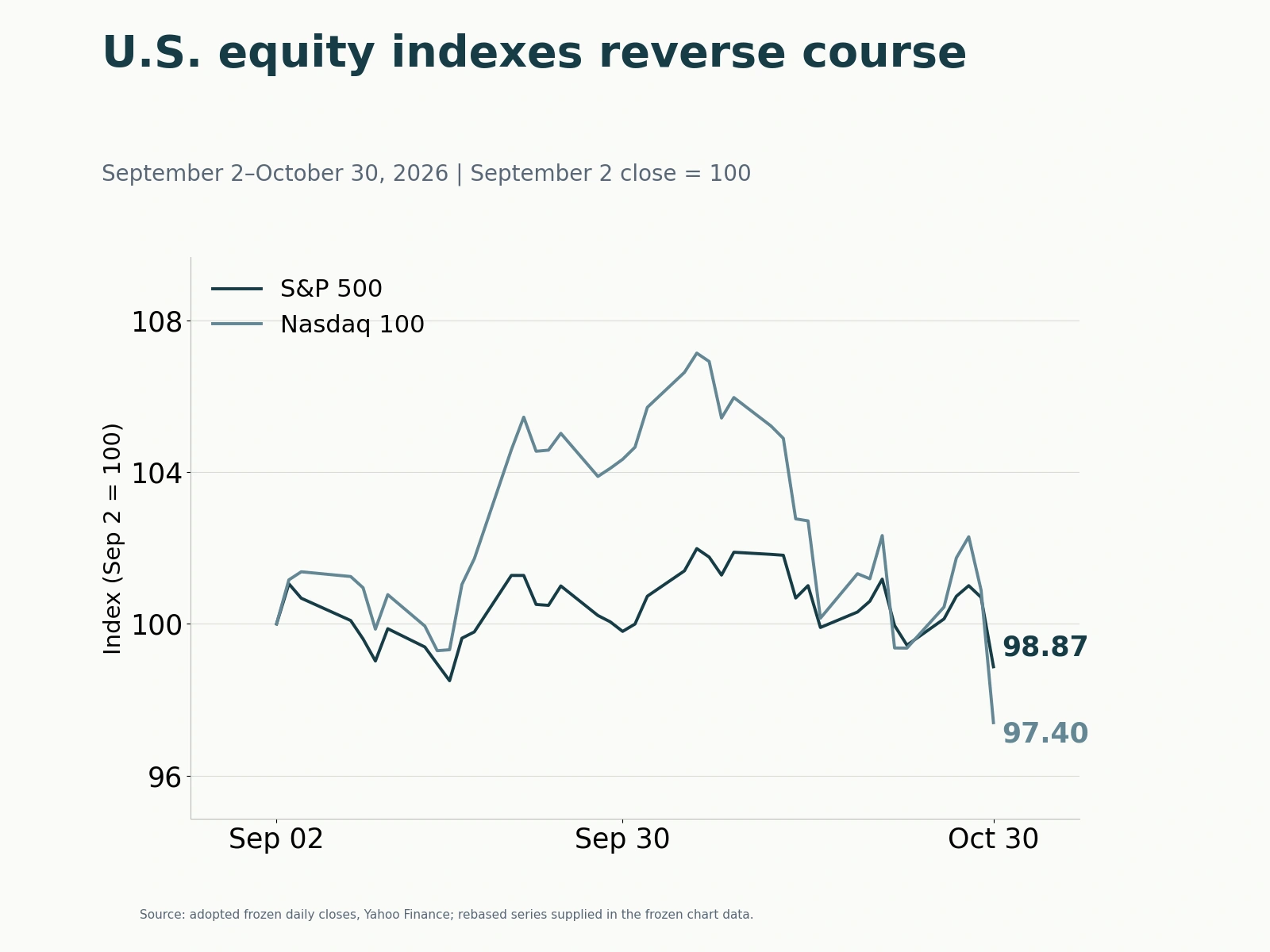
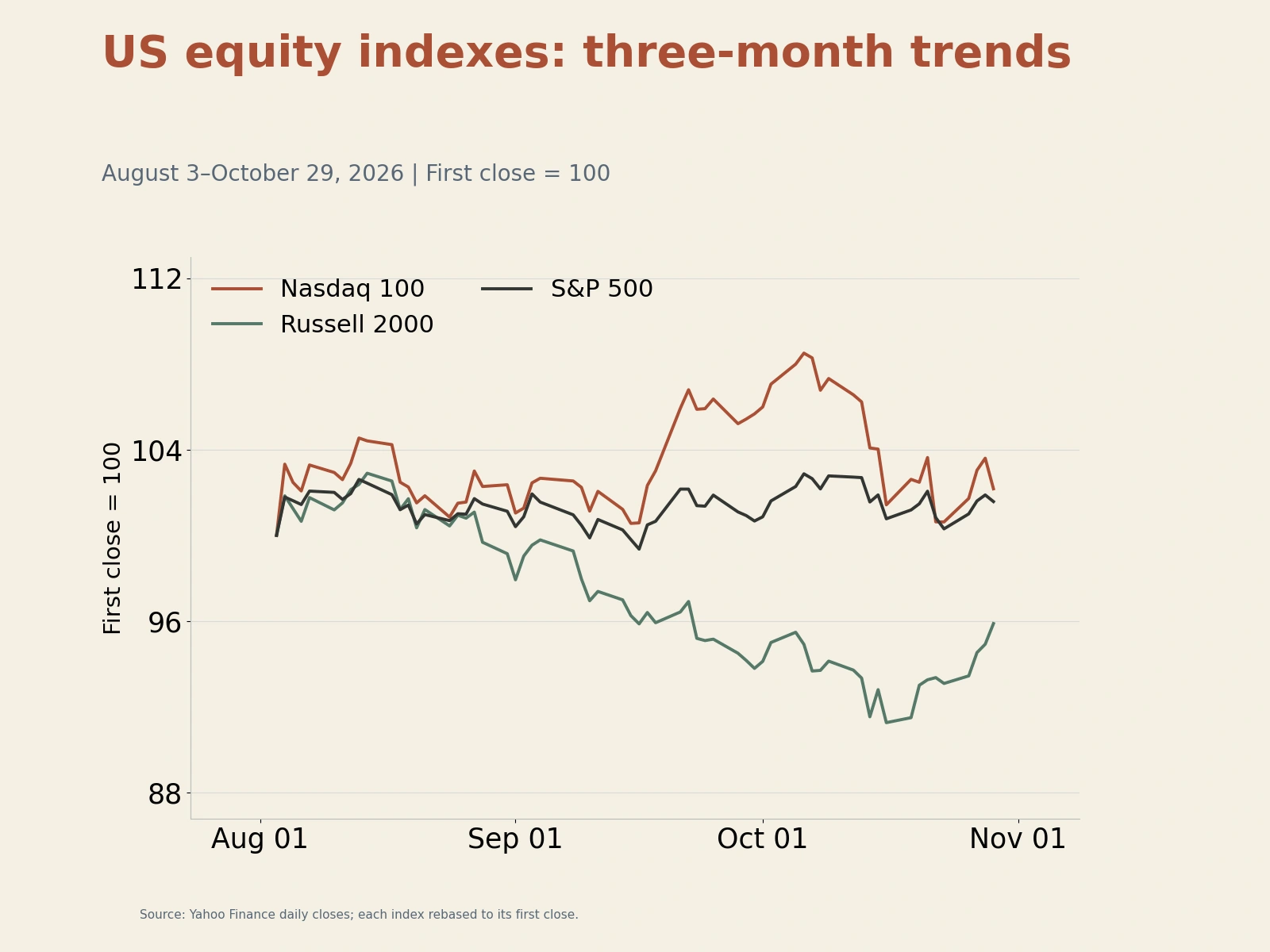
From October 26 to November 1, 2026, the latest earnings reports from Microsoft, Amazon and other technology giants shifted market attention to how quickly AI investment can generate cash returns. Cloud revenue continued to grow briskly, but enormous capital outlays and weak earnings guidance from some companies prompted a reassessment of valuations. During the October 26–30 trading week, the Nasdaq 100 fell 1.98% and the S&P 500 lost 0.57%, while the small-cap Russell 2000 gained 1.29%. The US Treasury yield curve shifted lower and steepened, with the two-year yield falling 13 basis points and the ten-year yield declining 6 basis points. Commodities diverged: international oil prices recovered their early-week losses to finish modestly higher, while gold futures fell 2.72%. With resilient US domestic demand in the third quarter, a September inflation rebound and pressure from the supply of long-term financing all in play, cash-flow constraints on technology investment, changes in households' real purchasing power and long-term financing costs jointly drove cross-asset pricing throughout the week.
Huge AI Outlays Raise Free-Cash-Flow Concerns as Technology and Chip Stocks Lead US Equities Lower
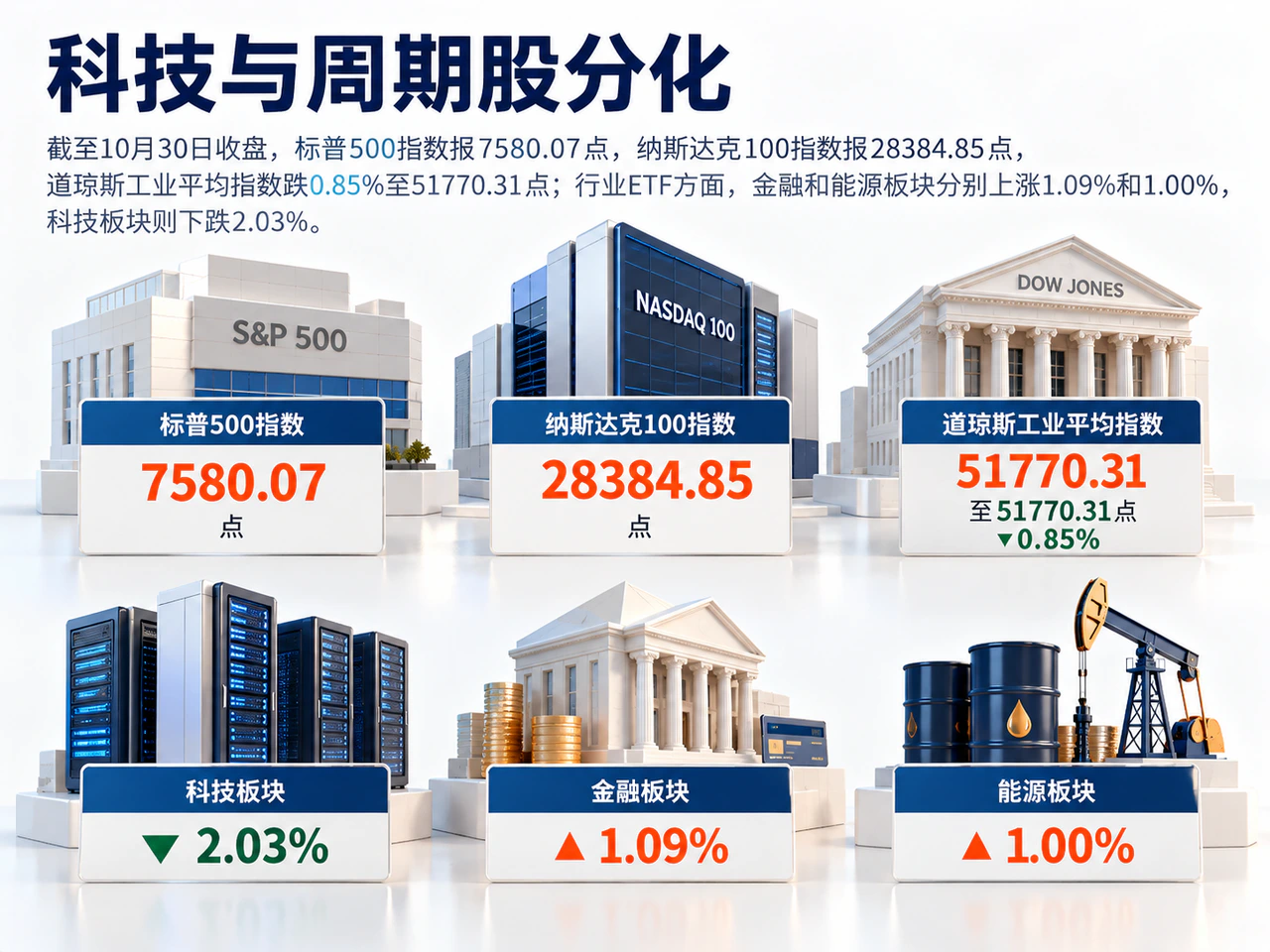
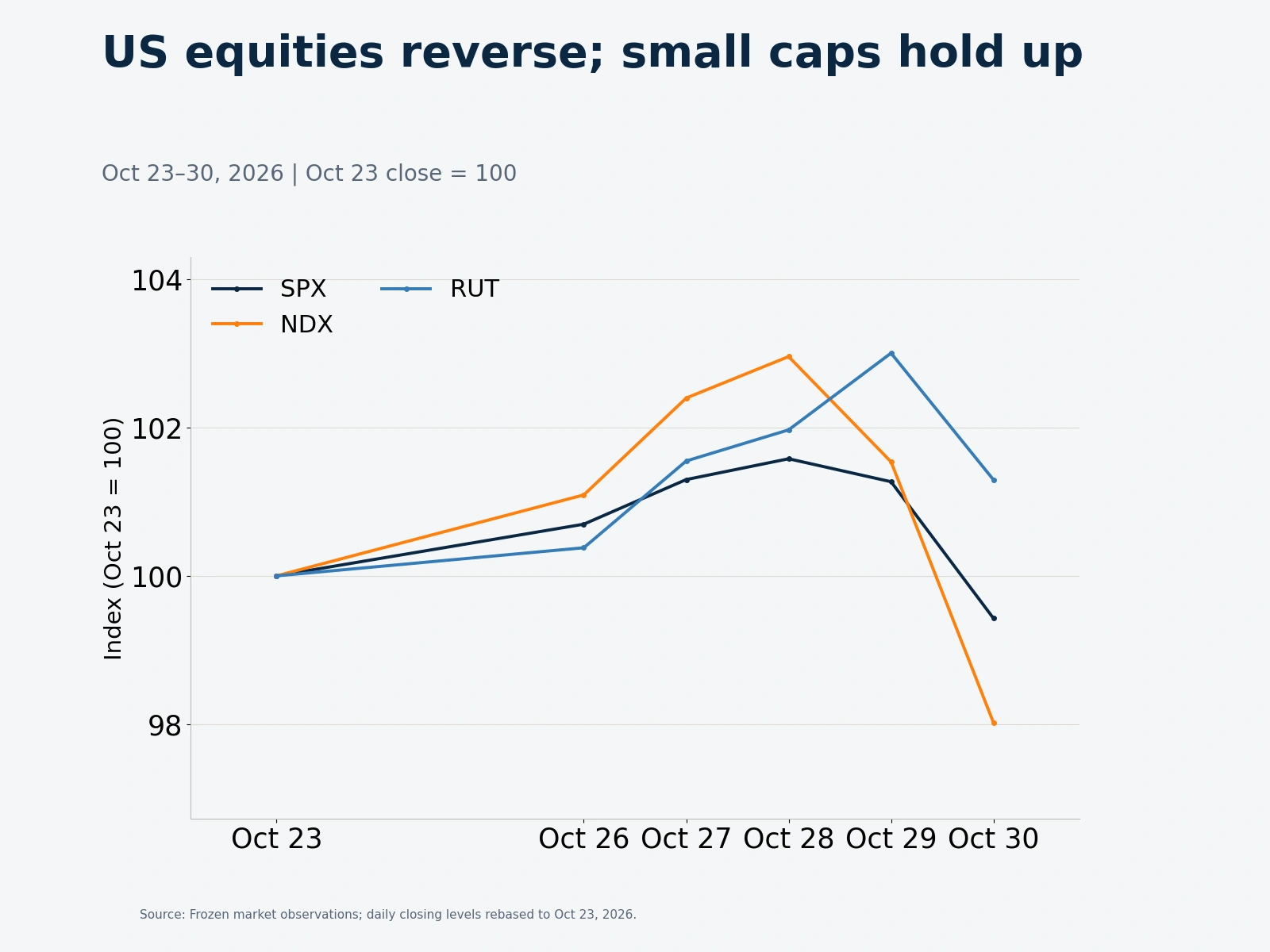
US equities saw pronounced sector rotation over the week. At the October 30 close, the S&P 500 stood at 7,580.07 and the Nasdaq 100 at 28,384.85, while the Dow Jones Industrial Average was down 0.85% for the week at 51,770.31. Among sector ETFs, financials and energy gained 1.09% and 1.00%, respectively, while technology fell 2.03%. The retreat in technology heavyweights alongside gains in small caps and cyclicals reflected a shift of capital out of richly valued growth stocks toward areas where valuations were better aligned with earnings.
Risk appetite reversed around the release of the technology giants' earnings. The Nasdaq 100 climbed from 29,273.40 on Monday to 29,813.16 on Wednesday before falling in each of the next two sessions. The S&P 500 Volatility Index, or VIX, declined from 19.45 on the preceding Friday to 16.91 on Wednesday, then rebounded to 19.42 by Friday, almost entirely reversing its early-week decline.
The earnings reports showed widening cash-flow differences beneath the strong growth of leading cloud providers. Microsoft's fiscal 2027 first-quarter results, released after the close on October 28, showed revenue rising 19% year on year to $92.3 billion, including 48% growth in Azure cloud revenue. Microsoft generated $58.0 billion in operating cash flow for the quarter. After $39.367 billion in cash purchases of property and equipment, it retained a cash cushion of about $18.6 billion: operating cash flow was sufficient to cover the quarter's cash capital purchases. Windows OEM and devices revenue nevertheless fell 22% year on year, indicating continued pressure on traditional hardware demand.
Amazon's third-quarter results, released after the close on October 29, highlighted a heavier capital-spending burden. AWS cloud revenue grew 39.3% year on year to about $46.0 billion, while total operating income reached $28.1 billion, giving the company an operating margin of 13.9%. However, free cash flow over the 12 months through the end of September swung from a net inflow of $14.8 billion in the comparable prior-year period to a net outflow of $42.4 billion. The company reported a $94.8 billion year-on-year increase in net purchases of property and equipment, primarily for AI infrastructure, and maintained its full-year cash capital-spending forecast at the elevated level of about $220 billion. The scale of this investment lengthened the period before cash returns could be realized and directly prompted a reassessment of technology valuations.
Selling spread rapidly through the semiconductor and hardware equipment supply chains on Friday. According to Reuters' October 30 market-close report, Intel plunged 28.6% after its fourth-quarter earnings outlook fell well short of analysts' expectations, compounding weak personal-computer demand with concerns about returns on AI investment. Nvidia fell 4.2%, AMD lost 10.9% and the Philadelphia Semiconductor Index slumped 7.2%. Decliners outnumbered advancers by about 1.8 to 1 on the New York Stock Exchange and 3.03 to 1 on the Nasdaq. Trading volume also exceeded the average of the previous 20 sessions, showing that the selloff had extended beyond a handful of technology heavyweights.
Broad US earnings fundamentals nevertheless provided a cushion for the market. Citing LSEG data, Reuters reported that 82% of the 299 S&P 500 companies that had reported third-quarter results by Friday had beaten market expectations. Analysts expected aggregate S&P 500 earnings to rise 31.6% year on year for the quarter. Traditional energy giants Exxon Mobil and Chevron both reported better-than-expected third-quarter profits; their shares rose 2.2% and 2.8%, respectively, on Friday, supporting the rotation within the market.
Fed Hold Helps Short-Dated Treasuries Recover, While Debt Supply Restrains the Long End

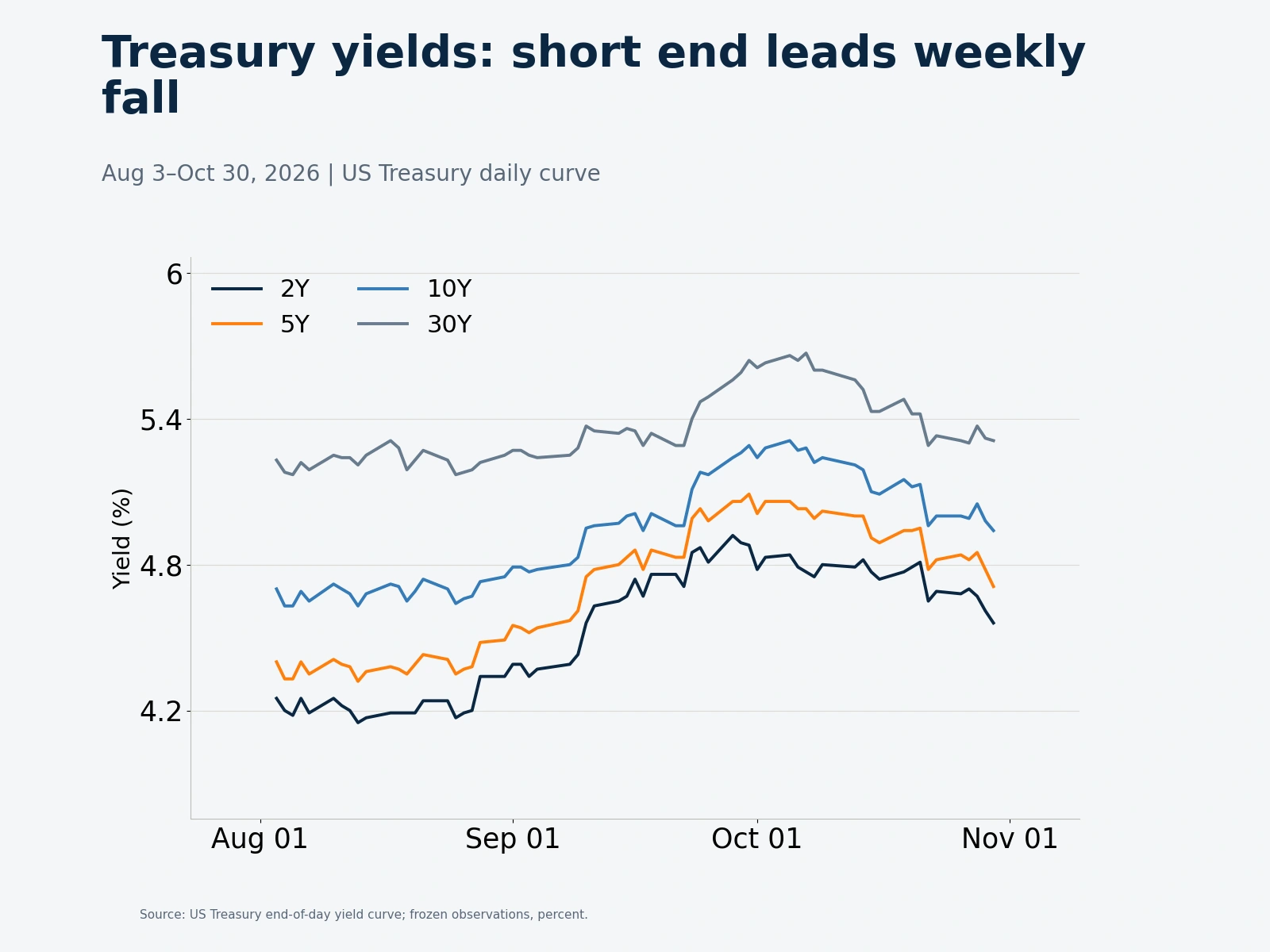
On the US Treasury's consistent end-of-day yield-curve measure, yields at all maturities were lower on October 30 than on October 23, but the declines diminished toward the long end.
| Maturity | October 23 | October 30 | Weekly change |
|---|---|---|---|
| 2-year | 4.69% | 4.56% | -13 basis points |
| 5-year | 4.82% | 4.71% | -11 basis points |
| 10-year | 5.00% | 4.94% | -6 basis points |
| 30-year | 5.33% | 5.31% | -2 basis points |
The spread between two- and ten-year Treasuries widened from 31 to 38 basis points over the week, a bull steepening of the curve. Ten- and thirty-year yields briefly reached 5.05% and 5.37%, respectively, on Wednesday before declining in each of the following two sessions. The recovery at the long end was nevertheless clearly weaker than in short- and intermediate-dated bonds.
The decline in short-term yields was driven mainly by monetary-policy expectations and safe-haven inflows. On October 28, the Federal Reserve left its benchmark rate unchanged. Reuters reported on October 29 that, although the Fed had upgraded its assessment of the economy's resilience, it had made no clear commitment to further rate increases, cooling market bets on additional hikes. Asset managers interviewed by Reuters on October 27 also said that some money was moving out of AI-related equity trades and into bonds for defensive positioning.
Long-dated Treasuries, by contrast, remained constrained by the enormous supply of public- and private-sector financing. On the corporate side, Microsoft announced on October 29 that it had priced $25 billion of senior unsecured notes, with issuance expected to close on November 4. Proceeds would fund general corporate purposes, including capital expenditure, share repurchases, acquisitions and debt repayment. On the fiscal side, Allspring, Pimco and other institutions interviewed by Reuters on October 30 believed that the November 3 US midterm elections were unlikely to reverse the momentum of fiscal spending quickly. The deadline for a US fiscal 2027 spending agreement had also been pushed back to December 11, leaving further appropriations negotiations to unsettle market assessments of long-term debt supply and the term premium.
The credit market gave back some of its midweek gains. As of October 29, the ICE BofA US investment-grade corporate option-adjusted spread, or OAS, stood at 89 basis points, 2 basis points narrower than on October 23. The high-yield spread was 326 basis points, 12 basis points narrower than on October 23. Both had touched their weekly lows on October 28, at 86 and 314 basis points, respectively, before widening again as equities became more volatile. In Asian US-dollar bonds, restructured property-company debt remained dependent on specific court proceedings and repayment arrangements, in addition to the transmission of US Treasury benchmark rates. Duration Finance reported on October 30 that the Hong Kong scheme hearing for R&F HK had been postponed to November 20.
US Third-Quarter GDP Grows at a 3.4% Annualized Rate, but September's Energy Price Rise Squeezes Real Consumption
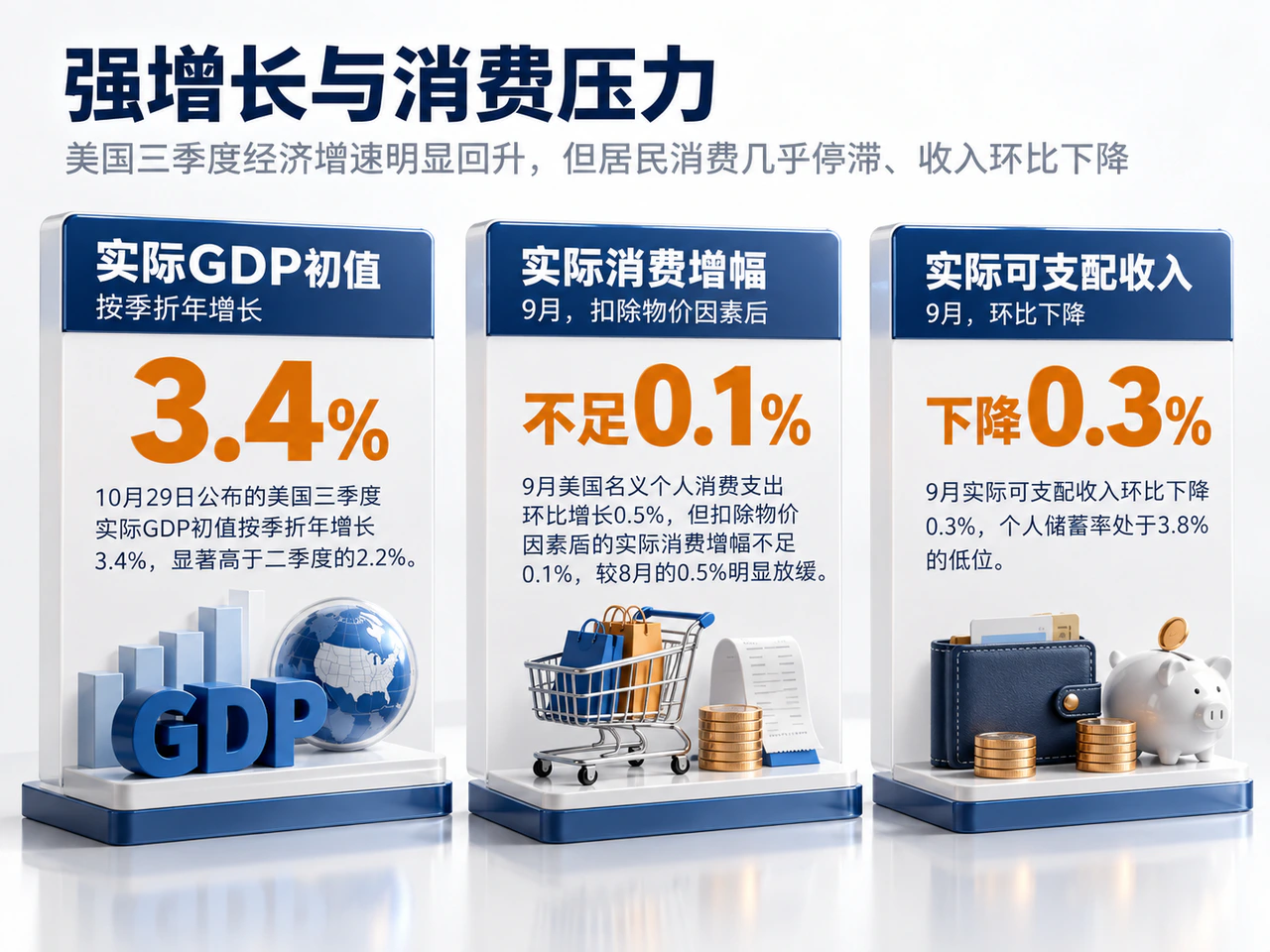
US macroeconomic data revealed a contrast between strong quarterly aggregate growth and slower real consumption at quarter-end. The initial estimate released on October 29 put third-quarter real GDP growth at a quarter-on-quarter annualized rate of 3.4%, well above the second quarter's 2.2%. Real final sales to private domestic purchasers—the sum of consumption and private fixed investment, a measure of core domestic demand—grew at an annualized 4.9%, also above the second quarter's 4.6%. Consumption, private investment and government spending all supported growth, with investment in computers and peripheral equipment within the information-processing equipment category particularly strong.
However, September personal income and spending data released on the same day showed household purchasing power being squeezed at quarter-end. Nominal US personal consumption expenditures rose 0.5% month on month in September, but real consumption increased by less than 0.1% after adjusting for prices, a marked slowdown from August's 0.5%. Real disposable income fell 0.3% in September, while the personal saving rate remained low at 3.8%.
The rebound in energy prices was the main force eroding households' real spending power. The US PCE price index rose 0.5% month on month and 3.6% year on year in September; core PCE rose 0.3% and 3.1%, respectively. According to CNBC, prices for gasoline and other energy goods surged 9.2% month on month in September, driving a 5.4% increase in overall energy goods and services prices. Higher energy bills directly crowded out other household spending and also increased cost pressures on businesses through transportation and production.
Pay growth in the labor market, meanwhile, did not accelerate in tandem. The third-quarter Employment Cost Index, or ECI, released on October 30 showed seasonally adjusted total compensation costs for civilian workers rising 0.8% quarter on quarter, down from 0.9% in the second quarter. Year-on-year wage and salary growth slowed from 3.2% in the second quarter to 3.1%, while benefit-cost growth edged up from 3.8% to 3.9%. Low layoffs continued to put a floor under consumption: seasonally adjusted initial jobless claims were 194,000 in the week ended October 24, and the four-week average fell to 196,750. Although the October consumer confidence index rose to 91.7 from an upwardly revised 84.2 in September, respondents' plans to spend on durable goods and services over the next six months weakened.
Strong quarterly domestic demand limited the Fed's room to ease policy, while weaker real consumption at quarter-end and slower wage growth raised the evidentiary bar for further tightening. Markets were closely awaiting the September JOLTS job-openings data due on November 3 and the October nonfarm payrolls report due on November 6 to assess whether labor demand could continue to support household spending.
Shipping Risks Help Oil Recover Early-Week Losses as Tight-Policy Expectations Weigh on Gold
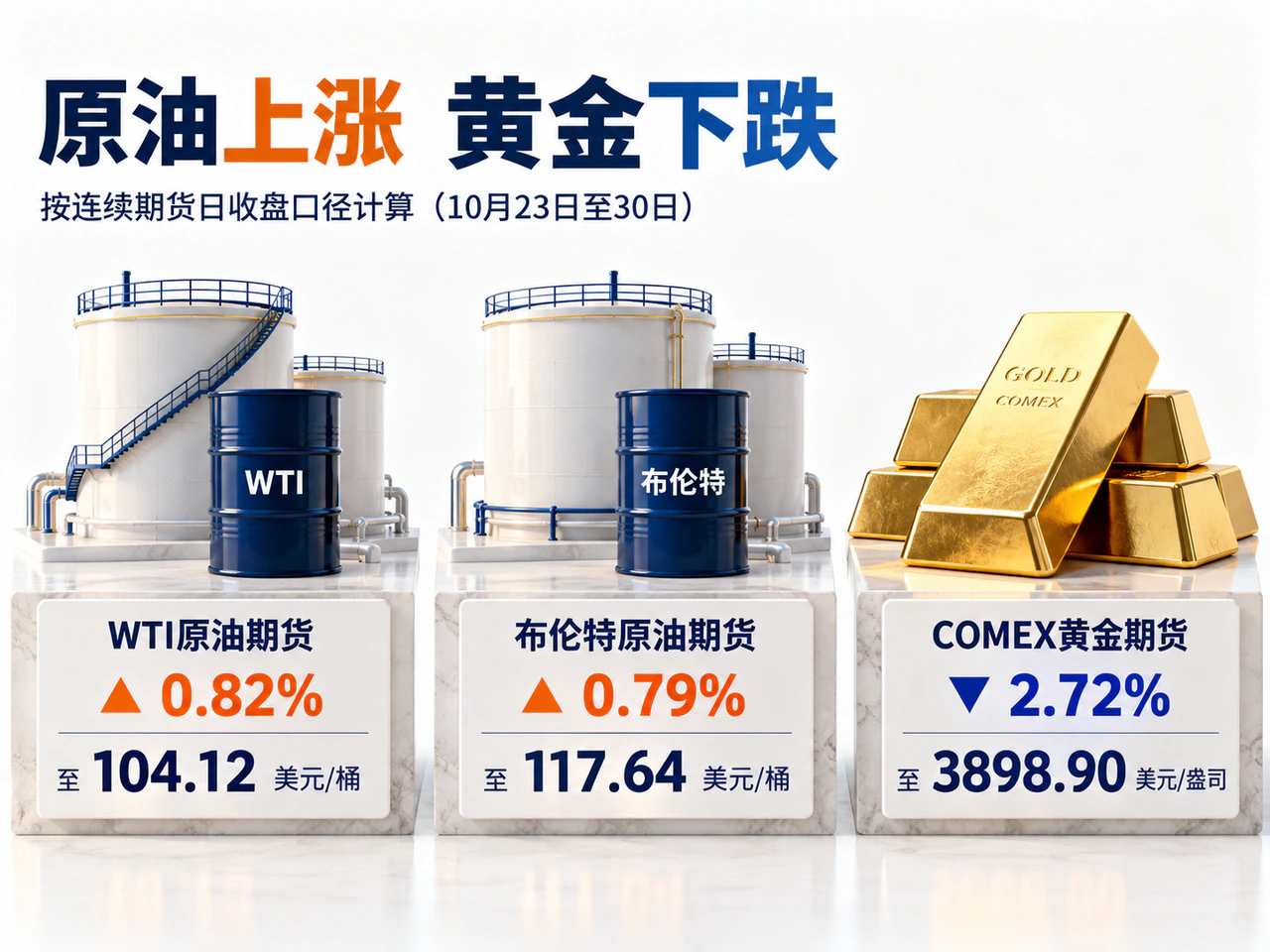
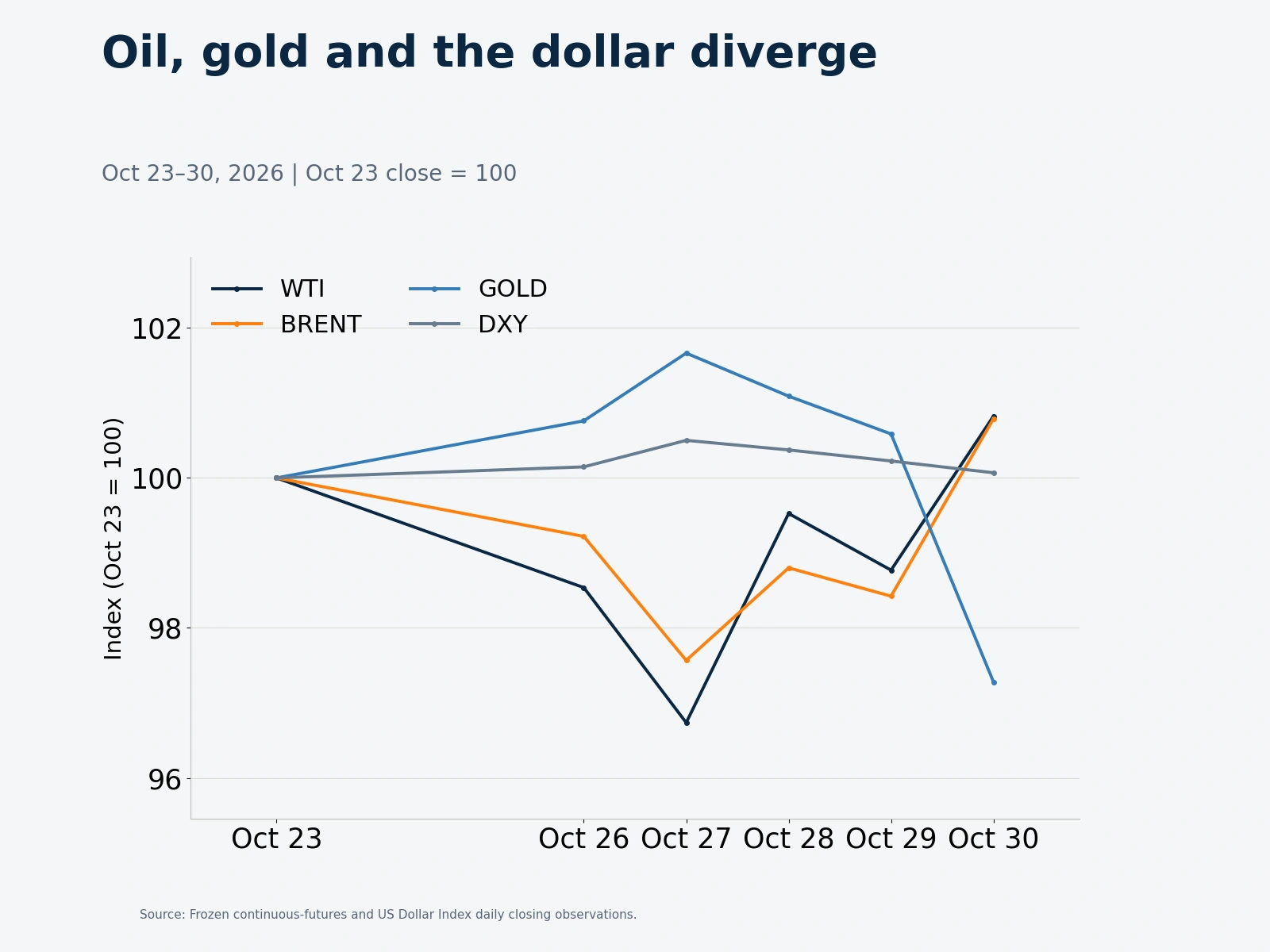
Based on daily closes of continuous futures series, WTI crude gained 0.82% over the week to $104.12 a barrel and Brent rose 0.79% to $117.64 a barrel. COMEX gold futures fell 2.72% to $3,898.90 an ounce. The US Dollar Index edged up just 0.07% to 101.88 over the same period, suggesting that currency moves were not the main driver of the divergence between oil and gold.
Crude prices fell before recovering during the week. Early on, diplomatic contacts raised expectations of improved supply, pushing WTI and Brent down to $99.90 and $113.88 a barrel, respectively, on October 27. US Energy Information Administration petroleum data for the week ended October 23, released on October 28, showed commercial crude inventories falling by 1.9 million barrels as net imports and export flows changed. Gasoline inventories, however, rose by 3.9 million barrels, while total petroleum products supplied, a proxy for demand, fell by about 1.02 million barrels a day from the previous week, indicating softer end-user demand for refined products.
As the weekend approached, Middle Eastern shipping risks again lifted oil's risk premium. On October 30, the United Kingdom Maritime Trade Operations agency, or UKMTO, reported an attack on a tanker in the Strait of Hormuz. Responsibility for the attack had not yet been established, and renewed threats to energy transport security intensified concerns about supply disruption. In the futures curve, Friday's Brent close of $117.64 a barrel represented the December contract expiring that day, while the more actively traded January contract for the following year settled at $113.43 a barrel. This backwardation reflected tight near-term physical delivery conditions. On November 1, seven core OPEC+ members also decided to leave their December production targets unchanged. The extent of any subsequent recovery in actual crude supply would still depend on producer compliance and shipping conditions.
Gold failed to benefit from lower nominal Treasury yields or geopolitical risks. After touching $4,074.60 an ounce on Tuesday, it declined steadily and fell 3.29% on Friday alone, erasing all of its early-week gains. In Reuters' October 30 morning report, UBS analyst Giovanni Staunovo said strong US third-quarter GDP data and rebounding oil prices had heightened concerns that monetary policy would remain restrictive, weighing on gold. With sticky inflation and expectations of high interest rates exerting pressure, safe-haven flows over the week favored short- and intermediate-dated Treasuries offering coupon income over non-interest-bearing gold.
US–Canada Tariff Changes and the UK Tax Increase Put Policy Surprises at the Center of Sector Performance
In trade and fiscal policy, the implementation of specific provisions—and how they differed from market expectations—became crucial to pricing in the affected industries.
On North American trade negotiations, Reuters cited sources on October 27 as saying that the United States and Canada were discussing reductions in Section 232 tariffs on steel, currently as high as 50%, and automobiles, currently 25%. Bloomberg reported on October 31, however, that Canadian Prime Minister Mark Carney had made clear he would not accept terms contrary to Canada's interests simply to secure a deal before the deadline. Tariff schedules were also continuing to change at the implementation level. According to Canadian law firm Blakes, effective October 30 the United States removed certain plywood, paper and plastic products, and agricultural machinery from a list previously subject to an additional 50% tariff. At the same time, it added certain flooring, paper products, air-conditioning equipment, medical products and chemicals to the tariff's scope, leaving procurement costs and pricing pressures increasingly uneven across cross-border manufacturers.
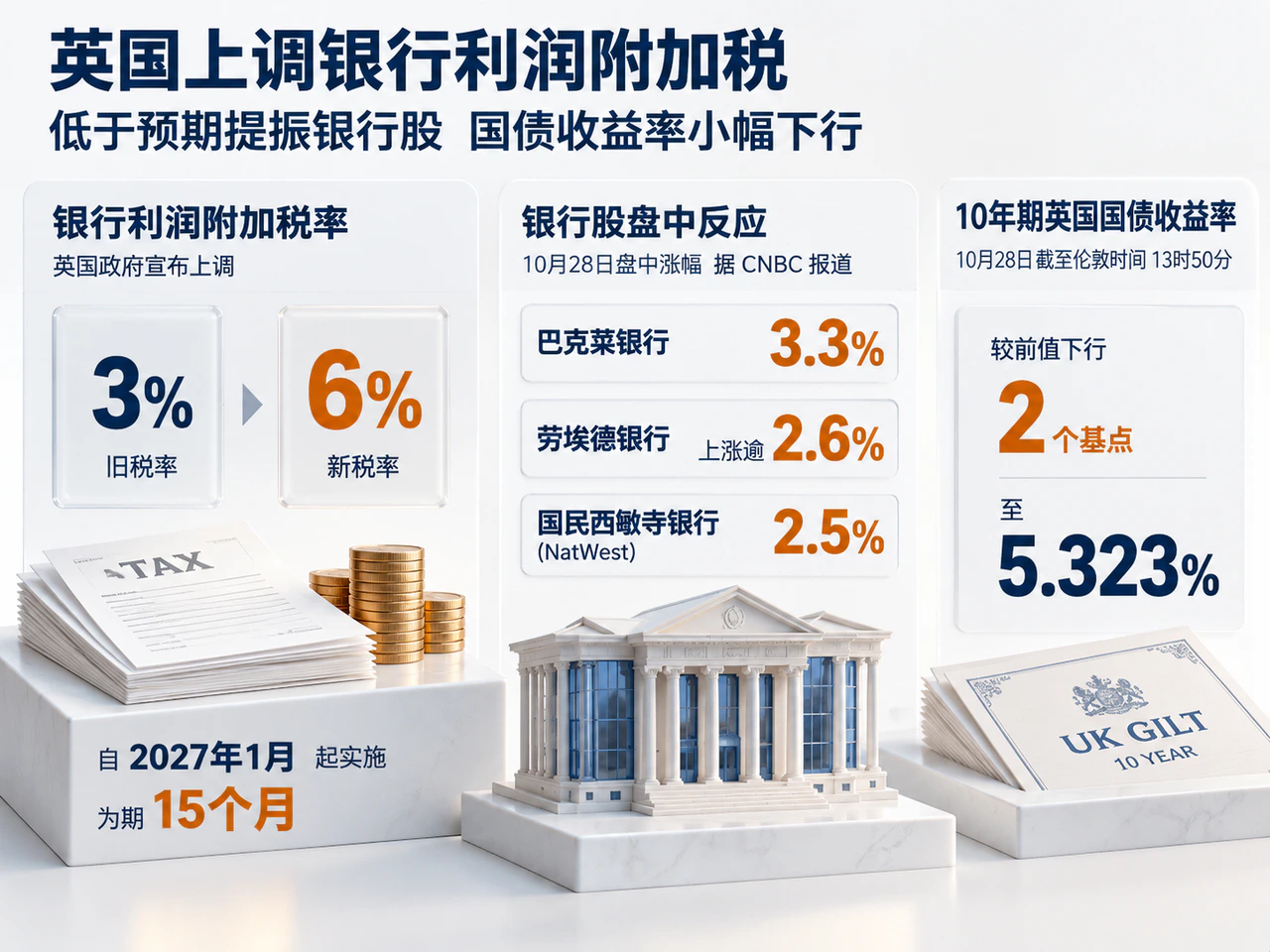
The UK's autumn budget illustrated a relief rally as the outcome proved less severe than feared. On October 28, the government announced that the bank profits surcharge would rise from 3% to 6% for 15 months beginning in January 2027, alongside household cost-of-living relief measures. Because the increase and its duration were milder than the market's earlier pessimistic expectations, Barclays rose 3.3% intraday, Lloyds gained more than 2.6% and NatWest advanced 2.5%, according to CNBC. As of 13:50 London time that day, the ten-year gilt yield had edged down 2 basis points to 5.323%.
Asia-Pacific Equities Retain Weekly Gains as Divergent Chinese Manufacturing Conditions and a Liquidity-Framework Overhaul Draw Attention
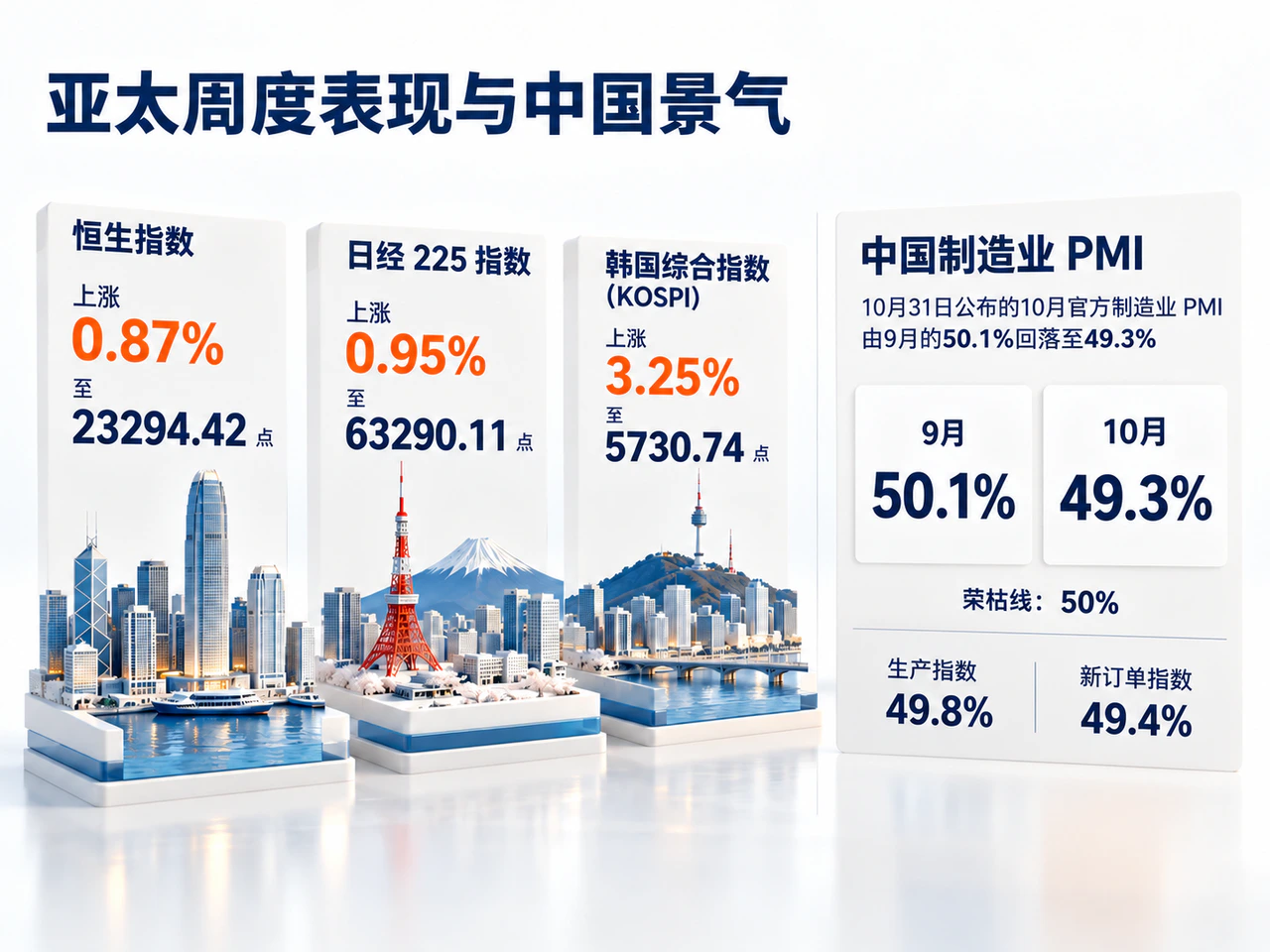
Major Asia-Pacific stock markets all posted positive weekly returns, although divergence was emerging by Friday's close. The Hang Seng Index rose 0.87% for the week to 23,294.42, the Nikkei 225 gained 0.95% to 63,290.11 and South Korea's KOSPI advanced 3.25% to 5,730.74. On Friday alone, the Nikkei and KOSPI fell 2.12% and 3.48%, respectively, while the Hang Seng bucked the trend with a 1.46% gain. Because Asian cash-market trading on Friday ended before the US Friday session began, Asia-Pacific markets would have to absorb the sharp US semiconductor selloff when they reopened the following week. The sustainability of North American cloud providers' capital spending and the pressure on their cash flow would directly test Japanese and South Korean chip and equipment supply chains.
China's macroeconomic data showed industrial profits heavily concentrated in high-technology sectors, while the breadth of the overall manufacturing recovery remained constrained. Data released on October 27 showed profits at industrial enterprises above the designated size rising 15.5% year on year in January–September. High-technology manufacturing profits surged 52.0%, and electronics-industry profits doubled, providing fundamental support for technology manufacturing supply chains.
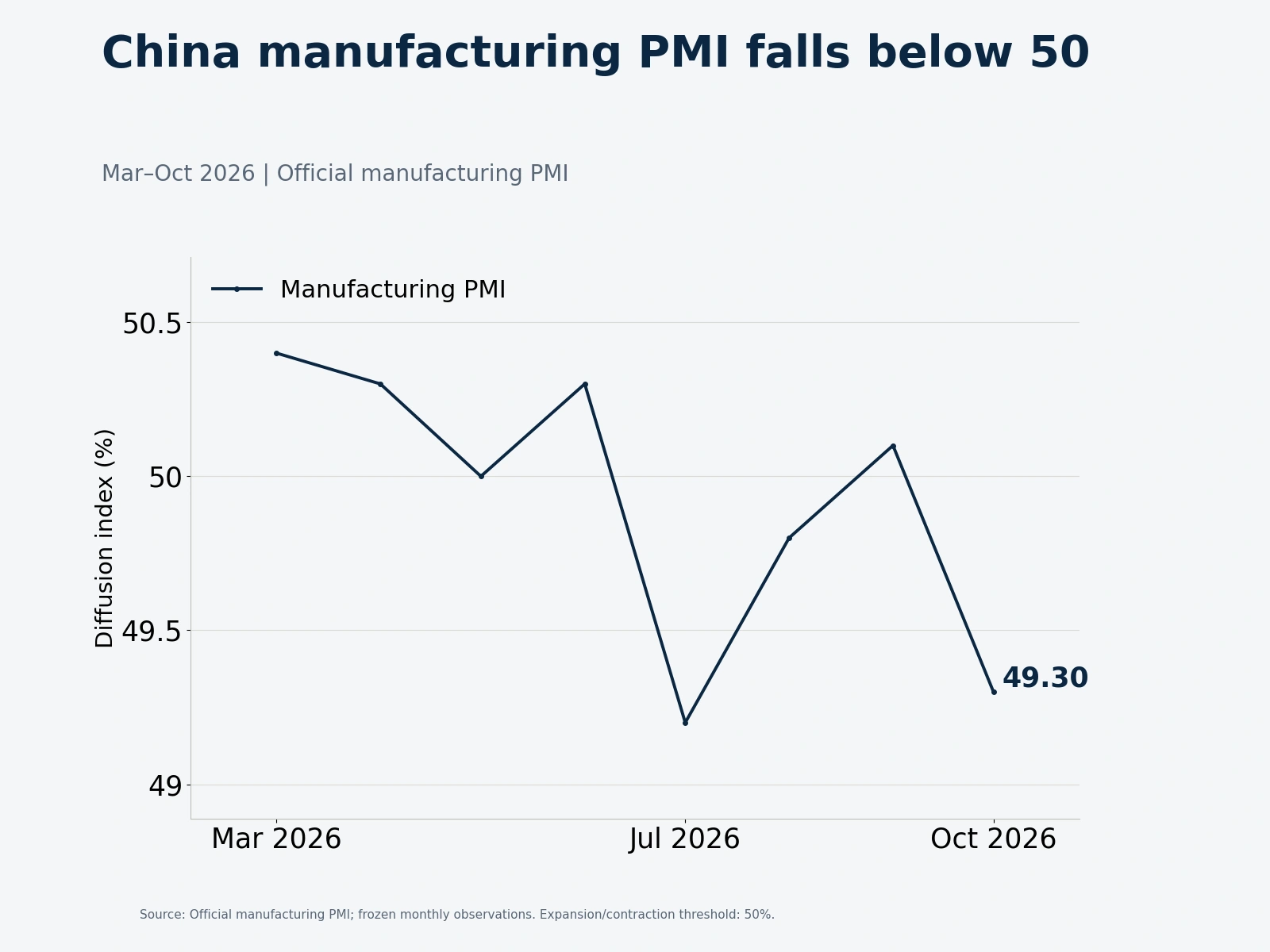
But the official October manufacturing PMI, released on October 31, fell from 50.1% in September to 49.3%, returning below the expansion–contraction threshold. The production and new-orders indices declined to 49.8% and 49.4%, respectively. Differences across industries and company sizes remained pronounced: the high-technology and equipment manufacturing PMIs stayed in expansionary territory at 51.3% and 50.6%, while the consumer-goods PMI stood at 48.8%. Conditions at large enterprises continued to expand, while those at small and medium-sized firms weakened. In non-manufacturing, the construction business activity index fell from 50.3% in September to 48.0%. How effectively strength in high-technology manufacturing spreads to the wider domestic-demand sectors will be central to the market's assessment of the breadth of the corporate earnings recovery.
On the monetary-policy operating framework, the People's Bank of China announced on October 30 that it would conduct overnight reverse repos every working day from November 2 through fixed-rate tenders in which participants bid for quantities, with the operation rate currently set at 1.25%. At the same time, seven-day reverse repos would shift to fixed-quantity interest-rate tenders, primarily to address liquidity fluctuations around tax-payment dates, month-end and similar periods. The change would anchor overnight funding prices more closely to the open-market policy rate and help smooth volatility in short-term market rates and liquidity.