On November 3, 2026, cross-border payments network RTGS.global announced the addition of Switzerland's AMINA Bank, offering eligible corporate clients fiat accounts and digital asset wallets on a single platform. The initial services cover Swiss franc and euro accounts and local payment networks, with US dollar and sterling accounts planned for a later stage. Digital asset services are thus extending into practical payments and collections: after acquiring digital assets, clients often still need bank accounts, merchant acceptance and settlement across institutions to put those holdings to work in their businesses.
The RTGS.global–AMINA partnership, Hong Kong's push for round-the-clock tokenised settlement, and OKX's launch of a stablecoin payment card in the United States address corporate banking, interbank settlement and personal spending, respectively. All three point in the same direction: reducing the conversions and waiting involved in using digital assets for actual payments and collections. Progress in practice will depend on the scope of services each makes available.
Corporate Accounts and Wallets on One Platform; Hong Kong's Pilot Extends Beyond Business Hours
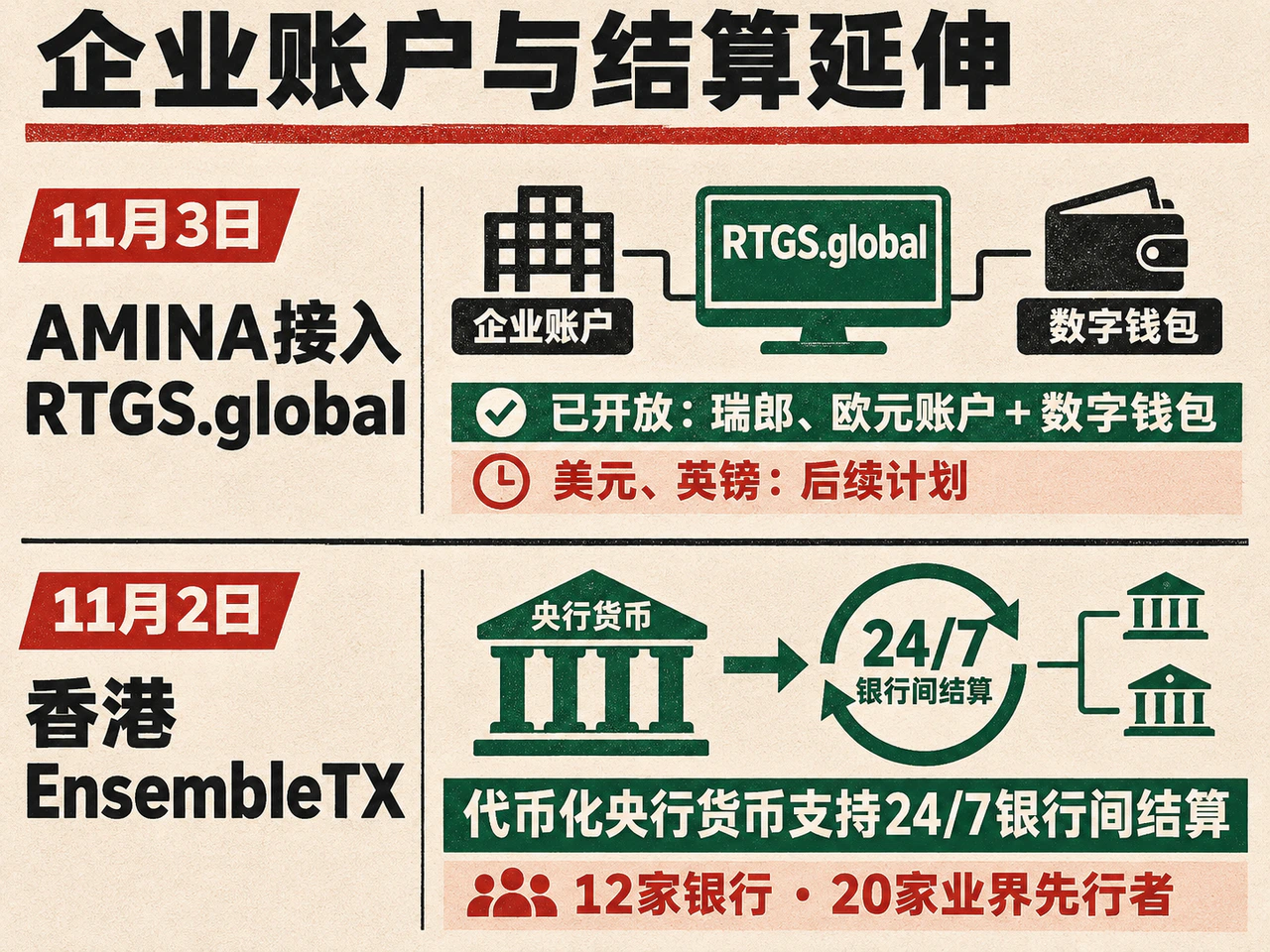
According to RTGS.global's announcement, eligible clients that complete onboarding with AMINA can hold accounts registered directly in their company's name and manage them alongside their other banking relationships through the RTGS.global platform. AMINA, which is regulated by the Swiss Financial Market Supervisory Authority, is the network's first bank to offer both fiat and digital asset services.
For payment service providers and remittance companies, this arrangement reduces the work of separately sourcing bank accounts, local clearing networks and digital wallet providers. When cross-border funds move through multiple service providers, each conversion adds operational and reconciliation steps. Bringing accounts and wallets onto the same management platform can help shorten that operational chain. The initial Swiss franc and euro services are already available. US dollar and sterling accounts, as well as AMINA's participation in foreign exchange quoting, remain planned additions, so their commercial effects should be assessed separately as the services expand.
Hong Kong's EnsembleTX upgrade, announced on November 2, addresses settlement timing more directly. The Hong Kong Monetary Authority said the pilot now supports round-the-clock interbank settlement of tokenised deposit transactions using tokenised central bank money, with participation expanding to 12 banks and 20 industry early adopters. The pilot previously used the Hong Kong dollar Real Time Gross Settlement system and had already involved real-value transactions. The new capability allows these transactions to settle outside traditional business hours.
This provides more continuous settlement support for corporate treasury management and tokenised fund transactions. When assets can trade around the clock, payments also need to settle in step. Otherwise, investors must either set aside funds while waiting for transfers to arrive or bear the timing risk between a transaction and receipt of the funds. Tokenised deposits remain liabilities of commercial banks, while final interbank settlement uses tokenised central bank money; each layer has its own responsible institution. Continuous operation also requires banks to arrange liquidity, monitoring and exception handling outside business hours. Whether transaction volumes can cover those costs will affect the pace of adoption.
OKX's Stablecoin Card Joins the Mastercard Network, Reaching Most US States
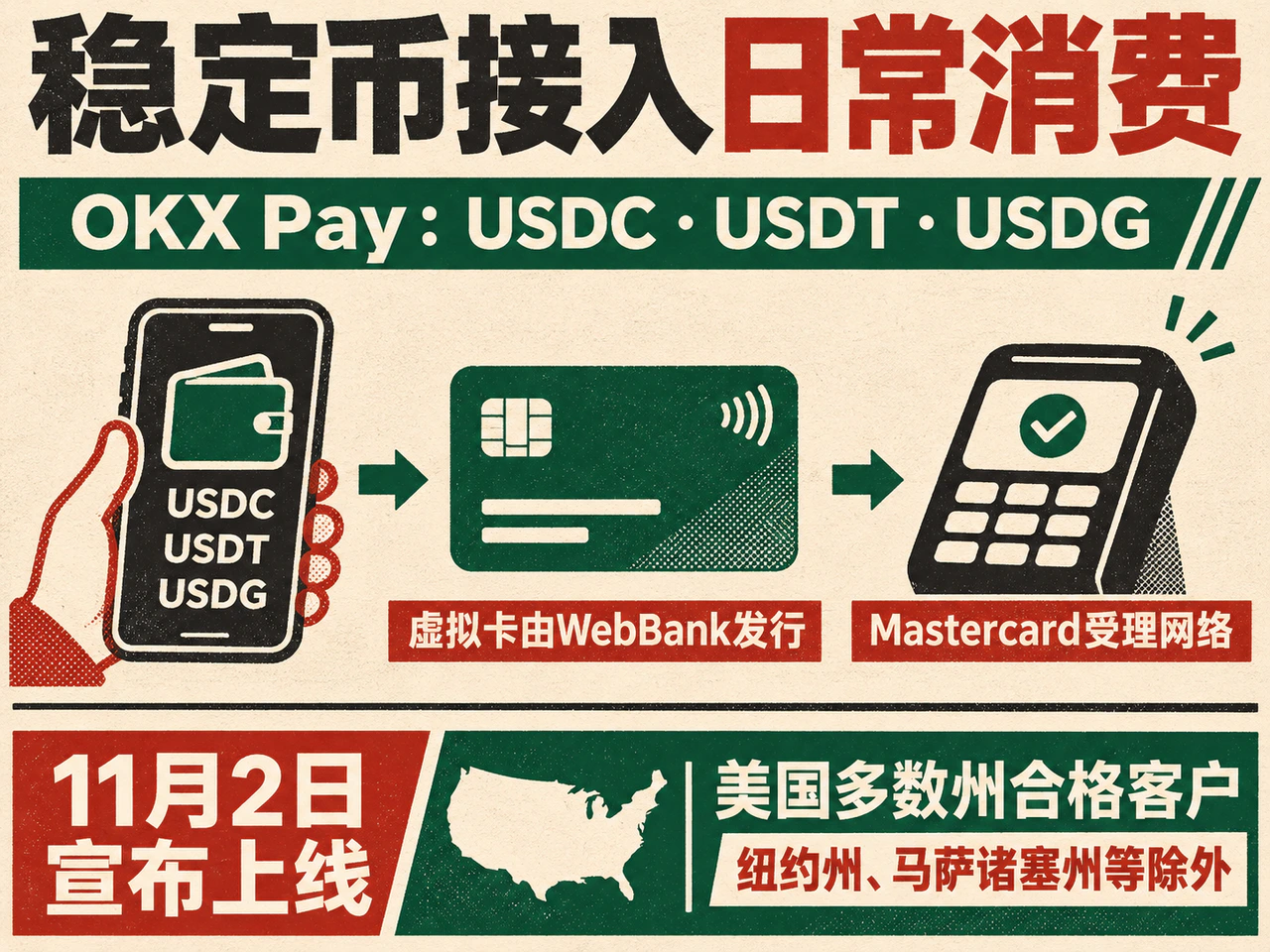
US consumers have gained another way to pay with stablecoins. On November 2, OKX announced that its Mastercard-network virtual card, issued by WebBank, was available to eligible customers in most US states and certain territories. Customers can fund purchases with USDC, USDT and USDG held in their OKX Pay wallets, without having to convert their stablecoins into fiat themselves or move funds into a separate balance before spending. The virtual card can be added to Apple Pay or Google Pay.
The product connects digital wallets with the existing card acceptance system. Consumers can reduce manual currency conversion and fund-transfer steps, while merchants continue using familiar acceptance channels. The official announcement also specifies geographic restrictions, with New York, Massachusetts and other locations excluded. A “US launch” therefore means availability within the stated eligibility and geographic limits.
For qualifying customers, OKX also combines automatic repayment using USDG, spending cashback and tiered yields on wallet balances. The specific benefits vary with customer tier, balance and spending requirements, with the aim of encouraging customers to keep funds in their wallets and use them for purchases. Assessing whether such products can build sustained demand requires looking at actual spending activity, user retention and subsidy costs. The number of people a platform can reach or its highest advertised benefit tier cannot directly stand in for the scale of its business.
Corporate account access, round-the-clock interbank settlement and stablecoin payment cards address three different links: business payments and collections, the timing of funds availability, and how frequently users transact. Banking services determine whether businesses can pay and receive funds smoothly; settlement infrastructure determines when those funds become available; and consumer products determine whether users want to return. Whether growth can continue will depend on how much real transaction activity these services generate within their existing eligibility, geographic and currency limits, and whether they can maintain reliable clearing and operations as they expand.
Click “Read more” to view the full article.