On November 6, 2026, US spot Bitcoin and Ethereum ETFs recorded combined net outflows of $505.2 million. During weekend trading on November 7, open interest in Binance BTC and ETH perpetual contracts fell by about 0.40% and 0.33%, respectively, while Deribit options implied volatility edged higher. ETF creations and redemptions, stablecoin supply and derivatives positioning together indicate that capital support remains weak, while the market's pricing of volatility has stopped declining.
Bitcoin ETFs lose $842.1 million over two days; stablecoins shrink 2.23% in a week

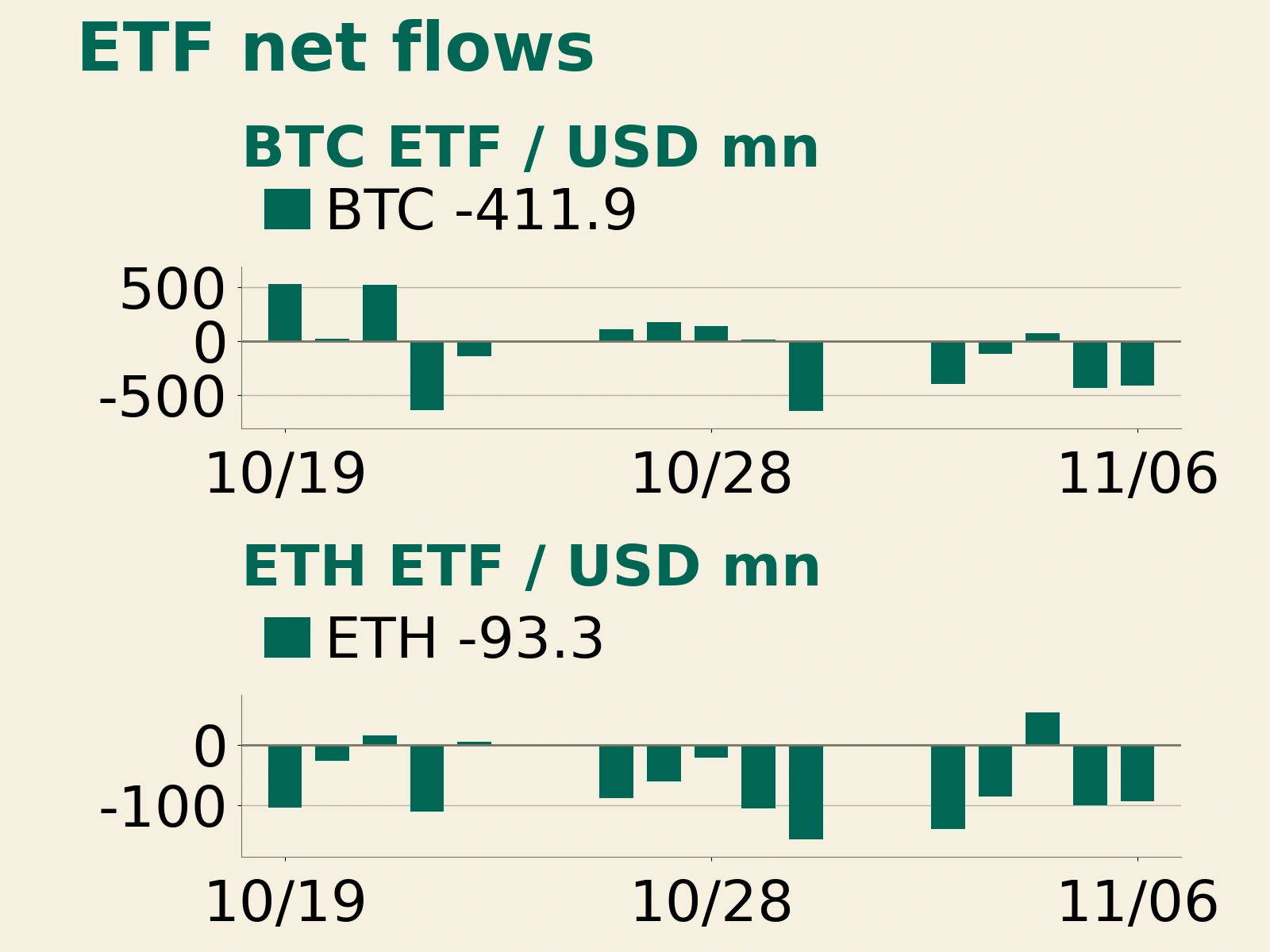
Farside's complete disclosure table shows that spot Bitcoin ETFs recorded net outflows of $411.9 million on November 6, slightly narrower than the previous trading day's $430.2 million. Cumulative net outflows over the two consecutive trading days reached $842.1 million, more than ten times the net inflow recorded on November 4. Across the five US trading days from November 2 to 6, only Wednesday saw a net inflow, leaving cumulative net outflows of $1.2817 billion. The midweek return of capital therefore looks more like a brief recovery; allocation demand has yet to provide sustained support.
Flows continued to diverge across products. On November 6, BlackRock's IBIT recorded net outflows of $403.0 million, while Fidelity's FBTC attracted net inflows of $42.8 million; BITB, ARKB and GBTC saw net outflows of $20.5 million, $20.1 million and $11.1 million, respectively. Redemptions from the largest product dominated the total, and subscriptions into other products were insufficient to offset them. Capital is moving selectively, but that has yet to reverse net outflows across the category.
Spot Ethereum ETFs recorded net outflows of $93.3 million on the same day, with ETHA accounting for the vast majority at $90.8 million. From November 2 to 6, cumulative net outflows from Ethereum ETFs reached $365.2 million, moving in the same direction as Bitcoin ETFs. US ETFs are closed over the weekend, so November 7 brought no new trading-day creation or redemption records. Once trading resumes, the question is whether inflows into individual products can broaden into consecutive net subscriptions across the category.
The pool of on-chain dollar assets is also shrinking. Under the version of DefiLlama's historical data used for this report, the circulating market capitalization of dollar-pegged stablecoins stood at about $292.296 billion at 00:00 UTC on November 7, down $1.429 billion, or 0.49%, from the previous day. It was $6.666 billion below October 31, a weekly decline of 2.23%, and approximately 4.89% below October 8. The daily decline extended a month-long contraction: the stock of dollar-like assets available on-chain for payments, trading and collateral has not expanded.
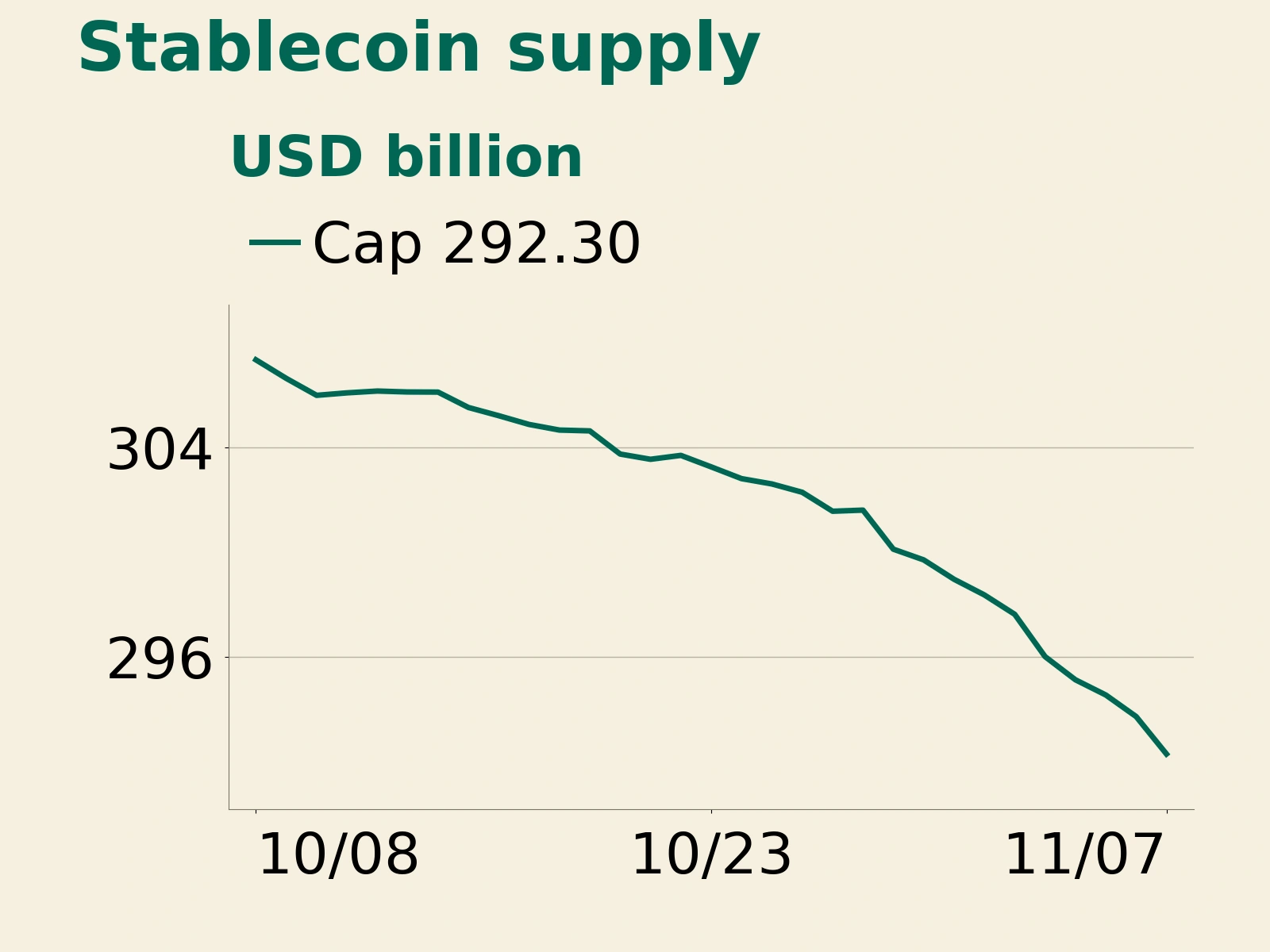
ETF creations and redemptions and stablecoin circulating market capitalization represent different funding channels. The former tracks changes in fund shares held through securities accounts; the latter encompasses on-chain payments, collateral, market-making and token reserves, and is affected by valuation at dollar market prices. Weakness in both indicates that the capital base has yet to improve consistently. If ETF inflows return first while stablecoin supply keeps falling, the recovery will depend more heavily on allocations through securities markets. Only expansion in both would broaden the sources of support for spot buying.
Perpetual open interest falls less than 0.5%; options implied volatility edges higher

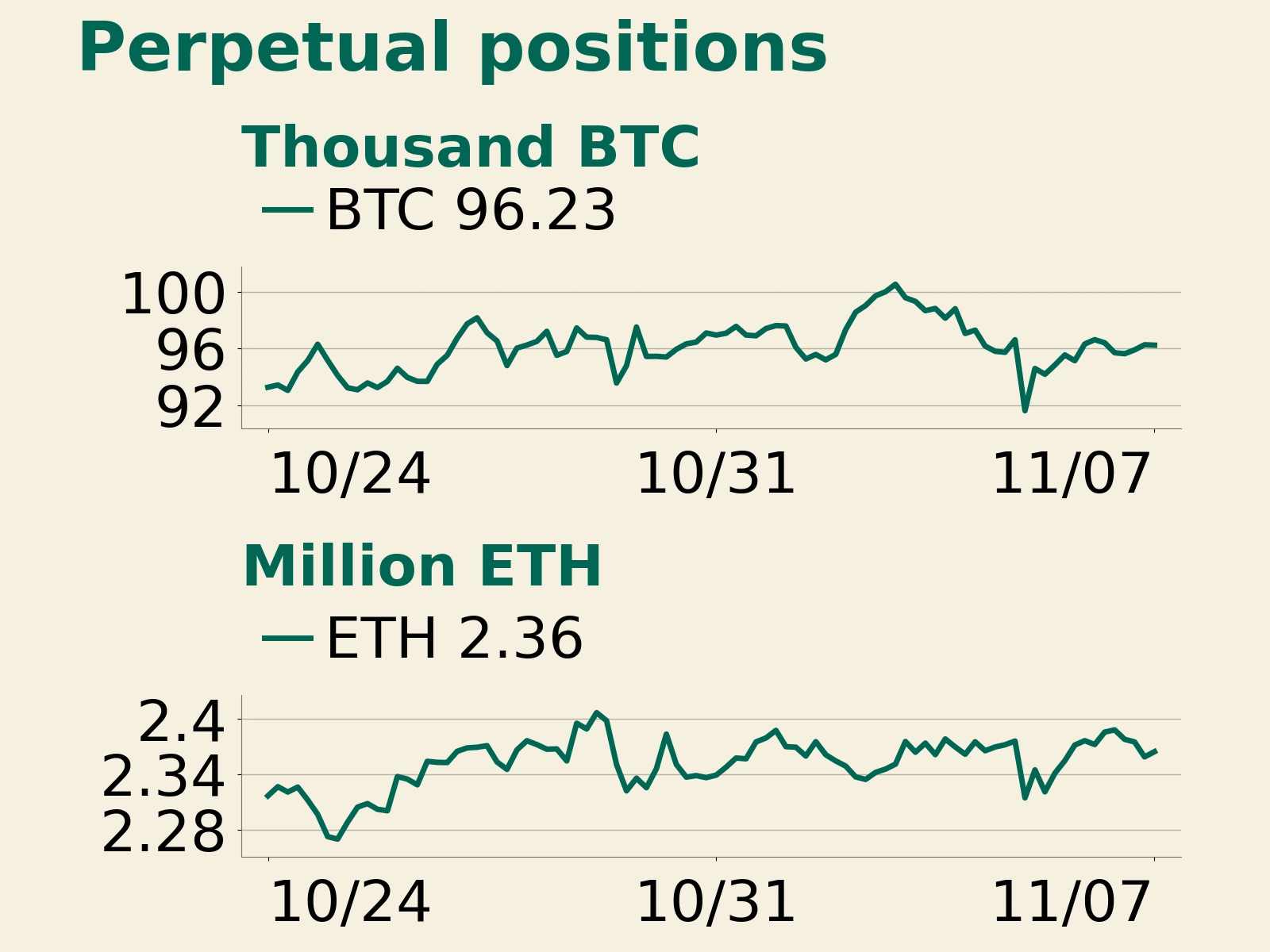
Changes in leveraged markets were modest over the weekend. Binance USD-M perpetual historical data show that between 20:00 UTC on November 6 and 20:00 UTC on November 7, BTCUSDT open interest fell from 96,616.210 to 96,226.893 BTC, a decline of about 0.40%; ETHUSDT fell from 2,372,366.481 to 2,364,595.434 ETH, down about 0.33%. Comparing quantities in the underlying coins avoids the distortion caused when dollar notional open interest mechanically changes with coin prices. This sample shows a slight contraction in positions, with no pronounced expansion in leverage.
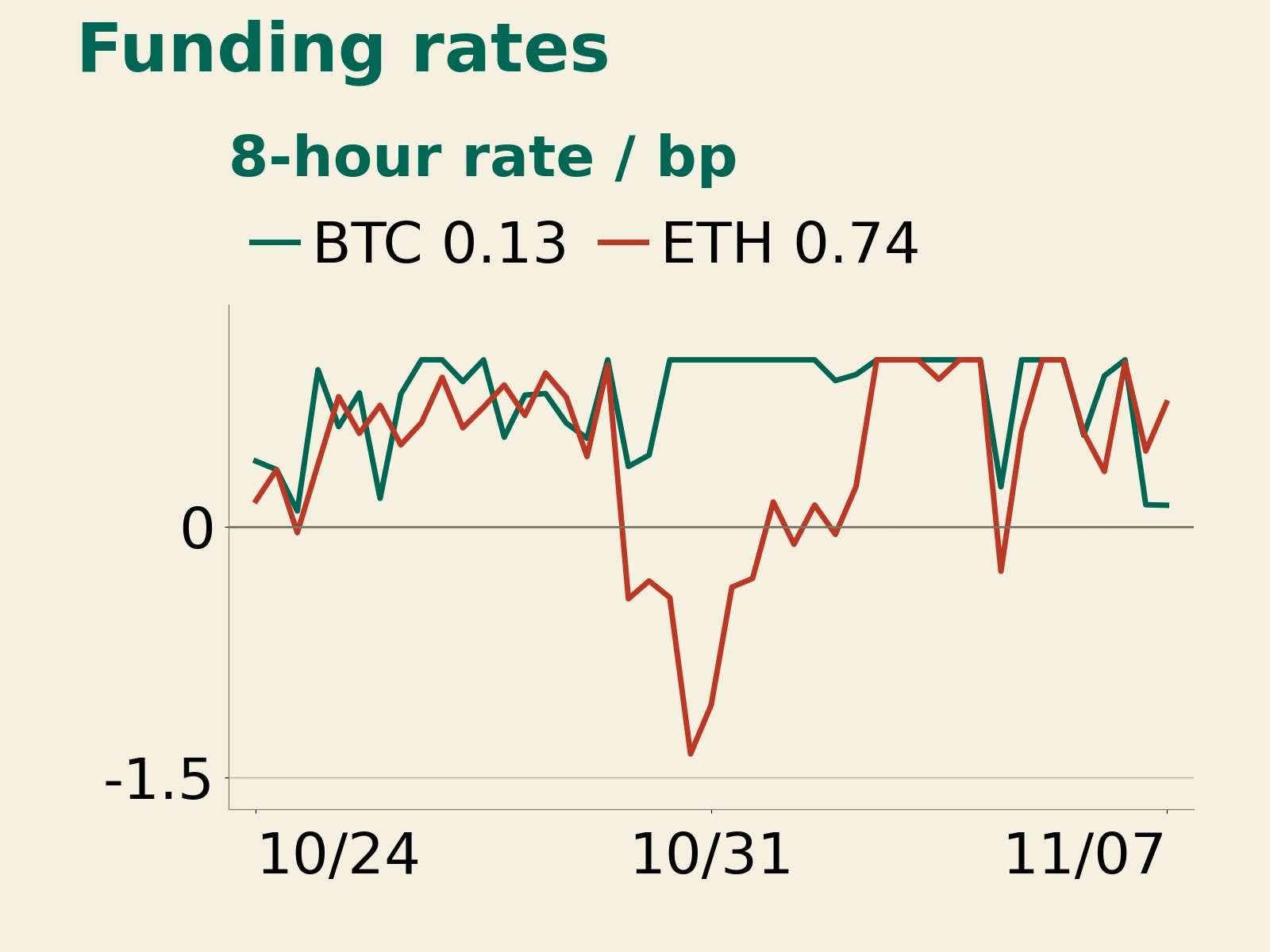
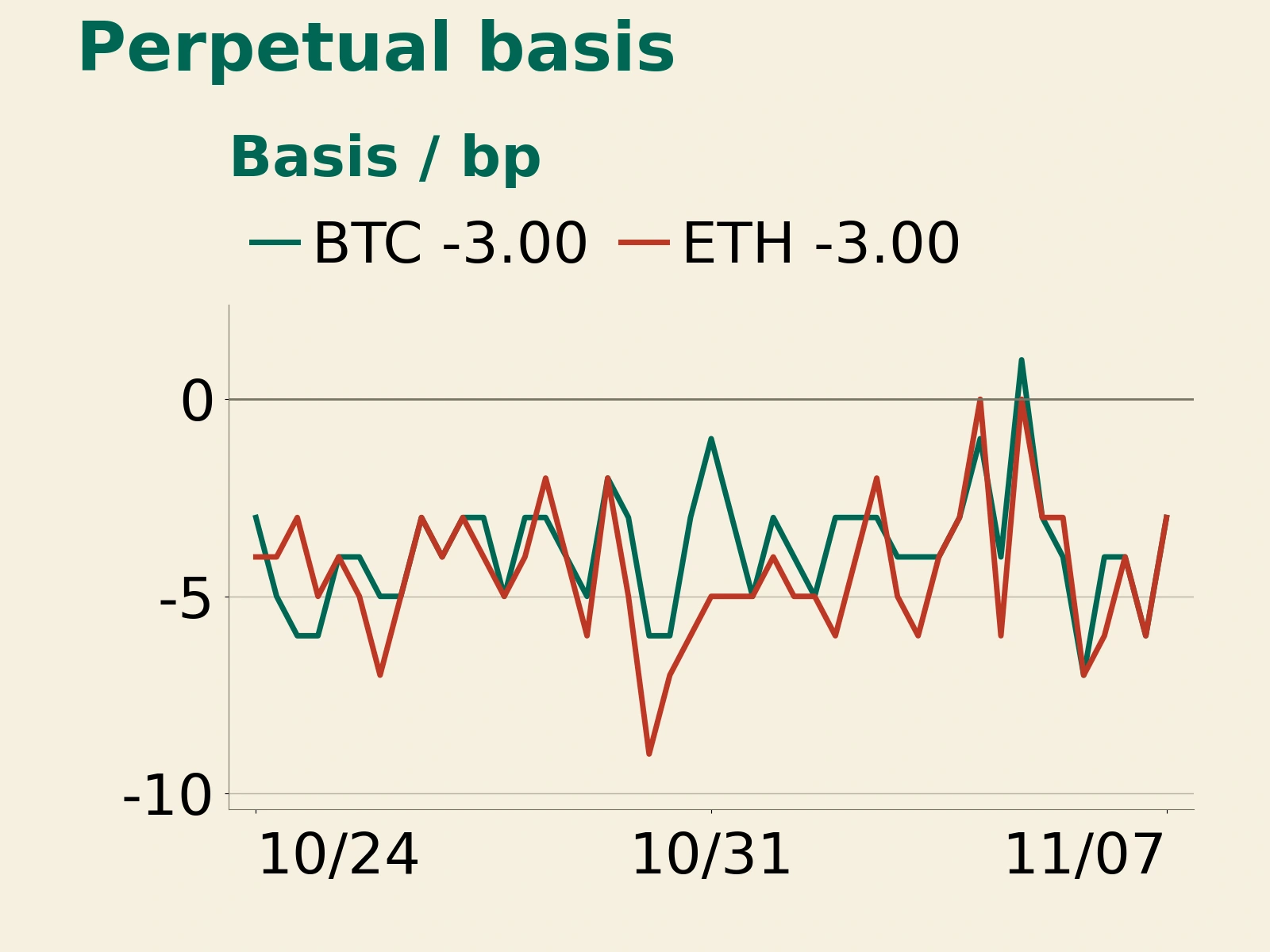
Funding rates show that the two markets did not heat up together. For the eight-hour funding period settled at 16:00 UTC on November 7, BTCUSDT's rate was +0.001302% and ETHUSDT's was +0.007427%, so longs were still paying shorts. Bitcoin's rate was markedly lower than the 0.009043% recorded at the same time the previous day, while Ethereum's was above its previous-day reading of 0.003319%. At that same observation time, both perpetual contracts had a basis of -0.03% relative to their indexes, remaining at a slight discount. Positive funding describes payments over a settlement period, whereas negative basis describes the price relationship at a particular observation time; the two can coexist.
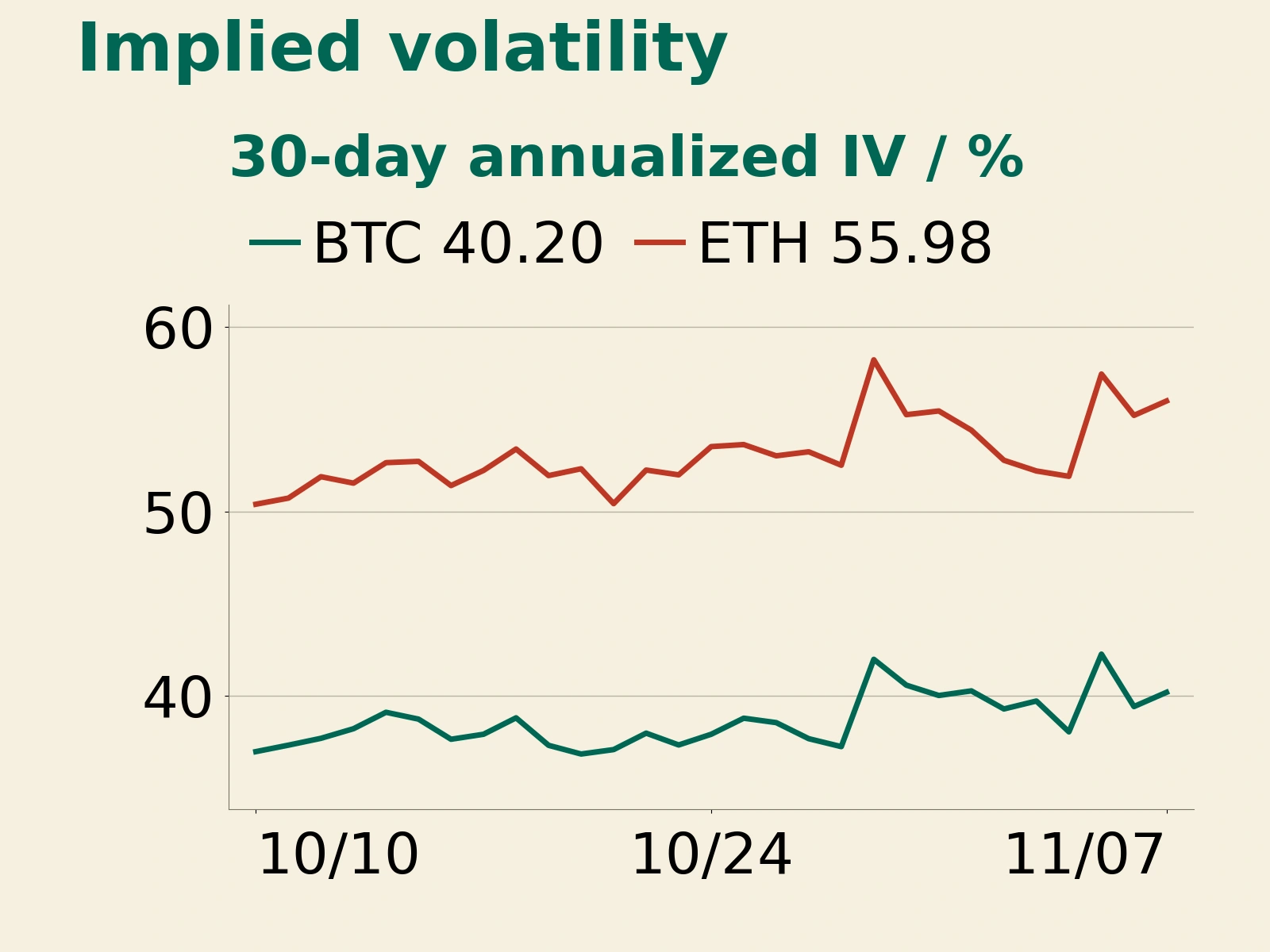
The options market, meanwhile, priced volatility slightly higher. Deribit's DVOL indexes of 30-day annualized implied volatility showed Bitcoin at 40.20 and Ethereum at 55.98 at the end of the November 7 UTC trading day, up from 39.43 and 55.20 the previous day, respectively, but still below the November 5 readings of 42.27 and 57.44. The volatility premium had already eased after the sharp sell-off, but it did not continue falling uninterrupted over the weekend. Ethereum's implied volatility remains substantially higher than Bitcoin's.
The key to assessing a recovery in funding conditions is whether support can persist. ETF redemptions and declining stablecoin supply show that the capital base remains weak; perpetual open interest has not expanded markedly, while options continue to price in a premium for uncertainty. Consecutive ETF net subscriptions, stabilization in stablecoin supply, and an accompanying improvement in both perpetual open interest and basis would together provide more complete evidence of a recovery in capital flows.
Click “Read the original” for the full details.